Archive for Tom Kitching

New Publication at the Open Journal of Astrophysics

Posted in OJAp Papers, Open Access, The Universe and Stuff with tags , , , , , , on December 17, 2021 by telescoper

It’s nice to be able to announce another publication in the Open Journal of Astrophysics before the Christmas break. This one was published yesterday, actually, but I didn’t get time to post about it until just now. It is the 17th paper in Volume 4 (2021) and the 48th in all.

The latest publication is entitled Mapping Spatially Varying Additive Biases in Cosmic Shear Data and is written by Tom Kitching and Anurag Deshpande of the Mullard Space Science Laboratory (UCL) and Peter Taylor of the Jet Propulsion Laboratory (Caltech).

Here is a screen grab of the overlay which includes the abstract:

You can click on the image to make it larger should you wish to do so. You can find the arXiv version of the paper here. This is another one for the Cosmology and Nongalactic Astrophysics folder, which is the most popular category so far on the Open Journal of Astrophysics site.

P. S. Let me apologise for any inconvenience caused by a recent temporary outage on our Scholastica platform overnight between 16th & 17th December (US time). Normal service has now been restored.

Astronomy in Darkness

Posted in The Universe and Stuff with tags , , , , , , , , on January 14, 2012 by telescoper

Yesterday, being the second Friday of the month, was the day for the Ordinary Meeting of the Royal Astronomical Society (followed by dinner at the Athenaeum for members of the RAS Club). Living and working in Cardiff it’s difficult for me to get the specialist RAS Meetings earlier in the day, but if I get myself sufficiently organized I can usually get to Burlington House in time for the 4pm start of the Ordinary Meeting, which is open to the public.

The distressing news we learnt on Thursday about the events of Wednesday night cast a shadow over the proceedings. Given that I was going to dinner afterwards, for which a jacket and tie are obligatory, I went through my collection of (rarely worn) ties, and decided that a black one would be appropriate. When I arrived at Burlington House I was just in time to hear a warm tribute paid by a clearly upset Professor Roger Davies, President of the RAS and Oxford colleague of the late Steve Rawlings. There then followed a minute’s silence in his memory.

The principal reaction to this news amongst the astronomers present was one of disbelief and/or incomprehension. Some  friends and colleagues of Steve clearly knew much more about what had happened than has so far appeared in the press, but I don’t think it’s appropriate for me to make these public at this stage. We will know the facts soon enough. A colleague also pointed out to me that Steve had spent most of his recent working life as a central figure in the project to build the Square Kilometre Array, which will be the world’s largest radio telescope. He has died just a matter of days before the announcement will be made of where the SKA will actually be built. It’s sobering to think that one can spend so many years working on a project, only for something wholly unforeseen to prevent one seeing it through to completion.

Anyway, the meeting included an interesting talk by Tom Kitching of the University of Edinburgh who talked about recent results from the Canada-France-Hawaii Telescope Lensing Survey (CHFTLenS). The same project was the subject of a press release because the results were presented earlier in the week at the American Astronomical Society meeting in Austin, Texas. I haven’t got time to go into the technicalities of this study – which exploits the phenomenon of weak gravitational lensing to reconstruct the distribution of unseen (dark) matter in the Universe through its gravitational effect on light from background sources – but Tom Kitching actually contributed a guest post to this blog some time ago which will give you some background.

In the talk he presented one of the first dark matter maps obtained from this survey, in which the bright colours represent regions of high dark matter density

Getting maps like this is no easy process, so this is mightily impressive work, but what struck me is that it doesn’t look very filamentary. In other words, the dark matter appears to reside predominantly in isolated blobs with not much hint of the complicated network of filaments we call the Cosmic Web. That’s a very subjective judgement, of course, and it will be necessary to study the properties of maps like this in considerable detail in order to see whether they really match the predictions of cosmological theory.

After the meeting, and a glass of wine in Burlington House, I toddled off to the Athenaeum for an extremely nice dinner. It being the Parish meeting of the RAS Club, afterwards we went through a number of items of Club business, including the election of four new members.

Life  goes on, as does astronomy, even in darkness.

(Guest Post) The GREAT10 Challenge

Posted in The Universe and Stuff with tags , , on December 8, 2010 by telescoper

I haven’t had any guest posts for a while, so I was happy to respond to an offer from Tom Kitching to do one about the GREAT10 challenge. I’ve been working a bit on weak gravitational lensing myself recently – or rather my excellent and industrious postdoc Dipak Munshi has, and I’ve been struggling to keep up! Anyway, here’s Tom’s contribution…

–0–

This guest post is about the the GREAT10 challenge, which was launched this week, I’ll briefly explain why this is important for cosmology, what the GREAT10 challenge is, and how you can take part. For more information please visit the website, or read the GREAT10 Handbook.

GREAT10 is focussed on weak gravitational lensing. This is an effect that distorts the shape of every galaxy we see, introducing a very small additional ellipticity to galaxy images. Weak lensing is a interesting cosmological probe because it can be used to measure both the rate of growth of structure and the geometry of the Universe. This enables extremely precise determinations of dark energy, dark matter and modified gravity. We can either use it to make maps of the dark matter distribution or to generate statistics, such as correlation functions, that depend sensitively on cosmological parameters.
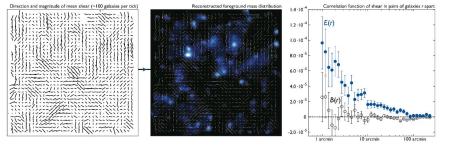
As shown in the Figure (click it for a higher-resolution version), the weak lensing effect varies as a function of position (left; taken from Massey et al. 2007), which can be used to map dark matter (centre) or the correlation function of the shear can be constructed (right; taken from Fu et al. 2008).

However, the additional ellipticity induced by weak lensing generates only about a 1% change in the surface brightness profile for any galaxy, far too small to been seen by eye, so we need to extract this “shear” signal using software and analyse its effect statistically over many millions of galaxies. To make things more complicated,  images contain noise, and are blurred by a PSF (or convolution kernel) caused by atmospheric turbulence and telescope effects.
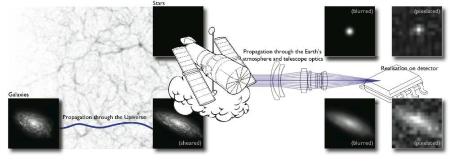
So the image of a galaxy is sheared by the large scale structure, then blurred by the PSF of the atmosphere and telescope, and finally distorted further by being represented by pixels in a camera. Star images are not sheared, but are blurred by the PSF. The challenge is to measure the shear effect (which is small) in the presence of all these other complications.

GREAT10 provides an environment in which algorithms and methods for measuring the shear, and dealing with the PSF, can be developed. GREAT10 is a public challenge, and we encourage everyone to take part, in particular we encourage new ideas from different areas of astronomy, computer science and industry. The challenge contains two aspects :

  • The Star Challenge : Is to the reconstruct the Point Spread Function, or convolution kernel, in astronomical images, which occurs because of the slight blurring effects of the telescope and atmosphere. The PSF varies across each image and is only sparsely sampled by stars, which are pixelated and noisy. The challenge is to reconstruct the PSF at non-star positions.
  • The Galaxy Challenge : Is to measure the shapes of galaxies to reconstruct the gravitational lensing signal in the presence of noise and a known Point Spread Function. The signal is a very small change in the galaxies’ ellipticity, an exactly circular galaxy image would be changed into an ellipse; however real galaxies are not circular. The challenge is to measure this effect over 52 million galaxies.

The challenges are run as a competition, and will run for 9 months. The prize for the winner is a trip to the final meeting at JPL, Pasadena, and an iPad or similar (sorry Peter! I know you don’t like Apple), but of course the real prize is the knowledge that you will have helped in creating the tools that will enable us to decipher the puzzle of understanding our Universe.

For more discussion on GREAT10 see MSNBC, WIRED and NASA.

–0–

EDITOR’S NOTE: I assume that second prize is two iPads…


Share/Bookmark