Archive for September, 2012

Remarks on Regrading

Posted in Education, Politics with tags , , , , , , on September 24, 2012 by telescoper

I haven’t had time thus far to comment on the ongoing row about GCSE examinations, but was inspired to do a quick lunchtime postette when I read some of Chief Stooge Deputy Prime Minister Nick Clegg’s comments over the weekend.

It seems Mr Clegg objects to Welsh Education Minister Leighton Andrews’ decision to order the examination board WJEC to regrade GCSEs in English, as a response to a report from regulatory officials arguing that the grading process had been unfair and that it had disadvantaged students. As a result of Leighton Andrews’ intervention, over two thousand Welsh students of English have received higher grades than initially awarded.  In England, on the other hand, the regulator Ofqual decided not to regrade examinations, but to offer students the chance to resit.

Here is a statement from a spokesperson for the Welsh Government explaining the different approaches in England and Wales:

Unlike in England where responsibility for qualifications is devolved through legislation to Ofqual, in Wales the Welsh Ministers have regulatory responsibility for the qualifications taken by learners.

In requiring the regrading to take place, the Minister was fulfilling properly these regulatory responsibilities. The decision to carry out the re-grade in Wales led to the swift resolution of an injustice served to well over 2,000 Welsh candidates.

The decision to direct the WJEC to carry out this work was about fairness and ensuring that Welsh students got the grades they deserved for the work they put into their examination. The result of the re-grade was the only acceptable outcome for learners affected by a questionable grading methodology.

Candidates can now rest assured that the process used to determine their final grades was fair and just.

Nick Clegg accuses the Welsh government of “moving the goalposts” – Westminster politicians can always be relied upon to produce  a tired cliché at the drop of a hat – and accused Mr Andrews of political interference.

I think what I’m going to say may prove quite controversial with readers of this blog, but I think Leighton Andrews did the right thing. He has responsibility for regulating the examination system in Wales, and his officials told him the grades were likely to be wrong. He therefore stepped in and ordered the examinations to be  regraded. What’s the problem?

Minister for Education Michael Gove has already admitted that the grading of GCSE examinations this year was indeed unfair, but he decided not to intervene and left it up to Ofqual to decide what to do. I don’t think this because he was worried about political interference in the examination system, as he’s been all over the exam system like a rash in recent months. He decided not to intervene because he wants to kill CGSEs, and the problems this year have probably done just that.

Presumably Nick Clegg’s response to the grading errors would just have involved saying “sorry”….

But whatever the rights and wrongs of Michael Gove and Leighton Andrews, I think this episode just demonstrates what a complete mess the examination system really is.  If anyone previously thought they knew what a grade C in English was supposed to mean then the behaviour of the exam boards this year will have convinced them otherwise. Students and parents must surely now regard the whole process as arbitrary and meaningless.

It’s also a shame that we now seem to think that education is entirely about examinations and qualifications, as if tinkering with the grades that come out of one end of the process somehow means that the students have learned more.  If  more people grasped the fact that there’s much more to education than bits of paper or rankings in league tables then the power of those in authority to depress and demoralize students and teachers would be immediately diminished.

That wouldn’t solve all the problems in our education system, but it would be a start.

Reflections on the Autumnal Equinox

Posted in Biographical with tags , , on September 23, 2012 by telescoper

So the autumnal equinox has been and gone again, reminding me that it is now just over four years since I started blogging; one of my very first posts was prompted by the Equinox in 2008. It’s also a reminder that the summer is now well and truly over, and teaching term is about to start. Some of my colleagues elsewhere have started teaching already but at Cardiff, lectures don’t start until 1st October. Next week, however, sees Freshers’ Week, and various other enrolment, registration and induction events. Many students have already arrived, if the crowds of young  bewildered people wandering around Tesco yesterday are anything to go by.

Tomorrow is our Board of Studies too, the first one I have to chair as Director of Teaching and Learning in the School of Physics and Astronomy. Most of the business is to do with tidying up loose ends of the last academic year and planning for the term to come. I’ll have to see whether I can chair it with sufficient ruthless efficiency that we don’t all end up missing lunch.

Anyway, this time of year always reminds me when I left home to go to University, as thousands of fledgling students are doing now. I did it thirty years ago, getting on a train at Newcastle Central station with my bags of books and clothes. I said goodbye to my parents there. There was never any question of them taking me in the car all the way to Cambridge. It wasn’t practical and I wouldn’t have wanted them to do it anyway. After changing from the Inter City at Peterborough onto a local train, me and my luggage trundled through the flatness of East Anglia until it reached Cambridge.

I don’t remember much about the actual journey, but I must have felt a mixture of fear and excitement. Nobody in my family had ever been to University before, let alone to Cambridge. Come to think of it, nobody from my family has done so since either. I was a bit worried about whether the course I would take in Natural Sciences would turn out to be very difficult, but I think my main concern was how I would fit in generally.

I had been working between leaving school and starting my undergraduate course, so I had some money in the bank and I was also to receive a full grant. I wasn’t really worried about cash. But I hadn’t come from a posh family and didn’t really know the form. I didn’t have much experience of life outside the North East either. I’d been to London only once before going to Cambridge, and had never been abroad.

I didn’t have any posh clothes, a deficiency I thought would mark me as an outsider. I had always been grateful for having to wear a school uniform (which was bought with vouchers from the Council) because it meant that I dressed the same as the other kids at School, most of whom came from much wealthier families. But this turned out not to matter at all. Regardless of their family background, students were generally a mixture of shabby and fashionable, like they are today. Physics students in particular didn’t even bother with the fashionable bit. Although I didn’t have a proper dinner jacket for the Matriculation Dinner, held for all the new undergraduates, nobody said anything about my dark suit which I was told would be acceptable as long as it was a “lounge suit”. Whatever that is.

Taking a taxi from Cambridge station, I finally arrived at Magdalene College. I waited outside, a bundle of nerves, before entering the Porter’s Lodge and starting my life as a student. My name was found and ticked off and a key issued for my room in the Lutyen’s building. It turned out to be a large room, with a kind of screen that could be pulled across to divide the room into two, although I never actually used this contraption. There was a single bed and a kind of cupboard containing a sink and a mirror in the bit that could be hidden by the screen. The rest of the room contained a sofa, a table, a desk, and various chairs, all of them quite old but solidly made. Outside my  room, on the landing, was the gyp room, a kind of small kitchen, where I was to make countless cups of tea over the following months, although I never actually cooked anything there.

I struggled in with my bags and sat on the bed. It wasn’t at all like I had imagined. I realised that no amount of imagining would ever really have prepared me for what was going to happen at University.

I  stared at my luggage. I suddenly felt like I had landed on a strange island where I didn’t know anyone, and couldn’t remember why I had gone there or what I was supposed to be doing.

After 30 years you get used to that feeling.

Sonnet No. 20

Posted in Poetry with tags , , on September 22, 2012 by telescoper

On most occasions when I post one of Shakespeare’s sonnets I don’t comment on the content or meaning, preferring to let you all make your own interpretation. This one, however, think deserves some discussion. At first reading it appears to be describing the poet’s love for a feminine-looking young man, and that has led to the interpretation that it was written about one of the many actors that played female roles on the Elizabethan stage. That could well be the case, of course, but it’s not at all obvious to me that this is describing sexual desire for said gender-bending individual. In fact, if you study this sonnet carefully you will find numerous puns and a liberal dose of sexual innuendo so I rather think this is just a bit of fun, rather than a serious discussion of the bard’s sexuality. The reference to “prick” in the penultimate line is obvious, but there’s also “nothing” in the previous line which Shakespeare often uses as a euphemism for a vagina. An even more clever and playful element is the existence of an extra unstressed syllable in each line (making 11 instead of the usual 10 in iambic pentameter), suggesting something added, fairly obviously a penis; the suggestion is that nature made this beautiful person as a woman but then added the “one thing” referred to in the poem.

Anyway, what I love most about this particular sonnet is its humour and ambivalence. That’s probably also why I enjoyed watching the Ladyboys of Bangkok so much on my birthday. So I hereby dedicate this post to them!


A woman’s face with nature’s own hand painted,
Hast thou the master mistress of my passion,
A woman’s gentle heart but not acquainted
With shifting change as is false women’s fashion,
An eye more bright than theirs, less false in rolling:
Gilding the object whereupon it gazeth,
A man in hue all hues in his controlling,
Which steals men’s eyes and women’s souls amazeth.
And for a woman wert thou first created,
Till nature as she wrought thee fell a-doting,
And by addition me of thee defeated,
By adding one thing to my purpose nothing.
But since she pricked thee out for women’s pleasure,
Mine be thy love and thy love’s use their treasure.


Sonnet No.20 , by William Shakespeare (1564-1616)

More on Slipher and the Expanding Universe

Posted in Books, Talks and Reviews, The Universe and Stuff on September 22, 2012 by telescoper

Here’s an account of the conference I recently attended in Flagstaff, about The Origins of the Expanding Universe, by Cormac O’ Raifeartaigh ( fellow blogger, who was also there).

cormac's avatarAntimatter

In an earlier post, I mentioned an upcoming  conference in Arizona to celebrate the pioneering work of the American astronomer Vesto Slipher. As mentioned previously, 2012 marks the centenary of Slipher’s observation that light from the Andromeda nebula was Doppler shifted, a finding he interpreted as evidence of a radial velocity for the nebula. By 1917, he had established that the light from many of the distant nebulae is redshifted, i.e. shifted to lower frequency than normal. This was the first  indication that the most distant objects in the sky are moving away at significant speed, and it was an important step on the way to the discovery of the expanding universe.

Vesto Melvin Slipher (1875-1969)

The conference turned out to be very informative and enjoyable, with lots of interesting presentations from astronomers, historians and science writers. It’s hard to pick out particular talks from such a great…

View original post 635 more words

Feynman Lectures on the Character of Physical Law

Posted in The Universe and Stuff with tags , , , on September 21, 2012 by telescoper

I’m going to be a bit busy today so by way of a post here’s a marvellous video showing the great Richard Feynman delivering a lecture at Cornell University in 1964, in full, complete with a lengthy introduction (but with some glitches in the film). This is the first in a series of four lectures called the Messenger Lectures, and is on the subject of the Law of Gravitation. The clip not only shows what a great showman Feynman was but also how he was able to talk in an interesting and original way about seemingly very familiar material. Do check out the other videos in this series; they’re really marvellous. Oh to be as gifted a communicator of science as Feynman!

AGP Matters

Posted in Biographical, Science Politics with tags , , on September 20, 2012 by telescoper

Well, just made it back to Cardiff following the (hopefully) final meeting of the  Astronomy Grants Panel (AGP) for this year’s round at the Science and Technology Facilities Council HQ in Swindon. It’s been a difficult process – though perhaps not quite as difficult as last year’s round which was completely overloaded with applications. I struggled a bit extra this year because I seem to have caught some sort of nasty bug during my recent travels. No doubt I’ve now infected the rest of the panel via coughing and spluttering too…

Anyway, we got through the business at hand, which basically involved merging two ranked lists produced by the sub-panels to produce an overall priority order for the proposals received.  What happens with this list now is that the good folk at STFC carefully calculate the costs of each proposal as they work down through the list and keep going until the money runs out. We don’t know for sure at this stage where the line will fall, but it’s pretty clear that some very good proposals won’t make it. That’s the way it is. There just isn’t enough money to fund all the best research.

I suppose that’s why I always have mixed feelings at the end of an AGP round. It’s good to see the process in operation, because it convinces one that everyone concerned is doing their best to achieve a fair outcome, but it’s very sad that some proposals will fall just short with potentially terrible consequences for those whose livelihoods depend on STFC funding. This accounts for the not inconsiderable quantity of gallows humour displayed by AGP members.

Of course the AGP doesn’t actually award grants. It makes recommendations which are then endorsed (or not) by the STFC Science Board. So although we’ve now done our job, it will take a while until the formal grant announcements start appearing, in November probably.

Anyway, I’ve been on the panel for 3 years now, which is the normal sentence term for an AGP member, so I have the feeling I might be “rotated” off after this round, whereupon it will be up to some other mug  esteemed researcher to take my place performing this thankless task valuable bit of community service.

Origins of the Expanding Universe Conference – My Contribution

Posted in History, The Universe and Stuff with tags , , , , , on September 19, 2012 by telescoper

For those of you interested in such things, here are the slides I used in my talk at the Origins of the Expanding Universe conference. I spoke about the events on and after 29th May 1919, when measurements were made during a total eclipse of the Sun that have gone down in history as vindicating Einstein’s (then) new general theory of relativity. I’ve written quite a lot about this in past years, including a little book and a slightly more technical paper. This was a relevant topic for the conference because it wasn’t until general theory of relativity was established as a viable theory of gravity that an explanation could be developed of Slipher’s measurements of galaxy redshifts in terms of an expanding Universe.

Views of Arizona

Posted in Biographical with tags , , , , on September 18, 2012 by telescoper

On the way to the airport on Sunday with my chauffeur, John Peacock, we took the opportunity to make a few detours to take in some of Arizona’s breathtaking scenery. The heat was also fairly breathtaking. I don’t really know how people manage to live out there, actually. Anyway, here are a few snaps I managed to capture with my phone camera.

The first is of course Meteor Crater, which is about 45 miles from Flagstaff:

The crater is about 170m deep and has a diameter of about 1.2km. You can see some mining equipment and other gear at the bottom. Initially people thought there would be the remains of a big iron meteorite buried underneath the crater, but magnetic tests showed that there was no so such thing. Modern understanding is that the meteorite vaporised on impact; evidence for this is found in tiny bits of fused iron that can be found as far as 7km from the impact site.

Here are another two pictures of the beautiful rocky landscape of Arizona which comprises various kinds of sandstone of different hues, including one which is just like terra cotta. Here’s an example of the spectacular formations you can find on the way from Flagstaff to Sedona:


This is Cathedral Rock in the afternoon sunshine

Well, that’s enough exotic travel pictures. Now I’m off to Swindon.

The Lowell Observatory

Posted in History, The Universe and Stuff with tags , , , , on September 17, 2012 by telescoper

Well, here I am back in Blighty after the  conference celebrating  Vesto M. Slipher. The return trip went remarkably smoothly – no hassles at the airport at either end, and all pretty well on time. When I arrived in Flagstaff last Thursday evening I missed the reception that took place in the Lowell Observatory, but fortunately had time on Sunday morning to have a look around the site, on “Mars Hill”, and take a few pictures.

First and foremost with regard to the topic of the conference, here is  a picture of the actual spectrograph used by Vesto Slipher to measure the radial velocity of the Andromeda Nebula (M31), which he actually did 100 years ago today, on 17th September 1912. I had a bit of a struggle with the reflection on the case, but you can see  it’s a beautiful piece of kit:

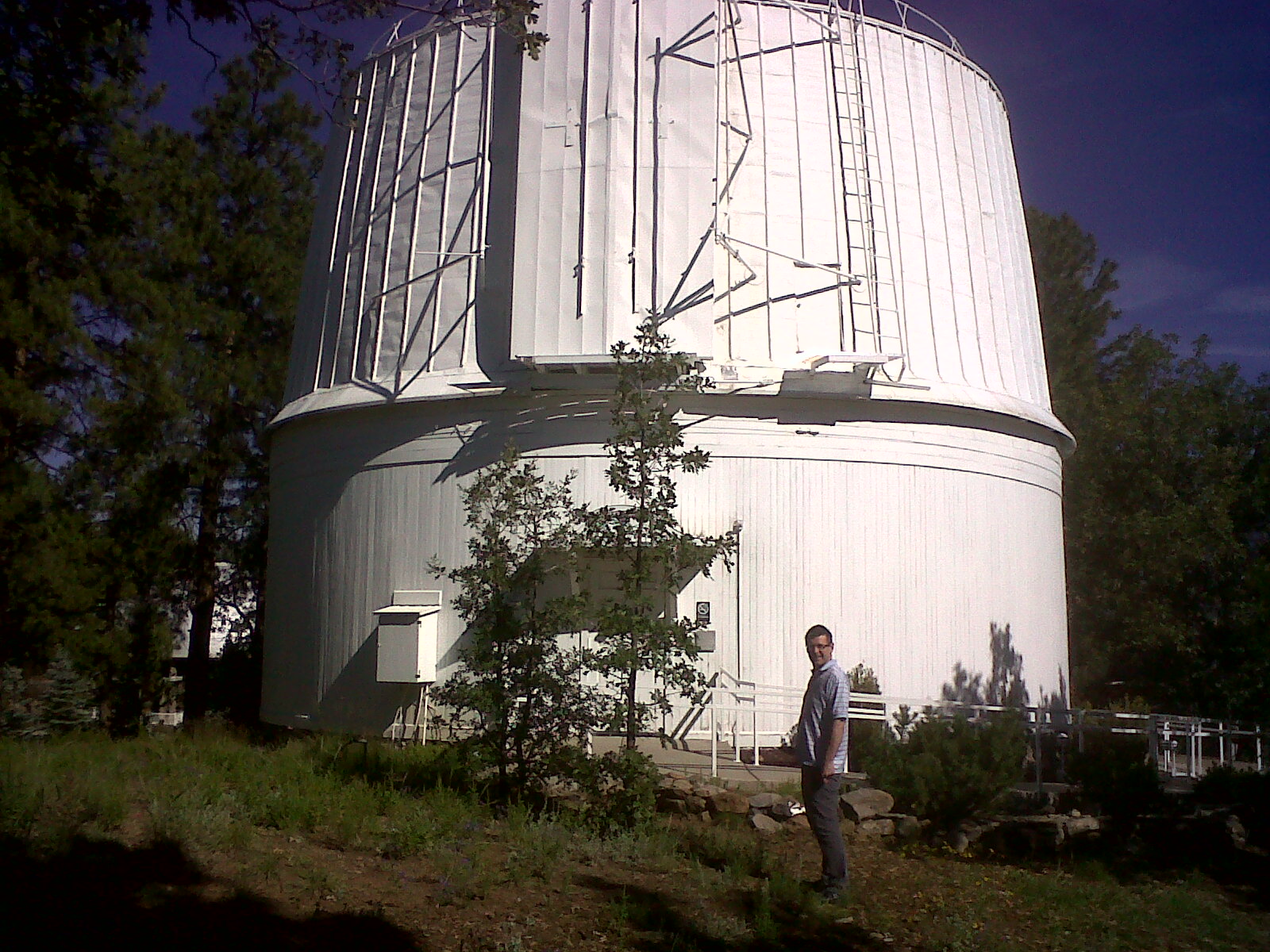
Here’s one of me standing outside the dome that houses the 24″ Clark Refractor that Slipher used for his spectrographic studies:

And just to remind you that the site isn’t famous only for Slipher’s work, here is the dome housing the 13″ astrographic telescope that was used in 1930 by Clyde Tombaugh to discover Pluto.

Here’s my chauffeur for the day, Prof. Peacock, with the rusting remains of a 42″ telescope:

Of course the Lowell Observatory is named after Percival Lowell (known to his friends as “Percy”) a flamboyant character who founded it in 1894. Lowell did many great things for astronomy, but unfortunately he is mostly remembered these days for his erroneous observations of “canals” on Mars.

“The Universe is Expanding…”

Posted in Biographical, Film, The Universe and Stuff with tags , , on September 16, 2012 by telescoper

Well, that’s the meeting over with. Now I’m off for a bit of sightseeing before going back to Phoenix for the evening flight back to London. I might be able to post some pictures when I get back, but for the mean time I’ll sign off with this clip which Michael Way used to end the last talk of the meeting!