Archive for December, 2018

Bill Bonnor on Cosmology with Negative Mass

Posted in mathematics, The Universe and Stuff with tags , , , , , on December 10, 2018 by telescoper

My post from Friday about negative mass in cosmology reminded me of my days at Queen Mary and discussions I had at that time with Bill Bonnor, who retired in 1985 but was a regular visitor to the weekly Relativity Seminars. I was sad to discover just now that Bill actually passed away in 2015 (at the age of 94) so I thought I would post a little note as a short tribute.

Bill Bonnor was an old-school mathematical relativist, which I definitely am not, but I recall talking to him quite a lot in the coffee room because we had a shared interest in gambling games. He had a liking for the fixed-odds competition in the football pools, which he played with considerable success.

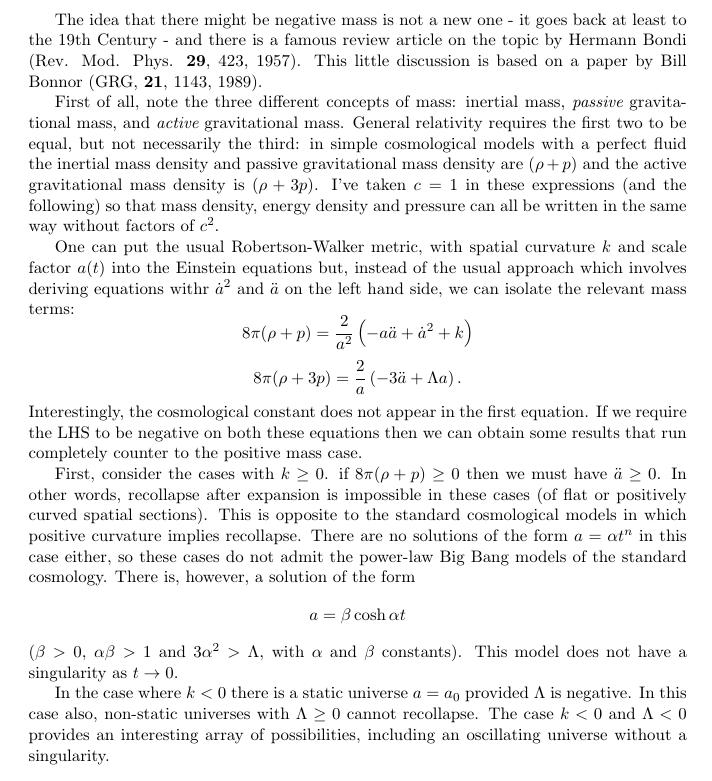
Anyway, Bill Bonnor published a paper in 1989 about Negative Mass in General Relativity. It’s not all about cosmological implications of negative mass, but I’ve just typed up a quick summary. In fact I used some of this in a university examination question many moons ago!

Before reading this, you might wish to look up active the terms gravitational mass, passive gravitational mass, inertial mass and equivalence principle, which you can find discussed here (for example).

Azed and Ireland

Posted in Crosswords, Maynooth with tags , , , on December 9, 2018 by telescoper

I had a nice surprise when I opened today’s Observer to the crossword page to find I had won a prize!
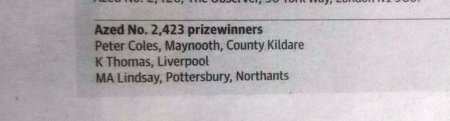
The solution to Azed 2423 printed in the paper is not, however, as I remember it.
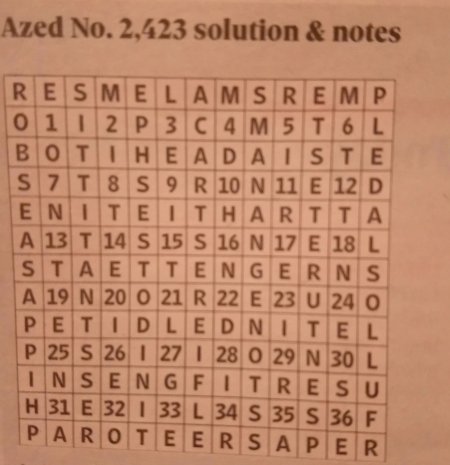
Obviously there have been a few gremlins at the Observer.

Although I’ve been doing the Azed Crossword for the best part of twenty years this is actually the first time I’ve won the regular crossword prize, in which solvers just have to send in a completed puzzle and the winners’ names are drawn out of a hat, as opposed to the Competition puzzle (which occurs roughly every 4 weeks), in which solvers also have to supply a clue for one of the answers in the grid. It’s also worth saying that this is the first crossword prize I’ve won from Ireland. I have won a couple of other prizes (Everyman and the Times Literary Supplement) in the the past year, but I gave my address in Wales on both occasions as I was spending half time there and half in Maynooth for much of the past year.

Anyway, the prize is not a dictionary but £25 in book tokens, which should be enough to buy a dictionary should I feel the need. I think I may choose something else, however, assuming the tokens ever make it across to Ireland! I’ve not been impressed with the efficiency of the postal service to and from the UK so far…

According to the &lit archive I’ve been sending in entries for about 18 years. Since 3/4 of the Azed puzzles are of the regular type that means that if I’d done every puzzle correctly for that period I would have about 18 × 52 ×¾ ≈ 700 chances to win, which gives a crude estimate of the number of correct entries that must be sent in each week. In fact I’ve missed quite a few and probably made some mistakes. Nevertheless, a weekly entry of several hundred seems a reasonable order-of-magnitude guess. The number that enter the monthly competition is somewhat lower (around 200 usually). I don’t need to guess that – Azed himself supplies the numbers via the Azed Slip.

I’ve got a mediocre record in the Azed clue-setting Competition – I think I’m much better as a solver than a setter! – but have at least scored some successes and finished 15th (equal) in 2010/11. That turns out to have been my high-water mark, as I stopped doing the Azed puzzle regularly when I moved to Sussex in 2013, at which time I started doing the Beelzebub puzzle in the Independent on Sunday. I only re-started buying the Observer when the Independent stopped producing a print edition in March 2016.

So far I’ve struggled with the clue-writing, but I’ll soldier on with it and hopefully will hit some form at some point. Three puzzles into the latest season I’ve scored three HCs, which is at least consistent. Officially `HC’ means Highly Commended’ but I translate it as `Hard Cheese’. One needs to get a VHC (`Very Highly Commended’) at least to score points so I’m still just an `Also Ran’ this year. I got one VHC last year and hopefully can improve on that this time round, with ten puzzles still to go.

Incidentally, looking at the latest Azed Slip I notice that there are several solvers in Ireland. I’ve never noticed that before. I wonder how many have moved recently, like me?

Finally I think I’ll mention the winning clue in the last Azed Competition. The word to be clued was SPASMODICAL and the winning clue was:

À la PM’s disco dancing?

The word `dancing’ here is an anagram indicator, and the previous letters (A+LA+PMS+DISCO) form an anagram of the target word. A different wording of the clue acts as the definition, suggesting that Theresa May’s dancing at the Tory Party Conference was spasmodical. This type of clue is described as `anag. &lit’ (meaning `anagram’ and literally what it says). Undoubtedly, &lit clues are very difficult to construct, and the anagram in the above clue is extremely clever. Whether you think the &lit constitutes a fair definition of SPASMODICAL is a matter of taste. It’s perhaps a bit borderline, but probably saved by the `?’ at the end which traditionally implies some sort of funny business with the definition. In any case, this one is far less controversial than some of the others I’ve seen. For example, here it a prize-winning clue for SUBORDINATELY:

As in ‘B-role’ duty possibly

Here `possibly’ is the anagram indicator, which is fair enough, but for me the surface reading barely makes sense. Azed is the only judge, however, and he generally does seem to cut people quite a bit of slack when they attempt this type of clue.

There are many ways to go mad…

Posted in History, Music with tags , , , on December 8, 2018 by telescoper

The clip below is of a live performance by Irish folk artist Lisa O’Neill (who is from Cavan) of her own song, `Violet Gibson’. I heard the studio version from her CD on the radio the other day and the first line really caught my attention. The Youtube version is preceded by a lengthy spoken by Lisa O’Neill which is worth listening to but if you want to jump to the point where the song starts, that’s about 5:27.

The story of Violet Gibson is both bizarre and tragic. She was in 1876 into a well-to-do family living in Merrion Square in Dublin. Her father, Edward Gibson, was made Baron Ashbourne in 1886. To cut a long story short, at 11am on 26th April 1926, Violet Gibson turned up in Rome where she attempted to shoot Fascist Leader Benito Mussolini with a pistol. She only failed in this task because Mussolini moved his head at the instant she pulled the trigger, and the bullet just grazed his nose. She tried to fire again, but her gun jammed. She was then seized by the angry mob of fascist supporters with whom she had mingled to get close enough to shoot. She was almost lynched but saved by the police. Eventually, the authorities came to the conclusion that she was insane and she was sent back to England. She spent the rest of her life in a psychiatric institution in Northampton. She died in 1956, at the age of 79.

P.S. If you want to find out more about Violet Gibson, I recommend a book about her life called The Woman Who Shot Mussolini by Frances Stonor Saunders.

P.P.S. Cavan is the county town of County Cavan, which is in the Irish Border Region. Although part of the province of Ulster, it is in the Republic of Ireland.

Negative Mass, Phlogiston and the State of Modern Cosmology

Posted in Astrohype, The Universe and Stuff with tags , , on December 7, 2018 by telescoper

A graphical representation of something or other.

I’ve noticed a modest amount of hype – much of it gibberish – going around about a paper published in Astronomy & Astrophysics but available on the arXiv here which entails a suggestion that material with negative mass might account for dark energy and/or dark matter. Here is the abstract of the paper:

Dark energy and dark matter constitute 95% of the observable Universe. Yet the physical nature of these two phenomena remains a mystery. Einstein suggested a long-forgotten solution: gravitationally repulsive negative masses, which drive cosmic expansion and cannot coalesce into light-emitting structures. However, contemporary cosmological results are derived upon the reasonable assumption that the Universe only contains positive masses. By reconsidering this assumption, I have constructed a toy model which suggests that both dark phenomena can be unified into a single negative mass fluid. The model is a modified ΛCDM cosmology, and indicates that continuously-created negative masses can resemble the cosmological constant and can flatten the rotation curves of galaxies. The model leads to a cyclic universe with a time-variable Hubble parameter, potentially providing compatibility with the current tension that is emerging in cosmological measurements. In the first three-dimensional N-body simulations of negative mass matter in the scientific literature, this exotic material naturally forms haloes around galaxies that extend to several galactic radii. These haloes are not cuspy. The proposed cosmological model is therefore able to predict the observed distribution of dark matter in galaxies from first principles. The model makes several testable predictions and seems to have the potential to be consistent with observational evidence from distant supernovae, the cosmic microwave background, and galaxy clusters. These findings may imply that negative masses are a real and physical aspect of our Universe, or alternatively may imply the existence of a superseding theory that in some limit can be modelled by effective negative masses. Both cases lead to the surprising conclusion that the compelling puzzle of the dark Universe may have been due to a simple sign error.

For a skeptical commentary on this work, see here.

The idea of negative mass is no by no means new, of course. If you had asked a seventeenth century scientist the question “what happens when something burns?”  the chances are the answer would  have involved the word phlogiston, a name derived from the Greek  φλογιστόν, meaning “burning up”. This “fiery principle” or “element” was supposed to be present in all combustible materials and the idea was that it was released into air whenever any such stuff was ignited. The act of burning separated the phlogiston from the dephlogisticated “true” form of the material, also known as calx.

The phlogiston theory held sway until  the late 18th Century, when Antoine Lavoisier demonstrated that combustion results in an increase in weight implying an increase in mass of the material being burned. This poses a serious problem if burning also involves the loss of phlogiston unless phlogiston has negative mass. However, many serious scientists of the 18th Century, such as Georg Ernst Stahl, had already suggested that phlogiston might have negative weight or, as he put it, `levity’. Nowadays we would probably say `anti-gravity.

Eventually, Joseph Priestley discovered what actually combines with materials during combustion:  oxygen. Instead of becoming dephlogisticated, things become oxidised by fixing oxygen from air, which is why their weight increases. It’s worth mentioning, though, the name that Priestley used for oxygen was in fact “dephlogisticated air” (because it was capable of combining more extensively with phlogiston than ordinary air). He  remained a phlogistonian longer after making the discovery that should have killed the theory.

The standard cosmological model involves the hypothesis that about 75% of the energy budget of the Universe is in the form of “dark energy”. We don’t know much about what this is, except that in order to make our current understanding work out it has to act like a source of anti-gravity. It does this by violating the strong energy condition of general relativity.

Dark energy is needed to reconcile three basic measurements: (i) the brightness distant supernovae that seem to indicate the Universe is accelerating (which is where the anti-gravity comes in); (ii) the cosmic microwave background that suggests the Universe has flat spatial sections; and (iii) the direct estimates of the mass associated with galaxy clusters that accounts for about 25% of the mass needed to close the Universe.

A universe without dark energy appears not to be able to account for these three observations simultaneously within our current understanding of gravity as obtained from Einstein’s theory of general relativity.

I’ve blogged before, with some levity of my own, about how uncomfortable this dark energy makes me feel. It makes me even more uncomfortable that such an enormous  industry has grown up around it and that its existence is accepted unquestioningly by so many modern cosmologists.

Isn’t there a chance that, with the benefit of hindsight, future generations will look back on dark energy in the same way that we now see the phlogiston theory?

Or maybe, as the paper that prompted this piece might be taken to suggest, the dark energy really is something like phlogiston. At least I prefer the name to quintessence. However, I think the author has missed a trick. I think to create a properly trendy cosmological theory he should include the concept of supersymmetry, according to which there should be a Fermionic counterpart of phlogiston called the phlogistino..

R.I.P. Pete Shelley (1955-2018)

Posted in Biographical, LGBTQ+, Music with tags , , on December 7, 2018 by telescoper

I heard the news late last night of the passing of Pete Shelley, best known as the lead singer of the Buzzcocks. Another iconic figure from my youth has gone. I was never really interested in the 70s punk movement in the UK, but the Buzzcocks managed to combine some of the energy and directness of punk rock with more conventional pop melodies. Above all, though, there was Pete Shelley’s style of delivery, head tilted to one side, a unique mixture of queer camp and unapologetic defiance. That had a big effect on me in my teenage years. In particular, I remember watching watching this performance on Top of the Pops in 1978 (forty years ago, when I was 15) and understanding exactly what the song was about. Ever Fallen In Love only got to number 12 in the charts, but in my memory it was a far bigger hit than that.

Rest in peace, Pete Shelley (1955-2018).

P.S. The answer to the question posed in the song is, of course, `yes’..

Fintan O’Toole on “Heroic Failure: Brexit and the Politics of Pain”

Posted in Literature, Maynooth, Politics with tags , , , on December 6, 2018 by telescoper

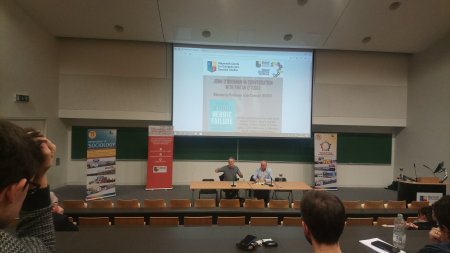
Time for a tea break and a quick post about a very interesting event this afternoon at Maynooth featuring renowned Irish journalist and author Fintan O’Toole (whose regular columns in the Irish Times I read with great interest).

This event saw John O’Brennan, Director of the Centre for European and Eurasian Studies in Maynooth in conversation with Fintan on his new book, Heroic Failure: Brexit and the Politics of Pain. The book deals with the Brexit referendum, the chaos it unleashed in British politics and the challenges posed to the island of Ireland by a ‘No Deal Brexit’. In particular the book examines how a country that once had colonies is redefining itself as an oppressed nation requiring liberation; the dreams of revolutionary deregulation and privatization that drive Arron Banks, Nigel Farage and Jacob Rees-Mogg; and the silent rise of English nationalism, the force that dare not speak its name. He also discusses the fatal attraction of heroic failure, once a self-deprecating cult in a hugely successful empire that could well afford the occasional disaster: the Charge of the Light Brigade, or Franklin lost in the Arctic. Now failure is no longer heroic – it is just failure, and its terrible costs will be paid by the most vulnerable of Brexit’s supporters, and by those who may suffer the consequences of a hard border in Ireland and the breakdown of a fragile peace.

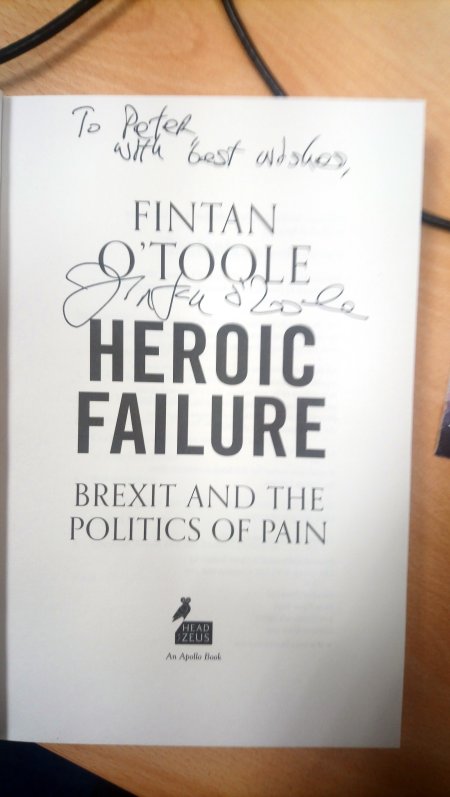
The discussion was so interesting – and Fintan O’Toole was so eloquent and amusing –  that I bought the book. The author was kind enough to sign it for me too!

There’s an extract printed on the cover that will give you a taste, but if you want more you’ll have to buy the book:

Of all the pleasurable emotions, self-pity is the one that most makes us want to be on our own…Only alone can we surrender completely to it and immerse ourselves in the steaming bath of hurt, outrage and tender regard for our terribly wronged selves. Brexit therefore makes sense of a nation that feels sorry for itself. The mystery, though, is how Britain, or more precisely England, came not to just experience this delightful sentiment but to define itself through it.

I only bought the book today so haven’t read it yet, but I will endeavour to write a review when I have.

Now back to the writing of lecture notes…

The Final Shootout

Posted in Film, Music, Politics with tags , , , , on December 6, 2018 by telescoper

“Only connect” they say so I thought I’d connect two topical items with this video clip of one of my favourite movie scenes.

The first item is that on 15th February next year the legendary composer Ennio Morricone will be conducting a concert of his music in Dublin. Moricone’s 90th birthday was on 10th November 2018.

The other thing is that the UK Parliament is currently debating the terms of Brexit. It seems that there are now only three options: accept Theresa May’s ugly Withdrawal Agreement, reject it and suffer a bad `No Deal’ Brexit or take the sensible, good choice of withdrawing Article 50, admitting it was all a terrible idea in the first place, and remaining in the European Union.

So here we are then, the climactic final shoot-out from Sergio Leone’s famous Spaghetti Western The Good The Bad And The Ugly, featuring Clint Eastwood, Eli Wallach and Lee Van Cleef respectively, together with superb (and very complex) music on the soundtrack from Morricone. We all know who wins in the end, at least in the film.

P.S. Hats off to the guitarist Alessandro Alessandroni (who also did the whistling on the soundtrack) producing that unforgettable twangy sound with a hint of scordatura

A LIGO Orrery

Posted in The Universe and Stuff with tags , , , , on December 5, 2018 by telescoper

Following yesterday’s post here is a nice video visualization of all the black hole binary mergers so far claimed to have been detected by Advanced LIGO. They’re computer simulations, of course, not actual black holes (which you wouldn’t be able to see). I always thought an Orrery was a clockwork device, rather than a digital computer, but there you go. Poetic license!

I can’t say I’m very keen on the music.

The New Wave of Gravitational Waves

Posted in The Universe and Stuff with tags , , , , on December 4, 2018 by telescoper

I think it’s very sneaky of the LIGO Scientific Collaboration and the Virgo Collaboration to have released two new gravitational wave papers while I was out of circulation fora  couple of days, so I’m a bit late on this, but here are links to the new results on the arXiv.

You can click on all the excerpts below to make them bigger.

First there is GWTC-1: A Gravitational-Wave Transient Catalog of Compact Binary Mergers Observed by LIGO and Virgo during the First and Second Observing Runs with this abstract:

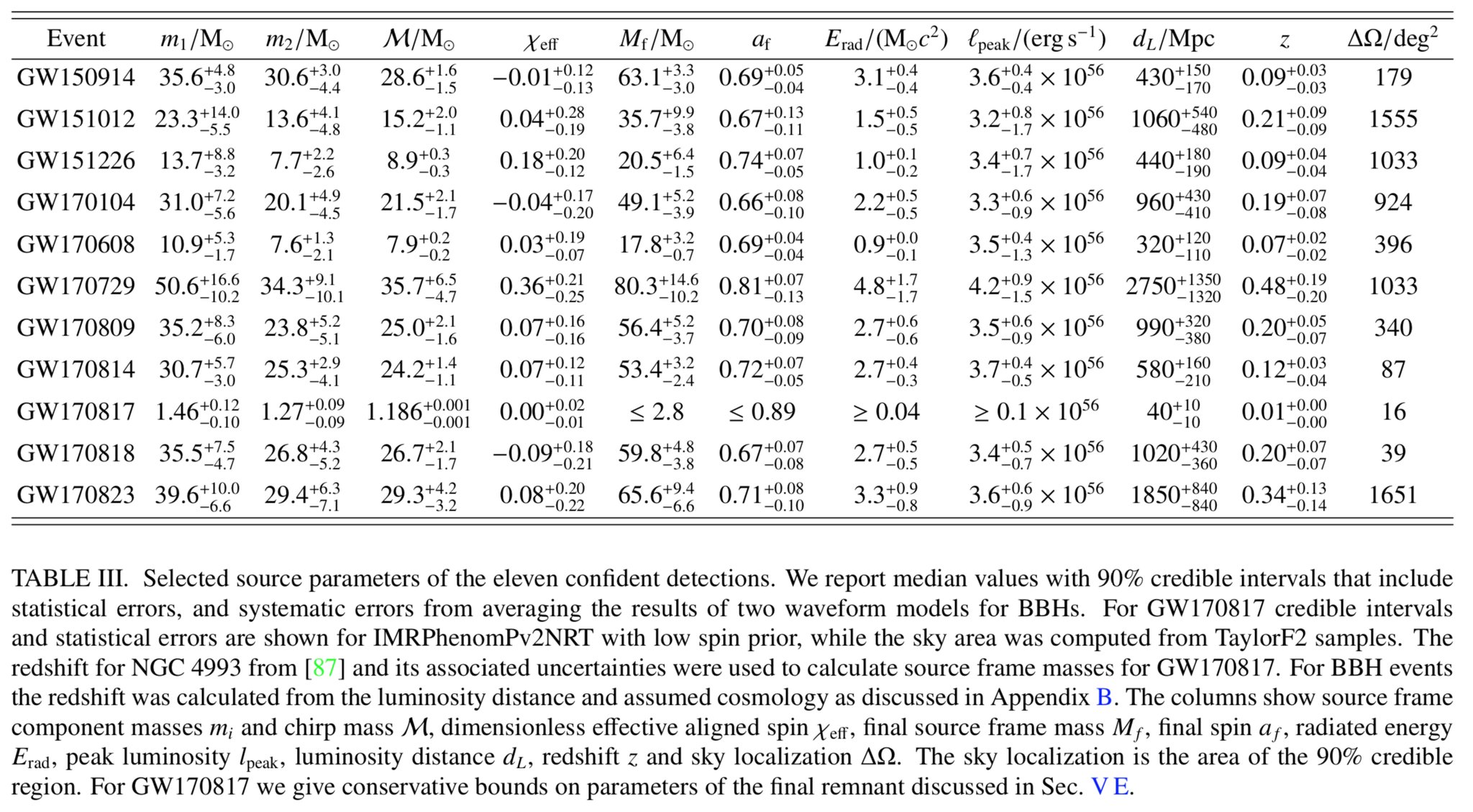
Here is a summary of the properties of the binary systems involved in the events listed in the above paper:

There are several (four) events in this catalogue that have not previously been announced (or, for that matter, subjected to peer review) despite having been seen in the data some time ago (as far back as 2015). I’m also intrigued by the footnote on the first page which contains the following:

…all candidate events with an estimated false alarm rate (FAR) less than 1 per 30 days
and probability > 0.5 of being of astrophysical origin (see Eq. (10) for the definition) are henceforth denoted with the GW prefix.

The use of false discovery rates is discussed at length here as a corrective to relying on p-values for detections. The criteria adopted here don’t seem all that strong to me.

The second paper is Binary Black Hole Population Properties Inferred from the First and Second Observing Runs of Advanced LIGO and Advanced Virgo which has this abstract:

I’ve been teaching and/or preparing lectures all day today, so I haven’t yet had time to read these papers in detail. I will try to read them over the next few days. In the meantime I would welcome comments through the box about these new results. I wonder if there’ll be any opinions from the direction of Copenhagen?

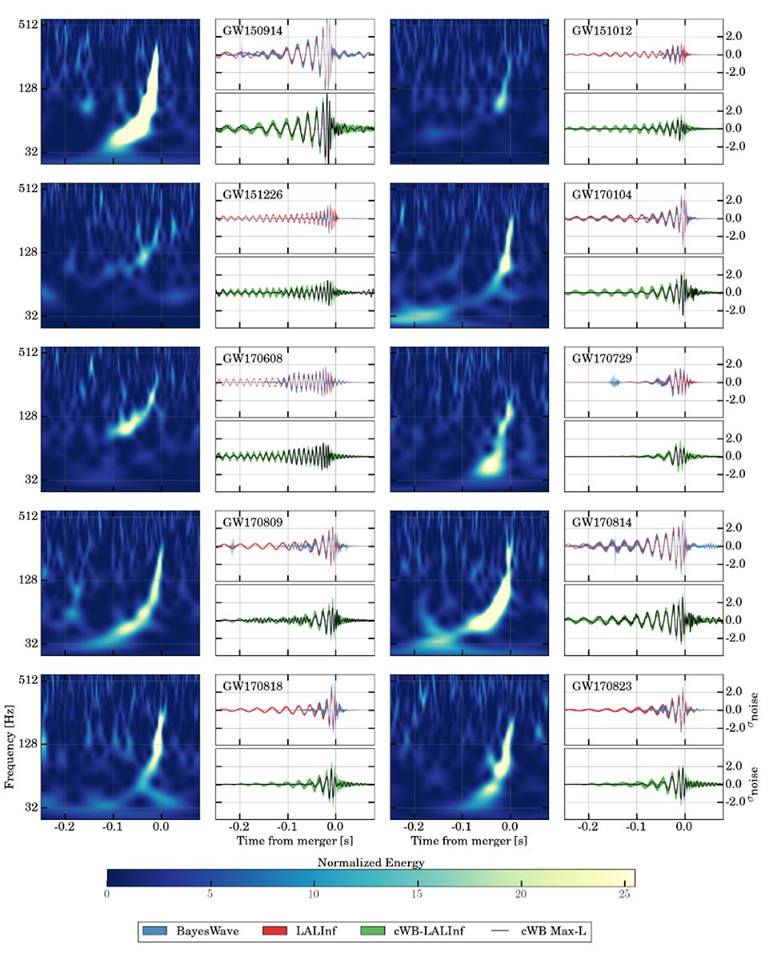
UPDATE: Here’s a montage of all 10 binary black hole mergers `detected’ so far…

I think it’s safe to say that if GW151266 had been the first to be announced, the news would have been greeted with considerable skepticism!

Acute Geometry Problem

Posted in Cute Problems, mathematics on December 3, 2018 by telescoper

I saw a plea for help on Twitter from Astronomer Bryan Gaensler who is stuck with his son’s homework.

So please give him a hand by solving this to find a, b and c.

Your time starts now.