Archive for February, 2019

R.I.P. Gordon Banks (1937-2019)

Posted in Football with tags , , , , on February 13, 2019 by telescoper

It’s been a hectic couple of days during which I somehow missed the very sad news of the passing of legendary goalkeeper Gordon Banks, who died yesterday (12th February 2019) at the age of 81.

Gordon Banks made 628 appearances during a 15-year career in the Football League, and won 73 caps for England, highlighted by starting every game of the 1966 World Cup campaign. He will however be best remembered for one amazing save in the 1970 World Cup, so by way of a short tribute here is a rehash of a post I wrote some years ago about that.

–0–

I’ve posted a few times about science and sport, but this bit of action seems to defy the laws of physics. I remember watching this match, a group game at Guadalajara (Mexico) between England and Brazil from the 1970 World Cup, live on TV when I was seven years old. The Brazil team of 1970 was arguably the finest collection of players ever to grace a football field and the names of Jairzinho, Carlos Alberto, Rivelino and, of course, Pelé, were famous even in our school playground. The England team of 1970 was also very good, but they were made to look very ordinary that day – with one notable exception.

The only thing I remember well about the game itself  was this save – the best of many excellent stops – by the great goalkeeper Gordon Banks. I’ve seen it hundreds of times since, and still can’t understand how he managed to block this header from Pelé. You can tell from Bobby Moore’s reaction (No. 6, on the line) that he also thought Brazil had scored…

Here’s the description of this action from wikipedia:

Playing at pace, Brazil were putting England under enormous pressure and an attack was begun by captain Carlos Alberto who sent a fizzing low ball down the right flank for the speedy Jairzinho to latch on to. The Brazilian winger sped past left back Terry Cooper and reached the byline. Stretching slightly, he managed to get his toes underneath the fast ball and deliver a high but dipping cross towards the far post. Banks, like all goalkeepers reliant on positional sensibility, had been at the near post and suddenly had to turn on his heels and follow the ball to its back post destination.

Waiting for the ball was Pelé, who had arrived at speed and with perfect timing. He leapt hard at the ball above England right back Tommy Wright and thundered a harsh, pacy downward header towards Banks’ near post corner. The striker shouted “Goal!” as he connected with the ball. Banks was still making his way across the line from Jairzinho’s cross and in the split-second of assessment the incident allowed, it seemed impossible for him to get to the ball. He also had to dive slightly backwards and down at the same time which is almost physically impossible. Yet he hurled himself downwards and backwards and got the base of his thumb to the ball, with the momentum sending him cascading to the ground. It was only when he heard the applause and praise of captain Bobby Moore and then looked up and saw the ball trundling towards the advertising hoardings at the far corner, that he realised he’d managed to divert the ball over the bar – he’d known he got a touch but still assumed the ball had gone in. England were not being well received by the locals after cutting comments made about Mexico prior to the tournament by Ramsey, but spontaneous applause rang around the Guadalajara, Jalisco stadium as Banks got back into position to defend the resulting corner. Pelé, who’d begun to celebrate a goal when he headed the ball, would later describe the save as the greatest he’d ever seen.

Here is Gordon Banks describing it in his own words.

Brazil deservedly went on to win the game, but only by a single goal. Without Gordon Banks, England would have been well and truly hammered.

Rest in peace, Gordon Banks (1937-2019).

Loughborough Pride in STEM Research Showcase

Posted in Biographical, LGBTQ+, Talks and Reviews on February 13, 2019 by telescoper


So here I am then, in Burleigh Court (a hotel on the campus of Loughborough University), having just had a fine breakfast, preparing for the start of today’s Pride in STEM Research Showcase, which I am very much looking forward to. I’m giving the keynote talk at the end of the day’s events and will be here for the whole day. I’m very grateful to the organizers for inviting me and especially to Claudia Eberlein, Dean of Science at Loughborough University for greeting me when I arrived at Burleigh Court.

Some readers may recall that I worked with Claudia Eberlein at the University of Sussex a few years ago – she was Head of the Department of Physics & Astronomy for a time, but last year she moved to her new role at Loughborough. It was nice to have a beer and share some gossip about goings-on at the old place. It seems quite a few of the people I worked with at Sussex until 2016 have moved on to pastures new. Perhaps I’d better not comment further.

Anyway, I travelled yesterday evening from Dublin via the dreaded Ryanair who operate the only direct flights from Dublin to East Midlands Airport. In fairness, though, it was a very pleasant experience: we departed and arrived on time, where I was met on arrival by a driver who took me to Burleigh Court by taxi.

Well, I had better get my act together for the start of the meeting. Toodle-pip!

Mumps and Mumpsimusses

Posted in Education, Maynooth with tags , , , , on February 12, 2019 by telescoper

I noticed that there has been an outbreak of mumps among students in the Dublin area (including a case in Maynooth). I had mumps when I was a kid and I can tell you it was no fun at all. I had thought mumps had been virtually eradicated by vaccination; the MMR vaccine was brought into use in the UK in 1988, and I had mumps long before that. I suppose one can lay the blame for the current outbreak at the door of the anti-vaxxers.

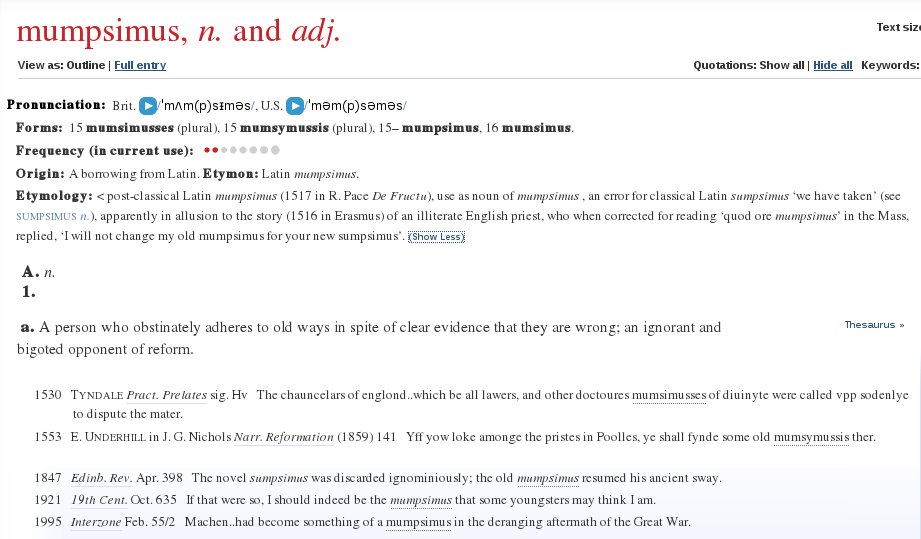
That brings me to one of my favourite words – yet another that I found out while doing a crossword – mumpsimus. Here is (part of) the OED entry:

Wikipedia gives “traditional custom obstinately adhered to however unreasonable it may be”, which is in the OED further down the page.

It seems to me that belief in idea that one’s children should not be protected against mumps is a mumpsimus, and people who cling to that belief are mumpsimusses.


On the alleged socialist dominance in academia

Posted in mathematics, The Universe and Stuff with tags , , , , on February 11, 2019 by telescoper

Various forms of Turning Point

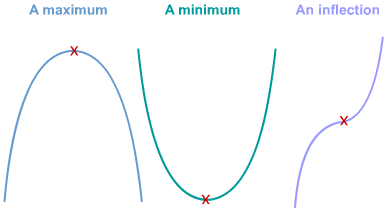
Yesterday there came to my attention to a tweet from an organization called `Turning Point’. Disappointingly this is not as its name suggests, something to do with differential calculus, but a far-right propaganda organization which, among other things, is bemoaning the `socialist dominance in academia’.

Left-wing infiltration of university education would be a very serious matter if it existed, so to allay the fears of my readership that this is not really a problem, in the following I am going to list a few physics topics I will be teaching this week to make it clear that they can not possibly be accused of being influenced by political bias.

  • Mathematical Physics. I will be explaining how Laplace Transformations can be used to solve ordinary differential equations by seizing the means of production.
  • Quantum Mechanics. I will be demonstrating how the path integral formalism allows the result of a quantum mechanical calculation to be obtained by considering the sum over all historical class struggles.
  • Electrostatics. I will be discussing  why some substances are insulators rather than conductors using the theory of dielectrical materialism.
  • Optics. The topic here is Snell’s Law, which relates the Engels of incidence and refraction for light of a given colour and for given pair of media.

It goes without saying that students will not pass the examination on these topics unless they get enough Marx.

I hope this clarifies the situation.

The Tree of Liberty Stone

Posted in History, Maynooth with tags , , , , on February 10, 2019 by telescoper

I had to come into the office today to do a few things ahead of what will be another busy week, but when I stepped out I found the weather to be much more pleasant than it has been of late, so went for a short stroll around the town of Maynooth. I’m also house-hunting, so I took the opportunity to have a look at the locations of a few properties I’d seen on the market before deciding whether to check them out in more detail.

Anyway, at the opposite end of the Main Street from the Maynooth University campus, I found the above monument, the Tree of Liberty Stone, which commemorates the (failed) Irish Rebellion of 1798 which had sought to emulate the French Revolution (which began in 1789) in overthrowing British rule in Ireland. This rebellion was launched by the Society of United Irishmen.

Incidentally, one of the founders and leading lights of the Society of United Irishmen was a character from Belfast by the name of Henry Joy McCracken. That name will be familiar to many astronomers, and especially to people involved in the European Space Agency’s Euclid mission, as there is an astronomer with exactly the same name who did his PhD in Durham and who now works in Paris. Whether the present Henry Joy McCracken is directly related I don’t know.

The historical Henry Joy McCracken was executed by public hanging on 17th July 1798 after the failure of the 1798 rebellion. He was just 30 years old. Another thing worth mentioning is that he was a Protestant republican. There were more of those than people tend to think.

A Hint of Blue Skies for Irish Science?

Posted in Science Politics, The Universe and Stuff with tags , , on February 9, 2019 by telescoper

I was quite excited the other day when I got an email notifying me that Science Foundation Ireland (SFI) has announced a new funding programme called Frontiers for the Future. What particularly caught my attention are the so-called Frontiers for the Future Projects, which..

will provide funding for high-risk, high-reward research that facilitates highly innovative and novel approaches to research.

The wording here contrasts with the Frontiers for the Future Awards, which…

will provide larger scale funding for innovative, collaborative and excellent research programmes that have the potential to deliver economic and societal impact.

The Projects can fund up to €480K over 4 years (compared to the Awards, which are up to €1M over 5 years). This second category seems to follow the policy of the past decade of SFI which is only to fund research which is able more-or-less immediately to generate a financial return. I’ve argued previously that I think this is a short-sighted policy, but I won’t repeat that argument here. It is a fact however that SFI’s policy has made it very difficult in Ireland for researchers who want to do basic `blue skies’ research, including us astronomers and astrophysicists.

The new `Projects’ however may just be a step away from this damaging shor-termism.

Further down the page SFI states (my emphasis):

To be eligible for funding through the SFI Frontiers for the Future Programme, all proposals must be aligned to one of the 14 Refreshed Priority Areas for 2018-2023, or to any other research area within SFI’s legal remit (i.e. oriented basic or applied research) where there is convincing evidence that there will be significant potential for economic and/or societal impact in Ireland.

Astronomers in the UK have succeeded in arguing that their big science projects have all kinds of societal impact (in inspiring more students into STEM disciplines, as well as wider public engagement) as well as direct economic impact in terms of developing research methods, and building up a talent pool, especially in areas like data science. Whether SFI will accept such arguments in Ireland, I just don’t know.

If you’re wondering what `oriented basic or applied research’ means, SFI defines it as follows:

Oriented basic research is research that is carried out with the expectation that it will produce a broad base of knowledge that is likely to form the background to the solution of recognised, or expected, current or future problems or possibilities.

To me that means virtually any science!

Anyway, I’ll probably throw the dice to see if I can get some  SFI support for my research in cosmology. It might turn out to be a waste of effort, but if you don’t buy a ticket you don’t win the lottery…


The Way You Look Tonight – Eric Dolphy

Posted in Jazz with tags , , on February 8, 2019 by telescoper

It’s been a very busy week so I’m about to go home and dive into a glass or two of wine, but before doing that I thought I’d leave a little something for the weekend.

Among the other things I have to do next week is make a short trip to Copenhagen to examine a PhD candidate. This track was recorded live at Copenhagen on September 8 1961 and it features Eric Dolphy (alto sax), Bent Axen (piano), Erik Moseholm (bass) and Jørn Elniff (drums). The tune The Way You Look Tonight is an old standard, written in 1936 by Dorothy Fields and Jerome Kern, but what a version this is! Dolphy tears through the changes on this performance, reinventing the piece in a way that turns what might be a routine tune into something absolutely new and refreshing. The combination of virtuosity and exuberance of the saxophone playing in this phenomenal performance is absolutely exhilarating. Enjoy!

The future of journal publishing here today – Guest Post by Syksy Räsänen

Posted in Open Access with tags , , , , on February 8, 2019 by telescoper

You may recall that the Open Journal of Astrophysics recently published a paper by Syksy Räsänen of the University of Helsinki. I invited Syksy to write a blog post on the Open Journal for Astrophysics about why he chose to publish with us, and I’m delighted to say that his post is now available there and, with the author’s permission, I am reproducing it below on this blog. It’s also available at Syksy’s own blog . It’s quite a long post, but there is some very interesting information in it, which will probably surprise you!

—0—

The bad news:: the scientific community can no longer afford commercial science journals.

The good news: the scientific community no longer needs commercial science journals.

The bottom line: open internet archives and overlay journals are the solution.

Scientific journal publishing is in crisis. Already 25 years ago librarians referred to the rising costs of journals as a “doomsday machine”. In 2012, Harvard University Library announced that it can no longer afford scientific journals, warning that publishers had created a “fiscally unsustainable” situation. The library took the unprecedented step of asking faculty to resign from publications that keep articles behind paywalls.

In its 2015 Open Access Policy White Paper, the Max Planck Digital Library assessed the annual revenue of scientific journal publishing as 7.6 billion euros. Divided by an estimated 1.5-2.0 million published articles, they arrived at a cost of €3800 to €5000 per article. The International Association of Scientific, Technical and Medical Publishers has estimated $10 billion in revenue and 2.5 million articles annually, which gives €3500 per article. According to them, 68-75% of the costs are borne by academic libraries.

These are enormous sums, funnelled from science to the pockets of large corporations. (Some journals are published by scientific societies, but this doesn’t change the overall picture.)

To put the numbers in perspective, the total construction cost of the Large Hadron Collider at CERN –the largest scientific experiment in the history of humanity–was around 5 billion euros, or 500 million euros per year. The cost of science publishing would cover the construction of 10 to 20 top-of-the-line successor experiments to the LHC. It is equivalent to the salaries and overheads of 150,000 to 200,000 postdoctoral researchers per year. This is likely more than the combined number of postdocs in the United States and the European Union.

Scientific publishing is a strange business. Scientists carry out research for free, write it up for free, give the article to the publisher for free, manage the peer review process as editors (some editors get paid), do peer-review for the publisher for free – and then the scientists’ institutions pay the publisher so that they can read the articles. In some cases scientists even pay the publisher to have their articles published. (Here “free” simply means the scientists are not paid by the publisher, but rather by their university or research institute – in the end, mostly by taxpayers.)

Is there any other industry where corporations pay nothing for the raw materials, have negligible processing costs and enjoy a captive market that automatically buys everything they produce? This setup leads to record profits. For example, the profit margin of Elsevier’s Scientific, Technical & Medical publishing division in the years 1991-2013 was consistently over 30%, and in 2013 it was 39%. For comparison, in the same year Apple, Google and Microsoft had profit margins of 22%, 20% and 28%, respectively. No wonder Robert Maxwell, a pioneer of scientific journal publishing, described the business as a “perpetual financing machine”.

In the past, publishers at least had the expenses of printing and shipping journals. With the internet, this cost has disappeared for many journals. However, prices have not come down – quite the opposite. Thankfully, the same technological advances that have made commercial journals so profitable have also rendered them unnecessary.

Journals used to be needed for registering and communicating research, for archiving it (via paper journals in libraries), and for performing quality control via peer review. In cosmology and particle physics, the first three services have been provided by the internet archive arXiv since 1991. Depositing articles to arXiv is free, and they can be read for free in perpetuity. In 2018, 140,616 articles appeared on arXiv, and its estimated total expenditures were $1,915,997, or 12€ per article. Other disciplines, such as economics and biology, have followed suit, either starting new categories on arXiv or setting up their own archives such as bioRxiv. There is no reason why this model cannot be extended to all fields of science.

A lot of discussion around the cost of journals centred on open access, so it is important to emphasise one thing: the issue is not open access. That problem has been solved by arXiv 27 years ago. The question is how to organise peer review in a cost-effective manner. This is where overlay journals come in.

The idea of overlay journals is simple: they are journals that concentrate on the only thing journals are needed for anymore, namely peer review. As articles appear on arXiv (or other online archives) anyway, there is no need to duplicate their work. An overlay journal has a website where papers (typically already available on arXiv) can be submitted. Peer review is conducted as usual, and in case of acceptance, the final version of the paper is updated on arXiv, with a journal reference and DOI link to the journal website.

Custom toolkits for overlay journals have been designed for more than 10 years, for example in the astrophysics RIOJA project. These days the necessary software is also available off the shelf from Scholastica. The service costs $99 per month plus $10 per submitted article, and getting a DOI from Crossref costs $1 per published article. As in the case of arXiv, the costs scale well with the number of papers. If a journal publishes 100 articles annually and has a 2/3 rejection rate, the cost works out to €38 per article – about 100 times less than the sum currently paid for article publishing.

Given that open archives and overlay journals could save 7 to 9 billion euros every year, why haven’t they already replaced commercial journals?

Unfortunately, the existence of a more optimal configuration does not automatically lead the community to shift there. Instead, people respond to individual incentives, and scientists are no exception. The publishing peer Robert Maxwell noted that “scientists are not as price-conscious as other professionals, mainly because they are not spending their own money”. As journal fees are paid centrally, there is little motivation for an individual researcher to change their publication pattern. Established journals are seen to provide a quality stamp that is necessary in the competition over positions and grants. Also, founding an overlay journal requires an investment of time that does not necessarily yieldproportionate professional rewards.

So researchers as individuals have rational reasons for not changing the system. What about libraries and scientific consortia that are struggling to bring the costs down? Unfortunately, institutional efforts have often concentrated on the narrow problem of getting journals to accept payment from the author rather than the reader (i.e. open access). However, the main issue is not whether the money is paid by the author or the reader (or rather their institutions), but what they are paying for.

Thus, for example, the SCOAP3 consortium has become part of the problem by providing life support to commercial journals. It has arranged to pay publishers vast amounts of money, entirely incommensurate with the actual costs, to make articles open access, guaranteeing them a steady stream of revenue.

The open access initiative Plan S launched last September is more ambitious. Particularly noteworthy is the commitment to provide incentives to establish new open access journals and platforms. However, open archives are only “acknowledged because of their long-term archiving function and their potential for editorial innovation”, not as publishing channels of their own right when paired with overlay journals. A lot depends on how the initiative will be implemented, but for now the scheme seems to focus on the old-fashioned aim of getting commercial publishers to convert journals to open access.

According to the Max Planck Digital Library White Paper, switching all commercial journals to an open access model would drop the cost of publication to between €1,100 and €2,000 per article. This would cut expenditures by a factor of 2 to 5, saving billions of euros every year – and continuing to waste billions of euros every year.

It is striking that the principles of Plan S contain no commitment to maximising the returns on public money and optimising financial sustainability, even though this is the heart of the matter. Instead, it supports the continuation of the commercial publishing model in co-operation with corporations, whose interests are at odds with those of the scientific community. We do not need to reform the business model of scientific journal publishing, we have to abandon it.

Open access consortia should start supporting a publishing model that begins from the needs of the scientific community and aims to fulfil them in an economical manner, while helping to make the transition as smooth as possible. This involves communicating with scientists about the costs of corporate publishing, following and expanding on Harvard’s example of calling on scientists to use the power of their labour (often given to the publishers for free) to change the situation, and providing incentives and support to establish and publish in overlay journals. Scientists, in turn, need to re-evaluate their brand loyalty to established journals, and give appropriate career merits for time spent on changing the publishing system.

Open archives and overlay journals are not a utopian solution for the future. Discrete Analysis, Open Journal of Astrophysics and others are publishing already. They are a proven model for open access publishing and quality peer review in a modern, cost-effective manner tailored to the needs of the scientific community. The sooner they become the new standard, the more money we will save for science.

The Future Circular Collider: what’s the MacGuffin?

Posted in Science Politics, The Universe and Stuff with tags , , , , , , , on February 7, 2019 by telescoper

I’ve been reading a few items here and there about proposals for a Future Circular Collider, even larger than the Large Hadron Collider (and consequently even more expensive). No doubt particle physicists interested in accelerator experiments will be convinced this is the right move, but of course there are other projects competing for funds and it’s by no means certain that the FCC will actually happen.

One of the important things about `Big Science’ when it gets this big is that it has to capture the imagination of people with political influence if it is to be granted funding. Based on past experience that means that there has to be a Big Discovery to be made or a Big Idea to be tested. This Big Thing has to be simple enough for politicians to understand and exciting enough to capture their imagination (and that of the public). In the case of the Large Hadron Collider (LHC), for example, this was the Higgs Boson. In the case of the Euclid space mission, the motivation is Dark Energy.

The Big Thing that sells a project to politicians is not necessarily the thing that most scientists are interested in. The LHC has done a lot of things other than discover the Higgs, and Euclid will do many things other than probe Dark Energy, but there has to be one thing to set it all in motion. It seems to me that the Big Question about the FCC is whether there is something specific that can motivate this project in the way the Higgs did for the LHC? If so, what is it?

Answers on a postcard or, better, through the comments box below.


Humphrey Bogart with the eponymous Maltese Falcon

Anyway, these thoughts reminded me of the concept of a  MacGuffin. Unpick the plot of any thriller or suspense movie and the chances are that somewhere within it you will find lurking at least one MacGuffin. This might be a tangible thing, such the eponymous sculpture of a Falcon in the archetypal noir classic The Maltese Falcon or it may be rather nebulous, like the “top secret plans” in Hitchcock’s The Thirty Nine Steps. Its true character may be never fully revealed, such as in the case of the glowing contents of the briefcase in Pulp Fiction , which is a classic example of the “undisclosed object” type of MacGuffin, or it may be scarily obvious, like a doomsday machine or some other “Big Dumb Object” you might find in a science fiction thriller.

Or the MacGuffin may not be a real thing at all. It could be an event or an idea or even something that doesn’t actually exist in any sense, such the fictitious decoy character George Kaplan in North by Northwest. In fact North by North West is an example of a movie with more than one MacGuffin. Its convoluted plot involves espionage and the smuggling of what is only cursorily described as “government secrets”. These are the main MacGuffin; George Kaplan is a sort of sub-MacGuffin. But although this is behind the whole story, it is the emerging romance, accidental betrayal and frantic rescue involving the lead characters played by Cary Grant and Eve Marie Saint that really engages the characters and the audience as the film gathers pace. The MacGuffin is a trigger, but it soon fades into the background as other factors take over.

Whatever it is or is not, the MacGuffin is responsible for kick-starting the plot. It makes the characters embark upon the course of action they take as the tale begins to unfold. This plot device was particularly beloved by Alfred Hitchcock (who was responsible for introducing the word to the film industry). Hitchcock was however always at pains to ensure that the MacGuffin never played as an important a role in the mind of the audience as it did for the protagonists. As the plot twists and turns – as it usually does in such films – and its own momentum carries the story forward, the importance of the MacGuffin tends to fade, and by the end we have usually often forgotten all about it. Hitchcock’s movies rarely bother to explain their MacGuffin(s) in much detail and they often confuse the issue even further by mixing genuine MacGuffins with mere red herrings.

Here is the man himself explaining the concept at the beginning of this clip. (The rest of the interview is also enjoyable, convering such diverse topics as laxatives, ravens and nudity..)

There’s nothing particular new about the idea of a MacGuffin. I suppose the ultimate example is the Holy Grail in the tales of King Arthur and the Knights of the Round Table in which the Grail itself is basically a peg on which to hang a series of otherwise disconnected stories. It is barely mentioned once each individual story has started and, of course, is never found. That’s often how it goes with MacGuffins -even the Maltese Falcon turned out in the end to be a fake – they’re only really needed to start things off.

So let me rephrase the question I posed earlier on. In the case of the Future Circular Collider, what’s the MacGuffin?

Banging the drum for ESO

Posted in Maynooth, The Universe and Stuff with tags , , , on February 6, 2019 by telescoper

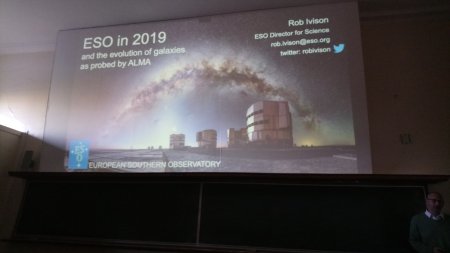
It was a pleasure to welcome Rob Ivison, Director of Science at the European Southern Observatory (ESO) , to Maynooth this afternoon for a colloquium.

I was on my best behaviour introducing his talk and even refrained from pointing out that his native Lancashire is actually in the Midlands.

Ireland became a full member of ESO earlier this year and Rob has been touring Ireland giving talks to encourage Irish astronomers to make the most of the many opportunities membership presents. Having already visited Cork and Galway he passed through Maynooth today before ending up in Dublin tomorrow.

It was an enjoyable and impressive talk and very nice to chat with Rob afterwards over dinner.

Bon voyage to Rob and thanks for the visit!