Archive for October, 2019

Antony Gormley at the Royal Academy

Posted in Art with tags , , on October 11, 2019 by telescoper

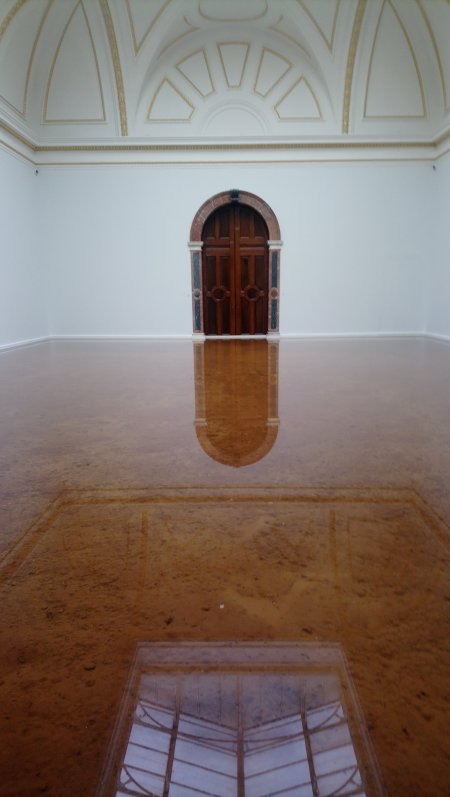
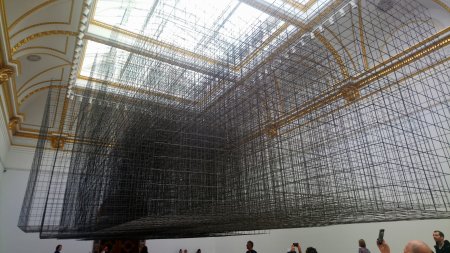
One of the nice things about the location of premises of the Royal Astronomical Society in Burlington House is that it’s right next to the Royal Academy. I took advantage of this proximity yesterday to have a look at the exhibition of work by Antony Gormley. The Main Gallery was very busy as I did my tour but I spent a very enjoyable time wandering around the various rooms and, in some cases, inside the installations therein.

The Royal Academy is a very traditional gallery space and it was the ingenious use of that space within the formal confines of the gallery that I found most impressive. In some of the rooms thin steel bars run through and out from the doors like beam of laser light. Two such beams arrive in one room where they are joined by a vertical bar of the same type, setting up coordinate axes for the whole show.

Here are some snaps I took on the way around:

Clearing

Matrix

Lost Horizon

Cave

Host

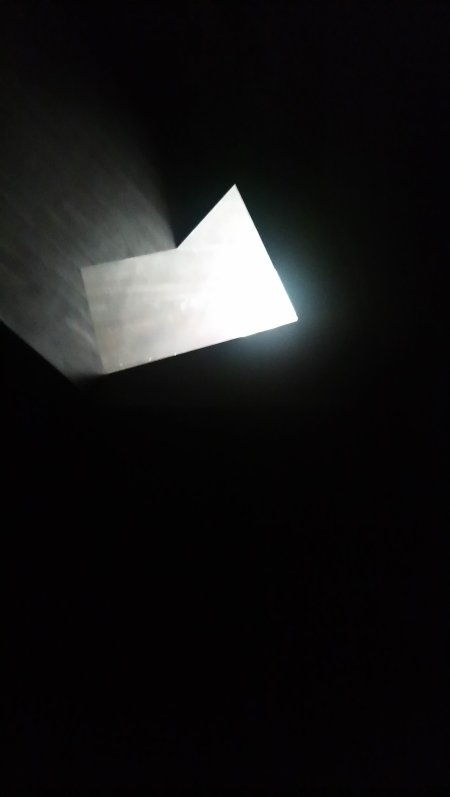
`Cave’ is a large sculpture in rolled steel that you can go into. Parts of it are very dark; the photograph I took was from inside looking out. `Lost Horizons’ has typical Gormleyesque human figures standing upright, upside-down and horizontally on the floor ceiling and walls, an idea that resonates with the coordinate axes mentioned above, which you encounter just before entering this room.

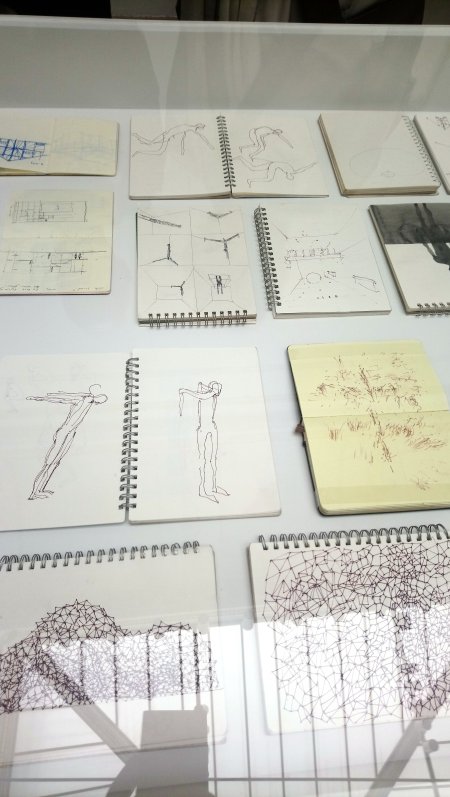
But one of the most fascinating parts of the exhibition is the large collection of Gormley’s workbooks, which show how he develops his ideas, always with reference both to the form and materials of his sculpture and the space into which they are to be placed.

The exhibition is open until 3rd December 2019. Do catch it if you can!


Diversity, Inclusion, Rain and Brexit

Posted in Biographical, Politics with tags , , , , on October 11, 2019 by telescoper

So here I am in a very rainy London. I arrived yesterday for a meeting of the IOP Diversity and Inclusion Committee, which was an interesting occasion with many new things about to unfold, tempered by a bit of sadness that the wonderful Head of Diversity at the IOP, Jenni Dyer, is leaving shortly to take up a new job. However will we manage?

Anyway, instead of flying back to Ireland last night after the meeting, I stayed in London last night because today there is an ordinary meeting of the Royal Astronomical Society at Burlington House, to be followed by a Club Dinner. I’ll be going home to Ireland tomorrow.

Unfortunately the weather has put a dampener on my plans to spend a bit of time wandering around London because it is raining quite heavily and is forecast to do so for the rest of the day. Still, at least the hotel I’m in has WIFI so I can get a few things done this morning before venturing out into the inclement conditions.

Meanwhile the pound is rising against the euro on optimism that there may be a Brexit deal on the horizon after yesterday’s meeting between Boris Johnson and Leo Varadkar. Nobody knows the details but it seems likely that it’s basically the same as Theresa May’s `deal’ except that the `backstop’ is to be replaced by what is effectively a  customs border in the Irish Sea.  My personal preference would be Boris Johnson thrown in the Irish Sea.

I doubt the Democratic Unionists will be happy with this, but Johnson is probably gambling that enough Labour quitlings will vote for it that he no longer needs their support. Of course, that all depends on whether what was discussed yesterday turns into a concrete legally-binding agreement signed off by the EU.

P.S. Bookies’ odds on a No-Deal Brexit on October 31st have drifted out from 4/1 to 5/1.


Peebles Princeton Press Conference

Posted in The Universe and Stuff with tags , , on October 10, 2019 by telescoper

Here I am in the Departure Lounge of Dublin Airport’s Terminal 2 ready for a quick trip to Poundland. To fill in a few minutes before my flight I thought I’d post this video of the press conference held at Princeton University upon the announcement of the award of a Nobel Prize to Jim Peebles. It’s full of interesting things but I particularly liked this quote:

My advice is not to aim for prizes and awards. They will come or they won’t. Don’t judge your career by their number, by the count of prizes. We’re in this for the joy of research, the fascination, the love of science. That is the reward really…

Don’t judge yourself by the awards. Judge yourself by how well you have done, and do your best.

For me that sums up the whole reason for being a physicist. Even those of us who have no chance of winning awards or prizes and whose achievements are at most modest can still feel the joy and the love of science. That is the reward.


Blind Man, Blind Man

Posted in Jazz with tags , , , on October 9, 2019 by telescoper

I heard this on the radio the other night and thought I’d share it here as it’s been a very busy day and I haven’t got the energy to do anything else. It’s from My Point of View the second album Herbie Hancock made for the Blue Note label and was released in 1963. This number is quite reminiscent of the 16-bar blues Watermelon Man, the big hit from his first album but this one has a relaxed soul jazz groove all of its own, backed by straight eights played by the 17-year old drummer Tony Williams and there are nice solos by Grant Green on guitar, Hank Mobley on tenor and Hancock himself on piano.  Donald Byrd plays trumpet on this track, but doesn’t take a solo.


A Nobel Prize for Jim Peebles!

Posted in The Universe and Stuff with tags , , , , , , on October 8, 2019 by telescoper

I’ve just dashed back in excitement to the office from two hours of mandatory Financial Report Training to write a quick post before my 12 o’clock lecture on Astrophysics & Cosmology because of the news about the award of the 2019 Nobel Prize for Physics.

My recent post was half right in the sense that half this year’s prize goes to Michel Mayor and Didier Queloz for the discovery of an extrasolar planet. I don’t know either of them personally, but heartiest congratulations to both!

My heart lept with joy, however, to see the other half of the prize go to Jim Peebles (above) for his work on theoretical cosmology. Much of the reason for that is that I’ve had the great honour and pleasure to meet Jim many times over the years. He is not only a truly great scientist but also a extremely nice man whose kindness and generosity is universally recognized. He’s not known as `Gentleman Jim’ for nothing!

The other reason for the excitement is that I was completely taken by surprise by the announcement. I had feared that his chance of winning a Nobel Prize had passed – I argued at the time that Jim should have been awarded a share of the 2006 Nobel Prize because without his amazing pioneering theoretical work the importance of the cosmic microwave background for cosmology and the large-scale structure of the Universe would not have been established so rapidly. As an author of the first paper to provide a theoretical interpretation of the signal detected by Penzias and Wilson, Jim was there right at the start of the modern era of cosmology and his subsequent work constructed the foundations of the theory of structure formation through gravitational instability. I was sad that he didn’t get a share in 2006 for this work, but am absolutely delighted that this has been rectified now!

This was one of the first cosmology books I ever bought. It’s an amazing piece of work that has been essential reading for cosmologists for almost 40 years!

Congratulations to Jim!

Now let me think about what to say to my students about this!

Dark Matter Day at DIAS

Posted in Books, Talks and Reviews, Talks and Reviews, The Universe and Stuff with tags , , on October 7, 2019 by telescoper

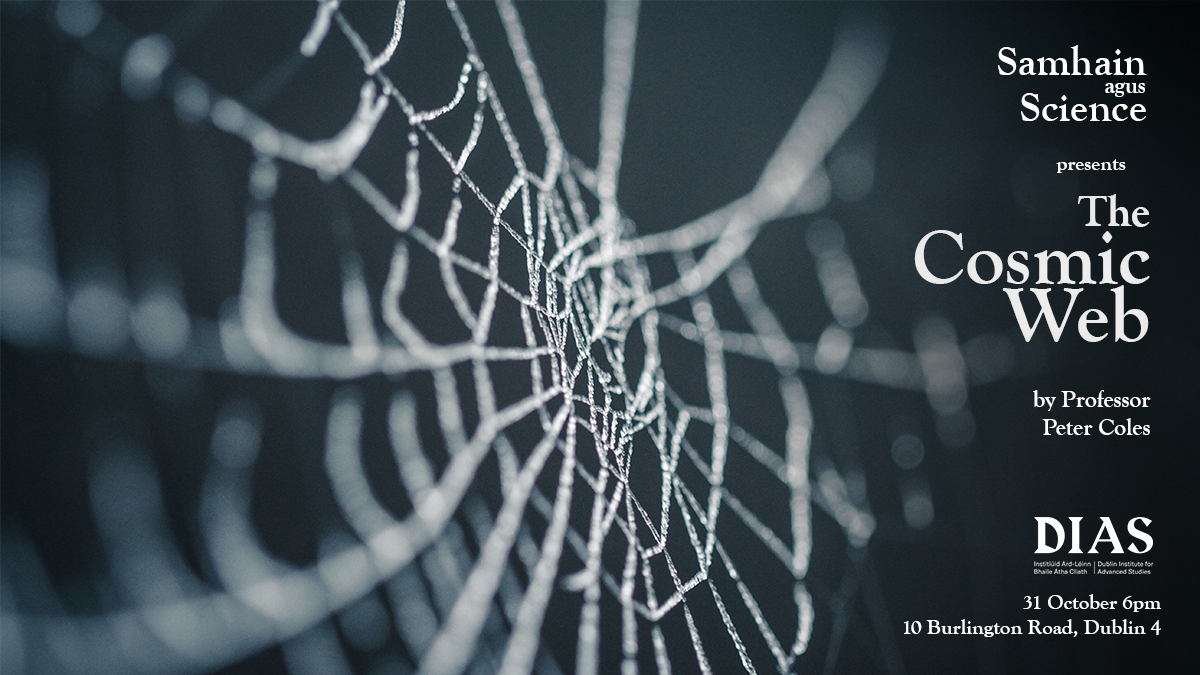
Just a quick post to mention that I’m giving a public talk at the Dublin Institute for Advanced Studies (DIAS) on Dark Matter Day, October 31st 2019, coincidentally the same day as Halloween. I am particularly grateful to be invited to give a talk that evening because it allows me to avoid getting involved in trick-or-treat or any of that nonsense.

Here is the nice advert the people at DIAS have made for the event:

The talk is free, but you need to sign up here as the venue is not infinitely large. You can also find some more details about the talk there.

Nobel Prize Time Approaches

Posted in Science Politics, The Universe and Stuff with tags , on October 6, 2019 by telescoper

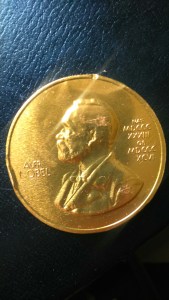
Just a quick reminder that this year’s crop of Nobel Prizes will be announced next week, with the one of most personal interest to me – the Physics Prize – being due on Tuesday 8th October. Before going on here is a picture of my own Nobel Prize Medal:


It’s actually chocolate inside, though it is 13 years old and by now probably inedible if not toxic. You can read about how I got it here.

Anyway, as usual there has been quite a lot of speculation about these awards. Despite not having a great track-record of success some persist in trying to use citation metrics as a predictor; see here for example. Others have a less formulaic approach; see e.g. here.

I don’t really have any idea who is going to get it this year, but here are three possibilities:

  • Extrasolar Planets. This has to be a strong contender, but to whom should the prize be awarded?  Possible winners include Didier Queloz, Aleksander Wolszczan, Dale Frail, and Michel Mayor, but the maximum number allowed to win is three….
  • Geometric Phase. Although if they were going to win they probably would have done so by now, I still think there’s an outside change for Michael Berry and Yakir Aharonov.
  • Quantum Information. This isn’t my area but is very hot these days. It’s also very broad so I’m not sure what specific area and which individuals would prompt an award – quantum cryptography is a possibility, but who?

Anyway, I’d welcome other suggestions through the comments box.


Topical Mechanics Problems

Posted in Politics, The Universe and Stuff with tags , , , on October 6, 2019 by telescoper

In writing the homework problems for my first-year Mathematical Physics module I was sorely tempted to include some political references but I restrained myself in order not to cause any offence. That doesn’t stop me posting some examples here, however, so here are three examples of the sort of thing I had in mind:

  1. Arlene and Boris arrange to have a secret meeting near the Irish British Border. Arlene drives a car at 20 mph along a straight road that takes her within one mile of a customs post where Boris is waiting. Boris has a bicycle on which his top speed is 12 mph and he wishes to leave the customs post at the last possible minute to intercept Arlene. How far away is Arlene when Boris leaves the customs post, and how far must Boris cycle to meet her?
  2. Donald falls 200m from the top floor of Trump Tower. Neglecting air resistance, what is Donald’s velocity when he hits the ground? Assuming he has a mass of 200 kg and he is brought to rest by the impact, what is the energy dissipated? Is this likely to cause serious damage (to the sidewalk)?
  3. Jacob is reclining on a bench in the House of Commons with his head against an arm rest. The coefficient of static friction between Jacob and the armrest is 0.3 and between Jacob and the seat it is 0.4. Assuming that Jacob is infinitely thin, one-dimensional and entirely rigid, calculate the minimum angle he can make with the bench without slipping.

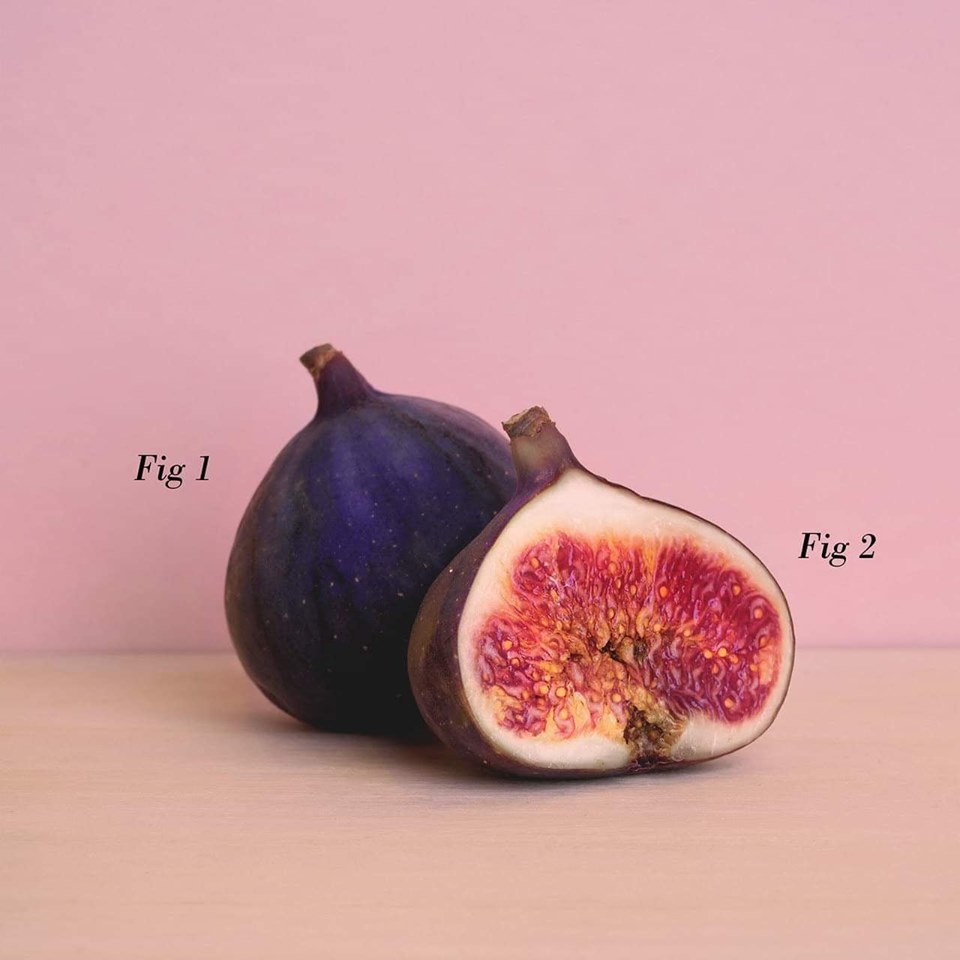
You may wish to refer to Fig 1 and Fig 2 here.

The Danger to Science from Hype

Posted in The Universe and Stuff with tags , , , , , , , on October 5, 2019 by telescoper

I came across an article in the Irish Times this morning entitled `Hyping research runs risk of devaluing science‘. That piece is directly aimed at medical science and the distressing tendency of some researchers in that field to make extravagant claims about `miracle cures’ that turn out to be a very long way from being scientifically tested. The combination of that article, yesterday’s blog post, and the fact that this year I’ve been speaking and writing a lot about the 1919 Eclipse expedition reminded me that I ended a book I wrote in 1998 with a discussion of the dangers to science of researchers being far too certain  and giving the impression that they are members of some sort priesthood that thinks it deals in absolute truths.

I decided to post the last few paragraphs of that book here because they talk about the responsibility scientists have to be honest about the limitations of their research and the uncertainties that surround any new discovery. Science has done great things for humanity, but it is fallible. Too many scientists are too certain about things that are far from proven. This can be damaging to science itself, as well as to the public perception of it. Bandwagons proliferate, stifling original ideas and leading to the construction of self-serving cartels. This is a fertile environment for conspiracy theories to flourish.

To my mind the thing  that really separates science from religion is that science is an investigative process, not a collection of truths. Each answer simply opens up more questions.  The public tends to see science as a collection of “facts” rather than a process of investigation. The scientific method has taught us a great deal about the way our Universe works, not through the exercise of blind faith but through the painstaking interplay of theory, experiment and observation.

This is what I wrote in 1998:

Science does not deal with ‘rights’ and ‘wrongs’. It deals instead with descriptions of reality that are either ‘useful’ or ‘not useful’. Newton’s theory of gravity was not shown to be ‘wrong’ by the eclipse expedition. It was merely shown that there were some phenomena it could not describe, and for which a more sophisticated theory was required. But Newton’s theory still yields perfectly reliable predictions in many situations, including, for example, the timing of total solar eclipses. When a theory is shown to be useful in a wide range of situations, it becomes part of our standard model of the world. But this doesn’t make it true, because we will never know whether future experiments may supersede it. It may well be the case that physical situations will be found where general relativity is supplanted by another theory of gravity. Indeed, physicists already know that Einstein’s theory breaks down when matter is so dense that quantum effects become important. Einstein himself realised that this would probably happen to his theory.

Putting together the material for this book, I was struck by the many parallels between the events of 1919 and coverage of similar topics in the newspapers of 1999. One of the hot topics for the media in January 1999, for example, has been the discovery by an international team of astronomers that distant exploding stars called supernovae are much fainter than had been predicted. To cut a long story short, this means that these objects are thought to be much further away than expected. The inference then is that not only is the Universe expanding, but it is doing so at a faster and faster rate as time passes. In other words, the Universe is accelerating. The only way that modern theories can account for this acceleration is to suggest that there is an additional source of energy pervading the very vacuum of space. These observations therefore hold profound implications for fundamental physics.

As always seems to be the case, the press present these observations as bald facts. As an astrophysicist, I know very well that they are far from unchallenged by the astronomical community. Lively debates about these results occur regularly at scientific meetings, and their status is far from established. In fact, only a year or two ago, precisely the same team was arguing for exactly the opposite conclusion based on their earlier data. But the media don’t seem to like representing science the way it actually is, as an arena in which ideas are vigorously debated and each result is presented with caveats and careful analysis of possible error. They prefer instead to portray scientists as priests, laying down the law without equivocation. The more esoteric the theory, the further it is beyond the grasp of the non-specialist, the more exalted is the priest. It is not that the public want to know – they want not to know but to believe.

Things seem to have been the same in 1919. Although the results from Sobral and Principe had then not received independent confirmation from other experiments, just as the new supernova experiments have not, they were still presented to the public at large as being definitive proof of something very profound. That the eclipse measurements later received confirmation is not the point. This kind of reporting can elevate scientists, at least temporarily, to the priesthood, but does nothing to bridge the ever-widening gap between what scientists do and what the public think they do.

As we enter a new Millennium, science continues to expand into areas still further beyond the comprehension of the general public. Particle physicists want to understand the structure of matter on tinier and tinier scales of length and time. Astronomers want to know how stars, galaxies  and life itself came into being. But not only is the theoretical ambition of science getting bigger. Experimental tests of modern particle theories require methods capable of probing objects a tiny fraction of the size of the nucleus of an atom. With devices such as the Hubble Space Telescope, astronomers can gather light that comes from sources so distant that it has taken most of the age of the Universe to reach us from them. But extending these experimental methods still further will require yet more money to be spent. At the same time that science reaches further and further beyond the general public, the more it relies on their taxes.

Many modern scientists themselves play a dangerous game with the truth, pushing their results one-sidedly into the media as part of the cut-throat battle for a share of scarce research funding. There may be short-term rewards, in grants and TV appearances, but in the long run the impact on the relationship between science and society can only be bad. The public responded to Einstein with unqualified admiration, but Big Science later gave the world nuclear weapons. The distorted image of scientist-as-priest is likely to lead only to alienation and further loss of public respect. Science is not a religion, and should not pretend to be one.

PS. You will note that I was voicing doubts about the interpretation of the early results from supernovae  in 1998 that suggested the universe might be accelerating and that dark energy might be the reason for its behaviour. Although more evidence supporting this interpretation has since emerged from WMAP and other sources, I remain skeptical that we cosmologists are on the right track about this. Don’t get me wrong – I think the standard cosmological model is the best working hypothesis we have – I just think we’re probably missing some important pieces of the puzzle. I may of course be wrong in this but, then again, so might everyone.



Gas Filaments in the Cosmic Web

Posted in Astrohype, The Universe and Stuff with tags , , , , , on October 4, 2019 by telescoper

I saw that there’s a new paper that has just been published in the journal Science by Umehata et al with the title Gas filaments of the cosmic web located around active galaxies in a protocluster. In case you run into a paywall at Science, you may of course, find the paper on the arXiv here.

The abstract reads:

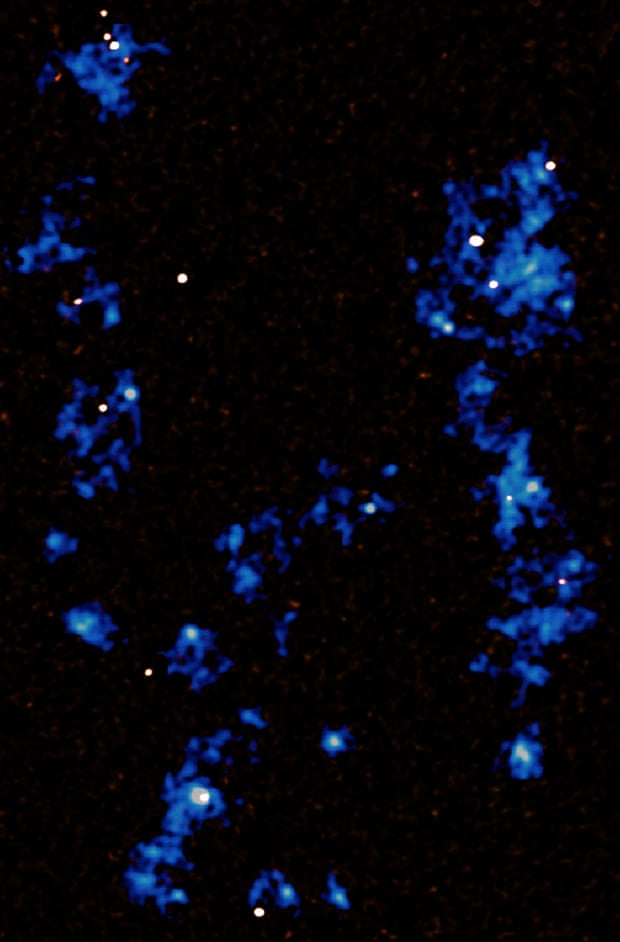
Cosmological simulations predict the Universe contains a network of intergalactic gas filaments, within which galaxies form and evolve. However, the faintness of any emission from these filaments has limited tests of this prediction. We report the detection of rest-frame ultraviolet Lyman-alpha radiation from multiple filaments extending more than one megaparsec between galaxies within the SSA 22 proto-cluster at a redshift of 3.1. Intense star formation and supermassive black-hole activity is occurring within the galaxies embedded in these structures, which are the likely sources of the elevated ionizing radiation powering the observed Lyman-alpha emission. Our observations map the gas in filamentary structures of the type thought to fuel the growth of galaxies and black holes in massive proto-clusters.

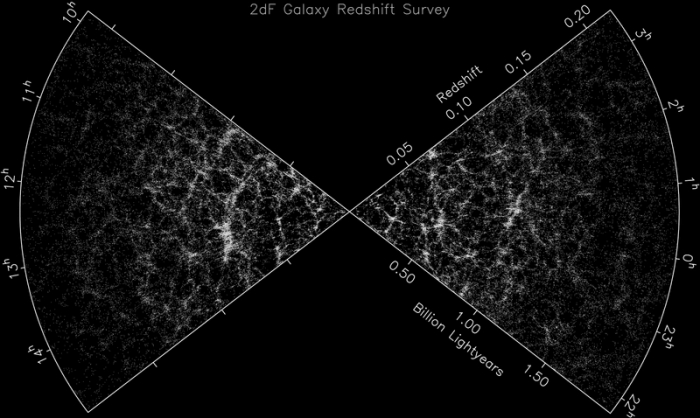
The existence of a complex cosmic web of filaments and voids has been known about for some time as it is revealed on large scales by the distribution of galaxies through redshift surveys:

You can see all my posts agged with `Cosmic Web’ here. There are also good theoretical reasons (besides numerical simulations) for believing this is what the large-scale distribution of matter should look like. Roughly speaking, dense knots of matter lie at the vertices of a three-dimensional pattern traced out by one-dimensional structures.

We have also known for some time, however, that there is more going on in cosmic structure than is revealed by light from stars in galaxies. In particular the way gas flows along the filaments into the knots plays an important role in galaxy and cluster formation. This paper reveals the distribution of gas around a giant cluster that has formed at such a node using observations made using the European Southern Observatory’s MUSE instrument.

Here’s a pretty picture:

I found out about this paper from a news piece in the Guardian with the title Scientists observe mysterious cosmic web directly for first time. That’s sufficiently misleading for me to cross-file the paper under `Astrohype’ because, as I explained above, we have been observing the cosmic web for decades. It is however only just becoming possible to observe the diffuse gas rather than having to join the dots between the galaxies so it is an exciting result. My complaint, I suppose, is that the word `directly’ is doing a lot of heavy lifting in the title!