Archive for June, 2020

New Publication at the Open Journal of Astrophysics!

Posted in OJAp Papers, Open Access, The Universe and Stuff with tags , , , , , , on June 25, 2020 by telescoper

Proving further the point that the The Open Journal of Astrophysics is definitely fully open we have published yet another paper. This one was actually published yesterday, which means that we had two in two days..

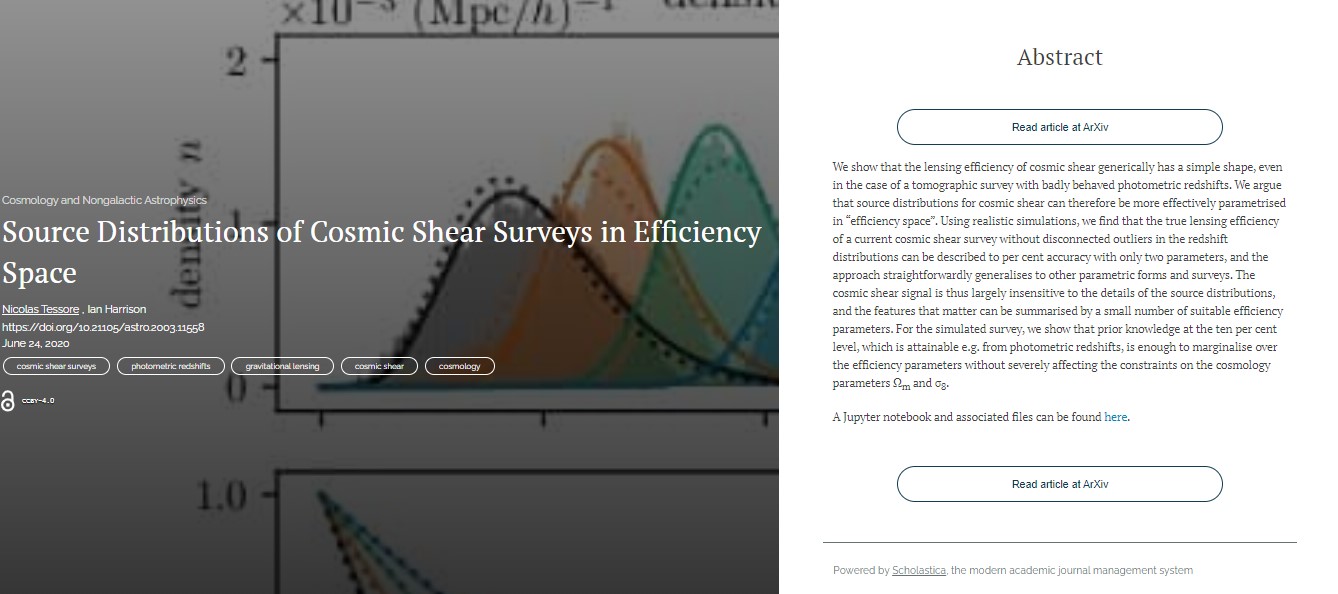
This one is in the Cosmology and Nongalactic Astrophysics section and is entitled Source Distributions of Cosmic Shear Surveys in Efficiency Space. The authors are Nicolas Tessore and Ian Harrison, both from the University of Manchester. The paper is concerned with the extraction of cosmological information from cosmic shear surveys.

Here is a screen grab of the overlay:

You can find the arXiv version of the paper here.

What kind of thing is GW190814?

Posted in The Universe and Stuff with tags , , , , , , , on June 24, 2020 by telescoper

There’s been a lot of interest in the past day or two over an event that occurred in the LIGO detectors last August, entitled GW190814. A paper has appeared declaring this to be “the observation of a compact binary coalescence involving a 22.2–24.3 M  black hole and a compact object with a mass of 2.50–2.67 M “. That would be interesting of course because the smaller object is smaller than the black holes involved in previous detections and its mass suggests the possibility that it may be a neutron star, although no electromagnetic counterpart has yet been detected.  It’s a mystery.

I was quite excited when I saw the announcement about this yesterday but my enthusiasm was dampened a bit when I saw the data from the two LIGO detectors at Hanford and Livingston in the USA and the Virgo detector in Italy.

Visually, the Livingston detection seems reasonably firm, but the paper notes that there were thunderstorms in the area at the time of  GW190814 which affected the low-frequency data. There doesn’t look like anything at all but noise in the Virgo channel. The Hanford data may show something but, according to the paper, the detector was “not in nominal observing mode at the time of GW190814” so the data from this detector require special treatment. What you see in the Hanford channel looks rather similar to the two (presumably noise) features seen to the left in the Livingston plot.

I know that – not for the first time – I’m probably going to incur the wrath of my colleagues in the gravitational waves community but I have to sound a note of caution. Before asking whether the event involves a black hole or a neutron star you have to be convinced that the event is an event at all.  Fortunately, at least some of the data relating to this have been released and will no doubt be subjected to independent scrutiny.

Now I’m going to retreat into my bunker and hide from the inevitable comments…

The Trouble with a J-1 Visa..

Posted in Biographical with tags , , on June 24, 2020 by telescoper

With the news going around about Donald Trump’s decision extend restrictions on travel to the USA, including banning the J-1 visa, I thought you might be interested to hear what happened to me when I tried to apply for a J-1 visa about 15 years ago. The following account is taken from an old post published in 2008.

–o–

When I was working at the University of Nottingham, I was given a sabbatical for one semester for the Autumn of 2005. I had already received an informal invitation from George Smoot at the University of California at Berkeley to visit, specifically from 1st August to 10th December that year. I had visited him the previous year while I was on holiday in California and enjoyed it very much, especially the good food and stupid jokes.

All I had to do was to get my visa and travel arrangements sorted out. The period of the visit was longer than the 90 days for which visa-free travel was allowed, and also the restrictions brought in after 9/11 involved stricter monitoring of scientific visitors. It was therefore necessary to apply for a J-1 visa.

For a J-1 visa for the USA you need first of all a form called a DS-2109 which, in the case of visiting scholars like me, is a kind of formal invitation issued by the host institution. I applied for this using a special form on March 10th 2005. My first problem was that Berkeley did not send the papers back to me until 12th July 2005. However, once I had it I was in a position to get the visa.

Nowadays nobody is issued a US visa without an “interview” at a US Embassy consular division. You are not allowed to book an interview until you have your DS-2109. I called the Embassy visa line (cost £1.30 per minute) and made an appointment. Unbelievably, the first available appointment was a month later, on 11th August 2005, 10 days after my sabbatical visit was supposed to start. Worse still, the instructions I received indicated a minimum of a further 5 working days should be allowed after the interview for the return of the passport with the visa.

You also have to surrender your passport at the interview with no promise of when it will be returned. They don’t even guarantee 5 days. As a matter of fact they don’t guarantee anything at all, as we shall see.

The next thing you have to do is to pay a fee called a SEVIS fee. In my case that was $100. You can do this online, so it was no problem. I paid the fee by credit card and printed out the receipt as instructed. There are then several forms to be filled in. DS-156 is the basic application form. I also needed to fill in a DS-157 and DS-158, which contain detailed information about my work history, qualifications and family circumstances. I was also told I would need to take with me to the interview evidence of my employment, bank statements, mortgage statements, and so on, presumably to prove I was not planning to gain entry to the US to work there; obviously everyone in Britain, even a University professor, really wants to leave their home and work as a waiter in America.

Finally you have to go to a bank and pay the visa application fee (£60) and get a formal receipt. Oh, and you need a photograph. Armed with all this paperwork, and my passport, I went to the Embassy in London on the morning of 11th August 2005. My appointment was scheduled at 12.45, but it’s a two-hour train journey from Nottingham to London. Incidentally, that cost me £94. I got there in good time, and actually entered the Embassy through its extensive security checks around 12.15.

The Embassy operates a take-a-ticket-and-wait system like the deli counter at a supermarket. I took a number and waited. After about an hour, my number was called. I went to a window and a lady who could hardly speak English asked for my documents. I passed them through the window. I then had my fingerprints scanned. And that was that. Except it turns out that is only Stage 1. I returned to my seat and waited for Stage 2, the interview

Three hours later I was finally called for my interview. The consular official was quite polite. He asked me some questions about my job, and work. I thought it was all going fine. It took about 15 minutes. Then he picked up my passport. It was a perfectly valid passport that I had used for a trip to Belgium a few weeks previously without any problems and it still had about two years left to run before a new one was required. He turned to the back page where the photograph was. He picked up a paper knife and stuffed it into the edge of back cover of the passport, between the plastic covering the photograph and the actual back cover, and started to waggle the knife about. He did this so violently that the photograph came loose, which it was not when I entered the Embassy.

Oh dear”, he said. “Looks like someone has tampered with your passport.” He showed me the damaged page through the glass.

I couldn’t believe my eyes. “Yes..you just did.”

Oh, anyone could have done that”, was the response. “Someone could replace your photograph with theirs, so I can’t accept this.”

I was actually shaking with anger and confusion at this point. He continued to the effect that he couldn’t issue a visa until I got a new passport. He gave me a form for the re-application and instructions on how to send everything back to the Embassy by courier. He told me if I did re-apply it would take at least 5 working days to process, but I wouldn’t need to pay another fee or have another interview. Finally, as an added bonus he stamped my ruined passport to indicate a visa had been refused.

Have a nice day”. He actually said that as I left.

Walking back from the Embassy to St Pancras station to get the train back to Nottingham my head was spinning. Had this really happened? Does the US Embassy actually think it has the right to destroy someone’s passport?

I came back to Nottingham that evening half-convinced I had dreamt the whole thing. Why would anyone do that? The passport was fairly old, but had another year or two to run. It was also a machine-readable passport, as is now required. It did not have a digital photograph printed directly on the information page, but the regulations did not actually require that to be the case. My passport was perfectly valid when I entered the Embassy, but it was now useless.

I can only guess that Consular staff had been issued with instructions not to accept passports with old-fashioned photographs in them, even if they were otherwise acceptable. However, rather than print updated guidelines the individual in charge of my application chose to mutilate my passport in order to give him an “official” reason for rejecting it.

Whatever the reason, my passport was ruined and if I was to go anywhere at all I would need a new one. I went to the Post Office the very next day, on Friday 12th August, and applied for a replacement passport. I received a shiny new one (with a digital photograph in it) the following week. As a bonus, the Passports office had noted the fact that my previous one had two years left to run so had given me a passport that wouldn’t expire until 2017.

Now I had to decide what to do. Partly because I had invested so much time and money already, and partly because I was worried about the fact that the immigration records for the US would contain information that I had been refused a visa, I decided to continue with the re-application. After all, if my record showed a refused visa it would be very unlikely I could travel to the USA without extreme difficulty at any time in the future. So I filled in all the forms again, got another photograph, got some more copies of bank statements and all the rest. I rang the Courier (SMS) and arranged for them to pick up the re-application (together with new passport) on 25th August. I paid for the return trip of my documents too. Total cost £19. The courier came and picked up the package to take to the Embassy as arranged.

Fine, I thought. Only 5 days and it will all be sorted. What a fool I was. By September 9th I still hadn’t received anything back. Without my passport I wasn’t able to travel abroad at all. I called the embassy to demand the immediate return of my passport whether it had a visa or not. I no longer cared about visiting the USA. I just wanted my papers back. The Embassy staff said that I would have to wait until it had been processed and, if I read the conditions of application, the five day processing time was never guaranteed.

I contacted the Member of Parliament for my constituency, Nick Palmer, who informed me that I should lodge a formal complaint to the Foreign & Commonwealth Office about the damage to my passport. Since UK passports remain Crown Property at all times, this is the appropriate channel for such matters. I even asked the Foreign Office to attempt the retrieval of my passport from the Embassy.

I was in such a rage I sent a few emails out to friends and colleagues who I thought might be interested in the story, some of whom forward them on. I got a number of nice replies from people all around the world with their own stories. I realized that although I was angry and frustrated, at least I wasn’t having my life torn apart, which is exactly what this kind of petty officialdom can do in different circumstances.

I don’t know which, if any, of these routes actually achieved anything but a few days later my passport arrived back by Courier. It even had a J-1 Visa in it.

Finally! Success!

But wait, there was a covering letter included with my documents. It said that although I had been given a J-1 visa , it wouldn’t be sufficient to achieve entry to the United States. I would have to take with me to the airport all the documents I had taken to the Embassy for my interview. Helpfully, they also pointed out that my DS-2109 had now expired because I should have entered the states on August 1st 2005 and it was now the middle of September. before I travelled I would therefore need to acquire a new DS-2109. Effectively I was back at square one.

Given how long it had taken to get this in the first place, I gave up. I abandoned all hope of ever taking my sabbatical in Berkeley or indeed anywhere in the USA. I had lost six weeks of my allotted time in any case.

I had to find a plan B. I contacted Dick Bond at the Canadian Institute for Theoretical Astrophysics in Toronto and asked if I could go there instead. I didn’t expect him to agree because it was very short notice, but he said yes. Next day I received a formal letter of invitation by FedEx and I booked my ticket to Canada. No visa needed.

I arrived in Toronto at the end of September and spent about three months there. It was an extremely enjoyable time, during which I managed to finish my book From Cosmos to Chaos, as well as a few other things. Of course the climate was a bit different from what I would have experience at Berkeley. It got quite cold in Toronto towards Christmas, but I didn’t mind at all. My only regret is that I wasted so much time and money before deciding to go there when I could have had another six weeks in Toronto without the hassle.

Nothing ever came of any of the formal protests. I’m not surprised about that. The chap who wrecked my passport has diplomatic immunity so can’t be prosecuted. I doubt that the British Government ever even approached the US Ambassador with this matter. Given the collusion of the British in the illegal rendition and torture of prisoners by US agents, it seems unlikely that they give a toss about international law anyway.

I passed the details onto Berkeley who contacted the US Visa Department in Washington, but I never heard anything back from them either. Even less surprising.

So I now have a passport with a J-1 visa in it, but no US entry stamp. I sometimes wonder what would happen if I turned up in the States and showed it to an immigration officer, but then I doubt if I’ll be going to the USA in the foreseeable future. I’ve also been asked about this unusual state of affairs a few times on entering other countries, which gives me the chance to tell the story I’ve just posted or at leas the gyst of it. The best response was from a Canadian Immigration Officer, when I arrived in Toronto in Autumn 2005.

That’s America for you. But you’re in a civilized country now.”

I am sorry I didn’t get the chance to visit George Smoot, though I did manage to meet up with him a year later in Sweden. But that’s another story...
 

New Publication at the Open Journal of Astrophysics!

Posted in OJAp Papers, Open Access, The Universe and Stuff with tags , , , , on June 23, 2020 by telescoper

Well, Maynooth University may well be still (partially) closed as a result of the Covid-19 pandemic but the The Open Journal of Astrophysics is definitely fully open.

In fact we have just published another paper! This one is in the Astrophysics of Galaxies section and is entitled A Bayesian Approach to the Vertical Structure of the Disk of the Milky Way. The authors are Phillip S Dobbie and Stephen J Warren of Imperial College, London.

Here is a screen grab of the overlay:


You can find the arXiv version of the paper here.

I’d like to take this opportunity to thank the Editorial team and various referees for their efforts in keeping the Open Journal of Astrophysics going in these difficult times.

Becoming a Culchie…

Posted in Biographical, Maynooth with tags , , on June 23, 2020 by telescoper

Among all the other things going at the moment, most of them to do with Covid-19, I am in the process of trying to buy a house. I did toy with the idea of moving to Dublin but property prices there are ridiculously high and I wanted to avoid having to commute, so I decided to stay local, not that houses are very much cheaper here in Maynooth…

Another factor has been my arthritis. It’s not at all bad at the moment, but a while ago I was viewing a property which was very nice but had very steep and narrow stairs and I suddenly struck me that in a few years’ time they would probably be quite difficult to manage. Eventually I found a lovely bungalow near Maynooth and last week had my offer on it accepted. There’s a lot that can go wrong from here but all the paperwork, survey, valuation and other stuff is proceeding and I am hoping to move into the new house towards the end of the summer. Fingers crossed. I know that a lot can go wrong in the house-buying business so I’m taking nothing for granted.

There are many similarities in the house buying saga here in Ireland compared to the United Kingdom (where I have bought and sold several properties over the years), but one big difference is the auction process. Estate agents here in Ireland are generally called auctioneers, actually. In order to register to bid you have to first show that you have the necessary funds and then you can place a bid online. It’s easy in an auction to get drawn in so far that you end up spending more than you wanted to, so I decided on an absolutely upper limit on how high I would go. Fortunately the bidding stopped well below that.

There are a few other differences between the UK and Ireland. One is that if you buy a new house here you have to pay VAT on it, which is a considerable increase in cost. Another is that stamp duty is just 1% in Ireland, whereas for a property of similar price in England it would be 5%. Other than that the business of mortgages and valuations and surveys and Land Registry is all tediously familiar.

When I told a friend what I was buying and where he described my putative new house as a “Culchie Bungalow”.
I’d heard the word Culchie before but decided to look it up. The original meaning was a person from rural Ireland, but nowadays it refers more-or-less to anybody who lives outside Dublin. I was quite surprised however to see that Maynooth is specifically mentioned as a place where culchies live on the wikipedia page

Anyway, I don’t mind being called a culchie. I’ve been called a lot worse over the years!

The World Is Waiting For The Sunrise

Posted in Jazz with tags , , on June 22, 2020 by telescoper

Today has been one of those frustrating days at work that ends with a to-do list longer than it started with so I’m in need of a pick-me-up. Here is Benny Goodman and his Sextet recorded on the Ed Sullivan show in 1960 playing The World is Waiting For the Sunrise. Goodman loved this tune and played many different versions of it over his long career. The audience definiely enjoyed this, and I think it’s BG himself who ends this one with a yeah to prove that he enjoyed it too! I hope you do likewise.

Over the years there have been some (indeed many) jazz critics who have written that Benny Goodman’s clarinet playing was `clinical’ and `unemotional’ and other such nonsense.  I think his playing on this is absolutely sensational (as incidentally is Red Norvo on the vibes).  Enjoy!


Scrambled Phases

Posted in Biographical, Covid-19, Maynooth with tags , , , on June 22, 2020 by telescoper

A couple of weeks ago I posted about the imminent start of Phase 2 of the Irish Government’s Roadmap for Reopening after the closures enforced because of the Covid-19 pandemic.

Since then the Irish Government has decided that there will only be four phases instead of five, and many elements of the programme will be moved forward. For example, all travel restrictions within the Republic will be lifted from next Monday (29th June), which is when Phase 3 is due to commence. It has also been announced that hairdressers, barbers, nail and brow salons, beauty salons, spas, make-up application services, tanning, tattooing and piercing services will re-open. I find that surprising, as I find it hard to see how such services can be provided at low risk of transmitting Covid-19.

In fact I find the whole idea of accelerating the Roadmap rather worrying. I hope I’m proved wrong, but it seems to me that the Government is rushing this. There are worrying signs in Germany that the R-number is increasing significantly and undue haste in opening business may lead to a similar rise. It must be stressed that the number of cases involved in Germany  is rather small and most are confined in local outbreaks that can be contained. Nevertheless, this remains a concern.

At the moment the situation looks stable, with new cases at a very low level:

I do worry however that, since only a very small fraction of the population (at most a few percent) have been infected with Covid-19, there will be very little resistance if Covid-19 starts to spread again.

As for my own work situation here at Maynooth University, what happens in Phases Three and Four is all a bit hypothetical, because we’re still stuck in Phase One! The University management is being extremely cautious about allowing anyone back to work at all until various protocols are agreed, risk assessments carried out, and staff training delivered. It seems likely therefore that we will reach Monday’s scheduled start of Phase 3 before we are even ready for Phase 2. In practice, therefore, the various phases of the Roadmap are no longer relevant in this particular setting. I think I’ll remain the only person coming in to the Department for quite some time!

I fully understand and support the careful approach adopted  by the University, of course, and the delay doesn’t matter that much as our teaching semester is now finished and, being theorists, we can all work from  home reasonably effectively. It must be more of a challenge for laboratory-based researchers. My main concern is  I’d be very surprised if all the other organizations and businesses due to open next Monday are as cautious. The last thing we need for people to cut corners and send us all back to square one.


Psychological Time

Posted in Biographical, Covid-19, Education with tags , , , on June 21, 2020 by telescoper

So, the Summer Solstice for 2020 is now in the past. It’s all downhill from here!

As the Solstice approached last night I was thinking back to the Vernal Equinox which had happened this year on March 20th, exactly three months before. That was at the end of Study Week in the Spring Semester but the students did not return the following week and we switched to remote teaching. I find it astonishing to think that was just three months ago. It seems like ancient history. Not only that but several major events took place during that period that I find it hard place in chronological order without looking at written records (including this blog).

I am not an expert on such matters but it seems to me that the isolation, disruption of social interaction, and the loss of familiar routines imposed by work are among the things responsible distorting perception of the passage of time. I have tried to impose a regular pattern on my day during this time but only with limited success. I suspect it’s not only me who has felt like this over the past weeks and months!

It’s not just the disruption to routine of course. There was also a genuine fear of becoming infected. My last in-person lecture was on 12th March, the Thursday before Study Week. From time to time I wondered if I would ever see those students again. I also made arrangements to write a will. For a time it looked likely that intensive care facilities in Ireland might be overwhelmed so I felt it important to make contingencies of that sort. Fortunately they weren’t needed. As far as I know the Coronavirus hasn’t reached me. I certainly haven’t had any symptoms, though I haven’t actually been tested.

Overall I found the lockdown very difficult at first but I think adjusted reasonably well despite (or perhaps because of?) having very peculiar dreams.

Now that the Covid-19 restrictions are gradually being wound down hopefully some measure of routine will resume and the sense of disorientation will fade. Time will tell.

The Summer Solstice 2020

Posted in The Universe and Stuff with tags , , , , , , on June 20, 2020 by telescoper

The Summer Solstice in the Northern hemisphere happens this evening, Saturday 20th June 2020, at 22:43 Irish Time (21.43 UTC). Among other things, this means that today is the longest day of the year. This is an earlier day in June than you might expect, primarily because 2020 is a leap year.

Days will get shorter from today until the Winter Solstice in December, although this does not mean that sunset will necessarily happen earlier tomorrow than it does today. In fact it is a little later. This is because there is a difference between mean solar time (measured by clocks) and apparent solar time (defined by the position of the Sun in the sky), so that a solar day does not always last exactly 24 hours. A description of apparent and mean time was given by Nevil Maskelyne in the Nautical Almanac for 1767:

Apparent Time is that deduced immediately from the Sun, whether from the Observation of his passing the Meridian, or from his observed Rising or Setting. This Time is different from that shewn by Clocks and Watches well regulated at Land, which is called equated or mean Time.

The discrepancy between mean time and apparent time arises because of the Earth’s axial tilt and the fact that it travels around the Sun in an elliptical orbit in which its orbital speed varies with time of year (being faster at perihelion than at aphelion).

Using a rapid calculational tool (Google), I found a table of the local mean times of sunrise and sunset for Dublin around the 2020 summer solstice. This shows that today is indeed the longest day (with a time between sunrise and sunset of 17 hours and 10 seconds), but sunset on 21st June is actually a bit later than this evening, but sunrise is also bit later so the day is indeed (slightly) shorter.

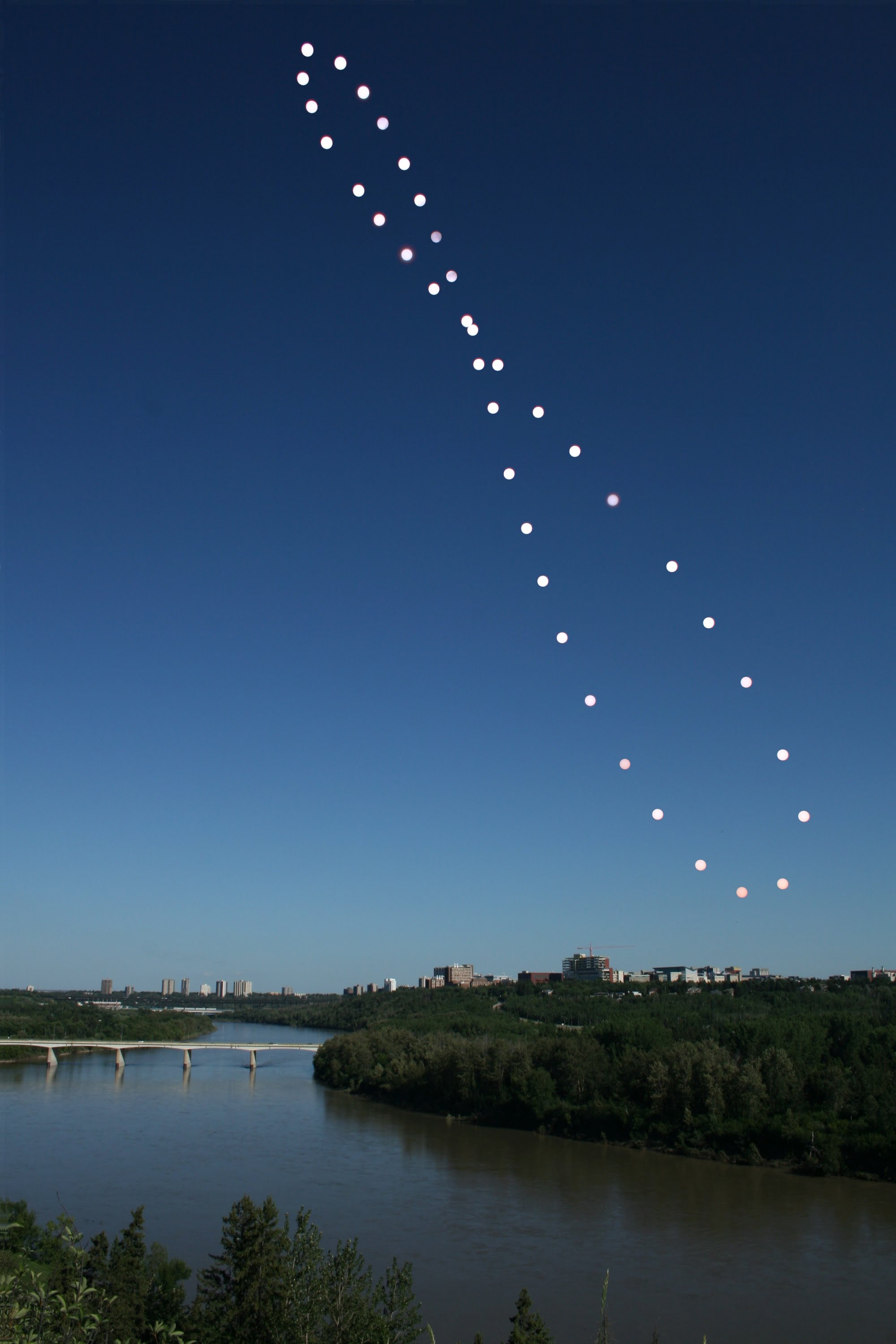
In fact if you plot the position of the Sun in the sky at a fixed time each day from a fixed location on the Earth you get a thing called an analemma, which is a sort of figure-of-eight curve whose shape depends on the observer’s latitude. Here’s a photographic version taken in Edmonton, with photographs of the Sun’s position taken from the same position at the same time on different days over the course of a year:

maxresdefault

The summer solstice is the uppermost point on this curve and the winter solstice is at the bottom. The north–south component of the analemma is the Sun’s declination, and the east–west component is the so-called equation of time which quantifies the difference between mean solar time and apparent solar time. This curve can be used to calculate the earliest and/or latest sunrise and/or sunset.

Challenges Past and Future

Posted in Covid-19, Education, Maynooth with tags , , , , , , on June 19, 2020 by telescoper

Yesterday afternoon we held our Departmental Examination Board in Theoretical Physics (via Microsoft Teams*) which all went remarkably well in the circumstances.

The most challenging thing to happen yesterday afternoon was that a bloke came to cut back the bushes outside my office with a very large and noisy hedge trimmer. I thought I was going to have to contend with that all afternoon but it seems he had done most of it the day before and only came back yesterday to finish off. He left before the Exam Board started.

The next stage of our Exams process is for all the Departmental results to be collated for those students on joint programmes before the final University Board takes place about ten days from now. After that students will get their results.

That doesn’t quite finish examination matters for 2019/20 however because some students will need to take repeat examinations in August. These will be a week later than usual as a knock-on effect of the extra week we were given to mark and correct the May exams. We anticipate that at least some of the repeats will be the traditional `in person’ on campus style, but some may be online timed assessments like the ones we held in May. That depends a bit on how the Covid-19 pandemic pans out in Ireland over the next few weeks (and of course how many students actually take repeats, as social distancing generates a capacity issue for the examination halls).

At the moment we are optimistic because the number of new cases of Covid-19 is low and stable. That coulld change, of course, if the virus starts to spread again so we have to have contingency plans.

Even more uncertain is what will happen in September, although I have been very annoyed by some reports in the media that seem to have been actively trying to put students off coming to University next academic year on the grounds that there won’t be any lectures. We certainly plan to offer as much face-to-face teaching as possible and I think other third-level institutions in Ireland will do likewise. There will of course have to be a backup if there is another lockdown, which may mean switching back to remote teaching at relatively short notice, but at least we’ve done that once already so know much better now what works and what doesn’t. Nevertheless I would encourage all potential students not to believe everything they read in the media nor be deterred from attending university by rumours from sources who don’t know what they are talking about.

Earlier this week I was starting to think about how we might build the required flexibility into our teaching for next year and two main things struck me.

The first is that while we have more-or-less been forced into making various kinds of video material available to students, this is something that I feel we should have been doing already. I’ve long felt that the more types of teaching we incorporate and the wider range of learning materials we provide the better the chance that students find something that works for them. Even if we do have a full programme of lectures next year, it is my intention to continue to provide, e.g., recorded video explainers as well because they might augment the battery of resources available to the student.

Some time ago I had to make some policies about `reasonable adjustments’ for some disabled students learning physics. In the course of providing extra resources for this small group I suddenly thought that it would be far better, and far more inclusive, simply to make these resources available to everyone. Likewise, we’ve been forced to adjust to providing material remotely but we should be thinking about how to keep the best things about what we’ve done over the last few months and embedding them in the curriculum for the (hopefully Coronavirus-free) future and not regard them all as temporary special measures.

The other thing that struck me is in the same vein, but a little more speculative. Over the last many years I have noticed that students use printed textbooks less and less for learning. Part of that may be because we in a digital age and they prefer to use online resources. The switch to remote learning has however revealed that there are some students who are disadvantaged by not having a good internet connection. I just wonder whether this might lead to a resurgence in the use of textbooks. I’ll certainly be making a strong recommendation to the new first-year students in Theoretical Physics that they should get hold of the recommended text, which I have previously regarded as an optional extra.

*At one point I got muddled up between Teams and Zoom and called it Tombs. It was a grave error, but it can only be a matter of time before Microsoft Tombs actually arrives…