Archive for February, 2021

How not to behave in a Zoom discussion…

Posted in The Universe and Stuff with tags , , , on February 14, 2021 by telescoper

A couple of days ago, on February 12th, there was a ‘Golden webinar in Astrophysics’ one of a series that seeks to bring forefront research in astronomy, astrophysics, and cosmology to the public in the English and Spanish languages. The speaker this time was Avi Loeb and the full title of his talk was  Extraterrestrial Life: Are We the Sharpest Cookies in the Jar? A video of the entire event can be viewed here.

Avi Loeb is a very distinguished theoretical physicist, with broad interests in the fields of astrophysics and cosmology who has done excellent rather mainstream work on the formation and evolution of black holes, the first generation of stars in the universe and the epoch of reionization, as well as high-redshift gamma-ray bursts. He has also produced a large number of much more speculative articles in areas such as extra-terrestrial life (including SETI) some of which, in my opinion, is rather flaky. Loeb was a long-serving Chair of the Department of Astronomy at Harvard University and is the current Director of the Institute for Theory and Computation there.

The following is a short excerpt from the panel discussion following his talk. I was surprised to Avi Loeb adopt such a dismissive and confrontational attitude towards Jill Tarter (who has worked in the field of SETI for over 40 years). I’m also surprised that there was no intervention by the moderator of the discussion.

Many members of the astrophysics community have worked very hard to ensure that conference talks, seminars and panel discussions (whether in person or virtual) are conducted in a collegiate and cooperative manner. I don’t think Loeb is setting a good example in this clip, especially for someone who is an experienced former Department Chair. We all have strong feelings about certain things, but there’s no need to adopt such an aggressive tone. No wonder so many people find academia a toxic environment.

My Funny Valentine – Miles Davis

Posted in Jazz with tags , , on February 14, 2021 by telescoper

From the album Cookin’ by the Miles Davis Quintet* of 1957 here is a classic.

*John Coltrane was in the Quintet but doesn’t play on this track: the musicians are Miles Davis (tp), Red Gardland (p), Paul Chambers (b) and Philly Joe Jones (d).

Faraday Rotation in the Milky Way

Posted in Biographical, The Universe and Stuff with tags , , , , , , on February 13, 2021 by telescoper

Yesterday I came across a very interesting paper on the arXiv by Sebastian Hutschenreuter et al. entitled The Galactic Faraday rotation sky 2020 which contains this stunning map of Faraday Rotation across the sky (presented in Galactic coordinates, so the plane of the Milky Way appears across the middle of the map):

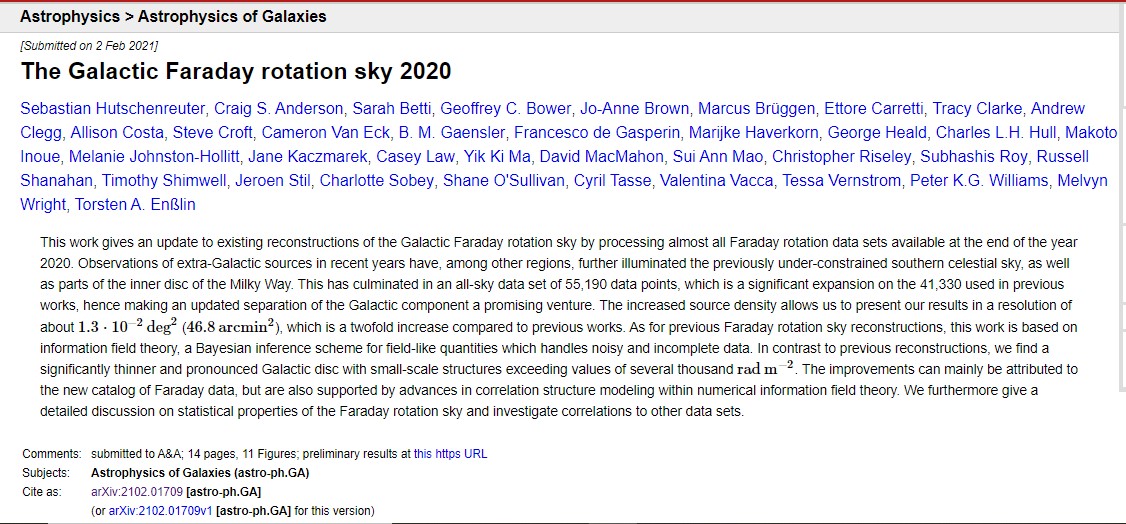
The abstract of the paper is here:

If you’ll pardon a short trip down memory lane, this reminds me of a little paper I did back in 2005 with a former PhD student of mine, Patrick Dineen (which is cited in the  Hutschenreuter et al. paper).

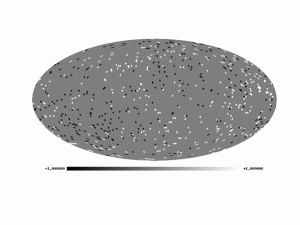
What we had back in 2005 was a collection of  Faraday Rotation measurements of extragalactic radio sources dotted around the sky. Their distribution is fairly uniform but I hasten to add that it was not a controlled sample so it would be not possible to take the sources as representative of anything for statistical purposes and there weren’t so many of them: we had three samples, with 540, 644 and 744 sources respectively.

Faraday rotation occurs because left and right-handed polarizations of electromagnetic radiation travel at different speeds along a magnetic field line. The effect of this is for the polarization vector to be rotated as light waves travel and the net rotation angle (which can be either positive or negative) is related to the line integral of the component of the magnetic field along the line of sight travelled by the waves. The picture below shows the distribution of sources, plotted in Galactic coordinates and coded black for negative and white for positive.
rotation

Some radio galaxies have enormously large Faraday rotation measures because light reaches us through regions of the source that have strong magnetic fields. However, for most sources in our sample the rotation measures are smaller and are thought to be determined largely by the propagation of light not through the emitting galaxy, near the start of its journey towards us, but through our own Galaxy, the Milky Way, which is near the end of its path.

If this is true then the distribution of rotation measures across the sky should contain information about the magnetic field distribution inside our own Galaxy. Looking at the above picture doesn’t give much of a hint of what this structure might be, however.

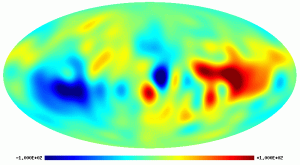
What Patrick and I decided to do was to try to make a map of the rotation measure distribution across the sky based only on the information given at the positions where we had radio sources. This is like looking at the sky through a mask full of little holes at the source positions. Using a nifty (but actually rather simple) trick of decomposing into spherical harmonics and transforming to a new set of functions that are orthogonal on the masked sky we obtained maps of the Faraday sky for the different samples. Here is one:
uni_16_rmjoint

(The technical details are in the paper, if you’re interested.) You probably think it looks a bit ropey but, as far as I’m concerned, this turned out surprisingly well!

The most obvious features are a big blue blob to the left and a big red blob to the right, both in the Galactic plane. What you’re seeing in those regions is almost certainly the local spur (sometimes called the Orion Spur; see below), which is a small piece of spiral arm in which the local Galactic magnetic field is confined. The blobs show the field coming towards the observer on one side and receding on the other. The structure seen is relatively local, i.e. within a kiloparsec or so of the observer.

I was very pleased to see this come out so clearly from an apparently unpromising data set, although we had to confine ourselves to large-scale features because of instabilities in the reconstruction of high-frequency components.

Now, 15 years later we have the beautiful map produced by Hutschenreuter et al.


You’ll see the vastly bigger data set (almost a hundred times as many sources) and way more sophisticated analysis technique has produced much higher resolution and consequently more detail, especially near the Galactic plane, but we did at least do a fairly good job at capturing the large-scale distribution: the blue on the left and red on the right is clearly present in the new map.

There’s something very heartening about seeing scientific progress in action! This also illustrates how much astrophysics has changed over the last 15 years: from hundreds of data points to more than 50,000 and from two authors to 30!
 

It’s The Sun..

Posted in Biographical, Brighton, LGBTQ+, Television with tags , , on February 12, 2021 by telescoper

Episode 4 of It’s A Sin is broadcast on Channel 4 tonight. I’ve already watched the series and I thought I’d post a quick comment, but don’t worry – no spoilers. Tonight’s episode is set in 1988 – when I was living in Brighton – and to give you an idea of what attitudes were like at that time here is a typically foul “opinion” piece published in The Sun in 1988:

I hope you can understand why many of us are still angry. Times have changed, but we need to be aware that they could easily change back. The Tories were not, are not, and will never be our friends.

The series has had a big impact on me, which is why I keep posting about it from time to time. It has reminded me of many terrible things that happened, but perhaps surprisingly my recollection of that period is that there were very many good times too and I am glad that it made many happy memories come back too.

R.I.P. Chick Corea (1941-2021)

Posted in Jazz with tags , , on February 11, 2021 by telescoper

I was just about to have an early night when I saw the news of the death at the age of 79 of legendary jazz pianist Chick Corea. Yet another of the Greats is no more.

In the circumstances I’ll just put up one example that demonstrates his talents both as a pianist and a composer. Chick Corea was in at the start of jazz fusion in the late Sixties when he joined Miles Davis’s band. At that time and through the 1970s he frequently performed on electric piano superb records such as In A Silent Way and Bitches Brew. He played on a huge range of records sometimes as leader, sometimes as a sideman and sometimes in a duet. One of the first jazz albums I bought was a live recording of a concert in Zurich in 1979 together with vibraphonist Gary Burton. I’ll certainly be playing that this weekend.

This track was recorded at a live performance in 2013 and released on the album Trilogy. It is a great example of him stretching out on a version of his own tune Armando’s Rhumba, of which he has recorded many very different versions, and which is now a jazz standard. The drummer is Brian Blade and the bassist Christian McBride.

Rest in peace, Chick Corea (1941-2021)

LIGO: Live Reaction Blog

Posted in Uncategorized on February 11, 2021 by telescoper

I don’t usually reblog my own posts, but this is just to mark the fact that the first discovery of gravitational waves by Advanced LIGO was announced on this day in 2016.

Can that really have been 5 years ago?

telescoper's avatarIn the Dark

So the eagerly awaited press conference happened this afternoon. It started in unequivocal fashion.

“We detected gravitational gravitational waves. We did it!”

As rumoured, the signal corresponds to the coalescence of two black holes, of masses 29 and 36 times the mass of the Sun.

The signal arrived in September 2015, very shortly after Advanced LIGO was switched on. There’s synchronicity for you! The LIGO collaboration have done wondrous things getting their sensitivity down to such a level that they can measure such a tiny effect, but there still has to be an event producing a signal to measure. Collisions of two such massive black holes are probably extremely rare so it’s a bit of good fortune that one happened just at the right time. Actually it was during an engineering test!

Here are the key results:

LIGO

Excellent signal to noise! I’m convinced! Many congratulations to everyone involved…

View original post 243 more words

The Angelus

Posted in Television with tags , , on February 10, 2021 by telescoper

It’s been a tradition in Ireland since 1950 for the main TV station (RTÉ One) to broadcast The Angelus at 6pm just before the main news . Initially this involved the Angelus, a Catholic prayer along with religious imagery and the sound of the bells of St Mark’s Pro-Cathedral in Dublin (originally live, but then later recorded). Nowadays the bells are still heard, but there is no explicitly religious content. Instead, there are short films of everyday life lasting about 70 seconds.

Here’s an example of one of the Angelus films. I think it’s rather lovely.

I know many Irish people think the Angelus should be ditched on the grounds that it is foisting religion on people. Although I am not religious I find it a wonderful haven of tranquility in the one minute and ten seconds of the Angelus broadcast each evening, especially in these days of Covid-19. It’s good to pause and contemplate the simple pleasures of life before heading into the news. The secretary of the Clonskeagh Mosque in Dublin and the Chief Rabbi of Ireland have supported keeping the Angelus. As an atheist I agree with them. Long may the Angelus continue. It’s one of the very few things I watch regularly!

Cold Snap

Posted in Maynooth on February 9, 2021 by telescoper

I just thought I’d try out something I’ve never done on here before: sharing an Instagram post. I’m curious to see what it looks like.

It’s also an opportunity to state for the record that we’re in a bit of a cold snap here in Maynooth. It’s snowed off and on most of today. Note however that the pictures are from 2018…

The Irish word for snow, incidentally, is sneachta.

Yesterday, before the snow arrived, I filled the bird feeders in my garden. This morning, when the snow was just starting, the peanut feeder was almost empty. It normally takes 4-5 days to become depleted. It’s as if the birds had been reading the forecast and decided to fatten up! Birds do seem to know when bad weather is on the way…

I ventured out before my lecture this morning to replenish the supply. I wonder if I’ll need to do it again tomorrow?

R.I.P. John Pullin (1941-2021)

Posted in Rugby with tags , on February 9, 2021 by telescoper

I was saddened yesterday to hear news of the death at the age of 79 of former England rugby captain John Pullin. The name is familiar to me from my youth – he was England captain when I started to learn how to play rugby at the grammar school I went to, but will also be familiar anyone who remembers that famous match between the Barbarians and the All Blacks in Cardiff way back in 1973. Pullin, one of just three Englishmen* in the side, was the hooker for the Barbarians, so threw in the ball at the line-out that led a few glorious minutes later to that try via a move in which he also played a part, receiving the ball from JPR Williams (whom Bryan Williams was tackling around the neck) and passing it to John Dawes whose dummy led to a scintillating burst out of defence. In fact Pullin’s were the only English hands to touch the ball in that move!

*The English rugby team of the early 1970s wasn’t very strong, even less so when compared with the Welsh!

Phosphine on Venus again…

Posted in Astrohype, The Universe and Stuff with tags , , , on February 8, 2021 by telescoper

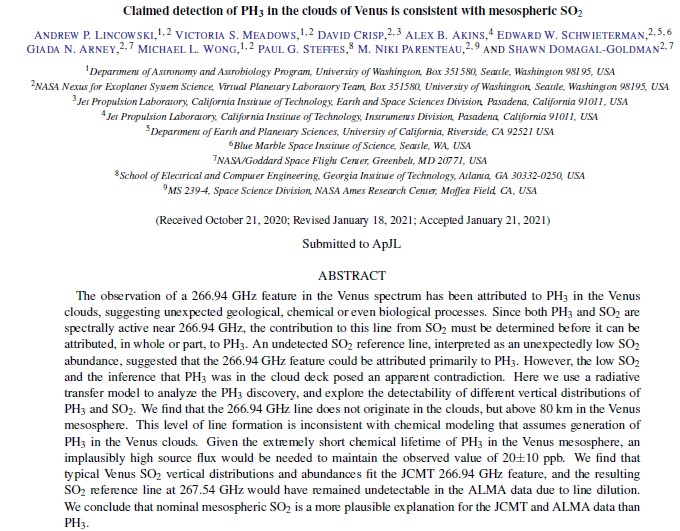
Remember all the excitement last September about the claimed detection of Phosphine in the atmosphere of Venus? If you do you will remember that the claim has been contested. Now there is another paper on this matter claiming that what was interpreted as a spectral feature due to Phosphine (PH3) could actually be due to Sulphur Dioxide (SO2)). Here is the abstract of the latest paper.

You can find the full paper on the arXiv here.

P.S. I bookmarked the arXiv paper about a week ago but was very busy and forgot about it until now!