I couldn’t resist sharing this video showing the state of play with the Vera Rubin Observatory, currently under construction on Cerro Pachón in Chile. This is a huge survey telescope with an 8.4m mirror and enormous camera to match, the main task for which will be a ten-year Legacy Survey of Space and Time (LSST) which has the same initials as the former name of the telescope (the Large Synoptic Survey Telescope). That’s obviously so they carry on using the LSST name for their website and elsewhere.
Anyway, the mount assembly has now been installed and tested (in both altitude and azimuth) so you can now get good idea of what the telescope will look like when it’s completed. It’s an amazing piece of engineering, particularly when you see such a huge piece of kit so finely balanced that it can be moved by hand…
Time to announce another publication in the Open Journal of Astrophysics. This one is the tenth paper in Volume 4 (2021) and the 41st in all. We actually published this one a couple of days ago but I’ve been so busy with start-of-term shenanigans that I didn’t get time to announce it until this morning.
The latest publication is entitled Consequences of constant elevation scans for instrumental systematics in Cosmic Microwave Background Experiments. The authors are Daniel B. Thomas & Nialh McCallum of Queen Mary, University of London, and Michael Brown of the University of Manchester.
Here is a screen grab of the overlay which includes the abstract:
You can click on the image to make it larger should you wish to do so. You can find the arXiv version of the paper here. This one is also in the folder marked Instrumentation and Methods for Astrophysics, though it is obviously of relevance to Cosmology and Non-Galactic Astrophysics too.
So here we are then. The Autumnal Equinox (in the Northern hemisphere) takes place this evening (Wednesday 22nd September) at 20.21 Irish Time (19.21 UT).
Although the term `equinox’ refers to a situation in which day and night are of equal length, which implies that it’s a day rather than a specific time, the astronomical equinox is more accurately defined by a specific event, i.e. when the plane defined by Earth’s equator passes through the centre of the Sun’s disk (or, if you prefer, when the centre of the Sun passes through the plane defined by Earth’s equator). Day and night are not necessarily exactly equal on the equinox, but they’re the closest they get. From now on days in the Northern hemisphere will be shorter than nights and they’ll get shorter still until the Winter Solstice.
Many people take the autumnal equinox to be the end of summer. There is a saying around these parts, however, that `Summer is Summer to Michaelmas Day’ (September 29th), which is not until next week. I must say, though, though it doesn’t feel very summery today.
Anyway, this is Welcome Week in Maynooth and, barring any sudden changes of plan, we’re due to start teaching first year students on Monday 27th September. Returning students commenced on Monday 20th. I gave my first lecture on Vector Calculus yesterday. That was the first in-person lecture I’ve done for over a year. It was strange because I taught the same students online last year, but obviously never actually saw or heard them, as students generally mute their video and sound when attending lectures. Today was an improvement on that but everyone in the class was wearing a mask so I still haven’t really seen them! At lest this means that all the students were observing the necessary protocol, which is a relief, and the masks didn’t interfere with them responding to questions of mine or asking questions of their own.
We are still one lecturer short as the visa office in Dublin has been sitting on the application from our new member of staff since June 23rd. On top of my own things to do I’ve been setting up lectures for him so the students can view them in the lecture hall remotely. I’m not sure how long that will go on for, although it’s out of my hands.
Other than that I’ve spent the last couple of days trying to iron out problems with the timetable – of which there are unfortunately many – as well as preparing my own lectures. I want to record my lectures from the classrooms but unfortunately the University has chosen not to install decent video equipment so I’ve had to improvise. I recorded yesterday’s lecture using a webcam attached to the stand for my tenor saxophone. It seemed to work out reasonably well.
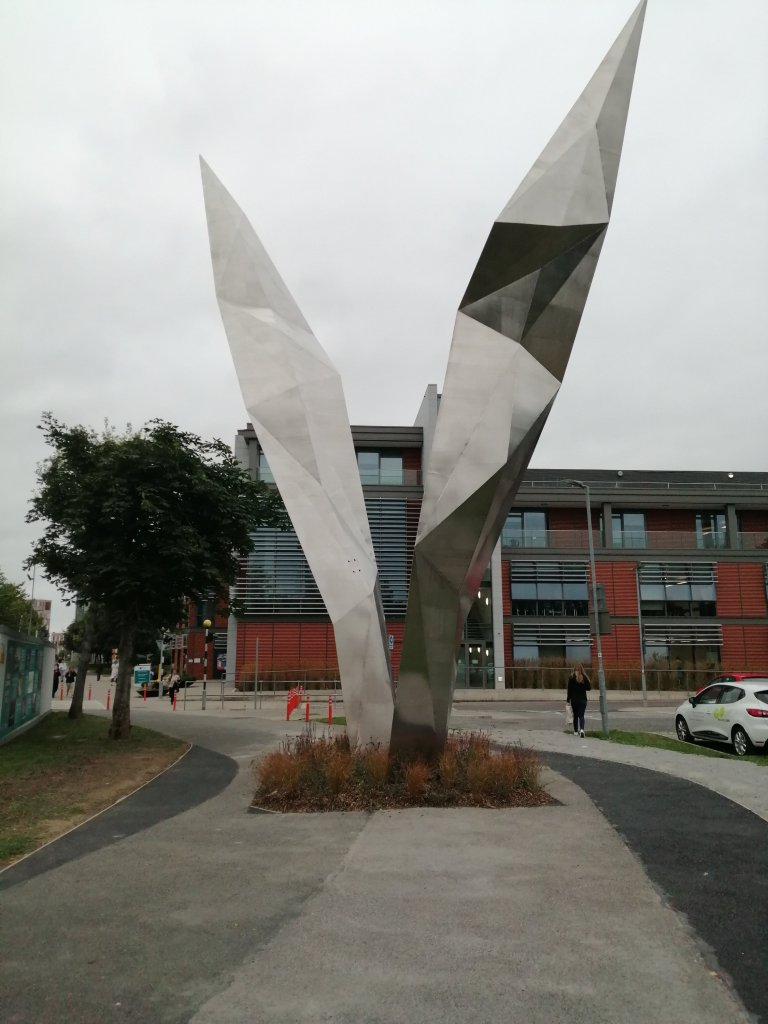
The photograph above shows the sculpture Freedom by Polish-Irish sculptor Alexandra Wejchert, which has recently been installed on the North Campus of Maynooth University. It was formerly located outside the former headquarters of AIB, the bank, in Ballsbridge. AIB has now moved its HQ – the old one is now occupied by Facebook – and the sculpture became surplus to requirements but managed to offload it on graciously offered it on loan to Maynooth University. I won’t comment on the artistic merits of this piece but it seems to me a very strange decision to plonk it right in the middle of the main pedestrian entrance to the North Campus so everyone has to walk around it. I’m also wondering how long it will be before a traffic cone is found on the tip of one of the prongs…
Well here we are at last, back to campus. Returning students were back to lectures this morning and although our new students don’t begin their lectures until next Monday (27th September) a sizeable contingent who accepted first-round offers were also here today doing orientation activities.
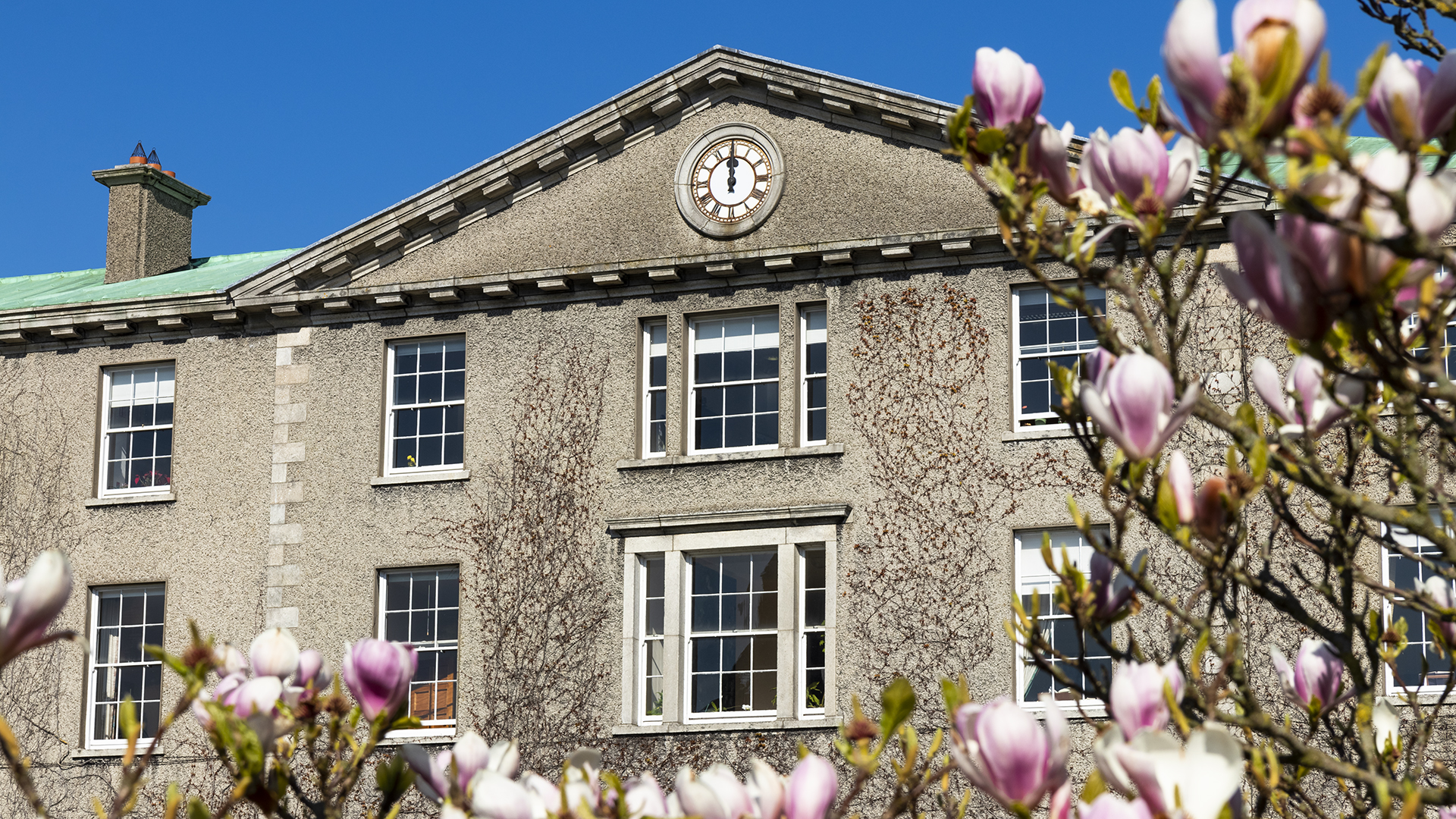
I didn’t actually have a lecture today as my first-year module doesn’t begin until next week but I did go to the lecture theatre at 11am this morning to chat to students about the module and give them some tips for studying theoretical physics. As it happens, that is Physics Hall which is on the ground floor of the building shown in the picture above. I’ll see the full class next week. My second year module has lectures on Tuesdays so my first real lecture will be tomorrow (afternoon).
We’re still short of one lecturer who still hasn’t obtained his visa yet. He will be doing lectures remotely until such time as he can arrive. I won’t deny that this has caused a lot of stress. We’re short-handed enough anyway without this.
Aside from that I’ve been trying to organize a number of things, including tutorials and course materials, and change some timetable bookings. The latter has proved necessary because we do have significantly more students than we had last year and some of the rooms we have been given are too small.
With another week to go until first-year lectures begin, and second-round CAO offers just going out today, we could still have a few more new students enrolling between now and then. The number of returning students has probably settled down by now, though we might get a few late enrolments.
I find myself doing yet another R.I.P. post. The great bassist George Mraz passed away on 16th September at the age of 77. When I heard the news I immediately thought of the famous live sessions he did as a member of Art Pepper’s Quartet at the Village Vanguard in New York in July 1977. The quartet featured Art Pepper (mainly on alto sax but also on clarinet and tenor saxophone), Elvin Jones on drums, George Cables on piano and George Mraz on bass. I think Art Pepper was very close to the peak of his prowess on these albums, having spent large parts of his earlier life in prison for narcotics offences. I had the privilege of seeing him play live on a couple of occasions, and he was great, but sadly he died in 1982 at the age of just 56.
The Art Pepper Quartet played on three consecutive nights and recordings were released on LP as Thursday Night at the Village Vanguard, Friday Night at the Village Vanguard and Saturday Night at the Village Vanguard; the latter being the source of this track. I bought all three albums and it’s worth quoting Art Pepper’s comment on Side 1 Track 1 of that album, the ballad You Go To My Head, on the sleeve of the LP
This is something I call a New York ballad. We played it a little faster that I usually play a ballad. Playing with George Mraz was great. When you play with a rhythm section, especially for the first time, sometimes everybody has their own ideas about the tune: the changes, the groove. But with George there’s a communication, he listens, and I can really feel what he’s doing.
Art Pepper, Sleeve Note for Saturday Night at the Village Vanguard
This is an object lesson for a bass player on how to provide a rich and swinging accompaniment at a relatively slow tempo:
Here is the video recording of the Invited Colloquium at the International School Daniel Chalonge – Hector de Vega I gave via Zoom on15th September 2021, introduced by Prof. Norma Sanchez.
In the talk I give a review about the absurdity of the current system of academic publishing, about what Open Access publishing means, and give a short introduction to the Open Journal of Astrophysics, an arXiv overlay journal.
I’m sorry if the recording is a bit choppy but that’s an occupational hazard with Zoom recordings and rather limited broadband!
The talk itself lasts about an hour, but was followed by an interesting discussion session so although the full video is rather long (2 1/2 hours) I’ve put it all there on Youtube.
You can download the video here. A PDF of the slides may be found here. You can also view the slides on slideshare:
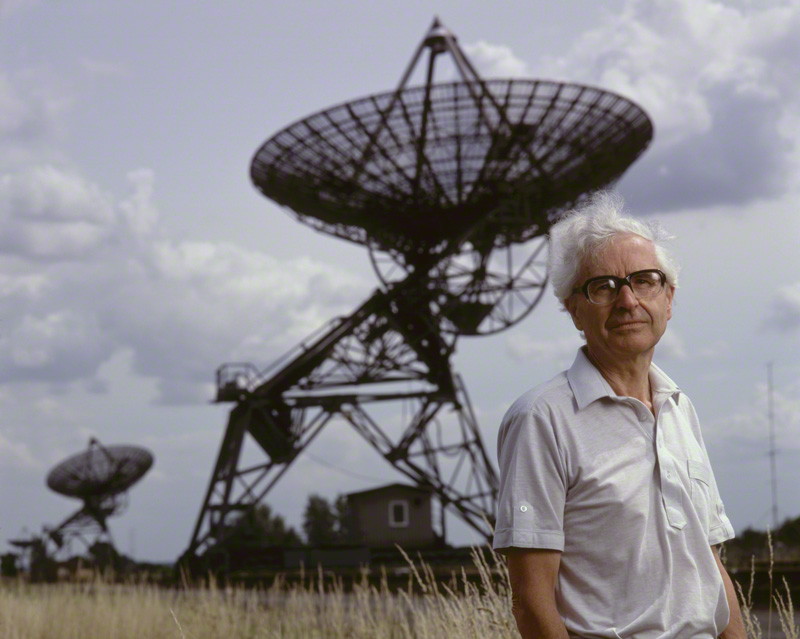
It’s a grim day when I have three R.I.P. posts on this blog, but I learned this afternoon via email that Nobel Prize winning Cambridge radio astronomer Antony Hewish has passed away on 13th September this year at the age of 97. You can read a full obituary at his college website here so I’ll keep my own remarks brief.
Tony Hewish was one of the pioneering generation of radio astronomers who were involved with the development of radar during World War 2 and went on to apply the knowledge they had gained to explore the Universe. He is most famous for winning the 1974 Nobel Prize for Physics (jointly with Martin Ryle) for the discovery of pulsars. Although the Nobel Foundation were clearly wrong not to give a share to Jocelyn Bell Burnell (who actually made the discovery). Indeed I would argue that Hewish should have declined the award unless Jocelyn Bell Burnell had been included. These errors should not however detract from Hewish’s scientific achievement in conceiving and constructing the Interplanetary Scintillation Array with which the discovery was made.
I’ll just add on a personal note that when I was a final-year undergraduate student at Cambridge (in the Lent Term in 1985) I took what was called a Major Option in Observational Cosmology which was lectured by Tony Hewish. As a matter of fact I still have the notes. Here’s the file opened at a random page:
It’s very out of date now, of course. A lot has happened in cosmology since 1985! At the time, though, I enjoyed the course very much and that affected my choice of potential areas in which to do my PhD. Although I ended up doing Theoretical rather than Observational Cosmology, at Sussex rather than at Cambridge, this course of lectures played a big part in me starting out on a career in that field.
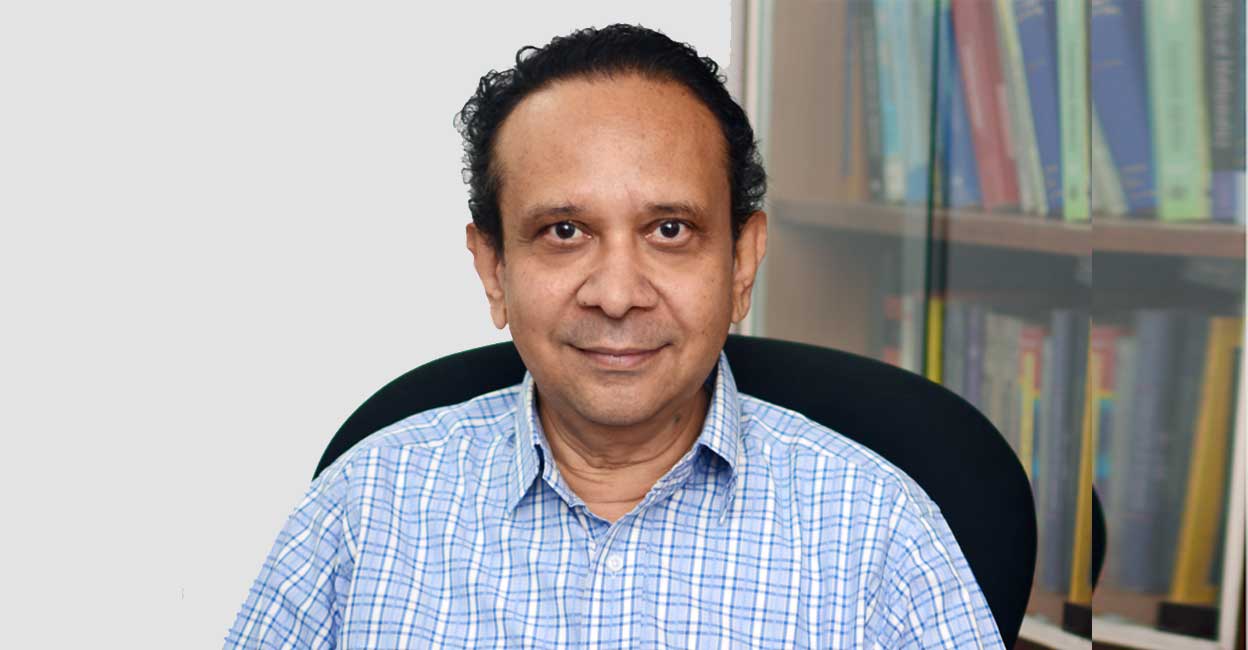
It’s my sad task to pass on yet another piece of bad news. Renowned Indian physicist and cosmologist Professor Thanu Padmanabhan (known to all as “Paddy”) passed away suddenly this morning at the age of 64. I believe he suffered a heart attack at his home in Pune.
Paddy was not only a prolific researcher, with over 300 articles and many books to his name, but also a very gifted public speaker. Although we met and chatted a few times I never really got to know Paddy personally, but I shall remember him best for the many wonderful lectures I heard him give, at conferences and in seminars, the first being at Sussex when I was a graduate student there ay back in the 1980s.
The sudden death of such a highly esteemed colleague and friend has shocked his family and circle of friends, as well as the physics community in India, and is sure to have a similar effect around the world as news travels. Paddy travelled widely and had collaborators across the globe, including in the United Kingdom and United States.
All I can do here is to offer my sincere condolences to his family, friends, scientific colleagues who are grieving now, and for whom his loss will be irreparable.
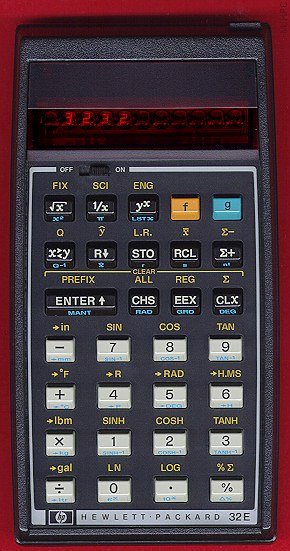
I am of a generation that began secondary school (a grammar school in my case) before pocket calculators were generally available, so my first two years of secondary mathematics education including learning how to logarithms for multiplying and dividing numbers. After that, from the third year onwards, slide rules were in use but by the time I got I got into the 3rd form these had been phased out and replaced with electronic calculators. The first commercially available such device was produced by Sinclair. I didn’t like the Sinclair calculator, however, which had a reputation for unreliability so my first simple calculator was a Casio machine which, if I recall correctly was also cheaper. Later on when I wanted a more advanced calculator I went for the wonderful Hewlett Packard HP32E, complete with Reverse Polish Notation.
I got interested in computing at school too. The machines we had available were Commodore PET machines running BASIC. The first computer I ever had at home was the very simple Acorn System 1 which had just 1K of RAM, a hexadecimal keypad and LED display and was programmed in 6502 Assembly language. Curiously, although I have great difficulty remembering my own phone number, I can still remember quite a lot of the hexadecimal opcodes in the 6502 instruction set!
The Acorn System 1 went into production in 1979 but just a year later Sinclair introduced the ZX80. Although very limited by today’s standards, it was really much more advanced than the machine I had. It did, however, have a reputation for unreliability and it was actually quite difficult to get hold of one due to supply issues. A friend at school bought one, but it seemed to me flimsy and awkward to use, so I never bought one. Nor did I buy the successor the ZX81.
Because I had experience using machines based on the 6502 processor I thought I would buy a BBC micro when they came out as I used to enjoy bypassing the BASIC interpreter on the Commodore PET and running my own machine code. In 1982, however, Sinclair released the ZX Spectrum. This again was very limited by today’s standards but was a significant improvement on its predecessors, so I bought one. I took it with me to Cambridge when I began as a student there in 1982.
I remember also buying various peripherals for it, including a dreadful printer that required rolls of special paper.
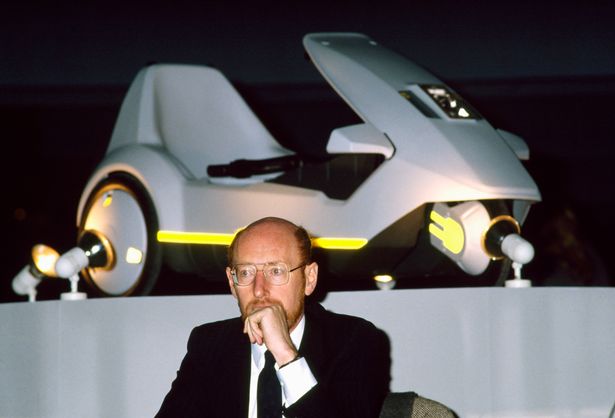
The ZX Spectrum was a great success but soon other companies took over the market. It seemed to be in Sinclair’s character to invent things and then lose interest and he subsequently switched his attention to other inventions, many of which flopped, such as the ridiculously impractical Sinclair C5 which launched in 1985 and sank shortly afterwards. He never seemed to let such failures bother him too much, though, which is to his credit, and he didn’t seem to mind being ribbed about them either. Here he is on Clive Anderson Talks Back:
Despite his failures it seems very clear to me that Clive Sinclair was a pioneer in the technological revolution who played a major role in shaping the digital landscape in which we find ourselves today, forty years after the first home computers. My washing machine has much more CPU power than any of the 1980s home computers, but you have to start somewhere.
The views presented here are personal and not necessarily those of my employer (or anyone else for that matter).
Feel free to comment on any of the posts on this blog but comments may be moderated; anonymous comments and any considered by me to be vexatious and/or abusive and/or defamatory will not be accepted. I do not necessarily endorse, support, sanction, encourage, verify or agree with the opinions or statements of any information or other content in the comments on this site and do not in any way guarantee their accuracy or reliability.




 In the Dark