As anticipated a couple of days ago, it’s now possible to announce another couple of new papers at the Open Journal of Astrophysics. These papers take us up to a total of 49 in Volume 6 (2023) and 114 in total since we started publishing.
It would be nice if we could make it to 50 in Volume 6 (2023), but I have already decided to close the publishing platform from 22nd December until 5th January (inclusive), so there there isn’t much time to get the single needed for our half-century. While we will not be publishing new papers during this closure, the peer review platform will remain open for submission of new and revised manuscripts and the editorial processes will continue.
Whether or not we make 50 this year, it is worth remarking that 49 is already a significant figure, as it corresponds to the total number of papers we published in the previous three years: 15 (2020); 17 (2021); and 17 (2022). Things are definitely looking up!
Anyway, the first paper of the most recent pair – published on December 8th – is “The Million Quasars (Milliquas) Catalogue, v8”; its primary classification is Astrophysics of Galaxies and the author is Eric Wim Flesch from New Zealand. The Milliquas catalogue includes quasars from the literature to 30 June 2023, including quasars from the DESI-EDR and SDSS-DR18Q surveys.
Here is a screen grab of the overlay which includes the abstract:
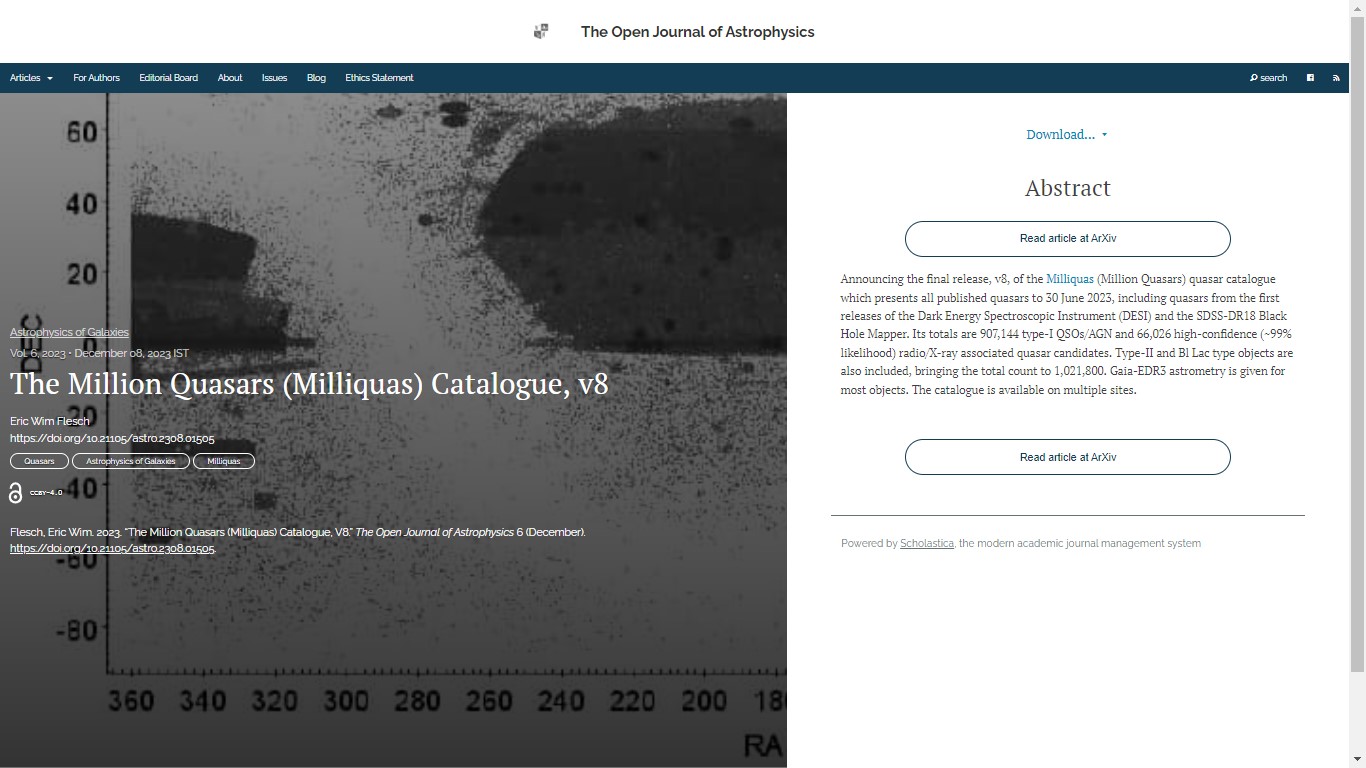
You can click on the image of the overlay to make it larger should you wish to do so. You can find the officially accepted version of the paper on the arXiv here.
The second paper was published on 11th December 2023 and is also in the folder marked Astrophysics of Galaxies.
The authors are all from various institutions in the USA: Michael Grudić (Carnegie Observatories), Stella Offner (University of Texas at Austin); Dávid Guszejnov (Harvard); Claude-André Faucher-Giguère (Northwestern University); and Philip F. Hopkins (Caltech). The paper presents a comparison of full radiative magnetohydrodynamics simulations of the formation of star clusters with simple stochastic modelling showing the limitations of the latter.
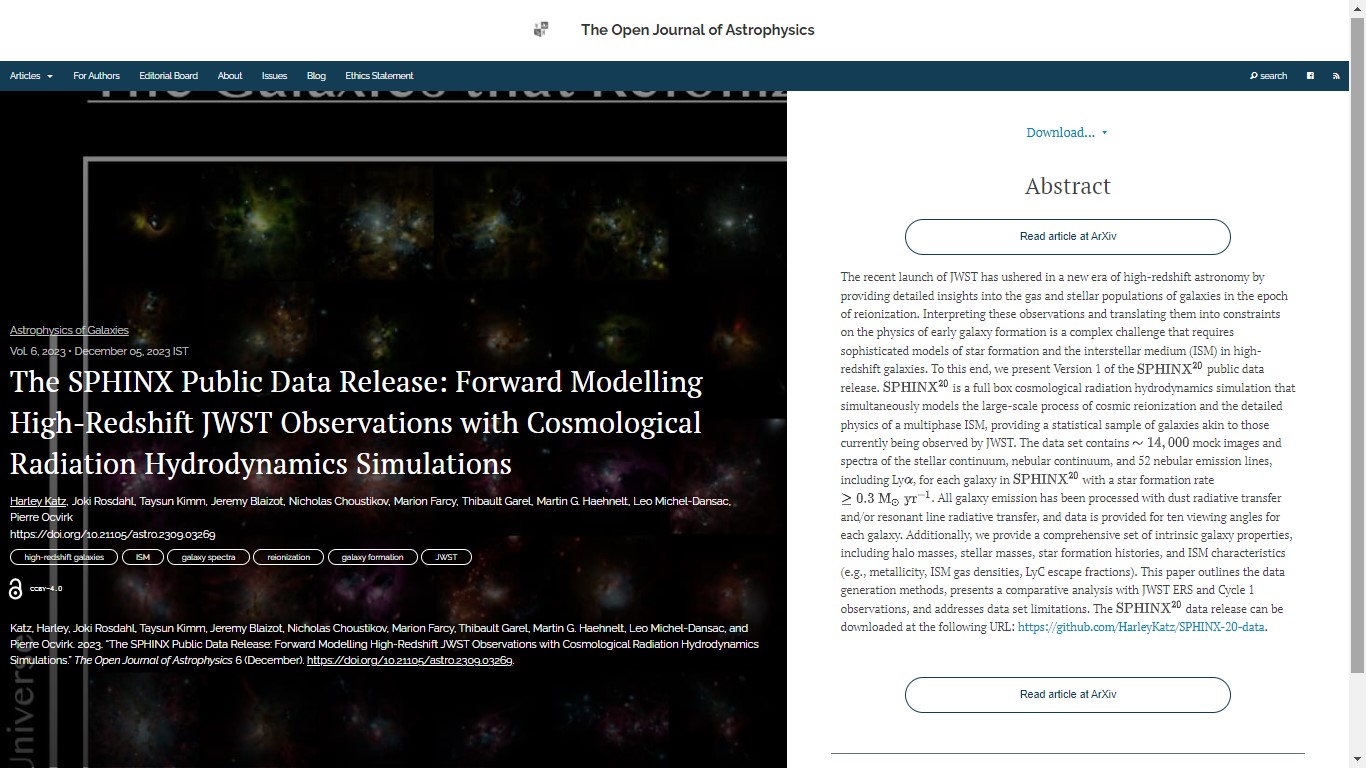
Here is a screen grab of the overlay which includes the abstract:
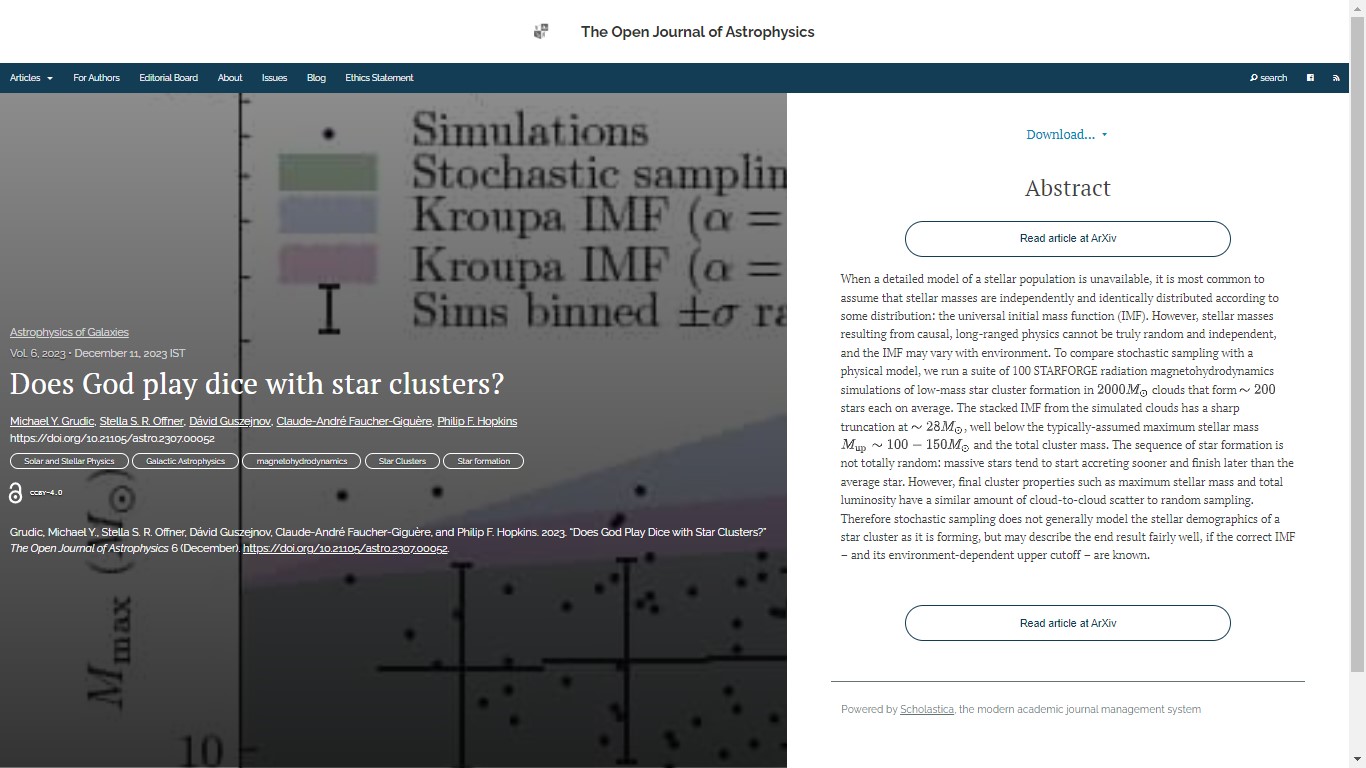
You can click on the image of the overlay to make it larger should you wish to do so. You can find the officially accepted version of the paper on the arXiv here.









 In the Dark