Archive for May, 2024

Another Day, Another Predator…

Posted in Open Access with tags , , , on May 9, 2024 by telescoper

It’s been a while since I reported on a couple of encounters with predatory publishers so I thought I’d do another post in the same vein. Just this morning I received an email:

The email is in Polish, followed by the above translation into English. Out of curiosity I had a look at the website for UK Zhende Publishing. Imagine my lack of surprise when I found out it was down! The company is however registered at Companies House. Mr Zihan Li – who is resident in China -owns 75% of the business.

The Open Journal of Astrophysics is not for sale under any circumstances, not that I own it anyway. I did toy with the idea of selling them some other journal I don’t own, but I’m too busy to play such games. I did, however, find the time to reply giving my “thoughts/comments” as requested, though it would be inappropriate to repeat them here.

The last time I received such an approach ( a few months ago) the suggested price was $70,000. I see it has now gone up to $100,000. I don’t know how Mr Zihan arrived at a valuation of $100K but it got me thinking. We have so far published 149 articles at OJAp. Taking the APC for MNRAS of £2500 (approximately $3000) as typical then we have saved the community about $447,000 in unnecessary publication charges.

Who Publishes A&A?

Posted in Euclid, Open Access with tags , , , , , , , on May 8, 2024 by telescoper

The journal Astronomy & Astrophysics, generally known as A&A, which featured in yesterday’s post, is and has been for some time the journal of choice for many astrophysics researchers, especially those based in Europe. It is the journal in which the bulk of publications from Euclid will be published, including a batch due to come out in a couple of weeks.

The journal, which has existed since 1969, is published on behalf of the European Southern Observatory by EDP Sciences (Édition Diffusion Presse Sciences) which began life as a joint venture of four French learned societies in science, mathematics, and medicine. The company was acquired in 2019 by  China Science Publishing & Media (which has headquarters in Beijing). Judging by its social media activity, EDP Sciences sees A&A as a flagship journal; for a list of other journals it runs see here.

A&A publishes papers through a curious hybrid model called “S2O” (Subscribe to Open; not to be confused with “420”). This is not fully Open Access because it requires libraries to pay a subscription to access the journal, but unlike some journals A&A does allow authors to place their papers on arXiv without restriction, so they can be read there for free. On the other hand, A&A also requires authors to pay “Page Charges” – essentially an Article Processing Charge (APC) – if they are not from a “member country”. Authors from a member country do not have to pay APCs to publish but their institutional libraries still have to pay a subscription if they are to access the paper.

You might ask why you should publish in A&A if you can put your papers on arXiv. The answer given on the website is:

Preprint servers such as arXiv play a vital role in bringing research into the astronomy and astrophysics communities as quickly as possible. However, content uploaded to this service has not undergone rigorous peer review and the editorial oversight offered by a professional publisher such as EDP Sciences. In addition, preprints don’t offer the content selection and curation processes that make a scholarly journal a reliable and trusted addition to library collections.

In summary, publishing your article in A&A increases the value and impact of your work by making your article more trustworthy, easier to find, read, and cite, whilst ensuring that the version of record is preserved in perpetuity.

In other words, A&A does nothing that the Open Journal of Astrophysics doesn’t do for free…

Incidentally, I am struck by the frequent assertion that publishers preserve or curate content. Actually they don’t. Libraries do that. If a publisher such as EDP Science decides a journal is no longer commercially viable it will simply ditch it. Fortunately nowadays institutions maintain their own repositories of published papers as insurance against this.

Here is some more information about how S20 works, taken from the A&A website:

A&A is a community journal sponsored by a board of member countries. While subscriptions fund the publishing costs of the journal, the editorial costs are funded both by the contributions from member countries, and the page charges for authors of non-member countries. This division of costs between authors and readers makes it possible to offer low subscription prices, while at the same time removing barriers to publishing for authors from A&A sponsoring countries, and allowing authors from non-sponsoring countries to publish for a modest charge.

If the S2O model is successful, editorial costs will continue to be funded by A&A member contributions and page charges, while subscriptions will be used to cover the open access publication of the journal. Authors from sponsoring countries can therefore publish in open access free of charge, while authors from other countries remain liable for page charges to fund the editorial process of their article (note: page charges are paid to A&A directly and not to the publisher).

This arrangement is being kept under annual review so whether it will persist is open to question.

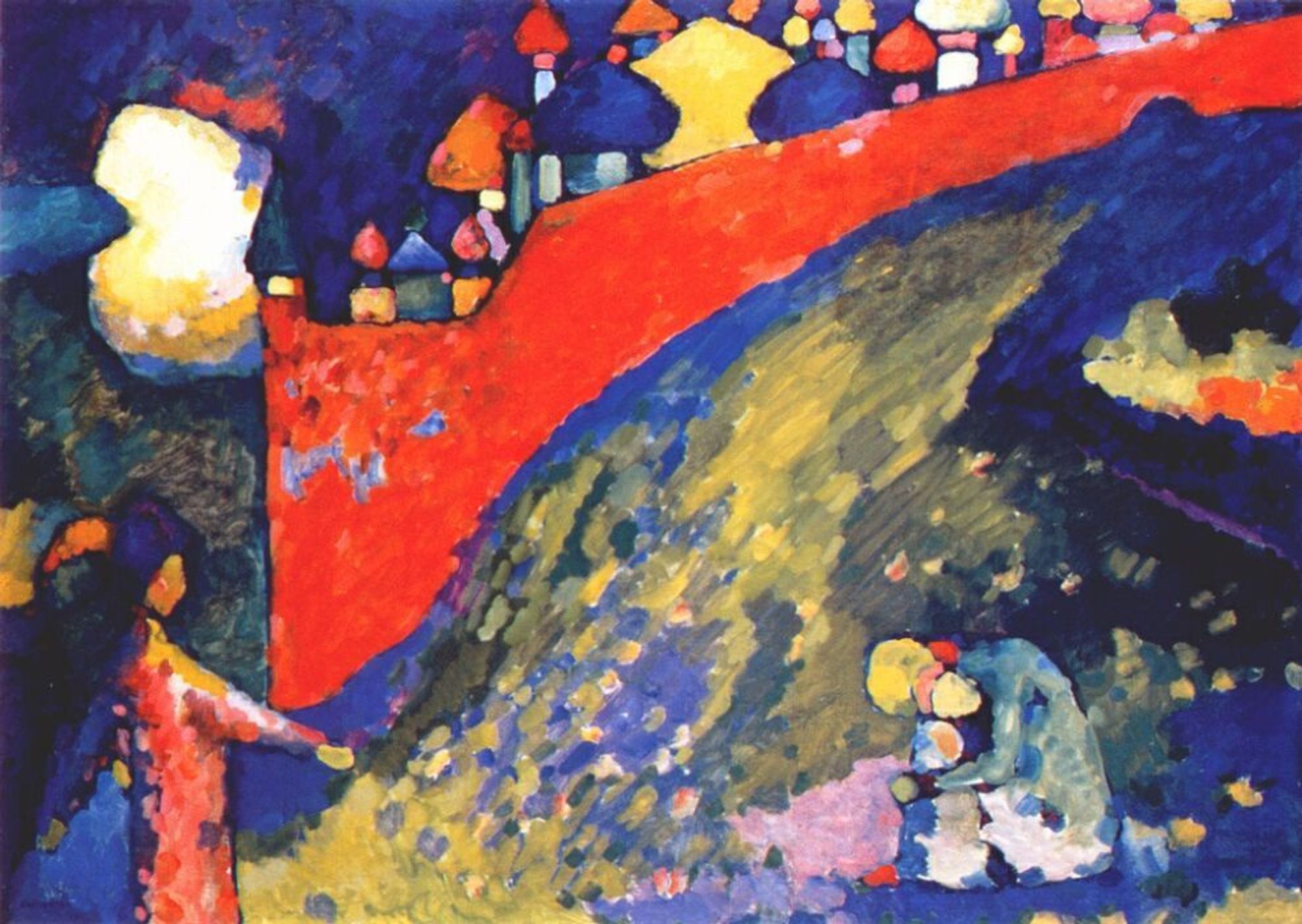
Red Wall Destiny – Wassily Kandinsky

Posted in Art with tags , on May 7, 2024 by telescoper
Red Wall Destiny

by Wassily Kandinsky (1909; oil on canvas, 83 x 116 cm; Astrakhan, Dogadin State Art Gallery)

Publishing Stats for Astrophysics Journals

Posted in Open Access, The Universe and Stuff with tags , , , , , on May 6, 2024 by telescoper

Somebody asked me about this recently so this afternoon while I was paying rapt attention to a Zoom call I was attending I did some quick sums and produced the table below. The request that was made was to give details of total numbers of papers published in the big astronomy and astrophysics journals last year. This is easy relatively easy to do using the excellent NASA/ADS search tool.

Name of JournalNumber of PapersNumber of CitationsAverage citations per paper
MNRAS413125,5406.18
A&A235415,9016.75
ApJ285915,7715.52
ApJL72610,22814.09
ApJS3382,6117.72
OJAp503717.42
Citations to papers published in 2023 (Data from NASA/ADS)

In case you weren’t aware of the standard abbreviations, MNRAS is Monthly Notices of the Royal Astronomical Society and A&A is Astronomy and Astrophysics; ApJ is the Astrophysical Journal, ApJL is the Astrophysical Journal Letters and ApJS is the Astrophysical Journal Supplement Series. The Open Journal of Astrophysics is OJAp.

Anyway, you can see that the big journals published many more papers last year than OJAp but in terms of citations per paper OJAp is doing well. We have a lot of ground to make up if we’re going to be a significant player in the game in terms of sheer quantity of publications, but since we don’t make a profit from APCs we have no reason to lower standards to achieve that.

If you’re interested, the average citations per paper so far this year (i.e. as of 6th May 2024) are: MNRAS (1.84); A&A (1.66); ApJ (2.29); ApJL (2.05), ApJS (2.09) and OJAp (2.90).

Open Access in Ecology

Posted in Open Access with tags , , , , on May 6, 2024 by telescoper

My attention was drawn yesterday to the following blog post about Open Access in the field of ecology. I recommend you read it (and the comments, some of which are excellent).

I will add a few comments of my own here.

First, whenever I read an article like this from a discipline different from my own it makes me not only feel grateful that we have arXiv but also wonder why so many fields don’t have the equivalent. On the other hand, there is EarthArxiv, but it doesn’t seem to have very many papers on it.

Second, I agree with the author of the post that far too many papers are being published. That is driven by the absurdity of a system that no longer regards the journal article as a means of disseminating scientific results but instead as a kind of epaulette to give status to the author. I also agree that scientists have largely got themselves to blame for this ridiculous situation.

Third, I disagree most strongly with this statement:

First, pipe dreaming academics who believed in the mirage of “Diamond OA” (nobody pays and it is free to publish). Guess what – publishing a paper costs money – $500-$2000 depending on how much it is subsidized by volunteer scientists. 

This is nonsense. It does not cost anything like $500-$2000 dollars to publish a paper. Of course it does cost something, but the true amount is trivial – tens of dollars, rather than hundreds or thousands – and can easily be absorbed. The entire annual running costs of OJAp are less than the typical Article Processing Charge for a single paper in a “prestigious” journal. Most money being paid in the form of APC goes directly into profit for the publishers, and the rest is largely wasted on administrative overhead. The Open Journal of Astrophysics is a Diamond Open Access journal, not a mirage. It may be a no-frills service, but it’s a reality. Why doesn’t someone set up an overlay journal on EarthArXiv?

The author of this blog post also spectacularly misses the point with “depending on how much it is subsidized by volunteer scientists”. Volunteer scientists are already subsidizing the profits of profit-making publishers! One of the commenters on the blog post has it right:

On Diamond OA and who pays; we’re already paying the big publishers with both our time and our money to publish in / review for / edit for their journals. Perhaps if we redirected that time to Diamond OA titles things would be somewhat different.

A final comment, only tangentially related to this post, is that I have been (pleasantly) surprised by the extent to which early career researchers have embraced the concept of the Open Journal of Astrophysics when you might have thought that they had more to lose by not publishing in mainstream journals rather than us oldies who don’t care any more. The explanation seems to be that younger people seem to see the absurdity and obvious unsustainability of the current publishing environment more easily than those who have put up with it for decades already.

A Table Alphabeticall

Posted in History, Literature with tags , , , on May 5, 2024 by telescoper

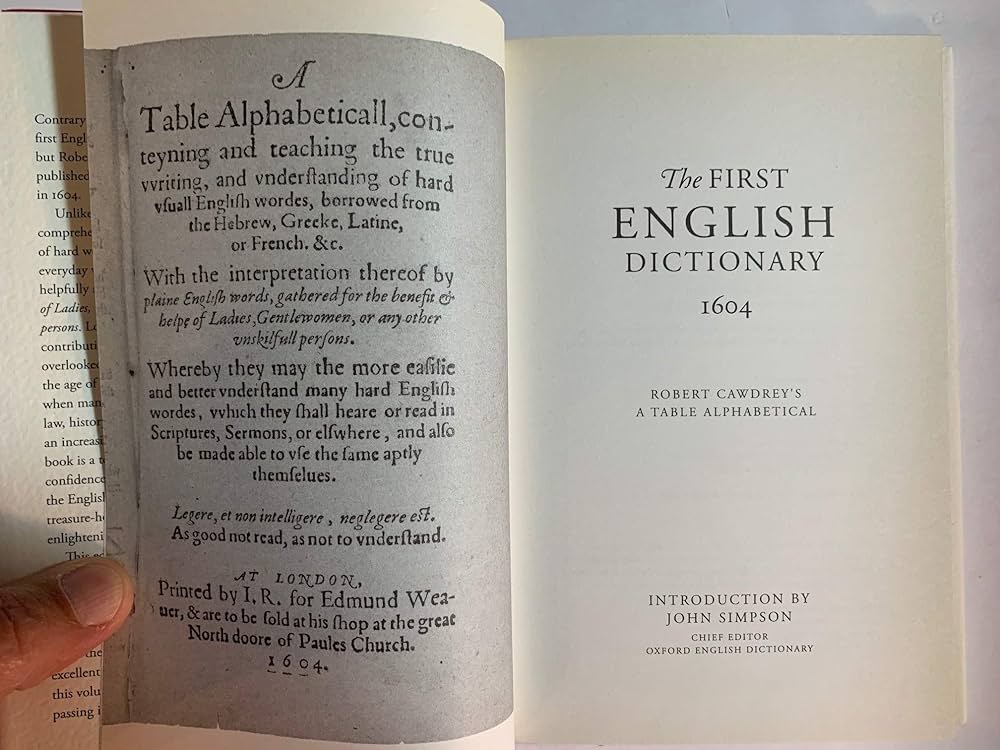
I’m having a lazy Sunday so instead of writing anything too demanding on here I thought I’d share something I stumbled across in a book I’ve been reading (and will probably review next week sometime). Not a lot of people know that the first true English dictionary was called A Table Alphabeticall which was created by Robert Cawdrey and first published in London in 1604, over 150 years before Samuel Johnson’s much more famous A Dictionary of the English Language.

This, on the left, is the frontispiece of the First Edition to A Table Alphabeticall:

Notice that it says it was compiled for the benefit and help of “Ladies, Gentlewomen, or any other unskilfull persons”. Ouch! By the Third Edition, published in 1613, this was amended to “all unskilfull persons”.

P.S. Notice the old-fashioned typesetting, especially the use of the “long s” which I have blogged about before.

Two New Publications at the Open Journal of Astrophysics

Posted in OJAp Papers, The Universe and Stuff with tags , , , , , , on May 4, 2024 by telescoper

It’s Saturday morning in Barcelona, and time to post another update relating to the  Open Journal of Astrophysics.  Since the last update we have published two more papers, taking  the count in Volume 7 (2024) up to 32 and the total published by OJAp up to 147. There’s every chance we will reach 150 next week.

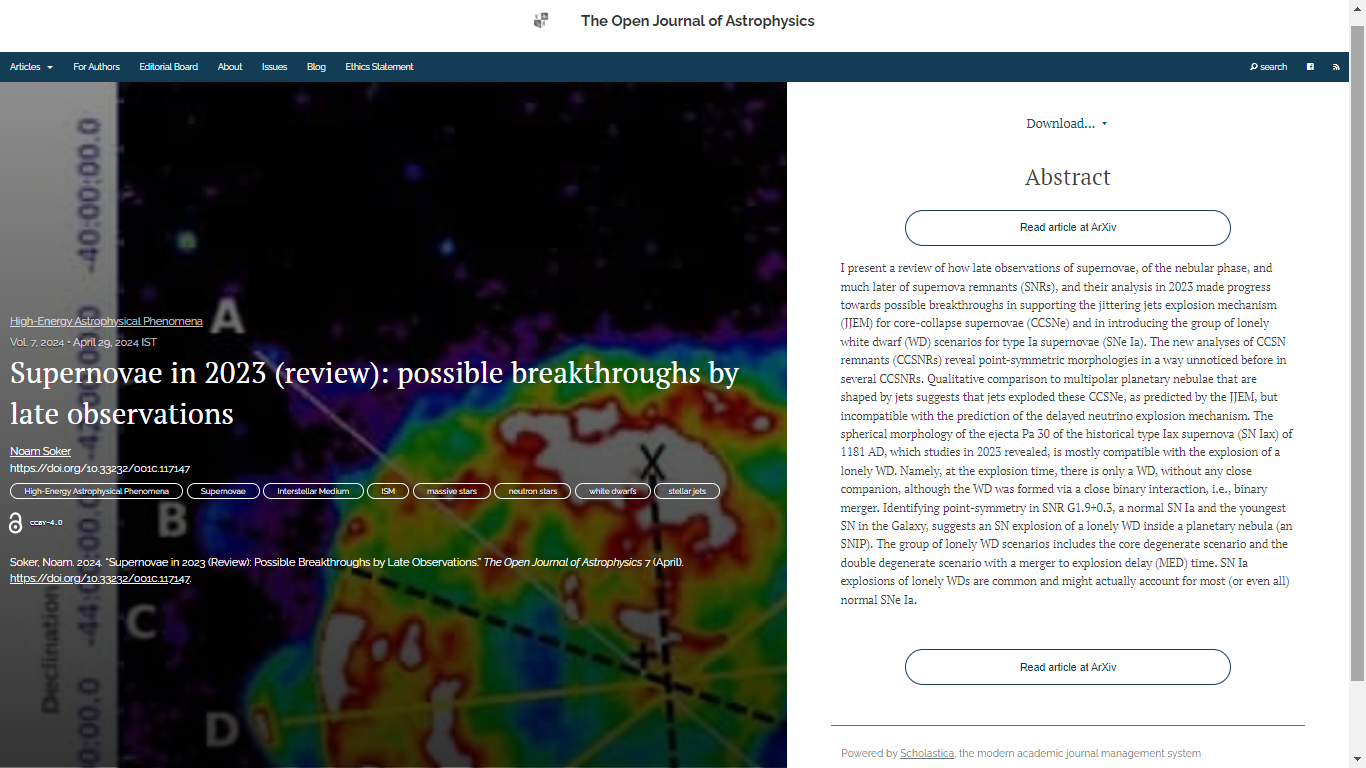
The first paper of the most recent pair – published on  Monday 29th April- is “Supernovae in 2023 (review): possible breakthroughs by late observations” by Noam Soker of Technion in Haifa, Israel. It presents  a discussion of observations of the aftermath of supernovae explosions, such as supernova remnants, and how these may shed light on the explosion mechanism. This one is in the folder marked High-Energy Astrophysical Phenomena.

Here is a screen grab of the overlay which includes the abstract:


You can click on the image of the overlay to make it larger should you wish to do so. You can find the officially accepted version of the paper on the arXiv here.

The second paper was published on Thursday 2nd May and has the title “ΛCDM is alive and well” The authors are: Alain Blanchard (Université de Toulouse, France), Jean-Yves Héloret (Université de Toulouse, France), Stéphane Ilíc (Université Paris-Saclay, France), Brahim Lamine (Université de Toulouse, France) and Isaac Tutusaus (Université de Genève, Switzerland). This one, which is in the folder marked Cosmology and NonGalactic Astrophysics, presents a review of  review of the alleged tensions between observations and the standard cosmological model.

I did a post recently relating to a Royal Society Meeting on this topic. The first version of this paper appeared on arXiv about two years ago but the final version is extensively modified.

Here is a screen grab of the overlay which includes the abstract:


You can click on the image of the overlay to make it larger should you wish to do so. You can find the officially accepted version of the paper on the arXiv here.

And that concludes this week’s update. More next week!

Back to Barcelona

Posted in Barcelona, Biographical with tags , on May 3, 2024 by telescoper

So, after a brief sojourn in not-Barcelona, I am back in  Barcelona for what is not a Bank Holiday weekend. Wednesday 1st May was celebrated here with a public holiday as International Workers Day but, in the UK and Ireland, the May Day holiday is on Monday 6th (and in any case is not so much a workers’ holiday but a spring festival of much older origin.

Right now, just after 7.30pm, it is a pleasant 19°C here, a bit warmer than in Ireland. It seems, however, that there was torrential rain for much of the day on Monday. It rained so much in fact that there is even talk of the current drought restrictions being eased. Yesterday, my flight here was delayed by a mysterious weather event that temporarily closed the airport, although what had happened was never fully explained.

From now on, temperatures are forecast to rise steadily until the real heat of the summer arrives. I have this apartment until the end of June and, at some point soon, I have to decide how much longer to stay in Barcelona. My sabbatical lasts until the end of August, but the University is closed for that month, and I would probably find the heat intolerable then anyway. The question is whether to stay for July…

This month will be very busy, with some important results from Euclid coming out on 23rd May and a number of things related to that. Before all that, though, I’m going to have a drink or two on the terrace. There may not be a Bank Holiday coming, so it’s not a Long Weekend but it’s still a weekend!

About Sligo

Posted in Biographical with tags , , , , , on May 2, 2024 by telescoper

I’m no longer in the part of not-Barcelona known as Sligo (which is Sligeach in Irish) but here are some random pictures and a random video clip I took while I was there.

Maynooth University Library Cat Update

Posted in Maynooth with tags , on May 2, 2024 by telescoper

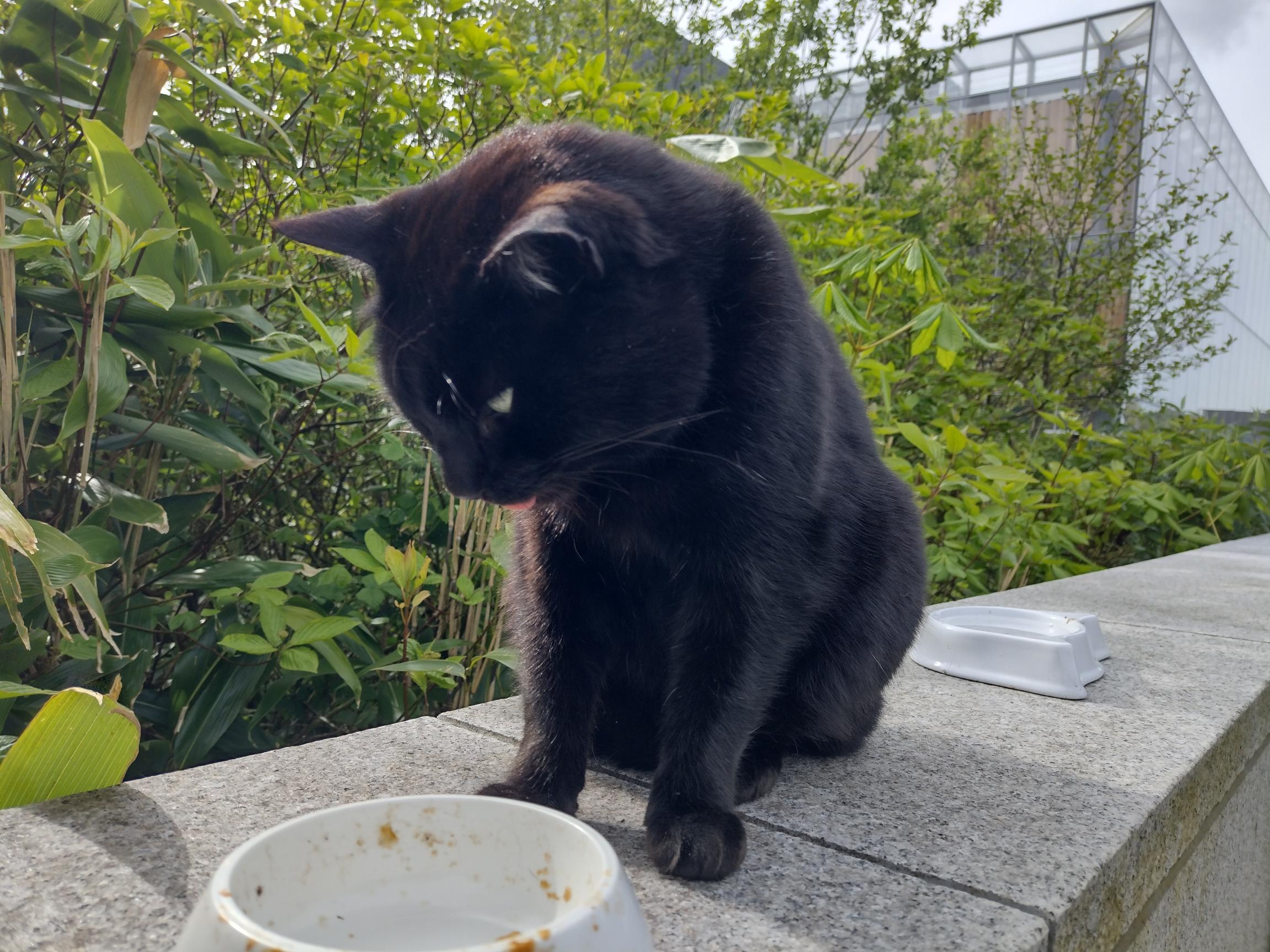
Quite a few people have asked for an update about Maynooth University Library Cat. I’m not actually in Maynooth right now so can’t pass on first-hand knowledge, but I am informed that said feline is doing fine and yesterday a colleague sent me this picture.

To be honest he looks a bit peeved* that his dish is empty. It is entirely possible, however, that he had been fed several times already before that picture was taken…

*In Irish, the word “peeve” is pronounced “piamh”