Duke Ellington’s tune The Mooche, composed in 1928, belongs to an era that spawned many other atmospheric classics such as Luis Russell’s Call of the Freaks and Don Redman’s Chant of the Weed. Fifty years later the menacing undertone of The Mooche was seized upon by saxophonist Steve Lacy and turned into an unforgettably raw version on his 1978 album Points (which I bought on vinyl when it first came out) in which he duets on soprano with Steve Potts, delivering the haunting minor-key theme with a sound like knives being sharpened.
Archive for June, 2024
The Mooche – Steve Lacy
Posted in Jazz with tags Duke Ellington, Points, soprano saxophone, Steve Lacy, Steve Potts, The Mooche on June 15, 2024 by telescoperTwo New Publications at the Open Journal of Astrophysics
Posted in OJAp Papers, Open Access, The Universe and Stuff with tags arXiv:2404.16036v3 Search..., arXiv:2405.21049v2, Astrophysics of Galaxies, galaxy clusters, Keck Telescopes, mass loss, protocluster, red supergiants, redshift, Solar and Stellar Astrophysics, spectroscopy, stellar mass loss, supernovae, The Open Journal of Astrophysics on June 15, 2024 by telescoperIt’s Saturday morning in Barcelona, and time to post another update relating to the Open Journal of Astrophysics. Since the last update we have published two more papers, taking the count in Volume 7 (2024) up to 47 and the total published by OJAp up to 162. We actually accepted four papers last week, but so far only two final versions have appeared on the arXiv.
The first paper of the most recent pair – published on Friday 14th June – is “Spectroscopic Confirmation of an Ultra-Massive Galaxy in a Protocluster at z ~ 4.9″ . The author list has a strong University of California flavour: Stephanie M. Urbano Stawinski (UC Irvine), M. C. Cooper (UC Irvine), Ben Forrest (UC Davis) , Adam Muzzin (York University, Canada), Danilo Marchesini (Tufts University), Gillian Wilson (UC Merced), Percy Gomez (Keck Observatories, USA), Ian McConachie (UC Riverside), Z. Cemile Marsan (York University, Canada), Marianna Annuziatella (Centro de Astrobiología CSIC-INTA, Spain) and Wenjun Chang (UC Riverside).
This paper presents an investigation of a cluster system involving a massive galaxy using Keck spectroscopy with determination of its redshift and star formation properties. The results pose a challenge for theorists. The paper is in the folder marked Astrophysics of Galaxies.
Here is a screen grab of the overlay which includes the abstract:

You can click on the image of the overlay to make it larger should you wish to do so. You can find the officially accepted version of the paper on the arXiv here.
The second paper, also published on Friday 14th June and has the title “Boil-off of red supergiants: mass loss and type II-P supernovae” by Jim Fuller (Caltech) and Daichi Tsuna (Caltech, USA and University of Tokyo, Japan). This one, which is in the folder marked Solar and Stellar Astrophysics, discusses A new model for stellar mass loss which predicts that low-mass red supergiants lose less mass than commonly assumed, while high-mass red supergiants lose more.
Here is a screen grab of the overlay which includes the abstract:

You can click on the image of the overlay to make it larger should you wish to do so. You can find the officially accepted version of the paper on the arXiv here.
That concludes this week’s update. Will we reach 50 for 20204 next week? Tune in next Saturday to find out!
The Scream with Paper Clips
Posted in Art with tags Adam Hillman, Edvard Munch, The Scream on June 14, 2024 by telescoper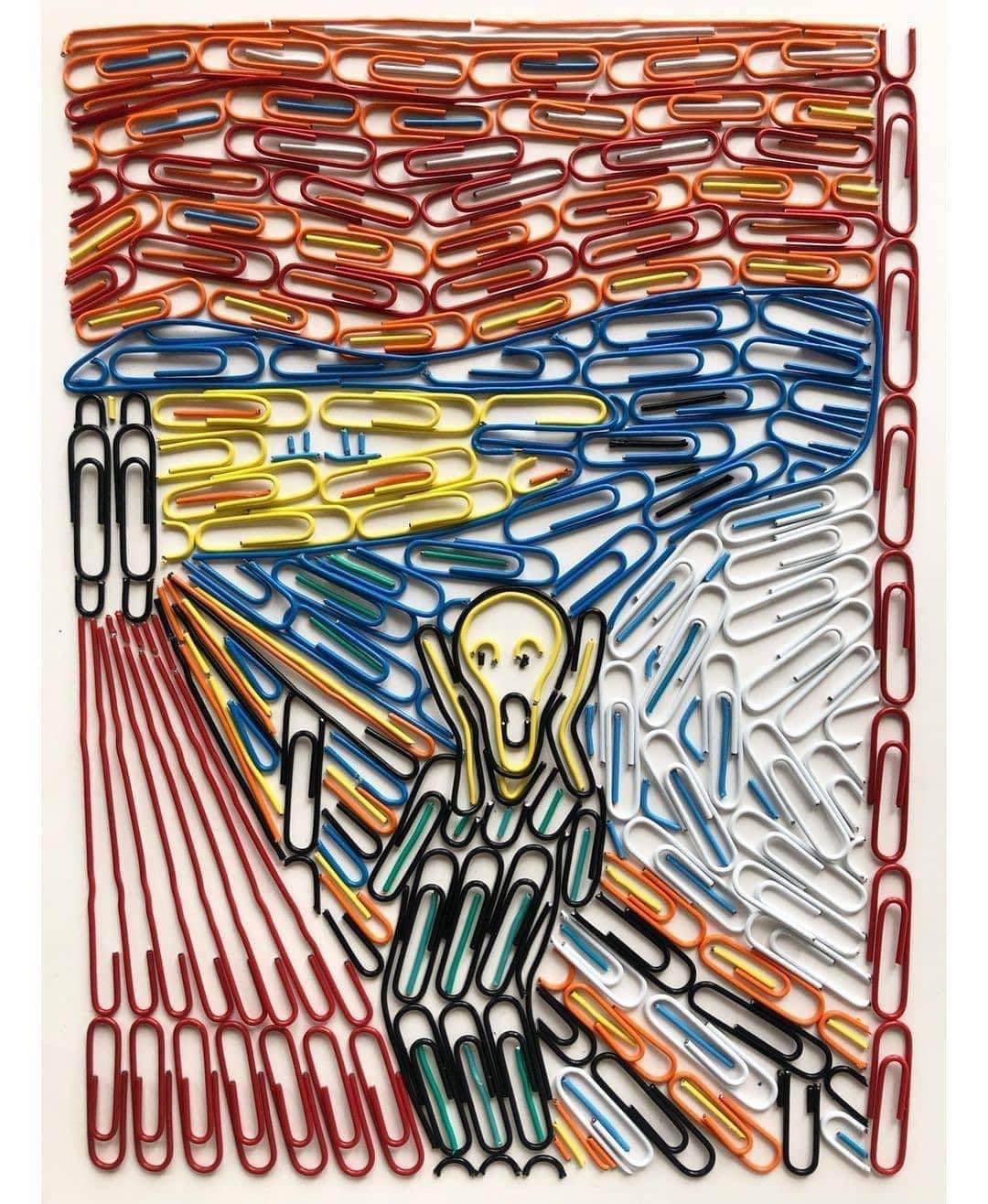
I was not inconsiderably amused by the above homage to The Scream by Edvard Munch which I see as a powerful artistic response to pointless corporate bureaucracy. It was created by Adam Hillman, an artist who specializes in making interesting designs and collages from everyday objects. You can read more about, and see more examples of, his work here.

The Nolan Case
Posted in Maynooth, Science Politics with tags Peter Clinch, Philip Nolan, Science Foundation Ireland, SFI on June 13, 2024 by telescoperA couple of weeks ago I posted an item about the sudden departure of Prof. Philip Nolan from his post as Director General of Science Foundation Ireland (SFI) after allegations of misconduct (including bullying). That post included these words:
As an outsider I have no idea what has been going on at SFI, so have no dirt to dish, but it must have been rather serious for Prof. Nolan to have been forced out so quickly.
Despite that clear statement I have received a number of emails from “journalists” asking for gossip. Obviously I didn’t reply to them.
Anyway, it’s not only the sudden decision that led to Prof. Nolan’s dismissal that is striking; there’s also the fact that no formal disciplinary process took place and it was accompanied by immediate termination of his access to emails, etc. Actions so extreme are usually reserved for situations in which a staff member has committed gross misconduct, but that is not the accusation here.
Anyway, just a few days after his apparent departure from SFI, Prof. Nolan went to court and obtained a temporary injunction restraining his dismissal ahead of a further hearing about the case which began on 11th June and has not yet completed. Although no longer fired, Prof. Nolan has not been allowed physically to return to work.
I have no idea how this mess will end. It does seem that there must have been a complete meltdown in SFI that will be very difficult to reverse. Perhaps the best way forward is to hasten the end of SFI and the beginning up of the new entity (Taighde Éireann– Research Ireland) supposed to be formed by the merger of SFI with the Irish Research Council.
I have no idea who is in the wrong at SFI. Perhaps both sides are. However, for the record, I will state that when my Mam died in 2019 Prof. Nolan (who was President of Maynooth University at the time) sought me out and offered his condolences in person. That was a kind gesture that I greatly appreciated at the time, and one which few University managers I have known would have made in the circumstances. Certainly not the current President of Maynooth University.
P.S. I discovered from reading this article about the Nolan Case that the Chairman of the Board of Science Foundation Ireland, Professor Peter Clinch, an economist; presumably no actual scientists were available.
Euclid Updates
Posted in Euclid, The Universe and Stuff with tags Dwarf galaxies in the Perseus galaxy cluster, ESA, Euclid, Euclid Flagship simulation, Ice, Knud Jahnke on June 11, 2024 by telescoperI’m travelling back to Barcelona today, later than planned because I’ve had a heavy cold that I struggled to shake off and didn’t want to infect fellow passengers on the flight. While I’m in transit I thought I’d share some updates about the European Space Agency’s Euclid mission.
The first thing to share is a piece by Knud Jahnke with news about Euclid’s issue with ice in the optical system. The latest intervention has led to an improvement, but since it is a closed system ice will probably form again – though perhaps not in the same place – and further procedures will probably be necessary in future. In the meantime, though, the survey resumes.
Now for some short videos -three, to be precise – about the Early Release Observations mentioned here. I posted another one in this series here. I think the titles are self-explanatory:
And if that isn’t enough, for those of you who like simulations here is another video about the Euclid Flagship simulation described in this paper.
Seriously, Scopus?
Posted in Open Access with tags CiteScore, Open Journal of Astrophysics, SCOPUS, The Academic Journal Racket on June 10, 2024 by telescoper
Five months ago I wrote a blog post mentioning that the Open Journal of Astrophysics (OJAp) had been accepted for listing in Scopus. A couple of months later, I posted an update explaining that the process of was taking much longer than the 4 to 6 weeks I was told it would. Well, I can now report that, a full five months after acceptance, we have finally made it onto the Scopus database.
Great! I hear you say. Well, no actually. Despite taking an excessive length of time to index the Open Journal of Astrophysics, the Scopus crew have messed up the bibliometric data relating to it in a most ridiculous fashion.
Here is the entry:

I draw your attention first to the column marked Documents 2020-23 under which you will see the number 67. In fact we published 99 articles between 2020 and 2023, not 67. This is easily established here. The number 67 relates to the period 2022-23 only. Accidentally or deliberately, Scopus has omitted a third of our papers from its database.
But the error doesn’t end there. Papers published in OJAp between 2020 and 2023 have actually been cited 959 times, not 137. If you restrict the count to papers published in 2022-23 there are 526 citations. It’s no wonder that OJAp has such a low CiteScore, and consequently appears so far down the rankings, when the citation information is so woefully inaccurate.
Incidentally, CiteScores are marketed by Scopus as “metrics you can verify and trust”. Oh no you can’t.
When I first saw this travesty I thought very hard about asking to have OJAp removed from Scopus altogether, but on reflection I decided to contact them with the actual numbers and a request that they issue a correction as soon as possible. Given that it took 5 months to get this far, however, I’m not optimistic for a speedy response.
While I’m waiting for that I suggest you consider whether these egregious errors are simply incompetent or whether they are deliberate acts of sabotage by a front organization for the commercial publishing industry? And another question: how much else in the Scopus database is as badly wrong as the OJAp entry?
Local Election Result
Posted in Maynooth, Politics with tags election, Elections, Fianna Fáil, Fine Gael, Local Elections, news, opinion, Peter Melrose, Politics, Sinn Féin, Social Democrats on June 9, 2024 by telescoperFollowing Friday’s vote, counting in Ireland’s local elections began Saturday morning. As it happened, Maynooth was one of the first LEAs to start counting and, the electorate being fairly small, was completed last night.
In the system employed in these elections, votes are progressively reallocated in various rounds until one ends up with the top n candidates to fill the n available seats. The STV system involves a quota for automatic election which is N/(m+1) + 1 votes, where N is the number of valid ballots cast and m is the number of seats in the constituency. To see why this is the case consider a four-seat constituency, where the quota would be 20% of the votes cast plus one. No more than four candidates can reach this level so anyone managing to get that many vote is automatically elected. Surplus votes from candidates exceeding quota, as well as those of eliminated candidates, are reallocated to lower-preference candidates in this process.
I thought it might be interesting to show how it went. Here is the state of the poll after the initial count of first preference votes:

Incumbent Councillor Naoise Ó Cearúil (Fianna Fáil) led the first preference votes, exceeding the quota of 1566, and was therefore immediately elected. When his surplus votes were reallocated to second-preference candidates they did not result in anyone else exceeding quota, so Peter Hamilton (who finished last) was eliminated and his votes reallocated, etc. And so it came to pass that Tim Durkan (Fine Gael) was elected on the third count, Angela Feeney (Lab) and Peter Melrose (Social Democrats) on the 6th Count, and Paul Ward (FF) on the 7th Count. Durkan, by the way, is the son of sitting Fine Gael TD Bernard Durkan. For those outside Ireland I should mention that the Irish Social Democrats are quite progressive – in contrast to some parties with the same name in other countries – and they have a TD in the form of Caroline Murphy who has strong local support.
The turnout in Maynooth, by the way, was 45.3%. That’s quite high by the standards of local elections in the UK, but I always find it disappointing when people can’t be bothered to vote.
Anyway, of the five councillors elected (2 FF, 1 FG, 1 Lab & 1 SD) four are incumbent. The only change was sitting Green candidate Hamilton was replaced by newbie Peter Melrose for the Social Democrats. It was a disappointing result for Sinn Féin, similar to what happened five years ago in this LEA. The losing candidate then, however, Réada Cronin, went on to win a seat as TD for North Kildare in the General Election of 2020.
As I write, under a quarter of LEAs have completed their counts but it is fairly clear that it has been a disappointing election for Sinn Féin who, despite riding high in the opinion polls a few months ago, have not really recovered significantly from their poor showing in the 2019 Local Elections. Of course the question asked in opinion polls is about a General Election, which is quite a different kettle of fish compared to a Local election. Lots of pundits are trying to interpret these local results as a kind of opinion poll on the General Election which must happen before next year. They do this in the UK too. I don’t think that is wise. I think most people vote in the Local Elections on the local and rather mundane issues which are actually what the County Councils can actually deal with. Councils have very little power in Ireland and candidates who have grandiose plans far beyond the scope of what a councillor can actually achieve are not likely to do well. There is also a definite advantage on being an incumbent who has done a good job for the past five years. A problem for Sinn Féin is that it had to put up new faces in many LEAs to replace those lost five years ago, and few have been successful.
Anyway, it seems the status quo parties have done better than expected, and a variety of Independents have done well. Fianna Fáil and Fine Gael – to me, indistinguishable conservative neoliberal parties – are currently governing Ireland in coalition with the Greens. It surprises me that there is so much support for establishment parties that have presided over a housing shortage, ever-increasing homelessness and steadily deteriorating public services, but there you go.
We’ll have to wait a considerable time for the European Election count to finish, as it hasn’t even started yet, but it seems likely that Sinn Fein will struggle and that Independent will do well.
Three New Publications at the Open Journal of Astrophysics
Posted in OJAp Papers, Open Access, The Universe and Stuff with tags aperiodic systems, arXiv:2303.05578v3, arXiv:2311.07374v2, arXiv:2402.12165v2, cosmography, Cosmology, Cosmology and NonGalactic Astrophysics, Halo Model, halo occupation distribution, High-Energy Astrophysical Phenomena, intrinsic alignments, Lognormal, lognormal distributions, OJAp, statistics, The Open Journal of Astrophysics, waiting times, weak gravitational lensing on June 8, 2024 by telescoperTime for another roundup of business at the Open Journal of Astrophysics. This time I have three papers to announce, which brings the total we have published so far this year (Vol. 7) to 45 and the total published by OJAp to 160. We’re still on track to publish around 100 papers this year or more, compared to last year’s 50.
First one up, published on 3rd June 2024, is “Log-Normal Waiting Time Widths Characterize Dynamics” by Jonathan Katz of Washington University (St Louis, Missouri, USA). This paper presents a discussion of the connection between waiting time distributions and dynamics for aperiodic astrophysical systems, with emphasis on log-normal distributions. This paper is in the folder marked High-Energy Astrophysical Phenomena.
Here is a screen grab of the overlay, which includes the abstract:

You can read the paper directly on arXiv here.
The second paper to present is “An Empirical Model For Intrinsic Alignments: Insights From Cosmological Simulations” by Nicholas Van Alfen (Northeastern University, Boston, USA), Duncan Campbell (Carnegie Mellon University, Pittsburgh, USA), Jonathan Blazek (Northeastern University), C. Danielle Leonard (Newcastle University, UK), Francois Lanusse (Université Paris-Saclay, France), Andrew Hearin (Argonne National Laboratory, USA), Rachel Mandelbaum (Carnegie Mellon University) and The LSST Dark Energy Science Collaboration. This paper presents an extension of the halo model (specifically the Halo Occupation Distribution, HOD) to include intrinsic alignment effects for the study of weak gravitational lensing. This paper is in the folder marked Cosmology and Nongalactic Astrophysics. It was published on Tuesday June 4th 2024.
The overlay looks like this:

You can read this paper directly on the arXiv here.
Last, but by no means least, comes “Towards Cosmography of the Local Universe” which proposes the multipoles of the distance-redshift relation as new cosmological observables that have a direct physical interpretation in terms of kinematical quantities of the underlying matter flow. This was also published on 4th June. The authors are Julian Adamek (IfA Zurich, Switzerland), Chris Clarkson (Queen Mary, London, UK), Ruth Durrer (Geneva, Switzerland), Asta Heinesen (U. Lyon, France & NBI Copenhagen, Denmark), Martin Kunz (Geneva), and Hayley J. Macpherson (Chicago, USA).
Here is a screengrab of the overlay:

To read the accepted version of this on the arXiv please go here. This paper is also in the folder marked Cosmology and Nongalactic Astrophysics.
That’s it for this week. I aim to post another update next weekend.

 In the Dark