Archive for October, 2024

Pastamarkers: astronomy meets gastronomy

Posted in The Universe and Stuff with tags , , , , on October 24, 2024 by telescoper

It’s time to share a paper on arXiv at the interface between astronomy and gastronomy. Here is the abstract:

We aim at facilitating the visualization of astrophysical data for several tasks, such as uncovering patterns, presenting results to the community, and facilitating the understanding of complex physical relationships to the public. We present pastamarkers, a customized Python package fully compatible with matplotlib, that contains unique pasta-shaped markers meant to enhance the visualization of astrophysical data. We prove that using different pasta types as markers can improve the clarity of astrophysical plots by reproducing some of the most famous plots in the literature.

arXiv:2403.20314

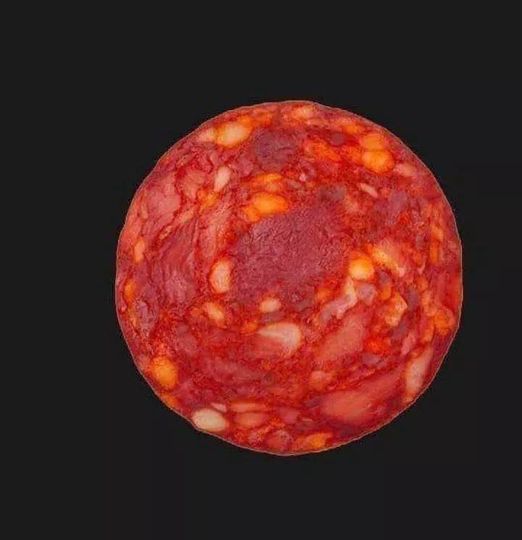
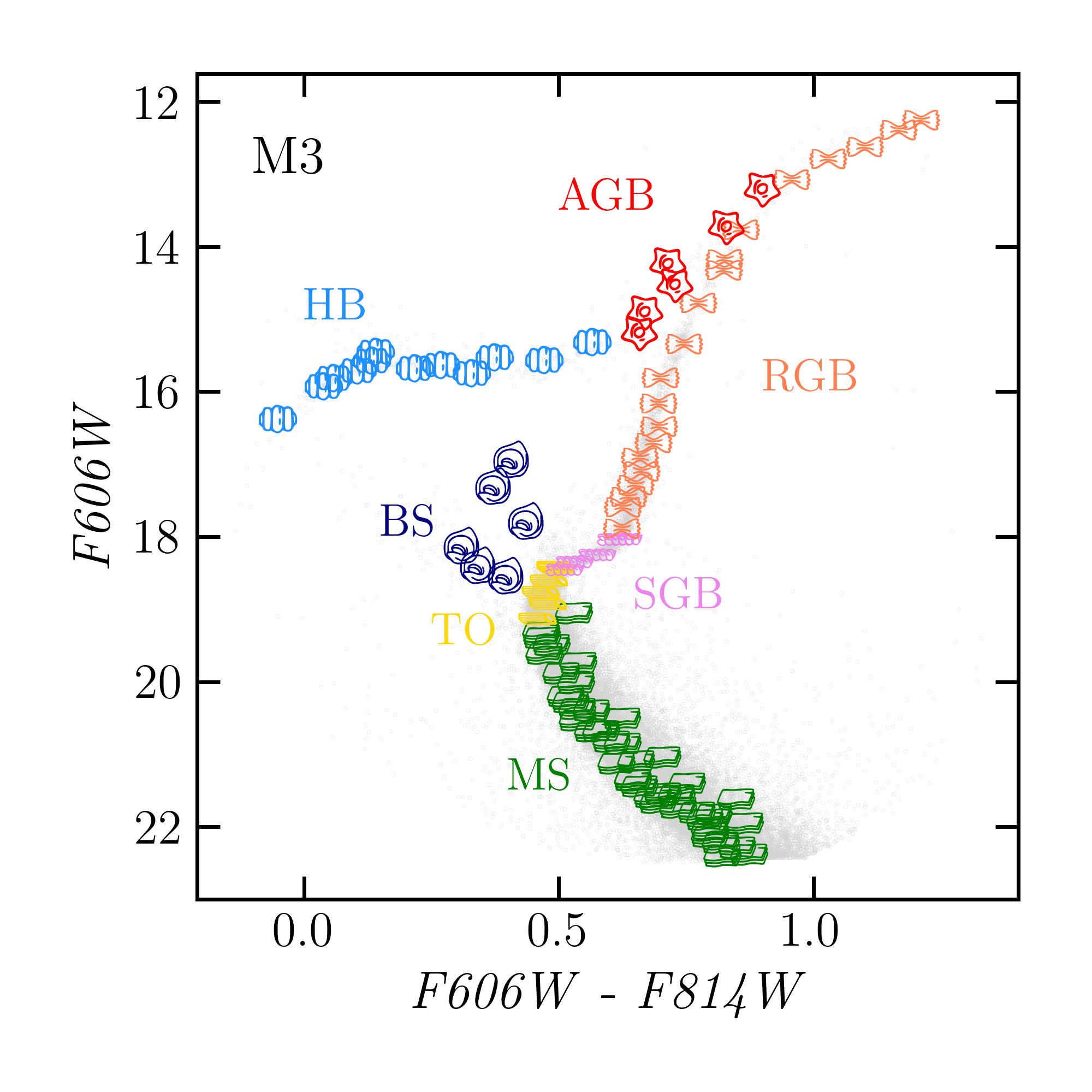
Here’s an example of a colour-magnitude diagram plotted with pasta markers, with the main sequence as Lasagne, etc.

You can download the pastamarkers package here.

Krapp’s Last Tape

Posted in Theatre with tags , , , on October 23, 2024 by telescoper

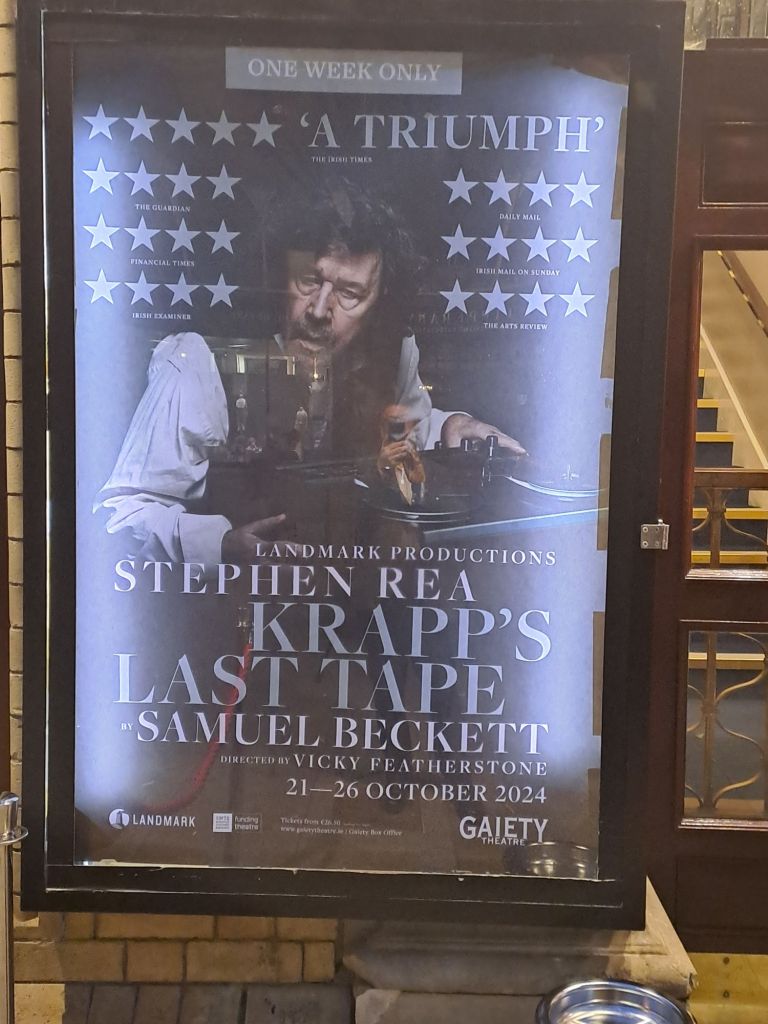
Unusually for me on a school night, this evening I travelled into Dublin not to the National Concert Hall but to the Gaiety Theatre for a performance of Samuel Beckett’s one-act play Krapp’s Last Tape.

The only character on stage for the performance is the eponymous Krapp played in this production by the inestimable Stephen Rea.

Krapp is listening to tape recordings he made as a younger man, apparently with the intention of recording another now he is an old man. It turns into a sort of dialogue between his present and past selves. Finally he gives up trying to make a new tape in favour of his memories. It’s a very poignant statement about ageing and the nature of memory.

Stephen Rea actually recorded the earlier tape about 12 years ago on the off-chance he would get to play the part, and the clear contrast in his voice makes the back-and-forth very convincing.

I’m very glad I got the chance to see this fine production of a modern masterpiece. Go and see it if you can!

P.S. Not a lot of people know that Samuel Beckett played first-class cricket.

Open Access Week 2024: Community over Commercialization

Posted in Open Access with tags , , , , , on October 22, 2024 by telescoper

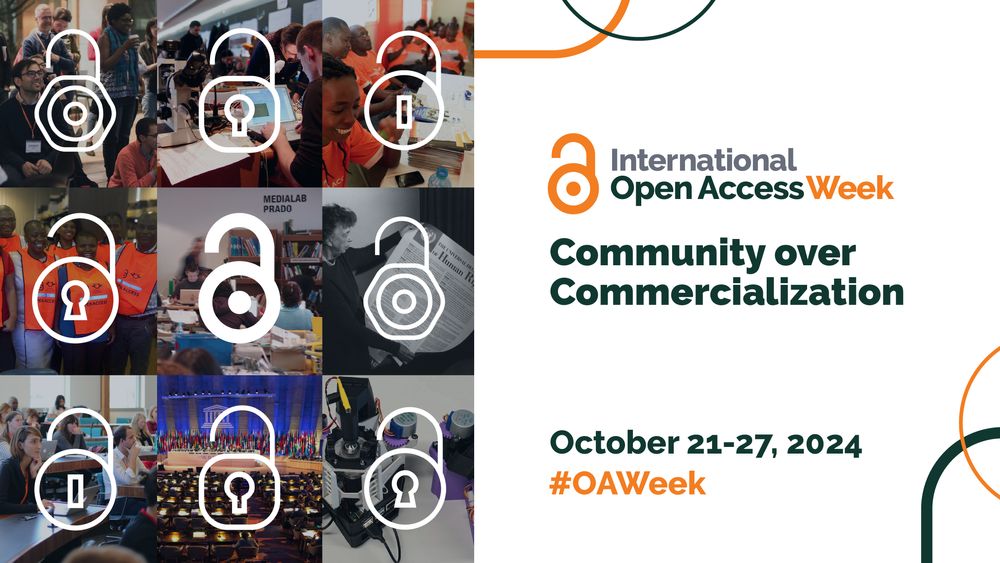
This week is Open Access Week 2024, the theme of which is Community over Commercialization. In light of this, among with some other journal editors I was contacted by Scholastica to provide some comments for their blog, Scholastica being the provider of the platform used by The Open Journal of Astrophysics. I was happy to respond to a couple of questions about how to build engaged communities.

Here are the comments of mine that they used in the blog post:

We started with a small editorial board basically formed from people who read various blog posts I’d written about the idea of the journal and followed its germination. We were lucky to have an initial group of high-profile scientists based all around the globe, including the USA. We started to get some papers from very well-known authors from leading institutes, and large international consortia. Some of these papers have generated large numbers of citations and have attracted coverage in the mainstream media, which also helped raise our profile.

Last year I was on sabbatical, which gave me the opportunity to travel and give invited talks about open access publishing in astrophysics at institutions in France, Spain, the UK, and Australia, and to audiences around the world via the Internet. Other members of the editorial board have also done their bit in promoting the journal. Our submission rate increased only slowly at first but is now more than doubling each year and we are currently receiving several submissions a day.  It has taken a while to establish the reputation of the Open Journal of Astrophysics this way, (i.e., mainly by word of mouth), but that has been good for us because it has enabled us to scale up our processes without becoming overwhelmed by a deluge.

My advice to others trying to set up a new journal would be to have a strong editorial board and clear policies, and above all to be patient. It takes a while — in our case more than 5 years — to establish a reputation in the academic community. These days there are too many people talking about this sort of publishing and not enough actually doing it. It’s time for researchers and research institutions to claim back the original purpose of academic publishing, the free dissemination of research for the public good.

You can read comments from three other editors of open access journals in the original Scholastica blog post.

“Optimized” Beer Glass Shapes

Posted in The Universe and Stuff with tags , , , on October 21, 2024 by telescoper

I couldn’t resist sharing a piece of fundamental research I found in an article on the arXiv withthe abstract:

This paper addresses the problem of determining the optimum shape for a beer glass that minimizes the heat transfer while the liquid is consumed, thereby keeping it cold for as long as possible. The proposed solution avoids the use of insulating materials. The glass is modeled as a body of revolution generated by a smooth curve, constructed from a material with negligible thermal resistance, but insulated at the base. The ordinary differential equation describing the problem is derived from the first law of Thermodynamics applied to a control volume encompassing the liquid. This is an inverse optimization problem, aiming to find the shape of the glass (represented by curve S) that minimizes the heat transfer rate. In contrast, the direct problem aims to determine the heat transfer rate for a given geometry. The solution obtained here is analytic, and the resulting function describing the relation between height ans radius of the glass, is in closed form, providing a family of optimal glass shapes that can be manufactured by conventional methods. Special attention is payed to the dimensions and the capacity of the resulting shapes.

arXiv:2410.12043v1

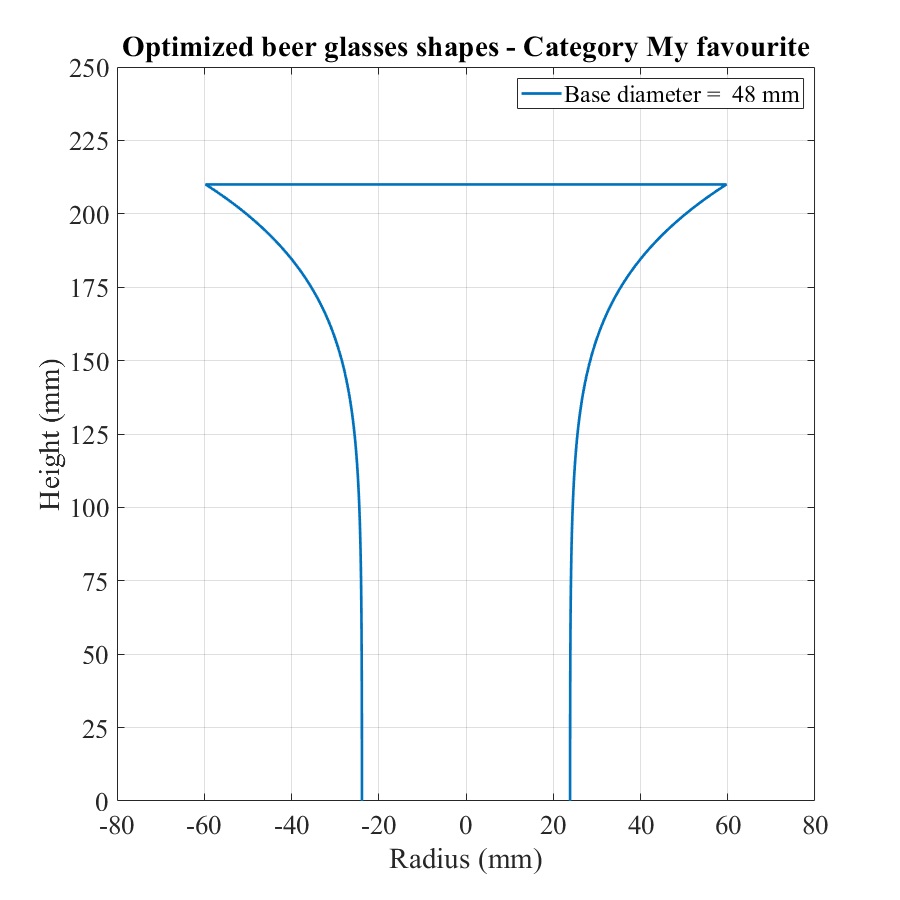
The author’s favourite shape is this:

Of course those of us who are used to proper beer don’t really want it to be cold in the first place, but I hope this doesn’t sound bitter. My main reservation about the conclusion of the paper is that it doesn’t seem to take into account how easy it is to drink from the glass. In that respect, I’m not convinced by the shape above!

Storm Ashley

Posted in Biographical with tags , on October 20, 2024 by telescoper

Storm season has arrived in Ireland!

Storm Ashley has been battering the West of the country today. It’s not been as bad here in the sheltered environs of Maynooth, though we have had gusts up to 80 km/h which has left my garden in disarray with leaves and twigs all over the place.

The Mark Brake Scandal, 15 years on…

Posted in Cardiff, Education with tags , , , , on October 20, 2024 by telescoper

This blog has been going for over 16 years now. Those readers who have been following it all that time will remember that in October 2009, 15 years ago, I posted an item about Mark Brake, a Professor at the University of Glamorgan who falsely claimed on a funding application that he had a PhD from Cardiff University. I thought for old times’ sake I would post the article again…

P.S. This story was responsible for me being threatened with a libel action. My response was to pass on the name and address of my solicitor with the message “Go ahead. Make my day” (or words to that effect). I never heard back.

P.P.S. The University of Glamorgan no longer exists as such, as in April 2013 it merged with University of Wales, Newport, to form the University of South Wales

Six New Publications at the Open Journal of Astrophysics

Posted in OJAp Papers, Open Access, The Universe and Stuff with tags , , , , , , , , , , , , , , , , , , on October 19, 2024 by telescoper

It’s Saturday morning again and time to post an update of activity at the Open Journal of Astrophysics. As last week there are six papers to announce, bringing the count in Volume 7 (2024) up to 93 and the total altogether up to 208.

In chronological order, the six papers published this week, with their overlays, are as follows. You can click on the images of the overlays to make them larger should you wish to do so.

First one up, published on Monday 14th October 2024, is in the folder marked Cosmology and NonGalactic Astrophysics and is called “Backreaction in Numerical Relativity: Averaging on Newtonian gauge-like hypersurfaces in Einstein Toolkit cosmological simulations“. This paper presents a numerical study of the effect of local inhomogeneities on the dynamical evolution of the Universe, i.e. the so-called “backreaction” problem; the authors are Alexander Oestreicher and Sofie Marie Koksbang of the University of Southern Denmark, Odense, Denmark.

Here is a screen grab of the overlay, which includes the abstract:

You can find the officially accepted version of the paper on the arXiv here.

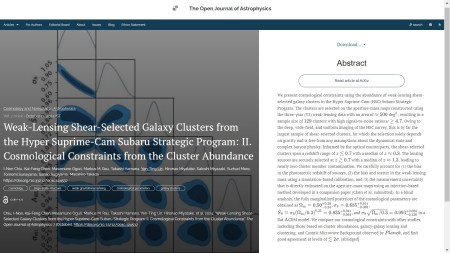
The second paper to announce, published on 15th October 2024, is “Weak-Lensing Shear-Selected Galaxy Clusters from the Hyper Suprime-Cam Subaru Strategic Program: II. Cosmological Constraints from the Cluster Abundance” by I-Non Chiu (National Cheng Kung University, Taiwan) and 11 others based in Taiwan, Japan, India and the USA. This paper, which is also in the folder Cosmology and NonGalactic Astrophysics  presents constraints on cosmological parameters obtained from a sample of galaxy clusters

You can see the overlay here:
The accepted version of this paper can be found on the arXiv here.

The third paper is “Image formation near hyperbolic umbilic in strong gravitational lensing” by Ashish Kumar Meena (Ben Gurion University, Israel) and Jasjeet Singh Bagla (IISER Mohali, India). It presents a detailed theoretical discussion of a particular form of strong gravitational lensing and its observational consequences; it is in the folder Astrophysics of Galaxies and was published on October 15th 2024.

The overlay is here:


The officially accepted version can be found on arXiv here.

The fourth paper, published on 16th October 2024 and in the folder Astrophysics of Galaxies,  is “Weak Gravitational Lensing around Low Surface Brightness Galaxies in the DES Year 3 Data” by N. Chicoine (University of Chicago, USA) et al. (105 authors; DES Collaboration). It presents a  demonstration of the viability of using weak gravitational lensing to constrain the halo masses of low surface brightness galaxies.

The overlay is here


You can find the officially accepted version of this paper here.

The fifth paper in this batch is “Imprints of interaction processes in the globular cluster system of NGC 3640” by Ana I Ennis (Waterloo, Canada) and Juan Pablo Caso & Lilia Patricia Bassino (Instituto de Astrofísica de La Plata, Argentina). This one was also published on 16th October 2024 and is in the folder Astrophysics of Galaxies, Here is the overlay


You can find the official accepted version on the arXiv here.

Finally for this week we have “On the nature of the C IV-bearing circumgalactic medium at 𝒛∼𝟏” by Suyash Kumar, Hsiao-Wen Chen, Zhijie Qu & Mandy C. Chen (U. Chicago), Fakhri S. Zahedy (U. North Texas), Sean D. Johnson (Carnegie Observatories), Sowgat Muzahid (IUCAA, India) and Sebastiano Cantalupo (U. Milan Bicocca)

The overlay is here


You can find the officially-accepted version on arXiv here.

That’s it for now. More next week!
Steps to Improve

Posted in Education, Maynooth with tags , , , , , on October 18, 2024 by telescoper

Along with all academic staff at Maynooth University I received an email this afternoon from the Vice-President for Research and Innovation, which contained the following request:

Well, I certainly won’t be providing any such lists at any time for this or any similar purpose, let alone by next Wednesday! I will be boycotting the QS World University Rankings and I urge any of my “peers” who are contacted about it to do likewise.

I assume that request this is a panicky reaction to the fact that Maynooth is so low in the current current QS league tables and falling in most others. This decline is a direct result of policies implemented by the Management Team at Maynooth, pushing up a student-staff ratio that is already the highest in Ireland, and starving core activities of resources while squandering millions on management salaries and perks – latest example of which is  €500,000 on a luxury taxi service for “priority staff members”; you can guess who that means. ..

I would prefer that the people in charge of Maynooth University made some attempt to improve teaching and research – you know, the things that a university is suppose to do – rather than try to game these ridiculous league tables. Such an approach, however, seems to be out of the question. Maynooth’s race to the bottom is bound to continue unless and until attitudes change at the top.

The trouble with arXiv

Posted in Biographical, Open Access with tags , , , , on October 17, 2024 by telescoper

We’re now publishing papers at a steady rate at the Open Journal of Astrophysics. This is probably not obvious to outsiders, but our platform actually consists of two different sites, one handling submissions and the other dealing with publishing those papers accepted. Although we have a large (and still expanding) team of volunteer Editors to deal with the former, as Managing Editor I am the only person with the keys to the publishing side of things. This part of the process has been simplified enormously after the automation introduced earlier this year but it still takes some time to do, as I have to check the overlay and metadata before pressing the button to deposit everything with Crossref and make the overlay live. I also announce each paper on social media. This usually takes around 15 minutes per paper, give or take.

Now that I’ve returned to full teaching duties at Maynooth University, I’ve developed a routine to deal with this activity. During workdays I usually wake around 7am, make some coffee, and then check the day’s arXiv mailing to see if any of our accepted papers have been announced. If any have, I do the honours while I have my coffee, and then proceed to shower and breakfast (including Coffee no. 2); if none have, I go straight to shower and breakfast. I’ve been following this routine for quite a while now.

In the last couple of weeks, however, I have noticed quite often when I try to look up newly-announced papers on arXiv that the connection times out with a message saying ‘rate exceeded’. If that happens I just wait a while and try again. It’s not a very serious issue but it does slow down the process.

Well, today I found out the reason via a message on Mastodon. The loading errors at arXiv are caused by people doing many simultaneous downloads in attempts to scrape all the content from arXiv as soon as it is announced. This is almost certainly to provide material for Large Language Models, such as ChatGPT, which are essentially Automated Plagiarism Engines. I propose the acronym APE for the kind of person who engages in this sort of activity.

This is a very tedious development and I hope arXiv can find a way of putting a stop to it without inconveniencing its authentic users. I suggest that the people managing arXiv identify the culprits and send the boys round.

Eyes Right!

Posted in Biographical with tags , , , on October 17, 2024 by telescoper

Yesterday afternoon I had my eyes examined, it being two years since my last test. I went with some trepidation because for the past several visits to the optometrist have resulted in a new prescription and the consequent need to fork out a not inconsiderable amount of dosh on new spectacles. I wear varifocals as I have both astigmatism (which primarily affects long-distance vision) and the usual problem at close range for people of my age. Varifocal lenses are rather expensive but do work pretty well for me. Since I’m now a member of the Over-Sixties Club I just assumed there would be steady deterioration from now on.

Every time I go to the opticians they seem to have different kit and a different procedure, but this time – to my surprise – the result was the same as last time: no change in prescription and therefore no need to buy new glasses. It was good to learn that my vision is relatively stable. I’m set for the next two years, unless I lose or break my specs and need to replace them.

Before the eye test itself I had a retinal exam which involved taking a picture of the back of my eye. This wasn’t carried out by the optometrist but by an assistant, but the resulting photographs were delivered magically onto the optometrist’s computer screen and shown to me. It turns out my eyes are reasonably healthy. Indeed the picture of my retina has hardly changed since the one from two years ago