Archive for November, 2024

Ring, Dvořák and Tchaikovsky at the National Concert Hall

Posted in Music with tags , , , , , , on November 30, 2024 by telescoper

After a gap of a few weeks due to other commitments, last night I went to the National Concert Hall in Dublin to see and hear another programme of music performed by the National Symphony Orchestra. Unusually for these Friday evening concerts by the NSO, it wasn’t broadcast live or even, judging by the absence of microphones on and over the stage, recorded. I suppose that might have been for some contractual reason.

Tyhe conductor for this performance was Patrik Rinborg, from Sweden. The first thing that struck me about him was that he is very tall – his was a towering presence on the podium. Looking through my back catalogue I find I attended a performance of the Dvořák Requiem conducted by him back in January 2020, not long before the pandemic struck.

The first piece, Everything was asleep as if the universe was a vast mistake by Judith Ring, received its performance in January 2023. The title is from a translation of a quite by Fernando Pessoa. I found this piece quite interesting, especially the changes of colour and energy, but spoilt a little for me by the repeated short sliding phrases coming from the trombones, which I thought sounded rather lavatorial and therefore jarring in the context of the work. Anyway, Judith Ring was in the audience last night and came up on stage at the end of the performance to great applause.

The second work was a perennial favouite in the concert hall, the Cello Concerto in B minor by Antonín Dvořák. I think most people, if asked to name half-a-dozen great works for cello and orchestra would put this one on their list. Last night’s soloist was Camille Thomas, resplendent in a glamorous purple frock, who played beautifully. Her body language was interesting even when she wasn’t playing, sometimes leaning back with her arms by her sides as if transported by the music, and sometimes turning around to look at the orchestra to encourage them. She got a well-deserved ovation at the end, and did a solo encore in the form of a piece called Song of the Birds by Pablo Casals.

After the wine break we returned for Symphony No. 5 in E minorOp. 64 by Pyotr Ilyich Tchaikovsky. In advance of the concert I had this muddled up with the Manfred Symphony, which I have heard live before. That was indeed the fifth symphony that Tchaikoksky composed, but is not counted among the numbered symphonies. I hadn’t previously heard a full performance of the Symphony No. 5 we heard last night, so I came to it relatively fresh. Things to note about it are distinct shifts in tonality through the four movements, and a single motif repeated throughout in different forms. It did make me think of the Symphony No. 7 “Leningrad” by Shostakovich who seems to have borrowed the idea for the “invasion” theme of the first movement.

I enjoyed the performance a lot – it was played with much vigour and nuance by the NSO – but at a first hearing I’m not a huge fan of the piece. It’s a bit less than 50 minutes long and by the end I was very bored with the motif. I wasn’t as uplifted by the final movement, where it reaches resolution in E Major, as I think I was supposed to feel as I thought it very brash and unsubtle.

Anyway the audience responded with generous applause at the end of this concert, which was quite a long one (partly because of the encore). For one thing that meant I had much less time to wait for my train back to Maynooth than usual.

New Publication at the Open Journal of Astrophysics

Posted in Maynooth, OJAp Papers, Open Access, The Universe and Stuff with tags , , , , , on November 30, 2024 by telescoper

It’s Saturday morning once again so it’s time for the usual weekly update of publications at the Open Journal of Astrophysics. This week’s report will be short because, like last week, there is only one paper to report this week, being  the 106th paper in Volume 7 (2024)  and the 221st  altogether. It was published on Thursday 28th November 2024. We have some more papers in the publishing pipeline, which I thought might appear, but they didn’t come out this week possibily because of the Thanksgiving holiday in the USA.

Anyway, The title of the latest paper is “Growth of Light-Seed Black Holes in Gas-Rich Galaxies at High Redshift” by Daxal Mehta, John Regan and Lewis Prole (all of the National University of Ireland, Maynooth*. This paper presents a discussion of the rate of growth of black holes in the early Universe on the basis of simulations run using the Arepo code.

Here is the overlay of the paper containing the abstract:


You can click on the image of the overlay to make it larger should you wish to do so. You can also find the officially accepted version of the paper on the arXiv here.

That’s all for this week – tune in next Saturday for next week’s update!

*The authors being from Maynooth, I of course recused myself from the editorial process for this article.

Polling Day!

Posted in Biographical, Politics with tags , , , , on November 29, 2024 by telescoper

This morning I noticed that the Google Doodle was reminding me to vote, so I took a detour on the way to work and exercised my franchise. I don’t have much optimism about the outcome, as I think we’re likely to end up with the same old same old, but at least I’ve had my little say.

Regardless of the likely outcome, I do enjoy voting in person. I don’t understand people who can’t be bothered, especially when there is an electoral system such as Ireland’s that allows a spread of political opinions to be represented. In my constituency there is a spectrum from far left to far right, though those most likely to win are the place everyone now calls Centre, but which to me is on the right. The two main parties in Ireland are really just one party, the Property Party, and it has two right wings (called FF and FG).

The polling station at the Presentation Girls School wasn’t busy when I voted, and the staff there were very friendly and helpful. The ballot paper was quite big – it had to be to accommodate sixteen names and photographs. Fortunately the weather has turned mild again so turnout should be reasonable. Polls stay open until 10pm and counting doesn’t start until tomorrow. I’ve plenty of other things with which to occupy myself for the rest of the day, including some coursework to be graded, a lecture to give, and later this evening, a concert to attend.

The Cuts in UK Higher Education

Posted in Biographical, Cardiff, Education, Maynooth, Politics with tags , , , , on November 28, 2024 by telescoper

Today friend of mine send me a message pointing out that in order to save money the University of Sussex is planning to make about 300 staff redundant; you can see an article about it in the Times Higher here. For the time being it seems the plan to make these savings via a voluntary severance scheme. I don’t know whether academic and administrative staff will be treated equally, either.

This is grim news. I worked at Sussex from 2013 until 2016 when I resigned my post as Head of School of Mathematical and Physical Sciences. I took that decision largely for personal reasons but there were professional reasons too. From 2013 the University had embarked on an ambitious growth plan based on buoyant student numbers and the fee income generated thereby. Staff numbers grew too, to cope with the increased demand for teaching. Unfortunately the management was unable to match this with real improvements in infrastructure, largely due to the disastrous outsourcing of campus estates and services. Many promises made to me as Head of School by Senior Management were broken. I wasn’t the only Head of School to compain of this, either. Although things were still going relatively well when I left in 2016, and I was optimistic for the future of the School then, there were severe risks to its financial stability if student recruitment dived. Sadly, that’s exactly what happened. Falling student numbers – especially from overseas – left the institution very vulnerable, especially since the fee per student did not change. That problem was exacerbated by a burst of inflation. AlthoughIt has clearly been a very difficult time for the University of Sussex, largely due to national and international forces beyond its control, but exacerbated by ineffective, and at times incompetent, institutional management. It should be said also that many University leaders enthusiastically embraced the fees-based system that has led their institutions where they are now, though most of them have now departed and left others to carry the can.

It worries me that Maynooth University is also trying to grow very quickly, without adequate investment in infrastructure especially teaching. It isn’t increasing the number of academic staff much either, preferring to hire more and more managers; yet another such position was advertised this week. I don’t know whether Maynooth’s financial trajectory will follow that of Sussex. The funding environment is very different in Ireland compared to the UK, so it may not. It is clear that the enviroment for education and research here is being steadily degraded by the current leadership.

Anyway, when I saw the announcement about Sussex, I checked other Universities I’ve worked in over the years. There’s a list here. It seems that while there are particular factors at play at Sussex, there are similar difficulties across the Board. Cardiff University has a deficit of £35 million and the VC has refused to rule out compulsory redundancies there. I’m not sure how this is all affecting the School of Physics & Astronomy. Nottingham University, where I worked from 1999 to 2007, has deficit of £30 million, in response to which it has opened a voluntary severance scheme, introduced hiring freezes, cut non-pay budgets, and refused to renew 500 fixed-term contracts.

There certainly are cold winds blowing across the University landscape in the United Kingdom, and there is no sign of any respite. This is just the start.

Approaching Examinations

Posted in Education, Maynooth with tags , , , , , , , , on November 27, 2024 by telescoper

We’re in Week 9 of teaching in the Autumn Semester at Maynooth University, which means we’ve got one eye on the forthcoming Examination Period, which starts on 10th January 2025. Examination papers have already been prepared in draft form, and are now being checked ahead of printing. A draft examination timetable has also been released to staff, but not yet to students in case it has to be revised because of clashes.

I’m still on schedule with both my modules to finish the actual content in time to do use the last week for revision classes, going through past examination papers and generally helping the students prepare for the ordeals of January. There is a continuously-assessed component of both my modules, which counts 20% of the overall grade. One purpose of these assignments is to give the students some practice at the sort of problems they might encounter in the examinations: if they can do the assignments, they shouldn’t be too fazed by the examination questions. The purpose of the coursework is not just about passing examinations, however. I think the only way really to learn about mathematical physics is by doing it; the coursework is at least as important as the lectures and tutorials in terms of actually learning the subject. I think that modern higher education involves drastic over-assessment. Too much emphasis on grades and scores can be detrimental to real learning, but assessment that is formative can be extremely beneficial. Continuous assessment provides a way to give feedback to students on how they are doing, and to lecturers on how well the message is getting across; giving grades to such coursework is really just an incentive to the students to do it. It’s not primarily intended to be summative.

Anyway, back to examinations. One big difference between our examinations in Theoretical Physics in Maynooth and those at other institutions at which I’ve taught (in the UK) is that most of the papers here offer no choice of questions to be answered. Elsewhere it is quite common to find a choice of two or three questions from four or five on the paper. In my module on Differential Equations and Complex Analysis, for example, there are four questions on the examination paper and students have to do all of them for full marks.

One  advantage of our system is that it makes it much harder for students to question-spot in the hope that they can get a good grade by only revising a fraction of the syllabus. If they’re well designed, a few longish questions can cover most of the syllabus for a module, which they have to in order to test all the learning outcomes. To accomplish this, questions can be split into parts that may be linked to each other to a greater or lesser extent in order to explore the connections between different ideas, but also sufficiently separate that a student who can’t do one part can still have a go at others. With such a paper, however, it is a  dangerous strategy for a student to focus only on selected parts of the material in order to pass.

As an examiner, the Maynooth style of examination also has the advantage that you don’t have to worry too much if one question turns out to be harder than the others. That can matter if different students attempt different questions, as students might be penalized if they chose a particularly hard one, but not if everyone has to do everything.

But it’s not just the number of questions that’s important, it’s the duration. I’ve never felt that it was even remotely sensible for undergraduate physics examinations to be speed tests, which was often the case when I was a student. Why the need for time pressure? It’s better to be correct than to be fast, I think. I always try to set examination questions that could be done inside two hours by a student who knew the material, including plenty of time for checking so that even a student who made a mistake would have time to correct it and get the right answer. If a student does poorly in this style of examination it will be because they haven’t prepared well enough rather than because they weren’t fast enough.

Dorothy Bishop’s Resignation from the Royal Society

Posted in Politics, Science Politics with tags , , , on November 26, 2024 by telescoper

Just a quick post to draw your attention to a blog post by eminent pyschologist Dorothy Bishop, who has just taken the decision to resign as a Fellow of the Royal Society in protest at that institution’s refusal to strip Elon Musk of the status of FRS he was awarded in 2018.

Here’s an excerpt from the post:

For many scientists, election to the Royal Society is the pinnacle of their scientific career. It establishes that their achievements are recognised as exceptional, and the title FRS brings immediate respect from colleagues. Of course, things do not always work out as they should. Some Fellows may turn out to have published fraudulent work, or go insane and start promoting crackpot ideas. Although there are procedures that allow a fellow to be expelled from the Royal Society, I have been told this has not happened for over 150 years.

The post – which is very well written – goes on to explain why Musk is unfit to hold the title FRS and why attempts to expel him have stalled. I suggest you read it all.

I’m not a Fellow of the Royal Society, and will never be elected such, but it beats me why any self-respecting scientist would want to be a member of the Elon Musk Fan Club anyway.

100 Years of Paul Desmond

Posted in Jazz with tags , , , , , on November 25, 2024 by telescoper

This evening I happened across a reminder that today is the centenary of the birth of saxophonist and composer Paul Desmond, who was born on November 25th 1924. Paul Desmond is best known for his work with Dave Brubeck’s quartet from 1951 to 1967, and particularly as composer of their smash hit Take Five. He didn’t only work with Brubeck, though. He made fine recordings with Chet Baker and Gerry Mulligan amongst others. His gentle tone and lyrical phrasing on alto saxophone were instantly recognizeable and very typical of the West Coast style of cool jazz, and on alto saxophone was instantly recognizeable. Never a speed merchant in the Charlie Parker tradition, Desmond fell out with Brubeck’s drummer Joe Morello who would often set the tempo, especially on Take Five, too fast in live performances, so I thought I’d pay my little tribute by playing a less familiar number, the Japanese-influenced Koto Song on which Paul Desmond plays very beautifully.

Machine-based Censorship

Posted in Biographical with tags , , , , , , , on November 25, 2024 by telescoper

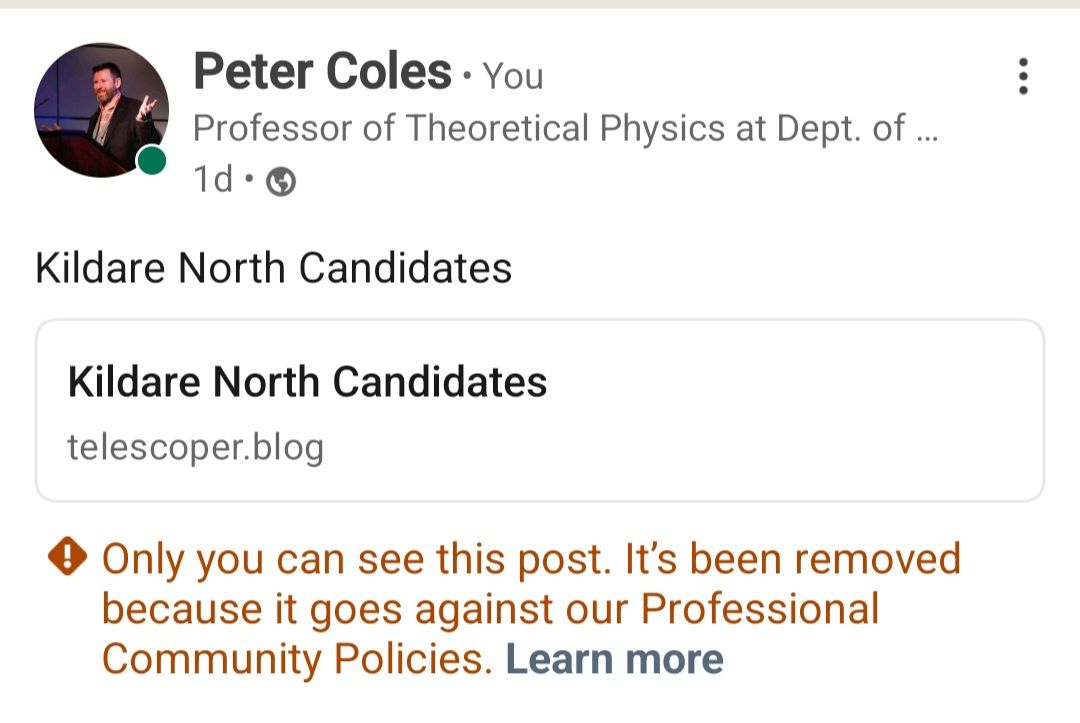
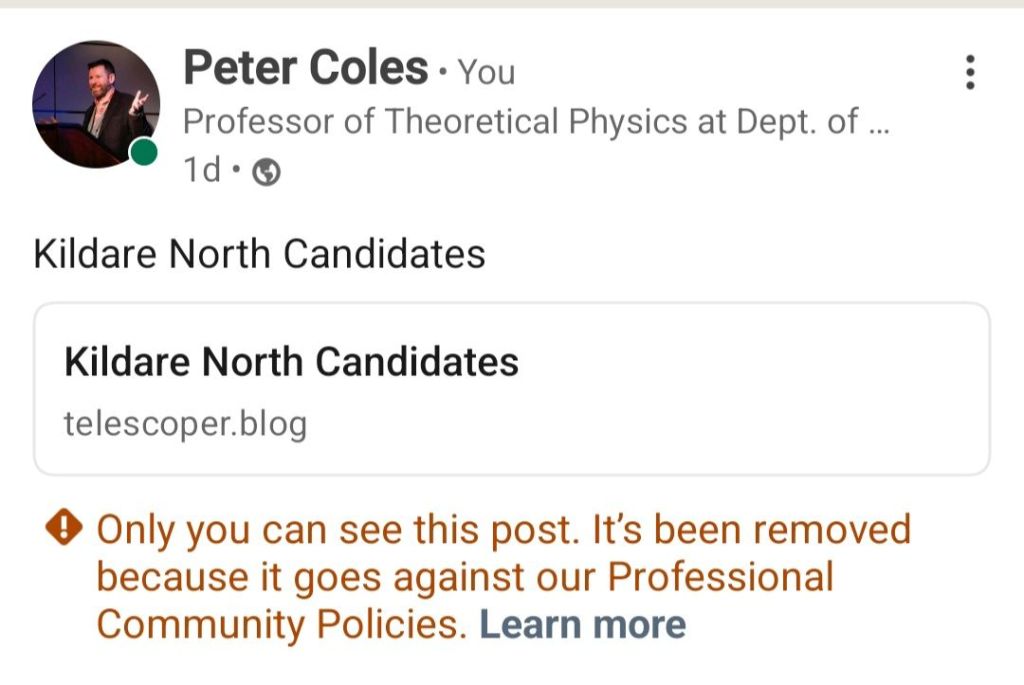
A very noticeable manifestation of the rise of so-called Artificial Intelligence has been the use of AI bots in censoring posts. The most recent example of this I’ve seen was on Saturday when I wrote a post about the general election candidates for my constituency, Kildare North. As usual when I write an article here it gets posted automatically on a variety of other platforms, including LinkedIn. However, Saturday’s post was blocked:

The powers that be did not tell me which of the “Professional Community Policies” that post might have violated so I looked through them all and couldn’t find any plausible reason for blocking that post. I can only assume some defect in the algorithm deployed by LinkedIn had been triggered wrongly. Unfortunately, all this is run by machine so there is no possibility of appeal.

I’ve noticed quite a few bizarre things like this over the past few weeks. The worst offender when it comes to random censorship is Meta (which runs Facebook, Instagram and Threads). I have been posting content automatically on Meta platforms, Facebook and Threads. Recently, however, Meta’s AI algorithm has gone berserk. A couple of weeks ago it blocked this post (about the Edgeworth family) on the grounds that it violated rules concerning “nudity or sexual activity”. Heaven knows how it decided that; you can read the post yourself. I defy you to find any nudity or sexual activity, or reference thereto, or link to any post that mentions such things, anywhere in it!

When I appealed the decision I got this.

Truly bizarre.

More recently, it blocked this post (one of my regular weekly updates for OJAp) on the grounds that it was identified as spam. I can see the need for an automatic screening given the huge volume of posts, but the problem is that my facebook feed is full of actual spam that gets through these filters while innocent posts get blocked. In other words the algorithm is crap. If you ask for a review of the decision, all Meta does is run the algorithm again – with the same results, which is a waste of time.

The algorithm that screens comments on this blog for spam has also been playing up, with some comments from regular contributors being tagged as spam.

None of these is in itself of any consequence to me personally, not least because I’m not trying to run a business using these platforms. However, such AI engines are being deployed nowadays in a huge range of contexts primarily in order to save money. No doubt such processes do save money, but if they are based on poorly constructed algorithms – which they seem to be – the consequences could be dire. Imagine the horror of a health service based on poorly trained AI…

Space Warps from Euclid

Posted in Euclid, The Universe and Stuff with tags , , , , , on November 24, 2024 by telescoper

A few months ago I posted about a joint initiative between Euclid and Galaxy Zoo that involved engaging members of the public in a project involving galaxy morphology. Well, a new “collab” (as you young people call such things) has just been announced on social media, and I encourage you to investigate further

The new venture is called `Space Warps – ESA Euclid’, and its aim is to find strong gravitational lenses in Euclid survey images. You can find out more about this project in this blog post by Knud Jahnke and you can find instructions and sign up for the project here.

The announcement of this initiative gives me an opportunity to pass on a little update on progress with the Euclid survey. The first `Quick’ Data Release (known to its friends as Q1) was made available to Euclid Consortium members just a few weeks ago. This will be made available to the general public next March, around the same time as the joint ESLAB and Euclid Consortium meeting in Leiden next year.

The Euclid survey is constructed as a set of contiguous `tiles’ covering the survey region, which will ultimately be about 15,000 square degrees (about one-third of the sky), with most of the region scanned by the satellite many times. The Q1 data will just be a taster of this. The main component of the Q1 data relates to a single visit (at the depth of the Euclid Wide Survey) over the Euclid Deep Fields (EDFs): 20 deg2 of the EDF North, 10 deg2 of EDF Fornax, and 23 deg2 of the EDF South. The deep fields will subsequently be visited multiple times during the mission.  The Q1 release will be of Level 2 data, i.e. data at the level of individual tiles.

The first full data release (DR1) is due to be published in June 2026.

Kildare North Candidates

Posted in Politics with tags , , , , , , , , , , , , , on November 23, 2024 by telescoper

The arrival of my polling card yesterday indicates that the general election in Ireland on Friday 29th November is approaching rapidly, so I thought I’d give a rundown of the 16 candidates who will appear on the ballot paper for my constituency, Kildare North.

Kildare North will return 5 TDs (Teachta Dála, or Deputies), one more than last time because of the population growth in the area. The current TDs are Réada Cronin (SF; Sinn Féin), Bernard Durkan (FG; Fine Gael), James Lawless (FF; Fianna Fáil) and Catherine Murphy (SD; Social Democrats). The latter is retiring so will not be standing at this election. The current government is a coalition of FG, FF and Green Party TDs.

The Single Transferable Vote system is used, meaning that voters have a single ballot paper on which they rank the candidates in order of preference. The candidate with the lowest number of first-preference votes is eliminated and their second preference votes redistributed. Candidates are thus progressively eliminated until the requisite number of TDs is selected.

There are three FG candidates: Bernard Durkan, Joe Neville and Evie Sammon). They are based in Maynooth, Leixlip and Celbridge respectively so are presumably hoping that local voting will work out in their favour. The idea presumably is that Bernard Durkan would be first choice in Maynooth, etc. However, I’ve already had canvassers arguing that I should put Joe Neville first. I won’t be voting for any of the candidates anyway, but I would be very amused if their decision to put three candidates forward backfired. Incidentally, Bernard Durkan is 79 and has been a TD since 1982. The leaflet I got from him promised “New Energy” for Kildare North. Yeah, right…

There are two FF candidates, James Lawless and Naoise Ó Cearúil; the latter was elected to the County Council this summer. I find FF indistinguishable from FG. Together or separately these two parties have governed the Republic since its creation and a change is long overdue.

The two Sinn Féin candidates are the incumbent Réada Cronin and Caroline Hogan. I haven’t seen any posters for Réada Cronin up in Maynooth, so I assume the campaign team is saving their resources for elsewhere. Maynooth is not traditionally an SF stronghold.

With Catherine Murphy not standing, the Social Democrats ran a process to select a replacement candidate, which was won by Aidan Farrelly (who actually works at Maynooth University) who is the official SD candidate. That doesn’t end the story, however. Former SD member Bill Clear is standing as an Independent because he didn’t get selected. Adding to the fact that Catherine Murphy had a considerable personal following, this looks like a bit of a mess for the Social Democrats whose vote will probaboly be reduced and split. It may be in order to capitalize on this that SF added a candidate; they only fielded one last time round.

Now we’re into the (probable) also-rans. Angela Feeney is standing for Labour. She is an active member of the Council, representing Maynooth, but it’s not clear whether she has reach over the rest of the constituency. Vincent Martin represents the Greens who haven’t previously been strong here. The Green Party in Ireland is nowhere near as left-wing as corresponding parties in the UK and elsewere. It often seems like the bicycle division of Fine Gael. Leah Whelan is standing for People Before Profit – Solidarity, the only really left-wing party standing in Kildare North.

Then we have we have a number of generally disagreeable (to me) fringe party candidates: Una O’Connor is standing for Aontú, a reactionary splinter group of people previously in Sinn Féin and Sean Gill for the Centre Party of Ireland, an ironic name for what is far-right splinter group of FG previously known as Renua. Gerry Waters is standing from the Irish Freedom Party. He was struck off the medical register for refusing to administer vaccines and has unsupportable far-right opinions on other issues. Last and by all means least is Avril Corcoran who is candidate for The Irish People, a far-right nationalist party which is part of the National Alliance of like-minded bigots.

It’s probably obvious which 11 candidates I’m not going to be voting for, but I’ll leave you to guess in what order I will rank the other 5!

P.S. LinkedIn didn’t like this post: