A couple of months ago I announced here a vacancy for a Professor of Observational Astrophysics or Cosmology at Maynooth. The position is on the AAS Jobs Register here. The deadline is 31st March 2025 which is today so if you were thinking of applying then this is your last chance! Applications close at 23.30 Irish Time; the clocks went forward yesterday so it’s actually 00.30 tomorrow CEST so you still have time. The application portal is here.
The strategic case for this Chair revolves around broader developments in the area of astrophysics and cosmology at Maynooth. Currently there are two groups active in research in these areas, one in the former Department of Experimental Physics (which is largely focussed on astronomical instrumentation) and the other, in the former Department of Theoretical Physics, which is theoretical and computational. We want to promote closer collaboration between these research strands. The idea with the new position is that the holder will nucleate and lead a research programme in the area between these existing groups as well as getting involved in outreach and public engagement.
It is intended that the position to appeal not only to people undertaking observational programmes using ground-based facilities (e.g. those provided by ESO, which Ireland recently joined), or those exploiting data from space-based experiments, such as Euclid, as well as people working on multi-messenger astrophysics, gravitational waves, and so on.
P. S. For those of you reading this from outside Ireland the job is tenured and includes a defined benefit pension way better than the equivalent UK system.
What with all the cosmological goings-on of the past couple of weeks – see here, here and here – I quite forgot to mention another important set of results. These are from the final data release Kilo-Degree Survey known as KiDS for short and represent a final analysis of the complete dataset. For those of you not in the know, KiDs is a weak lensing shear tomography survey and its core science drivers are to map the large scale matter distribution in the Universe and constrain the equation of state of Dark Energy. The results can be found in three papers on arXiv, which you can add to your reading list:
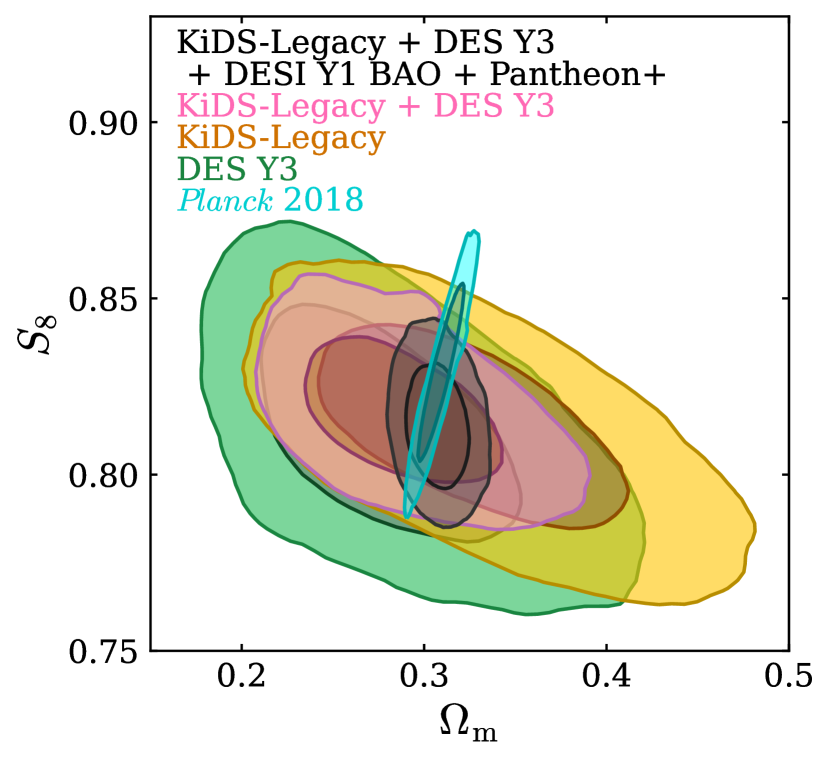
As far as I’m concerned, the main result to leap out from the cosmological analysis, which primarily constrains the clumpiness of matter in the universe, expressed by the density parameter Ωm and a fluctuation amplitude σ8 in the combined parameter “S8“, which is constrained almost independently from Ωm. The value obtained for this parameter by KiDS has previously been “in tension” with values from other experiments (notably Planck) ; see here for a discussion. The new results, however, seem consistent with the standard cosmological model. Here is a figure from the last paper in the above list that illustrates the point:
As is often the case, there’s also one of those nice Cosmology Talks videos that discusses this and other aspects of the KiDS Legacy results to which I refer you for more details!
It’s time once more for the regular Saturday morning update of papers published at the Open Journal of Astrophysics. Since the last update we have published three new papers which brings the number in Volume 8 (2025) up to 32 and the total so far published by OJAp up to 267.
We’re almost at the end of March so I checked the records. In the first three months of last year we published 22 papers, compared to the 32 so far this year.
We were affected by a few gremlins in the works at Crossref this week which delayed some submissions. Since our DOIs are generated and registered with Crossref at the time of publication this delayed some papers a little. I think these problems are ongoing but I know that the team at Crossref are working on them so expect will be fixed soon.
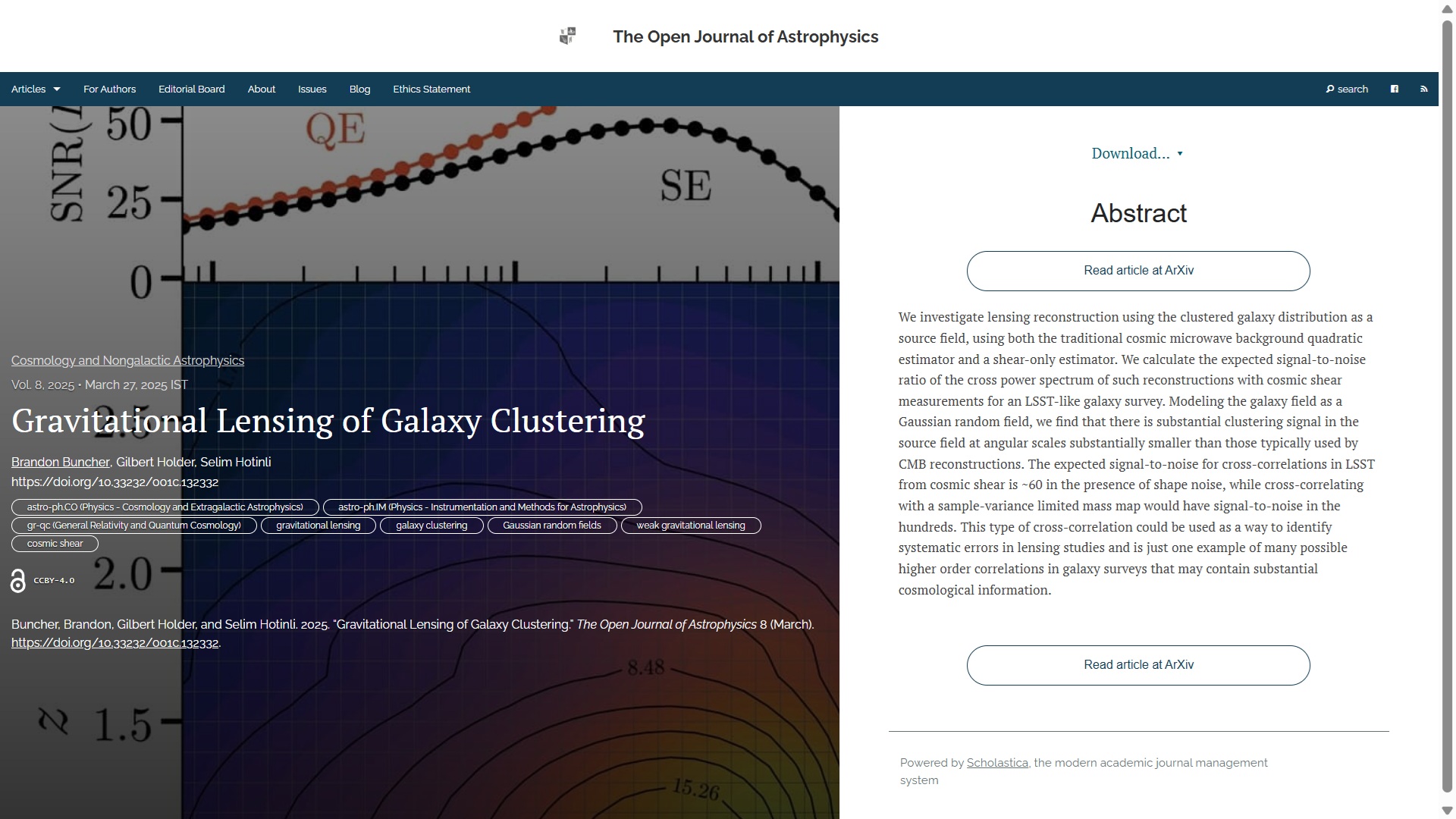
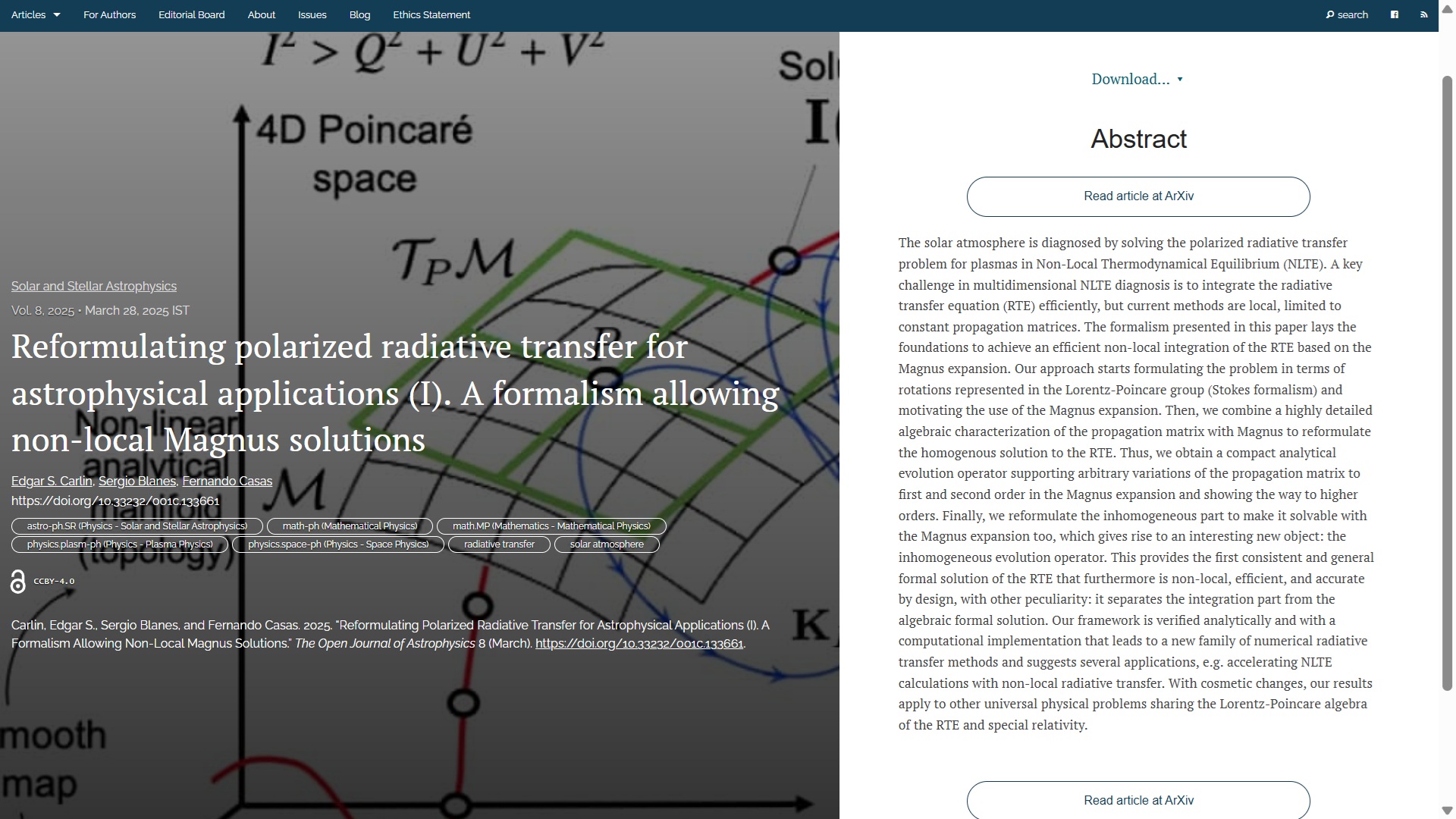
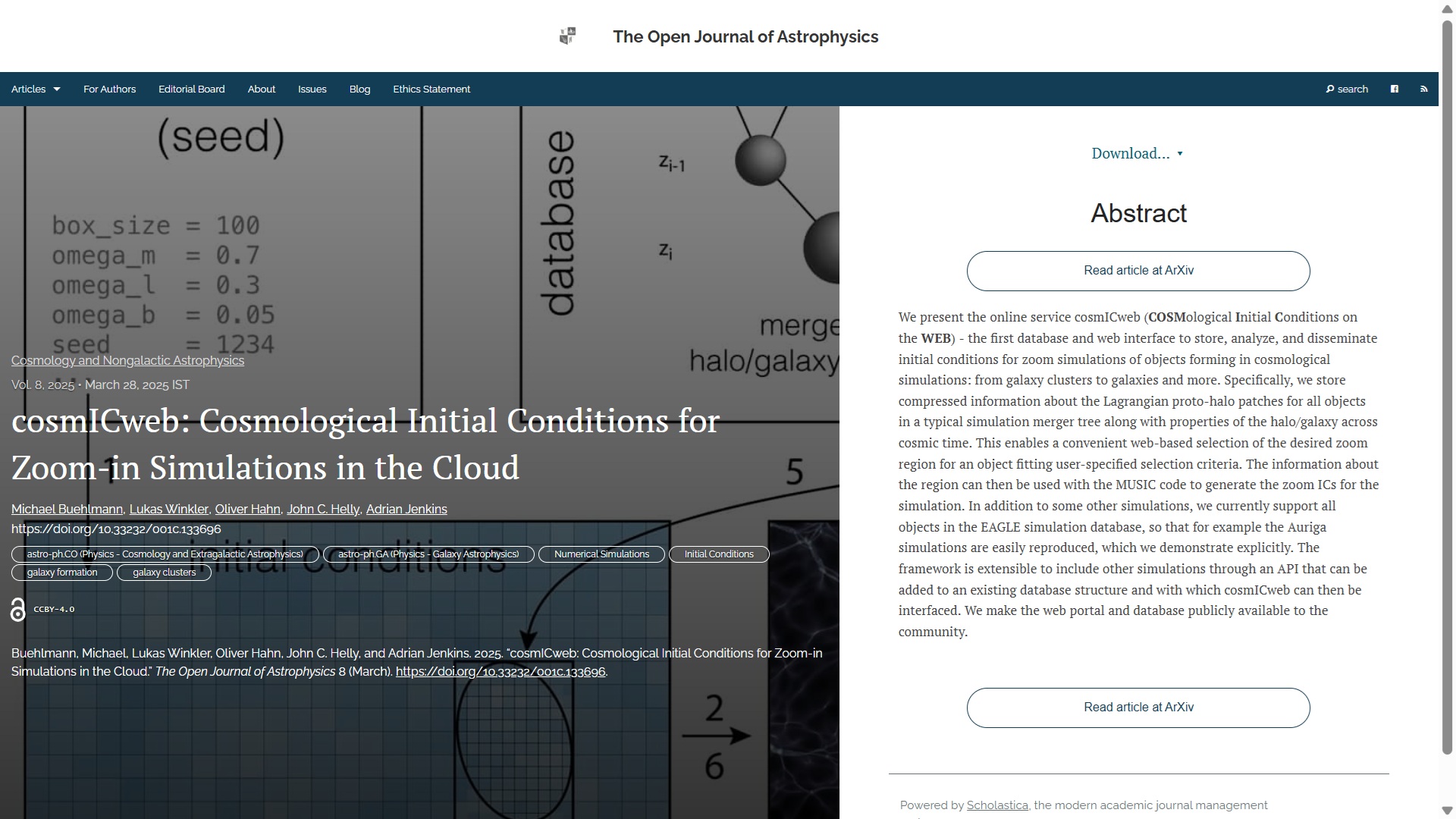
Anyway, in chronological order of publication, the three papers published this week, with their overlays, are as follows. You can click on the images of the overlays to make them larger should you wish to do so.
The first paper to report is “Gravitational Lensing of Galaxy Clustering” by Brandon Buncher & Gilbert Holder (University of Illinois Urbana Champaign) and Selim Hotinli (Perimeter Institute, Canada). This paper is in the folder marked Cosmology and NonGalactic Astrophysics and it was published on Thursday 27th March 2025. it presents a study of the cross-correlations between lensing reconstruction using galaxies as sources with cosmic shear measurements.
Here is the overlay:
You can read the officially accepted version of this paper on arXiv here.
It appears in the folder Solar and Stellar Astrophysics. It presents a new family of numerical radiative transfer methods and their potential applications such as accelerating calculations involving Non-Local Thermodynamic Equilibrium. This paper was published on Friday 28th March 2025.
Here is the overlay:
You can find the officially accepted version of this paper on arXiv here.
The final paper, also published on Friday 28th March, is in the folder Cosmology and NonGalactic Astrophysics. The title is “CosmICweb: Cosmological Initial Conditions for Zoom-in Simulations in the Cloud” and the authors are Michael Buehlmann (Argonne National Laboratory), Lukas Winkler (U. Wien), Oliver Hahn (U. Wien), John C. Helly (ICC Durham) and Adrian Jenkins (ICC Durham).
This paper describes a new database and web interface to store, analyze, and disseminate initial conditions for zoom simulations of objects forming in cosmological simulations. The database can be accessed directly here.
Here is the overlay:
The official published version can be found on the arXiv here.
That’s all for this week. I’ll do another update next Saturday.
There’s a good piece in Wired about Paul Ginsparg, the physicist who created arXiv. The lede of the article begins Modern science wouldn’t exist without the online research repository known as arXiv. For once, this isn’t an exaggeration. I recommend you read the piece yourself so I won’t say much more about it except that I found it fascinating. I couldn’t resist in including this extract, however, with which I wholeheartedly agree:
Every industry has certain problems universally acknowledged as broken: insurance in health care, licensing in music, standardized testing in education, tipping in the restaurant business. In academia, it’s publishing. Academic publishing is dominated by for-profit giants like Elsevier and Springer. Calling their practice a form of thuggery isn’t so much an insult as an economic observation. Imagine if a book publisher demanded that authors write books for free and, instead of employing in-house editors, relied on other authors to edit those books, also for free. And not only that: The final product was then sold at prohibitively expensive prices to ordinary readers, and institutions were forced to pay exorbitant fees for access.
I’ve written words to that effect so many times I’ve lost count!
Anyway, as if to reinforce the point about the transformative nature of arXiv, it has just been announced that the European Astronomical Society has awarded the 2025 Jocelyn Bell Burnell Inspiration Medal to arXiv “for its impact on astrophysical research thanks to the open, free and world-wide distribution of scientific articles”. What a bold, imaginative and fully justifiable decision that is, and congratulations to arXiv! It is a truth universally acknowledged that every paper in astrophysics worth reading is on arXiv.
I’m planning to be at this year’s EAS meeting in Cork at the end of June when this, and the other EAS awards, will be presented. I’m not sure who will receive it on behalf of arXiv but they’re sure to get a rousing ovation.
It is time once again to use the medium of this blog to advertise the fact that the MSc in Theoretical Physics & Mathematics at Maynooth University is open to applications for entry in September.
This postgraduate course is run jointly between the Departments of Physics and Mathematics & Statistics, with each contributing about half the material. The duration is one calendar year (full-time) or two years (part-time) and consists of 90 credits in the European Credit Transfer System (ECTS). This is split into 60 credits of taught material (split roughly 50-50 between Theoretical Physics and Mathematics) and a research project of 30 credits, supervised by a member of staff in a relevant area from either Department.
This course is a kind of follow-up to the existing undergraduate BSc Theoretical Physics & Mathematics at Maynooth, also run jointly. We think the postgraduate course will appeal to many of the students on that programme who wish to continue their education to postgraduate level, though applications are very welcome from suitably qualified candidates who did their first degree elsewhere.
Here is the “official” poster:
You can register your interest by scanning the QR code or, if you prefer, following the link here.
I thought I’d use the excuse that I’m teaching particle physics again to revive an old idea linking that subject to Mozart’s Opera The Magic Flute (Die Zauberflöte, K. 620).
I can’t remember how many times I have seen this opera performed nor in how many different productions. It’s a wonderful creation because it manages to combine being utterly daft with being somehow immensely profound. The plot makes no sense at all, the settings are ridiculous (e.g. “rocks with water and a cavern of fire”), and the whole thing appears to be little more than a pantomime. Since it’s Mozart, though, there is one ingredient you can’t quibble with: a seemingly unending sequence of gorgeous music.
When I first saw The Magic Flute I thought it was just a silly but sublime piece of entertainment not worth digging into too deeply. I wondered why so many pompous people seemed to take it so terribly seriously. Real life doesn’t really make much sense, so why would anyone demand that an opera be any less ridiculous? Nevertheless, there is a vast industry devoted to unravelling the supposed “mystery” of this opera, with all its references to magic and freemasonry.
But now I can unveil the true solution of problem contained within the riddle encoded in the conundrum that surrounds the enigma that has puzzled so many Opera fans for so long. I have definitive proof that The Magic Flute is not about freemasons or magic or revolutionary politics. It is actually about particle physics.
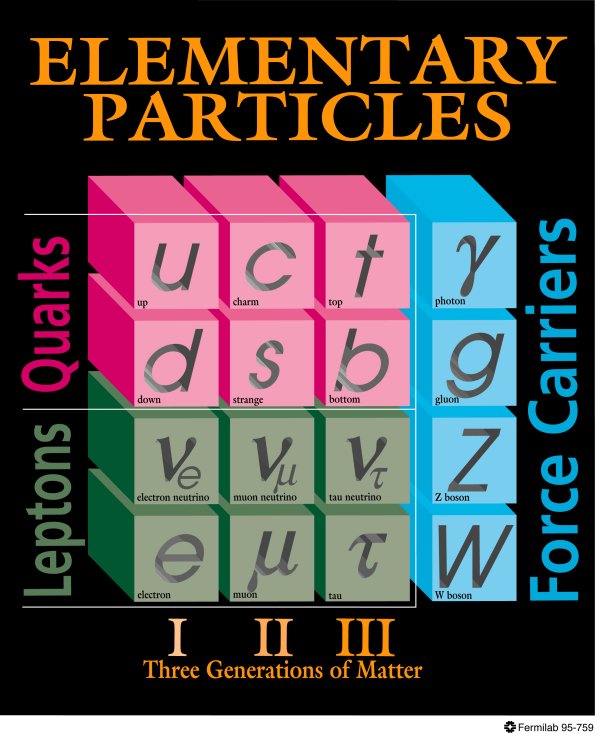
To see how I arrived at this conclusion note the following figure which shows the principal elementary particles contained within the standard model of particle physics:
To the left of this picture are the fermions, divided into two sets of particles labelled “quarks” and “leptons”. Each of these consists of three pairs (“doublets”), each pair defining a “generation”. This structure of twos and threes is perfectly represented in the cast The Magic Flute.
Let’s consider the leptons first. These can be clearly identified with the three ladies who lust after the hero Tamino in Act 1. This emotional charge is clearly analogous to the electromagnetic charge carried by the massive leptons (the electron, muon and tauon, lying along the bottom of the diagram). The other components in the leptonic sector must be the three boys who pop up every now and again to help Papageno with useful advice about when to jangle his magic bells. These must therefore be the neutrinos, which are less massive than the ladies, and are also neutral (although I hesitate to suggest that this means they should be castrati). They don’t play a very big part in the show because they participate only in weak interactions.
Next we have the quarks, also arrayed in three generations of pairs. These interact more strongly than the leptons and are also more colourful. The first generation is easy to identify, from the phenomenology of the Opera, as consisting of the hero Tamino (d for down) and his beloved Pamina (u for up); her voice is higher than his, hence the identification. The second generation must comprise the crazy birdcatcher Papageno (s for strange) and his alluring madchen who is called Papagena (c for charmed). That just leaves the final pairing which clearly is the basso profundo and fount of all wisdom Sarastro (b for bass bottom) and my favourite character and role model the Queen of the Night (t for top).
To provide corroboration of the identification of the Queen of the Night with the “top” quark, here is a clip from Youtube of a bevy of famous operatic sopranos having a go at the immensely different coloratura passage from the Act 1 aria “O Zittre Nicht, mein leiber Sohn” culminating in a spectacular top F that lies beyond the range of most particle accelerators, never mind singers.
There’s some splendid frocks in there too.
The Queen of the Night isn’t actually in the Opera very much. After this aria in Act 1 she disappears until the middle of Act 2, probably because she needs to have a lie down. When she comes back on she sings another glass-shattering aria (Der Hölle Rache kocht in meinem Herzen), which I like to listen to when I’m writing referee reports. The first line translates as “The rage of hell is boiling in my heart”.
The remaining members of the cast – The Speaker and Monostatos, as well as sundry priests, slaves, enchanted animals and the chorus – must make up the so-called Force carriers at the left of the table, which are bosons, but I haven’t had time to go through the identifications in detail. They’re just the supporting cast anyway. And there is one particle missing from the picture, the Higgs boson. This accounts for the masses of other particles by exerting a kind of drag on them so it clearly must be the Dragon from Act 1.
It seems like eternity since I was on sabbatical and had enough time to get stuck in to some reading not related to work. Since I got back from Barcelona last September I’ve lapsed and haven’t read many books since then. I keep reading reviews in the Times Literary Supplement but that’s as close as I generally get.
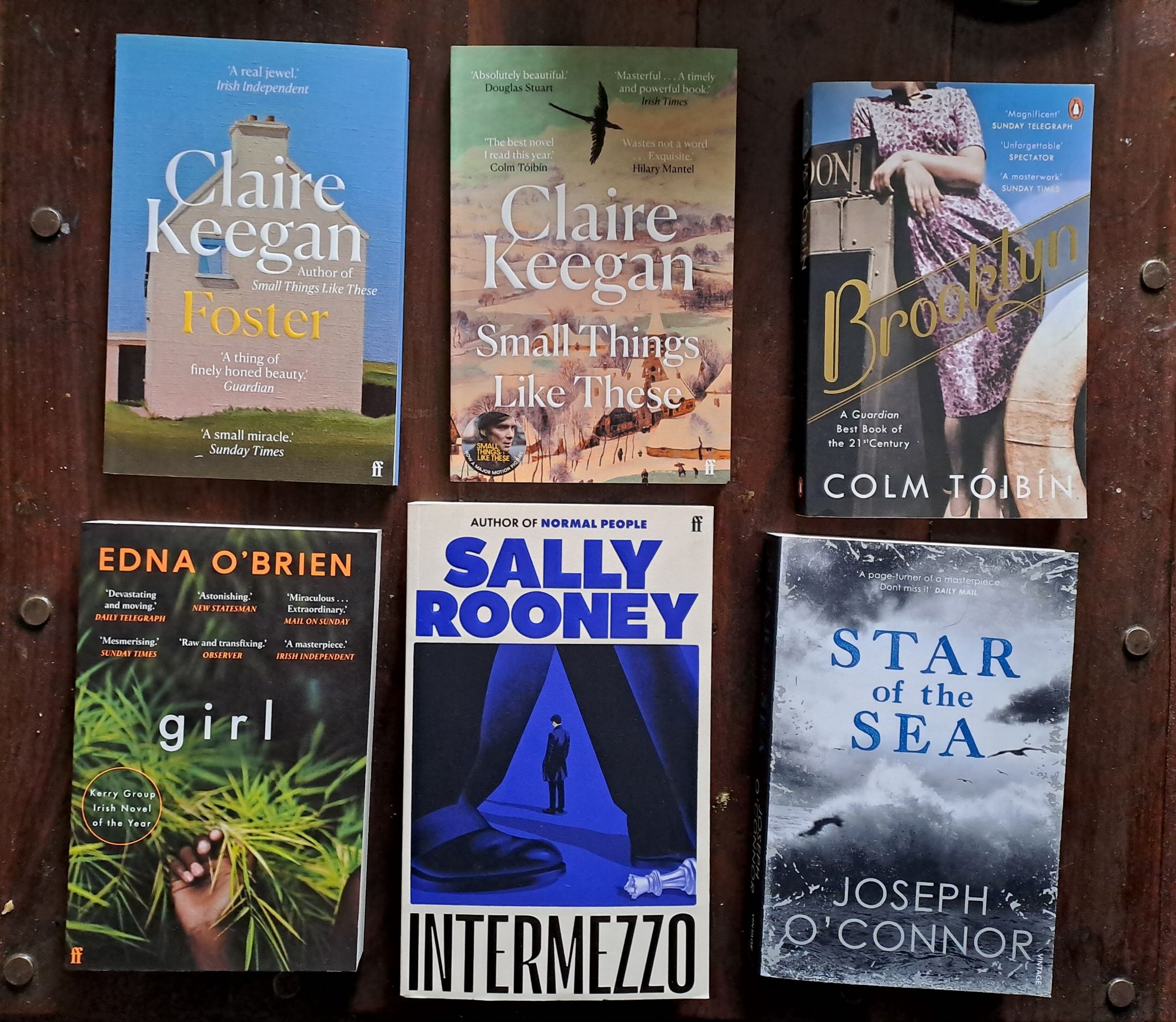
It’s been in my mind for a while to rejuvenate my interest in literature but last week I had two specific triggers. One was the news that Amazon has opened a dedicated website in Ireland. I view that as a trigger not in a positive way but because it will make life even harder for our excellent local bookshop in Maynooth so I felt I should do more to support them. The other trigger was that the Irish Times published a list of the “best” 100 Irish novels of the 21st Century. When I saw I had only read a few of them, and feel I should read more contemporary literary fiction emanating from Ireland, I decided I should use the list as a guide to help me get back into a reading habit. Anyway, I went to the bookshop last week and bought these six to start with:
These aren’t the top six, by the way. They’re just the ones that caught my fancy while I was browsing in the store.
I’m going to start with Claire Keegan’s novella Foster, as it was this work that inspired the beautiful Irish language film An Cailín Ciúin which I blogged about here. It’s quite short, so it should provide me with a relatively gentle re-introduction to reading. I have’t decided in what sequence I will read the others. It remains to be seen when I can get another six let alone how long it will take for me to read all the books on the list!
Any comments on these books, or indeed any others either on the top 100 list or not would be welcome!
It’s been a very busy day back to teaching after last week’s study break. This week there’s a big meeting in Leiden (Netherlands) which I would like to have attended as it combines the annual Euclid Consortium meeting with the 56th ESLAB Symposium. No doubt there’ll be a lot of discussion of the Euclid Q1 results announced last week. I can’t go, however, because of teaching commitments. The Euclid meetings are quite often scheduled in the summer, so I have a chance to attend, but not this time.
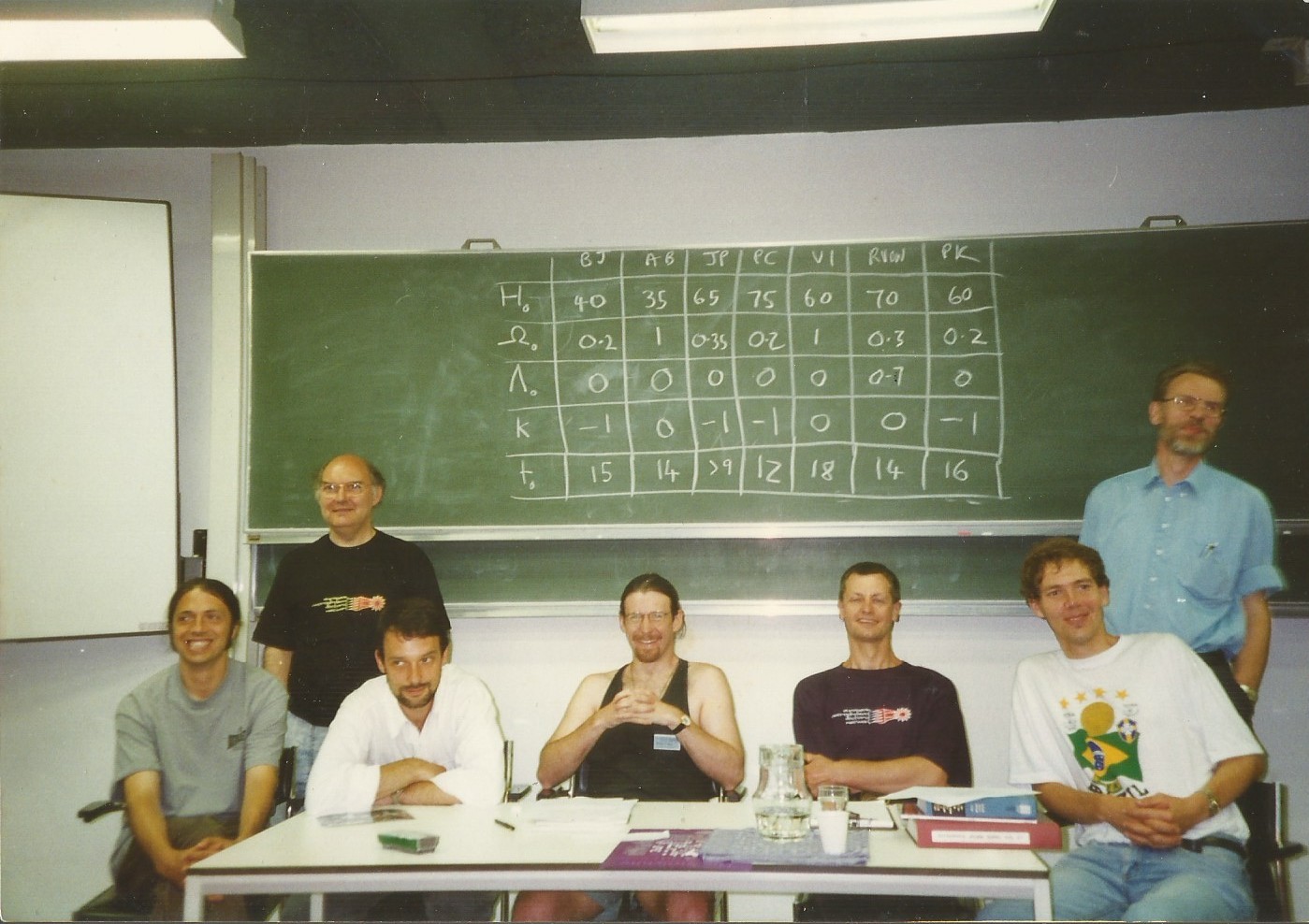
Anyway, I thought I would post a relevant memory from a previous trip to Leiden, about 30 years ago. which was taken at a conference in Leiden (Netherlands) in 1995. Was that really 30 years ago? Various shady characters masquerading as “experts” were asked by the audience of graduate students at a summer school to give their favoured values for the cosmological parameters (from top to bottom: the Hubble constant, density parameter, cosmological constant, curvature parameter and age of the Universe):
From left to right we have Alain Blanchard (AB), Bernard Jones (BJ, standing), John Peacock (JP), me (yes, with a beard and a pony tail – the shame of it), Vincent Icke (VI), Rien van de Weygaert (RW) and Peter Katgert (PK, standing). You can see on the blackboard that the only one to get anywhere close to correctly predicting the parameters of what would become the standard cosmological model was, in fact, Rien van de Weygaert…
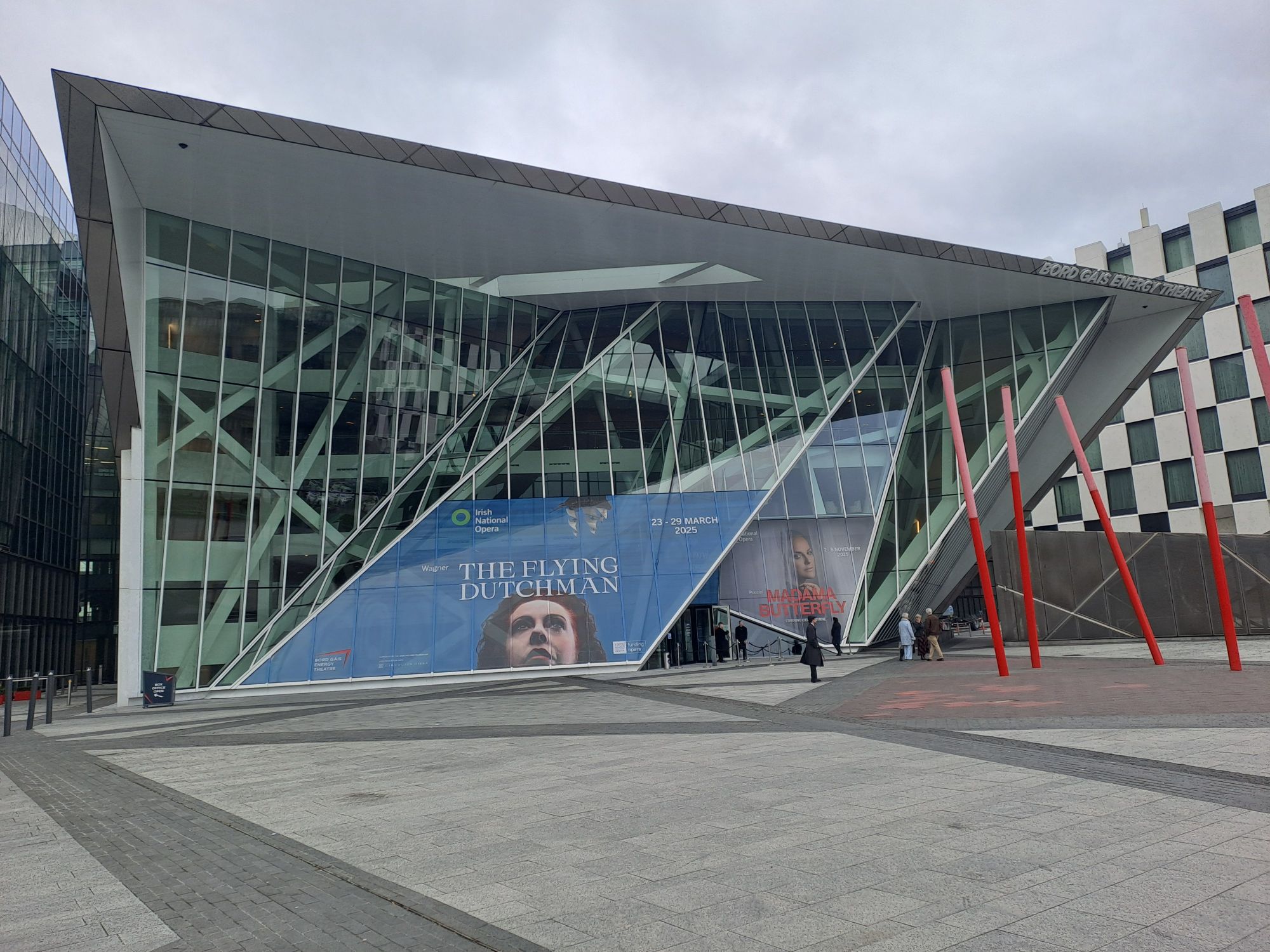
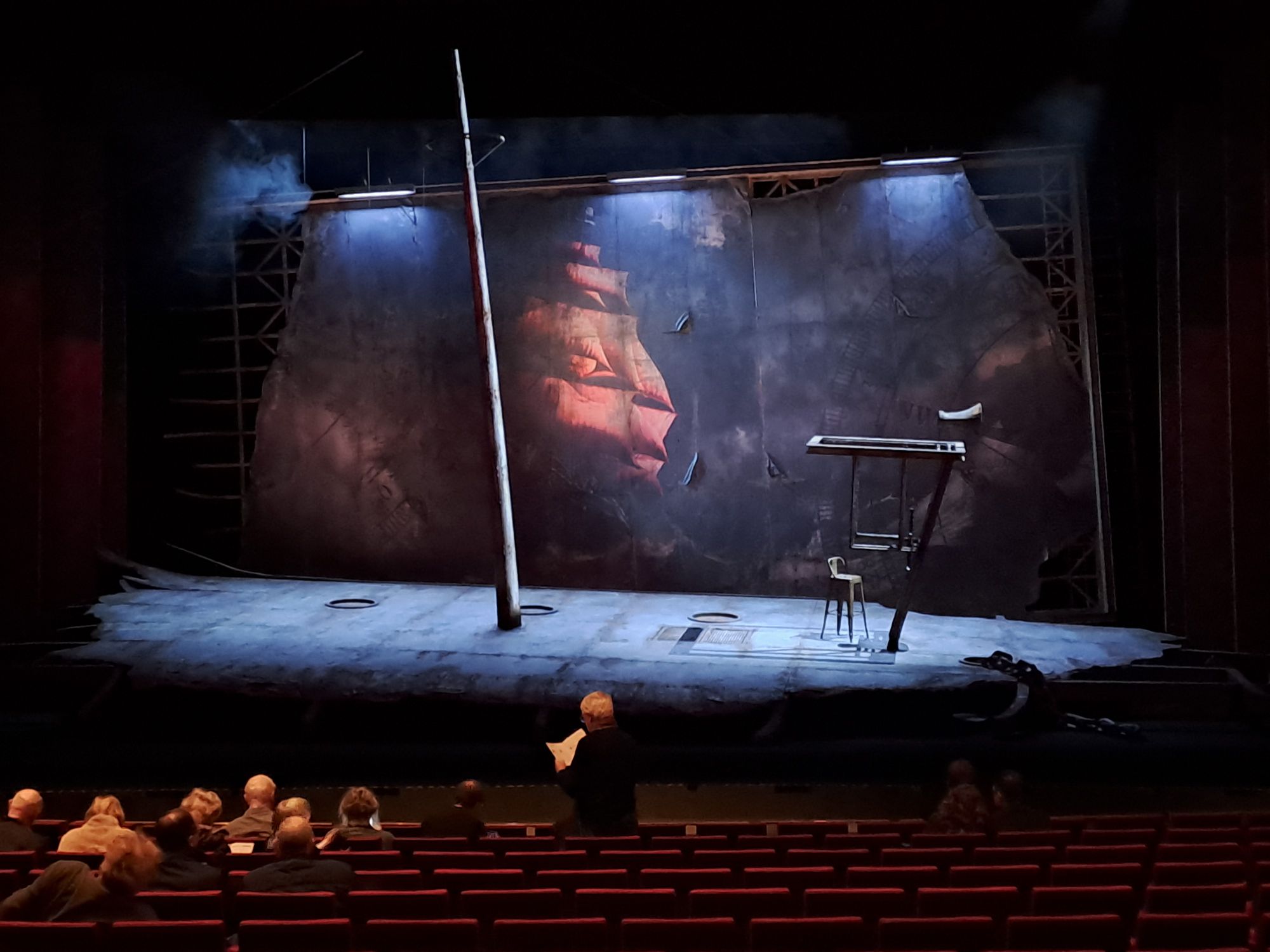
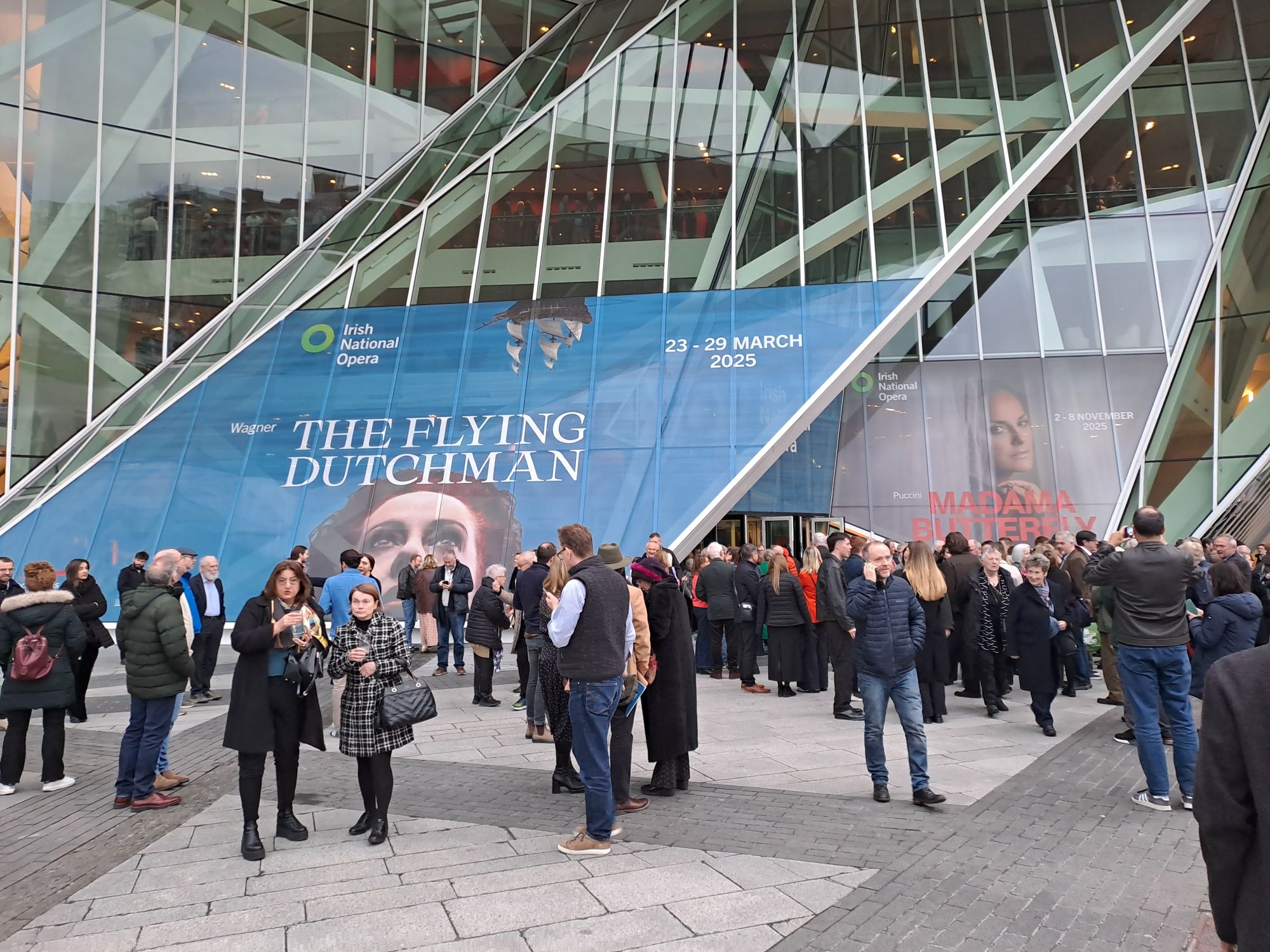
And so it came to pass that this afternoon I took the bus into Dublin to catch the first performance of Irish National Opera’s new production of Richard Wagner‘s The Flying Dutchman (or Der fliegende Holländer to give its proper title) at the romantically named Bord Gáis (Gas Board) Energy Theatre. It wasn’t exactly the first night, as the performance started at 5pm, but it did have a first night feel to it, with a smattering of media types in the full house.
OutsideInsideOutside again
The event took a bizarre twist at the interval, which was after Act 1. I’d only just collected my glass of wine when the fire alarm went off and we were told to leave the building. Amusingly, some of the cast joined us outside too, in costume. It was a false alarm, but the precautionary exodus extended the interval by about 15 minutes or so. When we were making our way back in, I overheard a nearby wit say “Never mind: worse things happen at sea”. Given the plot of the opera, that seemed a very apt comment.
The Flying Dutchman is an early composition by Wagner, first performed in 1843 when Wagner was only 30 years old. It’s much more of a conventional opera than his later music dramas. At least to my ears there are passages that sound a lot like Verdi, especially those featuring the chorus. It’s also quite short: it’s often performed without an interval, but even with one (and a fire alarm to boot) it’s only about three hours. On the other hand, there are some manifestations of things to come, especially the frequent use of a leitmotif whenever the eponymous Dutchman appears or is mentioned.
The story is set somewhere on the coast of Norway. This production has an intriguing preamble while the famous overture is playing. While the menfolk are away at sea, the women of a coastal village are going about their business. Among them is a little girl in a striking red coat. Shades of Schindler’s List, I thought. The little girl turns out to be “Little Senta”, a representation of the innocence of Senta, the leading female character.
The opera proper begings on a ship captained by a man called Daland which has been driven off course by a storm and is sheltering at anchor. While the crew are taking some rest, another ship appears beside and The Dutchman climbs onto Daland’s ship to have a look around. He meets Daland, explains that he is exiled from Holland, is fed up with travelling the seas all alone. He showers Daland with gifts and asks if he can marry Daland’s daughter, Senta. Daland is very keen to have a rich son-in-law and speedily gives his consent.
Meanwhile, back onshore, we’re in Act II. Senta is revealed to be obsessed with a portrait of the Flying Dutchman, a man cursed to wander the oceans until he finds a woman prepared to be completely faithful to him. She has known about this legendary figure since she was a child and wants to be the person who saves him from his fate. One person not happy about this is Erik, an impoverished hunter who himself wants to marry Senta. Eventually Daland’s and the Dutchman’s ships come home. Senta is overwhelmed to meet the Dutchman in person and consents to marry him.
Act III begins with a big party at which the sailor’s on Daland’s ship get drunk and try to get the crew of the Dutchman’s ship to reveal themselves, initially to no avail because they are ghosts. When they do appear it’s not a pretty sight. Erik comes back and tries to convince Senta to stay with him instead of mmarrying the Dutchman. The Dutchman overhears them and interprets their discussion as a betrayal in progress. He tells Senta to forget the whole thing and jumps on board his ship which descends into the sea. Heartbroken, Senta throws herself into the water after him, and drowns.
In the closing stages, Senta has changed is wearing a striking red coat just like Little Senta wore at the beginning. When Senta dies, Little Senta’s lifeless body appears suspended from a rope in the middle of the stage, symbolising her sacrifice and shattered dreams.
In a very strong cast, James Cresswell (bass) was an outstanding Daland, but others were fine too: Gavan Ring (tenor) was The Steersman, Jordan Shanahan (baritone) The Dutchman, Carolyn Dobbin (mezzo) Mary, Giselle Allen (soprano) Senta, Toby Spence (tenor) Erik and the non-singing part of Little Senta was engagingly played by Caroline Wheeler. The Orchestra and Chorus of Irish National Opera were also in fine form.
The set design by Francis O’Connor was relatively simple but highly effective: the only significant change after Act I (see picture above) was the wheelhouse to the right was removed and a lighthouse placed further towards the rear, from which Senta took her plunge at the end. There was some dramatic use of animated back-projections too.
This is the first time I’ve seen this opera. I was very impressed with the performance, both musically and dramatically. If anyone is thinking of trying their first taste of Wagner then they could do much worse than this production, but they’ll have to hurry – there are just three more performances in Dublin (Tuesday 25th, Thursday 27th and Saturday 29th March).
P.S. I usually go by train into Dublin for concerts and other performances, but there are two buses that go all the way from Maynooth to the Grand Canal Quay, which is where the Bord Gáis Energy Theatre is located so I thought I’d try them out. I took a C4 in and a C3 home, both journeys being pleasantly uneventful.
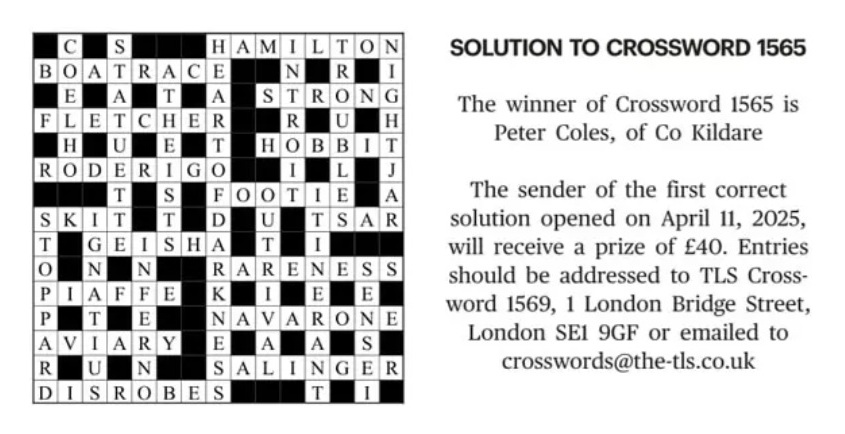
I got an email last week pointing out that I had won another prize in the Times Literary Supplement crossword competition 1565. They have modernised at the TLS, so instead of sending a cheque for the winnings, they pay by bank transfer and wanted to check whether my details had changed since last time. You can submit by email nowadays too, which saves a bit in postage.
Anyway, I checked this week’s online edition and found this for proof:
I checked when I last won this competition, which I enter just about every week, and found that it was number 1514, almost exactly a year ago. There are 50 competitions per year rather than 52, because there are double issues at Christmas and in August, so it’s actually just over a year (51 puzzles) since I last won. I’ve won the crossword prize quite a few times but haven’t been very careful at keeping track of the dates. I think it’s been about once a year since I started entering.
All this suggested to me a little problem I devised when I was teaching probability and statistics many years ago:
Let’s assume that the same number of correct entries, N, is submitted for each competition. The winner each time is drawn randomly from among these N. If there are 50 competitions in a year and I submit a correct answer each time, winning once in these 50 submissions, then what can I infer about N?
Answers on a postcard, via email, or, preferably, via the Comments!
The views presented here are personal and not necessarily those of my employer (or anyone else for that matter).
Feel free to comment on any of the posts on this blog but comments may be moderated; anonymous comments and any considered by me to be vexatious and/or abusive and/or defamatory will not be accepted. I do not necessarily endorse, support, sanction, encourage, verify or agree with the opinions or statements of any information or other content in the comments on this site and do not in any way guarantee their accuracy or reliability.





 In the Dark