Archive for April, 2025

Jazz 625 – Art Blakey and the Jazz Messengers

Posted in Jazz, Television with tags , , , , , , on April 20, 2025 by telescoper

This just appeared on Youtube a couple of days ago and I couldn’t resist sharing it here. It is from a BBC programme in the series Jazz 625 and is presented by a chap called Humphrey Lyttelton, himself a trumpeter and bandleader. Although Humph is best known as a musician on the traditional side of jazz, he was very broadminded about music and extremely knowledgeable about more modern forms, as he demonstrated on his long-running radio show The Best of Jazz, which I listened to avidly as a teenager and which introduced open my eyes and ears to lots of new things including “hard bop“, which is the genre to which this belongs.

This programme was broadcast in 1965, at which time the BBC Television programmes were all in black-and-white so the recording has been “colourized”, and think the sound has been remastered too. It sounds great.

Anyway, the band featured here is Art Blakey and the Jazz Messengers. I was lucky enough to hear a couple of later incarnations of this group play live in the 1980s. There’s no need to run through the personnel or tunes because Humph does so in the recording. I will just add that the intro and outro are Thelonious Monk’s 52nd Street Theme.

Weekly Update from the Open Journal of Astrophysics – 19/04/2025

Posted in OJAp Papers, Open Access, The Universe and Stuff with tags , , , , , , , , , , , , , , , , , , , on April 19, 2025 by telescoper

It may be the Easter holiday weekend, but it’s still time for the weekly Saturday morning update of papers published at the Open Journal of Astrophysics. Since the last update we have published five new papers, which brings the number in Volume 8 (2025) up to 42 and the total so far published by OJAp up to 277.

In chronological order of publication, the five papers published this week, with their overlays, are as follows. You can click on the images of the overlays to make them larger should you wish to do so.

The first paper to report is “Galaxy Clustering with LSST: Effects of Number Count Bias from Blending” by Benjamin Levine (Stony Brook, NY), Javier Sánchez (STScI, MD), Chihway Chang (Chicago, IL) Anja von der Linden (Stony Brook), Eboni Collins (Dillard, LA), Eric Gawiser (Rutgers, NJ), Katarzyna Krzyżańska (Cornell, NY), Boris Leistedt (Imperial College, UK) on behalf of the LSST Dark Energy Science Collaboration.

This presents a simulation-based study of the effect of source overlaps (blending) on galaxy counts expected for the Vera C. Rubin Legacy Survey of Space and Time (LSST). The paper is in the folder Cosmology and NonGalactic Astrophysics and was published on Monday 14th April 2025. The overlay is here:
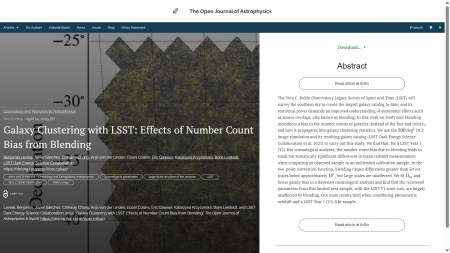
 

You can find the officially-accepted version of the paper on arXiv here.

The second paper to announce, published onTuesday 15th April 2025,  “Rapid, strongly magnetized accretion in the zero-net-vertical-flux shearing box” by Jonathan Squire (Otago, New Zealand), Eliot Quataert (Princeton, USA) & Philip F. Hopkins (Caltech, USA). This  paper presents a numerical study of turbulence in a flux shearing box, with discussion of the implications of the results for global accretion disk models and simulations thereof. It was published in the folder High-Energy Astrophysical Phenomena and the overlay is here:


You can read the officially accepted version of this paper on arXiv here.

The third paper of the week, published on Wednesday April 16th 2025,   is “DeepDISC-photoz: Deep Learning-Based Photometric Redshift Estimation for Rubin LSST” by Grant Merz (University of Illinois at Urbana-Champaign, USA) and 13 others (all based in the USA) on behalf of the LSST Dark Energy Science Collaboration. This paper describes adding photometric redshift estimation to the DeepDISC framework for classification objects in co-added images for use with the Vera C. Rubin LSST survey. It can be found in the folder Instrumentation and Methods for Astrophysics.

Here is the overlay:
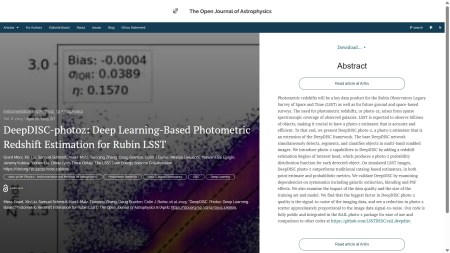
 

You can find the officially accepted version of this paper on arXiv here.

The next one to report is “Multidimensional Nova Simulations with an Extended Buffer and Lower Initial Mixing Temperatures” by Alexander Smith Clark and Michael Zingale (Stony Brook University, NY, USA). This paper presents new computer models of classical novae with improved ability to follow nucleosynthesis in the thermonuclear outburst and better treatment of convective transport. This one was also published on Wednesday 16th April 2025 but in the folder Solar and Stellar Astrophysics.

Here is the overlay:


The official published version can be found on the arXiv here.

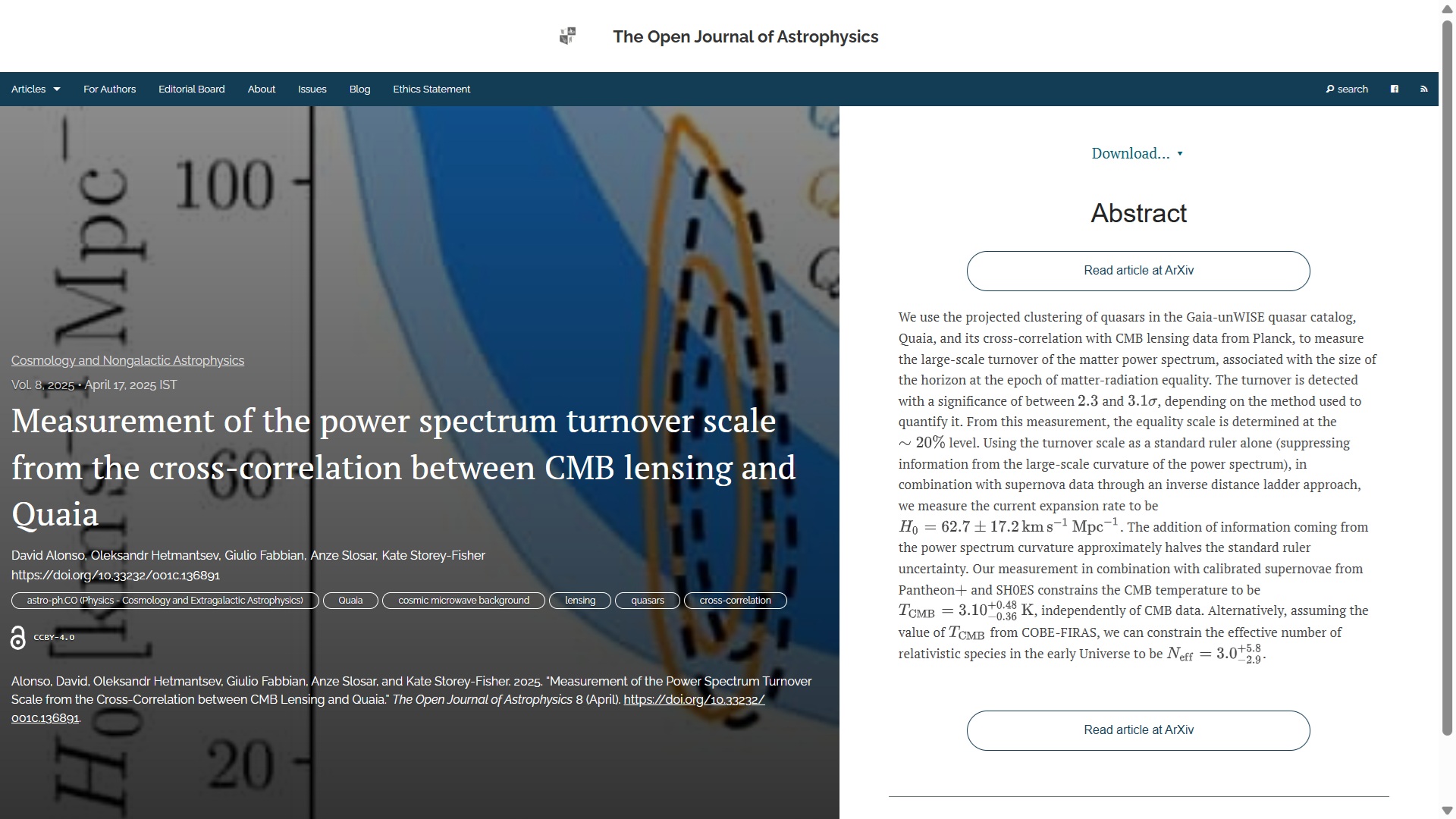
The last paper of the five published this week is “Measurement of the power spectrum turnover scale from the cross-correlation between CMB lensing and Quaia” by David Alonso (Oxford, UK), Oleksandr Hetmantsev (Kyiv, Ukraine), Giulio Fabbian (Cambridge, UK), Anze Slosar (Brookhaven National Laboratory, USA) and Kate Storey-Fisher (Stanford, USA). This is a discussion of using the spatial correlations of quasars and their cross-correlations with cosmic microwave background lensing data to measure a feature corresponding to the matter-radiation equality scale with consequences for cosmological parameter estimation. It was published on Thursday 17th April 2025 in the folder Cosmology and NonGalactic Astrophysics.

The overlay is here:

You can find the officially accepted version on arXiv here.

That’s all the papers for this week. I’ll just add a couple of things.

One is that, although there have been weeks before in which we have published five or more papers, we still haven’t managed to have a week on which we’ve published a paper on every weekday. This week we had two on Wednesday 16th but didn’t have any yesterday (Friday).

The second is that tt has been a while since I last posted a breakdown of the running costs here at the Open Journal of Astrophysics. Today I received an email from Scholastica, our service provider, reminding me our costs will go up shortly (from 22nd April). In the interest of transparency I am passing this information on here.

The new prices will be as follows:

  • Peer Review System annual cost will be $425/year (was $350/year) plus $10 per submission (no change)
  • OA Publishing Platform annual cost will be $1,499/year (was $1,399/year)

Last year we published 120 papers with about 250 submissions. We’re a bit ahead of that this year, so I estimate that our next year’s costs will be a bit less than $5000. That’s still less than the typical APC for a single paper at many journals.

I hope this clarifies the situation.

Good Friday Morning

Posted in Biographical, Education, Maynooth with tags , , , on April 18, 2025 by telescoper

Good Friday has a slightly strange status in Ireland. It is a Bank Holiday, meaning that the banks are shut, but it’s not a statutory public holiday so many people still go to work. This differs from the UK and Northern Ireland for which it is a public holiday, which seems strange when you think about the Republic’s Catholic traditions.

Schools in Ireland are closed today, but that’s because they are on an Easter break anyway. In contrast, Easter Monday (21st April) is both a Bank Holiday and public holiday. Maynooth University is closed today, so I miss a Particle Physics lecture, and next week is the Easter break (including Easter Monday). We return on Monday 28th April for the remaining two weeks of teaching, apart from Monday 5th May which is a Bank Holiday and a public holiday. The last day of teaching is Friday 9th May, which also happens to be the day on which I’m giving a colloquium at Maynooth, and examinations start a week later, on 16th May.

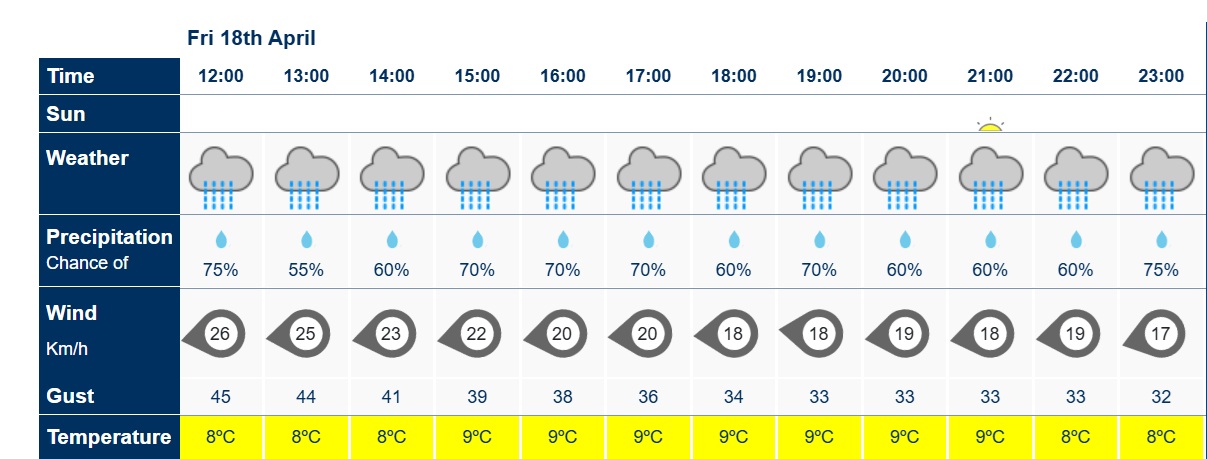
The weather so far is consistent with today being a Bank Holiday:

Bank Holiday weather

I think I’ll wait for a gap in the rain before going out.

Oh.

It looks be spending most of the day indoors! It seems a good day to make a start on my reading list.

It’s been a very busy week, not only because of the very enjoyable visit by Brian Schmidt, but also because I wanted to clear my coursework grading before the Easter break. I managed to do the last of that yesterday, so I don’t have to do any of that either this weekend or during the Easter break. There are some more assignments due, but I will deal with them when we return after Easter.

Biosignature Hype

Posted in Astrohype, Bad Statistics, The Universe and Stuff with tags , , , , on April 17, 2025 by telescoper

I was thinking just the other day that I haven’t posted much in either the Astrohype or the Bad Statistics folders on this blog. Well today I found an item that belongs in both categories. Many people will have seen the widespread press coverage of a misleading claim of the discovery of alien life; see, e.g., here. This misleading press coverage is based on a misleading press release from the University of Cambridge which you can find here.

The story is based on a paper in the pay-to-publish Astrophysical Journal Letters with the title “New Constraints on DMS and DMDS in the Atmosphere of K2-18 b from JWST MIRI“. The DMS and DMDS in the title refer to Dimethyl Sulphide and Dimethyl Disulphide respectively. These are interpreted by the authors as biosignatures.

There are two main problems with this claim. One is that DMS and DMDS are not necessarily biosignatures in the first place; see here for the reasons. The other is that there isn’t even any evidence for the detection of DMS or DMDS anyway. Here is the spectrum of which the lead author of the paper, Prof. Nikku Madhusudhan, has claimed “the signal came through loud and clear”.

Yeah, right. In statistical terms this is a non-detection. The Bayes Factor used in the paper to quantify the evidence for a model with DMS and/or DMDS over one without is just 2.62 in the logarithm. That’s not a detection by any stretch of the imagination; to be anywhere near convincing a Bayes Factor has to be at least 100. The subsequent cherry-picking of the data to improve the apparent probability of a detection is just statistical flummery.

Notice that the use of the phrase “Constraints on” in the title of the paper does not indicate that the article presents evidence that a detection has been made. That the claim has somehow morphed into the “the strongest evidence for life beyond our solar system” is absurd. The most charitable thing I can say is that Prof. Madhusudhan must have been carried away by enthusiasm. This doesn’t reflect very well on Cambridge University either.

This episode worries me greatly. This is a time of increasing hostility towards science and this sort of thing can only make matters worse. Scientists need to be much more careful in communicating the uncertainties in their results.

UPDATE: There’s a now paper on arXiv here that argues that a straight line is a better fit to the data, in other words that there is no strong statistical evidence for spectral features at all.

Supreme Prejudice

Posted in Biographical, LGBTQ+ with tags , , , , , , , on April 16, 2025 by telescoper

On reflection it was inevitable that the UK Supreme Court would make the decision that it did today, i.e. to decide to deprive trans people of the protections from discrimination that they should have under the 2010 Equality Act. After all, the Court did not consult with a single trans individual or organization representing trans people in the course of its deliberations, preferring instead to base its conclusions only on submissions from known transphobic groups. That alone renders the process indefensible.

That said, the Supreme Court had to twist itself in knots in its judgment to find some semblance of an argument. For example, the judgment claims that the definition of “sex” to be used in the context of the Equality Act is “biological sex” which is “binary”. I paraphrase, of course, but it doesn’t really matter that the argument about biology is wrong – ever heard of intersex people? – because they don’t use it anyway. In fact the judgment does not even attempt to define in biological terms what sex is nor what is a woman is. The definition asserted is “sex at birth”, which actually means what is written on a birth certificate. As a matter of fact, my birth certificate actually says “Boy”…

Whatever is written on an official document is not biological, but bureaucratic, and also non-binary. Intersex people sometimes have “intersex” written on their birth certificate, a fact that thus refutes the binary claim, but sometimes they are arbitrarily assigned “male” or “female” with potentially damaging consequences. I used intersex merely as an example. Very few things in nature are actually binary, and sex – whether it be genetic, hormonal , gonadal or whatever – is emphatically not one of them, particularly not in humans.

Here’s a helpful graphic.

Shoe-horning people into binary categories is wrong not only because it fails to accept scientific reality but also because of the harm it causes to human beings worthy of acceptance and respect. People who dismiss the non-binary nature of sex and gender often say words to the effect that “oh I know there are exceptions, but there aren’t many of them”. But:

  1. if there are so few then why are you so obsessed with them?
  2. one exception is sufficient to refute what purports to be a logical argument!
  3. it’s precisely because trans people are a small minority that means they deserve legal protection.

Today’s judgment looks set to cast an already beleaguered group entirely to the wolves. You can bet your bottom dollar that there will be a tidal wave of follow-up cases targetting trans people with the specific intention of stirring up more hostility. The Supreme Court actually acknowledges the existence of transphobic hate and offers some words to suggest that trans people will still have some legal protections. There can be no doubt however that the judges know that their ruling will be seen as a green light for bigots and their rich backers to engage in still more bigotry. I also fear a rise in the already appalling number of trans suicides that the UK Government is trying so hard to conceal. I think it goes without saying and contrary to the claims of those who brought the case, this ruling does absolutely nothing to protect cis women.

I can’t understand the mindset of people that can look at the evidently complex and nuanced of human sexual identity and respond by putting on blinkers and insisting that it is what it clearly isn’t. Some people just seem to need their bigotry to survive in their joyless unimaginative lives. Whatever that mentality is the Supreme Court shares it. They didn’t listen to any contrary views. It was a foregone conclusion, a sham contrived by a group of reactionary duffers.

I have tried throughout this piece to refer to trans people rather than trans men or trans women. Obviously the ruling today was in response to a case brought by cis women who hate trans women. It will almost certainly lead to more trans women being harassed and victimized (as was the intention of the case). But there are at least as many trans men as trans women. Under the new ruling trans men will presumably be forced to use “women-only” lavatories and will run the risk of hostility should they do so. Trans women using “male only” toilets are likely also to be harassed. The Supreme Court knows this is what will happen, but apparently doesn’t care, and is content to go along with a trajectory set by far-right activists who won’t stop here.

It’s no consolation to my friends living on TERF Island, but at least in Ireland the law is a bit more progressive and better grounded in reality. It’s a grim day for trans people in the UK. All I can do is send a message of solidarity and point you to this list of resources for trans people and their allies. I know it’s only a gesture but I’m proud to share the Trans Pride flag here too.

Update: 27th April. The British Medical Association has just passed this resolution:

That was the Dean’s Lecture that was..

Posted in Biographical, Maynooth, The Universe and Stuff with tags , , on April 15, 2025 by telescoper

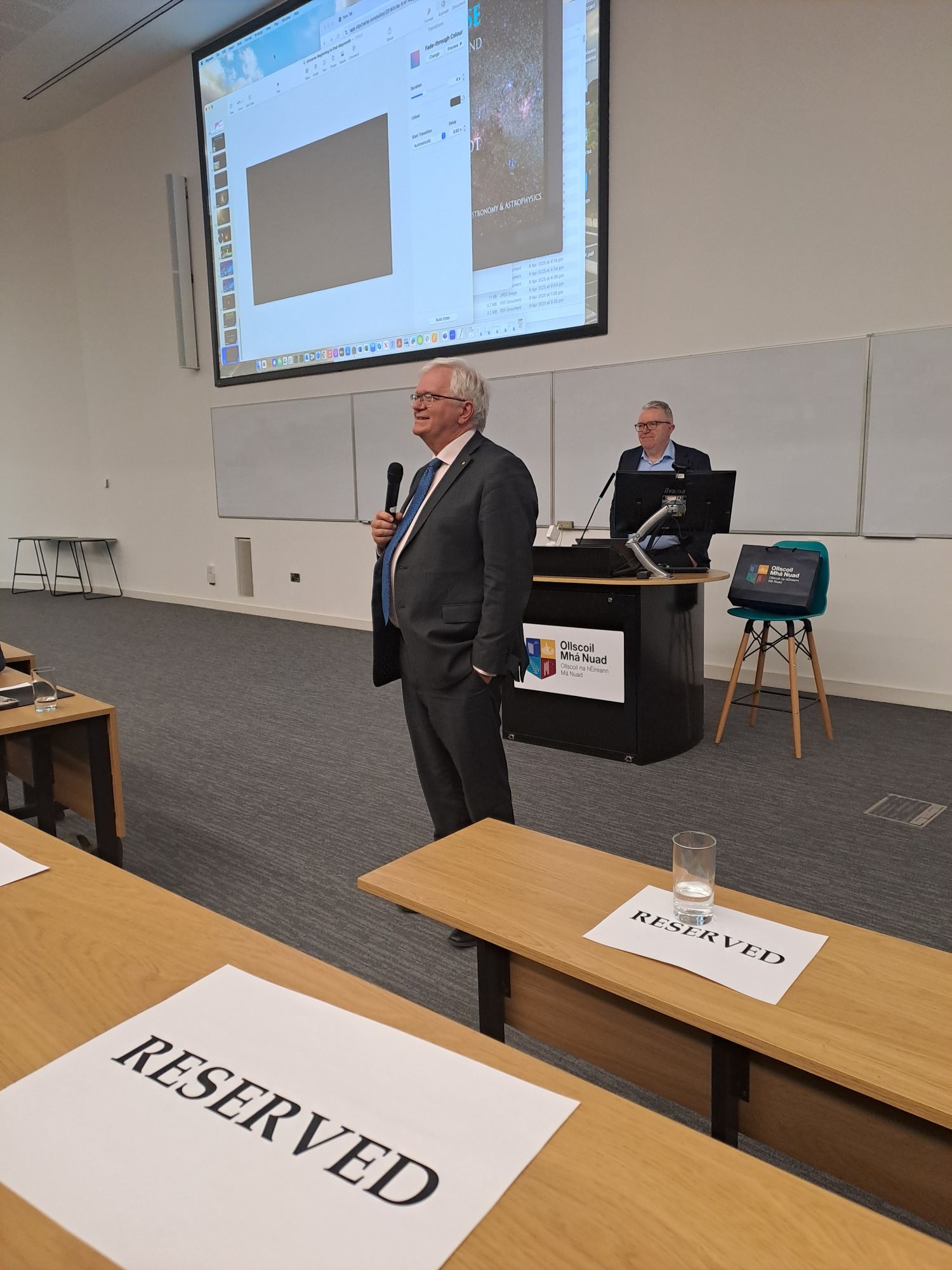
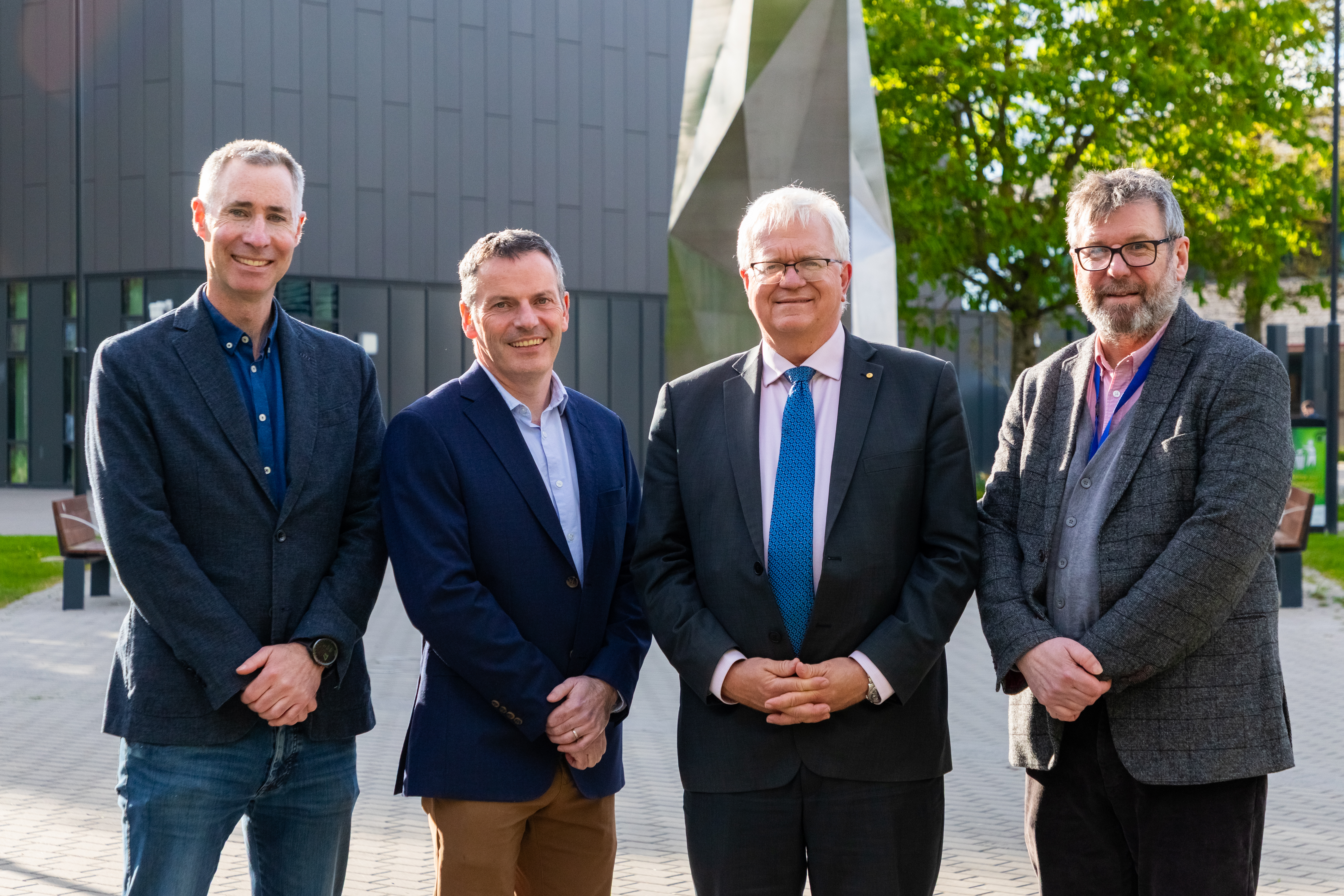
As it was foretold, last night we had a very special event in Maynooth in the form of a public lecture with the title The Universe from Beginning to End by Nobel Laureate Prof. Brian Schmidt. Brian actually arrived on Sunday and is still here today; he will be returning to Australia from Dublin this evening. It was really great of him to take the time to visit us here in Maynooth not just for the lecture but to chat informally with staff and students. He also did some interviews with the media, e.g. here and here.

The talk, which was for a lay audience, was extremely well attended. In fact we had to move it to a larger venue than we originally intended. I don’t know the official attendance figures but I would guess somewhere between 400 and 500 people came. The talk was excellent, and there were lots of very good questions from the audience afterwards which Brian dealt with very engagingly. The talk was recorded and if it becomes available publicly I will provide a link.

At the end I even found myself on the list to have dinner with Brian in a local restaurant. All in all, it was an excellent day.

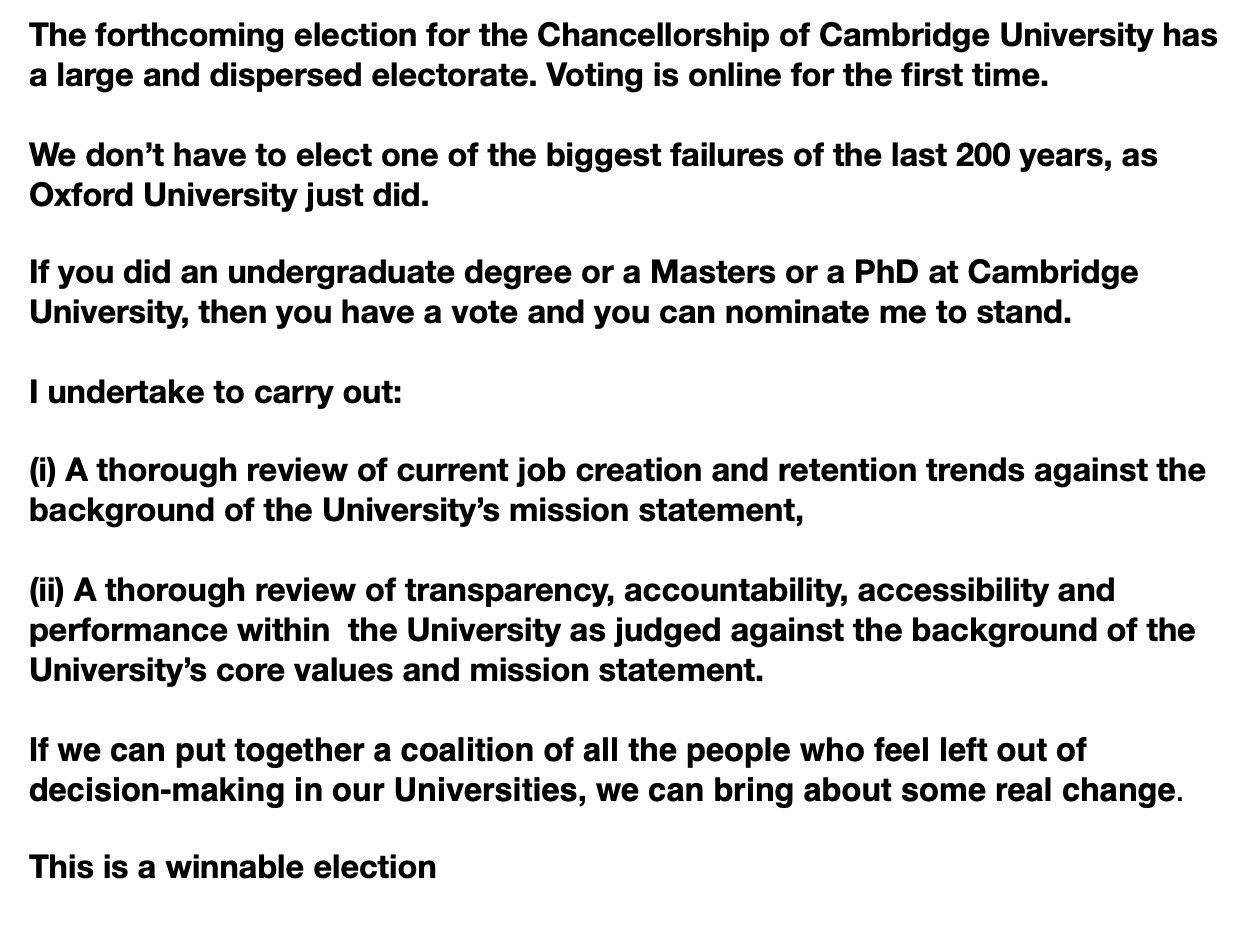
Wyn Evans for the Chancellorship of Cambridge University!

Posted in Education, Harassment Bullying etc with tags , , , , on April 14, 2025 by telescoper

Following on from yesterday’s post, I thought I’d pass on information about the campaign by Prof. Wyn Evans to be the next Chancellor of Cambridge University. You can find some of this information in the comment here and a longer version here. Here’s the gist of the campaign:

I am a graduate of Cambridge University and have just registered to vote in the forthcoming election. I shall of course be backing Wyn Evans, but in order to stand he needs to get 50 nominations. If you are a Cambridge graduate and wish to nominate Wyn Evans then please follow the instructions here or here.

That is all.

Bullying at Cambridge University

Posted in Harassment Bullying etc, Maynooth with tags , , , on April 13, 2025 by telescoper

There’s a long article in today’s Observer about bullying at Cambridge University, which I encourage you to read, as it shows that the scale of the bullying problem in Cambridge is very worrying. I’ll just emphasize a couple of things here.

One is that Cambridge University is due to elect a new Chancellor this year and, as is mentioned in the Observer, Professor Wyn Evans of the Institute of Astronomy is planning to stand as a candidate on an anti-bullying platform. This position is largely ceremonial, and is usually occupied by a politician or external establishment figure of some sort, like the incumbent, (Lord) David Sainsbury. In my view Wyn Evans is to be applauded for putting himself forward to draw attention to Cambridge’s internal problems, and I wish him success.

UPDATE: See the comment below by Wyn for instructions on how to support his nomination; he needs 50 nominations to go forward.

(In case you weren’t aware, Wyn Evans has commented on this blog on a number of occasions, often on astrophysics, but on other matters too; he also contributed this guest post on bullying in academia another about the 21Group here.)

UPDATE: See the comment below by Wyn for instructions on how to support his nomination; he needs 50 nominations to go forward.

The other thing I wanted to draw attention to stems from this excerpt:

Cambridge undertook its staff culture survey in January 2024 and is now facing accusations from academics that it tried to cover up the “grim” results, which have been released through freedom of information (FoI) requests.

Cambridge University is not the only higher education institute to carry out a staff survey, try to bury the results when they were unfavourable to The Management, only to be forced to reveal them by a Freedom of Information request. Exactly the same thing happened here in Maynooth.

Maynooth University’s “Staff Climate and Culture Survey” carried out in 2022 with the promise made to participants that results would be published in early 2023. No such results were ever communicated to staff and all mention of this survey was wiped off the University’s web pages. It was only after a Freedom of Information request was submitted by the Union IFUT that the results were released and even then they were not – and never have been – distributed to all staff. If you had seen the results, as I have, you will see immediately why the University tried to suppress them. The key measures show the management of Maynooth University in a very dim light indeed – far worse than the sector average.

As well as the specific measures against bullying and harassment suggested in the Observer article, universities need to take steps to improve their general transparency and accountability. Only then would they have an incentive to remove known bullies and harassers from office instead of what that they do now – which is to promote them.

Happy 85th Birthday, Herbie Hancock!

Posted in Jazz with tags , , , on April 12, 2025 by telescoper

Prolific jazz pianist, composer, and arranger Herbie Hancock was born on 12th April 1940, which means that today is his 85th birthday. I’ve posted quite a few pieces of music featuring Herbie Hancock over the years so I thought I’d put up something a little different to mark his birthday in the form of this unusual but very cool version of The House of the Rising Sun, featuring Donald Byrd on trumpet, Hancock on piano, Kenny Burrell on guitar, Bob Cranshaw (bass) and Grady Tate (drums) and the Donald Byrd Singers. This track appeared on the album Up With Donald Byrd which wasn’t well received when it came out in 1964, but I like it!

P.S. I did a Google search for Herbie Hancock House of the Rising Sun and found this:

Weekly Update from the Open Journal of Astrophysics – 12/04/2025

Posted in OJAp Papers, Open Access, The Universe and Stuff with tags , , , , , , , , , , , , , , , , on April 12, 2025 by telescoper

Time for the weekly Saturday morning update of papers published at the Open Journal of Astrophysics. Since the last update we have published four new papers, which brings the number in Volume 8 (2025) up to 37 and the total so far published by OJAp up to 272.

In chronological order of publication, the four papers published this week, with their overlays, are as follows. You can click on the images of the overlays to make them larger should you wish to do so.

The first paper to report is “Searching for new physics using high precision absorption spectroscopy; continuum placement uncertainties and the fine structure constant in strong gravity” by Chung-Chi Lee (Big Questions Institute (BQI), Sydney, Australia), John K. Webb (Cambridge, UK), Darren Dougan (BQI), Vladimir A. Dzuba & Victor V. Flambaum (UNSW, Australia) and Dinko Milaković (Trieste, Italy).

This presents a discussion of the problem of continuum placement in high-resolution spectroscopy, which impacts significantly on fine structure constant measurements, and a method for mitigating its effects. The paper is in the folder Solar and Stellar Astrophysics and was published on Tuesday 8th April 2025. The overlay is here:

You can find the officially-accepted version of the paper on arXiv here.

The second paper to announce, also published on 8th April 2025,  is “Deciphering Spatially Resolved Lyman-Alpha Profiles in Reionization Analogs: The Sunburst Arc at Cosmic Noon” by Erik Solhaug (Chicago, USA), Hsiao-Wen Chen (Chicago), Mandy C. Chen (Chicago),  Fakhri Zahedy (University of North Texas),  Max Gronke (MPA Garching, Germany),  Magdalena J. Hamel-Bravo (Swinburne, Australia), Matthew B. Bayliss (U. Cincinatti), Michael D. Gladders  (Chicago), Sebastián López (Universidad de Chile), Nicolás Tejos (Universidad Católica de Valparaíso, Chile).

This paper, which presents a study of the Lyman-alpha emission properties of a gravitationally-lensed galaxy at redshift z=2.37, appears in the folder Astrophysics of Galaxies. It was published


You can read the officially accepted version of this paper on arXiv here.

The third paper of the week  is “On the progenitor of the type Ia supernova remnant 0509-67.5” by Noam Soker (Technion, Haifa, Israel). This one was published on Wednesday 9th April 2025 in the folder High-Energy Astrophysical Phenomena. The author discusses possible ideas for the origin of a supernova that exploded inside a planetary nebula.

Here is the overlay:


You can find the officially accepted version of this paper on arXiv here.

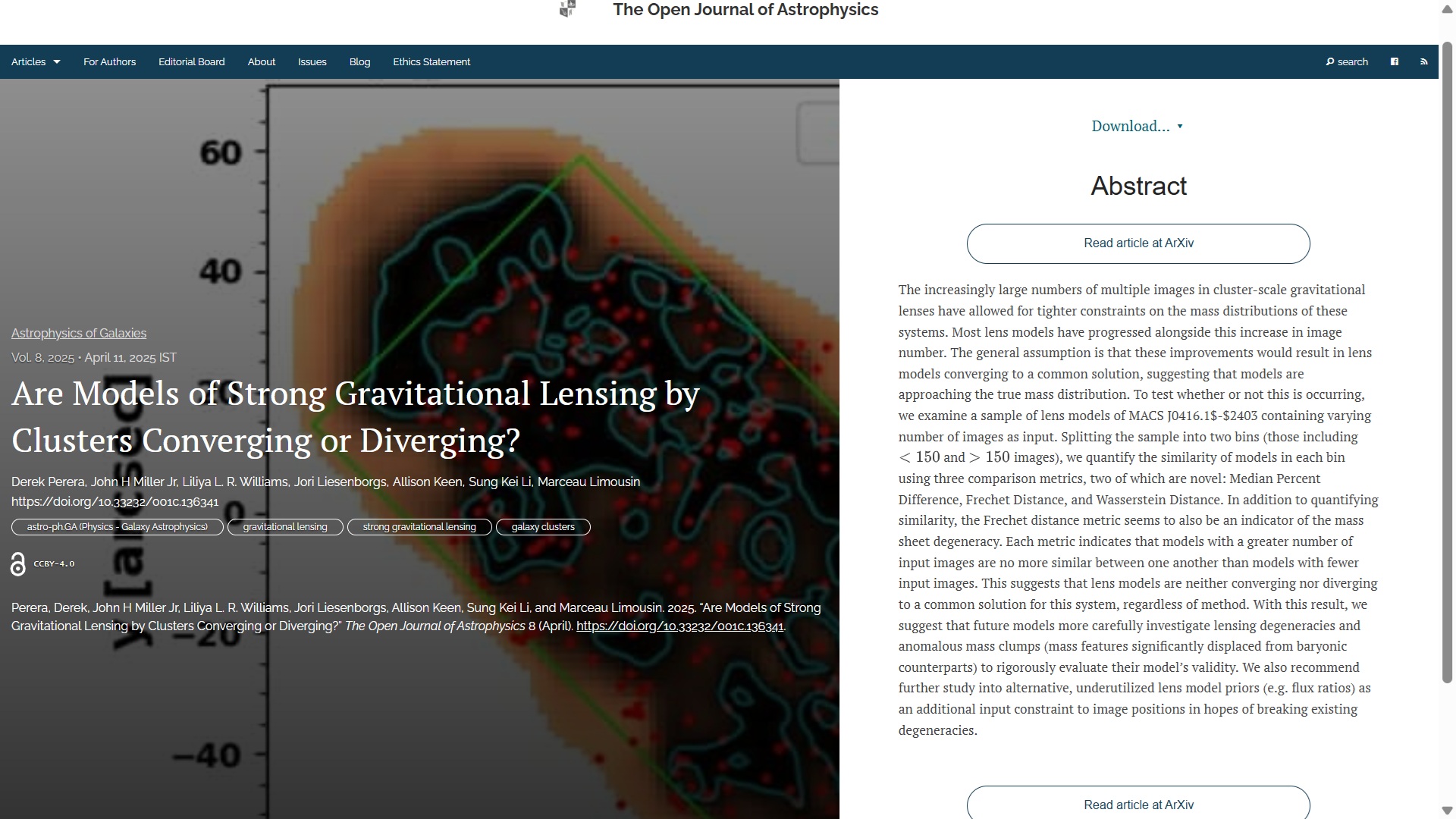
Last (but certainly) not least for this week, published on April 11th 2025, we have “Are Models of Strong Gravitational Lensing by Clusters Converging or Diverging?” by Derek Perera (U. Minnesota), John H Miller Jr & Liliya L. R. Williams (U. Minnesota, USA), Jori Liesenborgs (Hasselt U., Belgium), Allison Keen (U. Minnesota), Sung Kei Li (Hong Kong University), Marceau Limousin (Aix Marseille Univ., France).  This papers study various models of a strong gravitational lensing system, the results suggesting that lens models are neither converging to nor diverging from a common solution for this system, regardless of method.

Here is the overlay:


The official published version can be found on the arXiv here.


That’s all the papers for this week. By way of a postscript I’ll just mention that the gremlins that have affected submissions to Crossref (which we rely on for registering the article metadata) have now been resolved and normal services have been restored.