Archive for August, 2025

Weekly Update from the Open Journal of Astrophysics – 16/08/2025

Posted in OJAp Papers, Open Access, The Universe and Stuff with tags , , , , , , , , , , , , on August 16, 2025 by telescoper

It’s time once again for the usual update of papers published at the Open Journal of Astrophysics which I do every Saturday. Since the last update we have published two new papers, which brings the number in Volume 8 (2025) up to 116, and the total so far published by OJAp up to 351. The summer lull we always expected is now upon us, so this will be a shorter post than we have had of late.

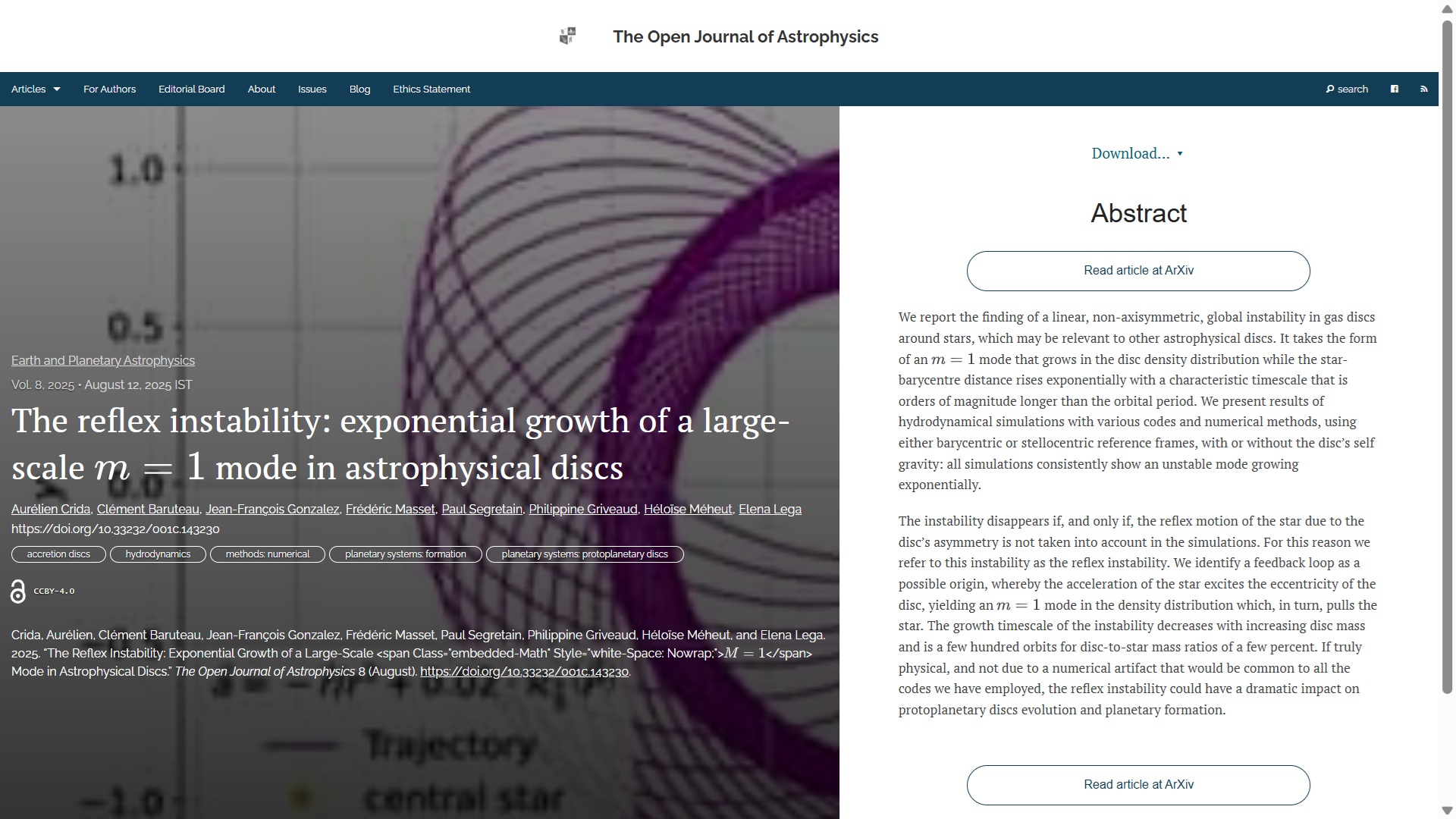
The first paper to report this week is “The reflex instability: exponential growth of a large-scale mode in astrophysical discs” by Aurélien Crida (Université Côte d’Azur, France), Clément Baruteau (Université de Toulouse, France), Jean-François Gonzalez (Universite Claude Bernard Lyon 1, France), Frédéric Masset (Universidad Nacional Autonoma de México) and Paul Segretain, Philippine Griveaud, Héloïse Méheut & Elena Lega (Université Côte d’Azur).  This paper was published on Tuesday August 12th 2025 in the folder marked “Earth and Planetary Astrophysics“. It discusses a exponentially-growing instability in gas discs around stars caused by the motion of the central star in response to the disc.

The overlay – which you can make larger by clicking on it – is here:
You can find the officially accepted version on arXiv here.

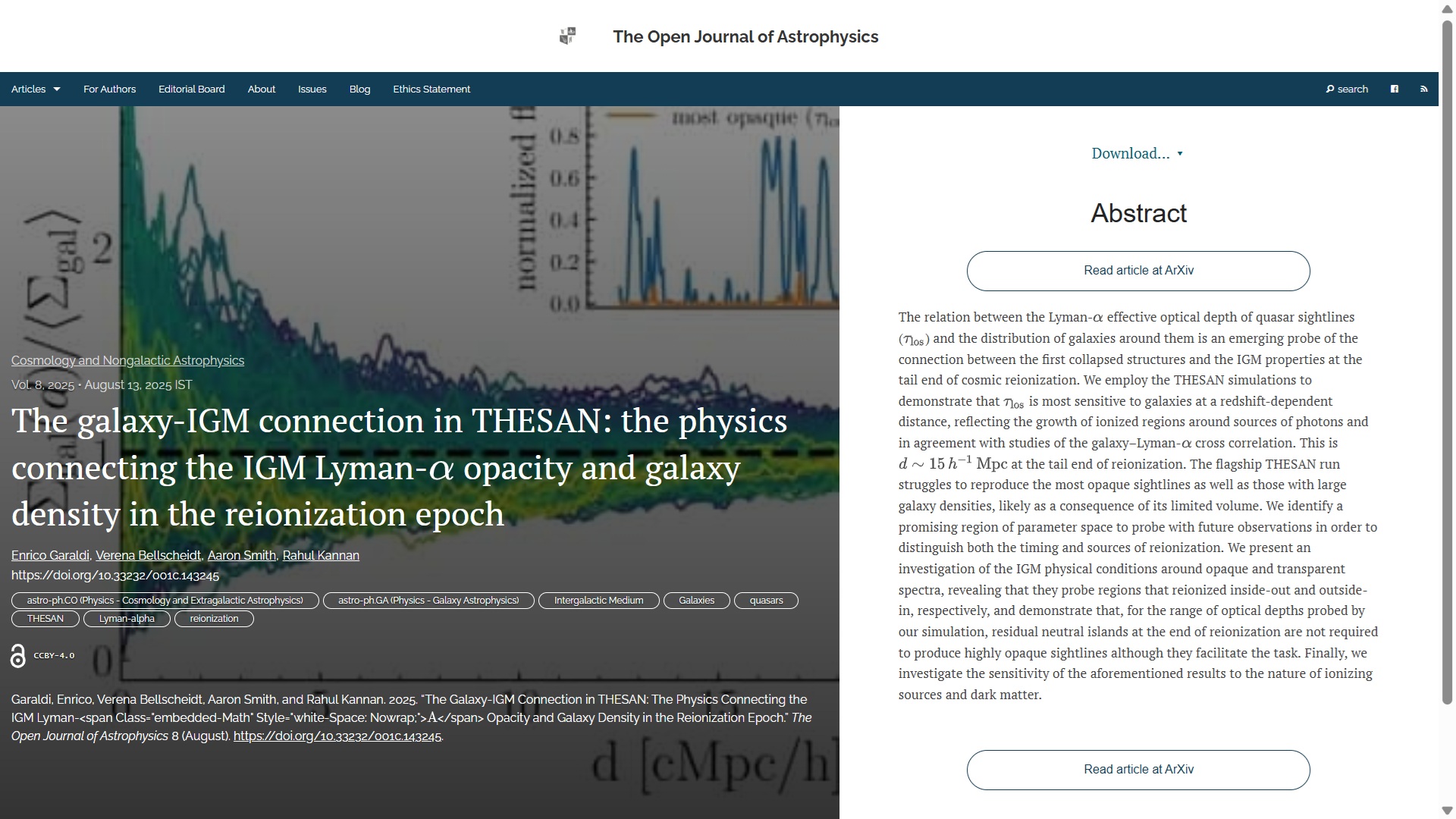
The other paper this week, published in the folder Cosmology and Nongalactic Astrophysics, is “The galaxy-IGM connection in THESAN: the physics connecting the IGM Lyman-alpha opacity and galaxy density in the reionization epoch” by Enrico Garaldi (University of Tokyo, Japan), Verena Bellscheidt (Technical University of Munich, Germany), Aaron Smith (York University, Canada) and Rahul Kannan (University of Texas at Dallas, USA).  It presents a study of the relation between the Lyman-alpha effective optical depth of quasar sightlines and the distribution of galaxiesas as a probe of ionized regions around sources of photons. It was published on Wednesday August 13th 2025.

The overlay is here:
 

You can find the officially accepted version of the paper on arXiv here.

That concludes the papers for this week. I’ll do another update next weekend, though I expect things will remain relatively quiet until September.

Presentation Day

Posted in Education, mathematics, Maynooth with tags , , , on August 15, 2025 by telescoper

Today was the day of the last component of our MSc in Theoretical Physics and Mathematics here in Maynooth. The students handed in their dissertations on Monday and today they all gave presentations about their work. Listening to them all was very enjoyable, actually, as they were on a range of different topics, some purely mathematical, some statistical, and some more obviously physics. Moreover, they were all very good.

I often worry that assessing presentations is much more subjective than written work in physics and mathematics. In the event, however, we usually find good consistency in the scores awarded by staff in attendance. 

It also occurred to me during today’s presentations that we may make more use of such assessments to deal with the encroaching use of AI in project dissertations. One can get a good idea if someone has actually done and understood the work if they can present it in person and answer questions. That is, after all, the main reason we do viva voce examinations at PhD level.

Listening to talk after talk in a long session can be quite wearying – conferences are usually set up like that and they’re not often useful or interesting – but today’s session was fun. Not so much for the students I suppose, as there were a few signs of nerves. When all the talks were over the students trouped off en masse (presumably to the pub) as that was the end of their course. The staff remained behind to agree a set of marks and combine them with the other components of assessment, i.e. the marks for the dissertation. The examination board meets early next week, after which the final results will go forward to the University.

It was great to see the students all completing their course successfully, especially because it is (I think) such a demanding one. My only sadness is that we won’t see them until the conferring ceremonies in October. The Masters students have been regularly present in the Department throughout the whole year and I’ve had quite a lot of interest chats with them. I saw my own project student even more frequently, once a week for almost a year. We have to banish such thoughts now, though, as our thoughts turn to next year’s intake.

I don’t think any of the MSc students will read this – for all I know they’re still in the pub! – but in any case I’d like to say congratulations to them all and wish them all the very best for the future. They’ve earned it!

Man and Boy

Posted in Art, History with tags , , , , , on August 14, 2025 by telescoper

A young (male) person of my acquaintance sent me this picture a while ago. I think he found it here. I assume he thinks the old guy with the walking stick is me, and the boy is him. We’ll gloss over what he was trying to say by sending it to me but, whatever the reason, I found it intriguing.

The online description reads

Elderly man supported by boy, fresco of the Tomb of the Jugglers, Necropolis of Tarquinia (Unesco World Heritage List, 2004), Lazio, Italy, Etruscan civilization, 6th century BC.

This is from the Etruscan (i.e. pre-Roman) period and the best guess for the date is around 530 BC, so the first thing of interest is that, although it is damaged, it has survived pretty well. Fresco (paint on wet plaster, left to dry) is a very fragile medium and many made 1,000 years after this have not lasted as well. The reason for this is that the tomb was not unearthed until 1961, so it was undisturbed for about 2,500 years. The piece above is a section from a larger work that depicts a sort of funerary ritual.

Now to the description quoted above. For a start, the man is not all that “elderly” as his beard is not grey. He is however clearly older than the boy, who isn’t wearing a beard (nor anything else for that matter). The description says “supported by a boy” but if you look at the painting the older man is holding the younger man firmly by the wrist. That doesn’t look like “support” to me!

When I first saw this piece I assumed the older man was holding a staff or walking stick of some sort, but if you look at his right hand you’ll see his index finger extended as if he is pointing and the object in question is behind his hand. The stick also appears to be decorated, but I think it might be the trunk of a small tree; there are fig trees with fruit than hangs on the trunk, for example. It could be that the damaged area at the top of the stick represented foliage at the top. There are several depictions of trees elsewhere in the tomb.

Iinitially I thought the shapes under the original excerpt were meant to be waves, but it seems they are just part of an abstract frieze that runs all the way around.

So what can we infer from these clues? One interpretation is that the man with the beard is taking the boy away reluctantly for some nefarious activity? Sexual relationships between boys and older men were not uncommon in Greek civilisation so maybe that was also the case for the Etruscans?

But there is another interpretation, which I find more plausible given the context of the painting. The scenes in the centre and right represent the funeral rites, including music, but the man and boy (on the left) are clearly walking away from all that. Moreover, the figure in the central panel apparently standing in some sort of vessel looks very much like the boy in the panel above. Is the lid off to let him out, or is he about to be sealed in?

My reading of it, therefore, is that the boy is dead, and the man with the beard is no less than Charun, the demon charged with guiding the departed to the underworld. The name Charun is derived from the Greek Charon, but the character of Charun is quite different from the ferryman Charon. Anyway, he definitely looks like he’s taking the boy somewhere he doesn’t want to go, and Charun is often depicted wearing a skull cap as he is in the picture.

Now I definitely need to find out why my young friend sent me this…

Loose Ends of the Academic Year…

Posted in Biographical, Education, Maynooth with tags , , , , , , , , , on August 13, 2025 by telescoper

I know most people outside academia thing university staff are on a long holiday between June and September, but that’s not the case. This week we have been trying to sort out some of the loose ends of Academic Year 2024/5 before we start on planning for 2025/6. The matters to be dealt with include undergraduate, taught postgraduate, and research posgraduate.

To start with I’ve had to mark my undergraduate repeat (resit) examinations. The grades need to be checked and uploaded before the appropriate examination board meeting next week. That will resolve a number of progression issues, as well as hopefully allowing some students to retrieve credit from their final year and thus be allowed to graduate.

Another set of tasks related to our taught MSc students. They submitted their dissertations on Monday which now need to be read and graded before another examination board (next Monday). They also have to do their presentations, which take place this Friday (15th August).

The following week, the School leaving certificate results come out, at which point we’ll start to get some idea of how many students we will have entering the first year in September.

Today I heard that my PhD student Aoibhinn, who passed her viva voce examination way back in May, has had her thesis corrections formally approved. She now has to submit a bound copy of the thesis along with an electronic version thereof by September 6th at the latest. Then her degree has to be approved by the Faculty of Science & Engineering (on September 16th) followed by Academic Council on (29th September). Assuming those formalities are observed, she can receive her doctorate at one of the conferring ceremonies at the end of October.

Another thing I heard today is that Aoibhinn has been awarded a prestigious research fellowship from the Alexander von Humboldt Foundation but she needs her degree certificate before she can start. That’s a stricter policy than elsewhere, but it is Germany. It’s a bit frustrating, but that particular loose end will definitely be tied soon enough, after which Aoibhinn will be off to Germany for two years. Fortunately the start date of the fellowship is flexible. Congratulations to Aoibhinn!

Saturn, the Bringer of Old Age

Posted in Music with tags , , , on August 12, 2025 by telescoper

I listened to a Proms performance of Gustav Holst’s The Planets the other night. It’s a piece I’ve heard dozens of times, but it was definitely the first time that I felt the most resonance with the Fifth movement, “Saturn, the Bringer of Old Age“. According to Wikipedia, this was Holst’s favourite section. It comprises three parts, “a slow processional which rises to a frightening climax before fading away as if into the outer reaches of space”. The central part has a touch of Charles Ives about it, I think.

Generative AI in Physics?

Posted in Artificial Intelligence, Education, mathematics, Maynooth with tags , , , , , , , , , on August 11, 2025 by telescoper

As a new academic year approaches we are thinking about updating our rules for the use of Generative AI by physics students. The use of GenAI for writing essays, etc, has been a preoccupation for many academic teachers. Of course in Physics we ask our students to write reports and dissertations, but my interest in what we should do about the more mathematical and/or computational types of work. A few years ago I looked at how well ChatGPT could do our coursework assignments, especially Computational Physics, and it was hopeless. Now it’s much better, though still by no means flawless, and now there are also many other variants on the table.

The basic issue here relates to something that I have mentioned many times on this blog, which is the fact that modern universities place too much emphasis on assessment and not enough on genuine learning. Students may use GenAI to pass assessments, but if they do so they don’t learn as much as they would had they done the working out for themselves. In the jargon, the assessments are meant to be formative rather than purely summative.

There is a school of thought that has the opinion that formative assessments should not gain credit at all in the era of GenAI since “cheating” is likely to be widespread. The only secure method of assessment is through invigilated written examinations. Students will be up in arms if we cancel all the continuous assessment (CA), but a system based on 100% written examinations is one with which those of us of a certain age are very familiar.

Currently, most of our modules in theoretical physics in Maynooth involve 20% coursework and 80% unseen written examination. That is enough credit to ensure most students actually do the assignments, but the real purpose is that the students learn how to solve the sort of problems that might come up in the examination. A student who gets ChatGPT to do their coursework for them might get 20%, but they won’t know enough to pass the examination. More importantly they won’t have learnt anything. The learning is in the doing. It is the same for mathematical work as it is in a writing task; the student is supposed to think about the subject not just produce an essay.

Another set of issues arises with computational and numerical work. I’m currently teaching Computational Physics, so am particularly interested in what rules we might adopt for that subject. A default position favoured by some is that students should not use GenAI at all. I think that would be silly. Graduates will definitely be using CoPilot or equivalent if they write code in the world outside university so we should teach them how to use it properly and effectively.

In particular, such methods usually produce a plausible answer, but how can a student be sure it is correct? It seems to me that we should place an emphasis on what steps a student has taken to check an answer, which of course they should do whether they used GenAI or did it themselves. If it’s a piece of code to do a numerical integration of a differential equation, for example, the student should test it using known analytic solutions to check it gets them right. If it’s the answer to a mathematical problem, one can check whether it does indeed solve the original equation (with the appropriate boundary conditions).

Anyway, my reason for writing this piece is to see if anyone out there reading this blog has any advice to share, or even a link to their own Department’s policy on the use of GenAI in physics for me to copy adapt for use in Maynooth! My backup plan is to ask ChatGPT to generate an appropriate policy…

Forgetfulness – Billy Collins

Posted in Poetry with tags , , on August 10, 2025 by telescoper
The name of the author is the first to go
followed obediently by the title, the plot,
the heartbreaking conclusion, the entire novel
which suddenly becomes one you have never read, never even heard of,

as if, one by one, the memories you used to harbor
decided to retire to the southern hemisphere of the brain,
to a little fishing village where there are no phones.

Long ago you kissed the names of the nine muses goodbye
and watched the quadratic equation pack its bag,
and even now as you memorize the order of the planets,

something else is slipping away, a state flower perhaps,
the address of an uncle, the capital of Paraguay.

Whatever it is you are struggling to remember,
it is not poised on the tip of your tongue
or even lurking in some obscure corner of your spleen.

It has floated away down a dark mythological river
whose name begins with an L as far as you can recall

well on your own way to oblivion where you will join those
who have even forgotten how to swim and how to ride a bicycle.

No wonder you rise in the middle of the night
to look up the date of a famous battle in a book on war.
No wonder the moon in the window seems to have drifted
out of a love poem that you used to know by heart.

by Billy Collins (b 1941)

National Famine Way

Posted in Biographical, History, Maynooth with tags , , , , , on August 9, 2025 by telescoper

Yesterday evening on my way out for a meal I got talking to a couple of people who asked for directions. It turned out that they were on the National Famine Way which, to my shame, I hadn’t heard about. When I got home I looked up the website and decided to put it on my list of things to do. The question is whether I can fit it in before term starts near the end of September…

In a time filled with tales of hunger and hearbreak, the National Famine Way commemorates just one example of the cruelty inflicted on Ireland’s poor. No fewer than 1490 starving tenants of the Mahon estate at Strokestown were evicted from their homes then marched along the Royal Canal to Dublin, escorted by the Bailiff responsible for the evictions. At Dublin they travelled by steamer to Liverpool and then crossed the Atlantic on an assortment of coffin ships bound for Canada, about a third of them dying on the way. This was called “assisted emigration”.

The sorrowful journey of the emigrants is marked by 32 pairs of bronze sculptures of children’s shoes on the National Famine Way walking trail.  There is a pair at Maynooth harbour, though I’ve never noticed it.

The 165km historical trail from Roscommon to Dublin weaves mostly along the Royal Canal , which passes through Maynooth. The trail starts in Strokestown Park at the National Famine Museum and ends at the Famine statues in Dublin Docklands, close to EPIC The Irish Emigration Museum, Dublin. On foot it’s a relatively gentle but long six days of walking, which will give me a chance to exercise my old knees as well as staying overnight few places along the way giving me the opportunity to see a bit more of Ireland. Being alongside the Royal Canal it’s very flat so, although it’s a reasonable distance each day, it shouldn’t be too strenuous.

Maynooth is the last stop before Dublin, actually, so I’ll be able to stay at home for the night before doing the final stage of 27km. I was a bit worried about getting to the start, in deepest Roscommon, but there is a bus from Maynooth that goes direct to Strokestown where the jouney starts. There are recommendations of places to eat and places to stay on the way so it should be fairly relaxed. At any rate it will certainly be more comfortable than the journey of the poor souls that made the same trip in 1847, at the height of the Great Famine.

P.S. Come to think of it, I might just do the 27km from Maynooth to Dublin one day just to check out if my knees can take it.

Weekly Update from the Open Journal of Astrophysics – 09/08/2025

Posted in OJAp Papers, Open Access, The Universe and Stuff with tags , , , , , , , , , , , , , , , , , , , , , on August 9, 2025 by telescoper

It’s Saturday morning so, once again, it’s time for an update of papers published at the Open Journal of Astrophysics. Since the last update we have published four new papers, which brings the number in Volume 8 (2025) up to 114, and the total so far published by OJAp up to 349.

The papers published this week, with their overlays, are as follows. You can click on the images of the overlays to make them larger should you wish to do so.

The first paper to report is “Caught in the Act of Quenching? – A Population of Post-Starburst Ultra-Diffuse Galaxies” by Loraine Sandoval Ascencio & M. C. Cooper (UC Irvine), Dennis Zaritsky, Richard Donnerstein & Donghyeon J. Khim (U. Arizona) and Devontae C. Baxter (UC San Diego). This paper was puvblished on Monday 4th August and is in the folder marked Astrophysics of Galaxies. It discusses a sample of Ultra-Diffuse Galaxies (UDGs) found to be post-starburst galaxies through spectroscopic analysis analysis of candidates selected from the Systematically Measuring Ultra-Diffuse Galaxies (SMUDGes) program.

The overlay is here:


The officially-accepted version can be found on arXiv here.

Next one up, published on Tuesday 5th August, in the folder Cosmology and Nongalactic Astrophysics, is “Damping Wing-Like Features in the Spectra of High Redshift Quasars: a Challenge for Fully-Coupled Simulations” by Nick Gnedin & Hanjue Zhu (University of Chicago, USA).  This paper presents a discussion of the difficulties that cosmological radiation transfer codes have in accounting for the existence of “neutral islands” in the universe at relatively low redshifts.

The overlay is here:


You can find the officially accepted version of the paper on arXiv here.

The third paper of the week is “Spectroscopic Analysis of Pictor II: a very low metallicity ultra-faint dwarf galaxy bound to the Large Magellanic Cloud” by Andrew Pace (U. Virginia, USA) and 32 others based in the USA, UK, Canada, Chile and Spain. This one was also published on Tuesday 5th August but in the folder Astrophysics of Galaxies. It describes Magellan/IMACS and Magellan/MIKE spectroscopy of the ultra-faint dwarf (UFD) galaxy Pictor II, which is located only 12 kpc from the Large Magellanic Cloud (LMC).

The overlay is here:


The final version is on arXiv here.

The fourth, and final, paper of the week, also published on Thursday 7th August, is “ASASSN-24fw: An 8-month long, 4.1 mag, optically achromatic and polarized dimming event” by Raquel Forés-Toribio (Ohio State University) and 22 others based in the USA, Austria, Chile and Australia. It is published in the folder Solar and Stellar Astrophysics, and it presents an observational study of an unusual dimming event likely to have been caused by eclipsing of a binary system by a dusty disk.

Here is the overlay:

You can find the officially-accepted version on arXiv here.

And that’s all the papers for this week. I’ll do another update next Saturday.

P.S. For those of you who missed the post I did earlier in the week, I have been looking at the accounts for the Open Journal of Astrophysics and can confirm that the cost to us per paper is less than $30 and will reduce with scale. We expect to publish around 180 papers in 2025 for which the total cost incurred by OJAp will be around $5000. Obviously if we increase by a factor, say, ten then that amount would become significant so we are taking steps to secure additional funding in the event that happens.

Points of the Compass

Posted in Biographical with tags , , , , , , , , on August 8, 2025 by telescoper

A while ago I posted about the countries that I’ve visited over the years. The result is summarized in this map:

You can see that I haven’t seen that much of the world. In fact the map exaggerates what I have seen, because the only place I have visited in Canada was Toronto (and some places to the West of that); I have visited the USA too, but not Alaska.  Likewise the only bit of Australia I’ve visited is Sydney and environs.

Anyway, I saw a thread on BlueSky yesterday which was asking people what was the furthest places on land they have visited North, South, East, and West. Here are my answers:

  • North. Tromsø (Norway), Latitude 69° 39′ N;
  • South. Cape Town (South Africa), Latitude 33° 55′ S;
  • East. Sydney (Australia). Longitude,  151° 12′ E;
  • West. San Francisco (USA). Longitude, 122° 27′ W.

I was initially tempted to put Nagoya (Japan) as my furthest East, but at a mere 136° 55′ it’s nowhere near as far East as Sydney. I wasn’t sure which of Sydney or Cape Town is furthest South either, but Sydney is just a little further North (33° 52′). I went to Tromsø years ago for an Aurora watch, which was great fun. Other than that my furthest North is Reykjavik (Iceland). Many of my observational astronomy colleagues will have been to Hawaii, which easily beats me in the westerly direction. Others have been to Antarctica, which beats me down under.

So my span is about 270° E-W (maximum of 360°) and about 103° N-S (maximum of 180°). Not that impressive really.

Anyway, should you be so inclined, feel free to add your own extremities via the comments box!