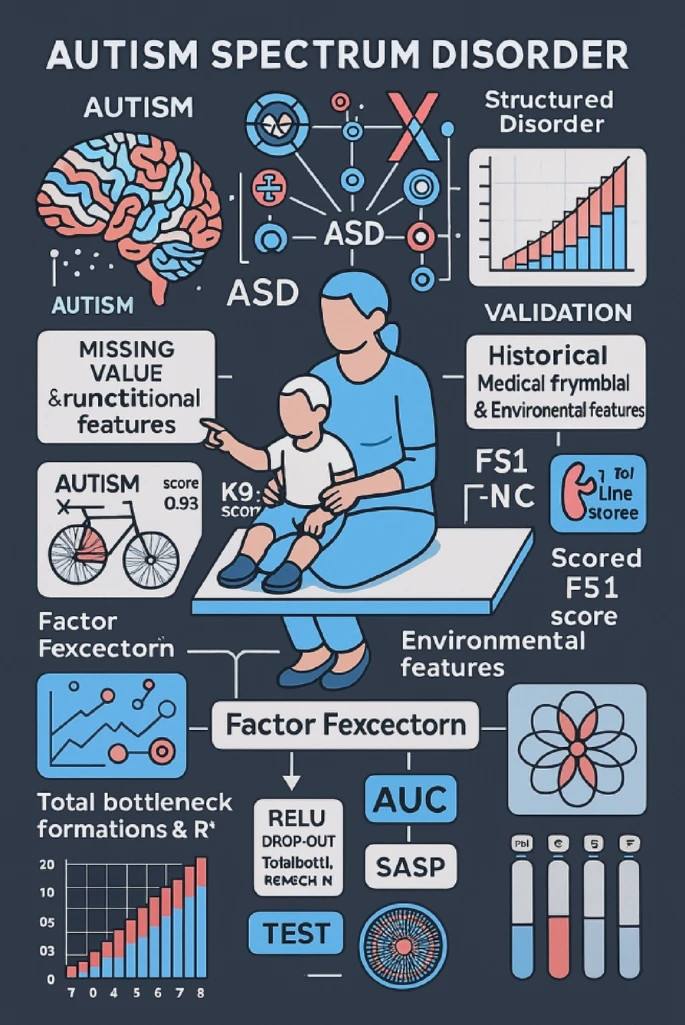
I’m no expert on Autism Diagnosis, but I’m pretty sure that neither “Fexcectorn” nor “frymblal” (medical or otherwise) nor “runctitional” are words in the English language. Why do the person’s legs go through the table? And why is Autism represented by a bicycle? This nonsensical figure was clearly generated by AI, as is much of the text of the paper. How on Earth did this crap pass peer review?
Still, Nature Scientific Reports is indexed in Scopus, which we all know is a watertight guarantee of quality…
P.S. The article was published on 19th November 2025. It is now prefaced by an Editor’s Note: “Readers are alerted that the contents of this paper are subject to criticisms that are being considered by editors. A further editorial response will follow the resolution of these issues.”
It’s Saturday again, so it’s time for the usual update of the week’s new papers at the Open Journal of Astrophysics. Publishing this week was interrupted by the Thanksgiving holiday in the United States, which meant there were no arXiv announcements yesterday. Nevertheless, since the last update we have published another four papers, which brings the number in Volume 8 (2025) up to 184, and the total so far published by OJAp up to 419.
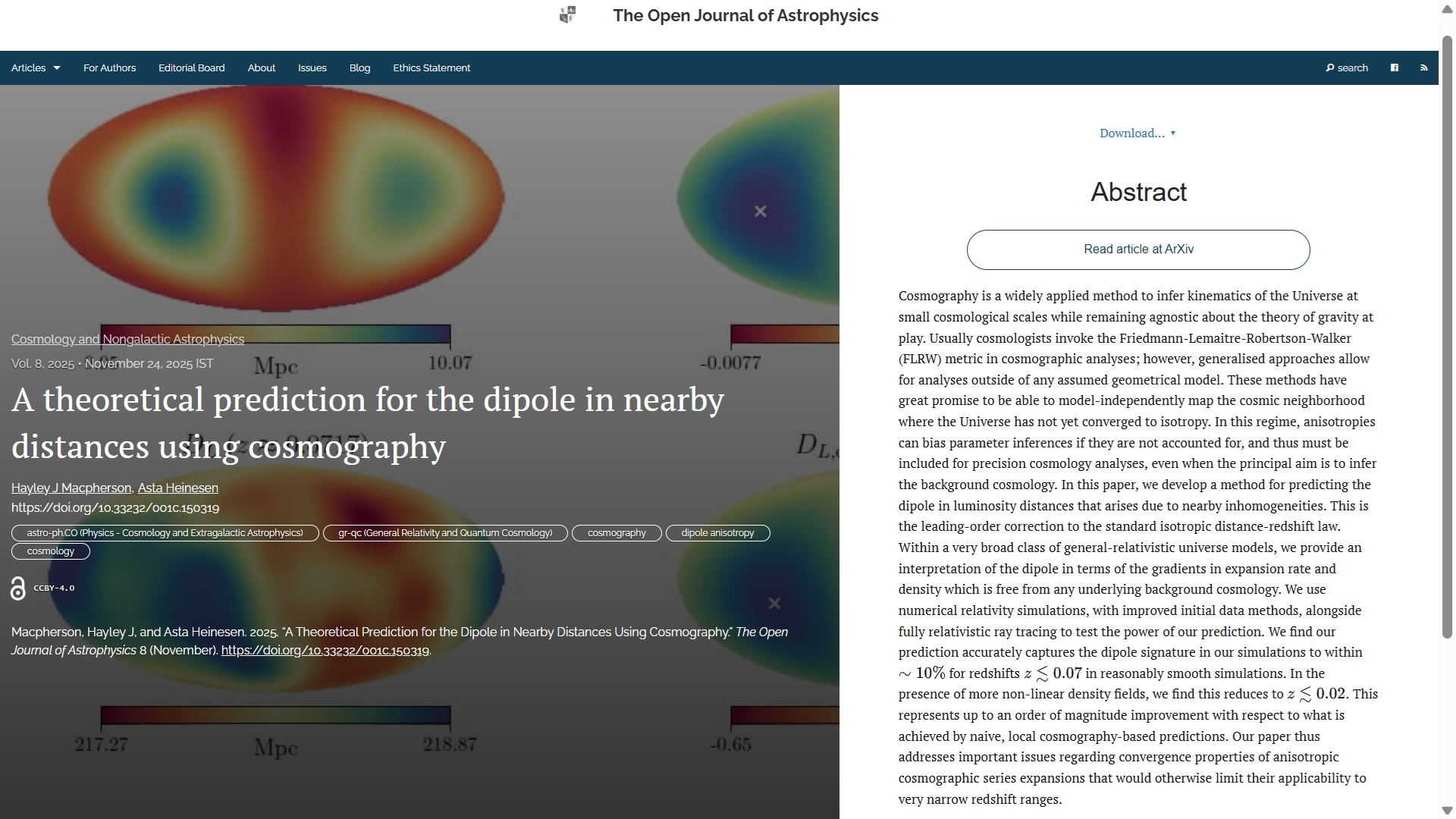
The first paper this week is “A theoretical prediction for the dipole in nearby distances using cosmography” by Hayley J. Macpherson (U. Chicago, USA) and Asta Heinesen (Niels Bohr Institute, Denmark). This was published on Monday 24th November 2025 in the folder Cosmology and Nongalactic Astrophysics. It presents a method to predict the dipole in luminosity distances that arises due to nearby inhomogeneities to leading-order correction to the standard isotropic distance-redshift law. Incidentally, I wrote about a talk by one of the authors here.
The overlay is here:
You can find the officially accepted version on arXiv here and the Fediverse announcement is here:
New Publication at the Open Journal of Astrophysics: "A theoretical prediction for the dipole in nearby distances using cosmography" by Hayley J Macpherson (U. Chicago, USA) and Asta Heinesen (Niels Bohr Institute, Denmark)
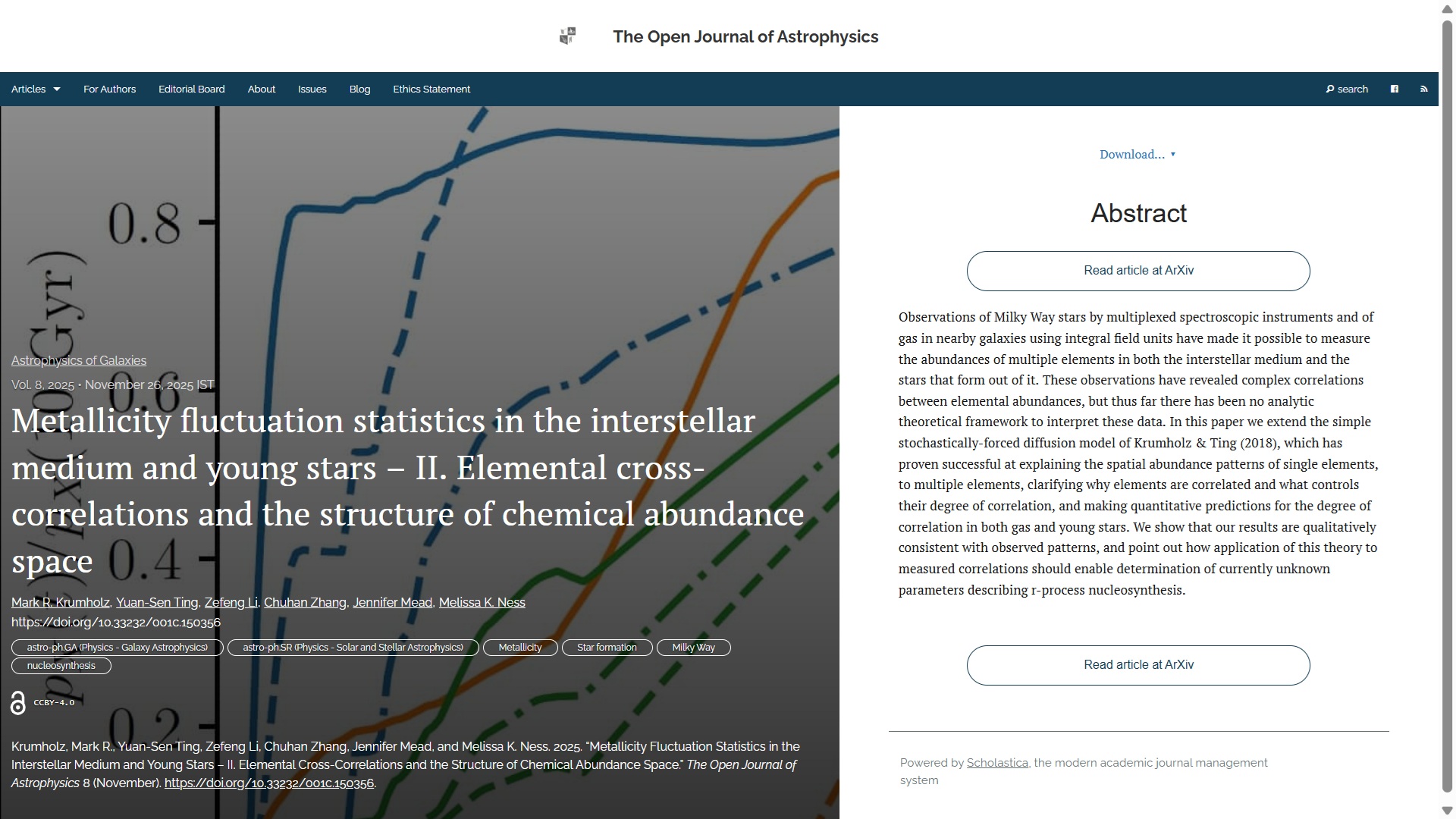
New Publication at the Open Journal of Astrophysics: "Metallicity fluctuation statistics in the interstellar medium and young stars – II. Elemental cross-correlations and the structure of chemical abundance space" by Mark R. Krumholz (ANU, Australia), Yuan-Sen Ting (Ohio State U., USA), Zefeng Li (Durham U., UK), Chuhan Zhang (ANU), Jennifer Mead (Columbia U., USA) and Melissa K. Ness (ANU)
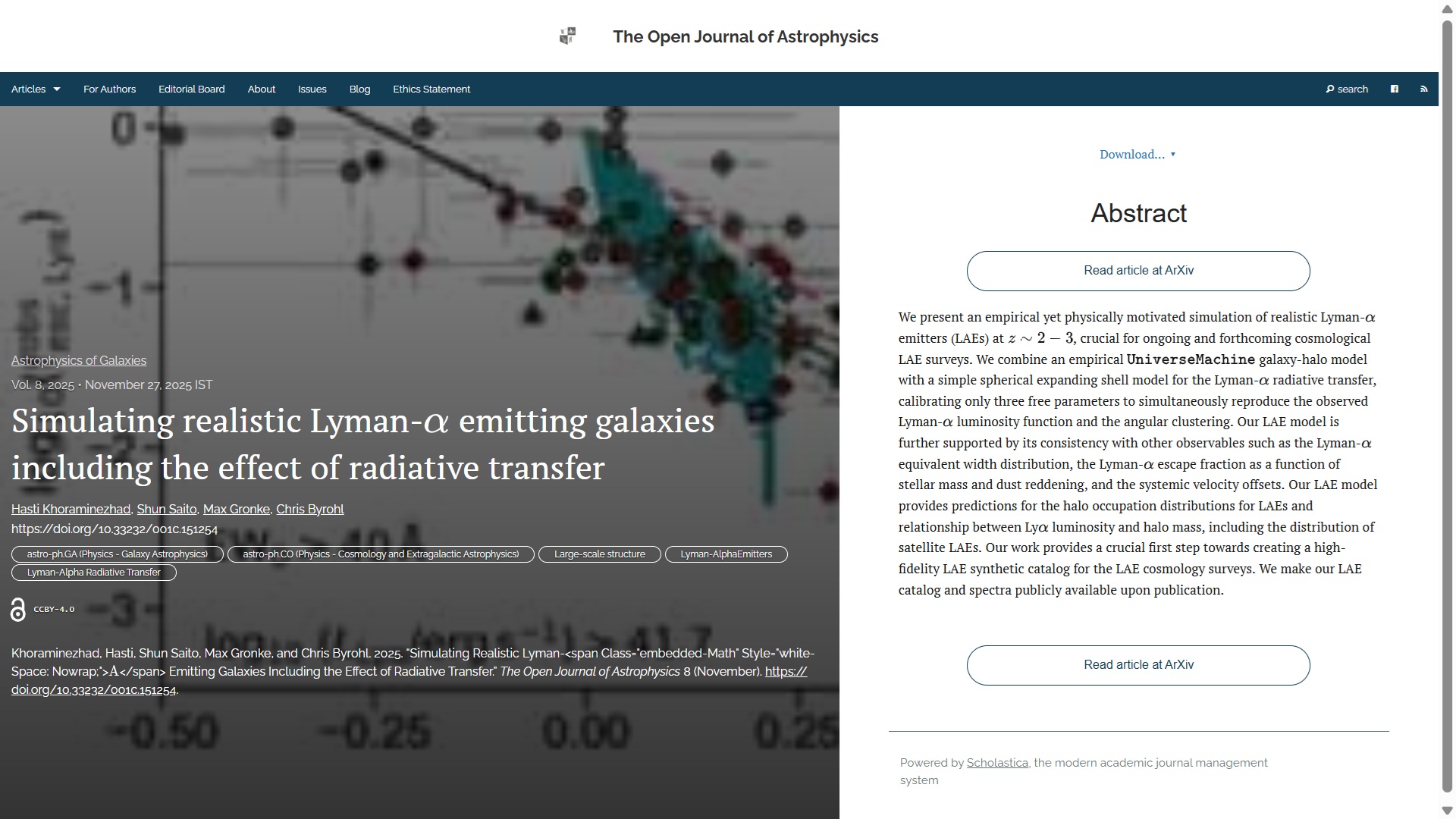
The fourth and final paper of the week is “Simulating realistic Lyman-alpha emitting galaxies including the effect of radiative transfer” by Hasti Khoraminezhad & Shun Saito (Missouri Institute of Science & Technology, USA), Max Gronke (U. Heidelberg, Germany) and Chris Byrohl (MPA Garching, Germany). An empirical model for Lyman-alpha emitters (LAEs) which provides predictions for the halo occupation distributions and relationship between luminosity and halo mass, including the distribution of satellite LAEs. It was published on Thursday November 27th 2025 in the folder Astrophysics of Galaxies.
The overlay is here:
You can find the official published version on arXiv here. The Fediverse announcement follows:
New Publication at the Open Journal of Astrophysics: "Simulating realistic Lyman-alpha emitting galaxies including the effect of radiative transfer" by Hasti Khoraminezhad & Shun Saito (Missouri Institute of Science & Technology, USA), Max Gronke (U. Heidelberg, Germany) and Chris Byrohl (MPA Garching, Germany)
After a false start a couple of days ago, the satellite MAUVE was launched at (10.44 Pacific Time (18.44 GMT) today from Vandenberg Space Force Base in California on a SpaceX Falcon-9 Transporter-15. So far, about 40 minutes after liftoff, it’s looking good.
You can see the live feed here:
As far as I know the launch went perfectly, but I’m waiting for confirmation of payload deployment, which begins about an hour after launch. The vehicle is carrying 140 different satellites, of which MAUVE (“Mission to Analyze the UltraViolet universE”) is just one.
The following is taken from my previous post. I repeat it here for completeness.
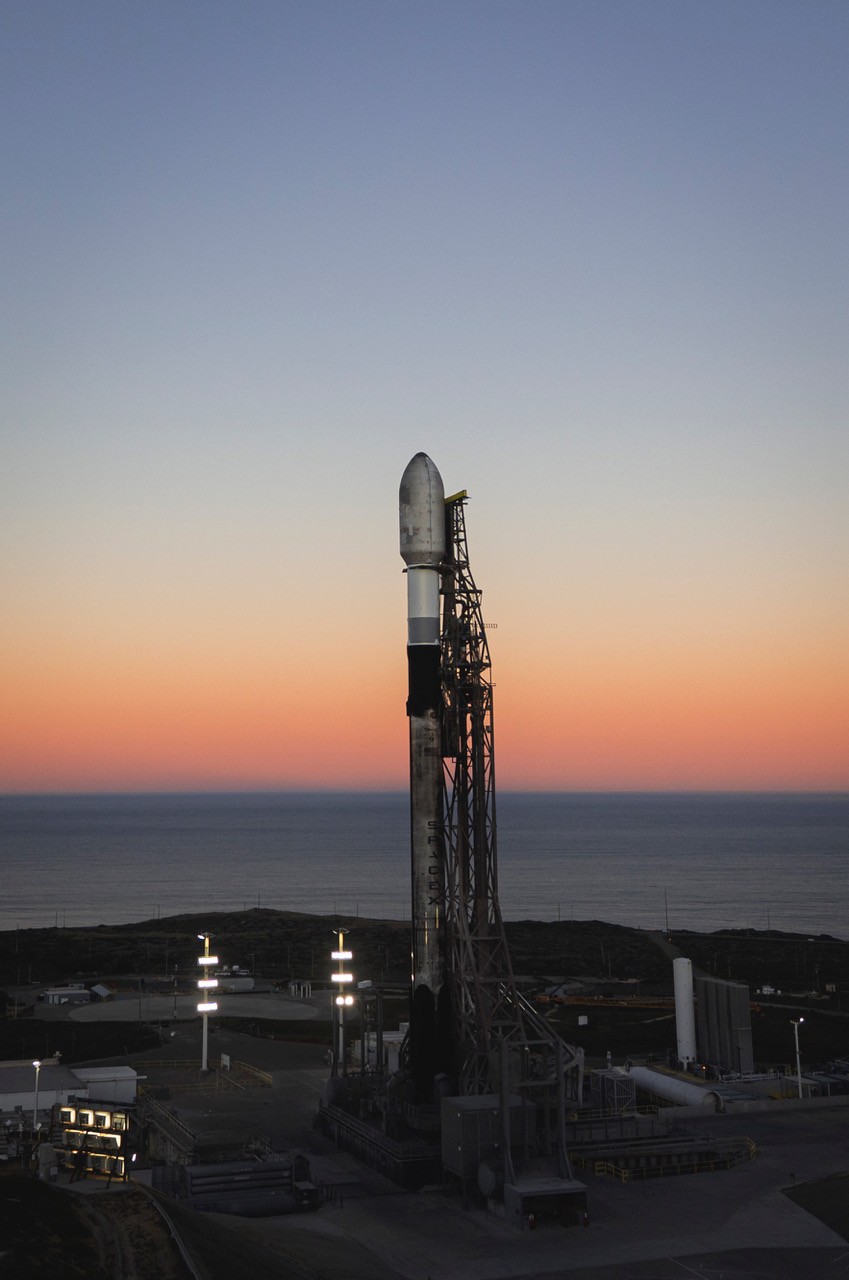
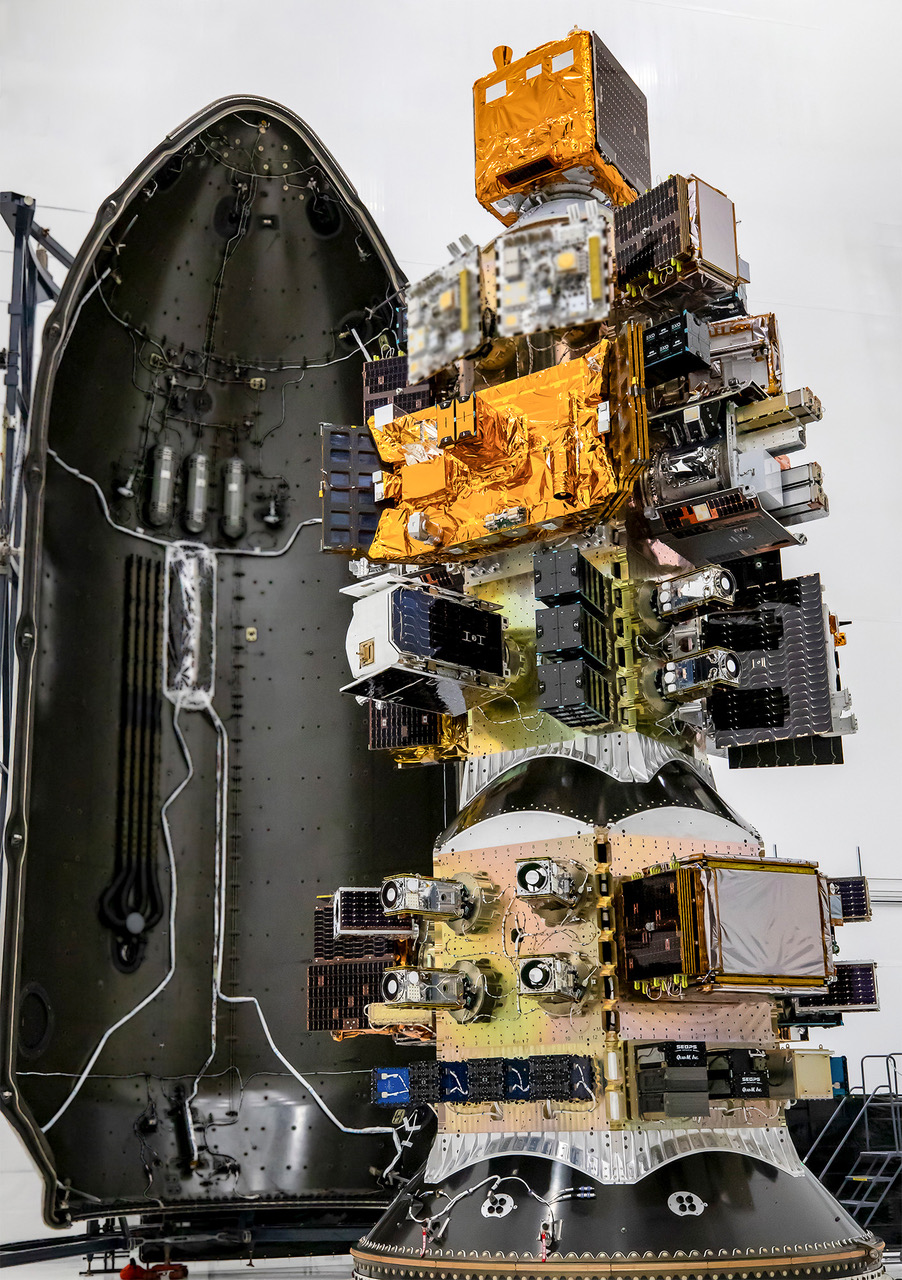
The Falcon-9 launcher ready to go, but not going…The payload: MAUVE is at the bottom right
Closeup of MAUVE
I’m not personally involved in MAUVE but the Department of Physics at Maynooth University is, through my colleague Dr Emma Whelan (who sent the above pictures) and her group. You can read more about the science – related to star and planet formation – it will do in a nice piece by Emma on RTÉ Brainstorm.
Every now and then I get talking over lunch to a distinguished Emeritus Professor at Maynooth University, Tony O’Farrell, about various things. A topic that came up recently was crossword puzzles, which reminded me that I haven’t posted much on that subject for a while. Regular readers of this blog will know that in the past I used to do a lot of crosswords, including the Guardian puzzles almost every day and Azed and Everyman in the Observer on Sundays. Since I moving to Ireland I have weaned myself off the UK newspapers so my regular crossword-solving is nowadays limited to the Times Literary Supplement and Cyclops in Private Eye. Since my TLS subscription has now lapsed, the only one I do regularly is Cyclops.
When I first arrived here almost eight years ago I had a look at the crosswords in the Irish Times. I had a go at the cryptic puzzle – called Crosaire – but didn’t find it particularly challenging (and there’s no prize competition) so never got into the habit of doing it. It’s about the same level of difficulty as Everyman, in my opinion, which I used to do mainly to limber up for Azed. I buy the Weekend Edition on paper and have an online subscription, but rarely look at the crossword.
After chatting with Tony, however, I decided to look at Crosaire again. I had a class test to supervise today so thought I would look at the puzzle that appeared in Saturday’s Weekend Edition as I still had the paper copy. The solution has already been published so I won’t be spoiling anyone’s fun!
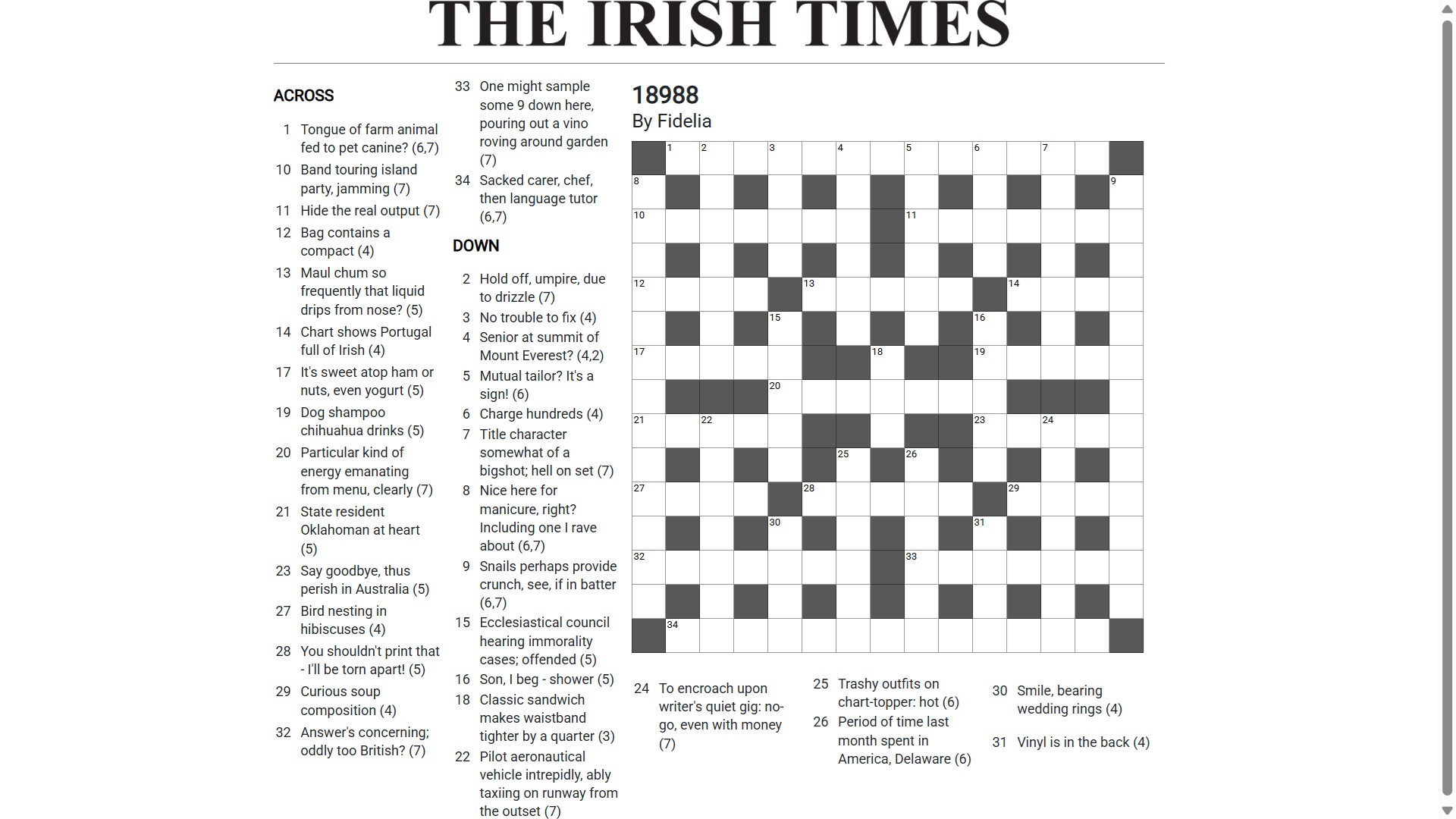
Anyway, here is Saturday’s puzzle (obtained from the Irish Times website)
I see that the screen grab misses the clue for 23 across, which is “Say goodbye, thus perish in Australia (5)”. That’s one of the easy clues; the solution is ADIEU. Other easy ones are 18 down (BLT) and 20 across (NUCLEAR)
Overall, it’s a fairly straightforward cryptic puzzle, with conventional wordplay, but there are one or two points of interest.
The first – and this seems to be a trademark – is that the four clues around the perimeter (1 across, 8 down, 9 down and 34 across) are thematically linked. The theme is also sometimes referenced elsewhere. Obviously getting these solutions is an enormous help in completing the grid. When I looked at 1 across I immediately suspected that “Tongue” might mean a language. I then saw an anagram for RIVIERA on 8 down and the starting word “Nice” gave the game away entirely. The four perimeter clues are thus: FRENCH BULLDOG, FRENCH RIVIERA, FRENCH CUISINE and FRENCH TEACHER; 33 down also refers to the French theme.
Other than that I see that there are more ‘hidden word’ type clues than one would normally see in a UK cryptic, such as the clue for NUCLEAR mentioned above. Another one is “Dog shampoo chihuaua drinks (5)” which is “pooch”, although I am not convinced by “drinks” as the indicator!
I also had to think about 14 across “Chart shows Portugal full of Irish (4)”; I thought it had to be PLAN but couldn’t parse the rest until I found out that lán is “full” in the Irish language, hence “full of Irish” with “P” for “Portugal”. I don’t think there are many references to Irish words in Crosaire, generally.
I’m no speed merchant when it comes to crosswords, but this one took me 10 minutes to solve. If you’re interested, the full solution with notes can be found here. Maybe I’ll try to get into the habit of solving this more frequently. That might provide a little compensation for the generally woeful Opinion pieces cluttering up the newspaper. Also, with retirement on my mind, I wonder if the Irish Times – or any other newspaper – is looking for any more setters?
P.S. Crosaire was the pseudonym taken by the original setter John Derek Crozier, as a play on his own name and on the Irish word for “crossroad”. The Irish word for “crossword” is crosfhocal.
I was hoping to do a post this evening about the satellite MAUVE which was due to be launched at 18.18 GMT from Vandenberg Space Force Base in California on a SpaceX Falcon-9 Transporter-15. Unfortunately the launched was scrubbed with about 15 minutes to go. In fact it was originally scheduled for 11th November but was postponed then. It’s now supposed to be launched on Friday 28th November. Let’s hope it’s third time lucky!
MAUVE is a small satellite, which is to be launched with a number of others; the name stands for “Mission to Analyze the UltraViolet universE” and the heart of it is a 60cm ultraviolet telescope.
The Falcon-9 launcher ready to go, but not going…The payload: MAUVE is at the bottom right
Closeup of MAUVE
I’m not personally involved in MAUVE but the Department of Physics at Maynooth University is, through my colleague Dr Emma Whelan (who sent the above pictures) and her group. You can read more about the science – related to star and planet formation – it will do in a nice piece by Emma on RTÉ Brainstorm.
There’s a more technical description of MAUVE on the arXiv here. The abstract reads:
We present the mission concept “Mission to Analyze the UltraViolet universE” (MAUVE), a wide-field spectrometer and imager conceived during the inaugural NASA Astrophysics Mission Design School. MAUVE responds to the 2023 Announcement of Opportunity for Probe-class missions, with a budget cap of $1 billion, and would hypothetically launch in 2031. However, the formulation of MAUVE was an educational exercise and the mission is not being developed further. The Principal Investigator-led science of MAUVE aligns with the priorities outlined in the 2020 Astrophysics Decadal Survey, enabling new characterizations of exoplanet atmospheres, the early-time light curves of some of the universe’s most explosive transients, and the poorly-understood extragalactic background light. Because the Principal Investigator science occupies 30% of the observing time available during the mission’s 5 yr lifespan, we provide an observing plan that would allow for 70% of the observing time to be used for General Observer programs, with community-solicited proposals. The onboard detector (THISTLE) claims significant heritage from the Space Telescope Imaging Spectrograph on Hubble, but extends its wavelength range down to the extreme UV. We note that MAUVE would be the first satellite in decades with the ability to access this regime of the electromagnetic spectrum. MAUVE has a field of view of 900″ x 900″ a photometric sensitivity extending to mUV ≤ 24 , and a resolving power of R ~ 1000. This paper provides full science and mission traceability matrices for this concept, and also outlines cost and scheduling timelines aimed at enabling a within-budget mission and an on-time launch.
Anyway, I hope to be able to give an update on Friday evening about the successful launch of MAUVE. Fingers crossed!
Yesterday I came across the old cartoon shown above and shared it on Bluesky. It seemed to cause some amusement so I thought I’d share it here too.
The in-tray reminds me of when I (briefly) worked in industry during the 80s. There was a guy in our large open-plan office who had two trays on his desk, one with a sign marked “IN” and the other with a sign marked “OUT”. Things were delivered on Mondays to the in-trays and collected from out-trays at the end of the day on Fridays. This guy never touched the stuff in his in-tray but just before he left work on Fridays he would swap the signs on the two trays…
I’ve been a bit preoccupied these recent weeks so it was with a shock that I realised that we’re into Week 9, which means just four weeks (including this one) until the end of term and just a month before Christmas. Teaching finishes here in Maynooth on Friday 19th December, but I don’t have any lectures on Fridays so in my case it will finish the day before (with a tutorial). I don’t know how many students will be there, but the module concerned is my 4th year Mathematical Physics module and the students are very hard-working, so I think most will attend. After such a busy term I’m sure that they will need a break as much as I will.
I had to rejig the schedule for both modules I am teaching this semester to accommodate the introduction of in-class tests to replace take-home assignments (for reasons I outlined here). I’ve also been handing out voluntary exercises for practice, not counting towards the module mark but for formative reasons. Both modules are mathematical in nature, and I think the best way to learn mathematics is by doing it…
Despite the changes with respect to last year, I am still roughly on track. In my Engineering Mathematics module I’ve just finished Laplace transforms, and will start Fourier methods tomorrow. With the mathematical physicists, I am in the middle of complex analysis, having done complex differentiation and conformal mappings and starting complex integration next week.
I still have a couple more class tests to get through. On the positive side, the students are turning up for them and have expressed approval for the fact that they don’t have compulsory homework to do off-campus. This form of assessment is undoubtedly harder work for the students, it’s also better preparation for the examination that take-home assignments.
We’ve just received the draft examination timetable for January, and I’m pleased that both of the examinations for which I am responsible will take place quite early in the examination period (on 12th and 15th January, respectively) so I should be able to get them corrected in time to have a break for some research before teaching resumes at the start of February.
So far this year we have published 181 articles in the Open Journal of Astrophysics. That’s a very small fraction – a few percent – of the output of the established journals in the area, Astrophysical Journal, Astronomy & Astrophysics and Monthly Notices of the Royal Astronomical Society, MNRAS.
I will take MNRAS as an example for comparison. Last time I looked, the Article Processing Charge (APC) (i.e. publication fee) for a paper submitted there is £2356. Our 181 papers published this year would have cost their authors £426,436 had they had to pay the MNRAS APC. Some – especially in the UK – do not pay directly, but have an equivalent amount taken from their institution(s) via Read-and-Publish agreements. The charge therefore does not come directly from the authors’ funds but from their institution, but that is just splitting hairs. The point about OJAp is that neither authors nor their institutions have to pay.
For comparison, a year’s stipend for a PhD student outside London at UKRI rates is £20,780. That means that the total amount saved by publishing in OJAp rather than MNRAS (£426,436) would be more than the cost of 20 PhD students. It might even be enough (just) to pay your Vice-Chancellor’s salary…
You might well think that is a trivial amount of money compared to the total circulating in science funding, but the real point is that it represents only a tiny fraction of the money being siphoned off from astrophysics research into other activities. Taking all the APCs paid (or page charges or other words that mean “publication fee”) to all the journals, the total figure is probably at least 50 times the £426,436 obtained above. That would be a figure in excess of £20 million. That is not a trivial amount of money. Even for a Vice-Chancellor.
Wouldn’t you and your institution rather keep your grant funds to spend on research than hand it over – directly or indirectly – to publishers? I know I would!
The weather here in Maynooth was very mild until a couple of weeks ago and with the arrival of inclement conditions I started putting out the bird feeders in my garden. I can see the level of the seed from my kitchen window so know when they need filling up. I had one out for a couple of days before the arrival of Storm Claudia with associated torrential rain, but when it passed I was surprised to see the feeders were still half full so I left them.
Last weekend it started to become very cold so I was surprised there were no birds at the feeder. When I went out to look I realized that owing the heavy rainfall some water had got into the seed container, with the result that some of the seeds had started to germinate. This formed a tangled mass of shoots that blocked the gap through which seed is dispensed. The reason the feeders were not empty was not that the birds weren’t hungry, but that no seed was coming out.
I took the feeders inside and cleaned out all the matted seedlings. Then I took them back to the shed to fill up, at which point I knocked over the jar in which I stored the birdseed, scattering the supply all over the floor. There wasn’t much left anyway, but my clumsiness reduced the stock to zero so I was unable to feed the birds despite having functioning feeders.
Yesterday I finally had time to buy some more birdseed. I filled up the feeders as soon as I got home. It was quite interesting to watch the sequence of events. The first to arrive were sparrows who, being small and agile, were quite happy taking terms perching at the feeders. Not long after, however, starlings arrived, squabbling and squawking as they usually do. Starlings are much larger then sparrows and are extremely messy and noisy eaters, their attempts to perch at a feeder causing it to swing and scatter seed all over the ground.
(Incidentally, the term for a large group of starlings is a murmuration, a congregation, a cloud, or a constellation, but there are alternatives for a smaller group like the dozen or so that arrived in my garden. These include a clutter, a scourge, a vulgarity and, my favourite, a filth…)
Some starlings and sparrows started to feed on the ground, as did a very bonny collared dove, walking around calmly amid the flurry of other birds and paying them no attention at all .
At this point the feeder was almost empty.
The last cohort to arrive were the rooks and jackdaws. These are too big to even attempt to perch so their modus operandi is to crash into the feeders to try to break them or knock them down to the ground where they are easier to attack. They didn’t succeed, so they left.
Now the feeders are empty, the birds have gone, and all is quiet. I think I’ll put more food out tomorrow before I go to work. I imagine they’ll be empty by the time I get back home.
The views presented here are personal and not necessarily those of my employer (or anyone else for that matter).
Feel free to comment on any of the posts on this blog but comments may be moderated; anonymous comments and any considered by me to be vexatious and/or abusive and/or defamatory will not be accepted. I do not necessarily endorse, support, sanction, encourage, verify or agree with the opinions or statements of any information or other content in the comments on this site and do not in any way guarantee their accuracy or reliability.





 In the Dark