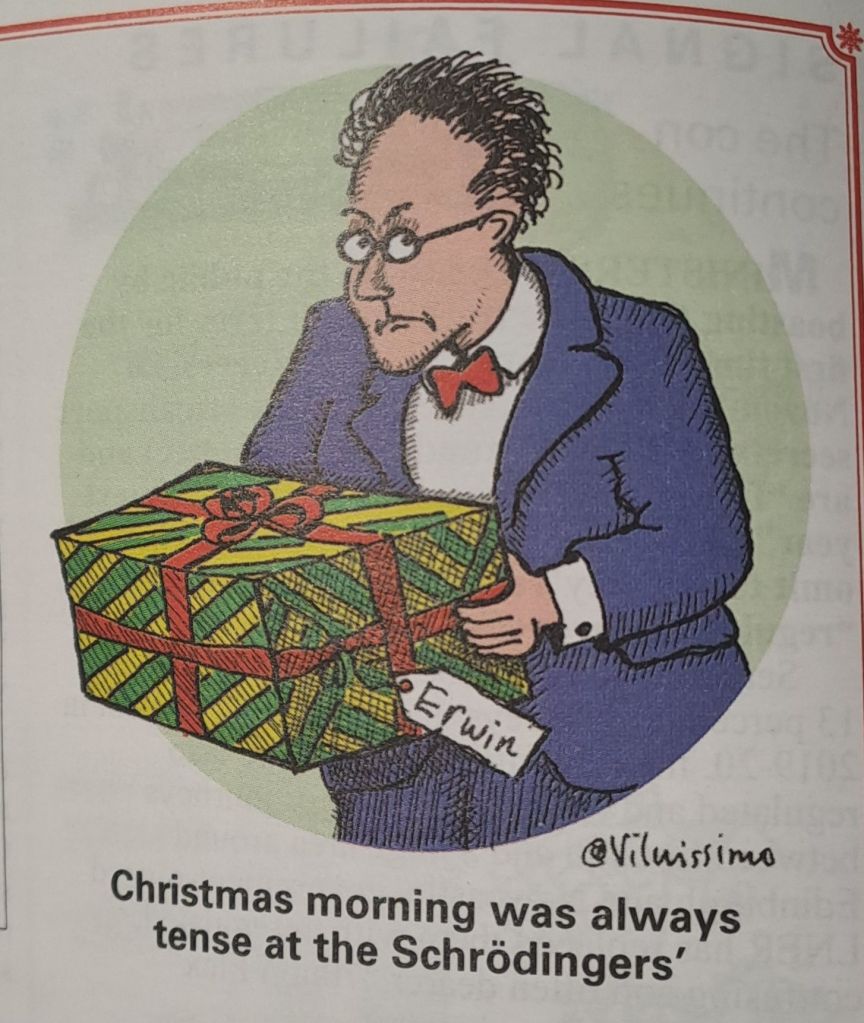
Archive for December, 2025

The Last of Teaching

Posted in Biographical, Maynooth on December 18, 2025 by telescoper

I’ve just returned to the office after delivering my last teaching session of 2025 (a tutorial on Differential Equations and Complex Analysis). I’m up to date with all my grading too, so I’m done with teaching for 2025.

Yesterday we had our Physics Department Christmas Celebration, which was very enjoyable. We went to a restaurant in Maynooth (The Avenue) and afterwards to a local pub (Brady’s). I didn’t stay out too late, though, because I had teaching today and I’m too old for that sort of thing. I got up quite early this morning, actually, although I have to admit it took even longer than usual for effective brain functioning to commence…

I was planning to go home directly after my tutorial and finish a few small jobs in my study, but I don’t particularly want to get drenched so I think I’ll finish them here on campus and hope that the current deluge passes soon…

Schumann: Arabeske in C major (Op. 18) – Boris Giltburg

Posted in Music with tags , , on December 17, 2025 by telescoper

A couple of weeks ago I blogged about a concert at the National Concert Hall that included a performance of a Mozart Piano Concerto by Boris Giltburg. The pianist did an encore piece – the Arabeske in C major by Robert Schumann – which I’ve been meaning to post because it was very nice. I managed to find this recording performed by Boris Giltburg himself, not at the NCH but in Georgia:

How magnetism might make galaxies…

Posted in Biographical, The Universe and Stuff with tags , , on December 16, 2025 by telescoper

I saw mention of paper recently published in Nature Astronomy by Karsten Jedamzik, Levon Pogosian and Tom Abel with the title Hints of primordial magnetic fields at recombination and implications for the Hubble tension. It’s behind a paywall but there is a version available on the arXiv here. The abstract of the Nature Astronomy version looks like this:

This paper reminded me of a paper I wrote a long time ago (in 1991, when I was at Queen Mary) about primordial magnetic fields and galaxy formation. It had its origins in a lunchtime talk I gave which was based on an old paper from the 1970s by Ira Wasserman. All I did was go through the paper and add a few small comments to update it, including some more recent observational constraints and mentions of dark non-baryonic matter; the Wasserman paper was framed in a model in which all the matter in the Universe was baryonic.

Anyway, the talk went down quite well and I was encouraged to write it up. I did so, and submitted it to a journal (MNRAS). Not unreasonably, it was rejected on the grounds that it didn’t have sufficient original content. I therefore expanded the discussion and submitted it as a review article to Comments on Astrophysics. That journal is now defunct, but the paper can be found on NASA/ADS here. It’s even got some citations!

Here’s the title and abstract:

You can find the whole paper here:

You will see I was advocating a larger magnetic field than in the recent one, with a view to affecting galaxy formation directly rather than larger scale features of the Universe. An important point is that primordial magnetic fields can have a large effect soon after recombination, so they might play a role in the formation of galaxies at high redshift which we are struggling to explain. At least – unlike some of the more exotic explanations that have been proposed – we know that magnetic fields actually exist…

The Last Judgment

Posted in Art, Maynooth with tags , , , , on December 15, 2025 by telescoper

Walking home through Maynooth this evening, the streets filled with partying students, I was reminded of this:

It’s the central part of the triptych Das letzte Gericht (The Last Judgment) by  Hieronymus Bosch. The medium is oil on oak panel and it measures 164 x 127 cm. The original work is in the Academy of Fine Arts in Vienna.

The figures at the top, looking down on the chaos, are clearly identifiable as members of academic staff, while those below are students. I’m sure that if Christmas jumpers had been invented in 1486, when the work is thought to have been completed, Bosch would have painted a few in…

Maynooth University Library Cat Update

Posted in Maynooth with tags , , on December 15, 2025 by telescoper

I saw Maynooth University Library Cat on the way to my office this morning. Most students I saw were heading in the opposite direction, in their Christmas jumpers, to pubs, or at least to queue outside them as they weren’t yet open. I think it will be a quiet day on campus, if not in town. Such is the Maynooth Student Xmas I blogged about yesterday.

Anyway, as you can see, Séamus was looking a bit disgruntled, though as usual he was receptive to a stroke or two and a head scratch. It had been raining overnight and such food as was in his dish had turned to mush and was in need of replacement. At least his water bowl was full.

Four Teaching Days to Christmas

Posted in Biographical, Maynooth with tags on December 14, 2025 by telescoper

The week ahead is the last week of the teaching term at Maynooth and, since I don’t have any sessions scheduled for Friday 19th December, I will finish on Thursday 18th and take the Friday off. I don’t think there’ll be many people – either staff or students – around on Friday anyway.

Tomorrow (Monday) is the infamous “Student Xmas” in Maynooth where many undergraduates spend the day getting drunk rather than attending lectures or tutorials. Many start drinking in the morning and carry on until the pubs close in the early hours. I wouldn’t mind this excess too much, but the town is usually in a terrible mess on Tuesday morning, with fast food containers, broken bottles and vomit littering the streets. I have a lecture at 2pm on Monday (tomorrow) which will go ahead and a telecon at 4pm. After those I’ll be making my way home and keeping well out of it until I have to navigate a passage through the debris on Tuesday morning.

Two pubs, Brady’s amd The Roost promote this pre-Chrtistmas celebration vigorously on social media. I imagine their takings are substantial. I wonder if they – or indeed the Student’s Union – pay a little to help clear up the aftermath?

On Tuesday I have three lectures, but one of them (at 11am) will be the final class test for Differential Equations and Complex Analysis so there’s little for me to do but sit there, invigilating. I have promised to get the answers corrected and returned before the break so I’ll have to do them by Thursday, the date of the last tutorial. Our Department Christmas Celebration is on the afternoon of Wednesday 17th, so I’ll have to fit the grading in on Tuesday evening or Wednesday morning.

The other two lectures on Tuesday are Engineering Mathematics, followed by another on Wednesday. I was going to use one of the Tuesday slots for the final class test for this module, but a number of students asked me to postpone it because they anticipate being hung over. I don’t mind but the only available time with a suitable room is Thursday, so they won’t get their marks until after the holiday, for which I feel no need to apologise. It’s good to have the three lecture slots because I missed an hour last week because of the power cut owing to Storm Bram.

Everything is a Simple Harmonic Oscillator

Posted in mathematics, The Universe and Stuff with tags , , , on December 13, 2025 by telescoper

Anyone who has studied theoretical physics for any time will be familiar with the simple harmonic oscillator, which I will call the SHO for short. This is a system that can be solved exactly and its solutions can be applied in a wide range of situations where it holds approximately, e.g. when looking at small oscillations around equilibrium. I’ve often remarked in lectures that we spend much of our lives solving the SHO problem in various guises, often pretending that the difficult system we have in front of us can, if looked at in the right way, and with sufficient optimism, be approximated by the much simpler SHO. Cue the old joke that if all you have is a hammer, everything looks like nail…

That rambling prelude occurred to me when I found this little problem in some old notes. It is a cute mathematical result that shows that the Friedman equations that underpin our standard cosmological model can in fact be written in the same form as those describing a Simple Harmonic Oscillator. In what follows we take the cosmological constant term to be zero.

The resulting equation is the SHO equation if k>0. I’m not sure whether this result is very useful for anything, but it is cute. It also goes to to show that, if looked at in the right way, the whole Universe is a Simple Harmonic Oscillator!

Weekly Update from the Open Journal of Astrophysics – 13/12/2025

Posted in OJAp Papers, Open Access, The Universe and Stuff with tags , , , , , , , , , , , , , , , , , , , , , , , , , , on December 13, 2025 by telescoper

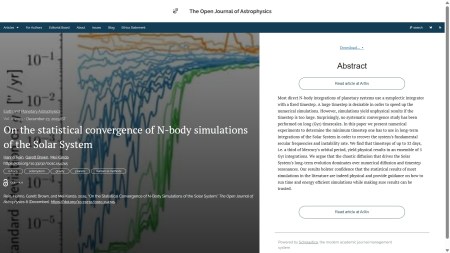
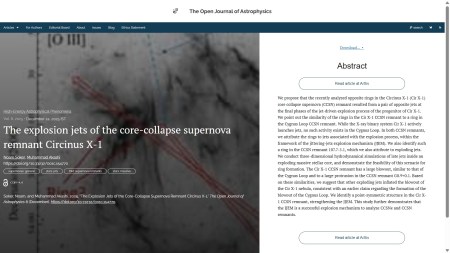
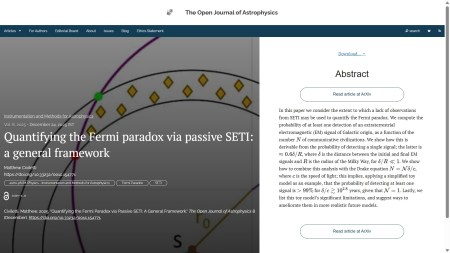
It’s time once again for the usual Saturday morning update of the week’s new papers at the Open Journal of Astrophysics. Since the last update we have published a further five papers, which brings the number in Volume 8 (2025) up to 195, and the total so far published by OJAp up to 430.

The first paper this week is “Cosmic Rays Masquerading as Cool Cores: An Inverse-Compton Origin for Cool Core Cluster Emission” by Philip F. Hopkins (Caltech), Eliot Quataert (Princeton), Emily M. Silich, Jack Sayers, Sam B. Ponnada and Isabel S. Sands (Caltech).  This was published on Tuesday 9th December 2025 in the folder marked High-Energy Astrophysical Phenomena. It presents an argument  that cosmic-ray inverse-compton emission could contribute significantly to the X-ray surface brightness (SB) in cool-corre clusters, implying that gas densities may have been overestimated therein.

The overlay is here:

You can find the officially accepted version on arXiv here and the Fediverse announcement is here:

Open Journal of Astrophysics

New Publication at the Open Journal of Astrophysics: "Cosmic Rays Masquerading as Cool Cores: An Inverse-Compton Origin for Cool Core Cluster Emission" by

Philip F. Hopkins (Caltech), Eliot Quataert (Princeton), Emily M. Silich, Jack Sayers, Sam B. Ponnada and Isabel S. Sands (Caltech)

doi.org/10.33232/001c.154053

December 9, 2025, 7:22 am 1 boosts 0 favorites

The second paper of the week is “Detecting False Positives With Derived Planetary Parameters: Experimenting with the KEPLER Dataset” by Ayan Bin Rafaih (Aitchison College, Lahore, Pakistan) and Zachary Murray (Université Côte d’Azur, France). This one was published on 9th December 2025 in the folder Earth and Planetary Astrophysics. It is an investigation into the performance of a range of machine-learning algorithms on the KEPLER dataset, using precision-recall trade-off and accuracy metrics.

The overlay is here:

You can find the official version of this one on arXiv here. The federated announcement on Mastodon is here:

Open Journal of Astrophysics

New Publication at the Open Journal of Astrophysics: "Detecting False Positives With Derived Planetary Parameters: Experimenting with the KEPLER Dataset" by Ayan Bin Rafaih (Aitchison College, Lahore, Pakistan) and Zachary Murray (Université Côte d’Azur, France)

doi.org/10.33232/001c.154054

December 9, 2025, 7:34 am 1 boosts 0 favorites

Next one up is “The role of peculiar velocity uncertainties in standard siren cosmology” by Chris Blake and Ryan J. Turner (Swinburne, Australia). This paper discusses the impact of peculiar velocities on the error in H0 determinations from local distance indicators with observed redshifts, incorporating the effect of bulk flows. It was published on Tuesday 9th December in the folder Cosmology and Nongalactic Astrophysics.

The overlay is here:
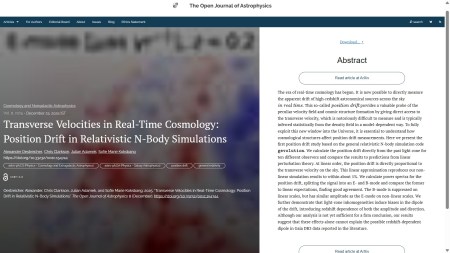
You can find the official accepted version on arXiv here. The fediverse announcement is here:

Open Journal of Astrophysics

New Publication at the Open Journal of Astrophysics: "The role of peculiar velocity uncertainties in standard siren cosmology" by Chris Blake and Ryan J. Turner (Swinburne, Australia)

doi.org/10.33232/001c.154055

December 9, 2025, 7:47 am 1 boosts 0 favorites

The fourth article of the week is “Transient QPOs of Fermi-LAT blazars with Linearly Multiplicative Oscillations” by P. Penil (Clemson University, USA) and 7 others based in the USA, Italy and Germany. This was published on Thursday 10th December in the folder High-Energy Astrophysical Phenomena. This paper presents an investigation of patterns of quasi-periodic oscillations in observed blazar systems characterized by periodic multiplicative amplitudes including both the periodicities and long-term variations.  The overlay is here:

You can find the official published version on arXiv here. The Fediverse announcement follows:

Open Journal of Astrophysics

New Publication at the Open Journal of Astrophysics: "Transient QPOs of Fermi-LAT blazars with Linearly Multiplicative Oscillations" by P. Penil (Clemson University, USA) and 7 others based in the USA, Italy and Germany

doi.org/10.33232/001c.154123

December 10, 2025, 12:22 pm 0 boosts 1 favorites

The last paper for this week is “Tidally Delayed Spin-Down of Very Low Mass Stars” by Ketevan Kotorashvili and Eric G. Blackman (U. Rochester, USA). This was published on Friday 12th December (yesterday) in the folder Solar and Stellar Astrophysics. It discusses the effect of tides from sub-stellar companions on rotational evolution of very low-mass stars, suggesting that these may explain the dearth of field, late-type M dwarfs with intermediate rotation periods.

The overlay is here:


You can find the officially-accepted version on arXiv here, and the Mastodon announcement is here:

Open Journal of Astrophysics

New Publication at the Open Journal of Astrophysics: "Tidally Delayed Spin-Down of Very Low Mass Stars" by Ketevan Kotorashvili and Eric G. Blackman (U. Rochester, USA)

doi.org/10.33232/001c.154268

December 12, 2025, 10:31 am 1 boosts 0 favorites


And that concludes the update for this week. I will do another of these regular announcements next Saturday, which will be the last such update for 2025. Will we make it past 200 for the year? Tune in next week to find out!

Blue Christmas Again

Posted in Jazz with tags , , , on December 12, 2025 by telescoper

I’ve had a very busy penultimate week of term and am out of energy so instead of attempting a new post I thought I’d repost this “festive” classic. I posted this one during the “festive” season” in 2013 and haven’t posted it since. Until now. The band is led by none other than Miles Davis; the other members are Frank Rehak (trombone), Wayne Shorter (tenor sax), Paul Chambers (bass), Jimmy Cobb (drums), and Willie Bobo (bongos); the arrangement is unmistakably by Gil Evans. The vocalist is the legendary Bob Dorough who also wrote the lyrics.

“Bah Humbug” never sounded so cool!

 P.S. I’m not particularly blue myself, just tired…

An Introduction to Philosophy

Posted in Uncategorized with tags , on December 11, 2025 by telescoper
Cartoon from Private Eye