Archive for Planetary Nebula

Hubble, Euclid and the Cat’s-Eye Nebula

Posted in Euclid, Maynooth, The Universe and Stuff with tags , , , , , on March 3, 2026 by telescoper

It’s been a while since I posted any Euclid-related news so I’m taking this opportunity to share a press-release related to this image:
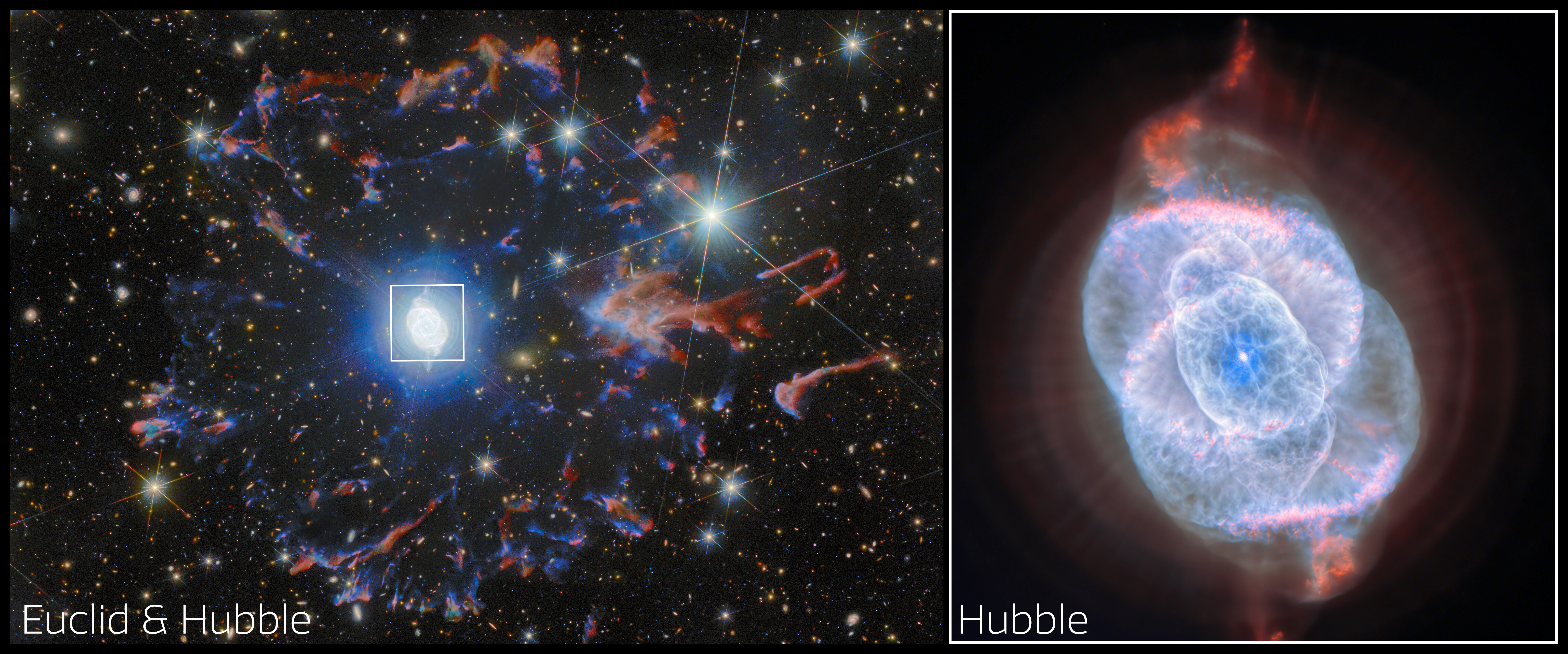
ESA/Hubble & NASA, ESA Euclid/Euclid Consortium/NASA/Q1-2025, J.-C. Cuillandre & E. Bertin (CEA Paris-Saclay), Z. Tsvetanov

The Press Release follows:

–o–

For this ESA/Hubble Picture of the Month, Hubble  is joined by ESA’s Euclid to create a new view of the most visually intricate remnants of a dying star: the Cat’s Eye Nebula, also known as NGC 6543.

This extraordinary planetary nebula in the constellation Draco has captivated astronomers for decades with its elaborate and multilayered structure. Observations with ESA’s Gaia mission place the nebula at a distance of about 4300 light-years.

Planetary nebulae, so-called because of their round shape when viewed through early telescopes, are in fact expanding gas thrown off by stars in their final stages of evolution. It was the Cat’s Eye Nebula itself where this fact was first discovered in 1864 – examining the spectrum of its light reveals the emission from individual molecules that’s characteristic of a gas, distinguishing planetary nebulae from stars and galaxies. 

Here, the nebula is showcased through the combined eyes of the NASA/ESA Hubble Space Telescope and ESA’s Euclid, highlighting the remarkable complexity of stellar death.

Though primarily designed to map the distant Universe, Euclid captures the Cat’s Eye Nebula as part of its deep imaging surveys. In Euclid’s wide, near-infrared and visible light view, the arcs and filaments of the nebula’s bright central region are situated within a halo of colourful fragments of gas zooming away from the star.

This ring was ejected from the star at an earlier stage, before the main nebula at the centre formed. The whole nebula stands out against a backdrop teeming with distant galaxies, demonstrating how local astrophysical beauty and the farthest reaches of the cosmos can be seen together in modern astronomical surveys.

Within this broad view of the nebula and its surroundings, Hubble captures the very core of the billowing gas with high-resolution visible-light images, adding extra detail in the centre of this image. The data reveal a tapestry of concentric shells, jets of high-speed gas and dense knots sculpted by shock interactions, features that appear almost surreal in their intricacy. These structures are believed to record episodic mass loss from the dying star at the nebula’s centre, creating a kind of cosmic “fossil record” of its final evolutionary stages.

Combining the focused view of Hubble with Euclid’s deep field observations not only highlights the nebula’s exquisite structure but also places it within the broader context of the Universe that both space telescopes explore. Together, these missions provide a rich and complementary view of NGC 6543 – revealing the delicate interplay between stellar end-of-life processes and the vast surrounding space.

–o–

For more information, see here. There’s also this video which shows the Nebula in context in Euclid’s extraordinarily impressive wide field capability and Hubble’s superb resolution in the optical band:

P.S. I put the following on my office door in Maynooth University to demonstrate the true scale (!) of my own involvement in Euclid.
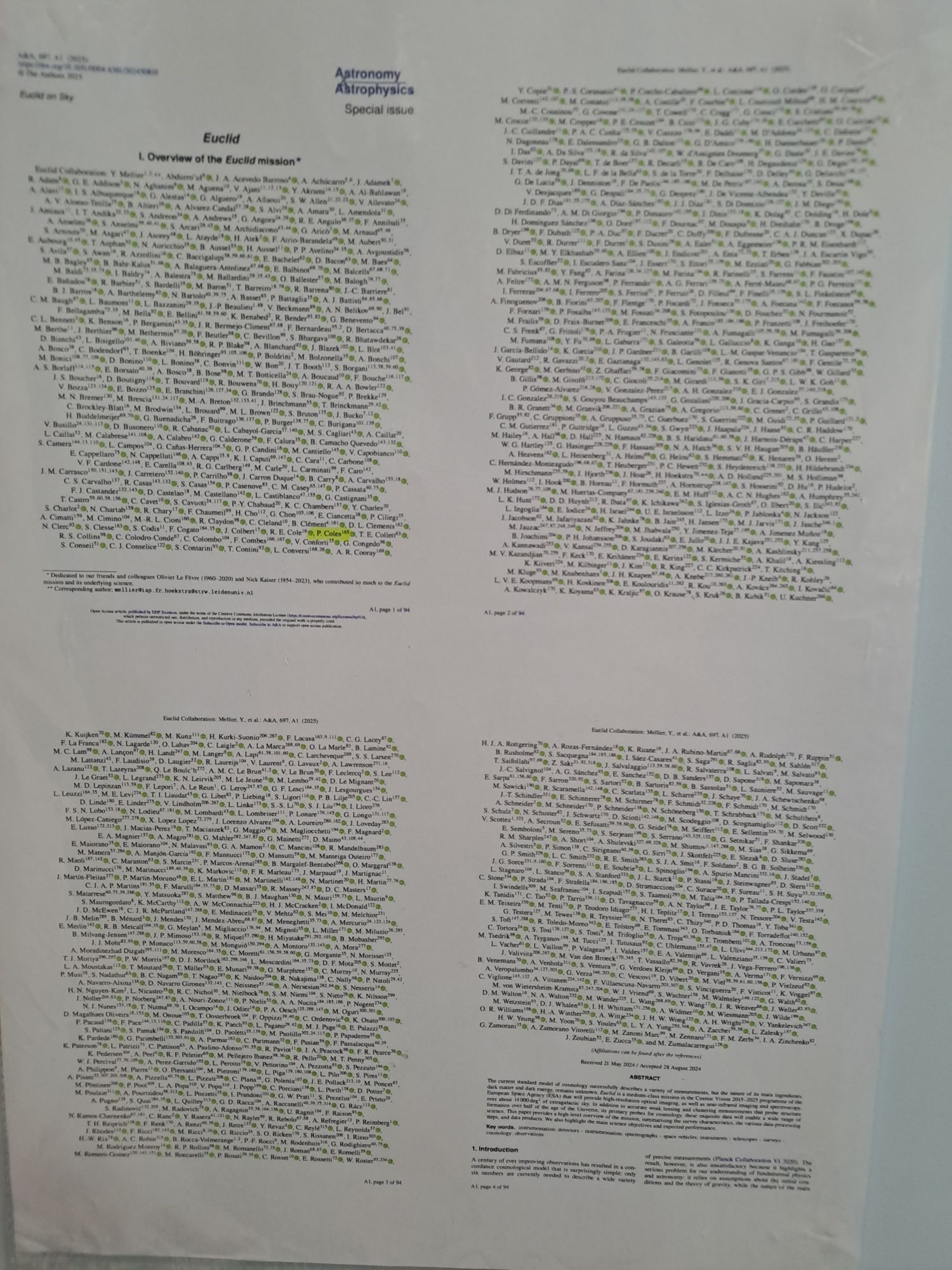
At least I’m on the first page!

Weekly Update from the Open Journal of Astrophysics – 12/04/2025

Posted in OJAp Papers, Open Access, The Universe and Stuff with tags , , , , , , , , , , , , , , , , on April 12, 2025 by telescoper

Time for the weekly Saturday morning update of papers published at the Open Journal of Astrophysics. Since the last update we have published four new papers, which brings the number in Volume 8 (2025) up to 37 and the total so far published by OJAp up to 272.

In chronological order of publication, the four papers published this week, with their overlays, are as follows. You can click on the images of the overlays to make them larger should you wish to do so.

The first paper to report is “Searching for new physics using high precision absorption spectroscopy; continuum placement uncertainties and the fine structure constant in strong gravity” by Chung-Chi Lee (Big Questions Institute (BQI), Sydney, Australia), John K. Webb (Cambridge, UK), Darren Dougan (BQI), Vladimir A. Dzuba & Victor V. Flambaum (UNSW, Australia) and Dinko Milaković (Trieste, Italy).

This presents a discussion of the problem of continuum placement in high-resolution spectroscopy, which impacts significantly on fine structure constant measurements, and a method for mitigating its effects. The paper is in the folder Solar and Stellar Astrophysics and was published on Tuesday 8th April 2025. The overlay is here:

You can find the officially-accepted version of the paper on arXiv here.

The second paper to announce, also published on 8th April 2025,  is “Deciphering Spatially Resolved Lyman-Alpha Profiles in Reionization Analogs: The Sunburst Arc at Cosmic Noon” by Erik Solhaug (Chicago, USA), Hsiao-Wen Chen (Chicago), Mandy C. Chen (Chicago),  Fakhri Zahedy (University of North Texas),  Max Gronke (MPA Garching, Germany),  Magdalena J. Hamel-Bravo (Swinburne, Australia), Matthew B. Bayliss (U. Cincinatti), Michael D. Gladders  (Chicago), Sebastián López (Universidad de Chile), Nicolás Tejos (Universidad Católica de Valparaíso, Chile).

This paper, which presents a study of the Lyman-alpha emission properties of a gravitationally-lensed galaxy at redshift z=2.37, appears in the folder Astrophysics of Galaxies. It was published


You can read the officially accepted version of this paper on arXiv here.

The third paper of the week  is “On the progenitor of the type Ia supernova remnant 0509-67.5” by Noam Soker (Technion, Haifa, Israel). This one was published on Wednesday 9th April 2025 in the folder High-Energy Astrophysical Phenomena. The author discusses possible ideas for the origin of a supernova that exploded inside a planetary nebula.

Here is the overlay:


You can find the officially accepted version of this paper on arXiv here.

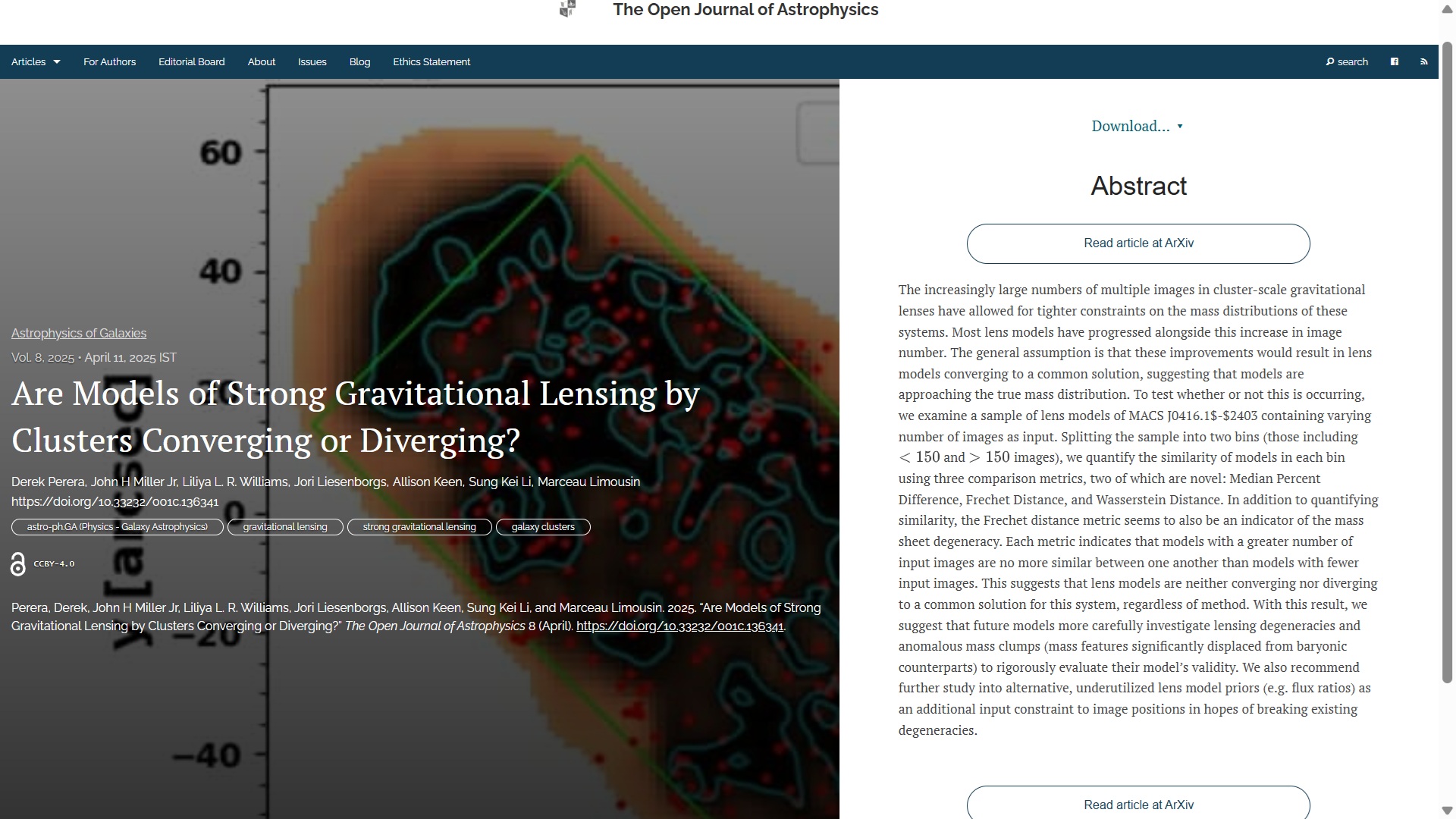
Last (but certainly) not least for this week, published on April 11th 2025, we have “Are Models of Strong Gravitational Lensing by Clusters Converging or Diverging?” by Derek Perera (U. Minnesota), John H Miller Jr & Liliya L. R. Williams (U. Minnesota, USA), Jori Liesenborgs (Hasselt U., Belgium), Allison Keen (U. Minnesota), Sung Kei Li (Hong Kong University), Marceau Limousin (Aix Marseille Univ., France).  This papers study various models of a strong gravitational lensing system, the results suggesting that lens models are neither converging to nor diverging from a common solution for this system, regardless of method.

Here is the overlay:


The official published version can be found on the arXiv here.


That’s all the papers for this week. By way of a postscript I’ll just mention that the gremlins that have affected submissions to Crossref (which we rely on for registering the article metadata) have now been resolved and normal services have been restored.

Two Views of the Ring Nebula

Posted in Cardiff, Maynooth, The Universe and Stuff with tags , , , , , , , , , on August 22, 2023 by telescoper

It’s very nice to have an opportunity, courtesy of JWST, to congratulate astronomers from my current institution (Maynooth, Ireland) and my previous one (Cardiff, UK) – as well as many others – or their involvement in stunning new observations of the Ring Nebula (aka M57 and NGC 6720), a planetary nebula. There is a full story on the Maynooth University website here detailing the involvement of Dr Patrick Kavanagh in the processing of the images and another on the Cardiff University website here about Dr Roger Wesson, who led the programme. Not surprisingly there has been a lot of news coverage about these wonderful images obtained with the NIRCam and MIRI instruments on JWST here in Ireland and in Wales and elsewhere.

A particular excuse for reproducing the pictures here is to try out the fancy “image comparison” tool on WordPress, which allows the reader – that’s you – to slide one picture over the other. Have a go!

This groovy visual shows two images side by side of the Ring Nebula. The image on the left shows the NIRCam view and the image on the right shows the MIRI image. The left image shows the planetary nebula as a distorted doughnut with a rainbow of colours with a blue/green inner cavity and clear filamentary structure in the inner region. The right image shows the nebula with a red/orange central cavity with a ring structure that transitions from colours of yellow to purple/blue. Picture credits ESA/Webb, NASA, CSA, M. Barlow, N. Cox, R. Wesson

The full paper describing these observations can be found on the arXiv here.