Archive for Plasma Physics

Weekly Update from the Open Journal of Astrophysics – 31/01/2026

Posted in OJAp Papers, Open Access, The Universe and Stuff with tags , , , , , , , , , , , , , , , , , , , , , , , , , , , on January 31, 2026 by telescoper

It’s Saturday once more so time for another update of activity at the Open Journal of Astrophysics. Since the last update we have published a further four papers, bringing the number in Volume 9 (2026) to 18 and the total so far published by OJAp up to 466.

I will continue to include the posts made on our Mastodon account (on Fediscience) to encourage you to visit it. Mastodon is a really excellent service, and a more than adequate replacement for X/Twitter which nobody should be using; these announcement also show the DOI for each paper.

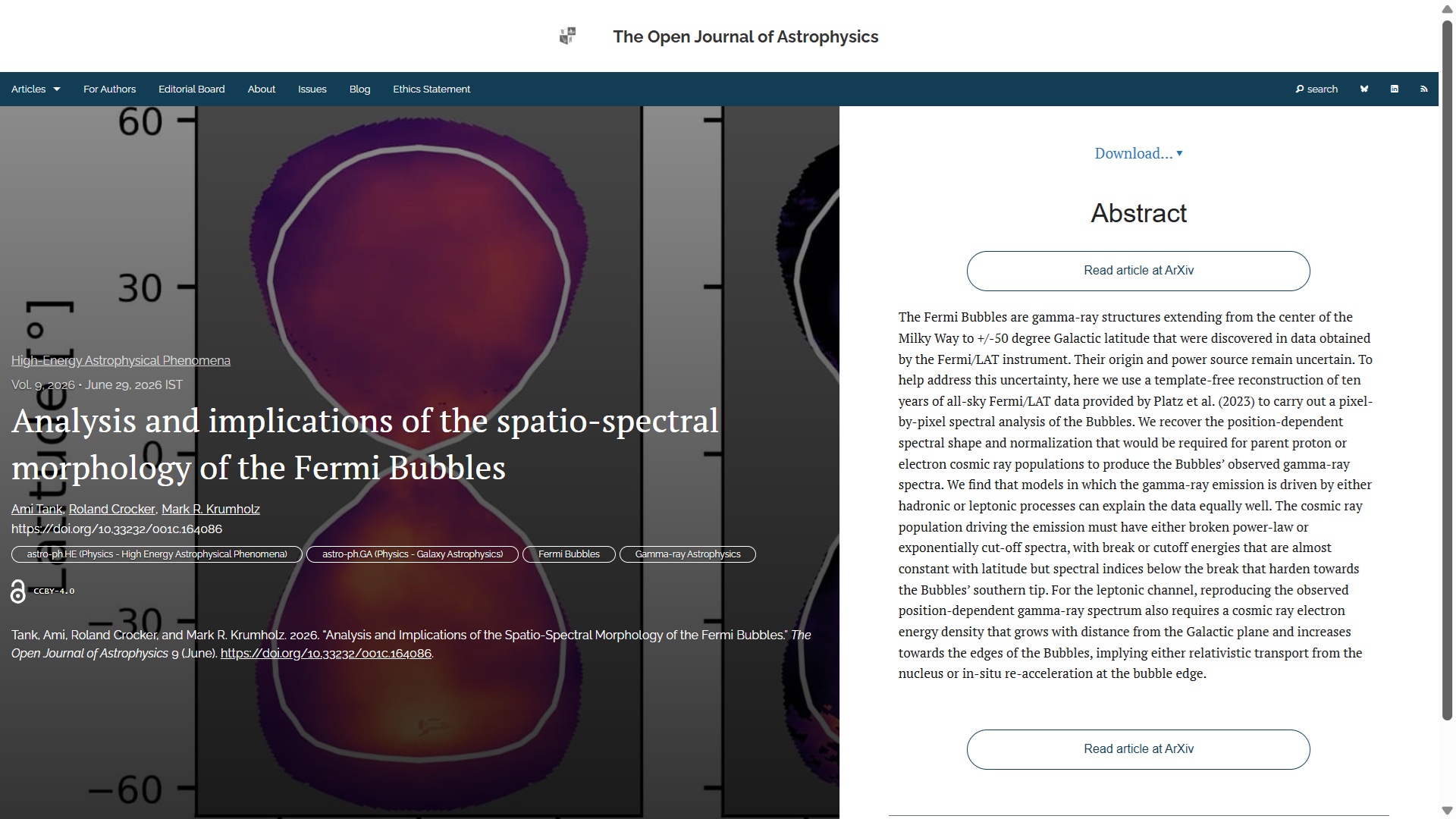
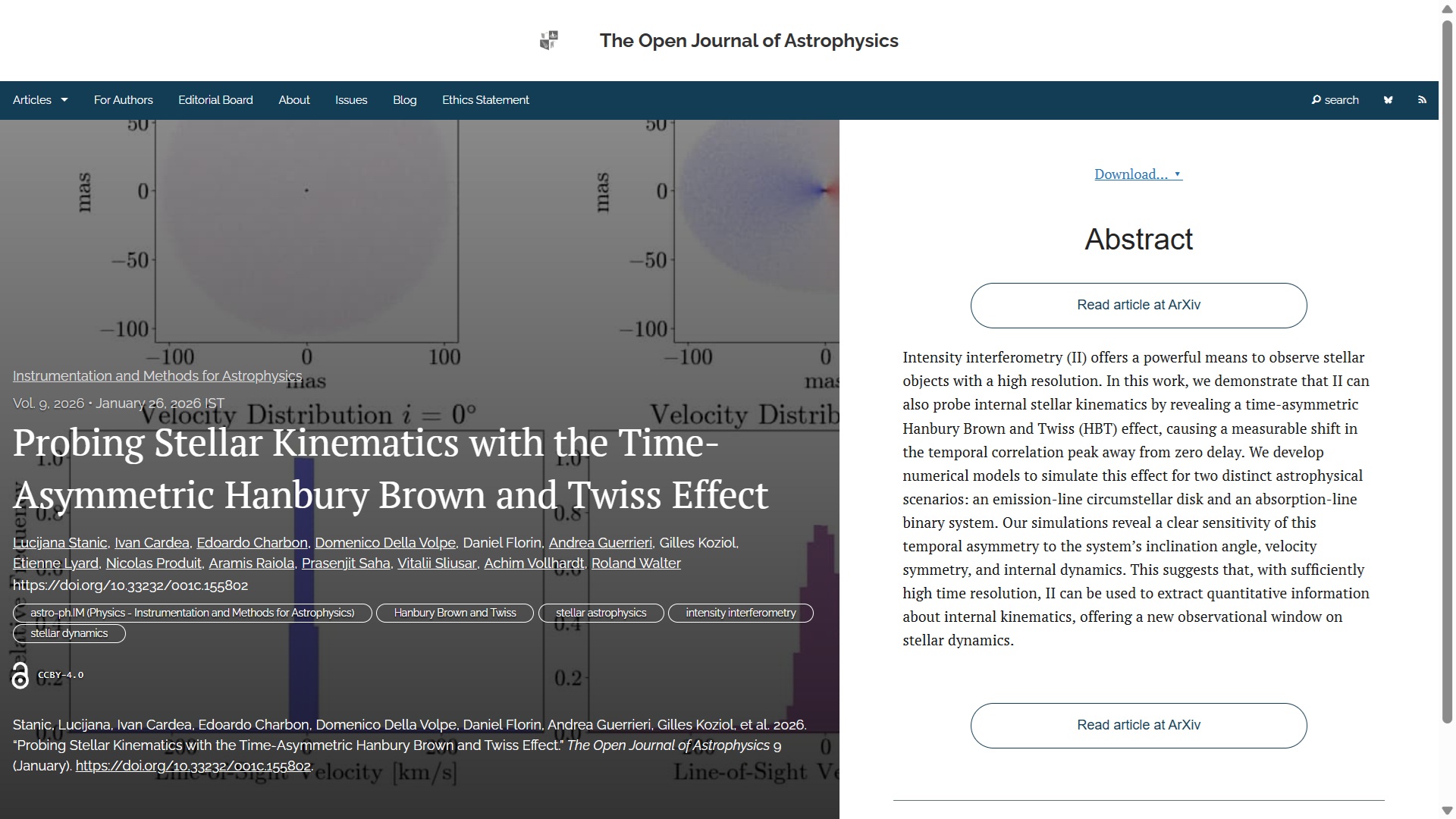
The first paper to report this week is “Probing Stellar Kinematics with the Time-Asymmetric Hanbury Brown and Twiss Effect” by Lucijana Stanic (University of Zurich, Switzerland) and 13 others based in Zurich, Lausanne and Geneva (all in Switzerland). This was published on Monday 26th January 2026 in the folder Instrumentation and Methods for Astrophysics. This research demonstrates that intensity interferometry can reveal internal stellar kinematics, providing a new way to observe stellar dynamics with high time resolution.

The overlay is here:

You can find the officially accepted version on arXiv here and the announcement on Fediverse here:

Open Journal of Astrophysics

New Publication at the Open Journal of Astrophysics: "Probing Stellar Kinematics with the Time-Asymmetric Hanbury Brown and Twiss Effect" by Lucijana Stanic (University of Zurich, Switzerland) and 13 others based in Zurich, Lausanne and Geneva.

doi.org/10.33232/001c.155802

January 26, 2026, 11:46 am 0 boosts 1 favorites

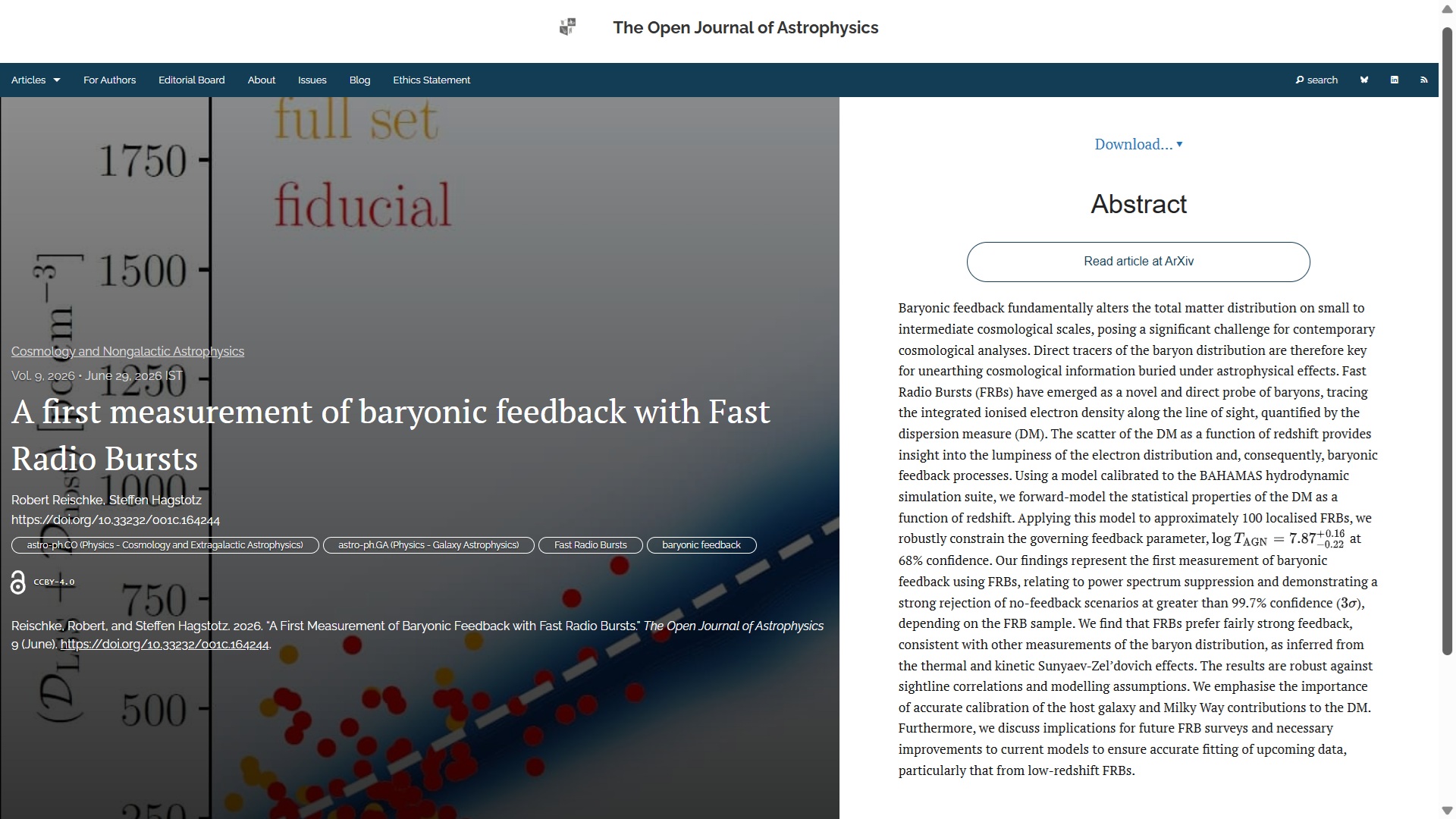
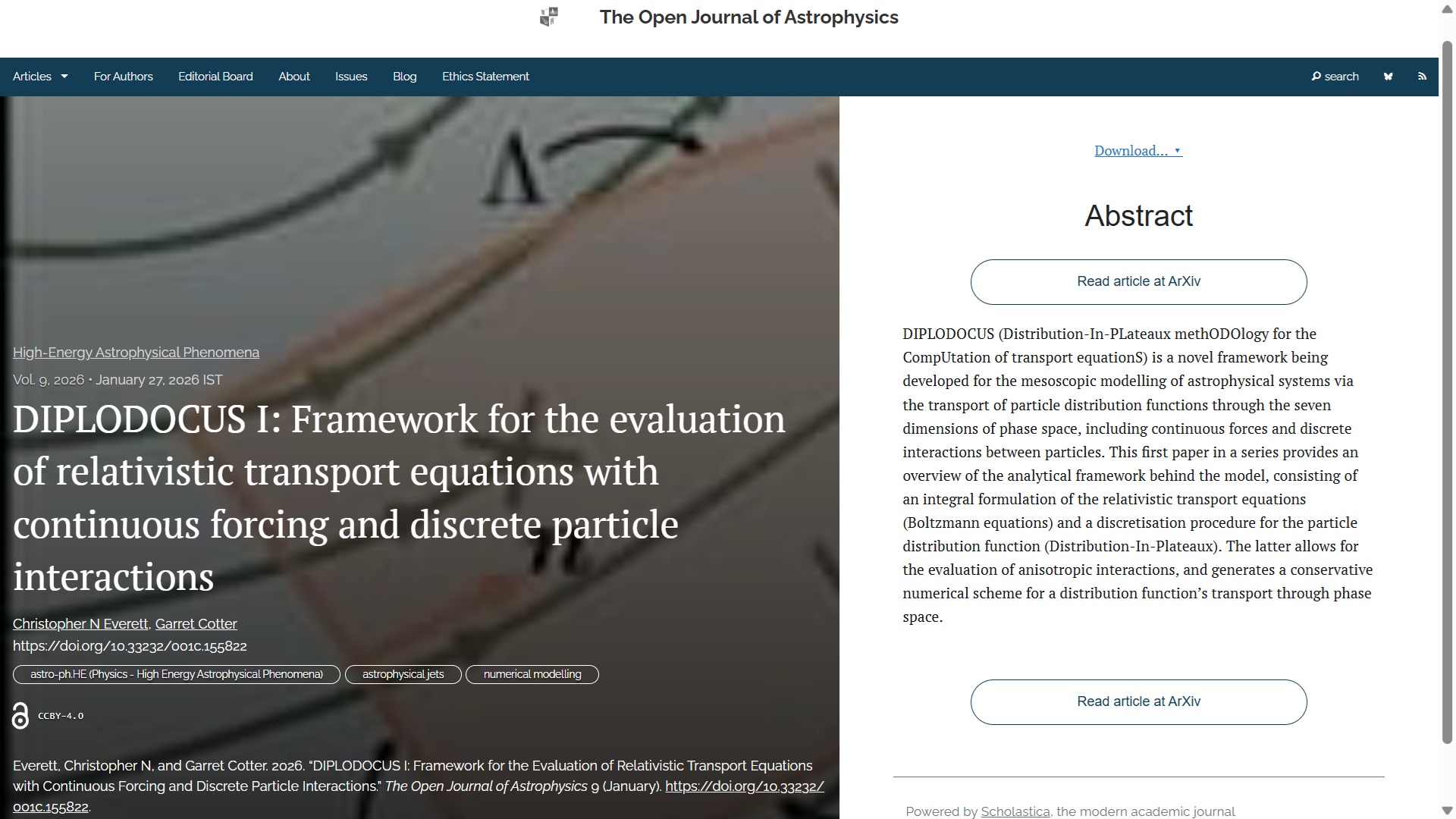
The second paper is “DIPLODOCUS I: Framework for the evaluation of relativistic transport equations with continuous forcing and discrete particle interactions” by Christopher N Everett & Garret Cotter (University of Oxford, UK). This was published on Tuesday January 27th 2026 in the folder High-Energy Astrophysical Phenomena. DIPLODOCUS is a new framework for mesoscopic modelling of astrophysical systems, using an integral formulation of relativistic transport equations and a discretisation procedure for particle distributions.

The overlay for this one is here:

The official version of the paper can be found on arXiv here and the Fediverse announcement here:

Open Journal of Astrophysics

New Publication at the Open Journal of Astrophysics: "DIPLODOCUS I: Framework for the evaluation of relativistic transport equations with continuous forcing and discrete particle interactions" by Christopher N Everett & Garret Cotter (University of Oxford, UK)

doi.org/10.33232/001c.155822

January 27, 2026, 8:49 am 1 boosts 0 favorites

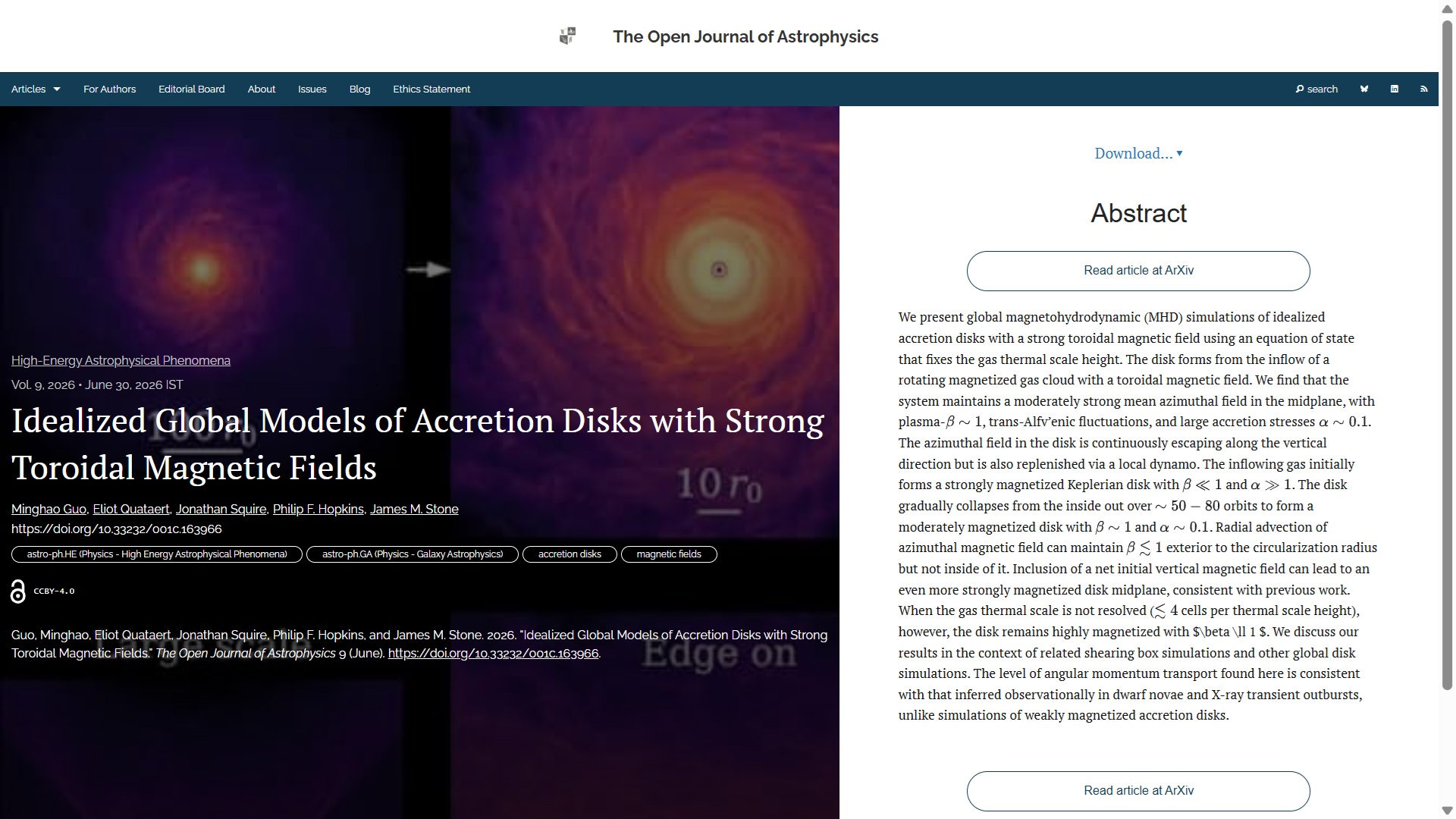
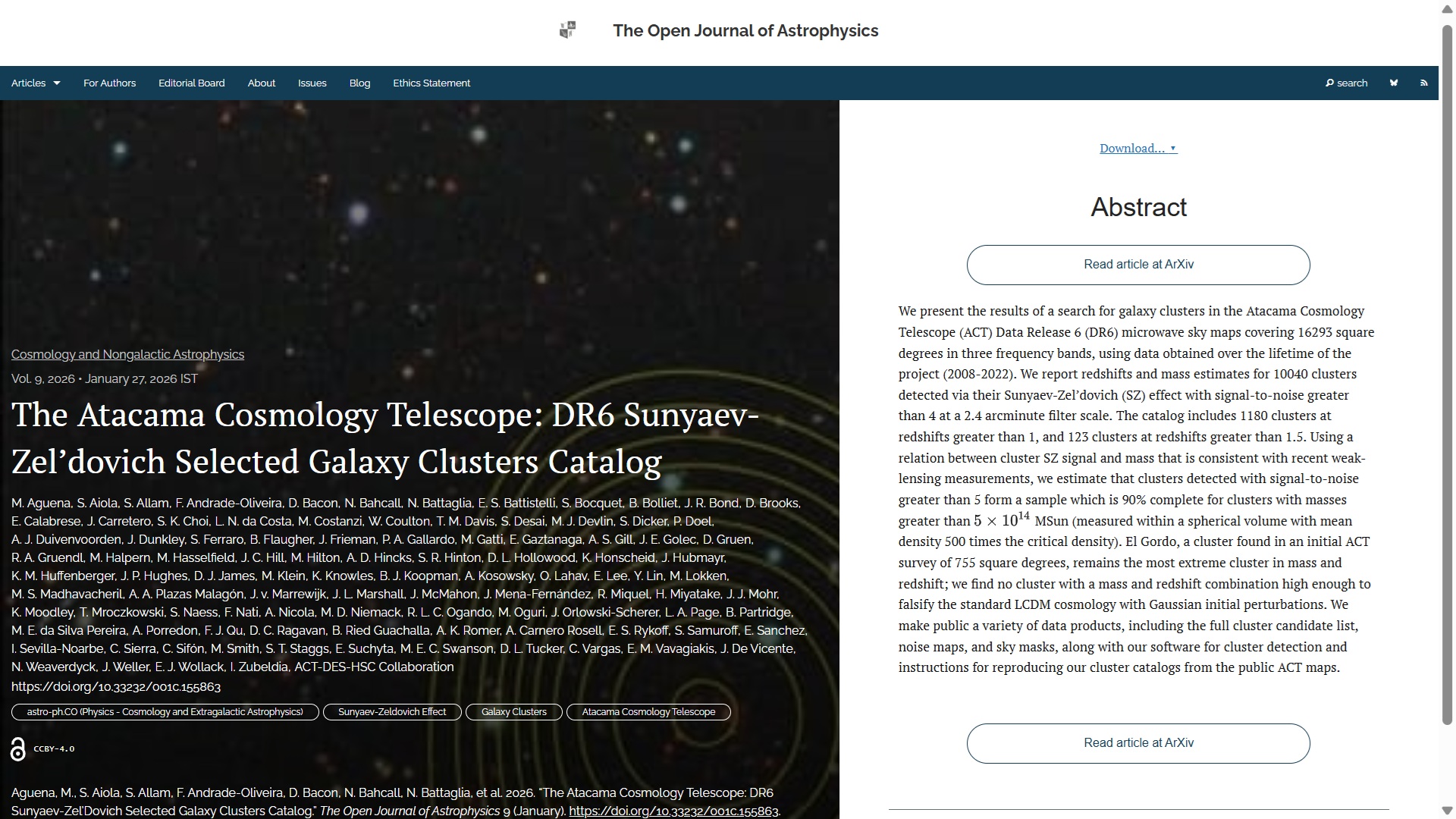
Next, also published on Tuesday January 27th but in the folder Cosmology and Nongalactic Astrophysics we have “The Atacama Cosmology Telescope: DR6 Sunyaev-Zel’dovich Selected Galaxy Clusters Catalog” by M. Aguena et al. (101 authors altogether), on behalf of the ACT-DES-HSC Collaboration. This article reports on the discovery of 10,040 galaxy clusters in the Atacama Cosmology Telescope data, including 1,180 clusters at high redshifts, using the Sunyaev-Zel’dovich effect.

The overlay is here:

The official version can be found on arXiv here and the Fediverse announcement is here:

Open Journal of Astrophysics

New Publication at the Open Journal of Astrophysics: "The Atacama Cosmology Telescope: DR6 Sunyaev-Zel’dovich Selected Galaxy Clusters Catalog" by M. Aguena et al. (101 authors altogether), on behalf of the ACT-DES-HSC Collaboration

doi.org/10.33232/001c.155863

January 27, 2026, 9:55 am 1 boosts 0 favorites

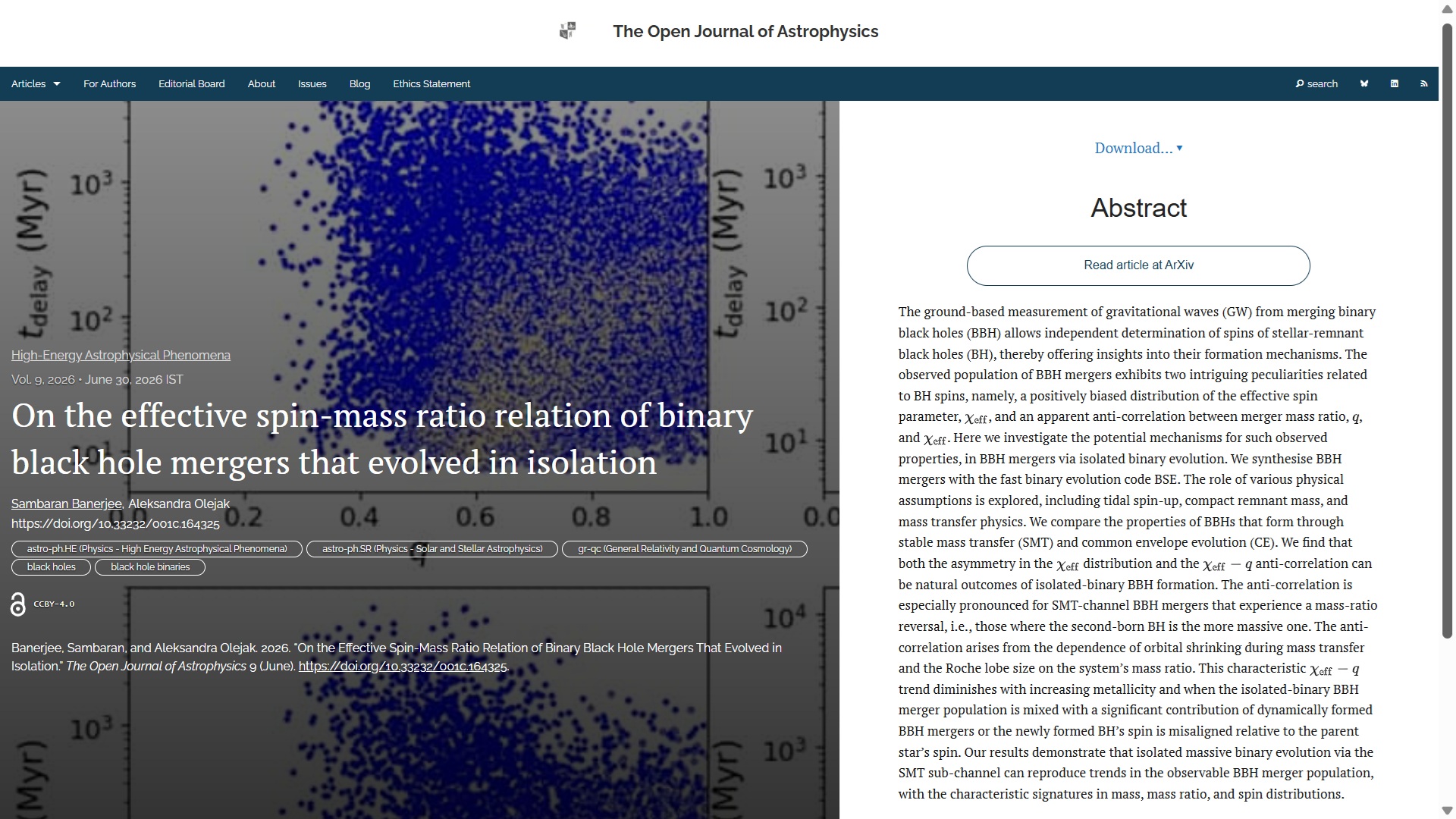
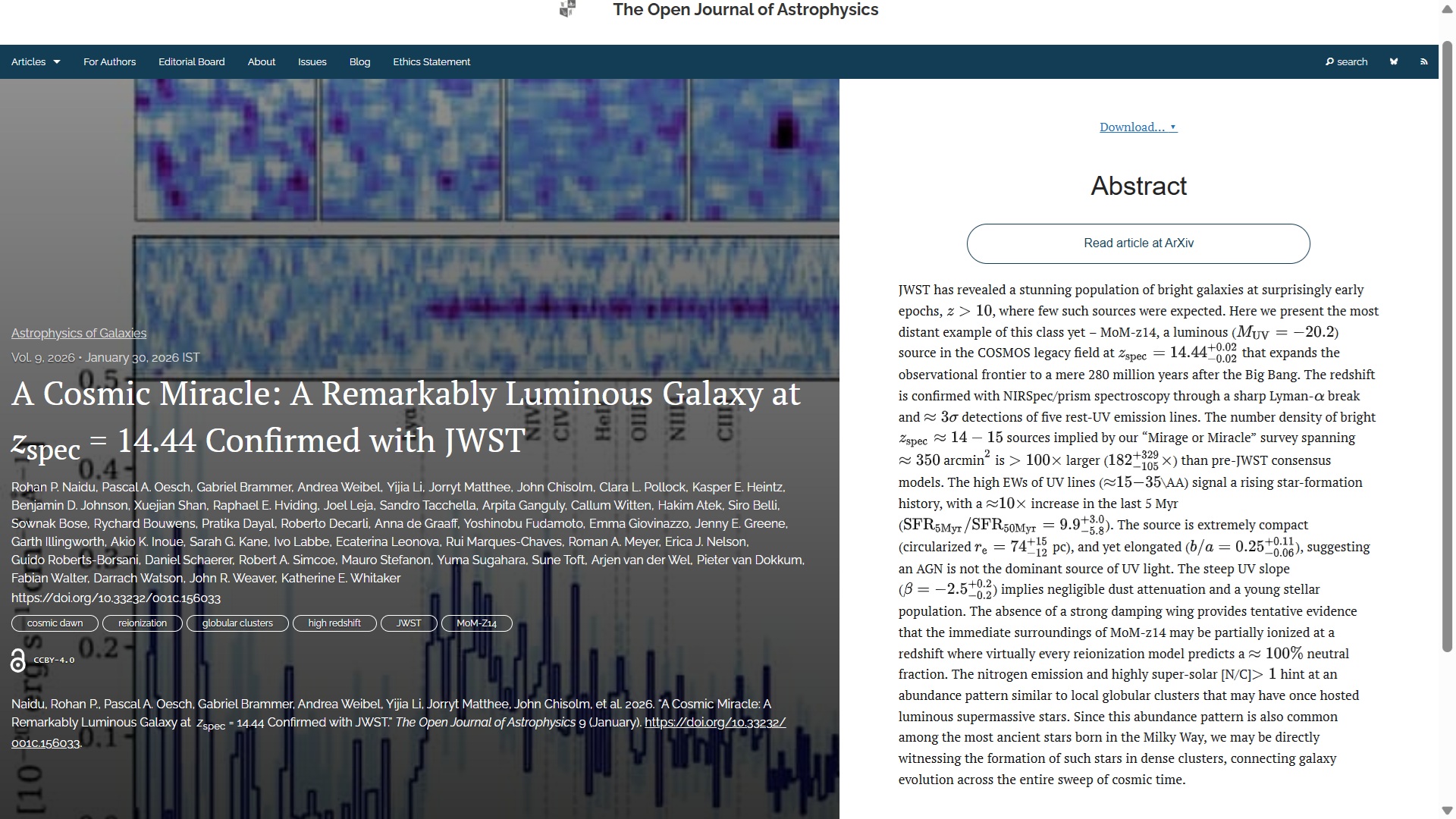
And finally for this week we have a paper published yesterday, Friday 30th January 2026, in the folder Astrophysics of Galaxies. This is the paper I blogged about yesterday: “A Cosmic Miracle: A Remarkably Luminous Galaxy at zspec = 14.44 Confirmed with JWST” by Rohan Naidu (MIT Kavli Institute) and an international cast of 45 others. This article reports on the discovery by the James Webb Space Telescope (JWST) of a bright galaxy, MoM-z14, located 280 million years post-Big Bang, that challenges models of galaxy formation and the star-formation history of early galaxies.

The overlay is here:

The accepted version can be found on arXiv here, and the fediverse announcement is here:

Open Journal of Astrophysics

New Publication at the Open Journal of Astrophysics: "A Cosmic Miracle: A Remarkably Luminous Galaxy at $z_{rm spec} = 14.44$ Confirmed with JWST" by Rohan Naidu (MIT Kavli Institute) and 45 others.

doi.org/10.33232/001c.156033

January 30, 2026, 7:20 am 2 boosts 1 favorites

And that concludes the update for this week. I will do another next Saturday.

Four New Publications at the Open Journal of Astrophysics

Posted in OJAp Papers, Open Access, The Universe and Stuff with tags , , , , , , , , , , , , , , , , , , , on September 14, 2024 by telescoper

Once again, it’s time for a quick update of activity at the Open Journal of Astrophysics. This week we have published another batch of four papers which takes the count in Volume 7 (2024) up to 77 and the total published altogether by OJAp up to 192. Things are picking up again after the summer lull, and we’re moving towards a double century. If we keep up a steady average of four per week we’ll be at 200 per year.

In chronological order, the four papers published this week, with their overlays, are as follows. You can click on the images of the overlays to make them larger should you wish to do so.

First one up is “Quasi-two-dimensionality of three-dimensional, magnetically dominated, decaying turbulence” by Shreya Dwivedi, Chandranathan Anandavijayan, and Pallavi Bhat of TIFR, Bangalore, India. The paper presents an analysis of numerical simulations of MHD turbulence using Minkowski Functionals, with implications for local anisotropies revealed therein. It was published on 9th September 2024 and is in the folder marked High-Energy Astrophysical Phenomena.

Here is a screen grab of the overlay, which includes the abstract:


You can find the officially accepted version of the paper on the arXiv here.

The second paper to announce, also published on 9th September 2024, is “mochi_class: Modelling Optimisation to Compute Horndeski In class” by  Matteo Cataneo (Universität Bonn, Germany) and Emilio Bellini (SISSA, Trieste, Italy). This article presents a cosmological Einstein-Boltzmann solver adapted to work with Horndeski gravity, together with validation tests. It is in the folder Cosmology and NonGalactic Astrophysics.

You can see the overlay here:


The accepted version of this paper can be found on the arXiv here.

The third paper, published on 11th September 2024 in the folder marked High-Energy Astrophysical Phenomena, is by Jonathan Katz of Washington University, St Louis, USA. The title is “The Sources of Fast Radio Bursts” and it presents a discussion of the possible physical origin of Fast Radio Bursts, arguing that they fall into two distinct groups.


The final version accepted on arXiv is here.

Last in this batch, but by no means least, is “RMS asymmetry: a robust metric of galaxy shapes in images with varied depth and resolution” by Elizaveta Sazonova (U. Waterloo, Canada) with 15 other authors spread around the world (in Canada, USA, Australia, Italy, Chile, UK, Poland, Mexico, Germany, and Spain). This paper presents a method of quantifying distortion of galaxy images connected with mergers or other instabilities. It is in the folder marked Astrophysics of Galaxies and was published on September 12th 2024 with this overlay:


You can find the official accepted version on the arXiv here.

That’s all for now. I will post another update in a week.

Controlled Nuclear Fusion: Forget about it

Posted in The Universe and Stuff with tags , , , on October 20, 2014 by telescoper

You’ve probably heard that Lockheed Martin has generated a lot of excitement with a recent announcement about a “breakthrough” in nuclear fusion technology. Here’s a pessimistic post from last year. I wonder if it will be proved wrong?

Michael de Podesta's avatarProtons for Breakfast

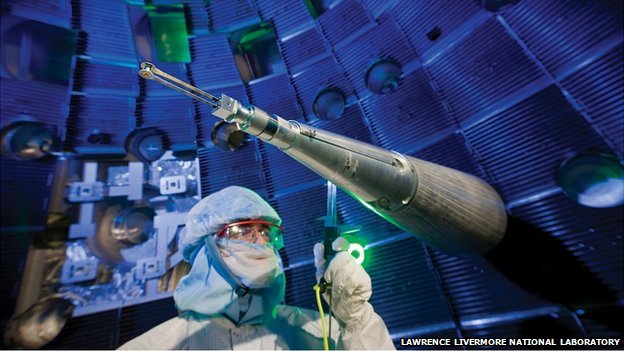
Man or woman doing a technical thing with a thingy told with laser induced nuclear fusion. Man or woman adjusting the ‘target positioner’ (I think) within the target chamber of the US Lawrence Livermore National Laboratory.

The future is very difficult to predict. But I am prepared to put on record my belief that controlled nuclear fusion as a source of power on Earth will never be achieved.

This is not something I want to believe. And the intermittent drip of news stories about ‘progress‘ and ‘breakthroughs‘ might make one think that the technique would eventually yield to humanity’s collective ingenuity.

But  in fact that just isn’t going to happen. Let me explain just some of the problems and you can judge for yourself whether you think it will ever work.

One option for controlled fusion is called Inertial Fusion Energy, and the centre of research is the US National Ignition Facility. Here the most powerful laser…

View original post 601 more words

Universality in Space Plasmas?

Posted in Astrohype, The Universe and Stuff with tags , , , , , , , , on June 16, 2013 by telescoper

It’s been a while since I posted anything reasonably technical, largely because I’ve been too busy, so I thought I’d spend a bit of time today on a paper (by Livadiotis & McComas in the journal Entropy) that provoked a Nature News item a couple of weeks ago and caused a mild flutter around the internet.

Here’s the abstract of the paper:

In plasmas, Debye screening structures the possible correlations between particles. We identify a phase space minimum h* in non-equilibrium space plasmas that connects the energy of particles in a Debye sphere to an equivalent wave frequency. In particular, while there is no a priori reason to expect a single value of h* across plasmas, we find a very similar value of h* ≈ (7.5 ± 2.4)×10−22 J·s using four independent methods: (1) Ulysses solar wind measurements, (2) space plasmas that typically reside in stationary states out of thermal equilibrium and spanning a broad range of physical properties, (3) an entropic limit emerging from statistical mechanics, (4) waiting-time distributions of explosive events in space plasmas. Finding a quasi-constant value for the phase space minimum in a variety of different plasmas, similar to the classical Planck constant but 12 orders of magnitude larger may be revealing a new type of quantization in many plasmas and correlated systems more generally.

It looks an interesting claim, so I thought I’d have a look at the paper in a little more detail to see whether it holds up, and perhaps to explain a little to others who haven’t got time to wade through it themselves. I will assume a basic background knowledge of plasma physics, though, so turn away now if that puts you off!

For a start it’s probably a good idea to explain what this mysterious h* is. The authors define it via ½h*ctc, where εc is defined to be “the smallest particle energy that can transfer information” and tc is “the correlation lifetime of Debye Sphere (i.e. volumes of radius the Debye Length for the plasma in question). The second of these can be straightforwardly defined in terms of the ratio between the Debye Length and the thermal sound speed; the authors argue that the first is given by εc=½(mi+me)u2, involving the electron and ion masses in the plasma and the information speed u which is taken to be the speed of a magnetosonic wave.

You might wonder why the authors decided to call their baby h*. Perhaps it’s because the definition looks a bit like the energy-time version of Heisenberg’s Uncertainty Principle, but I can’t be sure of that. In any case the resulting quantity has the same dimensions as Planck’s constant and is therefore measured in the same units (Js in the SI system).

Anyway, the claim is that h* is constant across a wide range of astrophysical plasmas. I’ve taken the liberty of copying the relevant Figure here:

constant_h

I have to say at this point I had the distinct sense of damp squib going off. The panel on the right purports to show the constancy of h* (y-axis) for plasmas of a wide range of number-densities (x-axis). However, but are shown on logarithmic scales and have enormously large error bars. To be sure, the behaviour looks roughly constant but to use this as a basis for claims of universality is, in my opinion, rather unjustified, especially since there may also be some sort of selection effect arising from the specific observational data used.

One of the authors is quoted in the Nature piece:

“We went into this thinking we’d find one value in one plasma, and another value in another plasma,” says McComas. “We were shocked and slightly horrified to find the same value across all of them. This is really a major deal.”

Perhaps it will turn out to be a major deal. But I’d like to see a lot more evidence first.

Plasma (astro)physics is a fascinating but very difficult subject, not because the underlying requations governing plasmas are especially complicated, but because the resulting behaviour is so sensitively dependent on small details; plasma therefore provide an excellent exemplar of what we mean by a complex physical system. As is the case in other situations where we lack the ability to do detailed calculations at the microscopic level, we do have to rely on more coarse=grained descriptions, so looking for patterns like this is a good thing to do, but I think the Jury is out.

Finally, I have to say I don’t approve of the authors talking about this in terms of “quantization”. Plasma physics is confusing enough as classical physics without confusing it with quantum theory. Opening the door to that is a big mistake, in my view. Who knows what sort of new age crankery might result?