It’s Saturday again, so it’s time for another update of activity at the Open Journal of Astrophysics. Since the last update we have published a further eight papers, bringing the number in Volume 9 (2026) to 237 and the total so far published by OJAp up to 685.
I continue to include the posts made on our Mastodon account (on Fediscience); these announcements also contain a clickable form of the DOI for each paper. Our Mastodon account has regular updates and other announcements from OJAp too, including posts from the OJAp blog.
The first new paper this week was published on Monday 5th October in the folder Solar and Stellar Astrophysics. The title of the paper is “Diameters and Temperatures VII: High-angular resolution measurements of Solar-type stars with the CHARA Array” and it isby Tabetha Boyajian (Louisiana State University, USA) and 10 others based in the USA and Australia. This study uses interferometric measurements to determine precise characteristics of 27 nearby solar-type stars, including their radii, effective temperatures, and luminosities. The findings represent benchmarks for testing stellar evolutionary theory.
The overlay for this one is here:
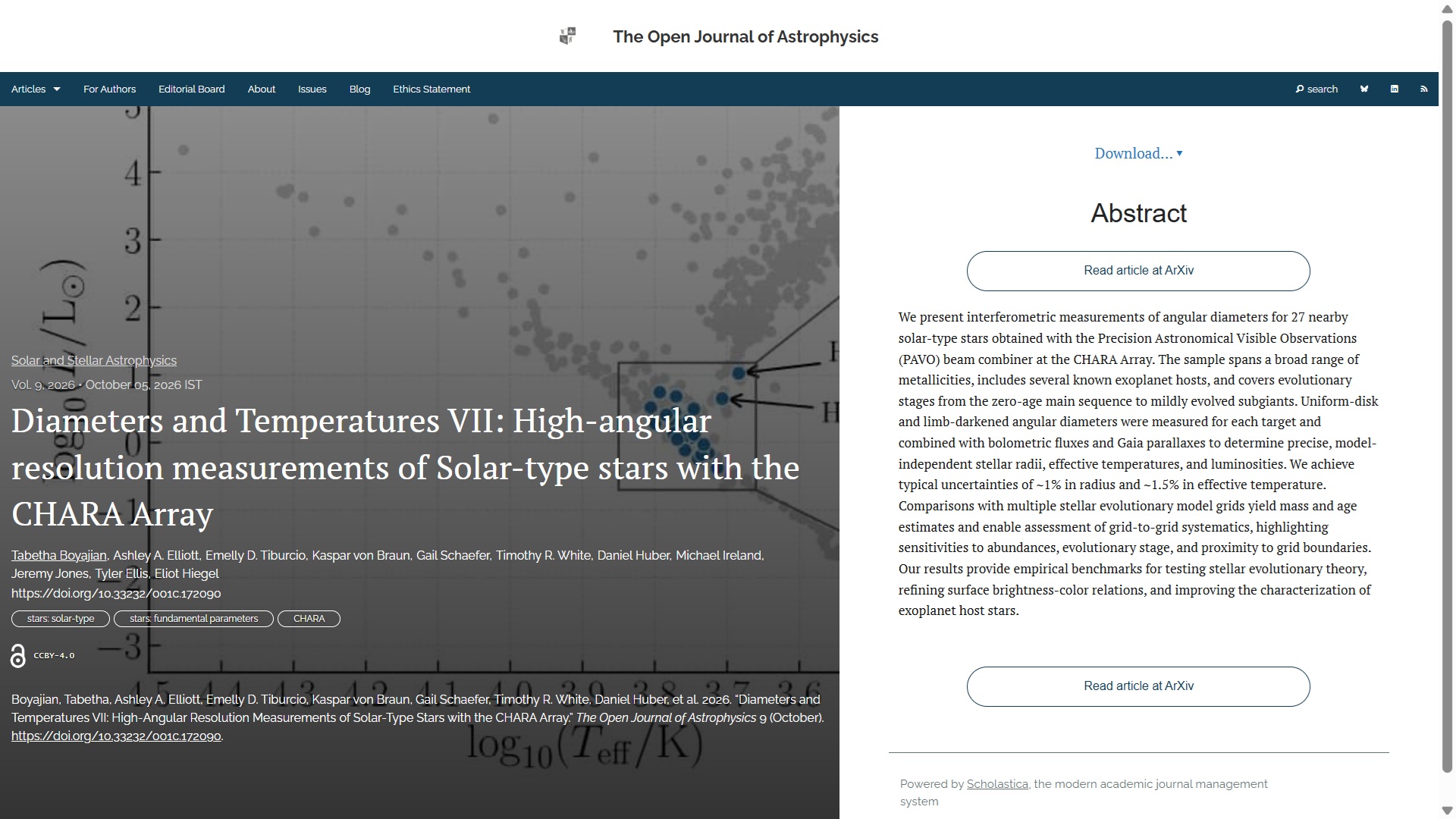
You can find the officially accepted version on arXiv here and the announcement on Fediverse here:

The second paper for this week, published on Tuesday 6th October, is “The jet-shaped pipe morphology in planetary nebulae and core-collapse supernova remnants” by Jessica Braudo and Noam Soker (Technion, Israel). This article, published in the folder High-Energy Astrophysical Phenomena, he study suggests that jets shape the ‘pipe’ structures in core-collapse supernova remnants and jet-shaped planetary nebulae, based on comparisons with hydrodynamical numerical simulations.
The overlay looks like this:
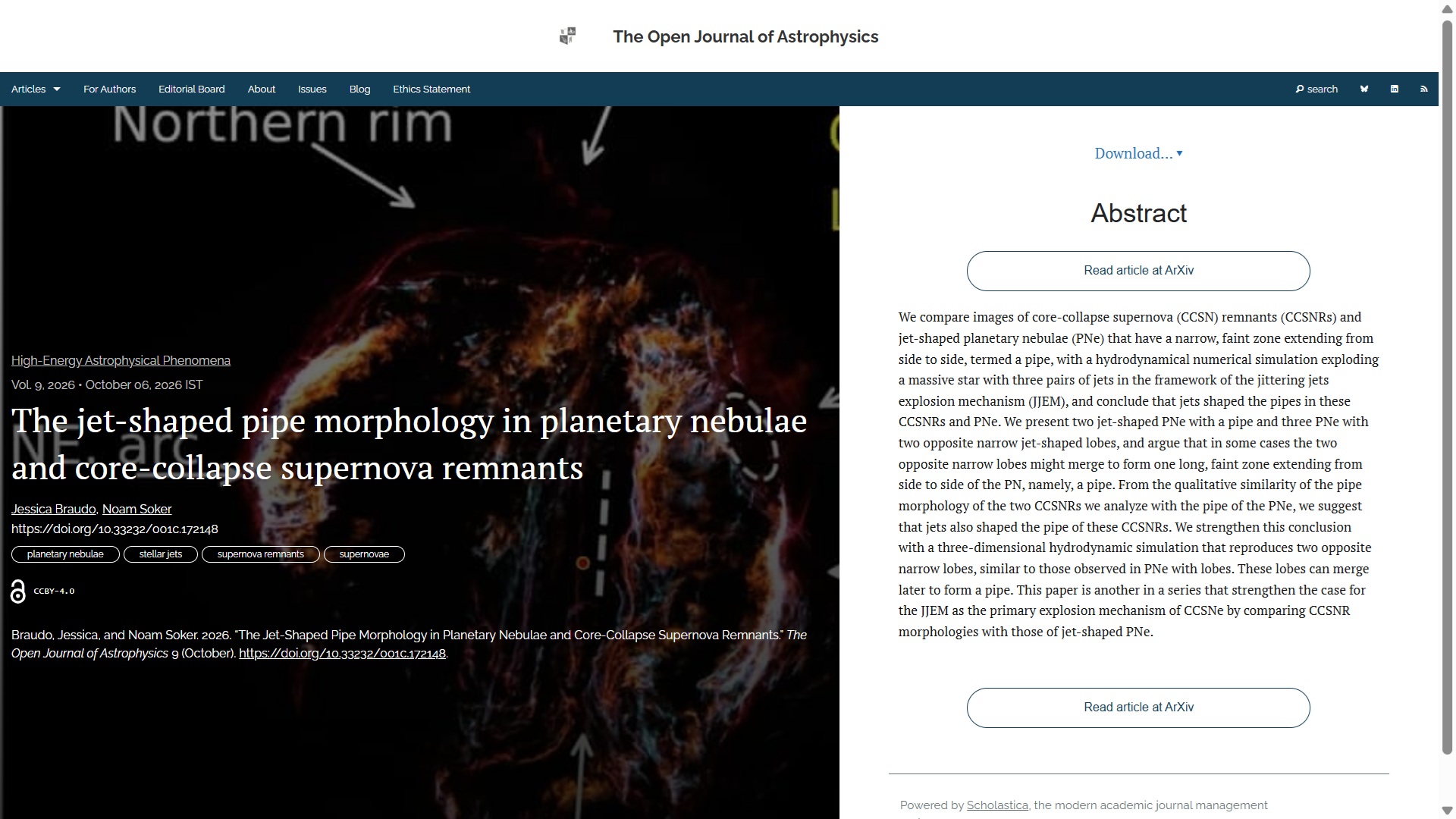
The official version of the paper can be found on arXiv here and the Fediverse announcement here:
The third paper of the week, “Balancing bias, baryons, and scale cuts in LSST 3x2pt analysis” is by Ottavia Truttero (U. Edinburgh, UK) and 5 others on behalf of the The LSST Dark Energy Science Collaboration. It was published on Tuesday 6th October in the folder Cosmology and Nongalactic Astrophysics and presents a new analysis for LSST Y1 and Y10 data, exploring the effects of galaxy bias and baryonic feedback. The article also introduces a new open-source pipeline, MGL.
The overlay for this is here:
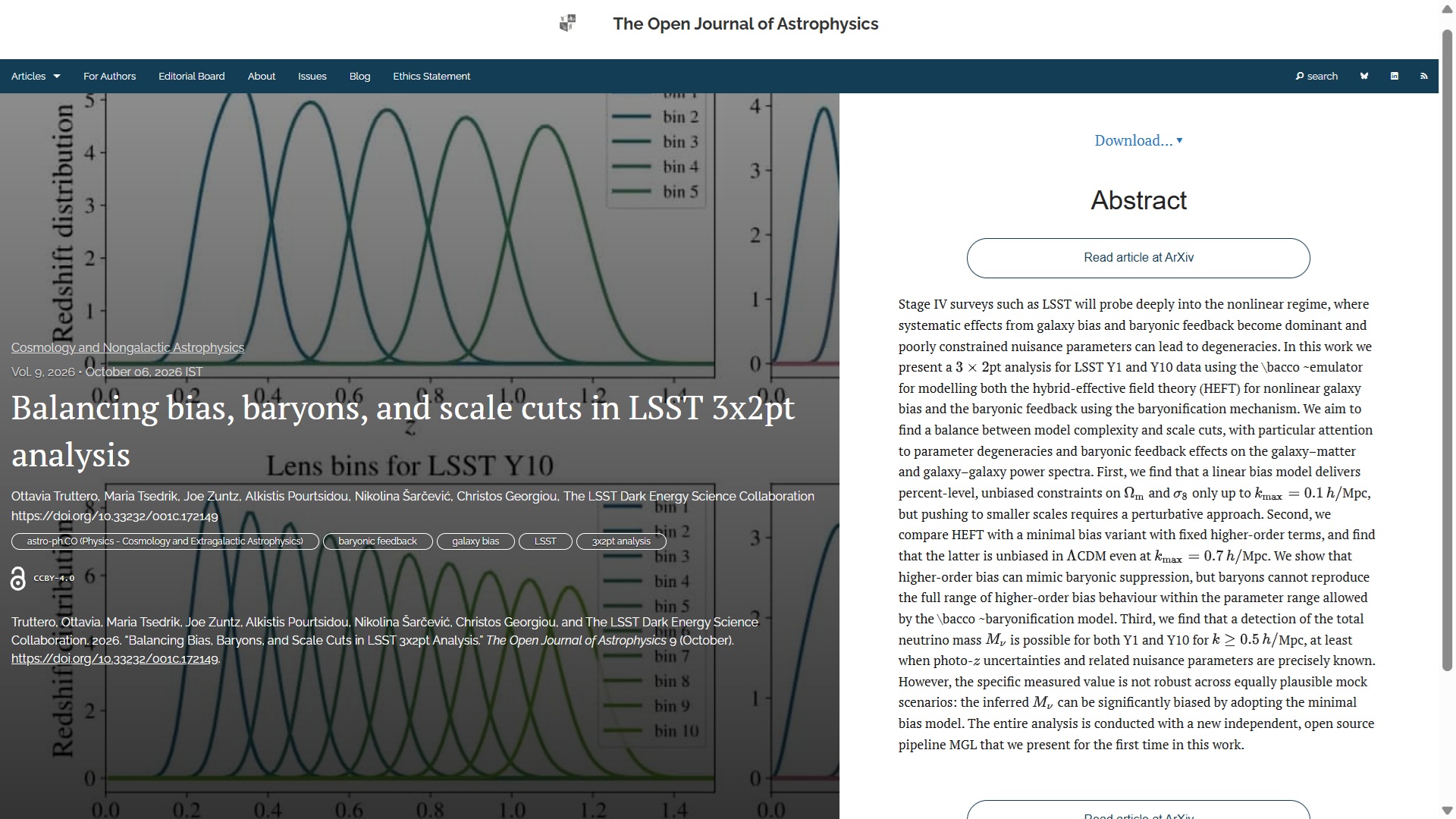
The accepted version of this one can be found on the arXiv here and the Mastodon announcement here:
The fourth new paper of the week, published on Wednesday 7th Octonber, in the folder Solar and Stellar Astrophysics, is “High-Precision Differential Radial Velocities of C3PO Wide Binaries: A Test of Modified Newtonian Dynamics (MOND)” by Serat M. Saad and Yuan-Sen Ting (Ohio State University, USA). The paper describes a technique to measure differential radial velocities of wide-binary stars, improving precision and enabling better analysis of Modified Newtonian Dynamics (MOND), suggesting tension with current estimates of the acceleration scale.
The overlay is here:
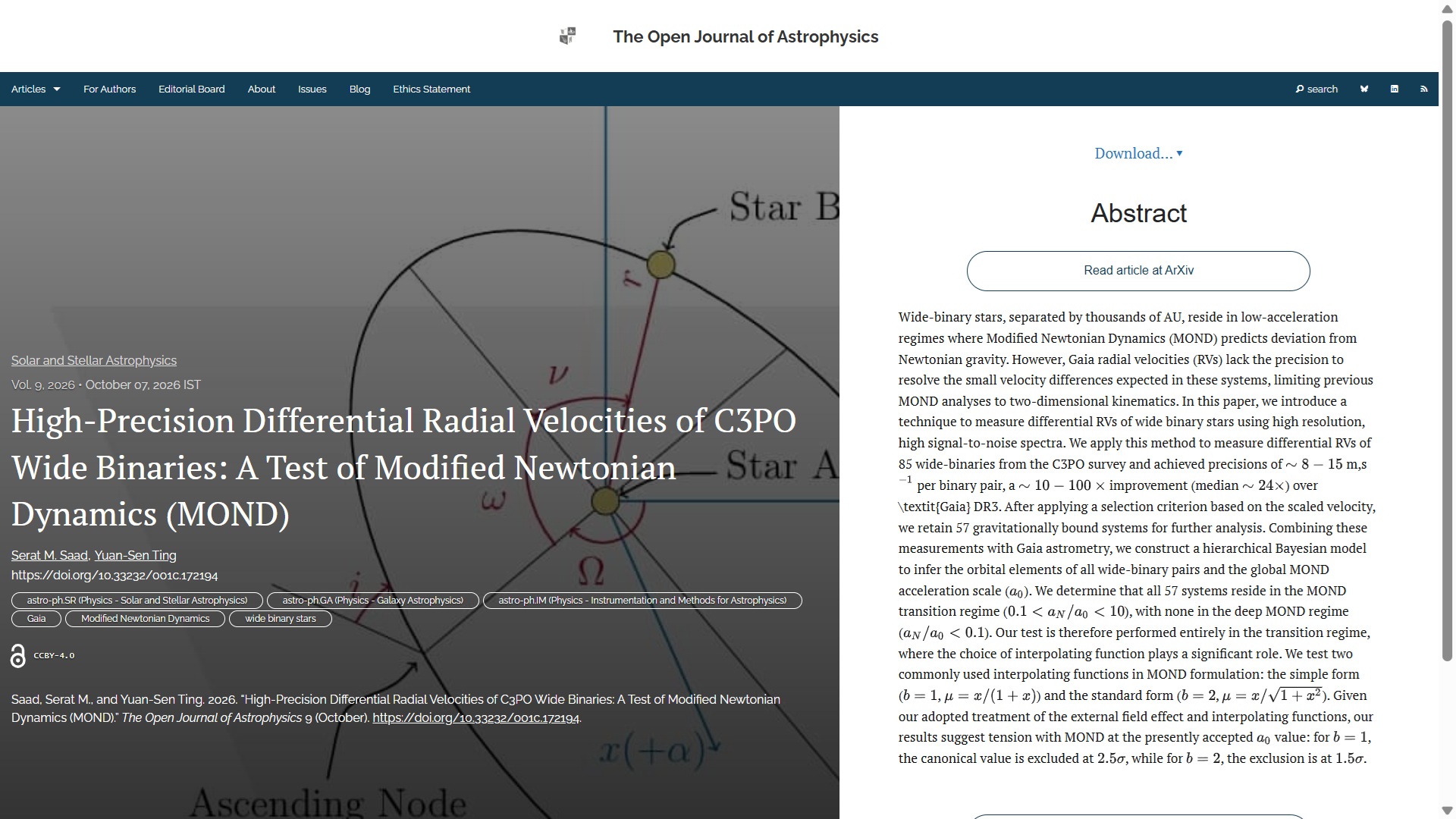
The official version of the paper can be found on arXiv here and the Fediverse announcement here:
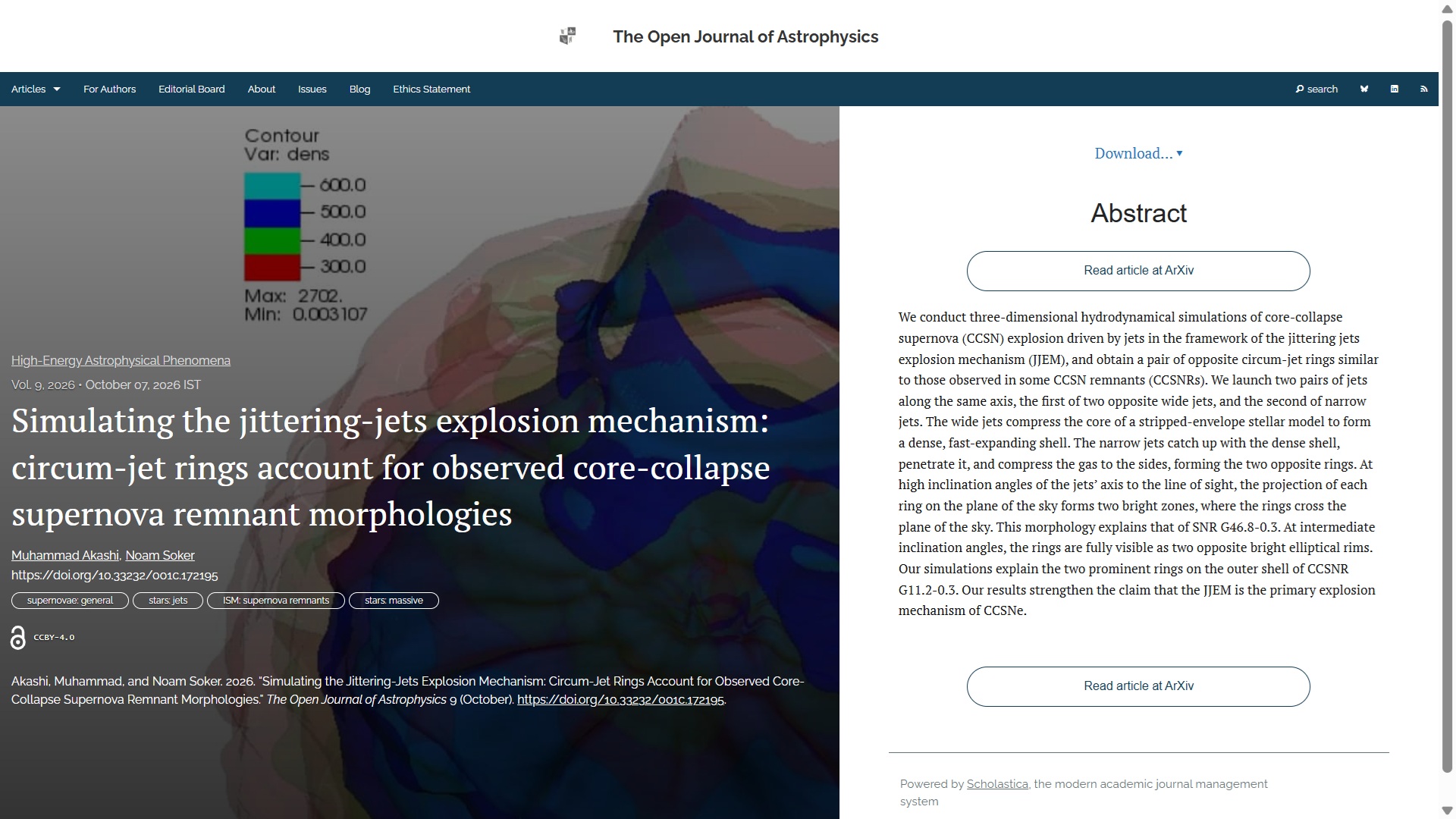
Paper Number Five for the week is “Simulating the jittering-jets explosion mechanism: circum-jet rings account for observed core-collapse supernova remnant morphologies” by Muhammad Akashi & Noam Soker (Technion, Israel). The study uses 3D simulations to explore core-collapse supernova explosions driven by jets, supporting the jittering jets explosion mechanism theory. The simulations explain observed circum-jet rings in supernova remnants. This was also published on Wednesday 7th October, but in the folder High-Energy Astrophysical Phenomena.
The overlay is here:
The officially-accepted version of the paper can be found on arXiv here and the Fediverse announcement here:
The sixth paper of the week is “Radio Continuum Study of One of the Brightest Large Magellanic Cloud Supernova Remnant N 132D” by Rami Z. E. Alsaberi (Western Sydney U. Australia) and 7 others. This was the first of three papers published on Friday 9th October, and it is in the folder High-Energy Astrophysical Phenomena. This one presents a radio continuum analysis of the Large Magellanic Cloud supernova remnant N 132D, revealing insights into its magnetic field structure, energetic properties, and particle acceleration.
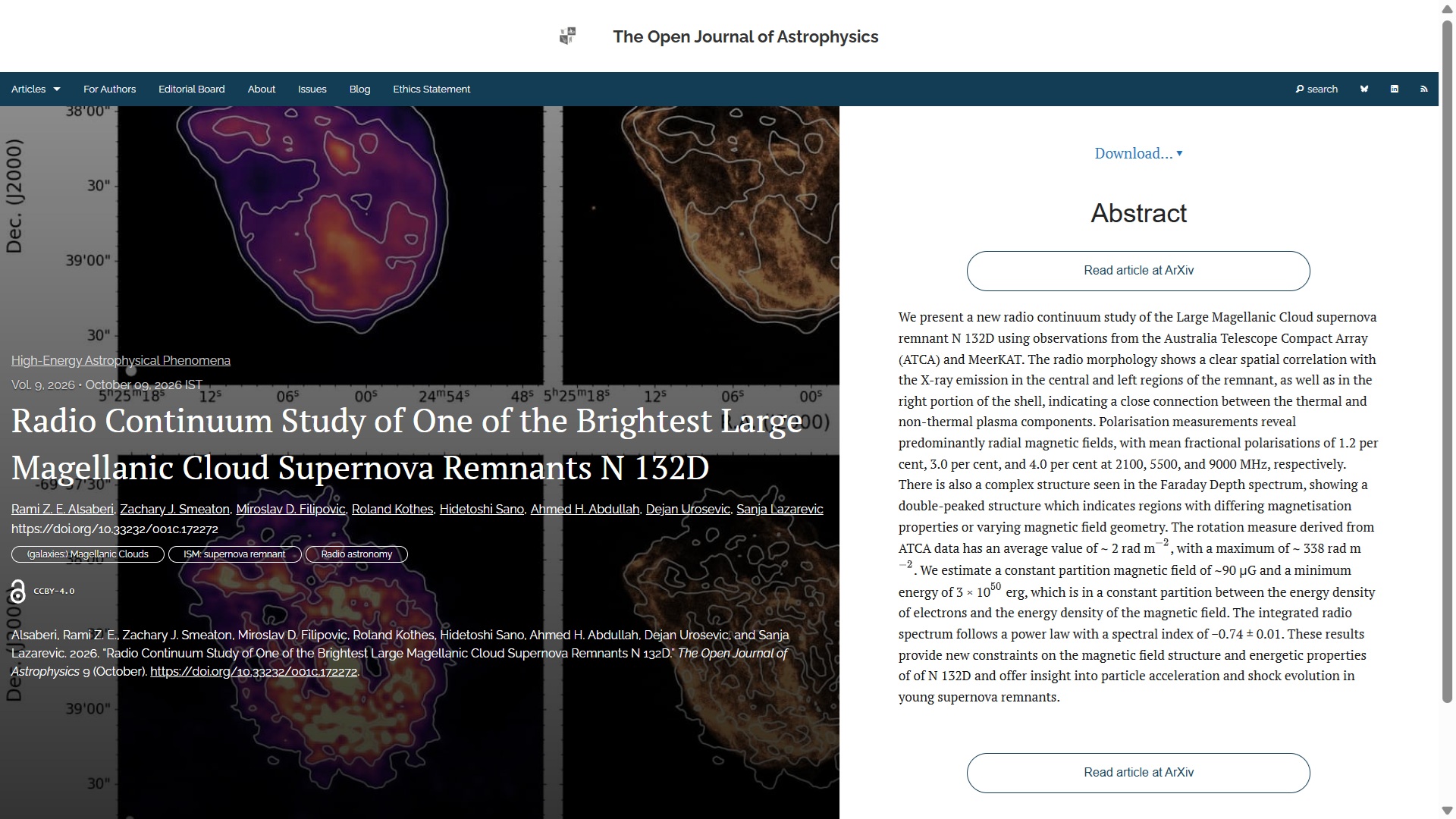
The officially-accepted version of this paper is on arXiv here and the Mastodon announcement on the fediverse here:
The seventh paper of the week is “New Signs Pointing Toward a Correlation Between Astrophysical Neutrinos and Radio Flares” by Yjan Gordon (U. Wisconsin-Madison), Peter S. Ferguson (U. Washington), Eric J. Hooper & Michael N. Martinez (U. Wisconsin-Madison); all in the USA. This was also published on Friday 7th October, but in the folder Astrophysics of Galaxies. It is very topical, in the light of the award of this year’s Nobel Prize for Physics to Francis Halzen for his work on IceCube. The paper explains how data from VLASS and IceCube Neutrino Observatory reveal a correlation between radio variability and astrophysical neutrino detection, suggesting radio flares contribute to about 13% of astrophysical neutrinos detected by IceCube.
The overlay is here:
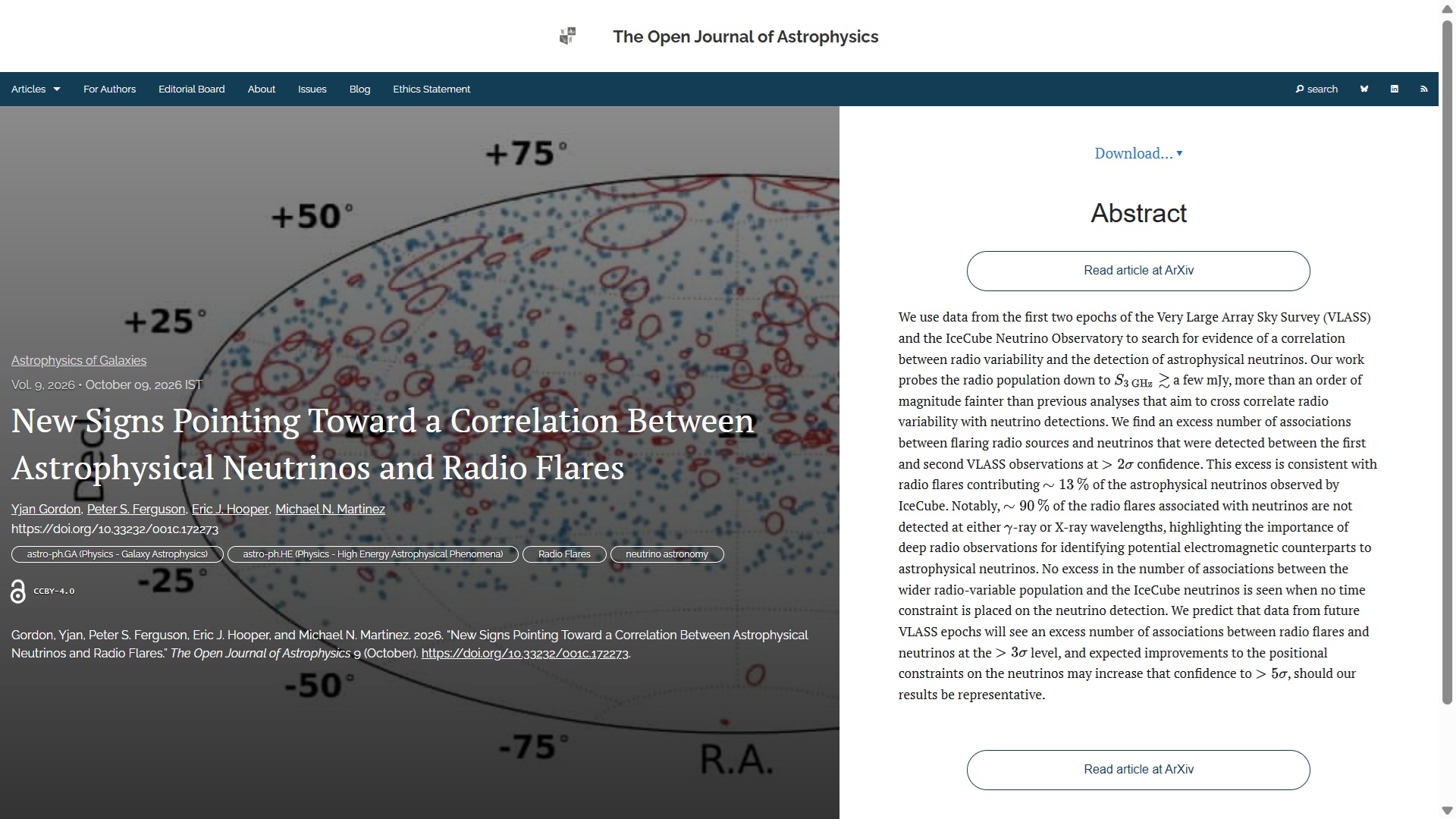
The officially accepted version is on arXiv here and the Mastodon announcement here:
The eighth, and last, of the new papers for this week is “Spectroscopic follow-up of compact object binary candidates from Gaia DR3: White dwarfs, neutron stars, black holes, and the parallax zeropoint” by Kareem El-Badry (Caltech, USA) and an international cast of 14 others. This paper uses data from Gaia DR3 to analyze orbits of binary systems, including potential black holes, neutron stars, and white dwarfs. It was published on Friday 9th October, i.e. yesterday, in the folder Solar and Stellar Astrophysics.
The overlay is here:
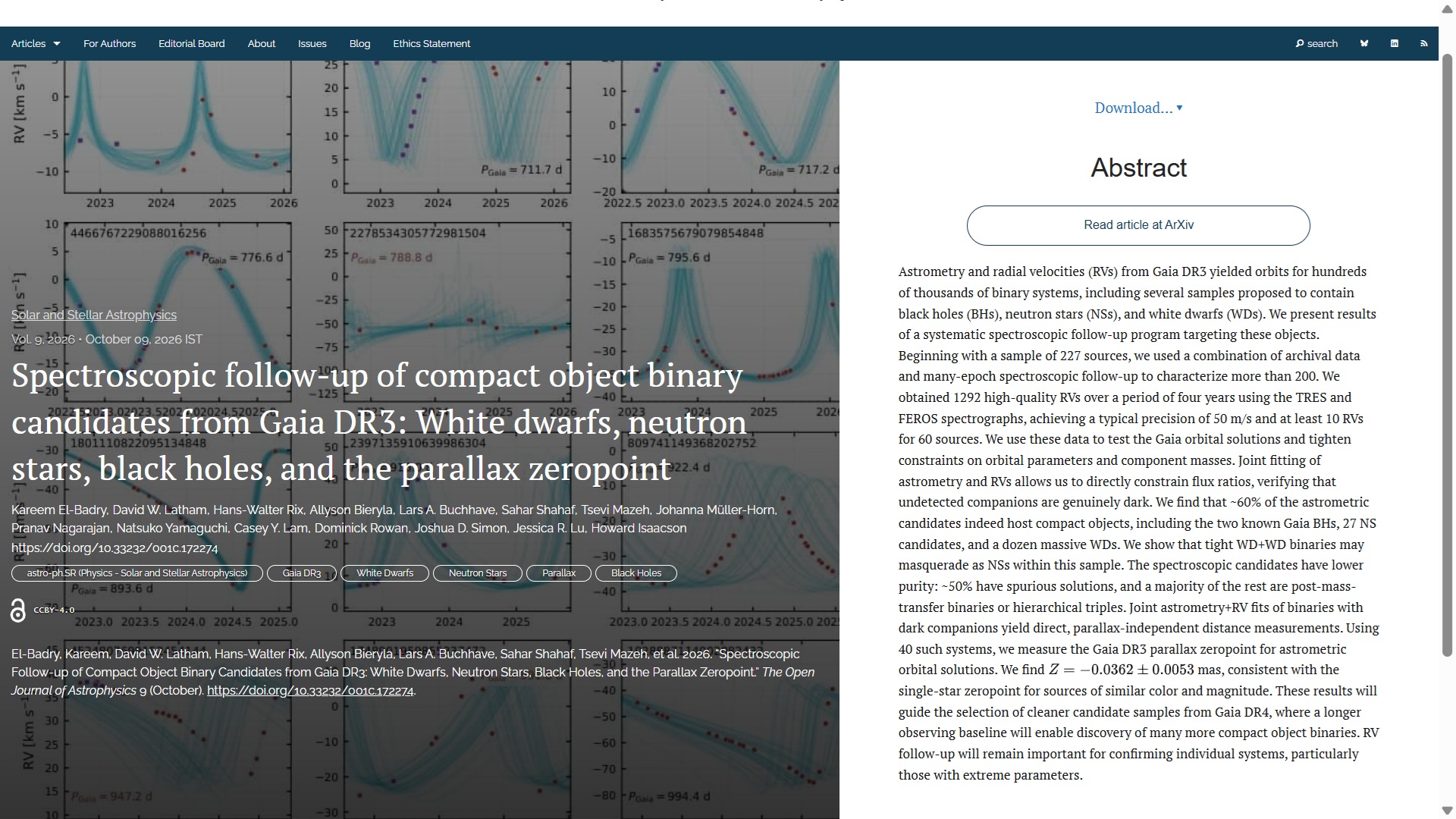
The final version of this paper is on the arXiv here and the Mastodon announcement here:
That concludes this week’s update. We’re still on target to publish over 300 papers and reach the 750 mark by the end of the year. I’ll do another update next week.


