Author Archive

What The World Needs Now

Posted in Music with tags on February 9, 2023 by telescoper

Very sad to hear today of the death at the age of 94 of the great songwriter Burt Bacharach. By way of a little tribute I thought I’d reblog this post from a few years ago. R.I.P. Burt Bacharach (1928-2023).

telescoper's avatarIn the Dark

I’ve always been a not-so-secret admirer of American songwriter and record producer Burt Bacharach, but when someone told me the other day that there’s an album called Blue Note Plays Burt Bacharach I assumed it was a wind up because Blue Note Records has for many years been an uncompromising voice at the cutting edge of modern jazz rather than the lighter and more popular form of music exemplified my Mr B.

There’s no reason why two forms of excellence can’t exist together, however, and the album is definitely real and is a very nice compilation of Bacharach numbers from Blue Note albums featuring various musicians over the years. Here’s an example featuring Stanley Turrentine on tenor sax, with McCoy Tyner on piano, Bob Cranshaw on bass and Micky Roker on drums. The tune is What The World Needs Now Is Love. Doesn’t it just?

View original post

Solidarity to the UCU Strikers #UCURising

Posted in Education with tags , , , on February 9, 2023 by telescoper

Today is Thursday 9th February so it sees the first of another two consecutive days of strike action by members of the University and College UCU across the UK. Although I no longer work in the UK I’d like to send this message of support to my former colleagues there who will be out on the picket lines tomorrow and on subsequent days. There will be further escalation of strike action next week, with three days of strikes.

This industrial action arises from a dispute over pensions, pay, and working conditions. The strikes will affect 2.5 million students but are necessary to safeguard not only the livelihoods of academic staff against increased casualisation and salary cuts but the UK university system itself, which is being ruined by incompetent management. Regrettably, the strikes will cause considerable disruption but, frankly, there is no point in a strike that doesn’t do that.

An Interview with Georges Lemaître

Posted in History, The Universe and Stuff with tags , , , , on February 8, 2023 by telescoper

This fascinating video surfaced recently after having been lost for decades. It’s an interview with Georges Lemaître who, along with Alexander Friedmann, is regarded as one of the originators of the Big Bang theory. Lemaître first derived the “Hubble’s law”, now officially called the Hubble–Lemaître law after a vote by members of the International Astronomical Union in 2018, by the IAU and published the first estimation of the Hubble constant in 1927, two years before Hubble’s article on the subject.

Lemaître is such an important figure in the development of modern cosmology that he was given his own Google Doodle in 2018:

The interview was recorded in 1964, just a couple of years before Lemaître’s death in 1966. It was broadcast by Belgische Radio- en Televisieomroep (BRT), the then name of the national public-service broadcaster for the Flemish Community of Belgium (now VRT). Lemaître speaks in French, with Flemish subtitles (which I didn’t find helpful), but I found I could get most of what he is saying using my schoolboy French. Anyway, it’s a fascinating document as it is I think the only existing recording of a long interview with this undoubtedly important figure in the history of cosmology.

As you can see, if you want to watch the video you have to click through to YouTube:

UPDATE: A transcript of this interview in French along with a translation into English can be found here.

New Publication at the Open Journal of Astrophysics

Posted in OJAp Papers, Open Access, The Universe and Stuff with tags , , , , , on February 8, 2023 by telescoper

We’re on a bit of a roll at the Open Journal of Astrophysics and it’s time to announce yet another paper. We actually published this one yesterday (7th February 2023), which makes it two in two days. I don’t think we’ll keep up that rate but we have seen a big increase in submissions recently and these are working their way through the system very nicely. We aim to publish accepted papers within a day of the revised version appearing on arXiv.

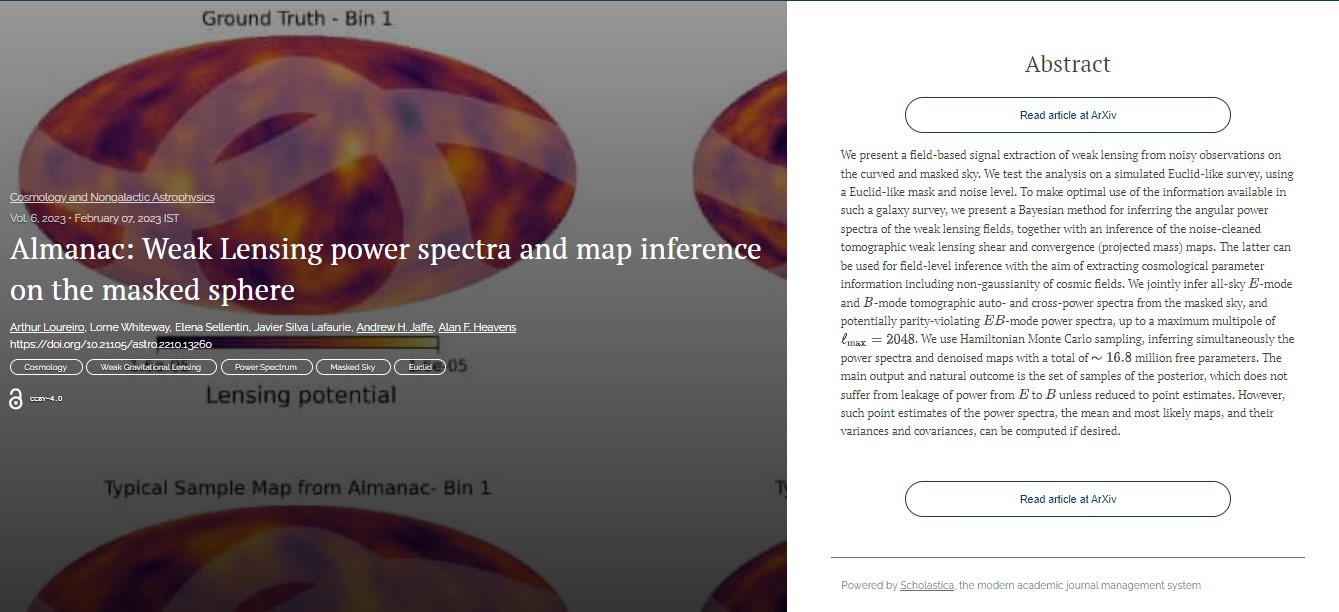
The latest paper is the 6th paper in Volume 6 (2023) as well as the 71st in all. This one is another one for the folder marked Cosmology and Nongalactic Astrophysics. The title is “Almanac: Weak Lensing power spectra and map inference on the masked sphere”. The nub of the problem addressed by this paper is that the usual statistical analysis of data presented in projection on the sky involves spherical harmonics, which are orthogonal functions on the celestial sphere, but when the sky is not completely covered (i.e. part of it is masked), these functions are not orthogonal on what remains.

The authors of this paper are Arthur Loureiro (University of Edinburgh, UK), Lorne Whiteway (University College London, UK), Elena Selentin (Leiden University, NL), Javier Silva Lafaurie (Leiden University, NL), Andrew Jaffe (Imperial College London, UK) and Alan Heavens (Imperial College London, UK)

Here is a screen grab of the overlay which includes the  abstract:


You can click on the image of the overlay to make it larger should you wish to do so. You can find the officially accepted version of the paper on the arXiv here.

How Euclid will scan the sky

Posted in The Universe and Stuff with tags , , , , , on February 7, 2023 by telescoper

A missive from Euclid High Command arrived yesterday confirming that ESA’s Euclid mission would be launched by SpaceX on a Falcon 9 rocket on a date between July 1st and July 30 (2023). It will soon be time to start getting nervous!

I also noticed that another video has appeared on the Euclid public website showing how the satellite will work. It’s not a traditional general-purpose observatory on which different users bid for time to observe different objects (as is the case for JWST, for example) but a dedicated mission that will compile a systematic survey with very specific science goals.

Euclid scans across the sky using a ‘step-and-stare’ method, combining separate measurements to form the largest cosmological survey ever conducted in the visible and near-infrared. Each time Euclid ‘stares’, its telescope points to a position in the sky, performing imaging and spectroscopic measurements on an area of approximately 0.5 deg² around this position. After each stare, the telescope steps to a new position.

This way the instruments will scan over a total of around 35% of the sky. This is the largest area over which one can guarantee a a complete detection of the galaxies necessary for Euclid’s cosmological studies. The rest of the sky is dominated by the high density of bright stars in our galaxy, and by the dust in the plane of our Solar System, both of which get in the way of the cosmology observations.

I hope this clarifies the situation.

New Publication at the Open Journal of Astrophysics

Posted in OJAp Papers, Open Access, The Universe and Stuff with tags , , , , on February 6, 2023 by telescoper

Well, it may be a Bank Holiday here in Ireland but there’s no break for the Open Journal of Astrophysics and it’s time to announce yet another paper hot off the press.

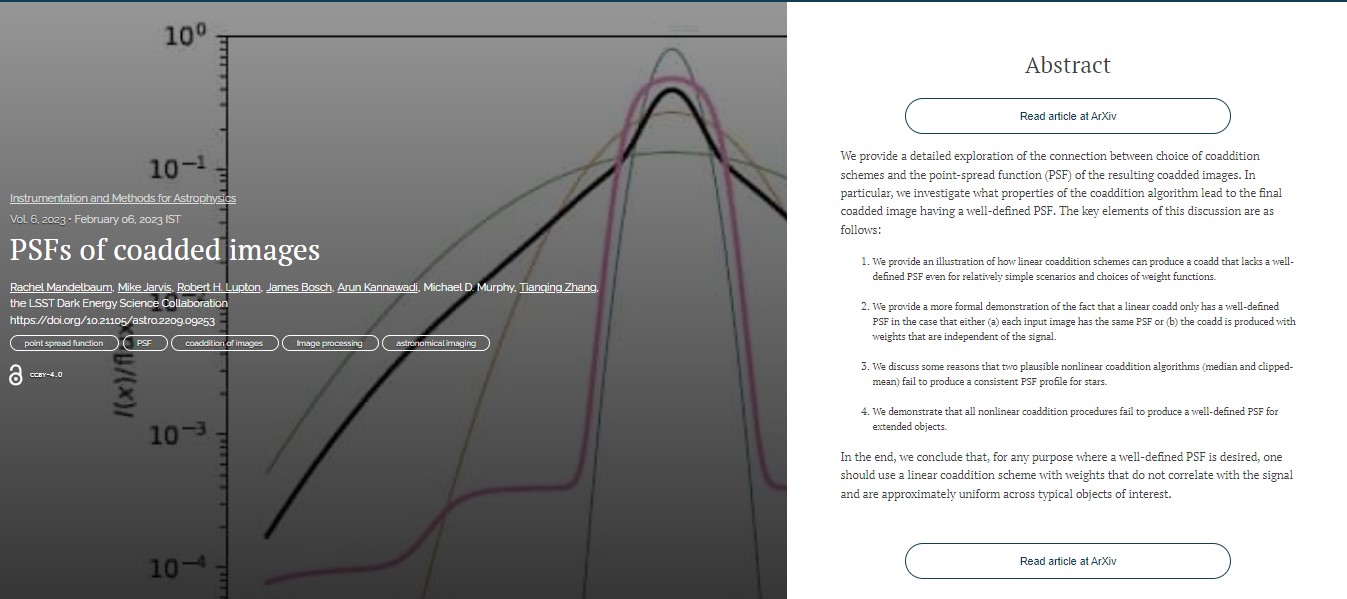
The latest paper is the 5th paper in Volume 6 (2023) as well as the 70th in all. This one is in the folder marked Instrumentation and Methods for Astrophysics. The title is “PSFs of coadded images”; for those of you not up with the lingo, “PSF” stands for point spread function.

The authors of this paper are Rachel Mandelbaum (1), Mike Jarvis (2), Robert H. Lupton (3), James Bosch (3), Arun Kannawadi (3), Michael D. Murphy (1) and Tianqing Zhang (1) and the LSST Dark Energy Science Collaboration. The affiliations of the individual authors are: (1) Carnegie Mellon University, Pittsburgh PA; (2) University of Pennsylvania, Philadelphia PA; (3) Princeton University, Princeton NJ; all in the USA of course.

Here is a screen grab of the overlay which includes the  abstract:


You can click on the image of the overlay to make it larger should you wish to do so. You can find the officially accepted version of the paper on the arXiv here.

Reflections on the St Brigid’s Day Holiday

Posted in Biographical, Education, Maynooth with tags , , on February 6, 2023 by telescoper

It’s Monday 6th February 2023, which means that today is a new experience for me: a Bank Holiday in February. This is taking place on the first Monday after Imbolc, a Gaelic festival marking the point halfway between the winter solstice and vernal equinox. The 1st day of February is also the Feast day of St Brigid of Kildare (c. 451-525), one of Ireland’s patron saints, along with Saints Patrick and Colm Cille. . From what I’ve read, St Brigid is an a sort of amalgamation of a pagan deity and an early Christian figure, part legend and part real person. One of her miraculous powers was the ability to change water into ale, which perhaps explains her enduring popularity among the Irish.

Anyway, it’s nice to have a day off even if it is just a week after the start of Semester Two, well before exhaustion sets in. Last week I started both my modules. I was particularly apprehensive about the first laboratory session for Computational Physics 1 on Thursday. In previous years the first session has always generated a lot of technical problems. This year we are running a new version of the operating system on our Linux cluster as well as a new version of Python. Students are issued with accounts specifically for use on this cluster and even logging for the first time and changing passwords has proved a challenge. I am now also using a digital display screen instead of the old data projector I used to have and which conked out last year.

This time, however, there were no significant problems at all in the Lab. Let’s hope the same is true for the Tuesday lab, which is a repeat but with a different (and slightly larger) group of students. In recognition of the likelihood of technical hitches I don’t usually aim to do very much in Lab 1, but this time I managed to cover quite a lot of material. By next week I’ll be starting to get the students to write bits of their own code. Thereafter it gets increasingly hands-on. There’s no efficient way to learn coding other than by doing it, so the sooner they get going with that the better.

I don’t actually have any lectures timetabled on Mondays this semester and, since the lab for tomorrow (Tuesday) is a repeat of last Thursday’s, I don’t have anything urgent to prepare. I’m therefore using the time off to do some Open Journal business – including publishing a paper – and, despite the cold, do a bit of gardening to prepare for Spring.

Kildare for All

Posted in Maynooth, Politics with tags , , on February 5, 2023 by telescoper

Earlier today in Courthouse Square, Maynooth I attended the gathering described above. It was organized at very short notice in response to a demonstration by about 20 fascists in the same place last week (which I didn’t see). Although the rally was quite small – I counted about 60 or 70 people – many motorists passing by along Straffan Road honked their horns to express support. Well done to the organizers for pulling this together on such a short timescale. I only found out about it yesterday.

The rally was in response to a wave of violence against refugees in Ireland incited, and in many cases carried out, by thugs belonging to fascist organizations. Kildare For All part of a national movement, Ireland For All, that seeks to take a stand in support of those facing violence and abuse from far-right thugs. We can’t let Ireland go down the fascist road. We know where it leads.

The fascists are trying to play on the understandable anger and resentment felt by many people in Ireland at the chronic housing shortage, poor healthcare and inadequate public services. These are not the fault of refugees who come here fleeing war and persecution, but are the fault of 15 years of failures in Government. If the Far Right were really bothered about housing etc they would have been protesting against homelessness all that time, which they did not do. They’re just using the situation as an excuse to exercise their racist and xenophobic views. Refugees are not to blame. All the recent influx of refugees has done has been to expose the indolence and incompetence of those in Government.

The rally included a number of speeches by union leaders and political figures, including Réada Cronin, the Sinn Féin TD for Kildare North of which Maynooth is a part.

Réada Cronin, the Sinn Féin TD for Kildare North at today’s rally

It is important for decent people to counter the campaign of disinformation from fascists on social media and to stand in solidarity against the threats, intimidation and actual violence against refugees in the places where they live. Today’s event was small, but it is only through grass-roots organizations like this that we can hope to stem the rising tide of bigotry and intolerance. There will be a much larger event in Dublin on 18th February.

Mozart, Ravel and Danielle de Niese

Posted in Biographical, Music with tags , , , , , , , , on February 4, 2023 by telescoper

After last week’s magnificent concert I couldn’t miss another chance to see and hear Danielle de Niese in at the National Concert Hall in Dublin, again with the National Symphony Orchestra under the direction of Jaime Martin. It was another fascinating (and very full) programme.

For last week’s concert, the National Concert Hall was only about two-thirds full but this time it was packed. I think the glowing reviews of La Voix Humaine contributed to that, as did the round of media interviews Danielle de Niese has done since then contributed to the full house.

Danielle de Niese seems to like singing 20th century French music and the concert opened with Shéhérazade by Maurice Ravel. This is a cycle of three songs which are settings of poems inspired by The Arabian Nights written by the pseudonymous poet Tristan Klingsor: Asie, La flûte enchantée, and L’Indifférent. Ravel was a real master of orchestration, and he creates a succession of exotic textures to complement the vocal lines. It’s not a long piece -altogether the three songs last about 15 minutes – but it covers a vast territory. There’s more than a nod to Debussy in this work too.

After that Danielle de Niese went off stage to change her frock, which was lime green for the Ravel, while the orchestra played the overture to the singspiel Die Entführung aus dem Serail (The Abduction from the Seraglio) by Wolfgang Amadeus Mozart. I’ve actually reviwed the whole Opera (was that really 12 years ago?) and wrote then (about the plot):

It’s admittedly a bit thin, even by the standards of comic opera but, right from the fabulous overture, the music is lovely and there’s a great deal of good-humoured fun, 

The overture is great fun to listen to, and obviously also to play. Jaime Martin was beaming and bouncing up and down on the podium during the performance.

And then Danielle de Niese returned (this time in a lurid red dress) to sing another piece by Mozart. Exsultate, Jubilate is a piece for solo voice and orchestra usually described as a motet but technically really a cantata. There are three movements, marked Allegro, Andante and Allegro. It’s obviously a work,with a religious theme, and the central Andante movement does sound like it is sacred music, but the outer Allegro movements are very operatic, with demanding coloratura passages, especially in the final Hallelujah. I don’t usually associate such vocal acrobatics with religious music, but it’s certainly a very exuberant and joyful piece. Astonishingly, Mozart was just 17 years old when he wrote it.

That piece by Mozart presented very different challenges to the soloist, Danielle de Niese but she showed herself to be a very accomplished performer in this too. With that her two-week residence in Dublin came to an end. She was presented with a huge bouquet of flowers and a standing ovation before we headed off to the bar for the interval.

After the wine break the National Symphony Orchestra was joined by the National Symphony Chorus for complete performance of the music to the ballet Daphnis et Chloé by Maurice Ravel. As is the case with Stravinsky’s Firebird, music from this ballet is often played in the form of a suite or, in the case of this ballet, two suites, but I have to say the whole is much greater than the sum of the suites and this work has become one of my favourite pieces to hear live. It’s a gloriously sensual and dramatic work, again brilliantly orchestrated, full of vibrant colours and lush textures, and even more wonderful when accompanied by the wordless singing of the massed ranks of the National Symphony Chorus. The score lasts a good hour, but that time seemed to flash by in this performance which was extremely well received by a very appreciative audience.

This was a very full programme and I had to leave during the applause to make sure I got back to Pearse station in time to catch the train back to Maynooth. I’m not as quick on my pins as I used to be. I arrived at Pearse with about five minutes to spare only to find that the train was five minutes late so I didn’t have rushed.

I have to congratulate whoever is doing the programming for these NSO concerts at the NCH. The last few have been excellent, and next week’s recipe of Ives, Beethoven and Sibelius looks great too!

New Publication at the Open Journal of Astrophysics

Posted in OJAp Papers, Open Access, The Universe and Stuff with tags , , , , , , on February 3, 2023 by telescoper

The articles are coming in thick and fast at the Open Journal of Astrophysics. and why trying to get them refereed and published as quickly as we can. It’s time to announce yet another paper. This one was published officially yesterday (2nd February 2023) but I just found time to post about it here today before I go to my 9am tutorial.

The latest paper is the 4th paper in Volume 6 (2023) as well as the 69th in all. This one is in the Astrophysics of Galaxies folder.

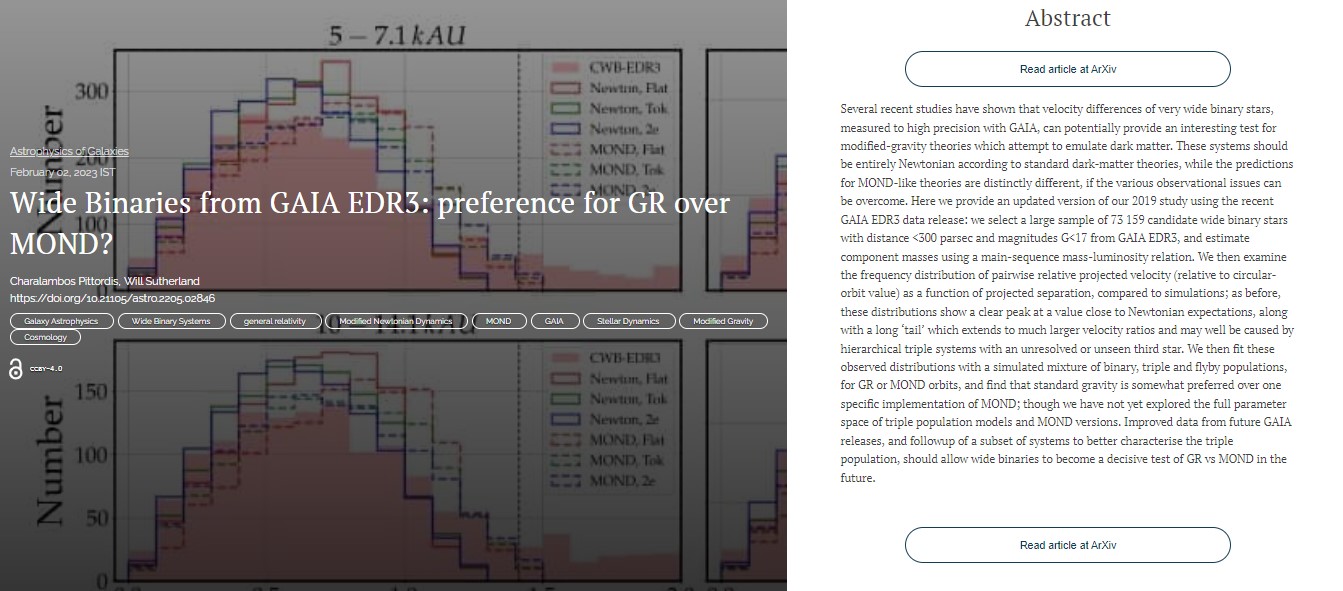
The latest publication is entitled “Wide Binaries from GAIA EDR3: preference for GR over MOND?”.  The authors of this paper,  Charalambos Pittordis and Will Sutherland, are both based at Queen Mary, University of London. We published a related paper last month.

Here is a screen grab of the overlay which includes the  abstract:


You can click on the image to make it larger should you wish to do so. You can find the officially accepted version of the paper on the arXiv here.