Author Archive

Hamiltonian Poetry

Posted in Poetry, The Universe and Stuff with tags , , , , , , on January 8, 2018 by telescoper

I posted a couple of items last week inspired by thoughts of the mathematician William Rowan Hamilton. Another thing I thought I might mention about Hamilton is that he also wrote poetry, and since both science and poetry feature quite regularly on this blog I thought I’d share an example.

In fact during the `Romantic Era‘ (in which Hamilton lived) many scientists wrote poetry related either to their work or to nature generally. One of the most accomplished of these scientist-poets was chemist and inventor Humphry Davy who, inspired by his friendship with the poets Wordsworth and Coleridge, wrote poems throughout his life. Others to do likewise were: physician Erasmus Darwin; and astronomer William Herschel (who was also a noted musician and composer),

William Rowan Hamilton interests me because seems to have been a very colourful character as well as a superb mathematician, and because his work relates directly to physics and is still widely used today. Interestingly, he was a very close friend of William Wordsworth, to whom he often sent poems with requests for comments and feedback. In the subsequent correspondence, Wordsworth was usually not very complimentary, even to the extent of telling Hamilton to stick to his day job (or words to that effect). What I didn’t know was that Hamilton regarded himself as a poet first and a mathematician second. That just goes to show you shouldn’t necessarily trust a man’s judgement when he applies it to himself.

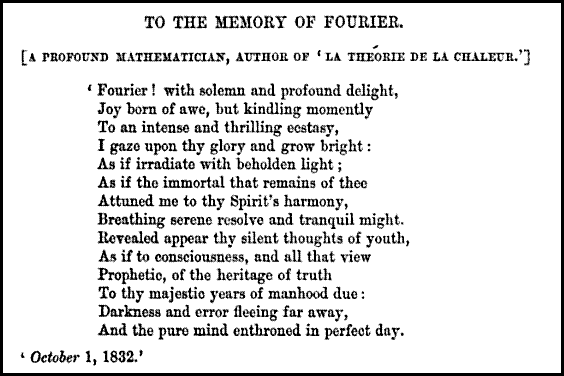
Here’s an example of Hamilton’s verse – a poem written to honour Joseph Fourier, another scientist whose work is still widely used today:

Hamilton-for Fourier

If that’s one of his better poems, then I think Wordsworth may have had a point!

The serious thing that strikes me is not the quality of the verse, but how many scientists of the 19th Century, Hamilton included, saw their scientific interrogation of Nature as a manifestation of the human condition just as the romantic poets saw their artistic contemplation. It is often argued that romanticism is responsible for the rise of antiscience. I’m not really qualified to comment on that but I don’t see any conflict at all between science and romanticism. I certainly don’t see Wordsworth’s poetry as anti-scientific. I just find it inspirational:

I HAVE seen
A curious child, who dwelt upon a tract
Of inland ground, applying to his ear
The convolutions of a smooth-lipped shell;
To which, in silence hushed, his very soul
Listened intensely; and his countenance soon
Brightened with joy; for from within were heard
Murmurings, whereby the monitor expressed
Mysterious union with its native sea.
Even such a shell the universe itself
Is to the ear of Faith; and there are times,
I doubt not, when to you it doth impart
Authentic tidings of invisible things;
Of ebb and flow, and ever-during power;
And central peace, subsisting at the heart
Of endless agitation.

Hold ’em Joe – Sonny Rollins

Posted in Jazz with tags , , , on January 6, 2018 by telescoper

So I’m in Dublin airport waiting to board a (delayed) flight. Since it’s cold and dark outside I thought I’d take the opportunity to use the free airport Wi-fi to share something that put a bit of a spring in my step when I heard it on the radio a couple of days ago. It’s a truly phenomenal performance on tenor saxophone by the great Sonny Rollins over an infectious calypso rhythm generated by Mickey Roker on drums. Enjoy!


Hamilton and the “Light-Bulb” Moment

Posted in Biographical, The Universe and Stuff with tags , , , , , , on January 5, 2018 by telescoper

In yesterday’s post I mentioned in passing the bridge (Broom Bridge) beside which William Rowan Hamilton first wrote down the fundamental result of quaternions after having a flash of genius while walking from Dunsink Observatory into Dublin.

That reminded me last night that a while ago I read a piece in Physics World (which you can read here, but only if you have a subscription) about whether breakthroughs in physics occur very often in the way of Hamilton’s – through sudden flashes of inspiration or, as they are called in the article,  “light-bulb moments” –  or are more often the result of solid hard graft, sweat and spadework? In other words, how much is inspiration and how much perspiration?

The piece includes some interesting comments from distinguished scientists about their own “Eureka” moments, which I’m sure will resonate with many researchers, not only physicists. Incidentally, the article refers to such moments as “claritons”, a word I’d never heard before, presumably intended to evoke solitons. It is interestin, though just how strongly the light-bulb has become so strongly associated with this sort of brainwave. You can find a short discussion of this here.
Anyway, I’m pretty sure that  most scientists – even the eminent individuals interviewed for the Physics World piece – have spent a large part of their time “stuck”. I know I have, but then I’m not really eminent anyway. In the long run it’s probably good to go through such periods as I think they’re essential for intellectual development, but they’re undoubtedly extremely frustrating at the time. How you get “unstuck” is a very mysterious process. I’m not a neuroscientist, but it seems to me that when you get really immersed in, say, a research problem, your subconscious brain gets drawn into what you think is a fully conscious process, to the extent that even when you’re apparently not thinking about something you really are. I’ve had ideas come to me in all kinds of weird situations: watching ducks paddling on a pond, listening to music, walking in a park, and even pushing a trolley around a supermarket. Often it seems that it’s precisely when you’re not thinking that you have your best ideas. It’s not always clear what acted as the trigger, but and when it is it is often something quite abstract. In the case I mentioned of the ducks on the pond it was just a question of thinking about reference frames. It was a nudge in the right direction, but I still had to do quite a lot of work to finish the calculation. Come to think of it, it’s usually at that conceptual level that such things happen rather than in the detailed working, at least in my case.

The Physics World piece also talks about ideas coming through dreams. That has happened to me too, but I think it’s basically the same phenomenon that I’ve just discussed. It seems to me that dreams are a product of your brain sorting through recent events or experiences and trying to make sense of them in terms of others it has filed away. This can help with a research problem by flagging up a connection with something else hidden away. I can remember at least two occasions when I’ve woken up from a dream with an exact understanding of what I’d been doing wrong and how I could fix it. It’s great to wake up in the morning with that kind of feeling!

I know it’s wrong to draw inferences about other people from one’s own particular experiences, but I do feel that there are some general lessons. One is that if you are going to be successful at research you have to have a sense of determination that borders on obsession. You have to immerse yourself in it and be prepared to put long hours in. When things are going well you will be so excited that you will find it as hard to stop as it is when you’re struggling. I’m writing as a physicist, but I imagine it is the just same for other disciplines.

The other, equally important, lesson to be learned is that it is essential to do other things as well as doing science. Being “stuck” on a problem is an essential part of mathematics or physics research, but sometimes battering your head against the same thing for days on end just makes it less and less likely you will crack it. The human brain is a wonderful thing, but it can get stuck in a rut. One way to avoid this happening is to have more than one thing to think about.

I’ve lost count of the number of times I’ve been stuck on the last clue in a crossword, which usually means that my facility for thinking laterally, which is so essential for solving cryptic puzzles, is not operating well. What I always do in that situation is put it down and do something else for a bit. It could even be something as trivial as making a cup of tea, just as long as I don’t think about the clue at all while I’m doing it. Nearly always when I come back to it and look at it afresh I can solve it. I have a large stack of prize dictionaries to prove that this works!

It can be difficult to force yourself to pause in this way. I’m sure that I’m not the only physicist who has been unable to sleep for thinking about their research. I do think however that it is essential to learn how to effect your own mental reboot. In the context of my research this involved simply turning to a different research problem, but I think the same purpose can be served in many other ways: taking a break, going for a walk, playing sport, listening to or playing music, reading poetry, doing a crossword, or even just taking time out to socialize with your friends. Time spent sitting at your desk isn’t guaranteed to be productive, and you should never feel guilty about taking a thinking break.

I’d be interested to receive examples of other “light-bulb” moments through the comments box. I’d also welcome comments from neuroscientists on my extremely naïve comments about how the brain works in such situations.
 

The Expanding Universe: An Introduction

Posted in The Universe and Stuff with tags , , on January 5, 2018 by telescoper

For those of you reading this blog who feel they need an up-to-date primer for the basics of modern cosmology without too much technical detail, I found a paper on the arXiv that might give you what you want. It’s over a hundred pages long but does not use much complicated mathematics but has some nice illustrations. The author is Markus Pössel; the abstract reads

An introduction to the physics and mathematics of the expanding universe, using no more than high-school level / undergraduate mathematics. Covered are the basics of scale factor expansion, the dynamics of the expanding universe, various distance concepts and the generalized redshift-luminosity relation, among other topics.

This paper focusses on the basics of the standard framework founded on general relativity, especially how cosmological distances are defined and measured, rather than on trendy modern topics like dark energy and the cosmic microwave background. I’d say any first-year physics student should be able to cope with it, but it’s not for someone who hasn’t learned calculus. On the other hand, it’s free to download so you don’t have much to lose by having a look!

You can download a PDF here.

Toby Young excluded from Beard of Winter shortlist

Posted in Beards, Politics on January 4, 2018 by telescoper

The campaign against Toby Young gathers strength…..

kmflett's avatarKmflett's Blog

Beard Liberation Front

Media Release

4th January

Contact Keith Flett 07803 167266

Toby Young excluded from Beard of Winter shortlist

The Beard Liberation Front the informal network of beard wearers has said that self-styled ‘right-wing maverick’ Toby Young has been excluded from the Beard of Winter shortlist due to be unveiled on 14th January.

The campaigners say that the BLF has investigated whether Young has faced pogonophobic discrimination, after New Year criticisms of his appointment as an official Universities regulator.

The finding was that, on the contrary, Toby Young, and particularly his social media presence, has brought the hirsute into disrepute

BLF Organiser Keith Flett said, the coveted Beard of Winter Award, the first of four seasonal Awards, invariably has a diverse shortlist, for example Prince Harry is certain to feature, but Toby Young is a beard too far.

View original post

Planes, Trains and Quaternions

Posted in Biographical, History, mathematics, Maynooth with tags , , , , , , , , on January 4, 2018 by telescoper

Well, here I am in Maynooth for the first time in 2018. I flew over from Cardiff yesterday. The flight was rather bumpy owing to the strong winds following Storm Eleanor, and it was rather chilly waiting for the bus to Maynooth from Dublin Airport; nevertheless I got to my flat safely and on time and found everything in order after the Christmas break.

This morning I had to make a trip by train to Dublin city  to keep an appointment at the Intreo Centre in Parnell Street, which is about 15 minutes walk from Dublin Connolly train station. I bought an Adult Day Return which costs the princely sum of €8.80. Trains, stations and track in Ireland are maintained and operated by Irish Rail (Iarnród Éireann), which is publicly owned. Just saying.

The distance between Maynooth and Dublin about 25 km, which takes about 40 minutes on the local stopping train or about 25 minutes on the longer distance trains which run nonstop from Maynooth to Dublin. As it happens I took one of the fast trains this morning, which arrived on schedule, as did the return journey on a commuter train. My first experience of the Irish railway system was therefore rather positive.

I had thought of having a bit of a wander around the city on my way to Parnell Street but it was raining and very cold so I headed straight there. I arrived about 20 minutes ahead of my scheduled appointment, but was seen straight away.

The reason for the interview was to acquire a Personal Public Services Number (PPSN), which is the equivalent of the National Insurance Number we have in the United Kingdom. This number is needed to be registered properly on the tax and benefit system in Ireland and is the key to access a host of public services, the electoral roll, and so on. You have to present yourself in person to get a PPSN, presumably to reduce the opportunity for fraud, and I was told the interview would take 15 minutes. In fact, it only took about 5 minutes and at the end a photograph was taken to go on the ID card that is issued with the number on it.

So there I was, all finished before I was even due to start. The staff were very friendly and it all seems rather easy. Fingers crossed that the letter informing me of my number will arrive soon. It should take a week or so, so I’m told. After that I should be able to access as many personal services as I want whenever I want them. (Are you sure you have the right idea? Ed.)

For  the return trip  to Maynooth I got one of the slower commuter trains, stopping at intermediate stations and running right next to the Royal Canal, which runs from Dublin for 90 miles through  Counties Dublin, Kildare, Meath and Westmeath before entering County Longford, where it joins the River Shannon. One of the intermediate stations along the route next to the canal is Broombridge, the name of which stirred a distant memory.

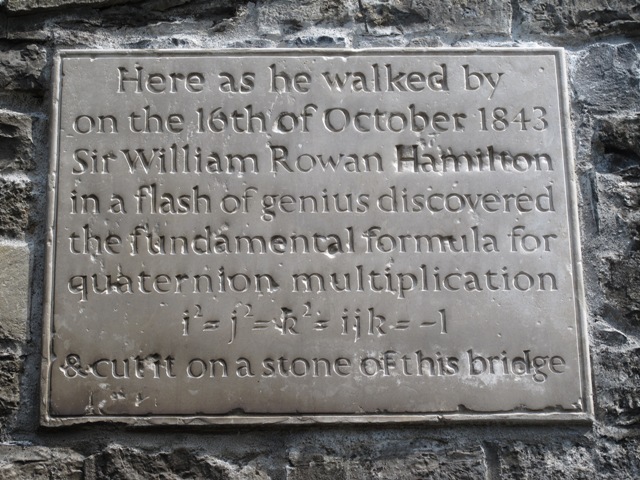
A quick application of Google reminded me that the town of Broombridge is the site of the bridge (Broom Bridge) beside which William Rowan Hamilton first wrote down the fundamental result of quaternions (on 16th October 1843). Apparently he was walking from Dunsink Observatory into town when he had a sudden flash of inspiration  and wrote the result down on the spot, now marked by a plaque:

Picture Credit: Brian Dolan


This episode  is commemorated on 16th October each year by an annual Hamilton Walk. I look forward to reporting from the 2018 walk in due course!

P.S. Maynooth is home to the Hamilton Institute which promotes and facilitates research links between mathematics and other fields.


Hypocrisy Illustrated

Posted in Politics with tags , , , on January 3, 2018 by telescoper

The playwright Alan Bennett recently said that “England excels at one thing…hypocrisy”. If you needed any evidence that he was right, take a look at these results from a 2014 COMRES survey:

The Old Year’s Blog Statistics

Posted in Biographical on January 2, 2018 by telescoper

I’ve been back in the office (in Cardiff) today, where I’ve got through quite a lot of work – as well as doing my tax return at lunchtime – owing to the fact that there’s nobody else here. I’m about to go home and try to figure out which assortment of bins to put out but before doing that I thought I’d do a quick blog about the blog.

Once upon a time, in the good old days, WordPress used to publish the annual statistical summary page for its bloggers, but it discontinued that practice last year so now I’ll just write my own brief summary based on the data available via the usual dashboard. First, however, a picture:

Now, for those interested I got about 413K hits this year, just over 1100 a day, with about 212K unique views. That’s up a bit since last year, probably because I’ve posted more (442 articles this year, including reblogs). The two most popular posts were about the Bullying Scandal in Zurich and on the rumours surrounding a gravitational waves from a source in NGC 4993 (proved later to be true).

In 2017 there were 2610 comments on this blog, up about 10% on last year. No prizes for guessing who wrote the most comments.

Altogether since this blog started in 2008 to the end of 2017, it has been viewed 3,371,843 times by a total of 1,094,975 unique visitors (though, obviously, all my visitors are unique). I passed 3 million reads and 1 million visitors during the course of last year.

Love in the Asylum

Posted in Poetry with tags , , on January 2, 2018 by telescoper

A stranger has come
To share my room in the house not right in the head,
A girl mad as birds

Bolting the night of the door with her arm her plume.
Strait in the mazed bed
She deludes the heaven-proof house with entering clouds

Yet she deludes with walking the nightmarish room,
At large as the dead,
Or rides the imagined oceans of the male wards.

She has come possessed
Who admits the delusive light through the bouncing wall,
Possessed by the skies

She sleeps in the narrow trough yet she walks the dust
Yet raves at her will
On the madhouse boards worn thin by my walking tears.

And taken by light in her arms at long and dear last
I may without fail
Suffer the first vision that set fire to the stars.

by Dylan Thomas (1914-1953)

Passport to Nowhere

Posted in Biographical, Politics on January 1, 2018 by telescoper

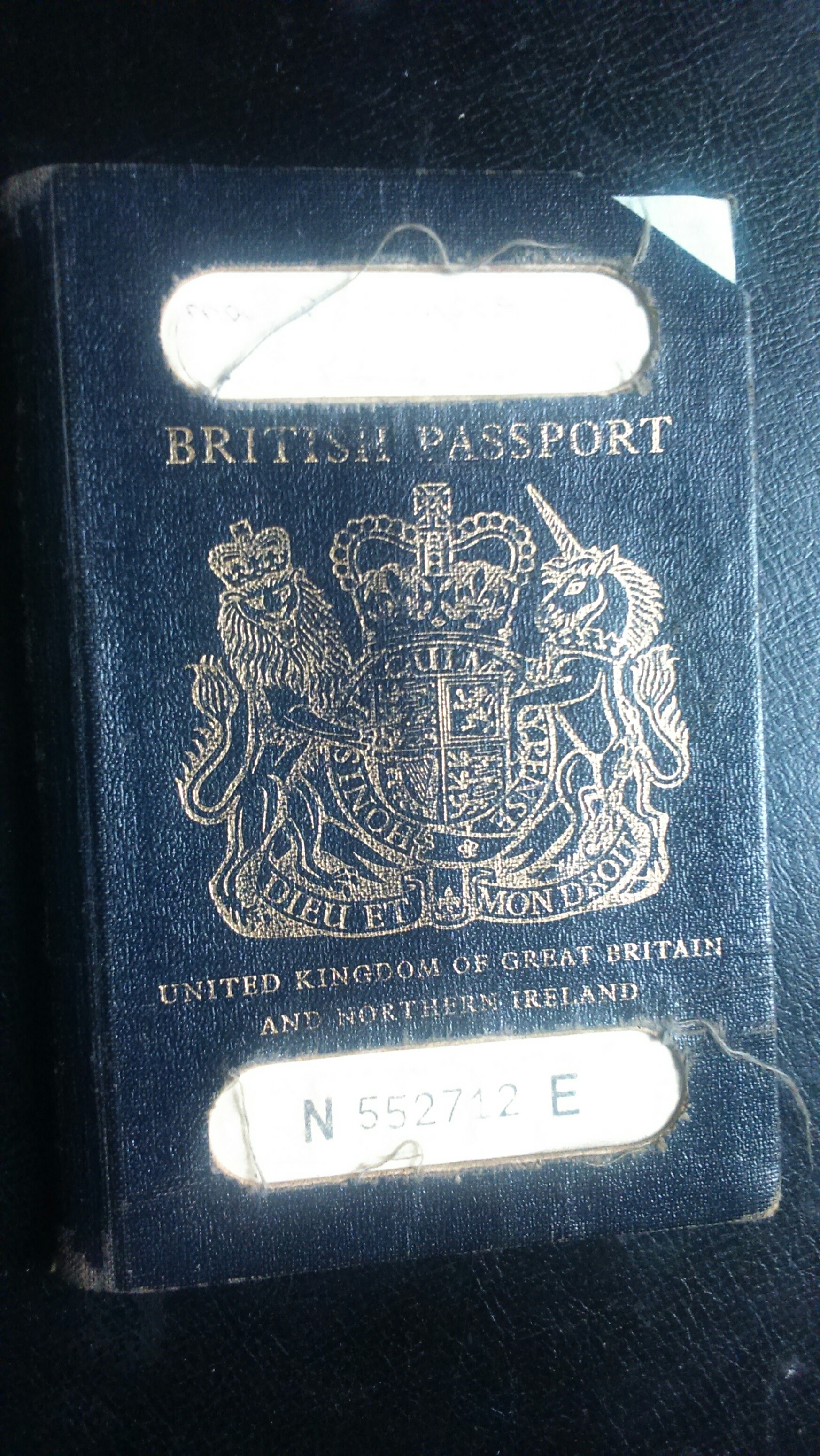
This is a picture of one of my old expired passports. It is, in fact, the first I ever had. It was issued to me in 1986, when I was 23 years old and a PhD student; I needed it to travel to a conference in France. It expired in 1996 (hence the docking of the top right corner) whereupon I had it replaced by a much better made Burgundy one.

I had never travelled abroad before 1986. I’m not from a wealthy family and we never had any holidays outside the UK. Given that,  I’m grateful that I ended up in a career that allowed me to travel quite widely,  within in the European Union and beyond.

I’m guessing that most of the people celebrating the imminent “return of the blue passport” recently announced by the Government never actually had one of these old-style passports, as they weren’t the colour of the ones UK citizens will have to carry after Brexit which will be Navy Blue, a tone much lighter than the blue of old passport, which is almost black.

This is, to me, just another example of the absurd hankering after an imagined past that never was that characterizes Brexit Britain.

Anyway, the colour of the next UK passport is of no real concern to me. Whatever its design it will not allow UK citizens to live and work freely within the European Union, so it will be of considerable less value than the existing ones.

Fortunately (for me, at least) I won’t be needing a British passport much longer and will have no need to renew mine for the downgraded version that will be mandatory after 2019. In fact when I get my Irish passport the first thing I’ll do is throw the old British one in the bin.