I’m going to be a bit busy today so by way of a post here’s a marvellous video showing the great Richard Feynman delivering a lecture at Cornell University in 1964, in full, complete with a lengthy introduction (but with some glitches in the film). This is the first in a series of four lectures called the Messenger Lectures, and is on the subject of the Law of Gravitation. The clip not only shows what a great showman Feynman was but also how he was able to talk in an interesting and original way about seemingly very familiar material. Do check out the other videos in this series; they’re really marvellous. Oh to be as gifted a communicator of science as Feynman!
Follow @telescoperAuthor Archive
Feynman Lectures on the Character of Physical Law
Posted in The Universe and Stuff with tags Cornell University, Law of gravitation, Messenger Lectures, Richard Feynman on September 21, 2012 by telescoperAGP Matters
Posted in Biographical, Science Politics with tags Astronomy Grants Panel, Science and Technology Facilities Council, STFC on September 20, 2012 by telescoperWell, just made it back to Cardiff following the (hopefully) final meeting of the Astronomy Grants Panel (AGP) for this year’s round at the Science and Technology Facilities Council HQ in Swindon. It’s been a difficult process – though perhaps not quite as difficult as last year’s round which was completely overloaded with applications. I struggled a bit extra this year because I seem to have caught some sort of nasty bug during my recent travels. No doubt I’ve now infected the rest of the panel via coughing and spluttering too…
Anyway, we got through the business at hand, which basically involved merging two ranked lists produced by the sub-panels to produce an overall priority order for the proposals received. What happens with this list now is that the good folk at STFC carefully calculate the costs of each proposal as they work down through the list and keep going until the money runs out. We don’t know for sure at this stage where the line will fall, but it’s pretty clear that some very good proposals won’t make it. That’s the way it is. There just isn’t enough money to fund all the best research.
I suppose that’s why I always have mixed feelings at the end of an AGP round. It’s good to see the process in operation, because it convinces one that everyone concerned is doing their best to achieve a fair outcome, but it’s very sad that some proposals will fall just short with potentially terrible consequences for those whose livelihoods depend on STFC funding. This accounts for the not inconsiderable quantity of gallows humour displayed by AGP members.
Of course the AGP doesn’t actually award grants. It makes recommendations which are then endorsed (or not) by the STFC Science Board. So although we’ve now done our job, it will take a while until the formal grant announcements start appearing, in November probably.
Anyway, I’ve been on the panel for 3 years now, which is the normal sentence term for an AGP member, so I have the feeling I might be “rotated” off after this round, whereupon it will be up to some other mug esteemed researcher to take my place performing this thankless task valuable bit of community service.
Views of Arizona
Posted in Biographical with tags Arizona, Cathedral Rock, Flagstaff, Meteor Crater, Sedona on September 18, 2012 by telescoperOn the way to the airport on Sunday with my chauffeur, John Peacock, we took the opportunity to make a few detours to take in some of Arizona’s breathtaking scenery. The heat was also fairly breathtaking. I don’t really know how people manage to live out there, actually. Anyway, here are a few snaps I managed to capture with my phone camera.
The first is of course Meteor Crater, which is about 45 miles from Flagstaff:

The crater is about 170m deep and has a diameter of about 1.2km. You can see some mining equipment and other gear at the bottom. Initially people thought there would be the remains of a big iron meteorite buried underneath the crater, but magnetic tests showed that there was no so such thing. Modern understanding is that the meteorite vaporised on impact; evidence for this is found in tiny bits of fused iron that can be found as far as 7km from the impact site.
Here are another two pictures of the beautiful rocky landscape of Arizona which comprises various kinds of sandstone of different hues, including one which is just like terra cotta. Here’s an example of the spectacular formations you can find on the way from Flagstaff to Sedona:

This is Cathedral Rock in the afternoon sunshine

Well, that’s enough exotic travel pictures. Now I’m off to Swindon.
Follow @telescoperThe Lowell Observatory
Posted in History, The Universe and Stuff with tags Canals on Mars, Clyde Tombaugh, Lowell Observatory, Percival Lowell, Vesto Slipher on September 17, 2012 by telescoperWell, here I am back in Blighty after the conference celebrating Vesto M. Slipher. The return trip went remarkably smoothly – no hassles at the airport at either end, and all pretty well on time. When I arrived in Flagstaff last Thursday evening I missed the reception that took place in the Lowell Observatory, but fortunately had time on Sunday morning to have a look around the site, on “Mars Hill”, and take a few pictures.
First and foremost with regard to the topic of the conference, here is a picture of the actual spectrograph used by Vesto Slipher to measure the radial velocity of the Andromeda Nebula (M31), which he actually did 100 years ago today, on 17th September 1912. I had a bit of a struggle with the reflection on the case, but you can see it’s a beautiful piece of kit:

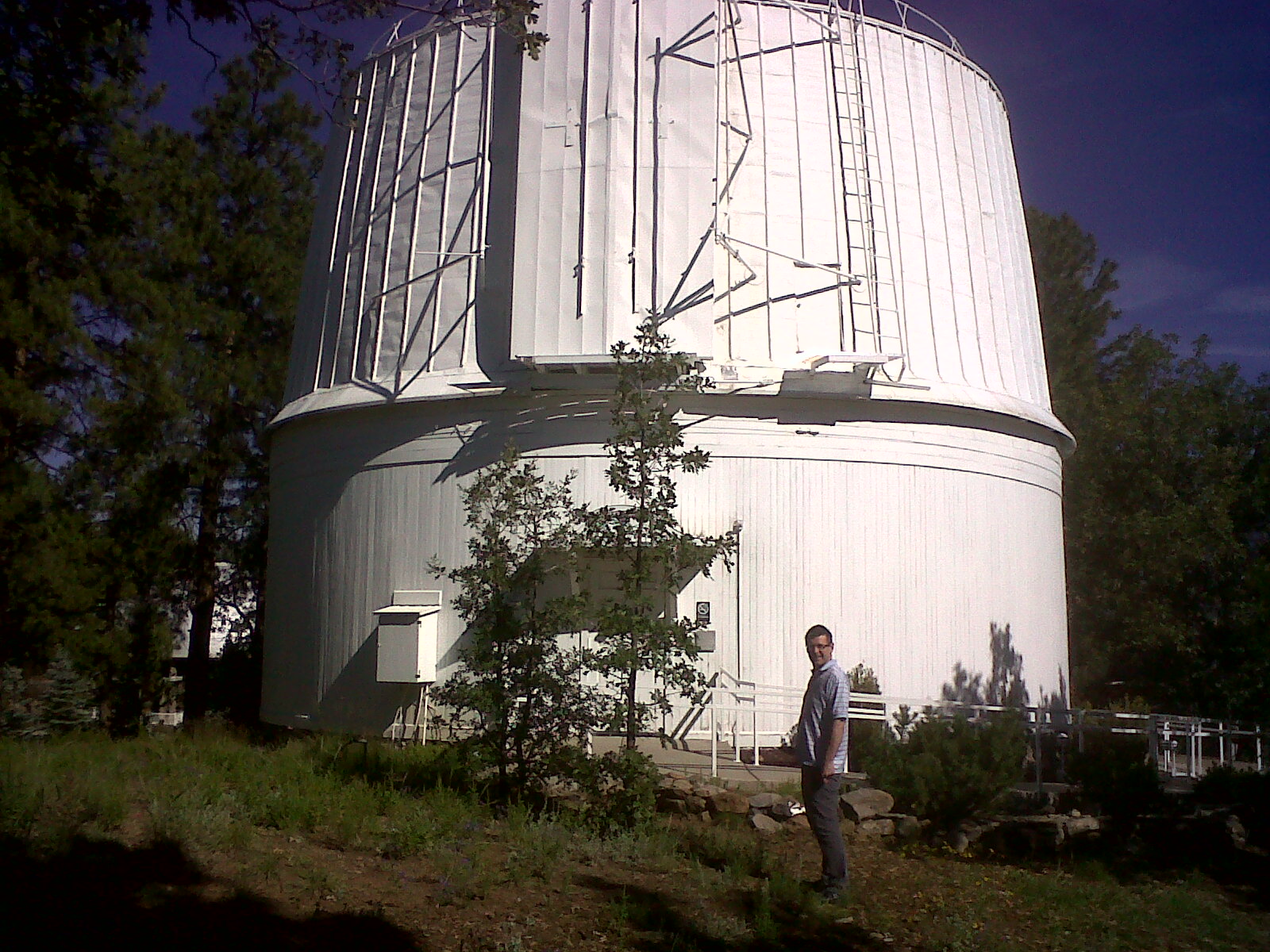
Here’s one of me standing outside the dome that houses the 24″ Clark Refractor that Slipher used for his spectrographic studies:
And just to remind you that the site isn’t famous only for Slipher’s work, here is the dome housing the 13″ astrographic telescope that was used in 1930 by Clyde Tombaugh to discover Pluto.

Here’s my chauffeur for the day, Prof. Peacock, with the rusting remains of a 42″ telescope:

Of course the Lowell Observatory is named after Percival Lowell (known to his friends as “Percy”) a flamboyant character who founded it in 1894. Lowell did many great things for astronomy, but unfortunately he is mostly remembered these days for his erroneous observations of “canals” on Mars.
Follow @telescoperHubble versus Slipher
Posted in History, The Universe and Stuff with tags Edwin Hubble, Hubble expasion, Hubble's Law, Lowell Observatory, Stigler's Law of Eponymy, Vesto Slipher on September 15, 2012 by telescoperSince I’m here at a conference celebrating the scientific achievements of Vesto M. Slipher, I thought I’d take the opportunity to make a few remarks about Slipher’s work and legacy.
I often use this picture in popular talks to illustrate the correlation between distance (x-axis) and apparent recession velocity (y-axis) that has become universally known as Hubble’s Law. This is an early version of such a plot published by Edwin Hubble in 1929.
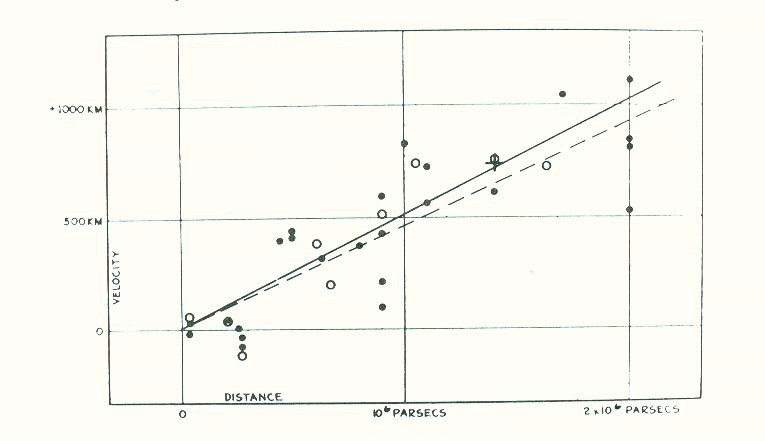
In public talks I rarely have time to go into the details of this, but it is worth saying that only the results on the x-axis were Hubble’s own measurements. Hubble only contributed half of the above plot, i.e. the distance measurements, and these turned out to be wrong by a factor of about 10 owing to an incorrect identification of the stars used as standard candles. All the recession velocities on the y-axis – obtained by looking at the displacement of lines in the target galaxy’s spectrum – were in fact obtained by Vesto Slipher at the Lowell Observatory here in Flagstaff, Arizona. Hubble used these data from Slipher with permission, but gave no credit to Slipher in the references to his 1929 work. A later, and more convincing, version of this plot published in 1931 by Hubble and Humason, was accompanied by a generous acknowledgement to Slipher’s contribution. However, by then, Hubble’s name was firmly associated with the plot and Slipher’s contribution was largely forgotten for many years subsequently.
This episode isn’t at all atypical of Hubble’s behaviour. He was an extremely ambitious man who was an expert in the art of promoting himself and the Mount Wilson Observatory where he worked. Slipher was a very different type of man: quiet, self-effacing, and very much a team player, dedicated to scientific accuracy rather than his own reputation.
It’s worth saying further that the key observation that led to the understanding that the Universe is expanding is the fact that most of the spectra obtained by Slipher, over the years subsequent to his first measurement of the spectrum of the Andromeda Nebula (M31) celebrated by this conference, showed a redshift indicating velocity away from the observer. Even without distance measurements this leads directly an interpretation in terms of cosmic expansion. Ironically, the first spectrum he obtained, M31 shows a blue shift, as do a few others plotted with negative velocities in the above diagram, but the more distant sources exclusively show a redshift.
As a scientist should be, Slipher was very careful about the interpretation of this result. The more distant objects are fainter and thus more difficult to observe. Could it arise from some systematic artifact? Or could there be an unknown physical effect that produces a redshift dependent on the size of the source? These questions could only be answered when accurate distances to the nebulae were established, so Hubble’s contribution was by no means negligible. It’s completely untrue, however, to say that Hubble discovered the expansion of the Universe, so there’s yet another example of Stigler’s Law of Eponymy whenever anyone talks about the Hubble expansion.
One of the great things about coming to this meeting was the chance to meet Alan Slipher, grandson of Vesto Slipher. He and other members of his family refer to Vesto as “VM”, by the way, which I hadn’t realised before. VM lived a long life, dying in 1969 just short of his 94th birthday, so Alan knew him well until age 17 or so. He spoke most warmly and movingly after yesterday’s conference dinner about his memories of his grandfather, who he clearly looked up to. His words confirmed the impression I’d already formed, that Slipher was an extremely cautious and serious scientist as well as a kindly and humble man.
The contrasting personalities of Slipher and Hubble are further illustrated by correspondence between the two that is archived at the Lowell Observatory. Slipher comes across as kindly and cooperative, Hubble as pompous and self-regarding. I know which of the two I admire the best, both and scientist and human being.
Follow @telescoperTravelblog
Posted in Biographical, Jazz with tags Arizona, Flagstaff, Nat King Cole, Phoenix, Route 66 on September 14, 2012 by telescoperI’m up bright and early this morning – well, early, at least – after my long trip yesterday. I was slightly nervous about my itinerary, especially the (for me) uncharted territory at the end. As it happens, the train from Cardiff to Heathrow, direct flight from Heathrow to Phoenix and shuttle bus from Phoenix to Flagstaff, Arizona, all went to plan. I arrived just after nine yesterday evening, tired but intact.
One thing worth mentioning is that this is the first time I’ve set foot on American soil for many years. My lamentable experience with the US Embassy in London in 2005 succeeding in putting me off visiting the States almost entirely. However, I’m told that travelling is meant to be good for me, so I decided to accept the invitation to attend and speak at the conference I posted about a while ago. One of the relics of the 2005 episode is an unused J-1 visa in my passport, and when we arrived in Phoenix I was consequently a little apprehensive about whether questions might be asked about it. That added to the usual anxiety about length of queues at Immigration. As it turned out, the staff were courteous and efficient and the uniformed officer I spoke to at the desk and who took my fingerprints etc was an enthusiastic amateur astronomer who seemed more interested in my work than in the formalities at hand. Anyway, my virgin visa attracted no comment at all.
Despite landing a bit late, I actually got through the airport in good time to catch the shuttle to Flagstaff. Phoenix, by the way, was a scorching 37 Celsius, even at 5.30 in the pip emma. I dread to think how hot it must have been at mid-day. Flagstaff is, I’m told, a bit cooler being up in the mountains although it was dark when I arrived and I didn’t really see much of the place before getting to the hotel, having a quick blog, and then crashing out.
Incidentally, the route from Phoenix to Flagstaff is north on the I-17 until it hits Route 66, subject of the famous song in which Flagstaff gets a mention:
My hotel is actually situated on Route 66, but so far there’s no sign of anything that could truthfully be described as “kicks”.
Anyway, I have to speak later today so I should probably start writing my talk. As they don’t say around these parts, Toodle-pip!
Follow @telescoperR.I.P. Leonid Grishchuk
Posted in The Universe and Stuff with tags Cosmology, gravitational waves, Kip Thorne, Leonid Grishchuk on September 14, 2012 by telescoperAs I was travelling to Heathrow airport in order to fly to the USA (from where I am posting this message), I heard the sad news of the death of a dear and respected colleague, Professor Leonid Petrovich Grishchuk.
Leonid was a Distinguished Research Professor here in Cardiff from 1995 until his retirement in 2009 and was frequently to be found in the department after that. You can read more of his scientific biography and wider achievements here, but it should suffice to say that he was a pioneer of many aspects of relativistic cosmology and particularly primordial gravitational waves. He was also a larger-than-life character, held in great affection by many scientists and friends around the world.
My first experience of Leonid was many years ago at a scientific meeting at which I attempted to give a talk. Leonid was in the audience and he interrupted me, rather aggressively. I didn’t really understand his question so he had another go at me in the questions afterwards. I don’t mind admitting that I was quite upset with his behaviour. I think a large fraction of working cosmologists have probably been “Grischchucked” at one time or another. Later on, though, people from the meeting were congregating at a bar when he arrived and headed for me. I didn’t really want to talk to him as I felt he had been quite rude. However, there wasn’t really any way of escaping so I ended up talking to him over a beer. We finally resolved the question he had been trying to ask me and his demeanour changed completely. We spent the rest of the evening having dinner and talking about all sorts of things and were good friends ever since. Over the years I’ve learned that this is very much a tradition amongst Russian scientists of the older school. They can seem very hostile – even brutal – when discussing science, but that was the way things were done in the environment where they learned their trade. In many cases the rather severe exterior masks a kindly and generous nature, as it certainly did with Leonid. Leonid’s confrontational behaviour was partly sport – once you got used to that twinkle in his eye it was impossible to take offence – but partly a genuine desire to cut away the flannel and get to the heart of things. He detested bullshit and had no time for people who traded in it.
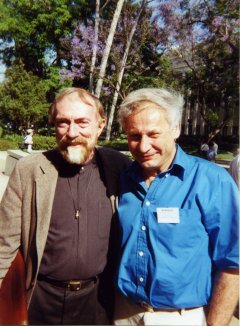
Here’s a picture of Leonid taken a few years ago with his longstanding friend Professor Kip Thorne.
Some months ago Leonid was struck down by a brain tumour, against which he struggled bravely. On Monday this week, however, the doctors were forced to admit that the treatment had failed and Leonid could not live much longer. Fortunately his death, when it came, was peaceful. He passed away in his sleep on Wednesday night.
Farewell, Leonid. We’ll all miss you.
Follow @telescoperNothing Gold Can Stay
Posted in Open Access, Poetry with tags Gold Open Access, Nothing Gold Can Stay, Poetry, Robert Frost on September 13, 2012 by telescoperNature’s first green is gold,
Her hardest hue to hold.
Her early leaf’s a flower;
But only so an hour.
Then leaf subsides to leaf.
So Eden sank to grief,
So dawn goes down to day.
Nothing gold can stay.
by Robert Frost (1874-1963)
Follow @telescoper
 In the Dark