Last week saw the 57th anniversary of the death of Charlie Parker, aka Bird, a musical genius on the saxophone whose influence not only on jazz but on twentieth century music is incalculable. I’ve posted quite a few tracks by Bird over the years and one thing I’ve learned from doing that is that he’s by no means everyone’s cup of tea. I can’t do anything about that, of course, but I can at least point out the existence of his wonderful legacy to those (regrettably many) people who’ve never heard of him or his musicI still remember the mixture of astonishment and exhilaration I felt when I first heard him on record and if I can give that sense of joy to just one person via the blogosphere then it’s worth a hundred posts.
Here’s Kim, another one of Bird’s tunes based on the rhythm changes, with an alto sax solo improvised at breakneck speed and with incredible virtuosity. The other day I was talking to a friend of mine who only has a passing interest in jazz and he asked me whether Charlie Parker really was that good. Well, if you’re asking that question to yourself, listen to this and then you’ll have the answer. As far as I’m concerned this is three minutes of pure awesome….
It’s a lovely morning in Cardiff. Later on, at 2.45pm, Wales will be playing their final match of the 2012 Six Nations Rugby against France here in Cardiff. Having won all four previous games they’re in line for a Grand Slam if they win. The atmosphere here is already electric with anticipation. Last night the city was filled with men in berets here to support France and today everything will be at a standstill for the match. I can’t describe what a wonderful feeling it is to be in Cardiff on match days, even if you don’t have a ticket!
People here seem to be taking it for granted that Wales will win this afternoon. I’d love a Welsh Grand Slam to happen, but I’m not sure it’s as much of cast-iron certainty the Welsh supporters seem to think it is. France are a dangerous side and their disappointing performances so far in the Six Nations don’t preclude the possibility that they’ll turn it on in the Millennium Stadium; they’re certainly not here just to make up the numbers. The Welsh team has its weaknesses and may yet meet their downfall…
Comparisons with the great Welsh teams of the 1970s are inevitable today. Although it may be tempting fate, I thought I’d post this video showing some of the great players of that era in action. Good though the current team is – and clearly the best of the six nations playing in the competition this year – I don’t think they’re in the same league as the side that included such wonderful players as Gerald Davies, Gareth Edwards, J.P.R. Williams, Barry John and, of course, Mervyn Davies who sadly died last week and in whose honour there will be a minute’s silence before this afternoon’s kick off. Here are some scintillating moments from that great team. We’ll never see their like again.
Even the commentators – especially the great Bill Maclaren – were so much better than the current generation!
But that was then and this is now. Good luck to Wales, and here’s to another Grand Slam this afternoon!
As a second bit of community service for the day, here is a guest contribution, written by Kaya Cantekin of the Open Rights Group about possible changes in UK copyright law and the implications for scientific research, particularly in the area of data mining. I’m grateful to Peter Bradwell of the same organisation for initially drawing my attention to this issue.
–o–
A Government consultation that may lead to badly needed reforms to copyright law opened for business in December. The consultation paper is available to download as a PDF file at the Intellectual Property Office website. The consultation would benefit significantly from input and evidence from the academic community. If you’d like to contribute, the call closes next Wednesday March 21st.
The consultation contains lots of important proposals for reforms that would help copyright adapt to the digital age, bringing greater access to and exploitation of information. Of particular interest to academics may be the proposal for a new copyright ‘exception’ that would allow researchers to text and data mine material that they have lawful access to (e.g. the web / subscribed-to journal databases etc) – on page 79 of the consultation document.
The consultation says (paras. 7.87, 7.96):
there is a strong case for ensuring that copyright does not obstruct the use of new technologies for scientific research, in particular where the use of those technologies does not unduly prejudice the aims of copyright.
The Government proposes to make it possible for whole works to be copied for the purpose of data mining for non-commercial research.
And asks:
Would an exception for text and data mining that is limited to non-commercial research be capable of delivering the intended benefits? Can you provide evidence of the costs and benefits of this measure? Are there any alternative solutions that could support the growth of text and data mining technologies and access to them?
Text mining is a technique used to harvest vast amounts of data from copyrighted research articles papers, by copying entire databases en masse and sifting through them using specialised algorithms. This allows researchers to use a much greater pool of information than that can be collected otherwise. It allows researchers to take advantage of the phenomenal opportunities for new kinds of analysis that new technology affords.
Evidence submitted previously to the ‘Hargreaves Review’ (where these proposals came from) by the British Library, Joint Information Systems Committee, and the National Centre for Text Mining supports this. And just last week, JISC published a new study on the benefits and value of text mining that added further weight behind the idea.
They found, for example, that
UK copyright restrictions mean that most text mining
in UKFHE is based on Open Access documents or bespoke arrangements. This means that the availability of material for text mining is limited.
The Government says in the consultation paper that it looked for collective solutions set forward by the publishers to address the problem of licensing text and data mining, but that it couldn’t find any good examples of best practice. We at the Open Rights Group agree that the issue should not be left for self-regulation. We disagree that it is the publishers who should be allowed to decide when and how researchers can undertake this valuable work, with material they have legal access to.
It’s really important that the government hears from people who may benefit from these changes and that they receive evidence of the possible benefits.
In other words, the Government is looking for evidence to make non-commercial research exempt from copyright laws that govern published research, and wants you to provide it.
If you have evidence to submit, or just want to have your say on some of the issues raised here, you have until Wednesday 21st March to do so. You can find the consultation response form here.
We can’t stress enough how important it is that those of you who have answers to those questions submit them. Without evidence, reform may not happen.
I got an email this morning telling me about the following interesting opportunities for research fellowships. They are in quite an unusual area – the philosophy of cosmology – and one I’m quite interested in myself so I thought it might ahieve wider circulation if I posted the advertisement on here.
–0–
Applications are invited for two postdoctoral fellowships in the area of philosophy of cosmology, one to be held at Cambridge University and one to be held at Oxford University, starting 1 Jan 2013 to run until 31 Aug 2014. The two positions have similar job-descriptions and the deadline for applications is the same: 18 April 2012.
For more details, see here, for the Cambridge fellowship and here for the Oxford fellowship.
Applicants are encouraged to apply for both positions. The Oxford group is led by Joe Silk, Simon Saunders and David Wallace, and that at Cambridge by John Barrow and Jeremy Butterfield.
These appointments are part of the initiative ‘establishing the philosophy of cosmology’, involving a consortium of universities in the UK and USA, funded by the John Templeton Foundation. Its aim is to identify, define and explore new foundational questions in cosmology. Key questions already identified concern:
The issue of measure, including potential uses of anthropic reasoning
Space-time structure, both at very large and very small scales
The cosmological constant problem
Entropy, time and complexity, in understanding the various arrows of time
Symmetries and invariants, and the nature of the description of the universe as a whole
Applicants with philosophical interests in cosmology outside these areas will also be considered.
For more background on the initiative, see here and the project website (still under construction).
I forgot to mention that, at the end of my talk on Monday evening, a gentleman in the audience who is apparently a regular reader of this blog asked if I was aware of that composer György Ligeti had written a piece of music called Volumina inspired by the Big Bang. I was indeed aware of this piece, and have a recording of it, but his question gives me the excuse to post a version here. I’m sure at least some of you will have heard some of it before, in fact, as an excerpt featured in the original radio series of The Hitchhiker’s Guide to the Galaxy which I listened to on the wireless many moons ago.
You might find Volumina a bit perplexing, but I can tell you that in surround sound with the volume up it’s absolutely amazing. My neighbours clearly agree, and were banging on the wall last night to show their appreciation.
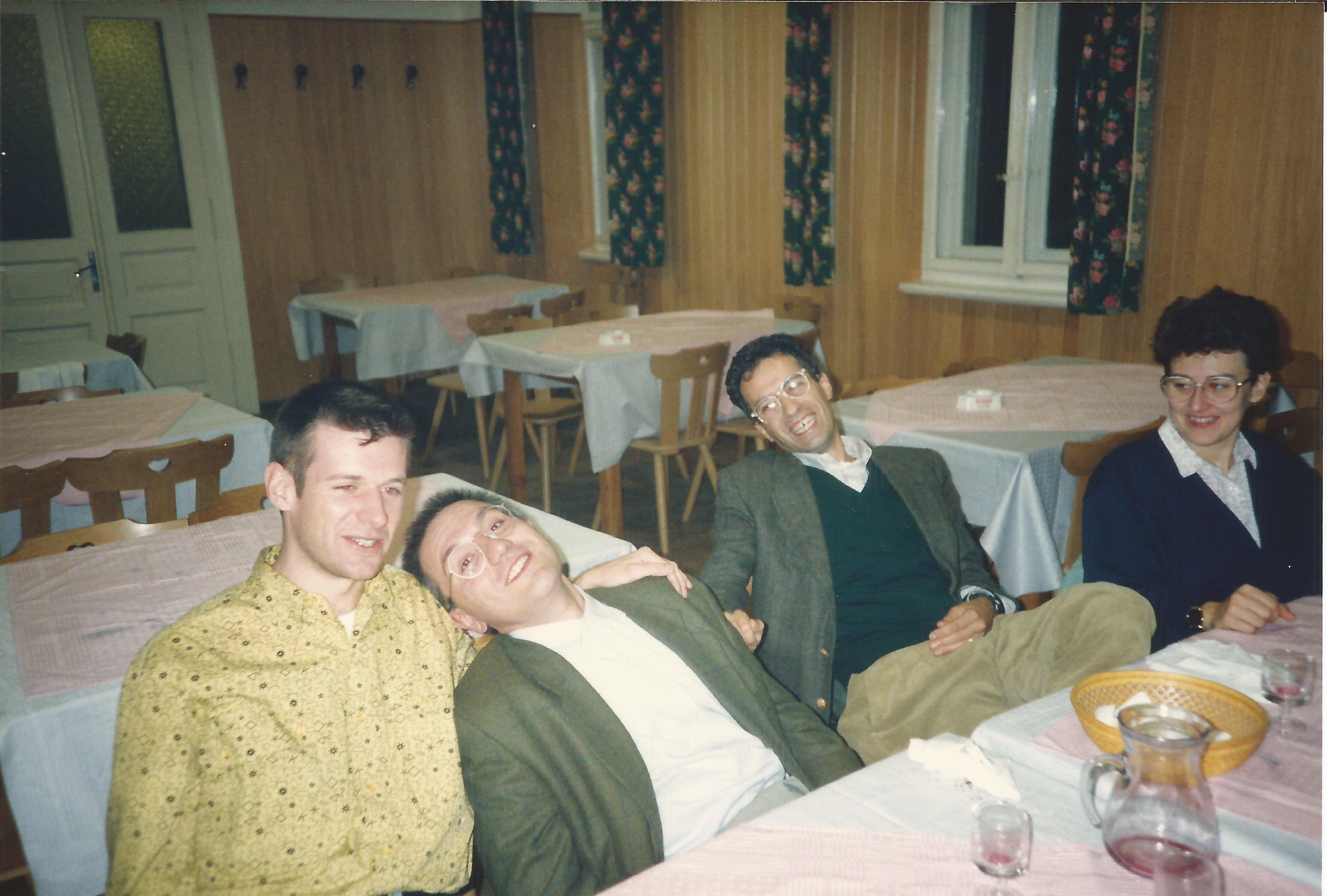
I was too tired last night to do anything but vegetate, and in the course of doing that I found a box of unsorted old photographs which made me all nostalgic. Here are some that reminded me of old friends. I don’t remember exactly when they were taken (probably in 1990), when I was visiting SISSA in Trieste. I don’t remember which particular trip it was or what paper resulted from it but I went there a number of times and had great fun. The first picture was taken in the office of Manolis Plionis, who is seated at the window facing the camera. In those days Manolis had a big motorbike, and I had a number of near-death experiences as his pillion passager on various high speed trips around Trieste, usually along the Strada Costiera…
To the right of Manolis is Francesco Lucchin (standing) with whom I co-authored a textbook on cosmology; Francesco sadly died in 2002. Seated in front of Francesco is Sabino Matarrese and at the computer is Lauro Moscardini.
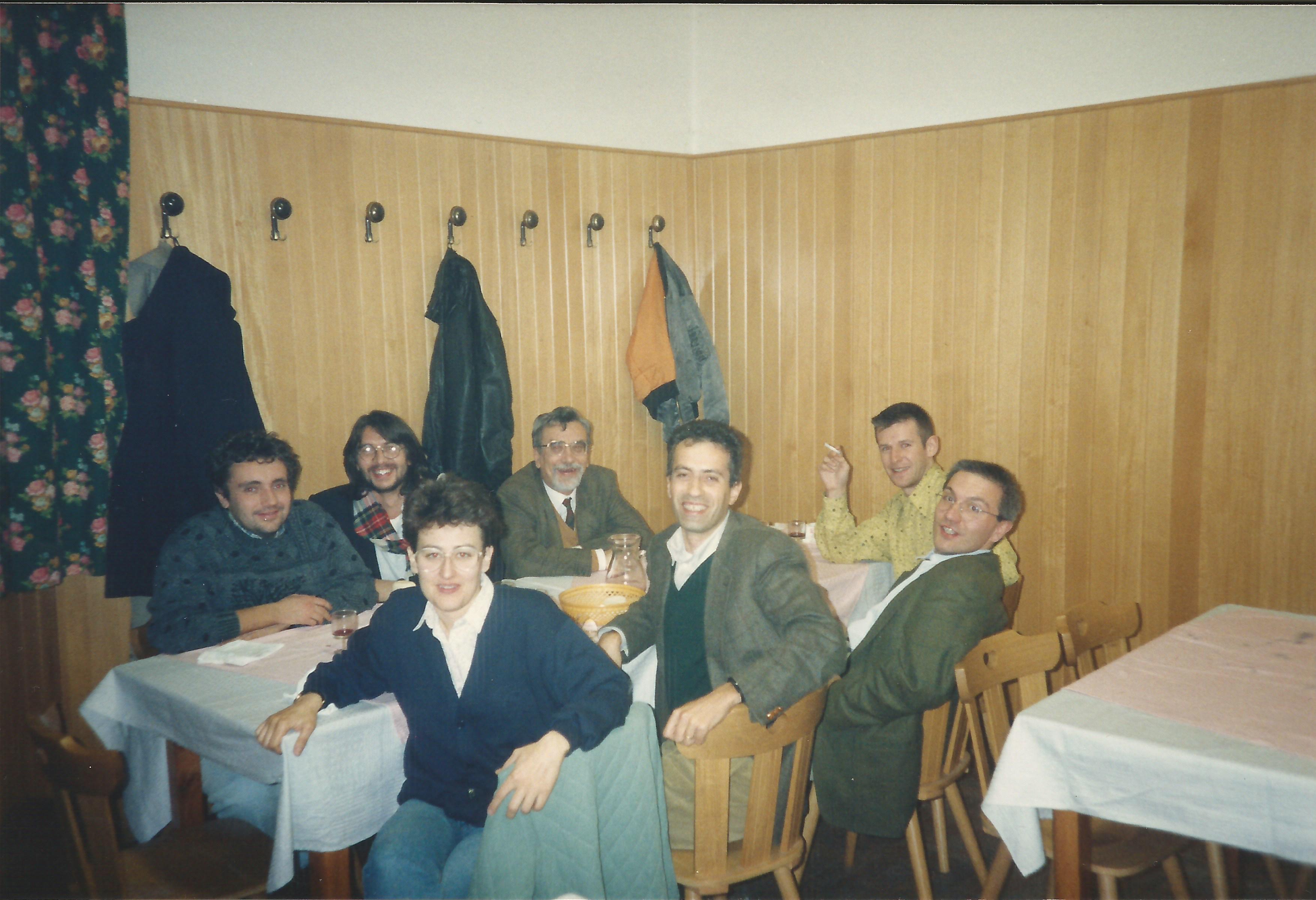
I think these next two were taken over the nearby border in Slovenia at the end of a dinner but that is relying on my memory which, at my age, is not very reliable. Me and Lauro on the left with Sabino laughing at us. As usual.
And this was the same evening. On Francesco’s right is Paolo Catelan, with whom I also wrote a paper, but I have now completely lost touch with him…
Everyone looks very youthful in these pictures, but it was 20 years ago .. and we’ve all passed a lot of water since then.
Neither the time nor the energy to post anything other than a bit of music, so I’ve picked a track someone happens to have posted on Youtube. I have Laughin’ to Keep from Cryin’ the original vinyl LP on the Verve label, but it’s still waiting for me to transfer it to digital. I love this record so much because it’s so joyful and at the same time so tragic. There’s some wonderfully upbeat stuff from the two trumpeters, the great Harry “Sweets” Edison (whom I’ve had the privilege to hear play live), who opens the piece, and then the perhaps even greater Roy Eldridge, but it’s also one of the last recordings made by legendary saxophonist Lester Young who was terminally ill with cancer at the time of this session in February 1958; he died just a year later. His formerly smooth tenor tone now ragged, barely able to stand or hold the saxophone, and playing almost in slow motion, he nevertheless manages to cast his fading light over the latter part of this tune and conjure up something quite magical. The other members of the band are Herb Ellis (guitar), Hank Jones (piano), George Duvivier (bass) and Mickey Sheen (drums) and this track is called Romping.
It’s National Science and Engineering Week this week and as part of the programme of events in Cardiff we have an open evening at the School of Physics & Astronomy tonight. This will comprise a series of public talks followed by an observing session using the School’s Observatory. I’m actually giving a (short) talk myself, which means it will be a long day, so I’m going to save time by recycling the following from an old blog post on the subject of my talk.
As you probably know the Big Bang theory involves the assumption that the entire Universe – not only the matter and energy but also space-time itself – had its origins in a single event a finite time in the past and it has been expanding ever since. The earliest mathematical models of what we now call the Big Bang were derived independently by Alexander Friedman and George Lemaître in the 1920s. The term “Big Bang” was later coined by Fred Hoyle as a derogatory description of an idea he couldn’t stomach, but the phrase caught on. Strictly speaking, though, the Big Bang was a misnomer.
Friedman and Lemaître had made mathematical models of universes that obeyed the Cosmological Principle, i.e. in which the matter was distributed in a completely uniform manner throughout space. Sound consists of oscillating fluctuations in the pressure and density of the medium through which it travels. These are longitudinal “acoustic” waves that involve successive compressions and rarefactions of matter, in other words departures from the purely homogeneous state required by the Cosmological Principle. The Friedman-Lemaitre models contained no sound waves so they did not really describe a Big Bang at all, let alone how loud it was.
However, as I have blogged about before, newer versions of the Big Bang theory do contain a mechanism for generating sound waves in the early Universe and, even more importantly, these waves have now been detected and their properties measured.
The above image shows the variations in temperature of the cosmic microwave background as charted by the Wilkinson Microwave Anisotropy Probe about a decade years ago. The average temperature of the sky is about 2.73 K but there are variations across the sky that have an rms value of about 0.08 milliKelvin. This corresponds to a fractional variation of a few parts in a hundred thousand relative to the mean temperature. It doesn’t sound like much, but this is evidence for the existence of primordial acoustic waves and therefore of a Big Bang with a genuine “Bang” to it.
A full description of what causes these temperature fluctuations would be very complicated but, roughly speaking, the variation in temperature you see in the CMB corresponds directly to variations in density and pressure arising from sound waves.
So how loud was it?
The waves we are dealing with have wavelengths up to about 200,000 light years and the human ear can only actually hear sound waves with wavelengths up to about 17 metres. In any case the Universe was far too hot and dense for there to have been anyone around listening to the cacophony at the time. In some sense, therefore, it wouldn’t have been loud at all because our ears can’t have heard anything.
Setting aside these rather pedantic objections – I’m never one to allow dull realism to get in the way of a good story- we can get a reasonable value for the loudness in terms of the familiar language of decibels. This defines the level of sound (L) logarithmically in terms of the rms pressure level of the sound wave Prms relative to some reference pressure level Pref
L=20 log10[Prms/Pref]
(the 20 appears because of the fact that the energy carried goes as the square of the amplitude of the wave; in terms of energy there would be a factor 10).
There is no absolute scale for loudness because this expression involves the specification of the reference pressure. We have to set this level by analogy with everyday experience. For sound waves in air this is taken to be about 20 microPascals, or about 2×10⁻¹⁰ times the ambient atmospheric air pressure which is about 100,000 Pa. This reference is chosen because the limit of audibility for most people corresponds to pressure variations of this order and these consequently have L=0 dB. It seems reasonable to set the reference pressure of the early Universe to be about the same fraction of the ambient pressure then, i.e.
Pref~2×10⁻¹⁰ Pamb
The physics of how primordial variations in pressure translate into observed fluctuations in the CMB temperature is quite complicated, and the actual sound of the Big Bang contains a mixture of wavelengths with slightly different amplitudes so it all gets a bit messy if you want to do it exactly, but it’s quite easy to get a rough estimate. We simply take the rms pressure variation to be the same fraction of ambient pressure as the averaged temperature variation are compared to the average CMB temperature, i.e.
Prms~ a few ×10-5Pamb
If we do this, scaling both pressures in logarithm in the equation in proportion to the ambient pressure, the ambient pressure cancels out in the ratio, which turns out to be a few times 10-5
With our definition of the decibel level we find that waves corresponding to variations of one part in a hundred thousand of the reference level give roughly L=100dB while part in ten thousand gives about L=120dB. The sound of the Big Bang therefore peaks at levels just a bit less than 120 dB. As you can see in the Figure to the left, this is close to the threshold of pain, but it’s perhaps not as loud as you might have guessed in response to the initial question. Many rock concerts are actually louder than the Big Bang, so I suspect any metalheads in the audience will be distinctly unimpressed.
A useful yardstick is the amplitude at which the fluctuations in pressure are comparable to the mean pressure. This would give a factor of about 1010 in the logarithm and is pretty much the limit that sound waves can propagate without distortion. These would have L≈190 dB. It is estimated that the 1883 Krakatoa eruption produced a sound level of about 180 dB at a range of 100 miles. By comparison the Big Bang was little more than a whimper.
PS. If you would like to read more about the actual sound of the Big Bang, have a look at John Cramer’s webpages. You can also download simulations of the actual sound. If you listen to them you will hear that it’s more of a “Roar” than a “Bang” because the sound waves don’t actually originate at a single well-defined event but are excited incoherently all over the Universe.
PPS. If you would like to hear a series of increasingly sophisticated computer simulations showing how our idea of the sounds accompanying the start of the Universe has evolved over the past few years, please take a look at the following video. It’s amazing how crude the 1995 version seems, compared with that describing the new era of precision cosmology.
Let me not to the marriage of true minds Admit impediments. Love is not love Which alters when it alteration finds, Or bends with the remover to remove: O no! it is an ever-fixed mark That looks on tempests and is never shaken; It is the star to every wandering bark, Whose worth’s unknown, although his height be taken. Love’s not Time’s fool, though rosy lips and cheeks Within his bending sickle’s compass come: Love alters not with his brief hours and weeks, But bears it out even to the edge of doom. If this be error and upon me proved, I never writ, nor no man ever loved.
P.S. This is one of over a hundred love sonnets written by Shakespeare to a young man to whom he was deeply devoted. If you think we shouldn’t admit impediments to people in similar relationships nowadays then perhaps you would consider signing the petition organized by the coalition for equal marriage…
And now for something completely different. I was listening to CD Review on Radio 3 yesterday morning and in the course of a fascinating section about new modern classical works, I heard some wonderful music by a Danish composer called Per Nørgård, whose name (pronounced in Danish something like nur-gaw) was quite new to me until then. I’ve spent most of this morning downloading various collections of his music and am now in danger of becoming a Nørgård bore.
Much of Nørgård’s music is based on ideas inspired by fractal geometry and exploits the so-called infinity series, representing a kind of extension of the serial techniques pioneered by such composers as Arnold Schoenberg. One of the great things about Nørgård, however, is that you really don’t need to know about that, or indeed that the following piece was inspired by the Aurora Borealis, in order to enjoy it. This is Nørgård’s Violin Concerto No. 1 Helle Nacht.
The views presented here are personal and not necessarily those of my employer (or anyone else for that matter).
Feel free to comment on any of the posts on this blog but comments may be moderated; anonymous comments and any considered by me to be vexatious and/or abusive and/or defamatory will not be accepted. I do not necessarily endorse, support, sanction, encourage, verify or agree with the opinions or statements of any information or other content in the comments on this site and do not in any way guarantee their accuracy or reliability.


 With our definition of the decibel level we find that waves corresponding to variations of one part in a hundred thousand of the reference level give roughly L=100dB while part in ten thousand gives about L=120dB. The sound of the Big Bang therefore peaks at levels just a bit less than 120 dB. As you can see in the Figure to the left, this is close to the threshold of pain, but it’s perhaps not as loud as you might have guessed in response to the initial question. Many rock concerts are actually louder than the Big Bang, so I suspect any metalheads in the audience will be distinctly unimpressed.
 In the Dark