Author Archive

Testing Times

Posted in Cricket with tags , , , , on May 29, 2011 by telescoper

It’s raining this morning (again), delaying the start of the fourth day’s play in the First Test between England and Sri Lanka which is taking place at the SWALEC Stadium here in Cardiff, just a few hundred yards from my house.

One of the advantages of living so close to the ground is that I can stay home and dry when there is a delayed start and simply toddle down there when start of play is announced on the radio. That’s my plan for today, in fact. It was a similar state of affairs yesterday. There was heavy rain first thing, which had been forecast, but it was exacerbated by persistent heavy drizzle for hours afterwards, which hadn’t. The covers therefore stayed on all morning with the result that (a) play didn’t start until 2pm but (b) I had time to write a lengthy blog post about Friday’s concert and (c) have lunch at home before walking to the ground.

The match was interestingly poised, with Sri Lanka all out for exactly 400 and England on 47-1 having lost Andrew Strauss late on Friday evening. Jimmy Anderson, who had come in as nightwatchman, departed almost immediately on Saturday, bringing in Jonathan Trott to join Alastair Cook. The pair batted steadily on. And on. Seventy overs passed, in fact, and the two accumulated runs in remorseless fashion without offering any significant chances, adding 240 runs to bring England to 287-2 at stumps, both reaching fine centuries. It wasn’t thrilling strokeplay of the crash-bang-wallop style you get in Twenty20, but good old-fashioned Test cricket. I thought it was magnificent, although it’s probably precisely the kind of cricket that puts some people off Test matches.

Unfortunately, the state of the game and the weather both mean that anything other than a draw is extremely unlikely. There’s already been quite a lot of time lost to the rain and only Sri Lanka’s first innings is complete. The forecast for today is showery – it’s raining right now, in fact – so it’s unlikely we’ll get a full day’s play. The forecast for Day 5 is even worse – with heavy rain in store most of the day. It’s hard to see how two more innings can possibly be completed. Moreover, England’s best bowler, James Anderson, is injured and will not be bowling in the Sri Lanka second innings (if there is one). The Cardiff wicket is basically a good batting pitch, although it is a bit on the slow side,  and I don’t see how England can bowl out Sri Lanka with only two seamers and a spinner. If England could have got to 600 plus then with a full bowling attack they might have had a chance at an inning’s victory – especially if the pitch starts to turn, which it shows signs of doing – but that seems very unlikely now.

At the risk of being too critical, I think this all illustrates the folly of England’s selection policy. They went into this game knowing that Sri Lanka was a good batting side, and Sri Lanka’s fine first innings display should not have come as a surprise. I wasn’t at the first two days’ but it seems that the England bowling attack looked quite ordinary even at full strength. I think a Test team really needs five bowlers. In the absence of a genuine all-rounder, England should not have picked a specialist batsman (Morgan) at number 6, but another bowler and the top-order batsmen told to stand up and be counted (which is precisely what they are doing). Wicket-keeper Prior should be at 6, with Broad and Swann counting as half an all-rounder each. The injury to Anderson reinforces this argument, as does Broad’s obvious lack of match fitness. They might get away with it for this game, but think they need to rethink this before taking on India who are a much stronger side than Sri Lanka.

I had been hoping to take a few snaps in the ground, but like the idiot I am I forgot to charge my phone up beforehand and when I got there the battery was almost flat. I decided to preserve what juice there was for emergency calls – though that was an unlikely contingency – by refraining even from Tweeting for the duration, regular intakes of beer staving off any sense of boredom. It was well after 7pm when the final over was bowled, and I only just got home to watch Barcelona’s comprehensive dismantling of Manchester United in the Champion’s League final.

UPDATE: Just for the record, England ended day 4 on 491-5 with Trott out for 203 and Bell unbeaten on 98. Great batting from everyone, except Pietersen. Not much chance of a result, though, especially if the weather forecast for tomorrow is accurate…

Final Thoughts

Posted in Music with tags , , , , , , on May 28, 2011 by telescoper

I decided to round off the working week last night with a trip to St David’s Hall in Cardiff to hear the BBC National Orchestra of Wales under the baton of guest conductor Jac van Steen in a programme of music by Richard Strauss and Anton Bruckner. Both pieces featured in the concert are longstanding favourites of mine and I’d been looking forward to the event for some time. The concert was billed Final Thoughts as each piece was in fact the respective composer’s last.

First up were the Vier Letzte Lieder (“Four Last Songs“). Richard Strauss had a particularly wonderful gift for writing music for the female voice and these pieces are perfect demonstrations of his art. Only published posthumously, they were never performed in Strauss’ lifetime but they quickly established themselves as concert favourites. In fact there’s no evidence that they were ever intended to form a set; the last – which happens to be my favourite, Im Abendrot, a setting of a poem by von Eichendorff, was completed before Strauss decided to set the other three, which are poems by Herman Hesse. There is more unity in compositional approach in the first three of the four, but nothing for me matches the sheer gorgeousness of the last. I freely admit that I quite often burst into tears listening to it, it’s so beautiful. I posted a favourite version elsewhere on this blog, and I have six different versions on CD.

Last night’s performance featured Swedish mezzo soprano Katarina Karnéus who has a very fine voice. They were performed at a slightly brisker tempo than is often the case (which is no bad thing) and the orchestra was in good form. The only problem was that the singer was standing so far back into the orchestra that she had difficulty projecting her voice, particularly since she was almost behind the conductor from where I was sitting. Some of her singing was barely audible, but when she did break through she brought out the beauty of Strauss music in fine style. Overall, a very nice performance. But no, I didn’t burst into tears this time.

After the interval we had Anton Bruckner‘s monumental Symphony No. 9, which was unfinished at Bruckner’s death in 1896. Insufficient material was recovered after the composer’s death to enable a reconstruction of the missing 4th movement, so this work is generally performed in its incomplete state with only three movements. Even so, it’s an immense work in both length and ambition. The majestic first movement (marked Feierlich, Misterioso; solemn & mysterious) with its soaring themes and thunderous climaxes always puts me in mind of a mountaineering expedition, with wonderful vistas to experience but with danger lurking at every step. At times it’s rapturously beautiful, at times terrifying. It’s not actually about mountaineering, of course – Bruckner meant this symphony to be an expression of his religious faith, which, in the latter years of his life must have been pretty shaky if the music is anything to go by.

The second movement (Scherzo) is all juddering rhythms, jagged themes and harsh dissonances reminiscent (to me) of Shostakovich. It alternates between menacing, playful and cryptic; the frenzied animation of central Trio section is especially disconcerting.

The last movement  (Adagio)  begins restlessly, with an unaccompanied violin theme and then becomes more obviously religious in character in various passages of hymn-like quality, still punctuated by stark crescendi. In this movement Bruckner doffs his cap in the direction of Richard Wagner,  especially when the four Wagner tubas appear, and the movement reaches yet another climax with the brass bellowing out the initial violin theme. This dies away and the movement comes to an unresolved, poignant conclusion. With a long pause in silence as if to say “that’s all he wrote”, the concert came to an end.

Although I’ve loved this work for many years I’ve only ever heard it on CD before last night.  The live performance definitely adds another dimension and I enjoyed it enormously. The BBC National Orchestra of Wales may not be the Berlin Philharmonic but I was generally very impressed, especially with the strings, who brought warmth and colour to a piece some people find a bit cold. On the other hand, on the way out people were raving about the four Wagner tubas, which I thought sounded ill-at-ease and unconvincing.

The concert was broadcast live last night on BBC Radio 3 (you can here it here for the next week or so), which is why it had to start at 7pm. A crazy decision by the controller of BBC Radio3, in my opinion, to insist that live concerts all start so early. There being no time to go home first, I just went straight there from work. I was deeply disappointed to see such a low turnout – the Hall was less than half full. Curiously, though, when I had tried to book a ticket just a week or so ago the vast majority of seats were sold and I had to settle for a place upstairs. I’m told that large numbers of seats are kept back for corporate guests and for BBC employees, of whom there are many in Cardiff as Auntie Beeb is a big employer here. Since these folk haven’t paid anything they often don’t turn up. The effect of this is that no matter how interesting the programme is, how fine the venue is, and how cheap the tickets are (top price is less than £30), the place is often pretty empty. It’s a shame.

Anyway, the one advantage of a 7pm start is that the concerts finish quite early, just after nine in this case. It was still twilight when I emerged from St David’s Hall, so I decided to take a crepuscular perambulation along the Taff embankment past the cricket ground at Sophia Gardens (where England are currently playing a Test Match against Sri Lanka). When I got near the SWALEC Stadium I was beset on all sides by a number of bats, no doubt feasting on insects flying over the river. They didn’t bother me at all. I find them fascinating creatures, in fact. At one point however, one of the critters flew into my leg at about knee level and fell back onto the path, apparently stunned. I stopped to find out whether it was badly hurt but after a bit of a struggle getting airborne it flapped off into the murk. It was a tiny little thing and, judging by the poor standard of its navigation, I suspect it was merely a trainee.

Echo of Creation – the Trailer

Posted in Education, The Universe and Stuff with tags , , , on May 27, 2011 by telescoper

Each day I find myself pressed for time and unable to think of anything to post, something seems to come along to rescue me. I found this on Twitter this morning and couldn’t resist sharing it, partly because it’s a cute video in its own right, and partly because it gives me the chance to advertise the event that it trails. Here’s the film …

..and it advertises a forthcoming event at the Cheltenham Science Festival, featuring the excellent Andrew Pontzen who is based at the Institute of Astronomy in Cambridge. Andrew is not only a whizzkid cosmology theorist but also an excellent public speaker, so do go and see his lecture if you can. Here’s the blurb:

Billions of years after the birth of the Universe, scientists realised they could tune into an echo of creation itself using nothing more sophisticated than a de-tuned television set. Andrew Pontzen explains the cosmos’ ‘background noise’ with hula hoops, beach balls and amazing telescopic pictures. But hold onto your hats: all is not as it seems with space and time…

Sounds fascinating! The talk is on Saturday 11th June 2011, 10am at the Town Hall in Cheltenham. You can book tickets here.

An easy physics problem…

Posted in Cute Problems with tags , , , on May 26, 2011 by telescoper

Based on the popularity of something I posted last week, I thought some of you might find this little problem amusing. It’s from a Physics A-level paper I took in 1981. The examination comprised two papers in those days (and a practical exam); one paper had long questions, similar to the questions we set in university examinations these days, and the other was short questions in a multiple-choice format. This is one of the latter type, from the mechanics section.

And here is a poll in which you may select your answer:

Pump up the Volume

Posted in Music with tags , on May 26, 2011 by telescoper

In the course of an archaeological investigation into one of the cupboards in my study last night I unearthed a box full of old vinyl 12″ singles, including this, Pump up the Volume by MARRS. Clearly inspired by the theory of cosmic inflation, it was very popular in dance clubs way back when I was a graduate student living in Brighton, then it got into the charts and climbed to Number 1 thus endowing MARRS with the status of One Hit Wonder. I was shocked when I realised that all this happened in 1987, before most of my students were born. Sigh. Anyway, it was nice to see the cute video again so I thought I’d share it for the benefit of other oldies out there, with the excuse that it’s slightly space-related. Try playing “spot-the-sample” as the record plays – it’s entirely cobbled together from bits of other tracks..

The Cosmos according to Disney

Posted in The Universe and Stuff with tags , , on May 25, 2011 by telescoper

Not really time for a proper post today but I’m grateful to one of my PhD students for coming to the rescue by pointing out this clip in which our own Professor Mike Disney tell us everything he knows about cosmology. The video lasts 2 minutes and 48 seconds.

Share/Bookmark

In Memoriam – HMS Hood

Posted in History with tags , , , on May 24, 2011 by telescoper

I just realised that today is a solemn anniversary which surprisingly hasn’t been marked in the media. On this day 70 years ago, i.e. 24th May 1941, the Royal Navy battlecruiser HMS Hood was sunk by the German Battleship Bismarck in the Battle of the Denmark Strait. Of a ship’s complement of 1418 only three survived the sinking of HMS Hood; it was one of the greatest maritime disasters of the Second World War. I’m not one for dwelling excessively  on the past, but I think it’s a shame this event has not been remembered. We owe a lot to people like the 1415 who gave their lives that day, so I’m glad I remembered in time to pay my respects.

Share/Bookmark

Whatever happened to Euclid?

Posted in Education, The Universe and Stuff with tags , , , , , , on May 24, 2011 by telescoper

An interesting article on the BBC website about the innate nature of our understanding of geometry reminded me that I have been meaning to post something about the importance of geometry in mathematics education – and, more accurately, the damaging consequences of the lack of geometry in the modern curriculum.

When I was a lad – yes, it’s one of those tedious posts about how things were better in the old days – we grammar school kids spent a disproportionate amount of time learning geometry in pretty much the way it has been taught since the days of Euclid. In fact, I still have a copy of the classic Hall & Stevens textbook based on Euclid’s Elements, from which I scanned the proof shown below (after checking that it’s now out of copyright).

This, Proposition 5 of Book I of the Elements, is in fact quite a famous proof known as the Pons Asinorum:

The old-fashioned way we learned geometry required us to prove all kinds of bizarre theorems concerning the shapes and sizes of triangles and parallelograms, properties of chords intersecting circles, angles subtended by various things, tangents to circles, and so on and so forth. Although I still remember various interesting results I had to prove way back then – such as the fact that the angle subtended by a chord at the centre of a circle is twice that subtended at the circumference (Book III, Proposition 20) – I haven’t actually used many of them since. The one notable exception I can think of is Pythagoras’ Theorem (Book I, Proposition 47), which is of course extremely useful in many branches of physics.

The apparent irrelevance of most of the theorems one was required to prove is no doubt the reason why “modern” high school mathematics syllabuses have ditched this formal approach to geometry. I think this was a big mistake. The bottom line in a geometrical proof is not what’s important – it’s how you get there. In particular, it’s learning how to structure a mathematical argument.

That goes not only for proving theorems, but also for solving problems; many of Euclid’s propositions are problems rather than theorems, in fact. I remember well being taught to end the proof of a theorem with QED (Quod Erat Demonstrandum; “which was to be proved”) but end the solution of a problem with QEF (Quod Erat Faciendum; “which was to be done”).

You can see what I mean by looking at the Pons Asinorum, which is a very simple theorem to prove but which illustrates the general structure:

  1. GIVEN
  2. TO PROVE
  3. CONSTRUCTION
  4. PROOF

When you have completed many geometrical proofs this way it becomes second nature to confront any  problem in mathematics (or physics) by first writing down what is given (or can be assumed), often including the drawing of a diagram. These are key ingredients of a successful problem solving strategy. Next you have to understand precisely what you need to prove, so write that down too. It seems trivial, but writing things down on paper really does help. Not all theorems require a “construction”, and that’s usually the bit where ingenuity comes in so is more difficult. However, the “proof” then follows as a series of logical deductions, with reference to earlier (proved) propositions given in the margin.

This structure carries over perfectly well to problems involving algebra or calculus (or even non-Euclidean geometry) but I think classical geometry provides the ideal context to learn it because it involves visual as well as symbolic logic – it’s not just abstract reasoning in that compasses, rulers and protractors can help you!

I don’t think it’s a particular problem for universites that relatively few students know how to prove the perpendicular bisector theorem, but it definitely is a problem that so many have no idea what a mathemetical proof should look like.

Come back Euclid, all is forgiven!

Share/Bookmark

Move

Posted in Jazz with tags , , , , on May 23, 2011 by telescoper

Well, it’s 1pm and my third-year students are just sitting down for two hours of fun with their Nuclear and Particle Physics examination. For my part I’m obliged to sit by the phone for the next two hours in case there’s a problem with the examination paper. Ideal excuse for a quick blog post while I eat my sandwich.

I also notice from my trusty wordpress dashboard that this is my 1000th post since I started blogging, way back in late 2008.  Time to indulge myself, then. I haven’t posted much jazz recently so I thought I’d share this classic recording with you. It’s from my favourite era of jazz – the late 1950s – and my favourite kind of jazz, bebop, which by then had matured, ripened and hardened considerably since its birth in the 1940s.

This gives me the excuse to mention a nice article in Saturday’s Grauniad about the poet Philip Larkin, his love for “trad” and his hatred for the “modern” jazz exemplified by bebop. It’s entirely a matter of personal taste, of course, but speaking for myself I can say that I’ve never had any problem loving jazz of all ages. For me, though, it reached a peak in the late 50s with musicians of the calibre of Miles Davis, John Coltrane, and Ornette Coleman.

This particular track features alto-saxophonist Lou Donaldson whom many jazz critics regarded as a pale imitation of the pioneering be-bop icon Charlie Parker but whose playing I’ve always admired. In my book, anyone brave enough to follow Charlie Parker deserves the highest esteem. In any case when Lou Donaldson walked into the Van Gelder studio in Hackensack, New Jersey on July 28th 2008 he clearly had fire in his belly.

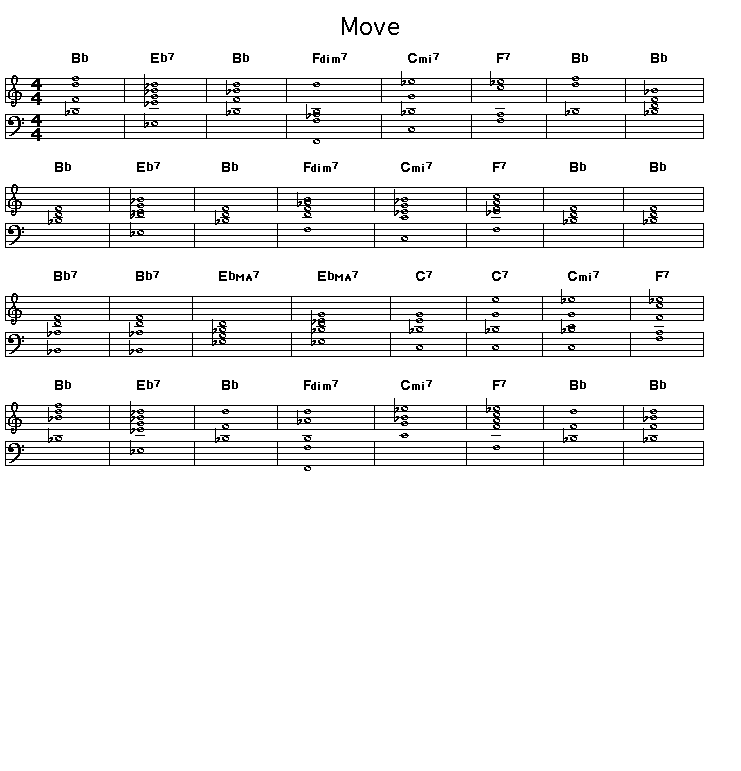
The tune is entitled Move and it was written by drummer Denzil Best. It’s quite unusual for a drummer also to be a composer, but Best wrote a number of classic jazz tunes. I even managed to find the chords that make up this one’s 32 bar AABA structure…

Many bebop compositions are based on the chord progressions of standard tunes, such as How High the Moon or I Got Rhythm, but with the melody replaced by something much more intricate than the original tune. I don’t recognize the chords above from anywhere else so it may be an entirely original composition by Denzil Best. I’m sure there’s a jazz buff out there who will correct me if I’m wrong. In any case the jagged melody is archetypal bebop stuff – complex and angular, very difficult to play but intensely exciting to listen to.

Share/Bookmark

Can the CMB Alone Provide Evidence for Dark Energy? (via astrobites)

Posted in The Universe and Stuff with tags , , , on May 22, 2011 by telescoper

While I’m in reblogging mood I’ll try to send some traffic the way of this post, which is somewhat related to Friday’s one about the Wigglezeddy survey (or whatever it’s called)…

Can the CMB Alone Provide Evidence for Dark Energy? Paper Title: The Atacama Cosmology Telescope: Evidence for Dark Energy from the CMB Alone Authors: Blake D. Sherwin et al. 1st Author’s Affiliation: Dept. of Physics, Princeton University Introduction Continuing with Monday’s theme of cosmology, today’s astrobite features an ApJ Letter that describes new evidence for dark energy.  In the past decade a number of cosmological tests have been developed that show a need for a cosmological constant th … Read More

via astrobites