Archive for the Art Category

All in a day’s work

Posted in Art, Biographical, Education, Science Politics, The Universe and Stuff with tags , , , , , on June 30, 2010 by telescoper

I got back from yesterday’s trip to a very muggy London with a raging sore throat and a brain as sluggish as an England defender on an action replay. Come to think of it, I must be as sick as a parrot. I’m sweating like a pig too, although I don’t know whether that’s a symptom of anything nasty or just because it’s still so warm and humid. Anyway, in view of my likely incoherence I thought I’d keep it brief (again) and just mention a few salient points from the last day or two.

I went to London as part of my duties as External Examiner for the MSc Course in Astrophysics at Queen Mary, University of London. Of course all the proceedings are confidential so I’m not going to comment on anything in detail, except that I spent a bit of time going through the exam scripts before the Examiners’ Meeting in a room that did a very passable impersonation of a heat bath. When I was later joined by the rest of the Exam Board the temperature soared still further. Fortunately the business went relatively smoothly so nobody got too hot under the collar and after concluding the formal business, a few of us cooled off with a beer or two in the Senior Common Room.The students spend the next couple of months writing their dissertations now that the written exams are over, so we have to reconvene in October to determine the final results. I hope it’s a bit cooler by then.

I couldn’t stay long at Queen Mary, however, as I had a working dinner to get to. Regular readers of this blog (both of them) may remember that I’m involved in project called Beyond Entropy which is organized by the Architectural Association School of Architecture. I’ve been working on this occasionally over the months that have passed since I first blogged about it, but deadlines are now looming and we need to accelerate our activity. Last night I met with the ever-enthusiastic Stefano Rabolli Pansera at the house of Eyal Weizman by Victoria Park in the East End, handily close to Queen Mary’s Mile End campus. Assisted by food and wine we managed to crystallise our ideas into something much more tangible than we had managed to do before on our theme of Gravitational Energy. The School has offered us expert practical assistance in making prototypes and  I’m now much more optimistic about our exhibit coming together, not to mention excited at the prospect of seeing it on display at the Venice Architecture Biennale. I won’t say what we’re planning just yet, though. I’d rather wait until it’s done before unveiling it.

Incidentally, here’s a link to a  lecture by Eyal Weizman where he gives some interesting perspectives on architectural history.

Finally, and nothing to do with my trip to the Big Smoke, I noticed today on the Research Fortnight Blog that the Higher Education Funding Council for Wales (HEFCW) is planning to reduce the number of universities in Wales “significantly” from its current level of 12. This is an interesting development and one that I’ve actually argued for here. Quoting Leighton Andrews, Welsh Assembly Minister responsible for higher education, the piece says

“This target does not mean fewer students,” he said in a statement. “But it is likely to mean fewer vice chancellors. We will have significantly fewer HE institutions in Wales but they will be larger and stronger.”

How these reductions will be achieved remains to be seen, but it seems obvious that quite a few  feathers will be ruffled among the management’s plumage in some institutions and it looks like some vice chancellors will be totally plucked!

When Energy Becomes Form

Posted in Art, The Universe and Stuff with tags , , , , , , on February 28, 2010 by telescoper

I’m back in Cardiff, exhausted but, at the same time, rather exhilirated by the past few days in Geneva. Before I crash out I thought I’d update the post I filed a couple of days ago.

On Friday we visited CERN, the highlight of which visit was, for me, seeing the facility where they test the superconducting magnets used in the Large Hadron Collider. We also saw the surface buildings of the ATLAS experiment, but since the LHC was getting ready to rumble again after its winter break we weren’t allowed to see the thing itself, 100 metres below ground. Coincidentally, I learned today that the LHC is now back making collisions once more. Obviously, the practical tips I passed on while I was there did the trick. One likes to help where one can.

The rest of Friday, back in downtown Geneva, was bizarre to say the least. We had the obligatory Swiss dinner of fondue, which is basically a big bowl of melted cheese into which you dip bits of bread repeatedly while hoping that at some point they’re going to bring some proper food. They don’t. To make matters worse we were serenaded by Swiss folk music:  cowbells, alphorns, yodelling – the works. One of the musicians was the spitting image of Dr Evil from the Austin Powers movies but at least there was no sign of Mini-me. I was traumatised by the thought that the world might be brought to a premature end, not by the LHC creating black holes but by excessive yodelling.

After that, as midnight approached, all 24 of us – 8 scientists, 8 artists and 8 architects – gave very short presentations about our work to the others in the hotel lobby area.  I couldn’t do justice to the range of ideas and forms presented there in a short blog like this so I’ll just say it was totally fascinating to listen to these people, see examples of their work, and have the chance to ask questions.

Saturday was the most intense and also the most interesting day. We were housed in a beautiful 19th Century house in the old part of Geneva that used to be the French ambassador’s residence the whole day. Split into various groups we thought, discussed, sketched, scribbled and generally brainstormed our way towards ideas for something to exhibit on our allocated theme. We got together at the end so each group could exchange their ideas with the others. It seemed every group had great fun and there seemed to be some great concepts floating around.

The artist I’m collaborating with is Carlos Garaicoa, who was born in Cuba and who has exhibited his work all over the world. He now shares his time between Havana and Madrid. He showed us examples of his work encompassing a huge range of materials and technologies: video, photography, sculpture – you name it. One of the themes he has been interested in is the idea of documentary matter, meaning objects of various kinds that bear testimony to events or forces acting on them.  Eyal Weizman is the architect Carlos and I will be working with.  He’s a research architect who has, amongst other things, recently completed a long project looking at the construction of the wall that the Israeli government has built in the west bank

And then there was me, like a fish out of water. I had looked at the title of the programme, Beyond Entropy: How Energy Becomes Form and decided that it might be interesting to get across the central idea in general relativity, i.e. that gravitational forces can be described in terms of the curvature of space. In my presentation I took this to an extreme and tried to explain how the large-scale structure of the Universe is shaped by small ripples in space in the early Universe that evolve under the action of gravity to produce the structures we see on scales as large as 100 million light years. It seemed to be a good example of gravitational energy becoming form. I summed it up with a quote from John Archibald Wheeler:

Matter tells space how to curve. Space tells matter how to move

Taking cue from these perspectives we had a wide-ranging conversation that took the idea of gravity as an effect of space, and explored this in more general contexts and from different angles. Space is often understood through its boundaries or through the surfaces constraining it and these edges take on a form that represents a sort of diagram of the forces that have acted on it. On a human scale we thought about walls and how the path they follow is shaped not only by topographical constraints but also by socioeconomic considerations. Walls and buildings generally suffer decay or damage too, including catastrophics events like explosions or earthquakes.

We also talked about the relationship between surfaces and the spaces they enclose or divide. The path of a wall such as the west bank barrier is extremely complicated because of the interplay between such factors. It curves in and out seemingly at random, but its shape makes it a document that contains information about the forces that have shaped it. It is a document in itself, not just because it happens to have things written on it in some places!

This thread of discussion got us interested in the possibility of using material objects to reconstruct the history of the processes that formed them: the Moon’s surface offers an example wherein the sequence of impacts can be inferred from the pattern of overlying and underlying craters. This led on to discussions about the relationship between surfaces and volumes generally, taking in holography as a specific example where  two-dimensional object contains three-dimensional volumes.

This all took us quite a long way from the initial riff, but I’m glad of that. My main worry about getting involved in this was that we might end up producing something that was merely didactic, just a fancy metaphorical treatment of basic physics. I wanted to avoid that because I think it would be very boring. I think I shouldn’t have worried that we might head in such a dull direction.

Some of the other groups managed to work up concrete ideas for prototypes to be exhibited. We didn’t really get that far. We were much keener to explore as many concepts as possible before settling on one. For myself, I was just really enjoying the discussion! There are no real constraints on what we can make – within reason of course. Sculptures, plans, buildings, installations, videos, photographs, and even books are all possibilities. It’s quite scary having such a blank canvas. We discussed a number of ways we might develop our discussion into material that can be exhibited but they all need a lot of work to develop, so we’ll carry on our collaboration remotely. I’m quite keen to bring some sort of holographic element into it, and promised to investigate the possibility of making some prototypes.

For the meantime, however,  it’s back to reality for me. A lecture to prepare and give, problem sets to get ready and an exercise class to run, an examination paper to finish writing, and a whole afternoon at the School’s research committee. I wonder if what I’ve been doing over the weekend will count as having “impact”?

Beyond Entropy

Posted in Art, The Universe and Stuff with tags , , , , , on February 26, 2010 by telescoper

It’s a cold and rainy morning here in Geneva, but I’m really looking forward to the next few days here. I arrived yesterday evening after a flight that was longer than it should have been. It seems the French air traffic controllers went on some sort of strike so my flight from Heathrow wasn’t allowed to cross French air space. For a flight between London and Geneva that is a bit of a problem. In the end we flew west over Belgium and then down into Switzerland from the North, the whole thing taking about an hour longer than expected. Still, when I did get to where I was going I found the hotel nice and comfortable and, better still, had a very enjoyable dinner at a swish Italian restaurant. It was nice to leave the chaos of French airspace behind.

I’m here as part of an unusual research project called (ironically, in the light of the aforementioned travel problems) Beyond Entropy. Organized by the Architectural Association School of Architecture, this experiment will bring together a group of artists, architects and scientists to investigate the notion of Energy. The way this is being done is by setting up a series of groups (one artist, one architect and one scientist) to look at each of a number of different forms of energy: potential, electric, thermal, mechanical, and so on; my own focus is gravitational energy. Each group will work together over the following few days to generate ideas a collaboration intended to create a work of some sort that gives form to the specific concept of energy they’re looking at. The subtitle of the project is “When Energy becomes Form”.

After we go back home, we’ll continue to work over the following months to produce prototypes of whatever emerges from the collaboration. The results will be exhibited at the Venice Architecture Biennale and the Architectural Association in August 2010. It is hoped that next year these prototypes will be developed into full-scale installations for the Venice Art Biennale in 2011.

I have no idea at this stage how the collaboration will work out or what is going to come out at the other end. The canvas is completely blank. I don’t really know the artist (Carlos Garaicoa) or the architect (Eyal Weizman) that I’ll be working with either. That makes it strangely exciting. At any rate it’s certainly different from the sort of scientific workshop I usually attend.

Anyway, to kick things off we’re going to be spending most of today at CERN, where I’ll be heading by bus just about as soon as I’ve finished this blog post. Later on today I’ll be giving a short presentation about how gravitational energy relates to my own research in the hope that this will stimulate a few ideas for my collaborators. Arts-science collaborations like this have been tried before and they have a chequered history, but we’ll just have to see how it goes. It feels more like research than most research workshops I’ve been to, in fact, because I really haven’t a clue what is going to happen!

P.S. Fellow blogger Andrew Jaffe is here too, but I think I might have beaten him in the competitive blogging stakes.

(Guest Post) What is Colour?

Posted in Art, The Universe and Stuff with tags , , , , , on February 7, 2010 by telescoper

As often happens on this blog, the comments following an item a few days ago went off in unexpected directions, one of which related to optics and vision. This led to my old friend, and regular commenter on this blog, Anthony Garrett (“Anton”), sending me an essay on the subject of colour perception and some very fine examples of abstract art. There thus appeared a perfect opportunity for another Guest Post, so for the rest of this item I’m handing over to Anton…

-0-

Some years ago I was privileged to get to know, toward the end of her life, a retired teacher from Durham called Olive Chedburn. She made wonderful greeting cards which she sent to her friends, using a technique known as encaustic art. This employs heated beeswax with coloured pigment added, and a hot iron; you can read more about it at Wikipedia.

Here are the three pieces that she sent to me:
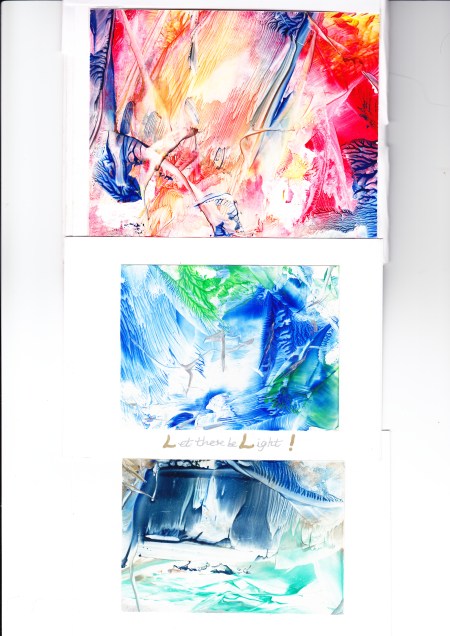
Although I am in general not a fan of abstract art, I think these are lovely. One friend said that they resembled underwater coral scenes. To me they look more like the inside of caves or chasms, perhaps with a waterfall. One of their beauties is that they definitely look like something – but you can never quite catch what.

Olive wrote a meditation on light and colour, in nature and in the Christian Bible, which I enjoyed reading very much. The main thing she left out was the science of light and colour, of which she had no knowledge. I wrote and sent her a complementary essay about this. Peter clearly likes her art and my essay, because he kindly offered to reproduce both on his blog, as you see. Olive died two years ago and her art now stands as her memorial. I hope you enjoy it as much as I did.

My essay now follows; if you want to look into the subject in greater depth then I recommend this website, which was designed to inform artists.

Colour perception is often said to be subjective. It is less clear what that means, however. The relevant scientific notion is wavelength. Light is a wave – although, remarkably, no physical medium oscillates (unlike sound waves in air, for instance); in the language of a century ago there is no ‘aether’.

Strictly speaking it would be better to talk about the frequency of light waves, because the wavelength changes with the density of the medium through which the light passes, but the frequency is unchanged. (The product of the wavelength and the frequency is the speed of light, which is a staggering 300,000 kilometers per second in empty space.) But the change in wavelength of light passing from a vacuum into air is so small that it can be ignored for present purposes. The change in wavelength (and in wave speed) is much greater when light passes into glass, or into the transparent fluids inside the eye, is much greater (25% reduction in water), since these media are much denser than air.

Light that consists of a single wavelength is called monochromatic light. Monochromatic light is not divided (further) by a prism, or by anything else that is done to it – a fact discovered by Isaac Newton in the 17th century. (Newton also reassembled the various colours back into white light.) One may superimpose differing amounts (intensities) of light of various wavelengths and look at the result. ‘White light’ is a superposition having roughly the same intensity in each colour band, as we confirm by putting it through a prism. (A prism splits light, because differing wavelengths of light entering the prism are shortened by differing amounts. The same effect creates rainbows as light passes through water droplets in the atmosphere.) In analysing colour, physics deals only the notion of how much light of each wavelength reaches the eye – the ‘spectrum’ (formally, the spectral density function) of the light. The distribution of the light across the retina – the screen at the back of the eye – also counts; a single object may appear to be coloured somewhat differently when viewed against differing backgrounds. Light has further characteristics (such as coherence, which is significant in lasers), but they make no difference to the perception of colour. A property of light known as its polarisation may change upon reflection from – or transmission through – a medium, but polarisation of light is not itself detected by the eye. (This raises the question: Are we interested in the object we are looking upon, or the light entering our eye?)

Wavelength is precisely defined, but colours – such as ‘blue’ – relate to a (fairly narrow) band of wavelengths, such that any monochromatic beam within that band will be perceived as blue. Moreover, if I add a low intensity of white light into blue, the result will still be perceived as blue. And if, in a spectrum that is generally agreed to be white, I make a small change in the amount of one particular wavelength, the result will still generally be agreed to be white. Only black is unambiguous: it is the absence of any light, of any wavelength. (Even then, it is the perceived absence, for light that is below the sensitivity threshold of the eye does not count; we shall consider perception below.)

We perceive some objects because they emit light into our eyes, such as a LED (light-emitting diode). Light of a particular frequency/wavelength/colour is emitted is when a (negatively charged) electron within an atom falls from one orbit around the positively charged atomic nucleus to another orbit around it; quantum theory tells us that only certain orbits are possible. (The difference in energy between the two orbits goes into the light that is emitted when the electron shifts orbit, and is proportional to the frequency of the light.) We see non-emitting objects because they reflect some of the light that falls on them, into our eyes. The colour that we say such an object is depends on the light that passes from the object to our eyes. This depends in turn on two factors: the combination of wavelengths falling on it; and how much of each particular wavelength the object reflects. (All light that is not reflected is absorbed, warming the object in the same way as sunbathing.) Intrinsic to the object is not its ‘colour’ but the proportion of each wavelength hitting it that it reflects. ‘Red paint’ means paint containing pigment that reflects only red light and absorbs all other colours (likewise for blue paint, etc); so that if ‘red paint’ is illuminated by a uniform mixture of light colours (i.e., white light) then only the red bounces back off it, and it looks red. But if the same object is illuminated by blue light, it absorbs the blue light so that (virtually) nothing comes off by way of reflection, and the object is perceived as black. We say that objects ‘are’ a particular colour because we generally view them in daylight or artificial white light, which contains all colours. ‘White paint’ is paint that reflects all colours and absorbs none. It looks whatever colour is shone at it – red in red light, blue in blue light, white in white light, and so on. Black paint absorbs all colours, and (uniquely) looks the same in any light.

A ‘red filter’ is something designed to let only red wavelengths through (and similarly for other filters). Something that lets all wavelengths through – the analogue of ‘white paint’ – is called transparent. (Air is virtually transparent, although it lets slightly more blue light through than other wavelengths – that is why the sky, which is lit by the many wavelengths emitted by the sun, looks blue.) Something that lets no light through – the analogue of black paint – is called a barrier. On its far side from the light source it looks black.

Also important is the texture of a surface. A perfectly reflecting material is colloquially called a white surface if it is rough enough to disperse incoming light in all directions, but if it is smooth on the scale of the incoming wavelengths then it is called a mirror. Texture is also responsible for the difference between matt and gloss paint. As for the scales involved, wavelengths of light visible to humans vary from red, which is around wavelength 0.7 micrometers (a micrometer is one thousandth of a millimetre) to blue/violet, which is about half that wavelength. In contrast, radio waves, which are of the same family and speed as light, have wavelengths of hundreds of metres.

Biological science can translate the physical specification of what lands on the retina into a specific pattern of nerve impulses passing from the eye to the visual cortex. That can in turn be correlated with the person saying “it’s green” or “it’s red” (or whatever). The names of colours are learned by tradition. As a child, each of us shared with an adult the experience of perceiving light of a particular wavelength; the adult named the colour and we learned the name. If children were not taught the names of colours then a consensus would emerge among them of what to call the colours, based on the similarity of their experiences. This consensus arises in turn from the common features of their perceptive systems (eye plus visual cortex).

Every colour to which humans give a name corresponds to a characteristic shape of the spectrum of wavelengths entering the eye. Lodged in the human retina are different types of colour receptor cells, known as cones. Each type of cone contains a different light-sensitive pigment, which absorbs and reacts most strongly to light of a particular wavelength. If you fire monochromatic light at a particular cone cell and then gradually decrease the wavelength (starting from red), the cell will transmit an increasingly strong signal to the brain until its own wavelength of peak sensitivity is reached; after that the signal will fall away on the other side the peak. Humans have three working types of cone cell, having distinct wavelengths of peak sensitivity. (The three sensitivity curves overlap to some extent.) This is why we can reasonably accurately simulate all colours that humans perceive by mixing just three colours, known as the primary colours.

People who are said to be colour-blind may have only two types of working cone, rather than three. They perceive the world differently, although they learn this only by observing that their reactions to certain wavelengths of light differ from the reactions of the majority. A man who was not colour-blind and whose cones of one particular type were suddenly switched off would see the world tinted, but a colour-blind man whose retinal cells had identical firing responses would say that things looked normal – because his brain would have trained itself from birth to regard this as the norm. Some species of animals have sensitivity spectra very different from the normal human one. Some animals see in black-and-white only (like humans at low light levels – see below); others have cone combinations with a less or a more uniform response than humans to light that is equally intense across the visual spectrum.

The mixing of primary colours of light to generate any colour known to human experience is a conceptually different problem from mixing paints to do the same. When you mix (‘add’) together light beams of the primary colours (Red, Green, Blue, roughly corresponding to the responses of the differing pigments in the three types of cone cells), you get white light. (Colour monitors and televisions have a multitude of ‘RGB’ dots.) These three are known as the ‘additive primary colours’. If you mix pigments of the three primary colours then the result is black paint, since each primary reflects only one colour, which the other primary pigments in the mixture suppress. Colour printers in fact mix cyan (which is blueish), yellow and magenta (pink-purple) in order to create all the colours known to man when the printer output is viewed in white light. These are the ‘subtractive’ primary colours, so named because if we subtract one of the additive primary colours from white light, leaving a mixture of the other two, we obtain the three subtractive primary colours. Whereas the mixing of light to obtain a desired colour is systematic, the mixing of pigment to do likewise is based on a library of knowledge gained by trial and error. Similarly, prediction of the colour of light that passes through consecutive glass jars of coloured translucent liquid (i.e., filters) is systematic, but the result of mixing the fluids is not.

Photography is conceptually more complicated than painting. What you see depends on further factors: the light that originally hit the photosensitive recorder; the response of the photosensitive recorder; the printing of the photograph (which may compensate for deficiencies in the response); and the light that the photograph is viewed in. Furthermore, negative film followed by printing and viewing; slide film viewing; digital photography viewed onscreen; and viewing a printout of a digital photograph each provide distinct re-creations at the eye of the light coming into the viewfinder.

Human perception of colour is actually more complex than I have stated. There are other cells in the retina called rods. These are more sensitive to light than cones but do not distinguish between colours. They come into their own at low levels of illumination; as a result, human vision under dimly lit conditions is essentially black-and-white. When the light intensity increases, beginning from darkness, the cones ‘kick in’ roughly when the rods become ‘saturated’ and send out no stronger signal as the brightness increases further. The brain also appears to take into account differences between the signals coming from the three types of cone, and differences between these and the rods.

A century after Newton, Goethe wrote on colour in an apparently opposing (and highly critical) way. Although what Newton had said was correct, hindsight makes it clear that Goethe was more concerned with the perception of colour than with the physics of light. We glimpse here two different philosophies: the ‘modern’ view espoused by the Enlightenment (no pun is intended on the name) that a world exists ‘out there’ to be explained (Newton), and the ‘post-modern’ view that our sensory impressions are all we have, and are therefore the most fundamental (Goethe). Goethe took the view that colour arises from the interplay between light and dark. Nowadays we have learned that humans perceive colours when they look at a spinning disc with a particular black-and-white pattern printed on it, for instance – presenting a challenge to theories of colour perception. Although Goethe’s explanations have been superseded, he was an acute observer of colour phenomena more complex than those analysed by Newton. There is still plenty to learn about the perception of colour.

Value for Money?

Posted in Art, Biographical, Finance, Science Politics with tags , , , , , on February 4, 2010 by telescoper

Looking at the BBC website at lunchtime while I munched a sandwich I’d bought for £1.40, the item that really caught my eye was a story about the sale of a sculpture at Sotheby’s for £65 million. The starting price for this particular work (L’Homme qui Marche by Alberto Giacometti) was set at £12 million, but only took a few minutes for the bidding to reach its final level. An anonymous bidder now gets to keep the sculpture, which will probably now be kept in a private location, or possibly even a bank vault.

Let me make it clear at the start that I’m not going to embark on a rant about modern art in general or Giacometti in particular. A couple of years ago I went to an exhibition of his work at the Museum of Modern Art in Louisiana, just north of Copenhagen (in Denmark) and I found his strange elongated figures really fascinating. He started out making small ones that he stretched and scratched  obsessively to get the shape he wanted. Over time the figures got larger, but he didn’t make many of them. I suppose the rarity of his work has something to do with why they are so valuable, which they obviously are.

But when I say they’re fascinating, I don’t necessarily mean £65 million worth of fascinating….

The point that has always really fascinated me about this sort of thing is exactly how something can acquire such an absurdly high commercial value and what it is that makes any collector decide to pay such a huge price. A work of art obviously has some intrinsic worth, but there doesn’t seem to me to be any simple relation between aesthetic, technical or historical considerations and the market value. That’s not just the case for modern art, either. Go to the Louvre in Paris and you’ll see hordes of people clamouring around a small, drab and frankly rather uninteresting painting called the   Mona Lisa –  and ignoring the dozens of wonderful things all around them in the same room, and even in the corridor leading to it. Some process – I don’t know what – has assigned a particular status to this painting and not to others which seem to me to have at least as much value, in an artistic sense. Not that I’ve any right claim my judgement is any better than anyone else’s, of course.

A similarly mysterious process goes on with other collectible things. Take wine, for example. I like a glass of wine now and then – or rather more often than that, if truth be told. I am, however, very fortunate that I don’t have a particularly discerning palate. I can tell the difference between cheap-and-nasty stuff and pretty good stuff but, generally speaking, my taste has saturated by the time the price reaches about £25 a bottle, and often long before that. That’s great because it means I can have a perfectly enjoyable evening drinking a bottle costing £15 when if I’d been an expert I would be unsatisfied unless I spent a lot more.

Years ago I went with a friend of mine to a house clearance in rural Sussex. He was an interior designer and he liked to buy old furniture from country houses and do it up to sell on. It’s a good plan, actually – old furniture is far better made than the modern stuff. Anyway in the middle of a whole load of junk was a case of vintage wine. Not just any wine, either. It was, in fact, Chateau Petrus – one of the finest Pomerols. It wasn’t a specialist auction, however, and nobody seemed to think it had any value. Bidding was slow when it came up in front of the auctioneer so I bid for it. In the end I bought the case (12 bottles) for about £300. When I got it home I realised what I had got. It turned out £300 per bottle would have been cheap. I was scared to open any of the bottles in case the wine was off or I didn’t like it, so I put it away. I sold the case some years later for about £6500.

Having told that story though, my main point is to wonder out loud about those wines that cost thousands of pounds per bottle. There is a roaring trade in these things – even ones that are two hundred years old – but I don’t think their value has anything to do with how  they are likely to taste. In the local wine merchant – conveniently located about 20 yards from my house – price is a good indicator of taste, but the scaling doesn’t apply at the extreme end of the fine wine market. Some other process is involved.

A house also  has a value that doesn’t have anything to do with anything other than what someone will pay to buy it.  But what sets this price? The market, obviously, but that is guided and controlled by Estate Agents who influence values in strange and subtle ways.

I suppose this all just goes to show I don’t know anything about economics, a point I’m now no doubt going to reinforce.

Governments also have to decide how much to spend on different things: health, education, defence, and so on. You can argue with the way their priorities work out at any given time, but the thing that baffles me is what the process is that leads to a decision to spend X on hospitals and Y on education. How can anyone possibly decide the relative value of £1 spent on health versus £1 spent on education?

I strongly support the notion that the government should support the performing arts, such as  the Opera. But how much it should spend is an unfathomable question to me. Some will say nothing, some would say more. Who decides? Clearly someone does.

And that brings us back home to science. The ongoing ructions about the financial crisis  at the Science and Technology Facilities Council –  unfolding in front of a parliamentary select committee –  seem to me to be really about the process by which value is assigned different bits of science by the people who hold the purse strings but probably don’t know much at all about science. I place a high value on astronomical research and, within that field, on cosmology. But that’s a personal judgement. Others will disagree. We all end up working in those areas we find  more interesting than the others so we can’t really be unbiased, but I think I’m more even-handed than many when it comes to the scientific merits of other fields. Having said that, it would take a lot of doing to convince me that the scientific value for money involved in sending, say, another probe to the Moon was anything like as high as, say, exploiting the full potential of the Herschel observatory.

Worse still, all spending on  blue skies research looks like to be cut back severely at the expense of shorter-term activity that leads to immediate commercial spinoffs. Commerce clearly trumps curiosity in the value game. If the STFC debacle was – as certainly seems likely to me – the result of a deliberate high-level decision, then who was it and what were their reasons for placing so little value on the quest to understand the most fundamental properties of the Universe?

And why doesn’t science have patrons like the anonymous buyer of the Giacometti figure? £65 million would solve an awful lot of STFC’s problems, as long as we stop certain people from wasting it on silly moon missions….

Tate Collection | Gordon’s Makes Us Drunk by Gilbert & George

Posted in Art with tags on December 11, 2009 by telescoper

I don’t know about you, but I think this is brilliant….

Vodpod videos no longer available.

more about “Tate Collection | Gordon’s Makes Us D…“, posted with vodpod

Critical Theory

Posted in Art, Music, Science Politics with tags , , , , , on August 18, 2009 by telescoper

Critics say the stangest things.

How about this, from James William Davidson, music critic of The Times from 1846:

He has certainly written a few good songs, but what then? Has not every composer that ever composed written a few good songs? And out of the thousand and one with which he deluged the musical world, it would, indeed, be hard if some half-dozen were not tolerable. And when that is said, all is said that can justly be said of Schubert.

Or this, by Louis Spohr, written in 1860 about Beethoven’s Ninth (“Choral”) Symphony

The fourth movement is, in my opinion, so monstrous and tasteless and, in it’s grasp of Schiller’s Ode, so trivial that I cannot understand how a genius like Beethoven could have written it.

No less an authority than  Grove’s Dictionary of Music and Musicians (Fifth Edition) had this to say about Rachmaninov

Technically he was highly gifted, but also severely limited. His music is well constructed and effective, but monotonous in texture, which consists in essence mainly of artificial and gushing tunes…The enormous popular success some few of Rachmaninov’s works had in his lifetime is not likely to last and musicians regarded it with much favour.

And finally, Lawrence Gillman wrote this in the New York Tribune of February 13 1924 concerning George Gershwin’s Rhapsody in Blue:

How trite and feeble and conventional the tunes are; how sentimental and vapid the harmonic treatment, under its disguise of fussy and futile counterpoint! Weep over the lifelessness of the melody and harmony, so derivative, so stale, so inexpressive.

I think I’ve made my point. We all make errors of judgement and music critics are certainly no exception. The same no doubt goes for literary and art critics too. In fact,  I’m sure it would be quite easy to dig up laughably inappropriate comments made by reviewers across the entire spectrum of artistic endeavour. Who’s to say these comments are wrong anyway? They’re just opinions. I can’t understand anyone who thinks so little  of Schubert, but then an awful lot of people like to listen what sounds to me to be complete dross. There even appear to be some people who disagree with the opinions I expressed yesterday!

What puzzles me most about the critics is not that they make “mistakes” like these – they’re only human after all – but why they exist in the first place. It seems extraordinary to me that there is a class of people who don’t do anything creative themselves  but devote their working lives to criticising what is done by others. Who should care what they think? Everyone is entitled to an opinion, of course, but what is it about a critic that implies we should listen to their opinion more than anyone else?

(Actually, to be precise, Louis Spohr was also a composer but I defy you to recall any of his works…)

Part of the idea is that by reading the notices produced by a critic the paying public can decide whether to go to the performance, read the book or listen to the record. However, the correlation between what is critically acclaimed and what is actually good (or even popular) is tenuous at best. It seems to me that, especially nowadays with so much opinion available on the internet, word of mouth (or web) is a much better guide than what some geezer writes in The Times. Indeed, the   Opera reviews published in the papers are so frustratingly contrary to my own opinion that I don’t  bother to read them until after the performance, perhaps even after I’ve written my own little review on here.  Not that I would mind being a newspaper critic myself. The chance not only to get into the Opera for free but also to get paid for spouting on about afterwards sounds like a cushy number to me. Not that I’m likely to be asked.

In science,  we don’t have legions of professional critics, but reviews of various kinds are nevertheless essential to the way science moves forward. Applications for funding are usually reviewed by others working in the field and only those graded at the very highest level are awarded money.  The powers-that-be are increasingly trying to impose political criteria on this process, but it remains a fact that peer review is the crucial part of the process. It’s not just the input that is assessed either. Papers submitted to learned journals are reviewed by (usually anonymous)  referees, who often require substantial changes to be made the work can be accepted for publication.

We have no choice but to react to these critics if we want to function as scientists. Indeed, we probably pay much more attention to them than artists do of critics in their particular fields. That’s not to say that these referees don’t make mistakes either. I’ve certainly made bad decisions myself in that role,  although they were all made in good faith. I’ve also received comments that I thought were unfair or unjustifiable, but at least I knew they were coming from someone who was a working scientist.

I suspect that the use of peer review in assessing grant applications will remain in place for a some considerable time. I can’t think of an alternative, anyway. I’d much rather have a rich patron so I didn’t have to bother writing proposals all the time, but that’s not the way it works in either art or science these days.

However, it does seem to me that the role of referees in the publication process is bound to become redundant in the very near future. Technology now makes it easy to place electronic publications on an archive where they can be accessed freely. Good papers will attract attention anyway, just as they would if they were in refereed journals. Errors will be found. Results will be debated. Papers will be revised. The quality mark of a journal’s endorsement is no longer needed if the scientific community can form its own judgement, and neither are the monstrously expensive fees charged to institutes for journal subscriptions.

Space Experiments

Posted in Art, Biographical, The Universe and Stuff with tags , , on May 9, 2009 by telescoper

I’ve been disconnected from the blogosphere for a few days,  as one of the consequences of a very interesting trip  to Berlin from which I’ve just returned.

When I received an invitation a few months ago to give a lecture on cosmology at the Institut für Raumexperimente (Institute for Space Experiments), I first thought that the “space experiment” concerned would be the forthcoming Planck mission, which is now firmly scheduled for launch on the afternoon of 14th May 2009. However, the institute I visited  is in fact part of the Universität der Künste Berlin (Arts University of Berlin) . It’s a new project run by Olafur Eliasson, a famous artist and a Professor at the University and I was one of a series of guests invited to talk to the students about various aspects of space and time. Olafur was one of the people behind the Experiment Marathon in Reykjavik which was almost exactly a year ago, and he’d decided to invite me to his new institute here and now as a result of my contribution there and then.

I was quite apprehensive about doing this because I’m really extremely ignorant about art, and didn’t want to appear too much of a philistine. I therefore decided to prepare a talk that was focussed strongly on the science but with just one or two references to works of art.  It turned out that the artist Matthew Ritchie was also around and keen to participate so we decided to do a joint presentation.

The eminent art historian Caroline Jones from MIT also sat in, contributing to the discussion and adding her own insights along the way

Matthew spoke first about how art can draw ideas and inspiration from scientific thought and argued that this was especially relevant today when science is so full of strange and wonderful concepts. Along the way he demonstrated an unexpectedly deep understanding of subjects such as thermodynamics, relativity and quantum theory.

I then took over and talked about cosmology, trying to focus on the interplay between theory and observation in order to convey some sort of idea of how the process of science actually works in this field.  I was particularly keen to get across the idea that we haven’t made scientific progress in cosmology by merely looking and recording. We have had needed to build theoretical frameworks to help us interpret what we see and to plan new observations.

Although we’d only discussed things for a few minutes before the event, as it turned out the two talks dovetailed rather nicely, I think.

When I was finished, Matthew finished by showing some of his own works which are complex, multi-faceted, multi-media creations evocations of and responses to ideas often, but not exclusively, arising from theoretical physics. The photograph above shows one of his installations. I haven’t seen his work up close, but it struck me as astonishingly inventive but at the same time possessing a great unity about it. His works are extremely diverse but they all seem to have a very distinctive signature all of his own.

After the talks and lots of discussion we adjourned for a nice dinner in a local bistro with some of the students who carried on asking about various bits of physics, such as the possible existence of  closed timelike curves. I was delighted by the intensity of their curiosity, which went far beyond that displayed by most physics students!

These days there seem to be quite a lot of initiatives aimed at promoting a dialogue between art and science although most of them don’t seem to be very successful. Science and art are obviously quite different types of activity. Each is also surrounded by a discursive penumbra of metaphors and simplifications that attempts to articulate what is going on inside the field to those outside. Not all artists try to explain their work in this way and neither do all scientists. Often the result is that the arts-science dialogue is simply a coming together of relatively superficial interpretations that does not really bring the core domains any closer. What is particularly impressive about Matthew Ritchie is that he does seem to have deeper insights into science than many artists and he responds to those insights in a way that is highly original.

The other thing that struck me after taking part in this event was the difference between art as a process and the products of that process in terms of “works of art”. Similar  processes are involved in making art as are needed in science, such as those involving problem-solving about how to implement an idea in a painting, sculpture or an equation. What differs is that works of art are, to a greater or lesser extent, consumable by the general public while those of science are not.

 The invitation to do this talk also gave me the chance to take a trip down the Unter den Linden of my memory. I’ve actually been to Berlin twice before. Once, about 25 years ago when I was a student, and then again in the early 90s when I attended a conference in Potsdam.

This time I stayed in a charming but rather antiquated hotel in the Prenzlauer Berg area of the city. Before 1989 this was in East Berlin, on the “wrong” side of the Berlin Wall. It had, however, escaped the total devastation that rained down on most of the rest of Berlin during the later stages of the war and it managed to retain much of its interesting architecture. After reunification it became a rather bohemian area and many artists set up studios there, which is presumably part of the reason my hosts had located there. Prenzlauer Berg had also been a major centre for Berlin’s sizeable  beer-making industry. One of the larger breweries has now been transformed into an exciting arts centre called the Kulturbrauerei and the Institut fur Raümexperimente is itself also housed in buildings that were once part of a brewery.  In fact, the whole area was built in the 19th century, itself a kind of space experiment, and still incorporates many features arising from its origins as an innovative piece of urban planning.

When I first came to the cityof Berlin in 1985 I stayed in the West – with its ostentatiously exuberant and uninhibited nightlife, West Berlin was an amazing place to visit in those days. I did, however, have a pass to travel to the East for a day. I remember walking through Checkpoint Charlie, on Friedrichstrasse, after passing through Potsdammerplatz south of the  Brandenburg Gate and looking eastwards across the strip of waste ground that had been levelled to create a killing zone for  escapees coming in the other direction. The transition from affluent and colourful West Berlin to the dreary drabness of the East was like swtiching channels to find a black-and-white movie on view. It was also frightening because everywhere you looked there were guns pointed at you, especially on the return leg from East to West. I also remember thinking how much the shoddy and unimaginative postwar architecture of East Berlin reminded me of Wolverhampton.

The drastic social and political experiment that lay behind the Berlin Wall was ultimately a failure, but its legacy will only slowly vanish. There are still signs of it even today, almost twenty years after the Wall fell in a metaphorical sense.

This time I reversed my previous path, starting out in the East and walking to the West. This time both sides were in glorious colour. In fact, it was a lovely spring morning and there were tourists everywhere.

Very little of the wall now remains. When I came in the 90s, just  a few years after the momentous events of 1989, much of it was still intact although there was a big gap in the central section. The killing zone was a strip of rubble-strewn ground which it was possible to walk over without any real hindrance.  Hitler’s bunker was located there too, although its position wasn’t advertised for fear of it becoming some kind of grisly  shrine.

At that time path of the wall through the city was easy to follow by eye as it was marked by the tall cranes involved in massive construction projects aimed at removing the scar that the wall had carved across the face of the city.

Returning now to the same location, I found new buildings covering almost all of the old cold war stuff but, in between the offices and administrative buildings, there is also a sombre and very moving Memorial to the Murdered Jews of Europe. Checkpoint Charlie has gone too, of course, but its site is also marked by a museum. Elsewhere in the city only one or two pieces of the wall remain, the biggest one in Bernauer Strasse, not far from my hotel.

It was fascinating to see the how the city slowly is renewing itself. There is still a huge amount of building going on but it’s a wonderful city to move around and it’s very green. The wide boulevards give a tremendous sense of space which contrasts enormously with the creeping claustrophobia of London.

Back from Berlin on Friday lunchtime I had time to pop into the RAS meeting and dine again at the RAS Club before returning on the late train back to Cardiff, bringing closure to a little space-like curve of my own. 

A short trip, but  fascinating and very enjoyable.

Jorunn Monrad

Posted in Art with tags , on April 23, 2009 by telescoper

Off the Wall is a small contemporary art gallery in Llandaff, about 15 minutes walk from my home in Pontcanna, Cardiff.  I went there this evening to a private view of some works by Norwegian artist Jorunn Monrad, who lives and works in Milan.

The artist herself was there and I got the chance to talk to her over a glass or two of pink champagne after looking at the paintings.

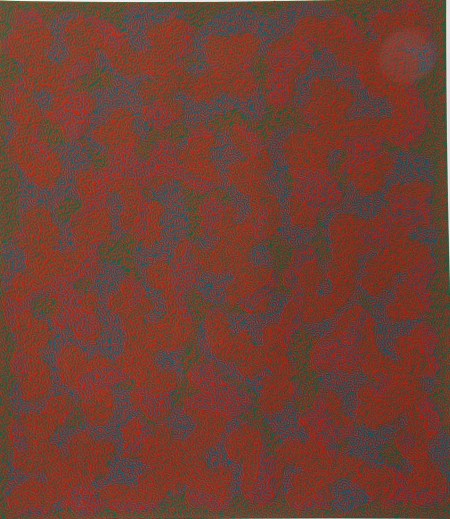
The works on view in her exhibition were all made this year, and they were produced with a technique developed in the Middle Ages that involves egg and casein tempera. The paintings are brilliantly coloured abstract works that involve structures built up  from representations of tiny proto-animals, meticulously painted all over the linen background so that they build up to larger structures. The dramatic colour palette produces interesting visual effects, at times  revealing and at times obscuring patterns present in the paint. The intricate detail and luminous colouring makes for a vivid but sometimes perplexing whole.

Here is an example (although the digital image doesn’t really do justice to the original).

dicembre2008verdevermilion

To quote her own description

My works are rooted in an imagery from my childhood: the snakes of the wooden sculptures of Viking and mediaeval Norwegian art, the forms that were created by nature, like branches, cloudsm forms of branches. The fables, the mysterious nature has also played a part. I have also done research on phenomena that are triggered by the imagery, one may say biological, on which precisely the visions of forms that repeat themselves during falling asleep and waking up can create this kind of visual effects.

From this I have obtained a kind of module, that is a kind of biomorphic form, rather than one specific animal or other, that is merely the building brick of of the structure, but that is multiplied in forms that are vertiginous and sometime perhaps unsettling. The idea is to create a dreamy, moving atmosphere that is nevertheless very different from the effects of op art, in short a less clashing, more “natural” effect.

The effects she achieves are, in some sense, a variation on those I blogged about previously but with elements that are entirely original.

If you’re in Cardiff this small exhibition is well worth seeing. Her paintings are for sale too, with a surprisingly modest price tag. I’m seriously thinking of investing in one myself, in fact.

The exhibition continues at Off the Wall, The Old Probate Registry, Llandaff until 30th May 2009.

PS. In response to the specific request below from Tom Shanks, who is never shy of making an exhibition of himself,  I’ve added this picture of his famous travelling installation:

dscf0001

Perception, Piero and Pollock

Posted in Art, The Universe and Stuff with tags , , , , , on April 15, 2009 by telescoper

For some unknown reason I’ve just received an invitation to a private view at a small art gallery that’s about ten minutes’ walk from my house. Cocktails included. I shall definitely go and will blog about it next week. I’m looking forward to it already.

This invitation put me in an artistic frame of mind so, to follow up my post on randomness (and the corresponding parallel version on cosmic variance), I thought I’d develop some thoughts about the nature of perception and the perception of nature.

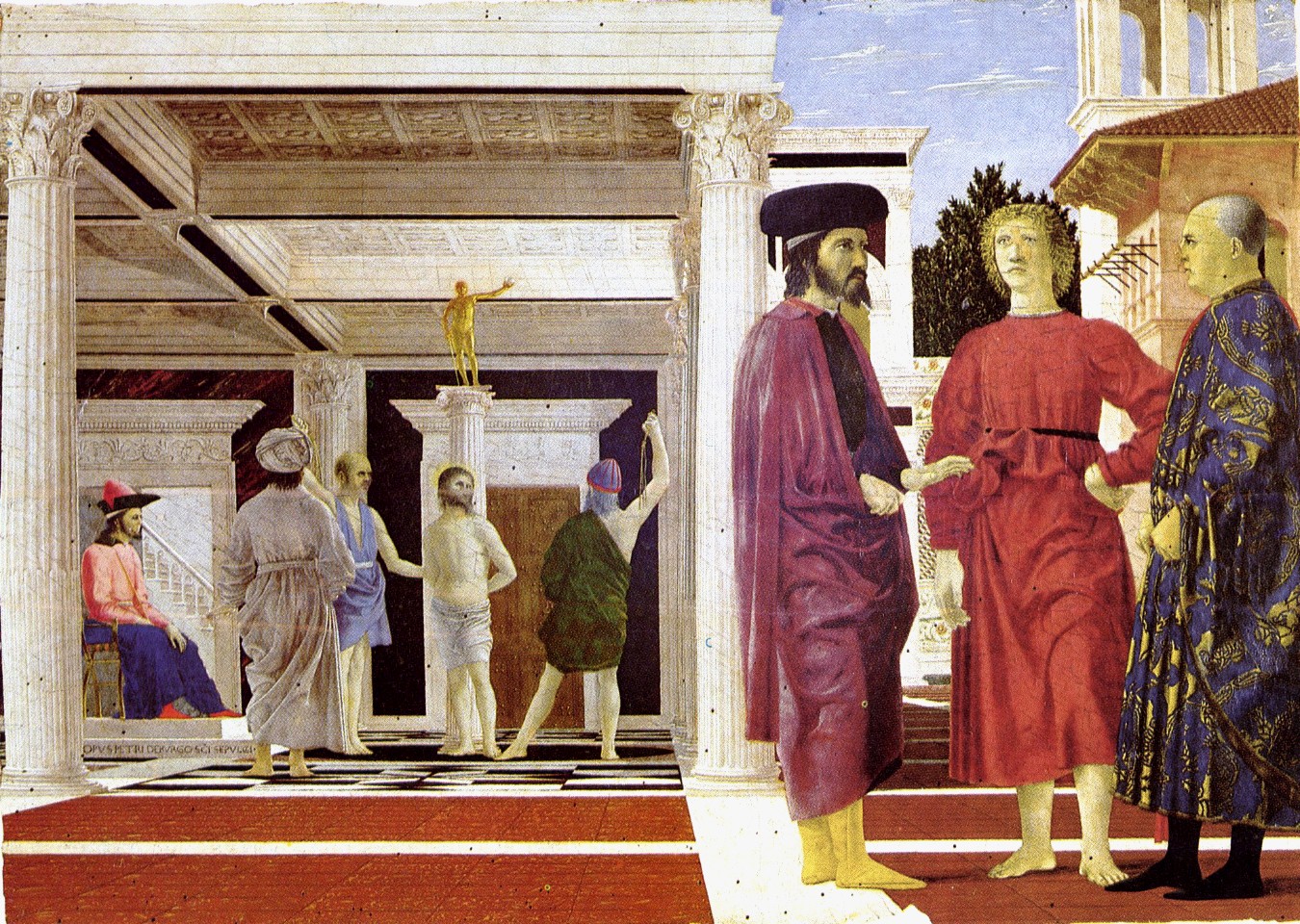
This famous painting is The Flagellation of Christ, by Piero della Francesca. I actually saw it many years ago on one of my many trips to Italy; it’s in an art gallery in Urbino. The first thing that strikes you when you see it is actually that the painting is surprisingly small (about 60cm by 80cm). However, that superficial reaction aside, the painting draws you into it in a way which few other works of art can. The composition is complicated and mathematically precise, but the use of linear perspective is sufficiently straightforward that your eye can quickly understand the geometry of the space depicted and locate the figures and actions within it. The Christ figure is clearly in the room to the left rear and the scene is then easily recognized as part of the story leading up to the crucifixion.

That’s what your eye always seems to do first when presented with a figurative representation: sort out what’s going on and fill in any details it can from memory and other knowledge.

But once you have made sense of the overall form, your brain immediately bombards you with questions. Who are the three characters in the right foreground? Why aren’t they paying attention to what’s going on indoors? Who is the figure with his back to us? Why is the principal subject so far in the background? Why does everyone look so detached? Why is the light coming from two different directions (from the left for the three men in the foreground but from the right for those in the interior)? Why is it all staged in such a peculiar way? And so on.

These unresolved questions lead you to question whether this is the straightforward depiction first sight led you to think it was. It’s clearly much more than that. Deeply symbolic, even cryptic, it’s effect on the viewer is eery and disconcerting. It has a dream-like quality. The individual elements of the painting add up to something, but the full meaning remains elusive. You feel there must be something you’re missing, but can’t find it.

This is such an enigmatic picture that it has sparked some extremely controversial interpretations, some of which are described in an article in the scientific journal Nature. I’m not going to pretend to know enough to comment on the theories, escept to say that some of them at least must be wrong. They are, however, natural consequences of our brain’s need to impose order on what it sees. The greatest artists know this, of course. Although it sometimes seems like they might be playing tricks on us just for fun, part of what makes art great is the way it gets inside the process of perception.

Here’s another example from quite a different artist.

This one is called Lavender Mist. It’s one of the “action paintings” made by the influential American artist Jackson Pollock. This, and many of the other paintings of its type, also get inside your head in quite a disconcerting way but it’s quite a different effect to that achieved by Piero della Francesca.

This is an abstract painting, but that doesn’t stop your eyes seeking within it some sort of point of reference to make geometrical sense of it. There’s no perspective to draw you into it so you look for clues to the depth in the layers of paint. Standing in front of one of these very large works – I find they don’t work at all in reduced form like on the screen in front of you now – you find your eyes constantly shifting around, following lines here and there, trying to find recognizable shapes and to understand what is there in terms of other things you have experienced either in the painting itself or elsewhere. Any order you can find, however, soon becomes lost. Small-scale patterns dissolve away into sea of apparent confusion. Your brain tries harder, but is doomed. One of the biggest problems is that your eyes keep focussing and unfocussing to look for depth and structure. It’s almost impossible to stop yourself doing it. You end up dizzy.

I don’t know how Pollock came to understand exactly how to make his compositions maximally disorienting, but he seems to have done so. Perhaps he had a deep instinctive understanding of how the eye copes with the interaction of structures on different physical scales. I find you can see this to some extent even in the small version of the picture on this page. Deliberately blurring your vision makes different elements stand out and then retreat, particularly the large darkish streak that lies to the left of centre at a slight angle to the vertical.

This artist has also been the subject of interest by mathematicians and physicists because his work seems to display some of the characteristic properties of fractal sets. I remember going to a very interesting talk a few years ago by Richard Taylor of the University of Oregon who claimed that fractal dimensions could be used to authenticate (or otherwise) genuine works by Pollock as he seemed to have his own unique signature.

I suppose what I’m trying to suggest is that there’s a deeper connection than you might think between the appreciation of art and the quest for scientific understanding.