Archive for the Art Category

Humph at the Conway

Posted in Art, Jazz with tags , , on September 8, 2011 by telescoper

After a very long day I’m too tired this evening to post anything too demanding, so I thought I’d put up a bit of old jazz. In fact this is the Humphrey Lyttelton Band vintage 1954, recorded live at the Conway Hall. This record was a bit of a novelty at the time because it was one of those new fangled Long Playing discs (LPs). Anyway, the tune Memphis Shake is introduced by Humph as “from way back” and I in fact posted the original version some time ago. The band clearly enjoyed playing that night “way back” in 1954.

There’s no actual video but if you notice you get a good look at the album cover, which features cartoons drawn by Humph himself. That gives me the opportunity to remind everyone that as well as being a fine trumpeter and bandleader, as well as radio presenter with a dry sense of humour and impeccable comic timing, he was also an extremely talented cartoonist and caricaturist. Here is another example – I think his cartoon of himself is really excellent!

“Cosmic Anomalies” Talk, Copenhagen, August 2011

Posted in Art, Books, Talks and Reviews, Cosmic Anomalies, The Universe and Stuff with tags , , on August 31, 2011 by telescoper

I think I’m getting the hang of this slideshare malarky so I thought I’d try it out by posting the slides I used for my (short) talk at the workshop in Copenhagen I told you about two or three weeks ago. I’m not sure how useful they will be to anyone, as I suppose it will be quite hard to reconstruct the talk using only the small amount of information I bother to put on the slides..

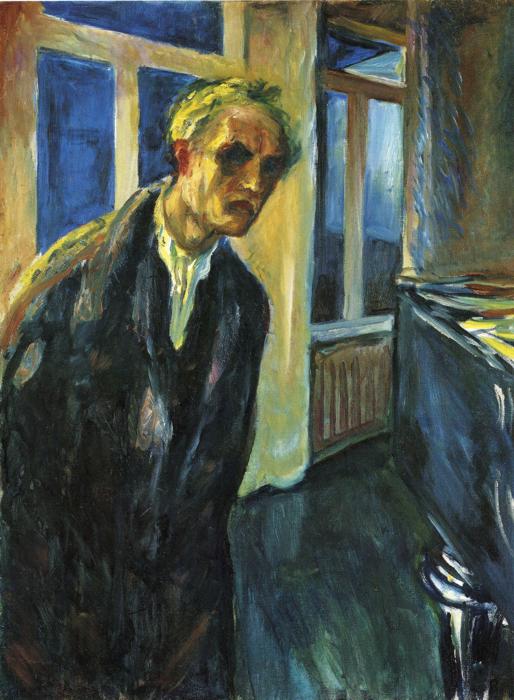
If you’re wondering about the presence of various apparently random works of art then what can I say? I like paintings!

Back to the Drawing Board

Posted in Art, Education, The Universe and Stuff with tags , , , , , , , , , on August 30, 2011 by telescoper

I came across a press release this morning which contains the following

More should be done to encourage students to use their drawing skills in science education, researchers at The University of Nottingham say.

In a paper being published in Science this week, academics say that although producing visualisations is key to scientific thinking, pupils are often not encouraged to create their own drawings to develop and demonstrate their understanding.

In the paper the authors, led by Dr Shaaron Ainsworth in the University’s School of Psychology and Learning Sciences Research Institute, said: “Scientists do not use words only but rely on diagrams, graphs, videos, photographs and other images to make discoveries, explain findings, and excite public interest.

In the light of this I thought it would be topical to post an updated version of an old piece I wrote on the theme of sketching. This is quite a strange subject for me to have picked pick because drawing is something I’m completely useless at, but I hope you’ll bear with me and hopefully it will make some sense in the end. I always thought that drawing was an important and neglected aspect of education, but I hadn’t until today any solid research to back it up!

-0-

What  spurred me on to think about this subject was the exhibit I was  involved with for the  Architecture Biennale in Venice as part of a project called Beyond Entropy organized by the Architectural Association School of Architecture. In the course of researching this project I came across this image of the Moon as drawn by Galileo

This led to an interesting discussion about the role of drawings like this in science. Of course  the use of sketches for the scientific representation of images has been superseded by photographic techniques, initially using film and more recently by digital techniques. The advantage of these methods is that they are quicker and also more “objective”. However, there are still many amateur astronomers who make drawings of the Moon as well as objects such as Jupiter and Saturn (which Galileo also drew). Moreover there are other fields in which experienced practioners continue to use pencil drawings in preference to photographic techniques. Archaeology provides many good examples, e.g.

The reason sketching still has a role in such fields is not that it can compete with photography for accuracy or objectivity but that there’s something about the process of sketching that engages the sketcher’s brain in a  way that’s very different from taking a photograph. The connection between eye, brain and hand seems to involve a cognitive element that is extremely useful in interpreting notes at a later date. In fact it’s probably their very subjectivity that makes them useful.  A thicker stroke of the pencil, or deliberately enhanced shading, or leaving out seemingly irrelevant detail, can help pick out  features that seem to the observer to be of particular significance. Months later when you’re trying to write up what you saw from your notes, those deliberate interventions against objectivity will take you back to what you  saw with your mind, not just with your eyes.

It doesn’t even matter whether or not you can draw well. The point isn’t so much to explain to other people what you’ve seen, but to record your own interaction with the object you’ve sketched in a way that allows you to preserve something more than a surface recollection.

You might think this is an unscientific thing to do, but I don’t think it is. The scientific process involves an interplay between objective reality and theoretical interpretation and drawing can be a useful part of this discourse. It’s as if the pencil allows the observer to interact with what is observed, forming a closer bond and probably a deeper level of understanding patterns and textures. I’m not saying it replaces a purely passive recording method like photography, but it can definitely help it.

I have not a shred of psychological evidence to back this up, but I’d also assert that sketching is very good for the learning process too.  Nowadays we tend to give out handouts of diagrams involved in physics, whether they relate to the design of apparatus or the geometrical configuration of a physical system. There’s a reason for doing this – they take a long time to draw and there’s a likelihood students will make mistakes copying them down. However, I’ve always  found that the only way to really take in what a diagram is saying is to try to draw it again myself. Even if the level of draftsmanship is worse, the level of understanding is undoubtedly better.Merely looking at someone else’s representation of something won’t give your brain as a good a feeling for what it is trying to say  as you would get if you tried to draw it yourself.

Perhaps what happens is that simply looking at a diagram only involves the connection between eye and brain. Drawing a copy requires also the connection between brain and hand. Maybe  this additional connection brings in additional levels of brain functionality. Sketching iinvolves your brain in an interaction that is different from merely looking.

The problem with excessive use of handouts – and this applies not only to figures  but also to lecture notes – is that they turn teaching into a very passive process. Taking notes in your own hand, and supplementing them with your own sketches – however scribbly and incomprehensible they may appear to other people – is  a much more active way to learn than collecting a stack of printed notes and meticulously accurate diagrams. And if it was good enough for Galileo, it should good enough for most of us!

Artikulation

Posted in Art, Music with tags , , on August 18, 2011 by telescoper

I just spent an amusing evening watching a football match with the sound turned off on the TV and some experimental compositions by George Ligeti playing on my sound system. I thoroughly recommend playing music instead of listening to the commentators, by the way; it’s much more fun! Anyway, a piece that worked particularly well was the pioneering electronic composition Artikulation (1958). Having a look on Youtube I found this wonderful video which adds an even more appropriate visual to Ligeti’s extraordinary sound world than a football match, in the form of a graphical score (created by Rainer Wehinger) which you can follow along as the music plays.

To quote from an explanatory article I found on the web:

In order to capture the dynamics of the performance Rainer abandoned the conventions of standard notation, concluding it was ineffective in dealing with compositions devoid of regular meter and harmonic scale. The alternative system he developed relied on color, shape, width and position to capture Ligeti’s work. Color in the score was used to denote pitch or timbre, combs represented noise, dots marked impulses and the width of the elements indicated their duration. The video below maps Ligeti’s compostion on to Rainer’s graphical score to demonstrate how effectively it describes the performance.

I imagine many readers of this blog won’t agree with me, but I find the result absolutely fascinating. The visual score has an abstract beauty on its own, but together with the music it creates a particularly interesting effect; each page of the score had me trying to imagine in my mind’s ear what was going to happen next….

Art in the Afternoon

Posted in Art, The Universe and Stuff with tags , , , , , , on August 10, 2011 by telescoper

Just a quick blogette to mention that yesterday the workshop participants here in Copenhagen went on an excursion to the Louisiana Museum of Modern Art, which is just north of Copenhagen.

This is an extremely interesting museum to visit at any time, not just for the temporary exhibitions which at present include the architecturally-themed Living and some wonderful drawings made by David Hockney using his iPad; the latter almost made me want to go out and buy one.

There’s also a fine permanent collection, including many wonderful  sculptures by Alberto Giacometti :
and several by Henry Moore standing (or rather reclining) in the grounds:

What’s really great about Louisiana though is its relaxed informal atmosphere; kids are encouraged to play around (and sometimes in) the scupltures, there is lots of green space to relax in, and you are welcome even to swim in the sea, although I didn’t because I didn’t have my bathing costume with me. Many consider modern art and its galleries to be a bit pretentious, but that couldn’t be further than the truth for this place. I’ll also add that it was very busy indeed so is obviously extremely popular.

For those of you not so interested in Modern Art (which actually seemed to the case for many of my dining companions last night), there is a strong astronomical connection with this place because it offers a view of the Island of Hven on which Tycho Brahe established a famous observatory Uraniborg.

I’ve been to Louisiana many times but have never taken the short boat trip out to Hven, largely because there’s nothing much of the observatory left. Apparently the locals were squeezed mercilessly for taxes to pay for the running costs of Tycho’s observatory, with the result that by the time Brahe left in 1597 the residents of Hven were thoroughly fed up with him and tore the whole thing down.

The moral is clear of that little story is clear: astronomers need to keep the public on their side!

Now it’s time to start the workshop for today so I’d best be off…

Feynman on a Flower

Posted in Art, The Universe and Stuff with tags , on July 9, 2011 by telescoper

I have a friend who’s an artist and has sometimes taken a view which I don’t agree with very well. He’ll hold up a flower and say “look how beautiful it is,” and I’ll agree. Then he says “I as an artist can see how beautiful this is but you as a scientist take this all apart and it becomes a dull thing,” and I think that he’s kind of nutty. First of all, the beauty that he sees is available to other people and to me too, I believe. Although I may not be quite as refined aesthetically as he is … I can appreciate the beauty of a flower. At the same time, I see much more about the flower than he sees. I could imagine the cells in there, the complicated actions inside, which also have a beauty. I mean it’s not just beauty at this dimension, at one centimeter; there’s also beauty at smaller dimensions, the inner structure, also the processes. The fact that the colors in the flower evolved in order to attract insects to pollinate it is interesting; it means that insects can see the color. It adds a question: does this aesthetic sense also exist in the lower forms? Why is it aesthetic? All kinds of interesting questions which the science knowledge only adds to the excitement, the mystery and the awe of a flower. It only adds. I don’t understand how it subtracts.

Richard Feynman (1918-1988)

And this time, as a bonus, here’s a clip of him saying the words..


Life is Space

Posted in Art with tags , , , on June 18, 2011 by telescoper

I just got back home from Berlin, an hour later than I’d hoped owing to having spent an unenjoyable hour circling in a holding pattern east of London waiting for Air Traffic Control to give us clearance to land at Heathrow. The reason for the delay remains mysterious. “Showers” was what we were told, but since when was a plane prevented from landing by showers? And when we landed the airport taxiways and apron were dry anyway. Very strange.  Still, the trip had been such fun that even this less than ideal ending didn’t cast much of a shadow over it.

I spent yesterday at the studio of renowned artist Olafur Eliasson who is probably best known for his installation The Weather Project which appeared in the Turbine Hall at Tate Modern in 2003/4. If you want to get an idea of why it made such an impact, take a look at this short clip

That work made him one of the world’s most famous contemporary artists, but he has of course done many other things besides.

About two years ago, Olafur invited me to his (then) new Institut für Raumexperimente, which is situated in the same converted brewery as his own studio, to talk to his students about my work on cosmology. I had a great time then so when I received an invitation to take part in another event at the studio, I gleefully accepted.

This event was in a series of extremely informal workshops called Life is Space. In fact this was the fourth; you can get an idea of the previous one here. The day revolved around a series of “experiments” involving all kinds of sensations and phenomena – sound, movement, laughter, even tickling – involving contributors and audience to a greater or lesser degree. Among the guests were scientists, artists, architects, musicians, poets, dancers – all sorts of creative people, really. Including the people working in Olafur’s studio and the guests the total number of participants was about 150, so it was a large event.

The day wasn’t really planned or rehearsed but (or perhaps because of this) was fascinating and, for me, quite inspirational. It was certainly a very different experience to the usual science conference.

I knew I was going to enjoy the day right from the start, because it opened with a reading of a poem by John Keats  which I think I’ll post on here in due course..

Lacking the ability to present any “real” experiments of my own I decided to talk about various thought (or, as they say in Germany, gedanken) experiments to illustrate the idea of a horizon in cosmology, but also managed to weave in a few other ideas that had been suggested by previous contributions. I wasn’t consciously trying to construct a narrative for a day which had been deliberately designed not to have one, but it seemed to turn out that way because I was on relatively  late in the day and I found lots of connections with earlier experiments sprang into my mind. Just as well because I hadn’t prepared anything!

In between the experiments there was a lot of time for informal discussion, all of it hugely stimulating, and we were given a splendid lunch and dinner at which the conversation and wine flowed freely. The participants were not only extremely knowledgeable about science but also very keen to learn more – I’ve got an inbox full of requests for information about various things I mentioned, which will take me some time to reply to.

The only disappointing part of the day for me was the contribution of Otto Rössler right at the end. This chap is a biochemist who achieved a certain amount of notoriety in 2009 for his claim that when it was switched on the Large Hadron Collider would create black holes that would destroy the Earth. He still thinks so, apparently, despite the evidence that it hasn’t. I was very embarrassed by his diatribe yesterday because it betrayed a staggering lack of understanding of basic physics but at the same time was delivered with an air of absolute confidence that he is right and everyone else is wrong.  He gave a description of the properties of a black hole that a 1st year physics student would be ashamed of and at which I almost laughed out loud. It also turns out he believes that the cosmic microwave background was discovered in the 19th century (which it wasn’t) and that  the Big Bang theory is wrong and that anyone who believes in it  has been brainwashed.

I was getting a bit hot under the collar as his incoherent monologue meandered on. I thought of interjecting, but didn’t want to end the day with acrimony and in any case I thought it was self-evident that he didn’t know what he was talking about. When proceedings drew to a close and we went outside for pre-dinner drinks, it became clear that most of the non-science participants had pretty much the same opinion as me. “Is that guy a fucking crank or what?”, one participant asked me. “Yes” was all I could say.

I wonder if  Prof.  Rössler had been invited to provide comedy value?

Anyway I finally staggered back to the Hotel about midnight, tipsy, but at the same time invigorated. I wish science conferences were as much fun as this!

For Charity’s Sake…

Posted in Art, Biographical with tags , , on April 10, 2011 by telescoper

Our beautiful spring continues. It’s another lovely day here in Cardiff so I’m going to get some work done in the garden then catch up with the weekend’s crosswords. I was too busy yesterday to get round to the Saturday Guardian Prize Crossword, so now I’ve got it and the Observer ones to do today.

I went to a posh do last night. The Vale of Glamorgan County Council is renowned for the splendour of its Balls, and last night the Mayor held one of them for Charity. This event took place in a Marquee which had been specially erected in the magnificent setting of Dyffryn Gardens. I’ve never been there before, but am definitely planning togo again, as we didn’t get very much time to see the gardens and no time at all to see the famous arboretum there. Anyway, here’s a shot of us wandering around the (slightly dilapidated) Dyffryn House, which forms the centrepiece of the Dyffryn Estate, with champagne glasses in hand. How very decadent.

The Ball itself was very pleasant. The food was good, and there was plenty of wine to go around. The dance band was a little ropey, in my opinion, but plenty of people were dancing and it was all jolly good fun. Also I was one of the youngest people there, so it was quite nice, for once, not to be one of the oldies.

Since it was a fundraising event for Charity there was the obligatory raffle, followed by an auction. Among the items being sold were two paintings by local artist Charles Byrd. I ended up buying one of them, which happened to have been painted in 1963 – the year of my birth. I’m very pleased with my acquisition, but haven’t figured out where I’m going to hang it yet; here’s a blurry phone picture of it in my study.


Share/Bookmark

That Old “Two Cultures” Thing…

Posted in Art, Biographical, Education with tags , , , , , on March 20, 2011 by telescoper

Just a very brief follow-up to a post earlier this week about the 2nd Bright Club Wales. First, for all of you who refuse to believe I actually did stand-up, here is a picture of me doing it, i.e. standing up. It’s a bit blurred, I’m afraid. The person taking the picture must either have been drunk or was laughing so hysterically that he couldn’t hold the camera still. You can also find a review of the evening here, which is where I got the picture from.

I mentioned in the comments on the earlier posts that one of the other “acts” that evening was a lecturer in Film Studies. In fact that was a chap called Daryl Perrins who works at the University of Glamorgan.

He started his 8 minutes with the comment “I hate science” and followed it up with a number of unfunny remarks that relied on crude stereotypes of what a scientist is. None of that endeared him very much to me, nor, judging by the stony silence did the rest of the audience appreciate it much. I wouldn’t have minded him taking the piss out of scientists at all had it been funny. After all, I do a fair bit of that on here..

Anti-science attitudes are far from unusual amongst the Arts & Humanities fraternity, which I think is a real shame. After all, you’ll have to work very hard to find a scientist who would be prepared to stand up in front of audience and proudly announce “I hate art”. Many of my scientific colleagues have deep passions for the performing arts (especially music and drama) as well as being very well read across a wide range of subjects.  Many also hold strong  (and often idiosyncratic) political opinions and are involved in a huge range of activities outside science.

In short, scientists don’t just sit in their labs and offices torturing small animals. We live in the real world and have as much contact with wider society as anyone else. Imagination, creativity and free thinking can be found in scientists, just as they can in the arts.  Scientists both contribute to and participate in our society’s cultural heritage.Scientists are human beings. Culture belongs to us too.

Coincidentally this week there was an article in the Times Higher with the title “Life depends on science but the arts make it worth living“. I agree with a lot of what is written in the piece, in fact, although it does seem also to contain numerous examples of non sequitur and I think it’s both poorly argued and highly exaggerated. The arts are undoubtedly among the things that make  life worth living, but there are others, such as “ordinary” human relationships and the “simple” enjoyment of the natural world, which academics of all persuasions all too frequently neglect. I am a scientist, however, and I do think that the government should be spending more on science, but I certainly don’t think it should be robbing the arts and humanities which is what its current policies are doing.

You probably think I’m going to go off on a rant about the famous Two Cultures thesis advanced  by C.P. Snow, but I’m not. I think Snow’s analysis is only marginally relevant. I do think that there are “two cultures”, but these are not “science” and “the arts”. One is a creative, thinking culture that encompasses arts, the humanities and science. The other is its antithesis, a “culture” that sees the sole function of education as being to train people  to take their place on the never-ending treadmill of production and consumption.

The way we are heading, it’s not “two cultures” that we should be worried about. It’s no culture at all.


Share/Bookmark

Rapture

Posted in Art, The Universe and Stuff with tags , , on November 1, 2010 by telescoper

Glorious video of timelapse photography by, Tom Lowe, the winner of the 2010 Astronomy Photographer of the Year award.


Share/Bookmark