Archive for the Bad Statistics Category

A Question of Entropy

Posted in Bad Statistics with tags , , on August 10, 2015 by telescoper

We haven’t had a poll for a while so here’s one for your entertainment.

An article has appeared on the BBC Website entitled Web’s random numbers are too weak, warn researchers. The piece is about the techniques used to encrypt data on the internet. It’s a confusing piece, largely because of the use of the word “random” which is tricky to define; see a number of previous posts on this topic. I’ll steer clear of going over that issue again. However, there is a paragraph in the article that talks about entropy:

An unshuffled pack of cards has a low entropy, said Mr Potter, because there is little surprising or uncertain about the order the cards would be dealt. The more a pack was shuffled, he said, the more entropy it had because it got harder to be sure about which card would be turned over next.

I won’t prejudice your vote by saying what I think about this statement, but here’s a poll so I can try to see what you think.

Of course I also welcome comments via the box below…

Falisifiability versus Testability in Cosmology

Posted in Bad Statistics, The Universe and Stuff with tags , , , , , on July 24, 2015 by telescoper

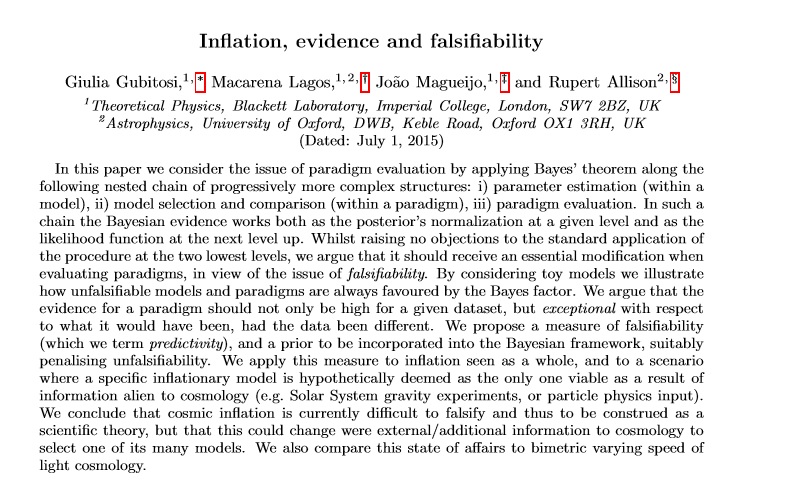
A paper came out a few weeks ago on the arXiv that’s ruffled a few feathers here and there so I thought I would make a few inflammatory comments about it on this blog. The article concerned, by Gubitosi et al., has the abstract:

Inflation_falsifiabiloty

I have to be a little careful as one of the authors is a good friend of mine. Also there’s already been a critique of some of the claims in this paper here. For the record, I agree with the critique and disagree with the original paper, that the claim below cannot be justfied.

…we illustrate how unfalsifiable models and paradigms are always favoured by the Bayes factor.

If I get a bit of time I’ll write a more technical post explaining why I think that. However, for the purposes of this post I want to take issue with a more fundamental problem I have with the philosophy of this paper, namely the way it adopts “falsifiablity” as a required characteristic for a theory to be scientific. The adoption of this criterion can be traced back to the influence of Karl Popper and particularly his insistence that science is deductive rather than inductive. Part of Popper’s claim is just a semantic confusion. It is necessary at some point to deduce what the measurable consequences of a theory might be before one does any experiments, but that doesn’t mean the whole process of science is deductive. As a non-deductivist I’ll frame my argument in the language of Bayesian (inductive) inference.

Popper rejects the basic application of inductive reasoning in updating probabilities in the light of measured data; he asserts that no theory ever becomes more probable when evidence is found in its favour. Every scientific theory begins infinitely improbable, and is doomed to remain so. There is a grain of truth in this, or can be if the space of possibilities is infinite. Standard methods for assigning priors often spread the unit total probability over an infinite space, leading to a prior probability which is formally zero. This is the problem of improper priors. But this is not a killer blow to Bayesianism. Even if the prior is not strictly normalizable, the posterior probability can be. In any case, given sufficient relevant data the cycle of experiment-measurement-update of probability assignment usually soon leaves the prior far behind. Data usually count in the end.

I believe that deductvism fails to describe how science actually works in practice and is actually a dangerous road to start out on. It is indeed a very short ride, philosophically speaking, from deductivism (as espoused by, e.g., David Hume) to irrationalism (as espoused by, e.g., Paul Feyeraband).

The idea by which Popper is best known is the dogma of falsification. According to this doctrine, a hypothesis is only said to be scientific if it is capable of being proved false. In real science certain “falsehood” and certain “truth” are almost never achieved. The claimed detection of primordial B-mode polarization in the cosmic microwave background by BICEP2 was claimed by some to be “proof” of cosmic inflation, which it wouldn’t have been even if it hadn’t subsequently shown not to be a cosmological signal at all. What we now know to be the failure of BICEP2 to detect primordial B-mode polarization doesn’t disprove inflation either.

Theories are simply more probable or less probable than the alternatives available on the market at a given time. The idea that experimental scientists struggle through their entire life simply to prove theorists wrong is a very strange one, although I definitely know some experimentalists who chase theories like lions chase gazelles. The disparaging implication that scientists live only to prove themselves wrong comes from concentrating exclusively on the possibility that a theory might be found to be less probable than a challenger. In fact, evidence neither confirms nor discounts a theory; it either makes the theory more probable (supports it) or makes it less probable (undermines it). For a theory to be scientific it must be capable having its probability influenced in this way, i.e. amenable to being altered by incoming data “i.e. evidence”. The right criterion for a scientific theory is therefore not falsifiability but testability. It follows straightforwardly from Bayes theorem that a testable theory will not predict all things with equal facility. Scientific theories generally do have untestable components. Any theory has its interpretation, which is the untestable penumbra that we need to supply to make it comprehensible to us. But whatever can be tested can be regared as scientific.

So I think the Gubitosi et al. paper starts on the wrong foot by focussing exclusively on “falsifiability”. The issue of whether a theory is testable is complicated in the context of inflation because prior probabilities for most observables are difficult to determine with any confidence because we know next to nothing about either (a) the conditions prevailing in the early Universe prior to the onset of inflation or (b) how properly to define a measure on the space of inflationary models. Even restricting consideration to the simplest models with a single scalar field, initial data are required for the scalar field (and its time derivative) and there is also a potential whose functional form is not known. It is therfore a far from trivial task to assign meaningful prior probabilities on inflationary models and thus extremely difficult to determine the relative probabilities of observables and how these probabilities may or may not be influenced by interactions with data. Moreover, the Bayesian approach involves comparing probabilities of competing theories, so we also have the issue of what to compare inflation with…

The question of whether cosmic inflation (whether in general concept or in the form of a specific model) is testable or not seems to me to boil down to whether it predicts all possible values of relevant observables with equal ease. A theory might be testable in principle, but not testable at a given time if the available technology at that time is not able to make measurements that can distingish between that theory and another. Most theories have to wait some time for experiments can be designed and built to test them. On the other hand a theory might be untestable even in principle, if it is constructed in such a way that its probability can’t be changed at all by any amount of experimental data. As long as a theory is testable in principle, however, it has the right to be called scientific. If the current available evidence can’t test it we need to do better experiments. On other words, there’s a problem with the evidence not the theory.

Gubitosi et al. are correct in identifying the important distinction between the inflationary paradigm, which encompasses a large set of specific models each formulated in a different way, and an individual member of that set. I also agree – in contrast to many of my colleagues – that it is actually difficult to argue that the inflationary paradigm is currently falsfiable testable. But that doesn’t necessarily mean that it isn’t scientific. A theory doesn’t have to have been tested in order to be testable.

The Curious Case of the 3.5 keV “Line” in Cluster Spectra

Posted in Bad Statistics, The Universe and Stuff with tags , , , , , , on July 22, 2015 by telescoper

Earlier this week I went to a seminar. That’s a rare enough event these days given all the other things I have to do. The talk concerned was by Katie Mack, who was visiting the Astronomy Centre and it contained a nice review of the general situation regarding the constraints on astrophysical dark matter from direct and indirect detection experiments. I’m not an expert on experiments – I’m banned from most laboratories on safety grounds – so it was nice to get a review from someone who knows what they’re talking about.

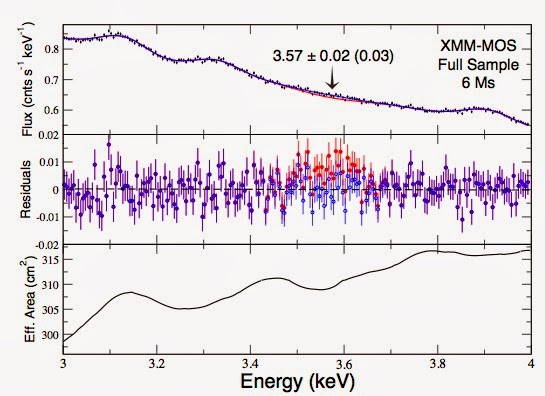
One of the pieces of evidence discussed in the talk was something I’ve never really looked at in detail myself, namely the claimed evidence of an  emission “line” in the spectrum of X-rays emitted by the hot gas in galaxy clusters. I put the word “line” in inverted commas for reasons which will soon become obvious. The primary reference for the claim is a paper by Bulbul et al which is, of course, freely available on the arXiv.

The key graph from that paper is this:

XMMspectrum

The claimed feature – it stretches the imagination considerably to call it a “line” – is shown in red. No, I’m not particularly impressed either, but this is what passes for high-quality data in X-ray astronomy!

There’s a nice review of this from about a year ago here which says this feature

 is very significant, at 4-5 astrophysical sigma.

I’m not sure how to convert astrophysical sigma into actual sigma, but then I don’t really like sigma anyway. A proper Bayesian model comparison is really needed here. If it is a real feature then a plausible explanation is that it is produced by the decay of some sort of dark matter particle in a manner that involves the radiation of an energetic photon. An example is the decay of a massive sterile neutrino – a hypothetical particle that does not participate in weak interactions –  into a lighter standard model neutrino and a photon, as discussed here. In this scenario the parent particle would have a mass of about 7keV so that the resulting photon has an energy of half that. Such a particle would constitute warm dark matter.

On the other hand, that all depends on you being convinced that there is anything there at all other than a combination of noise and systematics. I urge you to read the paper and decide. Then perhaps you can try to persuade me, because I’m not at all sure. The X-ray spectrum of hot gas does have a number of known emission features in it that needed to be subtracted before any anomalous emission can be isolated. I will remark however that there is a known recombination line of Argon that lies at 3.6 keV, and you have to be convinced that this has been subtracted correctly if the red bump is to be interpreted as something extra. Also note that all the spectra that show this feature are obtained using the same instrument – on the XMM/Newton spacecraft which makes it harder to eliminate the possibility that it is an instrumental artefact.

I’d be interested in comments from X-ray folk about how confident we should be that the 3.5 keV “anomaly” is real…

Bad Statistics, Bad Science

Posted in Bad Statistics, Science Politics, The Universe and Stuff with tags , , on July 2, 2015 by telescoper

I saw an interesting article in Nature the opening paragraph of which reads:

The past few years have seen a slew of announcements of major discoveries in particle astrophysics and cosmology. The list includes faster-than-light neutrinos; dark-matter particles producing γ-rays; X-rays scattering off nuclei underground; and even evidence in the cosmic microwave background for gravitational waves caused by the rapid inflation of the early Universe. Most of these turned out to be false alarms; and in my view, that is the probable fate of the rest.

The piece goes on to berate physicists for being too trigger-happy in claiming discoveries, the BICEP2 fiasco being a prime example. I agree that this is a problem, but it goes far beyond physics. In fact its endemic throughout science. A major cause of it is abuse of statistical reasoning.

Anyway, I thought I’d take the opportunity to re-iterate why I statistics and statistical reasoning are so important to science. In fact, I think they lie at the very core of the scientific method, although I am still surprised how few practising scientists are comfortable with even basic statistical language. A more important problem is the popular impression that science is about facts and absolute truths. It isn’t. It’s a process. In order to advance it has to question itself. Getting this message wrong – whether by error or on purpose -is immensely dangerous.

Statistical reasoning also applies to many facets of everyday life, including business, commerce, transport, the media, and politics. Probability even plays a role in personal relationships, though mostly at a subconscious level. It is a feature of everyday life that science and technology are deeply embedded in every aspect of what we do each day. Science has given us greater levels of comfort, better health care, and a plethora of labour-saving devices. It has also given us unprecedented ability to destroy the environment and each other, whether through accident or design.

Civilized societies face rigorous challenges in this century. We must confront the threat of climate change and forthcoming energy crises. We must find better ways of resolving conflicts peacefully lest nuclear or conventional weapons lead us to global catastrophe. We must stop large-scale pollution or systematic destruction of the biosphere that nurtures us. And we must do all of these things without abandoning the many positive things that science has brought us. Abandoning science and rationality by retreating into religious or political fundamentalism would be a catastrophe for humanity.

Unfortunately, recent decades have seen a wholesale breakdown of trust between scientists and the public at large. This is due partly to the deliberate abuse of science for immoral purposes, and partly to the sheer carelessness with which various agencies have exploited scientific discoveries without proper evaluation of the risks involved. The abuse of statistical arguments have undoubtedly contributed to the suspicion with which many individuals view science.

There is an increasing alienation between scientists and the general public. Many fewer students enrol for courses in physics and chemistry than a a few decades ago. Fewer graduates mean fewer qualified science teachers in schools. This is a vicious cycle that threatens our future. It must be broken.

The danger is that the decreasing level of understanding of science in society means that knowledge (as well as its consequent power) becomes concentrated in the minds of a few individuals. This could have dire consequences for the future of our democracy. Even as things stand now, very few Members of Parliament are scientifically literate. How can we expect to control the application of science when the necessary understanding rests with an unelected “priesthood” that is hardly understood by, or represented in, our democratic institutions?

Very few journalists or television producers know enough about science to report sensibly on the latest discoveries or controversies. As a result, important matters that the public needs to know about do not appear at all in the media, or if they do it is in such a garbled fashion that they do more harm than good.

Years ago I used to listen to radio interviews with scientists on the Today programme on BBC Radio 4. I even did such an interview once. It is a deeply frustrating experience. The scientist usually starts by explaining what the discovery is about in the way a scientist should, with careful statements of what is assumed, how the data is interpreted, and what other possible interpretations might be and the likely sources of error. The interviewer then loses patience and asks for a yes or no answer. The scientist tries to continue, but is badgered. Either the interview ends as a row, or the scientist ends up stating a grossly oversimplified version of the story.

Some scientists offer the oversimplified version at the outset, of course, and these are the ones that contribute to the image of scientists as priests. Such individuals often believe in their theories in exactly the same way that some people believe religiously. Not with the conditional and possibly temporary belief that characterizes the scientific method, but with the unquestioning fervour of an unthinking zealot. This approach may pay off for the individual in the short term, in popular esteem and media recognition – but when it goes wrong it is science as a whole that suffers. When a result that has been proclaimed certain is later shown to be false, the result is widespread disillusionment.

The worst example of this tendency that I can think of is the constant use of the phrase “Mind of God” by theoretical physicists to describe fundamental theories. This is not only meaningless but also damaging. As scientists we should know better than to use it. Our theories do not represent absolute truths: they are just the best we can do with the available data and the limited powers of the human mind. We believe in our theories, but only to the extent that we need to accept working hypotheses in order to make progress. Our approach is pragmatic rather than idealistic. We should be humble and avoid making extravagant claims that can’t be justified either theoretically or experimentally.

The more that people get used to the image of “scientist as priest” the more dissatisfied they are with real science. Most of the questions asked of scientists simply can’t be answered with “yes” or “no”. This leaves many with the impression that science is very vague and subjective. The public also tend to lose faith in science when it is unable to come up with quick answers. Science is a process, a way of looking at problems not a list of ready-made answers to impossible problems. Of course it is sometimes vague, but I think it is vague in a rational way and that’s what makes it worthwhile. It is also the reason why science has led to so many objectively measurable advances in our understanding of the World.

I don’t have any easy answers to the question of how to cure this malaise, but do have a few suggestions. It would be easy for a scientist such as myself to blame everything on the media and the education system, but in fact I think the responsibility lies mainly with ourselves. We are usually so obsessed with our own research, and the need to publish specialist papers by the lorry-load in order to advance our own careers that we usually spend very little time explaining what we do to the public or why.

I think every working scientist in the country should be required to spend at least 10% of their time working in schools or with the general media on “outreach”, including writing blogs like this. People in my field – astronomers and cosmologists – do this quite a lot, but these are areas where the public has some empathy with what we do. If only biologists, chemists, nuclear physicists and the rest were viewed in such a friendly light. Doing this sort of thing is not easy, especially when it comes to saying something on the radio that the interviewer does not want to hear. Media training for scientists has been a welcome recent innovation for some branches of science, but most of my colleagues have never had any help at all in this direction.

The second thing that must be done is to improve the dire state of science education in schools. Over the last two decades the national curriculum for British schools has been dumbed down to the point of absurdity. Pupils that leave school at 18 having taken “Advanced Level” physics do so with no useful knowledge of physics at all, even if they have obtained the highest grade. I do not at all blame the students for this; they can only do what they are asked to do. It’s all the fault of the educationalists, who have done the best they can for a long time to convince our young people that science is too hard for them. Science can be difficult, of course, and not everyone will be able to make a career out of it. But that doesn’t mean that it should not be taught properly to those that can take it in. If some students find it is not for them, then so be it. I always wanted to be a musician, but never had the talent for it.

I realise I must sound very gloomy about this, but I do think there are good prospects that the gap between science and society may gradually be healed. The fact that the public distrust scientists leads many of them to question us, which is a very good thing. They should question us and we should be prepared to answer them. If they ask us why, we should be prepared to give reasons. If enough scientists engage in this process then what will emerge is and understanding of the enduring value of science. I don’t just mean through the DVD players and computer games science has given us, but through its cultural impact. It is part of human nature to question our place in the Universe, so science is part of what we are. It gives us purpose. But it also shows us a way of living our lives. Except for a few individuals, the scientific community is tolerant, open, internationally-minded, and imbued with a philosophy of cooperation. It values reason and looks to the future rather than the past. Like anyone else, scientists will always make mistakes, but we can always learn from them. The logic of science may not be infallible, but it’s probably the best logic there is in a world so filled with uncertainty.


Still Not Significant

Posted in Bad Statistics with tags , on May 27, 2015 by telescoper

I just couldn’t resist reblogging this post because of the wonderful list of meaningless convoluted phrases people use when they don’t get a “statistically significant” result. I particularly like:

“a robust trend toward significance”.

It’s scary to think that these were all taken from peer-reviewed scientific journals…

mchankins's avatarProbable Error

Image

What to do if your p-value is just over the arbitrary threshold for ‘significance’ of p=0.05?

You don’t need to play the significance testing game – there are better methods, like quoting the effect size with a confidence interval – but if you do, the rules are simple: the result is either significant or it isn’t.

So if your p-value remains stubbornly higher than 0.05, you should call it ‘non-significant’ and write it up as such. The problem for many authors is that this just isn’t the answer they were looking for: publishing so-called ‘negative results’ is harder than ‘positive results’.

The solution is to apply the time-honoured tactic of circumlocution to disguise the non-significant result as something more interesting. The following list is culled from peer-reviewed journal articles in which (a) the authors set themselves the threshold of 0.05 for significance, (b) failed to achieve that threshold value for…

View original post 2,779 more words

One More for the Bad Statistics in Astronomy File…

Posted in Bad Statistics, The Universe and Stuff with tags , , , , , on May 20, 2015 by telescoper

It’s been a while since I last posted anything in the file marked Bad Statistics, but I can remedy that this morning with a comment or two on the following paper by Robertson et al. which I found on the arXiv via the Astrostatistics Facebook page. It’s called Stellar activity mimics a habitable-zone planet around Kapteyn’s star and it the abstract is as follows:

Kapteyn’s star is an old M subdwarf believed to be a member of the Galactic halo population of stars. A recent study has claimed the existence of two super-Earth planets around the star based on radial velocity (RV) observations. The innermost of these candidate planets–Kapteyn b (P = 48 days)–resides within the circumstellar habitable zone. Given recent progress in understanding the impact of stellar activity in detecting planetary signals, we have analyzed the observed HARPS data for signatures of stellar activity. We find that while Kapteyn’s star is photometrically very stable, a suite of spectral activity indices reveals a large-amplitude rotation signal, and we determine the stellar rotation period to be 143 days. The spectral activity tracers are strongly correlated with the purported RV signal of “planet b,” and the 48-day period is an integer fraction (1/3) of the stellar rotation period. We conclude that Kapteyn b is not a planet in the Habitable Zone, but an artifact of stellar activity.

It’s not really my area of specialism but it seemed an interesting conclusions so I had a skim through the rest of the paper. Here’s the pertinent figure, Figure 3,

bad_stat_figure

It looks like difficult data to do a correlation analysis on and there are lots of questions to be asked  about  the form of the errors and how the bunching of the data is handled, to give just two examples.I’d like to have seen a much more comprehensive discussion of this in the paper. In particular the statistic chosen to measure the correlation between variates is the Pearson product-moment correlation coefficient, which is intended to measure linear association between variables. There may indeed be correlations in the plots shown above, but it doesn’t look to me that a straight line fit characterizes it very well. It looks to me in some of the  cases that there are simply two groups of data points…

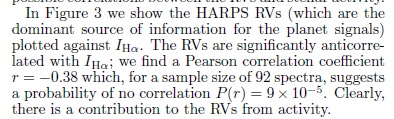
However, that’s not the real reason for flagging this one up. The real reason is the following statement in the text:

bad_stat_text

Aargh!

No matter how the p-value is arrived at (see comments above), it says nothing about the “probability of no correlation”. This is an error which is sadly commonplace throughout the scientific literature, not just astronomy.  The point is that the p-value relates to the probability that the given value of the test statistic (in this case the Pearson product-moment correlation coefficient, r) would arise by chace in the sample if the null hypothesis H (in this case that the two variates are uncorrelated) were true. In other words it relates to P(r|H). It does not tells us anything directly about the probability of H. That would require the use of Bayes’ Theorem. If you want to say anything at all about the probability of a hypothesis being true or not you should use a Bayesian approach. And if you don’t want to say anything about the probability of a hypothesis being true or not then what are you trying to do anyway?

If I had my way I would ban p-values altogether, but it people are going to use them I do wish they would be more careful about the statements make about them.

The Law of Averages

Posted in Bad Statistics, Crosswords with tags , , on March 4, 2015 by telescoper

Just a couple of weeks ago I found myself bemoaning my bad luck in the following terms

A few months have passed since I last won a dictionary as a prize in the Independent Crossword competition. That’s nothing remarkable in itself, but since my average rate of dictionary accumulation has been about one a month over the last few years, it seems a bit of a lull.  Have I forgotten how to do crosswords and keep sending in wrong solutions? Is the Royal Mail intercepting my post? Has the number of correct entries per week suddenly increased, reducing my odds of winning? Have the competition organizers turned against me?

In fact, statistically speaking, there’s nothing significant in this gap. Even if my grids are all correct, the number of correct grids has remained constant, and the winner is pulled at random  from those submitted (i.e. in such a way that all correct entries are equally likely to be drawn) , then a relatively long unsuccessful period such as I am experiencing at the moment is not at all improbable. The point is that such runs are far more likely in a truly random process than most people imagine, as indeed are runs of successes. Chance coincidence happen more often than you think.

Well, as I suspected would happen soon my run of ill fortune came to an end today with the arrival of this splendid item in the mail:

dictionary_beel

It’s the prize for winning Beelzebub 1303, the rather devilish prize cryptic in the Independent on Sunday Magazine. It’s nice to get back to winning ways. Now what’s the betting I’ll now get a run of successes?

P.S. I used the title “Law of Averages” just so I could point out in a footnote that there’s actually no such thing.

Uncertainty, Risk and Probability

Posted in Bad Statistics, Science Politics with tags , , , , , , , , on March 2, 2015 by telescoper

Last week I attended a very interesting event on the Sussex University campus, the Annual Marie Jahoda Lecture which was given this year by Prof. Helga Nowotny a distinguished social scientist. The title of the talk was A social scientist in the land of scientific promise and the abstract was as follows:

Promises are a means of bringing the future into the present. Nowhere is this insight by Hannah Arendt more applicable than in science. Research is a long and inherently uncertain process. The question is open which of the multiple possible, probable or preferred futures will be actualized. Yet, scientific promises, vague as they may be, constitute a crucial link in the relationship between science and society. They form the core of the metaphorical ‘contract’ in which support for science is stipulated in exchange for the benefits that science will bring to the well-being and wealth of society. At present, the trend is to formalize scientific promises through impact assessment and measurement. Against this background, I will present three case studies from the life sciences: assisted reproductive technologies, stem cell research and the pending promise of personalized medicine. I will explore the uncertainty of promises as well as the cunning of uncertainty at work.

It was a fascinating and wide-ranging lecture that touched on many themes. I won’t try to comment on all of them, but just pick up on a couple that struck me from my own perspective as a physicist. One was the increasing aversion to risk demonstrated by research funding agencies, such as the European Research Council which she helped set up but described in the lecture as “a clash between a culture of trust and a culture of control”. This will ring true to any scientist applying for grants even in “blue skies” disciplines such as astronomy: we tend to trust our peers, who have some control over funding decisions, but the machinery of control from above gets stronger every day. Milestones and deliverables are everything. Sometimes I think in order to get funding you have to be so confident of the outcomes of your research to that you have to have already done it, in which case funding isn’t even necessary. The importance of extremely speculative research is rarely recognized, although that is where there is the greatest potential for truly revolutionary breakthroughs.

Another theme that struck me was the role of uncertainty and risk. This grabbed my attention because I’ve actually written a book about uncertainty in the physical sciences. In her lecture, Prof. Nowotny referred to the definition (which was quite new to me) of these two terms by Frank Hyneman Knight in a book on economics called Risk, Uncertainty and Profit. The distinction made there is that “risk” is “randomness” with “knowable probabilities”, whereas “uncertainty” involves “randomness” with “unknowable probabilities”. I don’t like these definitions at all. For one thing they both involve a reference to “randomness”, a word which I don’t know how to define anyway; I’d be much happier to use “unpredictability”. Even more importantly, perhaps, I find the distinction between “knowable” and “unknowable” probabilities very problematic. One always knows something about a probability distribution, even if that something means that the distribution has to be very broad. And in any case these definitions imply that the probabilities concerned are “out there”, rather being statements about a state of knowledge (or lack thereof). Sometimes we know what we know and sometimes we don’t, but there are more than two possibilities. As the great American philosopher and social scientist Donald Rumsfeld (Shurely Shome Mishtake? Ed) put it:

“…as we know, there are known knowns; there are things we know we know. We also know there are known unknowns; that is to say we know there are some things we do not know. But there are also unknown unknowns – the ones we don’t know we don’t know.”

There may be a proper Bayesian formulation of the distinction between “risk” and “uncertainty” that involves a transition between prior-dominated (uncertain) and posterior-dominated (risky), but basically I don’t see any qualititative difference between the two from such a perspective.

Anyway, it was a very interesting lecture that differed from many talks I’ve attended about the sociology of science in that the speaker clearly understood a lot about how science actually works. The Director of the Science Policy Research Unit invited the Heads of the Science Schools (including myself) to dinner with the speaker afterwards, and that led to the generation of many interesting ideas about how we (I mean scientists and social scientists) might work better together in the future, something we really need to do.

Digit Ratio Survey

Posted in Bad Statistics, Biographical with tags , , , on February 9, 2015 by telescoper

I was intrigued by an article I found at the weekend which reports on a (no doubt rigorous) scientific study that claims a connection between the relative lengths of index and ring fingers and the propensity to be promiscuous. The assertion is that people whose ring finger is longer than their index finger like to play around, while those whose index finger is longer than their ring finger are inclined to fidelity. Obviously, since the study involves the University of Oxford’s Department of Experimental Psychology, there can be do doubt whatsoever about its reliablity or scientific credibility, just like the dozens of other things supposed to be correlated with digit ratio. Ahem.

I do remember a similar study some time ago that claimed that men with with a longer index finger (2D) than ring finger (4D) (i.e. with a 2D:4D digit ratio greater than one) were much more likely to be gay than those with a digit ratio lower than one. Taken with this new finding it proves what we all knew all along: that heterosexuals are far more likely to be promiscuous than homosexuals.

For the record, here is a photograph of my left hand (which, on reflection, is similar to my right, and which clearly shows a 2D:4D ratio greater than unity):

wpid-wp-1423482539378.jpeg

Inspired by the stunning application of the scientific method described in the report, I have decided to carry out a rigorous study of my own. I have heard that, at least among males, it is much more common to have digit ratio less than one than greater than one but I can’t say I’ve noticed it myself. Furthermore previously unanswered question in the literature is whether there is a connection between digit ratio and the propensity to read blogs. I will know subject this to rigorous scientific scrutiny by inviting readers of this blog to complete the following simply survey. I look forward to publishing my findings in due course in the Journal of Irreproducible Results.

PS. The actual paper on which the report was based is by Rafael Wlodarski, John Manning, and R. I. M. Dunbar,

Doomsday is Cancelled…

Posted in Bad Statistics, The Universe and Stuff with tags , on November 25, 2014 by telescoper

Last week I posted an item that included a discussion of the Doomsday Argument. A subsequent comment on that post mentioned a paper by Ken Olum, which I finally got around to reading over the weekend, so I thought I’d post a link here for those of you worrying that the world might come to an end before the Christmas holiday.

You can find Olum’s paper on the arXiv here. The abstract reads (my emphasis):

If the human race comes to an end relatively shortly, then we have been born at a fairly typical time in history of humanity. On the other hand, if humanity lasts for much longer and trillions of people eventually exist, then we have been born in the first surprisingly tiny fraction of all people. According to the Doomsday Argument of Carter, Leslie, Gott, and Nielsen, this means that the chance of a disaster which would obliterate humanity is much larger than usually thought. Here I argue that treating possible observers in the same way as those who actually exist avoids this conclusion. Under this treatment, it is more likely to exist at all in a race which is long-lived, as originally discussed by Dieks, and this cancels the Doomsday Argument, so that the chance of a disaster is only what one would ordinarily estimate. Treating possible and actual observers alike also allows sensible anthropic predictions from quantum cosmology, which would otherwise depend on one’s interpretation of quantum mechanics.

I think Olum does identify a logical flaw in the argument, but it’s by no means the only one. I wouldn’t find it at all surprising to be among the first “tiny fraction of all people”, as my genetic characteristics are such that I could not be otherwise. But even if you’re not all that interested in the Doomsday Argument I recommend you read this paper as it says some quite interesting things about the application of probabilistic reasoning elsewhere in cosmology, an area in which quite a lot is written that makes no sense to me whatsoever!