 I just stumbled upon a post about a talk I did last year at the Multi-Faith centre at the University of Derby. I’ll let you follow the link to see how the talk and discussion went, but here’s a copy of a photograph of me trying to talk with my mouth full.
Archive for the Books, Talks and Reviews Category
Old Talk
Posted in Books, Talks and Reviews, The Universe and Stuff with tags University of Derby on June 16, 2009 by telescoperNinety Years On…
Posted in Books, Talks and Reviews, The Universe and Stuff with tags Arthur Stanley Eddington, Eclipse, Einstein, general relativity, May 29th 1919, Principe, Sobral on May 28, 2009 by telescoperThe 29th May 2009 is a very special day that should be marked by anyone interested in the theory of relativity as it is the 90th anniversary of one of the most famous experiments of all time.
On 29th May 1919, measurements were made during total eclipse of the Sun that have gone down in history as vindicating Einstein’s (then) new general theory of relativity. I’ve written quite a lot about this in past years, including a little book and a slightly more technical paper. I decided, though, to post this little piece that is based on an article I wrote for Firstscience.
The Eclipse that Changed the Universe
A total eclipse of the Sun is a moment of magic: a scant few minutes when our perceptions of the whole Universe are turned on their heads. The Sun’s blinding disc is replaced by ghostly pale tentacles surrounding a black heart – an eerie experience witnessed by hundreds of millions of people throughout Europe and the Near East last August.
But one particular eclipse of the Sun, eighty years ago, challenged not only people’s emotional world. It was set to turn the science of the Universe on its head. For over two centuries, scientists had believed Sir Isaac Newton’s view of the Universe. Now his ideas had been challenged by a young German-Swiss scientist, called Albert Einstein. The showdown – Newton vs Einstein – would be the total eclipse of 29 May 1919.
Newton’s position was set out in his monumental Philosophiae Naturalis Principia Mathematica, published in 1687. The Principia – as it’s familiarly known – laid down a set of mathematical laws that described all forms of motion in the Universe. These rules applied as much to the motion of planets around the Sun as to more mundane objects like apples falling from trees.
At the heart of Newton’s concept of the Universe were his ideas about space and time. Space was inflexible, laid out in a way that had been described by the ancient Greek mathematician Euclid in his laws of geometry. To Newton, space was the immovable and unyielding stage on which bodies acted out their motions. Time was also absolute, ticking away inexorably at the same rate for everyone in the Universe.
 Sir Isaac Newton by Sir Godfrey Kneller Courtesy of the National Portrait Gallery, London Sir Isaac Newton proposed the first theory of gravity. |
For over 200 years, scientists saw the Cosmos through Newton’s eyes. It was a vast clockwork machine, evolving by predetermined rules through regular space, against the beat of an absolute clock. This edifice totally dominated scientific thought, until it was challenged by Albert Einstein.
In 1905, Einstein dispensed with Newton’s absolute nature of space and time. Although born in Germany, during this period of his life he was working as a patent clerk in Berne, Switzerland. He encapsulated his new ideas on motion, space and time in his special theory of relativity. But it took another ten years for Einstein to work out the full consequences of his ideas, including gravity. The general theory of relativity, first aired in 1915, was as complete a description of motion as Newton had prescribed in his Principia. But Einstein’s description of gravity required space to be curved. Whereas for Newton space was an inflexible backdrop, for Einstein it had to bend and flex near massive bodies. This warping of space, in turn, would be responsible for guiding objects such as planets along their orbits.
 Royal Observatory Greenwich Albert Einstein and Arthur Eddington: the father of relativity and the man who proved him right. |
By the time he developed his general theory, Einstein was back in Germany, working in Berlin. But a copy of his general theory of relativity was soon smuggled through war-torn Europe to Cambridge. There it was read by Arthur Stanley Eddington, Britain’s leading astrophysicist. Eddington realised that Einstein’s theory could be tested. If space really was distorted by gravity, then light passing through it would not travel in a straight line, but would follow a curved path. The stronger the force of gravity, the more the light would be bent. The bending would be largest for light passing very close to a very massive body, such as the Sun.
Unfortunately, the most massive objects known to astronomers at the time were also very bright. This was before black holes were seriously considered, and stars provided the strongest gravitational fields known. The Sun was particularly useful, being a star right on our doorstep. But it is impossible to see how the light from faint background stars might be bent by the Sun’s gravity, because the Sun’s light is so bright it completely swamps the light from objects beyond it.
 Royal Observatory Greenwich Scientist’s sketch of the path of the vital 1919 eclipse. |
Eddington realised the solution. Observe during a total eclipse, when the Sun’s light is blotted out for a few minutes, and you can see distant stars that appear close to the Sun in the sky. If Einstein was right, the Sun’s gravity would shift these stars to slightly different positions, compared to where they are seen in the night sky at other times of the year when the Sun far away from them. The closer the star appears to the Sun during totality, the bigger the shift would be.
Eddington began to put pressure on the British scientific establishment to organise an experiment. The Astronomer Royal of the time, Sir Frank Watson Dyson, realised that the 1919 eclipse was ideal. Not only was totality unusually long (around six minutes, compared with the two minutes we experienced in 1999) but during totality the Sun would be right in front of the Hyades, a cluster of bright stars.
But at this point the story took a twist. Eddington was a Quaker and, as such, a pacifist. In 1917, after disastrous losses during the Somme offensive, the British government introduced conscription to the armed forces. Eddington refused the draft and was threatened with imprisonment. In the end, Dyson’s intervention was crucial persuading the government to spare Eddington. His conscription was postponed under the condition that, if the war had finished by 1919, Eddington himself would lead an expedition to measure the bending of light by the Sun. The rest, as they say, is history.
The path of totality of the 1919 eclipse passed from northern Brazil, across the Atlantic Ocean to West Africa. In case of bad weather (amongst other reasons) two expeditions were organised: one to Sobral, in Brazil, and the other to the island of Principe, in the Gulf of Guinea close to the West African coast. Eddington himself went to Principe; the expedition to Sobral was led by Andrew Crommelin from the Royal Observatory at Greenwich.
 Royal Observatory Greenwich British scientists in the field at Sobral in 1919. |
The expeditions did not go entirely according to plan. When the day of the eclipse (29 May) dawned on Principe, Eddington was greeted with a thunderstorm and torrential rain. By mid-afternoon the skies had partly cleared and he took some pictures through cloud.
Meanwhile, at Sobral, Crommelin had much better weather – but he had made serious errors in setting up his equipment. He focused his main telescope the night before the eclipse, but did not allow for the distortions that would take place as the temperature climbed during the day. Luckily, he had taken a backup telescope along, and this in the end provided the best results of all.
After the eclipse, Eddington himself carefully measured the positions of the stars that appeared near the Sun’s eclipsed image, on the photographic plates exposed at both Sobral and Principe. He then compared them with reference positions taken previously when the Hyades were visible in the night sky. The measurements had to be incredibly accurate, not only because the expected deflections were small. The images of the stars were also quite blurred, because of problems with the telescopes and because they were seen through the light of the Sun’s glowing atmosphere, the solar corona.
Before long the results were ready. Britain’s premier scientific body, the Royal Society, called a special meeting in London on 6 November. Dyson, as Astronomer Royal took the floor, and announced that the measurements did not support Newton’s long-accepted theory of gravity. Instead, they agreed with the predictions of Einstein’s new theory.
 Royal Observatory Greenwich The final proof: the small red line shows how far the position of the star has been shifted by the Sun’s gravity. |
The press reaction was extraordinary. Einstein was immediately propelled onto the front pages of the world’s media and, almost overnight, became a household name. There was more to this than purely the scientific content of his theory. After years of war, the public embraced a moment that moved mankind from the horrors of destruction to the sublimity of the human mind laying bare the secrets of the Cosmos. The two pacifists in the limelight – the British Eddington and the German-born Einstein – were particularly pleased at the reconciliation between their nations brought about by the results.
But the popular perception of the eclipse results differed quite significantly from the way they were viewed in the scientific establishment. Physicists of the day were justifiably cautious. Eddington had needed to make significant corrections to some of the measurements, for various technical reasons, and in the end decided to leave some of the Sobral data out of the calculation entirely. Many scientists were suspicious that he had cooked the books. Although the suspicion lingered for years in some quarters, in the end the results were confirmed at eclipse after eclipse with higher and higher precision.

NASA In this cosmic ‘gravitational lens,’ a huge cluster of galaxies distorts the light from more distant galaxies into a pattern of giant arcs. |
Nowadays astronomers are so confident of Einstein’s theory that they rely on the bending of light by gravity to make telescopes almost as big as the Universe. When the conditions are right, gravity can shift an object’s position by far more than a microscopic amount. The ideal situation is when we look far out into space, and centre our view not on an individual star like the Sun, but on a cluster of hundreds of galaxies – with a total mass of perhaps 100 million million suns. The space-curvature of this immense ‘gravitational lens’ can gather the light from more remote objects, and focus them into brilliant curved arcs in the sky. From the size of the arcs, astronomers can ‘weigh’ the cluster of galaxies.
Einstein didn’t live long enough to see through a gravitational lens, but if he had he would definitely have approved….
Dublin Back
Posted in Art, Books, Talks and Reviews, Crosswords, The Universe and Stuff with tags ASGI, Cosmology, Dublin, Temple Bar, Times Literary Supplement on March 28, 2009 by telescoperI’m just back from a flying visit to Dublin, where I gave a talk yesterday at a meeting of the Astronomical Science Group of Ireland (ASGI), an organization which promotes scientific collaborations between individuals and institutions on both sides of the border between Northern Ireland and the Republic of Eire. The venue for the twice-yearly meetings moves around both countries, but this time it was held in the splendid environment of Trinity College, Dublin.
It turned out to be an easy trip from Cardiff to Dublin and my first opportunity to try out Cardiff’s fine little airport. A small airline called Air Arann operates the route to Dublin from there, and it all went to schedule despite the plane having to struggle against a 70 mph head wind across the Irish sea. For our small propeller-driven plane, that made a signficant difference to the flying time.
Arriving in Dublin on Thursday I had time to have a nice dinner before settling in to my hotel in the Temple Bar region of the city. There’s a huge concentration of bars and nightclubs there and it’s a traditional area for Stag and Hen Parties. There was plenty of evidence of drunken debauchery going on into the early hours of the morning, which remind me of the way the Irish rugby fans carried on last weekend in Cardiff.
Anyway, the meeting itself was interesting with a wide range of talks most of which were given by PhD students. I enjoy meetings where the younger scientists are encouraged to speak; too many conferences involve the same people giving the same talk time after time. Solar Physics was particularly well represented, and I learned quite a bit about about things that are far from my own province.
There isn’t much actual cosmology done in Ireland (North or South) so my brief as invited speaker was to give an overview of the current state of the field for astronomers who are not experts in cosmological matters. I therefore gave a summary of the concordance model which I’ve blogged about before and then made some comments about things that might point to a more complete theory of the Universe. I also mentioned some of the anomalies in the cosmic microwave background that I’ve also blogged about on here.
I usually use this piece of Hieronymus Bosch The Last Judgement to illustrate my feelings about the concordance model:
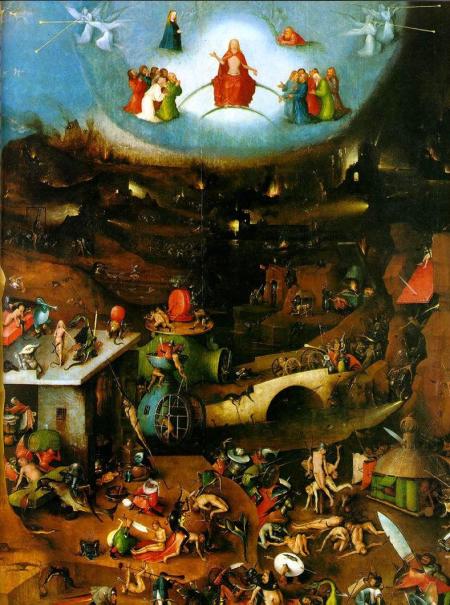
The top part represents the concordance cosmology. It clearly features an eminent cosmologist surrounded by postdoctoral researchers. Everything appears to be in heavenly harmony, surrounded by a radiant glow of self-satisfaction. The trumpets represent various forms of exaggerated press coverage.
But if you step back from it, and get the whole thing in a proper perspective, you realise that there’s an awful lot going on underneath that’s not so pleasant or easy to interptet. I don’t know what’s going down below there although the unfortunate figures slaving away in miserable conditions and suffering unimaginable torments are obviously supposed to represent graduate students.
The main point is that the concordance model is based on rather strange foundations: nobody understands what the dark matter and dark energy are, for example. Even more fundamentally, the whole thing is based on a shotgun marriage between general relativity and quantum field theory which is doomed to fail somewhere along the line.
Far from being a final theory of the Universe I think we should treat our standard model as a working hypothesis and actively look for departures from it. I’m not at all against the model. As models go, it’s very successful. It’s a good one, but it’s still just a model.
That reminds me of the school report I got after my first year at the Royal Grammar School. The summary at the bottom described me as a “model student”. I was so thrilled I went and looked up the word model in a dictionary and found it said “a small imitation of the real thing.”
Anyway, the talk went down pretty well (I think) and after a quick glass of Guinness (which definitely went down well) I was back to Dublin airport and home to Cardiff soon after that: Cardiff airport to my house was less than twenty minutes. I greatly enjoyed my short visit and was delighted to be asked to do a couple of seminars back there in the near future.
I was in a good mood when I got home, which got even better when I found out that I won the latest Crossword competition in the Times Literary Supplement. And the prize isn’t even a dictionary. It’s cash!
Factoid-based Learning
Posted in Books, Talks and Reviews, The Universe and Stuff with tags astronomy, education on March 16, 2009 by telescoperThere’s a post over on cosmic variance that asks the question What is Scientific Literacy? Some of the comments reminded me of a book review I did for Nature a while ago, so I thought I’d put it on here.
My point is that teaching science isn’t about teaching facts, it’s about trying to develop critical thinking and problem-solving skills.
At least that’s what it should be, if only the dumbers-down would stop meddling.
BOOK REVIEWED– Heavenly Errors: Misconceptions about the Real Nature of the Universe
by Neil F. Comins
Columbia University Press: 2001. 288 pp. $27.95, £18.95
Astronomy is a curious subject to teach. Even the most unpromising fledgling scientist has probably, at some stage, looked at the night sky and wondered about the meaning of it all. Students usually therefore enter the classroom with some preconceived notions about astronomical matters. These notions are often naïve, sometimes inaccurate, and occasionally downright bogus. The teaching of astronomy does not, therefore, begin with a blank piece of paper, as it does with other topics in physical science, but with the correction of misconceptions that may be deeply held.
In Heavenly Errors, Neil F. Comins illustrates the ambivalent consequences of astronomy’s peculiar allure with a series of commonly held misconceptions, misunderstandings and errors of logic. It is a promising idea for a book, particularly when the author has enlisted the willing help of thousands of undergraduate students to compile a list of frequently held wrong ideas about the Solar System and beyond. It is interesting to read of the origins of these misconceptions: Hollywood movies, astrology, the Internet and bad reporting of science all share some of the blame. But it’s even more interesting to look at the different kinds of misconception and what they tell us about the chasm that often lies between scientific thinking and the ‘common-sense’ reasoning they represent.
Ask why the weather is colder in the winter and you may well get the reply that, because its orbit is elliptical, the Earth is further from the Sun during winter than it is during summer and therefore receives less of the Sun’s power at that time of year. This explanation fails to explain why the Southern Hemisphere experiences summer at the same time as the Northern Hemisphere experiences winter, that is, at the same stage of the Earth’s orbit around the Sun. Talking through the logic of this example with students not only corrects the misconception, but also illustrates the scientific method by examining other necessary consequences of a given explanation before settling on the correct one. In this case, it is to do with the varying length of day and angle of the Sun in the sky.
Many of the examples presented by Comins are simple errors of fact. For example, “Polaris is the brightest star in the night sky”, comes in at number 8 in the top 50 Cosmic Clangers (it is Sirius). Many others do not justify being called misconceptions at all. Time travel, which Comins takes to be self-evidently impossible, is not, as he claims, excluded by the general theory of relativity. On the other hand, he states that black holes are definitely not black because they give off Hawking radiation — this despite the fact that Hawking radiation has not yet been observed in an astronomical object.
And what is a misconception anyway? Contrary to popular belief, planetary orbits are not circular, and yet circles provide a useful approximate description for many purposes. We are told that they are actually elliptical, but this is itself an approximation that ignores perturbations from other bodies and relativistic effects. Most scientific explanations are misconceptions if you view them like this.
Much of the early part of Heavenly Errors is excellent, particularly its explanations of the basic astronomical properties of the Sun, planets and comets. But further on, the book goes badly off the rails. Through its conflation of fact and theory, and its blurring of the distinction between truth and approximation, it turns into a misguided crusade that encourages the rote learning of factoids as a means to “acquire a sound scientific foundation for understanding nature”. I think this does more harm than good. T. H. Huxley, who knew a thing or two about science, put it best: “irrationally held truths may be more harmful than reasoned errors.”
From Here to Eternity
Posted in Books, Talks and Reviews, The Universe and Stuff with tags Big Bang, Cosmology, Infinity, Joe Silk, Steady State on February 3, 2009 by telescoperI posted an item about astronomy and poetry a couple of days ago that used a phrase I vaguely remember having used somewhere else before. I’ve only just remembered where. It was in this book review I did for Nature some time ago. Since I’m quite keen on recycling, I’d thought I’d put it on here.
How do physicists cope with the concept of infinity in an expanding Universe?
BOOK REVIEWED – The Infinite Cosmos: Questions from the Frontiers of Cosmology
by Joseph Silk
Oxford University Press: 2006. 256 pp. £18.99, $29.95
Scientists usually have an uncomfortable time coping with the concept of infinity. Over the past century, physicists have had a particularly difficult relationship with the notion of boundlessness. In most cases this has been symptomatic of deficiencies in the theoretical foundations of the subject. Think of the ‘ultraviolet catastrophe’ of classical statistical mechanics, in which the electromagnetic radiation produced by a black body at a finite temperature is calculated to be infinitely intense at infinitely short wavelengths; this signalled the failure of classical statistical mechanics and ushered in the era of quantum mechanics about a hundred years ago. Quantum field theories have other forms of pathological behaviour, with mathematical components of the theory tending to run out of control to infinity unless they are healed using the technique of renormalization. The general theory of relativity predicts that singularities in which physical properties become infinite occur in the centre of black holes and in the Big Bang that kicked our Universe into existence. But even these are regarded as indications that we are missing a piece of the puzzle, rather than implying that somehow infinity is a part of nature itself.
The exception to this rule is the field of cosmology. Somehow it seems natural at least to consider the possibility that our cosmos might be infinite in extent or duration. If the Universe is defined as everything that exists, why should it necessarily be finite? Why should there be some underlying principle that restricts it to a size our human brains can cope with?
But even if cosmologists are prepared to ponder the reality of endlessness, and to describe it mathematically, they still have problems finding words to express these thoughts. Physics is fundamentally prosaic, but physicists have to resort to poetry when faced with the measureless grandeur of the heavens.
In The Infinite Cosmos, Joe Silk takes us on a whistle-stop tour of modern cosmology, focusing on what we have learned about the size and age of the Universe, how it might have begun, and how it may or may not end. This is a good time to write this book, because these most basic questions may have been answered by a combination of measurements from satellites gathering the static buzz of microwaves left over from the Big Bang, from telescopes finding and monitoring the behaviour of immensely distant supernova explosions, and from painstaking surveys of galaxy positions yielding quantitative information about the fallout from the primordial fireball. Unless we are missing something of fundamental importance, these observations indicate that our expanding Universe is about 14 billion years old, contains copious quantities of dark matter in some unidentified form, and is expanding at an accelerating rate.
According to the standard model of cosmology that emerges, the Universe has a finite past and (perhaps) an infinite future. But is our observable Universe (our ‘Hubble bubble’) typical of all there is? Perhaps there is much more to the cosmos than will ever meet our eyes. Our local patch of space-time may have its origin in just one of an infinite and timeless collection of Big Bangs, so the inferences we draw from observations of our immediate neighbourhood may never tell us anything much about the whole thing, even if we correctly interpret all the data available to us.
What is exciting about this book is not so much that it is anchored by the ramifications of infinity, but that it packs so much into a decidedly finite space. Silk covers everything you might hope to find in a book by one of the world’s leading cosmologists, and much more besides. Black holes, galaxy formation, dark matter, time travel, string theory and the cosmic microwave background all get a mention.
The style is accessible and informative. The book also benefits from having a flexible structure, free from the restrictions of the traditional historical narrative. Instead there are 20 short chapters arranged in a way that brings out the universality of the underlying physical concepts without having too much of a textbook feel. The explanations are nicely illustrated and do not involve any mathematics, so the book is suitable for the non-specialist.
If I have any criticisms of this book at all, they are only slight ones. The conflation of the ‘expanding Universe’ concept with the Big Bang theory, as opposed to its old ‘steady state’ rival, is both surprising and confusing. The steady-state model also describes an expanding Universe, but one in which there is continuous creation of matter to maintain a constant density against the diluting effect of the expansion. In the Big Bang, there is only one creation event, so the density of the expanding Universe changes with time. I also found the chapter about God in cosmology to be rather trite, but then my heart always sinks when I find myself lured into theological territory in which I am ill-equipped to survive.
Poems of Space
Posted in Books, Talks and Reviews, Poetry, The Universe and Stuff with tags Fleur Adcock, Gwyneth Lewis, John Donne, Poetry, Walt Whitman, WB Yeats, WH Auden, William Wordsworth on February 1, 2009 by telescoperA couple of weeks ago I bought a copy of Dark Matter: Poems of Space, an anthology of poems old and new with astronomical connections edited by Maurice Riordan and Dame Jocelyn Bell Burnell.
I quite like having anthologies because if you open one randomly you’re not absolutely sure what’s going to crop up, which can lead to pleasant surprises. But they’re also unsatisfactory to read through from cover to cover because there are huge differences in style and substance that are difficult to adjust to on a poem-by-poem basis. Random access is definitely better than sequential for this type of thing, so rather than attempt to study it all, over the last fortnight or so I’ve been taking regular dips into this particular collection, and very interesting it has been too.
The book contains over 200 poems mostly by different authors, although there is more than one contribution from a few (including Shelley and Auden). It’s a mixture of the familiar and the brand new, including some commissioned especially for this book. I couldn’t possibly write about the whole, but a few things struck me as I sampled various tidbits.
The first is that while many of these poems celebrate the beauty and majesty of the heavens, and some even embrace the wonder of scientific discovery, quite a few are quite anti-scientific. Two examples spring to mind (both of them paradoxically by favourite poets of mine!). This excerpt from The Song of the Happy Shepherd, a very early poem by WB Yeats is a good example
………………………………Seek, then,
No learning from the starry men,
Who follow with the optic glass
The whirling ways of stars that pass –
Seek, then, for this is also sooth,
No word of theirs – the cold star-bane
Has cloven and rent their hearts in twain,
And dead is all their human truth.
Hardly a ringing endorsement of observational astronomy, although strictly speaking it only refers to optical techniques so I suppose those working in radio-, X-ray and other types of astronomy are off the hook.
Incidentally, if I’d been given the task of picking a poem by Yeats for this collection it would have been this:
HAD I the heavens’ embroidered cloths,
Enwrought with gold and silver light,
The blue and the dim and the dark cloths
Of night and light and the half light,
I would spread the cloths under your feet:
But I, being poor, have only my dreams;
I have spread my dreams under your feet;
Tread softly because you tread on my dreams.
It’s not really much to do with astronomy or space but it’s one of his most beautiful lyrical verses, with a wonderful use of repetition (e.g. light, dreams, spread, tread) and assonance (light/night, spread/tread).
Anyway, another example of this kind of attitude displayed by Yeats Happy Shepherd is provided by Walt Whitman:
WHEN I heard the learn’d astronomer;
When the proofs, the figures, were ranged in columns before me;
When I was shown the charts and the diagrams, to add, divide, and measure them;
When I, sitting, heard the astronomer, where he lectured with much applause in the lecture-room,
How soon, unaccountable, I became tired and sick;
Till rising and gliding out, I wander’d off by myself,
In the mystical moist night-air, and from time to time,
Look’d up in perfect silence at the stars.
I think I’ve been to enough boring seminars to understand how he feels, but the theme of both these poems is that studying the stars or applying science to them somehow robs them of their wonder. I think many non-scientists probably go along with this view: it’s beautiful to gaze at the sky but reducing it to measurements and graphs somehow ruins it.
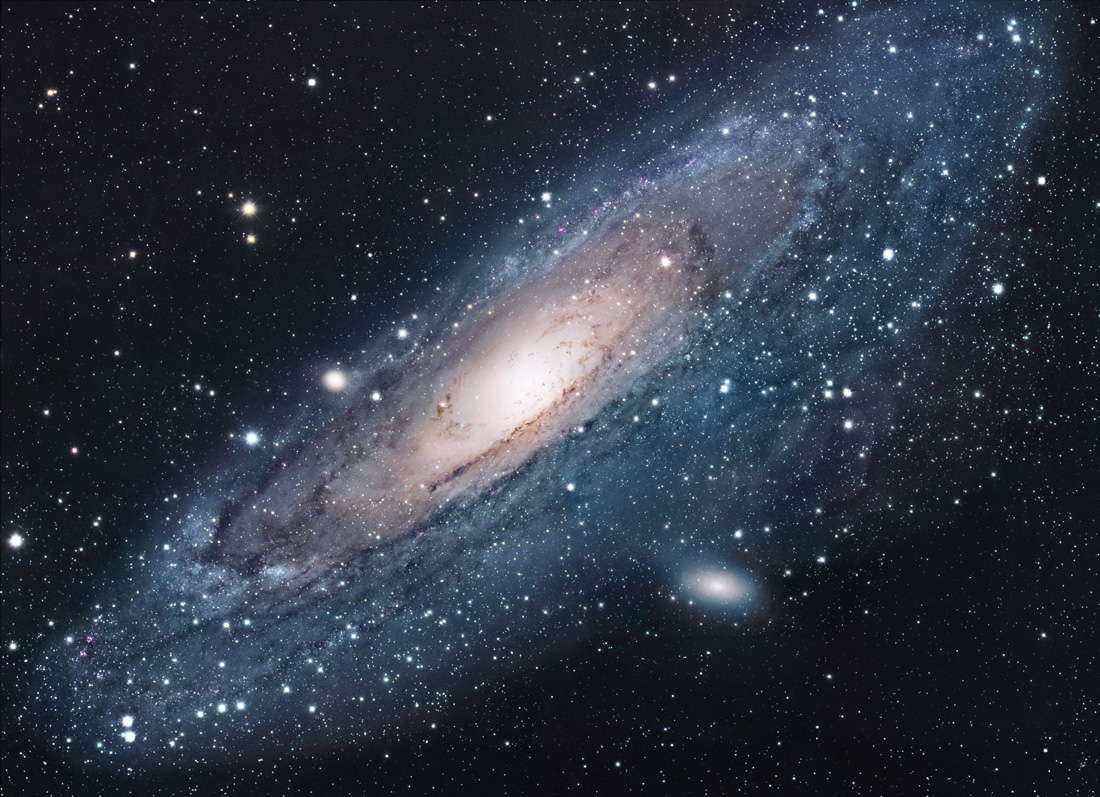 Of course I don’t agree. Without professional astronomers we would never have discovered that, say, the Andromeda Nebula (shown above) was a galaxy just like our own Milky Way containing thousands of millions of stars like our Sun and that it is rotating about its axis with a timescale of hundreds of millions of years. Knowing things like this surely increases the sense of wonder rather than decreasing it?
On the other hand it is true that the nature of science makes it rather prosaic. When scientists try to write for a popular readership they often spice up their accounts with quotations from poems, even if the quotes aren’t really all that appropriate. Perhaps some will turn to this collection for a source of such snippets. I know I will!
Another thing that struck me was that I always tended to think that engagement between science and poetry was a relatively recent thing, typified by WH Auden’s humorously perplexed After Reading a Child’s Guide to Modern Physics:
Our eyes prefer to suppose
That a habitable place
Has a geocentric view,
That architects enclose
A quiet Euclidian space:
Exploded myths – but who
Could feel at home astraddle
An ever expanding saddle?
But in fact the metaphysical poets of the 17th century also grappled with such issues. Consider this fragment from John Donne’s An Anatomy of the World:
We think the Heavens enjoy their spherical,
Their round proportion embracing all.
But yet their various and perplexed course,
Observed in divers ages, doth enforce
Men to find out so many eccentric parts,
Such divers down-right lines, such overthwarts,
As disproportion that pure form….
That could almost have been written about the possibility of a lop-sided universe that I’ve blogged about here and there, and which is a major topic of current cosmological research.
Other reactions I had were more personal. There is a poem in the collection by Fleur Adcock, who visited the Royal Grammar School in Newcastle when I was there. She judged a poetry reading competition (which I didn’t win) for which the test piece was Stevie Smith’s Not Waving but Drowning. I remember that she was quite a glamorous-looking lady, but she got everybody’s name wrong in her presentation address. She must be getting on a bit by now.
I have also met one of the other poets represented here too, Gwyneth Lewis, who was elected the first national poet for Wales and also spent some time as poet-in-residence in the School of Physics & Astronomy at Cardiff University where I now work. She wrote a number of poems about science but is probably most famous for writing the words “In These Stones Horizons Sing” which are incorporated in the design of the facade of the Wales Millennium Centre.
Anyway, I thoroughly recommend this book which is a rich treasury of verse ancient and modern. Some of the lovely things in it are quite new to me and I am definitely going to read more by some of the poets represented in it. That’s the way to use an anthology: go and read more systematically whoever catches your eye.
Being an old-fashioned romantic I think I’ll finish off with an excerpt from William Wordsworth‘s epic The Prelude. Regular readers (both of you) will know that I greatly admire Wordsworth and, for me, The Prelude is one of the highest pinnacles in all of English literature.
The universal spectacle throughout
Was shaped for admiration and delight,
Grand in itself alone, but in that breach
Through which the homeless voice of waters rose,
That dark deep thoroughfare, had Nature lodged
The Soul, the Imagination of the whole.
Science and Stamp Collecting
Posted in Books, Talks and Reviews, The Universe and Stuff with tags Cosmology, extrasolar planets, quasars on November 18, 2008 by telescoperMusing over the comments posted on my (slightly ironic) blog item about exoplanetary ennui, I remembered a piece I wrote for the Times Literary Supplement last summer so I dusted it off, chopped it up, and updated it for presentation here because it expands a bit on the earlier contribution.
If the Sun were the size of a golf ball, then the Earth would be a speck of dust a few metres from it and the nearest star would be hundreds of kilometres away. And this is what it is like in the relatively crowded environment of the Milky Way. The unimaginable scale of our Universe means that astronomy has never really become an experimental science, but has largely remained an observational one, having more in common with, say, archaeology than chemistry or other laboratory-based disciplines. Consequently, even though it is perhaps the oldest science, it is also in some respects the least mature. The absence of the traditional interplay between theory and experiment, the inability to perform repeated experiments under slightly different conditions, and the sheer difficulty of measuring anything at all have stunted its development compared to younger fields. For this reason, one often finds in astronomy certain tendencies that other subjects have largely grown out of, such as an unhealthy mania for classification and nomenclature.
Taxonomy has its place within the scientific method: modern chemistry owes much to Dmitri Mendeleev‘s periodic table; botany could not have progressed without Linnaeus; and the theory of evolution was founded on Charles Darwin‘s painstaking studies on the Galapagos Islands. But arranging things in groups and giving them names does not in itself constitute scientific progress, no matter how systematically it is done. The great experimental physicist Ernest (Lord) Rutherford dismissed this kind of activity as not science but “stamp collecting”.
This brings us to the grand debate that took place in Prague in the summer of 2006 under the auspices of the International Astronomical Union. One of the problems before the IAU’s 26th General Assembly was what to do about the fact that recent investigations have revealed the presence of a number of objects orbiting the Sun that are ostensibly at least as worthy of the name “planet” as Pluto, which in our current textbooks is the ninth one out. Obviously, which objects should be called planets depends on how you define what a planet is. The solar system contains objects of all shapes and sizes, from tiny asteroids to immense gas giants such as Jupiter and Saturn. Where should one draw the line? The original proposal was to increase the number of planets to twelve by admitting some lowly new members to the club, but in the end the IAU decided to demote Pluto to the status of a “dwarf” planet thus restricting the number of true planets to eight. This was a controversial decision, at least in the United States, because the vital vote was taken on the last day of the meeting when most of the US delegates had to take flights home. Pluto was discovered by an American, Clyde Tombaugh, in 1930, so the decision deprived the nation of its only planet-discoverer.
The “no” decision hinged on the adoption of three criteria: that the object be round, i.e. have a shape determined by internal gravitational forces; that it should have cleared its own orbit of debris; and that it should be orbiting our own star, the Sun. None of these has any special scientific value; the resulting decision was therefore pretty arbitrary. Moreover, deep-space observations have led to the discovery of literally hundreds of planetlike objects orbiting other stars. These exoplanets offer much greater prospects for scientific progress into the general theory of planet formation than the few objects that happen to have formed in our particular vicinity, so why are they excluded from the definition? In any case, what have we learned scientifically from the new nomenclature? Pluto is still the same object that it was before August 2006, and astronomers still don’t understand what one can infer from its own particular properties about the general process of planet formation.
So is Pluto a planet?
Who cares? In this case there really is nothing in a name. When I was asked this question on the telephone by a reporter I gave precisely that answer and he was shocked. I’m sure he thought that all that astronomers do is look at things and give them names. There are some that do that, of course, but most of us prefer doing proper science.
In the field of exoplanet research we are seeing real signs of maturity, although current studies are still firmly rooted in the “discovery” and “classificatuion” stage. Witness last weeks press interest in the first directly imaged exoplanets. I am well aware of the immense potential that those pictures have for stimulating interest in science, but there is still a long way to go before this field reaches its prime. That probably makes it an excellent area for young scientists to work in. But ultimately this youthful exuberance should give way to something a bit more serious, which is to go beyond what these discoveries are in themselves and ask what deeper questions they might answer.
One can see many other parallels in the history of astronomy, such as the discovery of quasars in the late 1950s. The first few of these must have generated a huge amount of excitement because they were not at all understood. Within a few years hundreds had been detected by radio observations but their nature remained unknown. The subsequent identification of redshifted hydrogen emission lines in the spectra of these objects led to them eventually being identified as very distant extragalactic sources of immense intrinsic power. By the 1980s quasars were identified as a particular type of active galaxy and placed within a general classification scheme that also involved blazars, Seyfert galaxies, and so on. Nowadays we have samples of tens of thousands of quasar spectra and the interest evolves around how the activity in their nucleus relates to the process of galaxy formation in an expanding Universe and how we can use these objects to map out the large-scale distribution of matter. To an outsider these tasks may seem less glamorous that the early days of quasar research, but that’s what science is like.
At the extreme end of the distance scale of astronomical investigation lies my own field of cosmology, the scientific study of the Universe as a whole. The scale of the solar system is challenging enough, but the cosmos is really big. Until recently, cosmology was so lacking in reliable observational input that it was thought of as a flaky offshoot of astronomy, more a branch of metaphysics than a proper scientific discipline, a paradise for theoreticians whose wildest speculations stood no chance of ever being tested with real measurements. Over the past twenty years or so, however, staggering advances in astronomical instrumentation have allowed astronomers to probe the darkest depths of space, capturing light that has travelled for almost 14 billion years on its way towards us. Theories are now so tightly constrained by these observations that there is very little room for manoeuvre. From this interplay between conjecture and refutation has emerged a cosmological framework that accounts, at least in a broad-brush sense, for how the Universe is constructed and how it is evolving.
There are some important gaps, including some puzzling anomalies, and the precise nature of many of its constituents is yet to be understood, but the establishment of the “concordance model” is a sign that cosmology really has come of age.
Powers and the Playhouse
Posted in Books, Talks and Reviews, Uncategorized with tags Derby Playhouse on October 21, 2008 by telescoper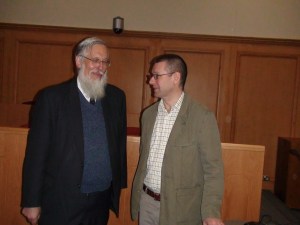
I got this picture this morning from the University of Derby. It was taken at the end of my lecture there last week. The chap on the left of the picture is Jonathan Powers, who is a former pro-vice chancellor of the University of Derby and who introduced my lecture as well as generally acting as master of ceremonies. He’s a very knowledgeable and genial fellow with a huge range of interests.
Over drinks after the talk he told me how he had recently become involved with a campaign to save the historic Derby Playhouse which was recently put into administration and is in danger of demolition if the current rescue package doesn’t work out.
I promised to put in a plug for the campaign, but forgot to do so until the photograph reminded me. You can keep in touch with the campaign and hopefully get involved by visiting their website here.
East Midlands yesterday
Posted in Books, Talks and Reviews on October 16, 2008 by telescoperI travelled to Derby yesterday to give the annual Flamsteed Lecture, named in honour of John Flamsteed who was born in Derby and was the first Astronomer Royal. I was delighted to find out that there was a full house of around 250 in the audience, including a contingent from Derby and District Astronomical Society who had a display outside the lecture hall at the University of Derby.
Curiously the lecture hall itself turned out to be the “Court Room”, a complete mock up of a court complete with witness box, dock and jury box used for training would-be lawyers. Apparently the local police sometimes use it too, for practicing the giving of the evidence. Anyway, I hope in my case it wasn’t too much of a trial for the audience.
After the lecture there was a wine and cheese reception laid on by the University of Derby and the local branch of Waterstone’s stayed open late so I could do a book signing. That seemed to go well too, although it kept me away from the wine. I didn’t keep track of how many books they sold, but every little helps!
When the festivities were over I went back to the Midland Hotel near Derby station where I crashed out as I had to get a very early train back this morning to give a postgraduate lecture on statistics. Rushing to get my slides together on the train I made quite a few mistakes – I hate powerpoint – and found myself having to correct on the fly during the lecture. I also discovered I had accidentally deleted one slide altogether. As I got increasingly flustered, the lecture degenerated into one of the worst I’ve ever done.
This sort of reflective practise, criticizing one’s performance, is supposed to be good for lecturers to do, but I think it’s probably better to prepare things more carefully in the first place, i.e. not on the train first thing in the morning while trying to contend with a hangover.
Still, at least the train wasn’t late.
Shameless Self-promotion
Posted in Books, Talks and Reviews with tags Flamsteed Lecture on October 13, 2008 by telescoper On Wednesday (15th October) I’m going to be travelling up to the East Midlands in order to deliver this year’s prestigious Flamsteed Lecture at the University of Derby. It’s very nice to be asked to give this year’s lecture, especially when there have been so many distinguished speakers in this series the past, including Sir Martin (now Lord) Rees and my thesis supervisor John Barrow. The University of Derby has done a very nice press release describing my talk to go with the nice poster, so I’ll leave it at that.

 In the Dark