Archive for the Cardiff Category

WNO Peter Grimes

Posted in Cardiff, Opera with tags , , , , , , on April 6, 2025 by telescoper

The reason for my flying visit to Cardiff this weekend was to visit the Wales Millennium Centre to catch the opening night of Welsh National Opera’s new production of the Opera Peter Grimes by Benjamin Britten. It was a full house and, being a premiere, there was a fair sprinkling of media types among the crowd. There will no doubt be many reviews but I don’t mind adding to the verbage. I’ve seen this Opera several times and it is one of my favourites in the entire repertoire.

Peter Grimes premiered at Sadler’s Wells in London on 7th June 1945 almost 80 years ago. I wasn’t there – I’m not that old – but I do have an original programme from that season (left), bought in a second-hand bookshop. Perhaps surprisingly, given the grim subject matter and the intense music it was an immediate hit with audiences. Its popularity has not wained. Welsh National Opera gave its first performance in 1946, but is currently facing an uncertain future.

I’ve often heard Peter Grimes described as one of the greatest operas written in English. Well, as far as I’m concerned you can drop “written in English” from that sentence and it’s still true. I think it it’s a masterpiece, fit to rank alongside any by any composer. Searching through the back catalogue on this blog, however, I didn’t find any reviews of it, so the times I’ve seen it must have been before I started blogging back in 2008. I saw an excellent production by Opera North in Nottingham many moons ago, and also remember one at Covent Garden which stuck in my memory for its impressive staging.

Based on a character from the narrative poem The Borough by George Crabbe, the story revolves around the eponymous Peter Grimes, a fisherman, and the inhabitants of a small coastal village in Suffolk. Grimes is by no means a sympathetic character: he is an outcast with no social skills and is prone to fits of violent temper. The Opera begins witha Prologue in which Grimes is in court after the death of his apprentice; he is acquitted of any wrongdoing but the folk of the Borough – apart from the schoolteacher Ellen Orford and retired naval Captain Balstrode – still regard him as guilty. Against all advice, Grimes takes on another apprentice (John) whom he is subsequently suspected of mistreating. When the second boy dies (in accidental circumstances), Grimes flees with the crowd in pursuit. At the end he is given no choice but to take to his boat, sail it out to sea and sink it, taking his own life.

For me the key to the success of this Opera is its treatment of the character of Peter Grimes. In the original poem, Crabbe depicts Grimes is a monstrous figure rather like a pantomime villain. Britten is much more sympathetic: Grimes is misunderstood, a misft who as never been socialised; he just doesn’t know the rules that he should conform to. That’s his tragedy. Britten’s Grimes is not a villain. He’s not a hero either. At one point, shockingly, he even lashes out at Ellen Orford a lady who has shown him nothing but kindness. There’s good and bad in Grimes, like there is in all people. Who of us can say that we don’t share some of the faults of Peter Grimes? And if he’s bad what made him bad? Was he himself abused as a child? Could a little kindness along the way have made him better adjusted?

The Opera not just about Grimes, though. We get a vivid insight into the life of an isolated seaside community: the gossiping hypocrisy of the “good people” of the Borough, the debauchery of the landlady and her two “nieces” who cater to the needs of their male visitors, but above all the importance of the sea in their lives – stressed by Britten’s wonderful interludes describing dawn over the town, moonlight over the sea, and a raging storm. It also sheds light on the common practice of “buying” apprentices from the workhouse, essentially a means of slave labour, a systematic abuse far worse than anything Grimes ever does!

Anyway, to last night’s performance. In short, it was magnificent. The cast was very strong indeed: Nicky Spence shone in the role of Peter Grimes (tenor). Britten wrote the part to suit the characteristics of the voice of his partner, Peter Pears, and it doesn’t suit all tenor voices: the superb arioso When the Great Bear and Pleiades, for example, has dizzying head tones that challenges some singers. Ellen Orford was the excellent Sally Matthews (soprano) and Balstrode was the admirable baritone David Kempster.

I’ll mention three particularly memorable moments, near the end of the opera. The first is after the apprentice John has died; the gorgeous sea interlude Moonlight, which serves as a prelude to the third and final act, is played while the grieving Grimes cradles the lifeless corpse of the boy. The second is when Grimes is on the run, with the chorus calling his name and baying for blood. In fear of his life, he breaks down and is reduced to repeating his own name to himself. I’ve always found that scene unbearably moving and it was that way again last night. Finally, at the very end, the bodies of the two dead apprentices appear, one sprawled on a rock, the other standing eerily in the suspended boat which is tipped up vertically above the stage. When Grimes accepts Balstrode’s advice to drown himself, the two boys come to life; they exchange smiles, hold hands and walk off into the distance. It’s the only time Grimes looks happy in the whole performance. Only in death can he find his peace.

The staging is very spare but cleverly done. The basic set consists of a wet beach sloping up towards the rear above which from time to time a small fishing boat appears, suspended by wires, in a variety of attitudes. Otherwise there is little in the way of scenery. The clever part of this is the use of the dancers of Dance Ensemble Dawns. All the boys’ roles were in fact played by female dancers, including John the second apprentice, a non-speaking role played with great pathos by Maya Marsh whose use of body language was extraordinarily effective. Not only did they portray the boys of the village, often to be found generally misbehaving and taunting Peter Grimes, they also use their movements do evoke the storm in an extraordinarily compelling way. Not content with that they came on from time to time, in stylised fashion, to move scenery and props. The inn, for example, is conjured up by two simple props: a door frame and a window frame, held up by members of the ensemble for other members of the cast to walk or lean through. In all these contributions, the dancers were brilliant.

The simplicity of the staging probably reflects the financial crisis currently engulfing Welsh National Opera. They probably just didn’t have the money to pay for a elaborate sets, but it’s a testament to the skill and creativity of the designers that they were able to pull a triumph out of a financial disaster. I was sitting in the Circle so could see very well into the orchestra pit, where all the musicians of the Orchestra of Welsh National Opera were all wearing “SAVE OUR WNO” t-shirts. They played their hearts out. The WNO Chorus has always been excellent every time I’ve seen them, and last night was no exception.
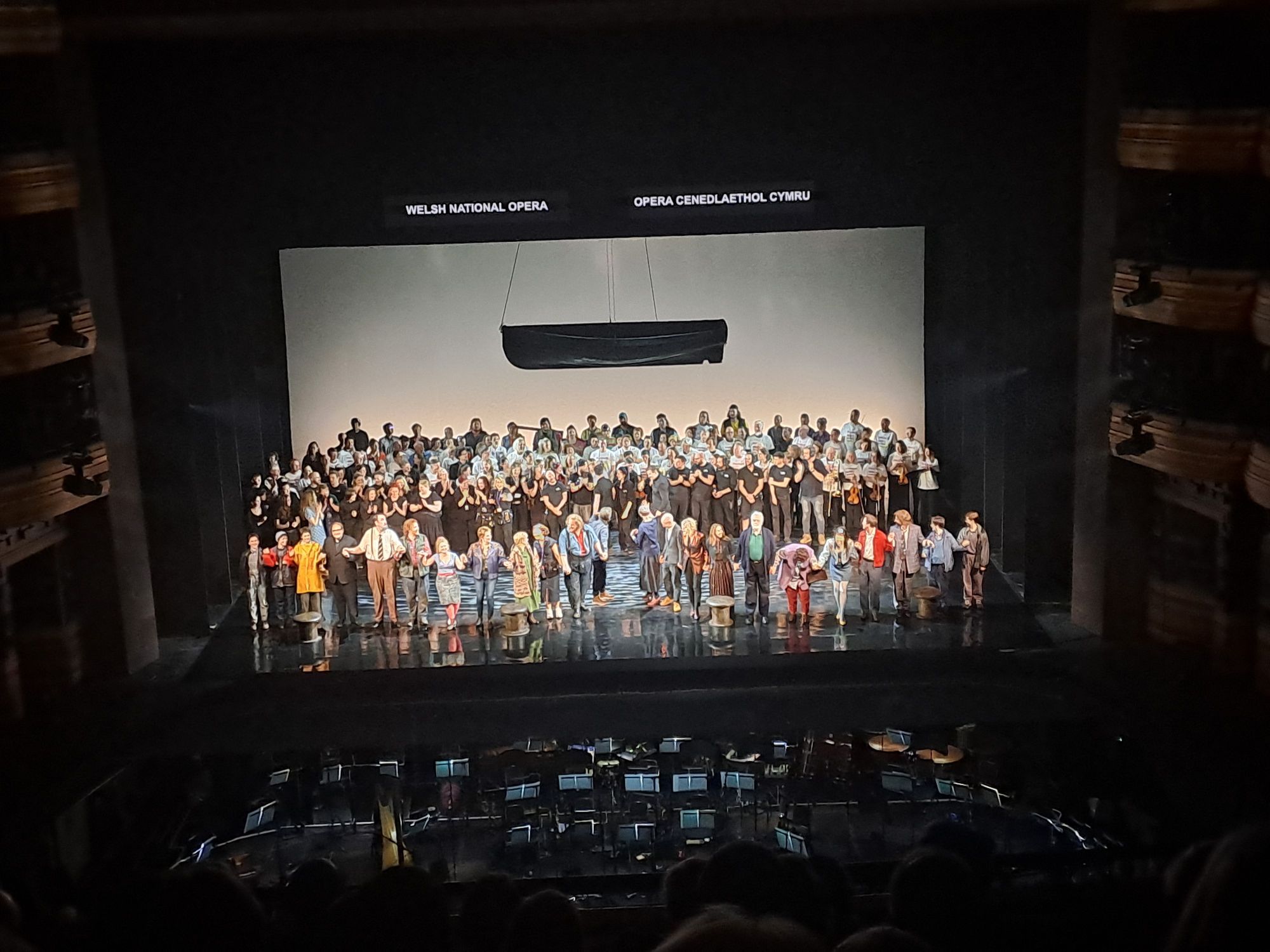
At the end of the opera, the cast, chorus and dancers were joined on stage not only by the entire orchestra (including instruments, where possible) and many members of the technical team. I’ve never seen that happen before! There were speeches by the co-directors of WNO expressing their determination to carry on through the financial turbulence that threatens to drown them. Welsh National Opera is a wonderful part of the artistic and cultural scene not only in Wales but across the rest of the UK and beyond. It just cannot be allowed to wither.

P.S. Last night’s performance was recorded for later broadcast on BBC Radio 3.

A Day in Cardiff

Posted in Art, Biographical, Cardiff, LGBTQ+, Opera, Politics with tags , , , , , on April 5, 2025 by telescoper

I got up at Stupid O’Clock this morning to catch an early morning plane from Dublin to Cardiff. It was very cold when I  arrived but it soon warmed up and turned into a lovely day.

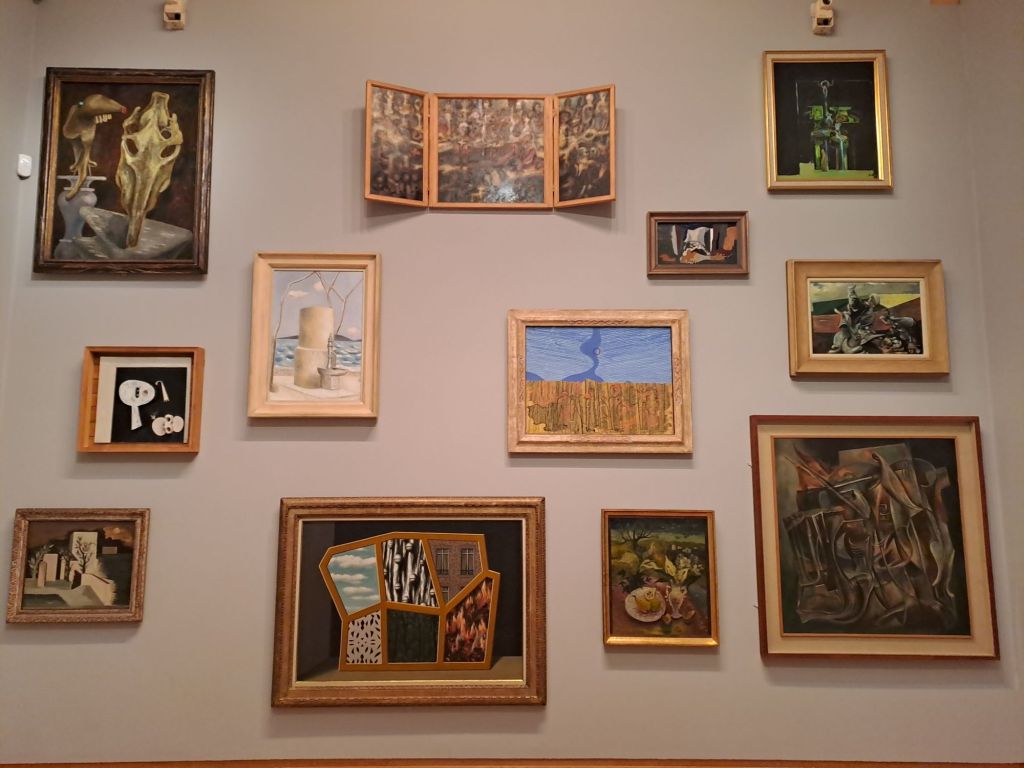
I had a nice breakfast at Bill’s when I arrived in the City then did tour of the National Museum of Wales where there is an exhibition about the Miners’ Strike of 1984/5, from which this display case caught my attention:

I also had time for a round of Name That Artist (scoring a miserable 3/12, for Sutherland, Ernst, and Magritte).

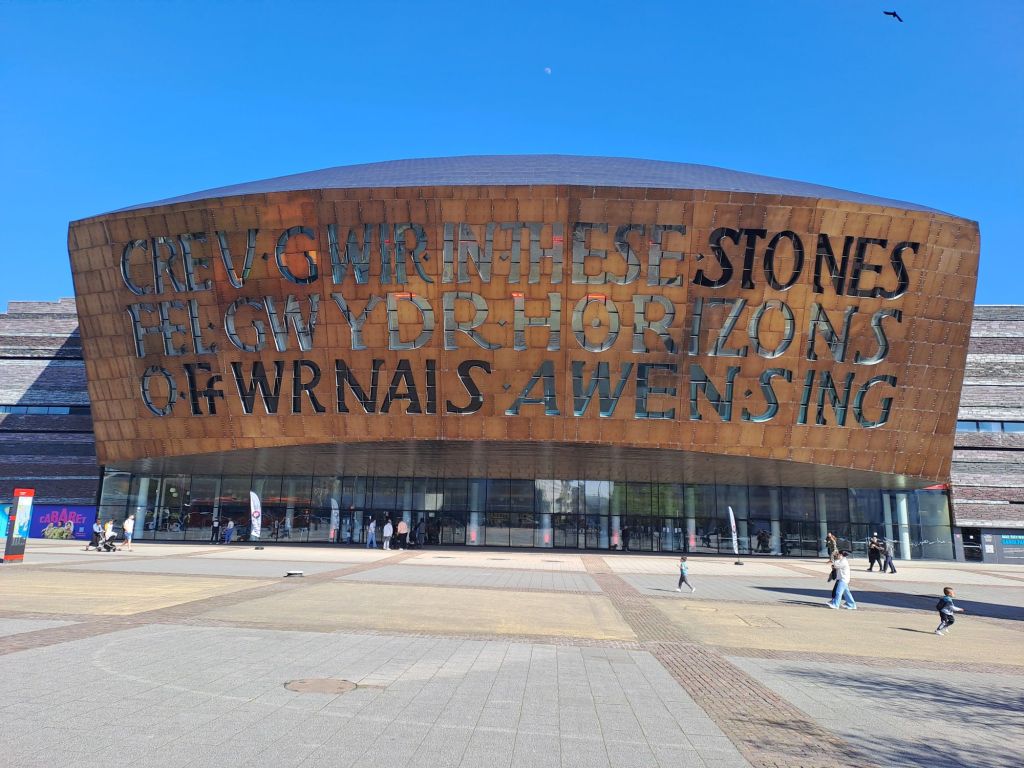
After that, I took a stroll around Bute Park before heading to my hotel in Cardiff Bay to check in and have a rest before the reason for my visit, an event which will take place here at 7pm:

I won’t be able to blog about that until I get back to Maynooth tomorrow afternoon.

Results from the Atacama Cosmology Telescope

Posted in Cardiff, The Universe and Stuff with tags , , , , , , , on March 19, 2025 by telescoper

Today is going to be a very busy day on the cosmology front – with the Euclid Q1 Data Release coming out at 11am GMT – but I’ll start off by sharing news of final data release (DR6) by the Atacama Cosmology Telescope. This was announced yesterday and includes former colleagues at Cardiff University, so congratulations to them and all concerned. Here is a pretty picture showing one of the beautiful cosmic microwave background polarization and intensity maps:

Intensity and Polarization maps from ACT: arXiv:2503.14451

There are three related preprints on the arXiv today:

There’s a lot to digest in these papers but a quick skim of the abstracts gives two pertinent points. First, from the second paper:

We find that the ACT angular power spectra estimated over 10,000 deg2, and measured to arcminute scales in TT, TE and EE, are well fit by the sum of CMB and foregrounds, where the CMB spectra are described by the ΛCDM model. Combining ACT with larger-scale Planck data, the joint P-ACT dataset provides tight limits on the ingredients, expansion rate, and initial conditions of the universe.

They also find that, when combined with CMB lensing from ACT and Planck, and baryon acoustic oscillation data from the Dark Energy Spectroscopic Instrument (DESI Y1), the ACT data give a “low” value for the Hubble constant: H0=68.22 ± 0.36 km s-1 Mpc-1.

The third paper also says

In general, models introduced to increase the Hubble constant or to decrease the amplitude of density fluctuations inferred from the primary CMB are not favored by our data.

The “Hubble tension” remains!

Lecture Recordings Again

Posted in Cardiff, Covid-19, Education, Maynooth with tags , , , , , on March 5, 2025 by telescoper

Long before the pandemic restrictions – was it really five years ago that all that started? – I posted an item about an innovation I encountered when I moved to Sussex in 2013, namely lecture capture facilities which

…allow lecturers to record videos of their own lectures which are then made available for students to view online. This is of course very beneficial for students with special learning requirements, but in the spirit of inclusive teaching I think it’s good that all students can access such material. Some faculty were apparently a little nervous that having recordings of lectures available online would result in falling attendances at lectures, but in fact the evidence indicates precisely the opposite effect. Students find the recorded version adds quite a lot of value to the “live” event by allowing them to clarify things they might not have not noted down clearly.

A few years later, when I did some teaching back in Cardiff, I discovered that lecture recording had become normal practice there too. The main difference was that Sussex had a proper policy on important matters such as who could see the recordings, and what they could be used for, which allayed some staff fears about snooping and the inhibition of academic freedon; the policy at Cardiff had not been fully developed in advance of the rollout of lecture capture, which I think was a big mistake.

Anyway, before the pandemic we didn’t really have any facilities at Maynooth University for recording lectures so it certainly wasn’t normal practice. With the onset of Covid-19 lecture recordings and live streams became the only way to carry out teaching and we lecturers made the best of what we had at home. A couple of years ago, after restrictions were lifted, I posted about a meeting between student representatives and staff in the (then) Department of Theoretical Physics during which students criticized, among other examples of inadequate teaching resources. Part of the reason for this is the drastic shortage of student accommodation which means many students have to commute long distances to campus and have difficulty doing that every day for lectures.

I – and I’m speaking personally here – wish we could offer lecture recordings as routine. Unfortunately, however, and much to my disappointment, Senior Management at Maynooth University has discouraged lecture recording as a matter of policy and has not invested in the technology required to enable it, so it is not practicable anyway.

In my view the benefits of lecture capture far outweigh the disadvantages, and we should incorporate recordings of lectures as part of our standard teaching provision, as a supplement to learning rather than to replace face-to-face sessions. Every student learns in a different way and we should therefore be doing as much as we possibly can to provide a diverse range of teaching resources so that each can find the combination that suits them best. Technology allows us to do this far better now than in the past.

Some really enjoy live in-person lecture sessions, especially the ability to interact with the lecturer and the shared experience with other students, but others don’t like them as much. Others have reasons (such as disability) for not being able to attend in-person lectures, so providing recordings can help them. Others still have difficulty attending all lectures because of a dratic shortage of student accommodation. Why not in any case provide recordings for everyone? That seems to me to be a more inclusive approach.

The problem with lecture capture in Maynooth is that we will need to improve the cameras and recording equipment in the large lecture rooms to make it possible for lectures with a significant mathematical content. The existing setups in teaching rooms do not easily allow the lecturer to record material on a whiteboard or blackboard. In Cardiff, for example, the larger rooms had more than one camera, usually one on the lectern and one on the screen or whiteboard (which has to be placed further away and therefore needs to be of higher resolution). In Maynooth we only have small low-resolution cameras in the teaching rooms. In fact I have far better facilities in my study at home – provided at my own expense – than my employer is prepared to provide on campus.

Anyway, the reason for mentioning all this is that I saw an article today in the University Times (a student newspaper based at Trinity College, Dublin). I can only infer that someone at Trinity has floated the idea of mandatory lecture recordings, because the piece argues against them even with

…established guidelines for their use, re-use, storage, and dissemination, and a ban of their use during industrial action.

I think a properly negotiated agreement with the Trade Union representing staff (e.g. IFUT, of which I am a member) covering these points would allow me to accept mandatory lecture recordings. Worries about covert monitoring or unauthorized dissemination on social media would hopefully be assuaged by such an agreement. A particular issue in the UK, given the current meltdown of its higher education sector, Senior Management may sack lecturers to save money but keep using their recordings. That would be unconscionable, but that doesn’t mean it won’t be tried.

Cardiff University in Crisis

Posted in Cardiff, Education with tags , , on January 28, 2025 by telescoper

I saw in the news today that Cardiff University has announced a series of mergers, closures and widepsread job cuts in order to deal with a financial deficit. If I understand the announcement correctly, the intention is to terminate the equivalent of 400 full-time academic posts, which is over 10% of the academic staff complement. No doubt there will also be job losses among the important professional services and support staff. There is plenty of doubt, however, as to whether they will extend to members of the Senior Management Team who made today’s announcement and who should really be the ones held to account.

Cardiff is by no means the only UK university being decimated in this way. It is just the latest in a long list. The crisis in UK higher education has been brewing since Brexit, and the subsequent reduction in overseas students needed to balance the books in the absence of significant ncreases in tuition fees for UK students. A burst of inflation post-Covid and, more recently, increased National Insurance contributions have taken many institutions to the brink of solvency. That’s the official line. You can add, unofficially, poor decision-making at senior management level, in many cases pursuing expensive and over-ambitious vanity projects that have ultimately proved unaffordable but impossible to cancel.

One has to remember that when university managers make decisions on closing down units, it’s not often on the basis that those units are losing money. For a start, universities operate according to complicated and arbitrary financial models small adjustments to which can easily move a department from black to red or vice versa. Moreover, over half the income of a university is not spent on the front-line activities of teaching and research: a huge slice is absorbed by the central administration to fund “strategic” investments (i.e. risky projects) and of course to pay vast salaries to the VC, PVCs and other assorted cronies. Departments therefore tend to be judged not on whether they can cover their own costs but whether they return a surplus to The Centre.

(Incidentally, while the UK Higher Education sector is in turmoil, there is no sign of vice-chancellor pay packages being cut. Quite the opposite, in fact.)

I’d be the first to admit that running a large university is a difficult job. Even in the lower levels of management as Head of School at Sussex, I agonized over many decisions. During that time I came to the conclusion that being a successful manager of something is very stressful if you actually care about it. This is why so many of the people who prosper in senior university management circles are not people who care at all about what makes a university what it is. They just see everything as a sterile combination of metrics and spreadsheets and boxes to be ticked. This, not the funding shortfall per se, is why universities are experiencing an “existential crisis”.

Anyway, among the specific proposals at Cardiff are the closures of courses and whole Departments in Ancient History, Modern Languages, Music, Nursing and Religion & Theology. Job cuts (or, as the announcement puts it, “reductions in staff FTE”) will affect (among others) the Schools of Biosciences, Chemistry, Computer Sciences, Engineering, Mathematics, and Medicine. The list of Schools to face job losses look to me to be mainly those who had relied strongly on overseas students as a source of revenue, a source which must have dried up.

Another proposal (one of four mergers of Schools) involves the creation of a new School of Natural Sciences formed by merging Chemistry, Earth Sciences and “Physics”. The latter should be “Physics & Astronomy“, not “Physics”. I hope that carelessness is not typical of the forthcoming process. Physics & Astronomy is not earmarked for losses of academic jobs, but the merger is almost certainly intended to allow cuts in support staff. As per the above paragraph, Chemistry staff will be cut, so the new School of Natural Sciences will not be off to a happy start.

I worked at Cardiff University for many years, and am in regular touch with a number of friends and former colleagues still there, so this news is very distressing. All I can do is offer a message of solidarity and encourage everyone who is not in a Union to join immediately! I have a terrible feeling that today’s announcement is only the start.

2024 in Retrospect

Posted in Barcelona, Biographical, Cardiff, Maynooth with tags , , , , , on December 31, 2024 by telescoper
What we call the beginning is often the end
And to make an end is to make a beginning.
The end is where we start from.

T. S. Eliot, from Little Gidding, the last of the Four Quartets.

I wasn’t really planning on posting a retrospective of the year 2024, but the rain is pouring down outside so I’ve decided to use up a bit of time before going out in the hope that the rain stops.

The past year has been very busy with significant life events. One particular highlight has to be a wonderful once-in-a-lifetime trip to Sydney in February. I don’t know if I’ll ever get the chance to visit Australia again, but if I do I’ll take it! Shortly after returning from that trip I went back to Barcelona until the summer, leaving briefly for visits to Rome (Euclid Consortium Meeting), Valencia (Department Colloquium), Newcastle (to do a PhD examination) and Oxford (to give the inaugural Pride talk at the Department of Physics).

Unfortunately, at that point my laptop gave up the ghost so I had to come back to Maynooth a little earlier than planned to salvage what was on it and get a new one. And so ended my sabbatical. I’d like to take the opportunity again to thank everyone at the Universities of Barcelona and Sydney for making me feel so welcome and, of course, to Maynooth for granting me a full-year sabbatical in the first place.

As well as giving me some time for my own research, the year saw significant progress with the Open Journal of Astrophysics, both in terms of numbers of papers published (120 in 2024) but also some much-needed work on automation and an increase in the size of the Editorial Board. It’s hard to predict what will happen in 2025, but I’m glad that a significant number of members of the astrophysics community seem to be regarding OJAp as a viable avenue for communicating their results.

I will also mention – for those that care – that the Open Journal of Astrophysics is now listed in Scopus, but all the numbers they have published about the journal are inaccurate. I have spent months trying to get them to correct the figures but, although they have admitted errors, they have failed to do so. My next step will be to take legal action against Scopus (which is based in The Netherlands) under the Dutch Civil Code.

The big event workwise at Maynooth was the merger of the Departments of Theoretical Physics and Experimental Physics into a single Department of Physics. So far this has been largely paper exercise. What will result from it in the long term remains to be seen. I was given two new modules to teach last Semester and have another new one next Semester (as well as one I’ve done before). Although this made for a heavy workload, it wasn’t as bad as what happened after the only other sabbatical I’ve had in my career. I got a one Semester sabbatical when I was at Nottingham, but the Department simply moved my first-semester teaching to the second semester in addition to what had already been allocated for the second, so I had a double teaching load when I got back!

There has been a significant change in my personal circumstances too. During 2024 I finally completed the sale of my former home in Pontcanna, Cardiff. I had intended to do this years ago, but the pandemic and subsequent workload issues made it difficult to travel and sort this matter out. In the meantime bought my house in Maynooth with a mortage so I owned two properties, one of which was empty for much of the time. After much stopping and starting, and being badly let down by more than one prospective buyer, the Cardiff house is now sold. I now feel much less delocalised. I also felt very rich when the proceeds hit my bank account, but only briefly. I used a big chunk to pay off my mortgage and put the rest into fixed-term investments for retirement.

Anyway, writing about Sydney reminded me that there are parts of the world in which it is 2025 already, so let me end with a “Happy New Year” and a few interesting numerological facts about the number 2025:

P.S. It’s still raining.

P.P.S. Athbhliain faoi shéan agus faoi mhaise daoibh! 

Nearly there…

Posted in Biographical, Cardiff, Education, Maynooth with tags , , , on December 19, 2024 by telescoper

Today I completed the lectures for one of my modules, the one on Differential Equations and Transform Methods for Engineering students, and gave the penultimate lecture for Differential Equations and Complex Analysis for final-year Mathematical Physics students. Both were revision lectures. As campus has been very quiet for the last few days I didn’t expect many (if any) students to show up for either of these classes, but some did, although numbers were a long way down on the start of the year.

Campus is always quiet this close to the holiday, but this time there has been a bug going around which has led to a few more absences than usual among students. Some staff have been affected too. I had a mild dose of whatever it was earlier in the week but got over it relatively quickly.

Tomorrow, the last day of Semester 1, I have my last lecture of this term, followed by a couple of final-year project presentations. Then that’s it until 2025. I am already thinking about what to do tomorrow evening to mark the end of term. I haven’t reached any definite conclusions yet, but it will almost certainly involve wine. Then I suppose I’ll have to start my Christmas shopping which will include buying more wine.

I am a bit flush this week because I’ve finally received rebates of overpayment from OVO Energy and Dŵr Cymru Welsh Water relating to my former house in Cardiff. I sold this property months ago, after much tedious to-ing and fro-ing, but getting money back from utility companies is like getting blood out of a stone. OVO Energy were particularly bad, violating their statutory obligations. The offer3d me £60 additional payment in recognition of this but, although they eventually settled the bill, they never paid the compensation. It seems they just lied.

In contrast, and giving credit where it’s due, I am grateful to Cardiff City Council for paying back my overpaid Council Tax very promptly.

The Cuts in UK Higher Education

Posted in Biographical, Cardiff, Education, Maynooth, Politics with tags , , , , on November 28, 2024 by telescoper

Today friend of mine send me a message pointing out that in order to save money the University of Sussex is planning to make about 300 staff redundant; you can see an article about it in the Times Higher here. For the time being it seems the plan to make these savings via a voluntary severance scheme. I don’t know whether academic and administrative staff will be treated equally, either.

This is grim news. I worked at Sussex from 2013 until 2016 when I resigned my post as Head of School of Mathematical and Physical Sciences. I took that decision largely for personal reasons but there were professional reasons too. From 2013 the University had embarked on an ambitious growth plan based on buoyant student numbers and the fee income generated thereby. Staff numbers grew too, to cope with the increased demand for teaching. Unfortunately the management was unable to match this with real improvements in infrastructure, largely due to the disastrous outsourcing of campus estates and services. Many promises made to me as Head of School by Senior Management were broken. I wasn’t the only Head of School to compain of this, either. Although things were still going relatively well when I left in 2016, and I was optimistic for the future of the School then, there were severe risks to its financial stability if student recruitment dived. Sadly, that’s exactly what happened. Falling student numbers – especially from overseas – left the institution very vulnerable, especially since the fee per student did not change. That problem was exacerbated by a burst of inflation. AlthoughIt has clearly been a very difficult time for the University of Sussex, largely due to national and international forces beyond its control, but exacerbated by ineffective, and at times incompetent, institutional management. It should be said also that many University leaders enthusiastically embraced the fees-based system that has led their institutions where they are now, though most of them have now departed and left others to carry the can.

It worries me that Maynooth University is also trying to grow very quickly, without adequate investment in infrastructure especially teaching. It isn’t increasing the number of academic staff much either, preferring to hire more and more managers; yet another such position was advertised this week. I don’t know whether Maynooth’s financial trajectory will follow that of Sussex. The funding environment is very different in Ireland compared to the UK, so it may not. It is clear that the enviroment for education and research here is being steadily degraded by the current leadership.

Anyway, when I saw the announcement about Sussex, I checked other Universities I’ve worked in over the years. There’s a list here. It seems that while there are particular factors at play at Sussex, there are similar difficulties across the Board. Cardiff University has a deficit of £35 million and the VC has refused to rule out compulsory redundancies there. I’m not sure how this is all affecting the School of Physics & Astronomy. Nottingham University, where I worked from 1999 to 2007, has deficit of £30 million, in response to which it has opened a voluntary severance scheme, introduced hiring freezes, cut non-pay budgets, and refused to renew 500 fixed-term contracts.

There certainly are cold winds blowing across the University landscape in the United Kingdom, and there is no sign of any respite. This is just the start.

The Mark Brake Scandal, 15 years on…

Posted in Cardiff, Education with tags , , , , on October 20, 2024 by telescoper

This blog has been going for over 16 years now. Those readers who have been following it all that time will remember that in October 2009, 15 years ago, I posted an item about Mark Brake, a Professor at the University of Glamorgan who falsely claimed on a funding application that he had a PhD from Cardiff University. I thought for old times’ sake I would post the article again…

P.S. This story was responsible for me being threatened with a libel action. My response was to pass on the name and address of my solicitor with the message “Go ahead. Make my day” (or words to that effect). I never heard back.

P.P.S. The University of Glamorgan no longer exists as such, as in April 2013 it merged with University of Wales, Newport, to form the University of South Wales

Back to A-level Again

Posted in Cardiff, Covid-19, Education with tags , , , on August 16, 2024 by telescoper

Yesterday was the day that students in United Kingdom received this year’s A-level results. It seems the number of students getting the highest grades went up in England but down in Wales and Northern Ireland. That difference could be because of the timing of the transition from Covid-19 adjustments, with marks in Wales and Northern Ireland only returning to pre-pandemic levels this year; this may disadvantage applicants to universities this year, of course.

Another thing worth mentioning is that the number of students taking Physics A-level has increased by 12% this year, reversing a recent downward trend. In Physics, 31.5 per cent of students achieved the top grades. This was an increase from last year when 30.8 per cent were awarded an A or A*. That probably means that most students who applied to do Physics at university will get a place in their first-choice institution.

As always my advice to students who got disappointing results is

There’s always the clearing system and there’s every chance you can find a place somewhere good. If you’re reading this blog you might be interested in Physics and/or Astronomy so I’ll just mention that both Cardiff and Sussex have places in clearing and both are excellent choices.

At least you’ve got your results; students here in Ireland will have to wait next Friday (23rd August) to get to get theirs – not in the form of GCE A-levels, of course, but the School Leaving Certificate. I have been away all year so don’t know how admissions have been going for Maynooth but the intention seems to be to increase student numbers in any way possible despite the already huge student-staff ratio (the highest in Ireland) and lack of student accommodation. Anyway, Covid-19 adjustments are still in place in Ireland so the artificial inflation of Leaving Certificate grades will continue. It seems the Government doesn’t know how to get out of the system it has locked itself into and is intent on leaving it for the next Government to sort out.