Archive for the Education Category

Break Points

Posted in Biographical, Education, Maynooth with tags , , , on August 11, 2023 by telescoper

Well, that’s one reasonably large set of tasks finished. Today I completed the grading of my repeat examinations. The marks are now checked and uploaded to the system. For good measure, I also checked the marking of a few papers done by other staff. So that’s all done and dusted in time for a meeting of the Examination Board next week at which we’ll peruse the outcomes.

It’s strange to think that this will be the last set of examinations I have to correct until January 2025. I’m away on sabbatical from September 1st 2023 until 31st August 2024 so have no teaching duties until the First Semester of 2024, with examinations coming the following January. Although I realize the assessment of student learning is important, setting and marking examinations is not something that I greatly enjoy so it will be very nice to have a break from it.

Earlier this week the President of Maynooth University sent around a missive to all staff about the news that had leaked out about the proposed merger with Dundalk IT. That email referred twice to the “summer break”. It is ironic that such wording should be used right in the middle of repeat examination period. The last few weeks certainly haven’t felt like a break to me! It’s yet another indication of the gulf between the view that Senior Management have of academic life and the reality.

By the way, the aforementioned Presidential circular promised that staff would be fully updated in the Autumn about the proposed merger. I hope in this new spirit of openness the President will also update staff about the outcomes of the “Staff Climate and Culture Survey” which was carried out in 2022. The promise was made then that results would be published in early 2023. No such results have ever been communicated to staff and all mention of this survey has been wiped off the University’s web pages.

Having finished exam marking duties for the academic year, my attention will now turn to other things to be done before I take off for sabbatical land. Next week I have cleared the decks to complete a paper I’ve been struggling over for a long time. Just before the repeat examinations started I spotted the error that was holding me back, so hopefully it will now all fall quickly into place. I’ll be very happy if I can get that submitted before leaving.

In the mean time, though, it’s time for a wine break. Cheers!
ITP 2023 at Maynooth

Posted in Biographical, Education, Maynooth, The Universe and Stuff on August 9, 2023 by telescoper

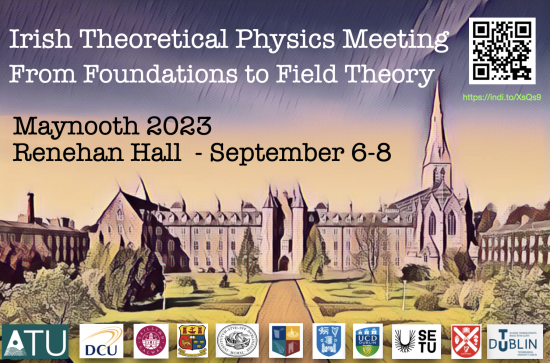
I’m a bit preoccupied at the moment with marking repeat examinations but, now that I have three packs done and only one to go, I thought I’d do a quick advertisement for a little meeting that takes place in Maynooth about a month from now. This is the annual Irish Theoretical Physics (ITP) Meeting which takes place in a different location in Ireland each yea. Last year it was at DIAS in Dublin; this year it’s Maynooth’s turn.

In the pat these meetings have been given different names, including Irish Quantum Foundations (IQF) and Irish Quantum Field Theory (IQFT), as well as ITP. For this reason I usually refer to it as ITPQF+…

You can find out more about the meeting here, including instructions on how to register should you wish to do so! The detailed scientific programme will be announced in due course, though there is a rumour that I might be giving a public talk on the first evening.

The Existentialist University: A Strategic Plan for Authentic Learning

Posted in Education, Maynooth with tags , , on August 8, 2023 by telescoper

Guess who has been playing with an AI text generator again?

I. Introduction

In the vast cosmos of knowledge, we find ourselves, a university, a microcosm of the universe itself. We are not merely an institution, but a collective entity, a gathering of minds seeking to understand the essence of existence. Our strategic plan, therefore, is not a mere roadmap, but a philosophical treatise, a reflection of our existentialist ethos.

II. Vision

Our vision is to cultivate an environment where students are not just passive recipients of knowledge, but active seekers of truth. We aim to foster a culture of questioning, where the essence of learning is not in the answers, but in the pursuit of questions. We envision a university where education is not a means to an end, but an end in itself.

III. Mission

Our mission is to create a space where students can confront the absurdity of existence, and find meaning in their own individuality. We strive to nurture minds that are not confined by societal norms, but are free to explore the depths of their own consciousness. We aim to produce graduates who are not just equipped with skills, but with the courage to face the existential angst of life.

IV. Core Values

1. Authenticity: We value authenticity over conformity. We encourage our students to be true to themselves, to embrace their uniqueness, and to resist the pressure to fit into predefined molds.

2. Freedom: We uphold the freedom of thought, the freedom to question, and the freedom to dissent. We believe that true learning can only occur in an environment where minds are free to explore, to challenge, and to innovate.

3. Responsibility: We emphasize the responsibility that comes with freedom. We instill in our students the understanding that they are the authors of their own lives, and that every choice they make shapes their destiny.

V. Strategic Goals

1. Curriculum Development: To develop a curriculum that encourages critical thinking, fosters existential inquiry, and promotes self-discovery.

2. Faculty Development: To attract and retain faculty who are not just experts in their fields, but are also committed to our existentialist ethos.

3. Student Engagement: To create opportunities for students to engage in meaningful dialogues, to participate in existential debates, and to express their individuality.

4. Community Engagement: To extend our existentialist ethos beyond the university, and to engage with the wider community in discussions about the meaning of life, the nature of existence, and the purpose of education.

VI. Conclusion

In the face of an ever-changing world, our strategic plan is not a rigid blueprint, but a flexible guide. It is a reflection of our commitment to existentialist principles, and our belief in the power of education to transform lives. We invite all members of our university community to join us in this existential journey, as we strive to create a university that is not just a place of learning, but a space for authentic living.

Lá Saoire i mí Lúnasa

Posted in Biographical, Education, Maynooth with tags , , , on August 7, 2023 by telescoper

Today, Monday 7th August 2023, being the first Monday in August, is a Bank Holiday in Ireland. This holiday was created by the Bank Holiday Act of 1871 when Ireland was under British rule. While the August Bank holiday was subsequently moved to the end of August in England and Wales, it has remained at the start of August in Ireland. Today is also a Bank Holiday in Scotland, though the Scots have the best of both worlds and have a holiday at the end of August too.

I recently mentioned that 1st August marks the old Celtic festival of Lughnasadh, named after the God Lugh, on which is celebrated the beginning of the harvest season. This coincides with the English Lammas Day one of many Christian festivals with pagan origins. Traditionally this marks the start of the harvest season and is celebrated accordingly, with rites involving the first fruit and bread baked from flour obtained from the first corn. It is also one of the cross-quarter days, lying roughly half-way between the Summer Solstice and the Autumnal Equinox (in the Northern Hemisphere).

In the Northern hemisphere, from an astronomical point of view, the solar year is defined by the two solstices (summer, around June 21st and winter, around December 21st) and the equinoxes (spring, around March 21st, and Autumn, around September 21st). These four events divide the year into four roughly equal parts of about 13 weeks each.

Now, if you divide each of these intervals in two you divide the year into eight pieces of six and a bit weeks each. The dates midway between the astronomical events mentioned above are (roughly) :

  • 1st February: Imbolc (Candlemas)
  • 1st May: Beltane (Mayday)
  • 1st August: Lughnasadh (Lammas)
  • 1st November: Samhain (All Saints Day)

The names I’ve added are taken from the Celtic/neo-Pagan (and Christian terms) for these cross-quarter days. These timings are rough because the dates of the equinoxes and solstices vary from year to year. Imbolc is often taken to be the 2nd of February (Groundhog Day) and Samhain is sometimes taken to be October 31st, Halloween. But hopefully you get the point.

It seems to be a tradition in Maynooth that the Bank Holidays in May and August are are adjacent to examinations. This year the repeat examinations began on 1st August. My first paper (of four) was on Saturday and I have two more on Tuesday (tomorrow). That means by the end of tomorrow I will have three packets of scripts to mark…

There are two ways of looking at the fact that the day before these exams is a holiday. One is that students have an extra day to revise. Another is that the holiday is ruined by having to prepare for examinations.

Anyway, by the time the Solstice arrives I will hopefully away on sabbatical.

Defend Democracy at Maynooth University

Posted in Education, Maynooth with tags , on August 3, 2023 by telescoper

A few weeks ago I mentioned on this blog the appalling decision by the President to scrap elections to the Governing Authority of the University in favour of having representatives chosen only by The Management. This contempt for democratic processes is just one example of the increasingly authoritarian administration of the University. Can anyone justify the complete disenfranchisement of the staff of the University from the governance of the University? Or that an executive body should itself select the board to which it is supposed to be accountable?

Within the last week, an article appeared in the Independent that contained the following:

A university spokeswoman said the governing authority “is reflecting on the recent feedback from some staff about the process for establishing a new governing authority”. The new governing body was to be put in place later this year. “The governing authority is scheduled to meet on August 22 to consider the most appropriate way forward on this issue,” she added.​

Independent, Sunday 30th July.

Note the use of an “anonymous spokeswoman”. I have no idea who this person is, nor who gives her authority to speak on behalf of the governing authority. This state of affairs is symptomatic of the complete detachment of The Management from the rest of us at the University. The story suggests that the University is going to consider different options for appointments to the new Governing Authority. Perhaps it should have considered a bit more before trying to ram through a massively unpopular process that has brought the management into such disrepute that its poor governance is now appearing regularly in the news media?

Anyway, in my opinion the only sensible approach is to restore elections to the Governing Authority. I’m not the only one to think this. In fact there is a petition raised by the Union IFUT:

We call on Maynooth University to reverse their decision to instigate selection and to restore the democratic election process for all five staff representatives on the Governing Authority.

It goes on to say

The decision by MU’s Governing Authority and senior management to replace democratic elections with a selection process, whereby they assume, with the assistance of a private recruitment firm, the responsibility of handpicking staff representatives, is an attack on basic principles of democracy and good governance.

I agree with this wholeheartedly, and have signed the petition. I encourage you to do likewise. You can sign it here. And please spread the news of the petition as widely as you can. This is a battle we can’t afford to lose, as experience suggests it is the thin end of a very sinister wedge.

I’ll just add a more general point. If The Management thinks that the deliberate alienation of its staff is a recipe for a successful high education institution then it has another think coming. Perhaps it should consider working with its academics rather than against them?

A Marxist University Strategic Plan

Posted in Education, Politics with tags , on August 2, 2023 by telescoper

I asked an AI text generator to write a University strategic plan using language inspired by revolutionary Marxist ideology. 

–0–

Title: A Revolutionary Blueprint for the Liberation of Academia

Introduction:

In a world plagued by capitalist exploitation and class struggle, our University stands as a potential beacon of hope, empowering the masses through education and disseminating revolutionary knowledge. This strategic plan aims to dismantle oppressive structures, challenge the prevailing bourgeois ideology, and create a training ground for future Marxist revolutionaries.

1. Mission Statement:

Our mission is to cultivate a class-conscious academic community that aims to dismantle the prevailing capitalist neoliberal order, liberate the proletariat, and build a socialist society based on equality, justice, and collective ownership of the means of production.

2. Curriculum Reform:

a) The fundamental aim of our curriculum will be to decolonize knowledge, expose the hidden power dynamics embedded within it, and weave an emancipatory narrative from a Marxist perspective.

b) Introduce mandatory courses on critical theory, historical materialism, and class struggle that challenge dominant paradigms.

c) Ensure that the curriculum reflects the experiences and ideas of historically marginalized groups, giving voice to their struggles and promoting solidarity among all oppressed peoples.

3. Faculty and Staff:

a) Establish strict selection criteria to ensure that faculty and staff align with our revolutionary vision and principles, actively engage in anti-capitalist research and activism, and prioritize pedagogical engagement.

b) Encourage the formation of faculty and staff unions to safeguard against exploitation, regularly review salaries to ensure equitable compensation, and provide opportunities for professional development.

c) Encourage the recruitment of scholars from historically oppressed communities, diversifying perspectives and challenging dominant knowledge production.

4. Campus Community:

a) Create safe spaces for open discussions and political organizing, fostering an environment that encourages class-consciousness, solidarity, and resistance.

b) Establish student support systems that address financial burdens, mental health struggles, and any form of discrimination or oppression.

c) Promote democratic decision-making processes in all aspects of university governance, where students, faculty, and staff have equal voices in shaping the university’s direction.

5. Research and Activism:

a) Encourage and support research that critically examines capitalist exploitation, exposes the contradictions of the system, and offers alternatives for a just socialist society.

b) Forge alliances and partnerships with grassroots organizations, labour movements, and other revolutionary groups to nurture a culture of activism and revolutionary praxis.

c) Prioritize research that positively impacts working-class communities, seeking solutions to their pressing problems and involving them in the research process.

6. Community Engagement:

a) Forge strong ties with working-class communities, initiating outreach programs that offer educational resources and promote social mobility.

b) Establish partnerships with trade unions and labor organizations to provide students with opportunities for practical learning and connection to real-world struggles.

c) Collaborate with progressive organizations to advocate for policy changes that address socio-economic inequalities and pave the way for a socialist transformation.

Conclusion:

This strategic plan strives to create an academically rigorous, politically conscious, and inclusive environment that nurtures critical thinking, challenges capitalist hegemony, and empowers students, faculty, and staff towards the emancipation of the working class. By implementing these measures, our University will become a bulwark of Marxist education, fostering the next generation of revolutionaries who will shape a society based on justice, equality, and liberation.

The Battle of Mission Drift

Posted in Education, Maynooth on August 2, 2023 by telescoper

Here is a concise description of the effect on the morale of academic staff at Maynooth University of the current strategy of expanding the number of senior administrators at Maynooth University at the expense of resources for teaching and research.

Autumn Repeats

Posted in Education, History, Maynooth with tags , , , , , , on August 1, 2023 by telescoper

It’s August already, which means it is time once again for the repeat examination period to begin. Maynooth University has produced this nice good luck message for those resitting so I’ll pass it on here:

I was a bit surprised when I first arrived here that the August repeat examinations are called the Autumn Repeats. After all, they start on 1st August which is generally regarded as summer rather than Autumn. The term is, I think, a relic of the old Celtic calendar in which the start of Autumn coincides with the start of harvesting, the old festival of Lúnasa being when people celebrated the Celtic deity Lugh, who would bring a good harvest or who, if not satisfied, could bring his wrath in storms that would mess everything up. Lúnasa is the name for August in modern Irish; Lá Lúnasa is 1st August, a cross-quarter day lying (approximately) half-way between the summer solstice and the autumnal equinox. The festival is marked in the modern calendar by a Bank Holiday on the first Monday in August (Lá Saoire i mí Lúnasa) which is next Monday (7th August), so I have a long weekend to look forward to!

Anyway, the repeat examinations start today and go on for ten days or so, except there are none on the Bank Holiday when the University is closed. As it happens, my first paper is on Saturday, so I won’t be able to collect any scripts until Tuesday 8th, on which day I have two further examinations, so I’ll have three different sets to deal with.

Every year at this time I mention the difference between the system of repeats in Maynooth compared to other institutions with which I am familiar, especially in the UK. Students generally take resits when, because they have failed one or more examinations the previous May, they have not accumulated sufficient credits to proceed to the next year of their course. Passing the resit allows them to retrieve lost credit, but their mark is generally capped at a bare pass (usually 40%). That means the student gets the credit they need for their degree but their average (which determines whether they get 1st, 2nd or 3rd class Honours) is affected. This is the case unless a student has extenuating circumstances affecting the earlier examination, such as bad health or family emergency, in which case they take the resit as a `sit’, i.e. for the first time with an uncapped mark.

Here in Maynooth, however, the mark obtained in a repeat examination is usually not capped. Indeed, some students – though not many – elect to take the repeat examination even if they passed earlier in the summer, in order to increase their average mark.

Some people don’t like the idea of uncapped repeats because they feel that it would lead to many students playing games, i.e. deliberately not taking exams in May with the intention of spreading some of their examination  load into August. There’s not much sign of students actually doing that here, to be honest, for the reason that the results from the repeat examination period are not confirmed until early September so that students that deploy this strategy do not know whether they are going to be able to start their course until just a couple of weeks before term. That could cause lots of problems securing accommodation, etc, so it doesn’t seem to me to be a good ploy.

I’d welcome comments for or against whether resits/repeats should be capped/uncapped and on what practice is adopted in your institution.

Last Call for the Maynooth MSc in Theoretical Physics & Mathematics!

Posted in Education, Maynooth with tags , , on June 26, 2023 by telescoper

While I remember, here’s another plug for our new MSc course in Theoretical Physics & Mathematics, further details of which may be found here. Maynooth University offers Taught Masters Scholarships for high-flying applicants but you need to apply by 30th June to get one, which is why I’m advertising this one more time.

The new postgraduate course will be run jointly between the Departments of Theoretical Physics and Mathematics & Statistics, with each contributing about half the material. The duration is one calendar year (full-time) or two years (part-time) and consists of 90 credits in the European Credit Transfer System (ECTS). This will be split into 60 credits of taught material (split roughly 50-50 between Theoretical Physics and Mathematics) and a research project of 30 credits, supervised by a member of staff in a relevant area from either Department.

This new course is a kind of follow-up to the existing undergraduate BSc Theoretical Physics & Mathematics at Maynooth, also run jointly. We think the postgraduate course will appeal to many of the students on that programme who wish to continue their education to postgraduate level, though applications are very welcome from suitably qualified candidates who did their first degree elsewhere.

Postgraduate admissions in Ireland operate differently from the UK, in that there is a central system in Ireland (called PAC) that is similar to the undergraduate admissions system; in the UK PG courses are dealt with by individual institutions. You will need to apply online via PAC after the following the instructions here. The requisite PAC code for the full-time version of the course is MHQ56.

Examinations, Past and Future

Posted in Biographical, Education, mathematics, Maynooth with tags , , , , , on June 7, 2023 by telescoper

No sooner is yesterday’s departmental Examination Board done and dusted (after just two and a half hours) when attention switches to school examinations. The Junior Certificate and Leaving Certificate examinations both start today, so the first thing I need to do is wish everyone taking examinations the very best of luck!

Among other things, the results of the leaving certificate examinations are important for next year’s University admissions. As we gradually dispense with the restrictions imposed during the pandemic, it seems this year we just might have the results before the start of teaching at the end of September. That will make a nice change!

In the system operating in England and Wales the standard qualification for entry is the GCE A-level. Most students take A-levels in three subjects, which gives them a relatively narrow focus although the range of subjects to choose from is rather large. In Ireland the standard qualification is the Leaving Certificate, which comprises a minimum of six subjects, giving students a broader range of knowledge at the sacrifice (perhaps) of a certain amount of depth; it has been decreed for entry into this system that an Irish Leaving Certificate subject counts as about 2/3 of an A-level subject for admissions purposes, so Irish students do the equivalent of at least four A-levels, and many do more than this. It’s also worth noting that all students have to take Mathematics at Leaving Certificate level.

Overall I prefer the Leaving Certificate over the UK system of A-levels, as the former gives the students a broader range of subjects than the latter (as does the International Baccalaureate). I would have liked to have been allowed to take at least one arts subject past O-level, for example.

For University admissions points are awarded for each paper according to the marks obtained and then aggregated into a total CAO points, CAO being the Central Applications Office, the equivalent of the UK’s UCAS. This means, for example, that our main Science pathway at Maynooth allows students to study Physics without having done it at Leaving Certificate level. This obviously means that the first year has to be taught at a fairly elementary level, but it has the enormous benefit of allowing us to recruit students whose schools do not offer Physics.

As much as I like the Leaving Certificate, I have concerns about using a simple CAO points count for determining entry into third-level courses. My main concern about is with Mathematics. Since the pandemic struck, students have been able to choose to questions from just six out of ten sections. That means that students can get very high grades despite knowing nothing about 40% of the syllabus. That matters most for subjects that require students to have certain skills and knowledge for entry into University, such as Physics.

I’ve been teaching the first year Mathematical Physics course in Maynooth for about 5 years. At the start of the module I put up a questionnaire asking the students about various mathematical concepts and asking them how comfortable they feel with them. It’s been noticeable how the fraction that are comfortable with basic differentiation and integration has been falling. That’s not a reflection on the ability of the students, just on the way they have been taught. As well as making adjustments during the pandemic for online teaching, etc, I have changed various things about the teaching, in particular adjusting the way I have introduced calculus into the module. Another problem is that we have been forced to start teaching first-years a week late because of delays to the CAO process caused by the pandemic.

I’ll be on sabbatical next academic year so I won’t be teaching the first-years (or anyone else) in September. It’s time to hand these challenges on to someone else!