Archive for the Education Category

Geometric Algebra

Posted in Education, Maynooth, The Universe and Stuff with tags , , , on March 26, 2022 by telescoper

Yesterday we had a very nice pedagogical seminar in the Department of Theoretical Physics by one of our PhD students, Gert Vercleyen, who talked about something that isn’t really to do with his main research topic. A departmental seminar is a good environment for research students to gain experience giving presentations. Anyway, the abstract for this talk was:

Anyone doing a degree in physics, engineering, or mathematics will, at a very early stage, need to learn how to deal with vectors. Typically the theory of vectors comes with several products, like the dot product which is useful for determining lengths and angles, the cross product which allows one to find orthogonal vectors, and in 2D the complex product which allows one to easily describe rotations and dilations. Each of these products has its benefits and problems. The dot product is not invertible, the complex product only works in 2D, and the cross product has too many issues to put in this abstract. The goal of the talk is to present an alternative product of vectors, the geometric product, that works in any dimension, allows one to get geometric data, and can be used to apply geometric transformations. I will describe how the usual products can be obtained from the geometric product and work out various examples. 

I was familiar with the basic ideas of this approach (related to Clifford algebra) which encompasses many ideas used frequently in theoretical physics – including quaternions for example (I have to mention them as I’m in Ireland) – in a single elegant formalism. I have never actually used it for anything however. Maybe that will change, though, as many interesting ideas suggested themselves during the talk.

If you’d like to learn a bit more at an introductory level about Geometric Algebra you could do a lot worse than read this paper which, unbelievably, is almost 30 years old. I mentioned at the end of the talk that the first author of this paper, Steve Gull, taught the first course in Mathematics for Natural Sciences I took when I was in the first year at Cambridge way back in 1982. Although he crammed a huge amount into that course, including the “standard” way of talking about vectors, rotations thereof using matrices, and a bit of cartesian tensors, he didn’t talk about Geometric Algebra.

I do think however that there is a case for starting in Year 1 with geometric algebra instead of the way we do it nowadays, not least because as well as being an elegant formalism it lends itself very easily to computational implementation; indeed, I note that there is a Python implementation of Clifford Algebra (which I have not yet played with). Also I think it’s harder to “unlearn” traditional methods and adapt to new ones as you get older.

Nice Tutorial Problems

Posted in Education, The Universe and Stuff with tags , , , , on March 24, 2022 by telescoper

Back to the day job, teaching Advanced Electromagnetism, I put up these two nice tutorial problems about the Lorentz transformation of Electric and Magnetic fields, as a prelude to doing the fully covariant formulation of the Maxwell equations. You might like to have a go at these exercises:

Half Semester Break

Posted in Biographical, Covid-19, Education, Maynooth with tags , on March 12, 2022 by telescoper

So we arrive at the start of the mid-Semester study break at Maynooth University. There are no lectures next week, and there are two bank holidays (17th March, St Patrick’s Day, and 18th March, the new holiday announced earlier this year).

I was talking to some students on Thursday and I think they’re all as tired as the staff are. Many have long commutes to and from college because they weren’t able to find local accommodation, some have to work to provide income, and some have been ill with Covid-19 and are still recovering. Some staff are also having to work from home being close contacts of people with Covid-19.

Although the Minister responsible for Higher Education declared that students would return to campus, the reality is not really like that. For the above reasons (and, no doubt, others), attendance at in-person lectures has fallen to very low levels, and from what I’ve heard this is not only in the Department of Theoretical Physics. I don’t know whether it is the case at other universities in Ireland. At least I’m recording my lectures – except when there’s a power cut! – so students who can’t come in can have something to study from.

Ironically, the one module I am teaching that is quite easy to deliver online – Computational Physics – still has good attendance for the laboratory sessions, with only one or two students tuning in remotely.

At the end of this Semester, in May 2022, we have examinations on campus for the first time in two years. For students in the first and second year these will be the first university examinations they have ever taken. I for one am a bit nervous about how things will go given the difficulties facing students up to this point.

But that’s for later. For now we have a break from teaching. I have an assignment ready for my Advanced Electromagnetism students but I decided not to put it up until after Study Week as I think it’s better for them to take a bit of a break before the final six weeks of the Semester. For many in my class this will be the final six weeks of their course so it’s important to approach this period with as much energy as possible.

For myself although I have no teaching next week there are a number of things going on between Monday and Wednesday – including some conferring ceremonies – and I’m behind with quite a lot of things, so I’ll be in the office more-or-less as usual. I’ll be looking forward to a glass of wine or several on Wednesday evening though, ahead of Thursday morning’s St Patrick’s Day parade in Maynooth (weather permitting).

Lecturing in the Dark

Posted in Biographical, Education, History, Maynooth, Politics with tags , on March 9, 2022 by telescoper

We’ve had several power cuts on Maynooth University campus today.

I had a lecture during one of them. The lecture went ahead with the usual chalk-and-talk, although the room was a bit on the dark side without any electric lights. More seriously I could neither record nor webcast the lecture because there was no internet so I couldn’t connect to Panopto. Ironically, the topic of the lecture was electromagnetism.

After a couple of false starts we finally got power back this afternoon, but the power failure seems to have had a number of fairly drastic consequences. Our office machines which are currently unable to access the internet. Also the data projector in our computer lab seems to be completely bust, but that is less important than the fact that the none of lab computers is working. Fortunately we don’t have a lab session on Wednesday afternoons, but I hope we can get this fixed before tomorrow when we do have a lab session!

By the way this is what our computer lab looks like:

Fortunately, next week is study week (the week containing the St Patrick’s Day holiday) which will give us time to regroup. It can’t come soon enough!

With an energy crisis looming as a result of Russia’s invasion of Ukraine I wouldn’t bet against much worse problems with electricity supply in the near future. I’m old enough to remember the Oil Crisis of 1974, with petrol rationing, regular power cuts and the Three Day Week. I wonder if we will soon be experiencing something similar again?

Update: after yet another power cut I decided to go home earlier than usual. When I got back to my house in Maynooth at 6pm I saw no sign that the power had been off at all!

They think it’s all over…

Posted in Biographical, Covid-19, Education, Maynooth on February 18, 2022 by telescoper

This afternoon it was announced that the Government of Ireland would be accepting the latest advice from the National Public Health Emergency Team (NPHET) to wind down most of the remaining Covid-19 restrictions from 28th February 2002. The first officially recognized Covid-19 case in Ireland was reported on March 1st 2020, so that will be two years after the arrival of the pandemic here.

The decision means that face masks will no longer be required on public transport or in shops or in schools, though they will be mandatory in hospitals and other health-care settings. I assume this extends to universities too. Likewise limits on social distancing. The Chief Medical Officer has also announced that PCR testing will no longer be performed for anyone under the age of 55. It seems that even NPHET itself is to be phased out.

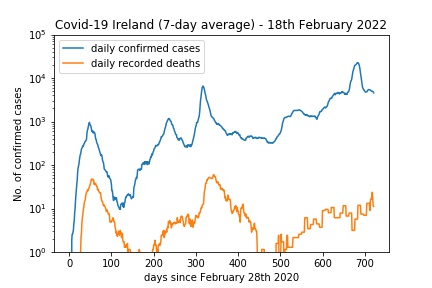
I know many people will be celebrating the end of these restrictions, but in case you need reminding here are the latest figures for Covid-19 in Ireland:

PCR-confirmed new cases are still running at 4500+ per day (almost double that if you include self-reported antigen tests). That means medically vulnerable people would be at risk of infection if those around them are not wearing masks. Masks protect others more than they protect the wearer so allowing the wearing of face masks to be discretionary puts such people in danger. For this reason I for one will be continuing to wear a face covering in shops, on buses, etc for the foreseeable future.

I don’t mind this – it was widespread practice in Asia long before the Coronavirus pandemic – and just can’t understand the extreme anti-maskers who liken the wearing of a face covering to being put in a concentration camp. I just hope we don’t get situations in which those who choose to wear a mask on, say, a bus get picked on by those who don’t.

At the moment in the Department of Theoretical Physics at Maynooth the situation is that a significant fraction of our students are staying away from lectures because of illness or self-isolation and one lecturer is having to do his teaching remotely. That’s not too bad; I feared much worse. I think other Departments have worse problems, missing demonstrators and tutors who are unable to come on campus.

The logic behind scrapping these restrictions is that despite the high case numbers the vaccination programme (helped, perhaps by the ‘milder’ omicron variant) does seem to have succeeded in keeping hospitalizations and deaths at a much lower level than in previous waves. Implicitly the strategy is to let Covid-19 wash over the population without worrying that the Health Service will be overwhelmed. My main worry now is what if another variant emerges after we have let our guard down?

A Message of Solidarity

Posted in Education, Politics with tags , , , on February 14, 2022 by telescoper

Today members of the Universities and Colleges Union (UCU), which represents academic staff in UK universities, begin ten days of strike action over cuts to pensions, pay and working conditions.

I know it doesn’t help very much, but I’d like to take this opportunity to wish all the strikers well and express solidarity and support for their wholly justified action.

Universities affected by the strike include three that I’ve actually worked in: Sussex, Nottingham and Queen Mary, University of London. I understand that a large majority of those voting in the ballot at Cardiff were in favour of industrial action but there were insufficient responses to meet the legal threshold for a strike to be lawful.

Third Level Ireland – The Core Problem

Posted in Biographical, Education, Maynooth, Politics with tags , on February 13, 2022 by telescoper

One of the things I noticed straight away when I moved from the UK to my current job in Ireland is how under-resourced the Irish higher education system is. That realization was driven home still further by the Covid-19 pandemic during which those of us working in Irish universities had to switch to online teaching with precious little support.

Academic staff worked very hard to keep going during the various lockdown periods, but I’m sure I’m not the only person to feel deep regret that we were unable to do things better and that many students have a right to feel they have been let down by the system.

Now that we’re back teaching on campus the problems have not gone away. With a significant number of students prevented from attending lectures by the need to self-isolate we should be making recordings or live streams available, but we lack the equipment to do so properly. I have to carry a webcam and a tripod around campus to record my classes in improvised and not very satisfactory fashion. Contrast with the UK, where proper lecture capture facilities were commonplace in universities long before the pandemic. We are at least a decade behind.

This is one example of a deep crisis in the Irish third level system. Sadly it is by no means clear that the current Government is interested in solving it. There is talk of reducing the “student contribution” (currently €3000, the highest in the EU) because of the cost-of-living crisis but cutting this tuition fee (which is effectively what it is) would reduce the money coming into higher education unless offset by an increase in Government funding. According to this report (from November 2019), core state funding per student in third level institutions fell from about €9K in 2009 to under €5K in 2019.

A sizeable fraction of the income of a university is spent on its staff. In Ireland academic staff are treated as public sector employees which means that salary levels are set centrally. After being cut after the financial crisis they are now fairly generous and increase in line with overall pay settlements. Academic staff get annual increments and can get promoted, which adds to costs on top of the cost-of-living increases.

And that’s the crunch.

If the resource per student is decreasing but the salary bill is increasing, universities have to find other ways of generating income (which has been particularly difficult during the pandemic) or to increase the number of students. Keeping staff and student numbers constant means sliding into deficit. The way out of this many have found is to freeze permanent academic hires and instead take on casual teaching staff that can be paid lower wages than full-time staff. With no disrespect at all to people employed on such contracts, who generally do an excellent job, I feel we are short-changing students if they are not taught by academics who are active in research.

Take my current Department of Theoretical Physics at Maynooth University as an example. This has a student-staff ratio of about 15. That would be considered quite high for a physics department in the United Kingdom, but lower ratios are financially viable there because the fee income per student is much higher and physics departments bring in significant research income that makes a contribution to both direct and indirect costs. The latter is very difficult in Ireland because of the lack of research funding, especially in basic sciences; fortunately we have been relatively successful in generating research income and have recently increased student numbers, so we’re keeping our head above water. For now.

The price is that all academic staff in the Department have very heavy teaching loads – about five modules a year. That is way higher than physics departments in the UK, where most staff teach at most a couple. That makes it very difficult to stay competitive in research.

The problem is that science subjects are (a) more expensive to teach and (b) have limited capacity to grow because of constraints on, e.g., laboratory space (and the fact that there is a limited pool of suitably qualified school-leavers). As a consequence there is a strong incentive for universities to expand in subjects that are cheaper to teach. Something has to be done to ensure that Ireland’s universities can continue to provide education in a broad range of subjects.

Given the funding situation and the charges currently levied on students, it amazes me that more don’t seek their tertiary education elsewhere in the EU where fees are much lower (and in some places non-existent) especially since there is such a terrible shortage of student housing In Ireland. Does the Government really want to continue giving its young people such strong incentives to emigrate?

I was going to end this post there, having stated that the mismatch between between income and salary costs is the core problem facing Irish universities. As I went along though I came to think that the really basic problem is at a deeper level than that. Irish universities are public institutions but the political parties that have dominated Irish government for decades are of a neoliberal hue and are at best ambivalent towards the public sector. There are many in the current Government who would privatize everything if they could get away with it. They are pragmatic, though, and realize that these institutions are actually popular, just like the NHS in England. It is however very difficult for public institutions to function when the Government in charge doesn’t really believe in them.
Leaving Certificate Matters

Posted in Covid-19, Education, Maynooth with tags on February 4, 2022 by telescoper

On the last day of a very busy first week of the new term I’ve finally cleared a backlog of things and thought I’d take a break for a quick comment about the arrangements for this year’s Leaving Certificate which has implications for this year’s University admissions (amongst many other things).

It has been decided that this year’s Leaving Certificate will revert to the pre-pandemic style of written examinations, but with the important proviso that the overall distribution of marks will be scaled to be no lower than the results last year (when accredited grades were taken into account). In addition the examinations will offer students more choice, so that they have to answer a smaller subset of the questions than in the good old days before Covid.

Last year’s Leaving Certificate results revealed a big increase in scores and consequent changes in offers for many courses. For example, the points required for our Theoretical Physics and Mathematics course (MH206) at Maynooth University went up by about 50 to around 550. Perhaps surprisingly this resulted in the admissions to this course going up by about a factor three. I won’t speculate on the reasons for this here.

The reason for scaling this year’s results is to ensure that students entering third-level education this year are not disadvantaged relative to those who left school last year and took a year out. Also, there is much less information on which to base accredited grades, because of pandemic interruptions.

My concern about the announcement is not so much about the return to formal examinations but on the matter of choice. Take Mathematics for instance. Instead of answering questions in each of 10 sections, students this year will only have to answer questions from six. That means that students can get very high grades despite knowing nothing about 40% of the syllabus. That matters most for subjects that require students to have certain skills and knowledge for entry into University.

In my own discipline (physics) we already have to get new students rapidly up to speed in, e.g., calculus – a difficulty exacerbated this year by the fact that the first Semester was shortened as a knock-on effect of delays in Leaving Certificate process – this is likely also to be a problem for next year’s entry. I can see we’re going to have to do a lot of thinking over the summer about how to deal with this.

Overall I prefer the Leaving Certificate over the UK system of A-levels, as the former gives the students a broader range of subjects than the latter (as does the International Baccalaureate), but I still have doubts about using a simple points count for determining entry into third-level education. Changing a system so deeply embedded is likely to prove difficult, though, so we for the foreseeable future we just have to make the best of what we’ve got.

A Day of Computing

Posted in Biographical, Education, Maynooth, The Universe and Stuff with tags , , , , , , on February 3, 2022 by telescoper

Last Semester, Thursday was what I optimistically called a “Research Day” (on the basis that I had no teaching on it). This Semester it’s one of my busiest teaching days, with lecturing in the morning and a lab session in the afternoon, both for Computational Physics.

For most of the last two years I’ve been delivering the lectures and running the lab remotely, but now that we’re back teaching face-to-face I gave the lecture in person and was in the lab with the class for this afternoon’s session. I’ve got about twice as many students this year as last year swill be running two lab sessions (one next Tuesday repeating the material from the Thursday one, and so on throughout the term).

Running the lab remotely worked reasonably well because Python is available to download for free and works on a standard Windows-based PC. In the lab however we use a Linux (Ubuntu) system, which gives the students the chance to try a different operating system (and one which is for many purposes better than Windows).

It’s good to be back running the computing laboratory class in person but I was a bit nervous this morning because since I last did it that way the machines we have in our laboratory have all been upgraded to a new operating system and have a new (and very different) version of Python (3.9 versus the now obsolete 2.7). I’ve been around long enough to realize that things can go wrong in such situations, so I warned the class during this morning’s lecture that there might be teething troubles. Sure enough we had quite a few technical glitches but, to be honest, it it could have been a lot worse. Next Tuesday’s lab should be a bit less stressful as we’ve fixed a few of the things that went wrong.

So, by no means a disaster, but a busy and quite stressful day. Time to go home and relax.

Back to Electromagnetism

Posted in Biographical, Education, Maynooth, The Universe and Stuff with tags , , , on February 1, 2022 by telescoper

So today I gave my first lecture of the new Semester, it being a gentle reintroduction to Maxwell’s equations for a 4th-year class on Advanced Electromagnetism. They have seen these equations before but it doesn’t do any harm to spend a bit of time refreshing the memory. In what follows I do some potential theory, applications to electrostatics (method of images, multipole expansions, use of the complex potential, etc), dielectric materials and polarization, magnetostatics, relativistic formalism of electromagnetism, gauge invariance, electromagnetic radiation and energy transport, and (if time) plasma physics (if time).

When I taught this module last year I did it all remotely from home – using the blackboard shown above – but this year until further notice I’ll be doing it in person in an actual lecture theatre, though I will be recording the lectures in case any students wish to look at them again for revision, etc, and webcasting them for any students unable to attend on campus. I know there are differences of opinion on this, but I think recording of lectures should become routine practice – as it is in all UK universities I’m aware of – but that is difficult here in Maynooth because the equipment available is inadequate (by which I mean virtually non-existent). Let’s hope the necessary investment will be made at some point.