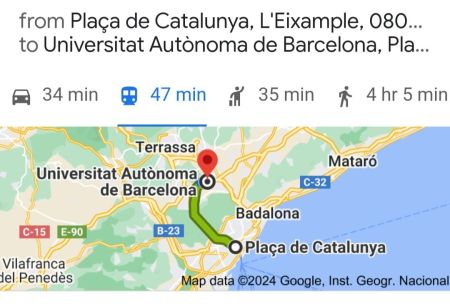
So here I am at the Institut de Ciencies de L’Espai (ICE-CSIC) which is on the campus of the Universidad Autónoma de Barcelona (UAB) for the first ever Euclid Spain Meeting. This involved a 40-minute trip on the S2 train from Plaça de Catalunya, which is a short walk from my apartment, then a short walk from the railway station at UAB through the campus to the Institute.
I was able to speak at this meeting because I happen to be in Barcelona right now. I mean that I was able to attend because I was in Barcelona anyway, not that the meeting was held because I am in Barcelona!
Anyway, I gave my talk early on this morning, so have been able to enjoy the rest of the day having got that out of the way. There are about 50 people here. It’s great to see the sizable Euclid community in Spain getting together and sharing their work.
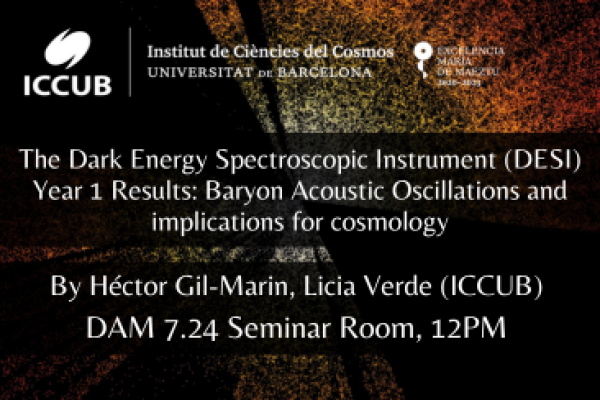
There has been a lot of excitement around the ICCUB today – the press have been here and everything – ahead of the release of the Year 1 results from the Dark Energy Spectroscopic Instrument (DESI). The press release from the Lawrence Berkeley Laboratory in California can be found here.
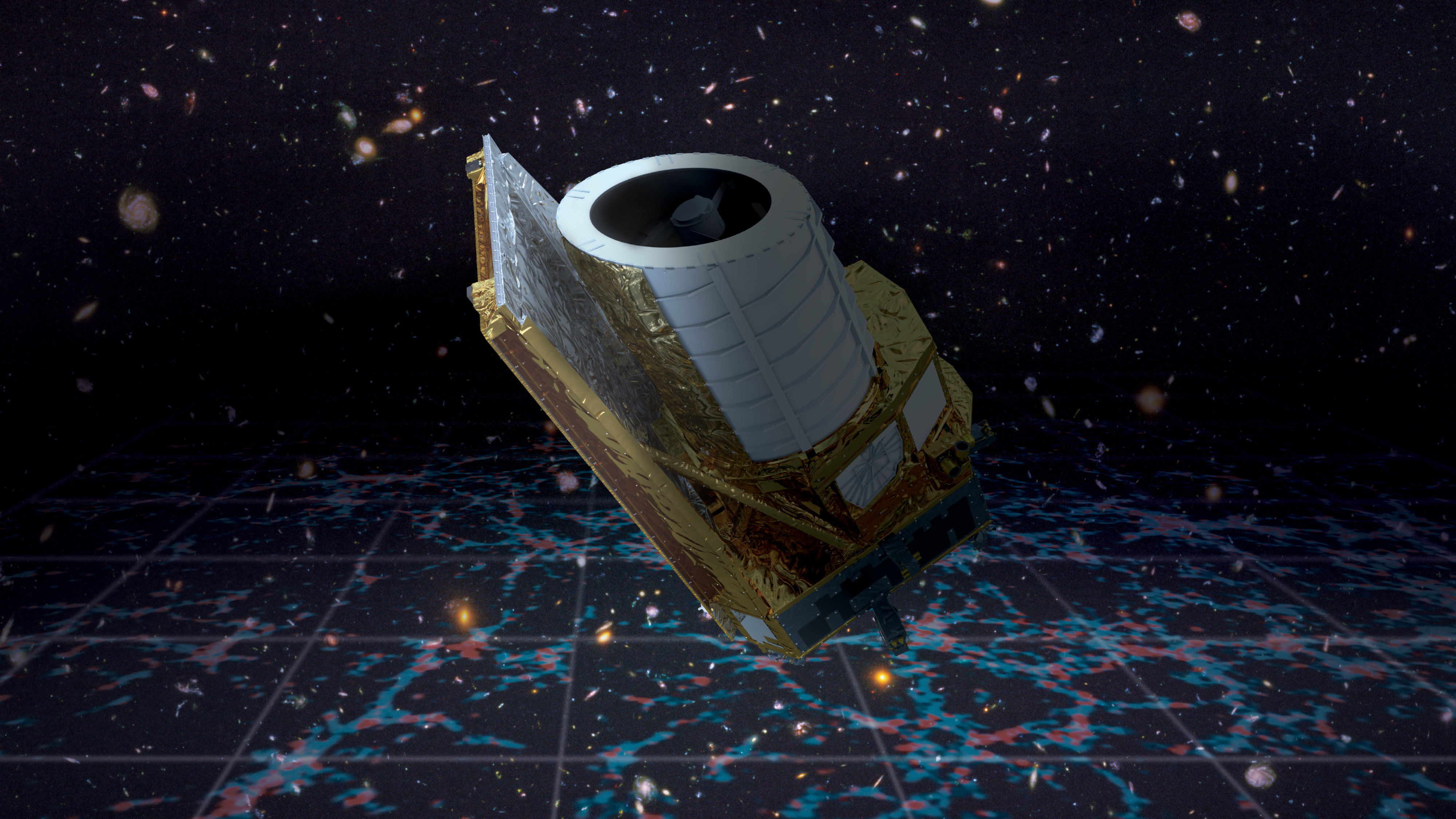
The papers were just released at 5pm CEST and can be found here. The key results pertain to Baryon Acoustic Oscillations (BAOs) which can be used to track the expansion rate and geometry of the Universe. This is one of the techniques that will be used by Euclid.
There’s a lot of technical information to go through and I have to leave fairly soon. Fortunately we have seminar tomorrow that will explain everything at a level I can understand:
I will update this post with a bit more after the talk, but for the time being I direct you to the high-level cosmological implications are discussed in this paper (which is Paper VI from DESI).
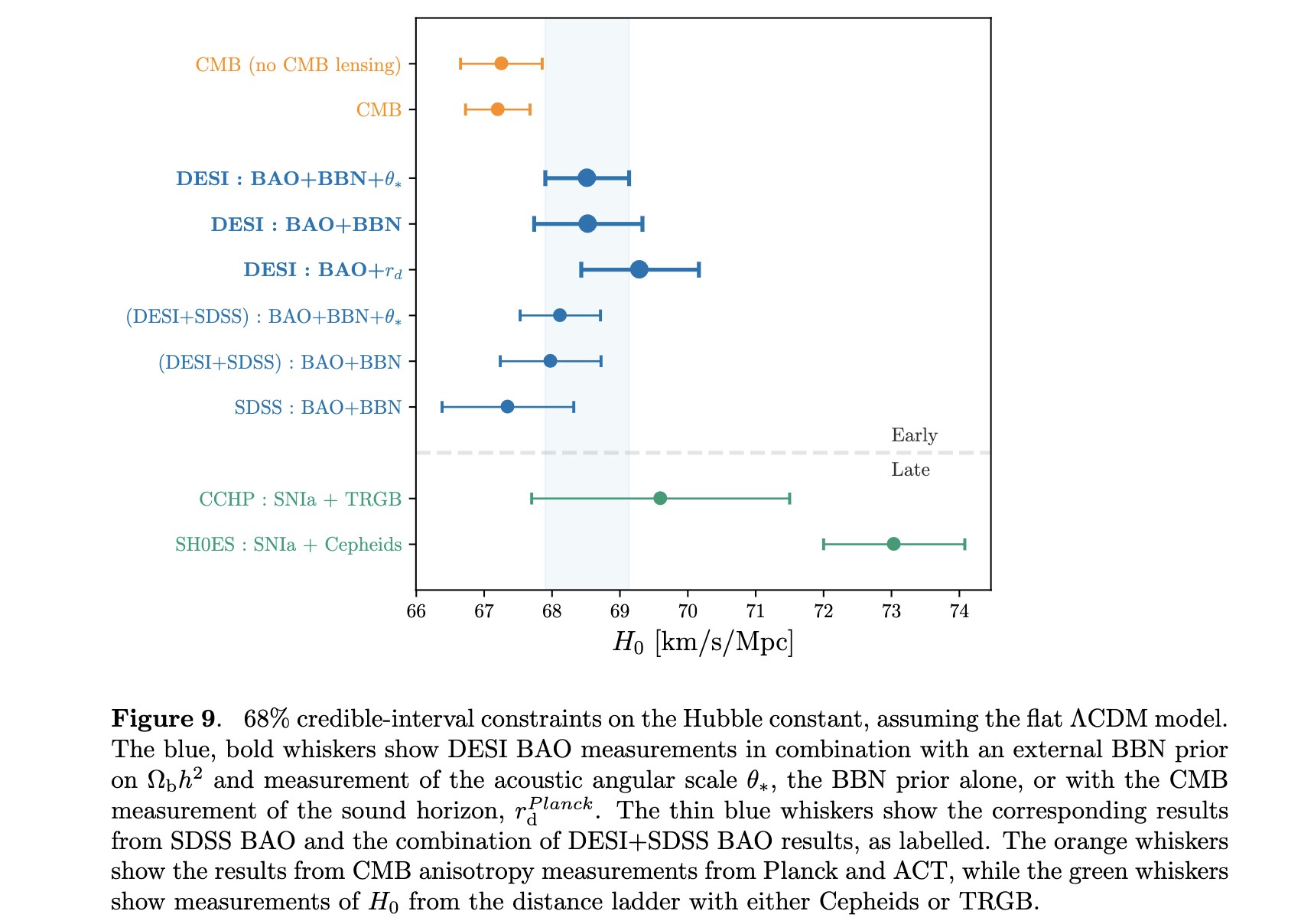
If your main interest is in the Hubble Tension then I direct you to this Figure:
Depending on the other data sets included, the value obtained is around 68.5 ± 0.7 in the usual units, closer to the (lower) Planck CMB value than the (higher) Supernovae values but not exactly in agreement; the error bars are quite small too.
You might want to read my thoughts about distances estimated from angular diameters compared with distances measured using luminosity distances here.
If you’re wondering whether there is any evidence for departures from the standard cosmology, another pertinent comment is:
In summary, DESI data, both alone and in combination with other cosmological probes, do not show any evidence for a constant equation of state parameter different from −1 when a flat wCDM model is assumed.
DESI 2024 VI: Cosmological Constraints from the Measurements of Baryon Acoustic Oscillations
More complicated models of time-varying dark energy might work, but there’s no strong evidence from the current data.
That’s all from me for now, but feel free to comment through the box below with any hot takes!
UPDATE: As expected there has been quite a lot of press coverage about this – see the examples below – mostly concentrating on the alleged evidence for “new physics”. Personally I think the old physics is fine!
I thought it would be appropriate to add a little update about the European Space Agency’s Euclid mission. I’ll keep it brief here because you can read the full story on the official website here.
You may have seen in the news that the Euclid telescope has been having an issue with ice forming on surfaces in its optical systems, especially the VIS instrument. This is a common problem with telescopes in space, but the extent of it is not something that can be predicted very accurately in advance so a detailed strategy for dealing with it had to be developed on the go.
The layers of ice that form are very thin – just tens of nanometres thick – but that is enough to blur the images and also reduce the throughput of the instruments. Given that the objects we want Euclid to see are faint, and we need very sharp images then this is an issue that must be dealt with.
Soon after launch, the telescope was heated up for a while in order to evaporate as much ice as possible, but it was not known how quickly the ice would return and to what parts of the optical system. After months in the cold of space the instrument scientists now understand the behaviour of the pesky ice a lot better, and have devised a strategy for dealing with it.
The approach is fairly simple in principle: heat the affected instruments up every now and again, and then let them cool down again so they operate; repeat as necessary as ice forms again. This involves an interruption in observations, it is known to work pretty well, but exactly how frequently this de-icing cycle should be implemented and what parts of the optical system require this treatment are questions that need to be answered in practical experimentation. The hope is that after a number of operations of this kind, the amount of ice returning each time will gradually reduce. I am not an expert in these things but I gather from colleagues that the signs are encouraging.
Since it’s been a couple of weeks since Euclid commenced its routine survey operations, I thought I would share this little video from the European Space Agency that shows how the surveying will proceed over the next six years with explanatory text adapted from here:
This animation shows the location of the fields on the sky that will be covered by Euclid’s wide (blue) and deep (yellow) surveys. The sky is shown in the Galactic coordinate system, with the bright horizontal band corresponding to the plane of our Milky Way.
The wide survey will cover more than one third of the sky as shown in blue. Other regions are avoided because they are dominated by Milky Way stars and interstellar matter, or by diffuse dust in the Solar System – the so-called zodiacal light. The wide survey is complemented by a deep survey, taking about 10% of the total observing time and repeatedly observing just three patches of the sky called the Euclid Deep Fields, highlighted in yellow.
The Euclid Deep Field North – towards the top left – has an area of 20 square degrees and is located very close to the Northern Ecliptic Pole. The proximity to the ecliptic pole ensures maximum coverage throughout the year; the exact position was chosen to obtain maximum overlap with one of the deep fields surveyed by NASA’s Spitzer Space Telescope.
The Euclid Deep Field Fornax – in the lower right of the image – spans 10 square degrees and is located in the southern constellation Fornax, the furnace. It encompasses the much smaller Chandra Deep Field South, a 0.11 square degree region of the sky that has been extensively surveyed in the past couple of decades with the Chandra and XMM-Newton X-ray observatories, as well as the Hubble Space Telescope and major ground-based telescopes.
The third and largest of the fields is the Euclid Deep Field South – between the Large Magellanic Cloud and the Euclid Deep Field Fornax. It covers 20 square degrees in the southern constellation of Horologium, the pendulum clock. This field has not been covered to date by any deep sky survey and so has a huge potential for new, exciting discoveries. It has been planned to be observed from the ground by the Vera C. Rubin Observatory.
P.S. According to my latest calculations, I shall have retired by the time the Wide survey is completed.
It’s a lovely sunny Saint Ash Valentine’s Wednesday Day in Australia though I’m not sure what day it is at the 2nd Lagrange Point of the Earth-Sun system. Nevertheless, as I mentioned last week, Euclid’s Wide Survey starts today; here is the official announcement of this from ESA. To mark this momentous event here is another nice video update showing the preparations that have been going on ahead of the arrival of the deluge of real data:
Among other things, you will see an appearance by Henry Joy McCracken whose namesake led the United Irishmen in the Rebellion of 1798.
I just heard some excellent news about Euclid so thought I would post a quick update here. I won’t say much because there will no doubt be official communications from the European Space Agency and the Euclid Consortium. You can find a variety of Euclid-related posts on this blog here.
Over the past few months, there has been a huge amount of activity relating to commissioning the instruments, verifying their performance, and measuring parameters of the optical system that will be needed for analysis of the huge amount of data due to come from Euclid. All this effort fed into the Mission Commissioning Results Review (MCRR) which concluded yesterday that all was well.
This is an important milestone for Euclid because, in ESA parlance, it marks the change from a project to a mission. Until commissioning, there is a project manager who works with ESA and the industrial contractors to ensure everything functions properly; when nominal operations start the project team is disbanded and the mission team takes over; and so it came to pass that the Project Manager (Giuseppe Racca) handed over the reins to the Mission Manager (Pierre Ferruit).
That’s when the role of the Euclid Consortium increases substantially. In particular the Science Ground Segment (SGS), which includes the pipelines that will process the data, has been declared to be ready for business. You can read more about the SGS here but here’s a graphic that shows how data comes from the telescope, external telescopes, or simulations, then run through their respective pipelines for VIS, NISP, or external data, then are merged into a coherent format. Pipelines then extract scientific information and compute science data products for further analysis
Each element of this diagram is rather complex. Here, for example, is the organization of the Science Data Centre (SDC) component of the Science Ground Segment at the bottom of the above picture, consisting of computing centers responsible for implementing and running the data processing pipelines:
Anyway, the immediate upshot of all this is that full surveying activities of Euclid can now proceed. The Euclid mission will conduct primarily two different surveys: a “Wide Survey”, covering about 15,000 square degrees on the sky, and a “Deep Survey” of about 50 square degrees, where the instruments will observe three fields much longer than the rest of the sky to capture much fainter galaxies and hence look further out into space. I understand that the Wide Survey will commence in earnest on 14th February.The timescale from now is that the first full set of survey data (DR1) will be available internally to the Euclid Consortium in May or June 2025 and will be made public a year later (i.e. by June 2026).
That doesn’t mean that Euclid will be silent until 2026. In fact, the first batch of post-launch papers will come out very soon, in May 2024. This will include science papers resulting from the Early Release Observations – the data from these will also be made public at the same time – as well as an overview paper for the whole mission and papers describing the details of NISP and VIS instruments using measurements made during commissioning. There will also be a release in May 2025 of data from the Deep Survey patch of about 50 square degrees.
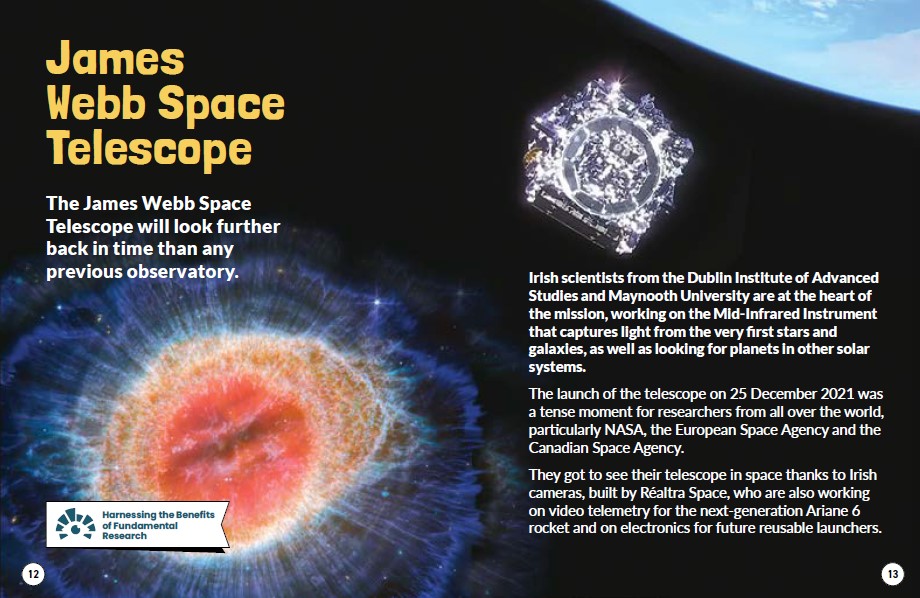
A few months ago, I blogged on the occasion of the launch by Simon Harris TD, Minister for Further and Higher Education, Research, Innovation and Science, of the Little Book of Irish Research. This book, which is aimed at school students, so is written at an elementary level, gives quick summaries of areas of research that the general public said that they were interested in, grouped into sixteen themes, and it will be distributed to schools all round Ireland.
if you want to read it here is a PDF file of the whole thing for you to download at your leisure. When I posted about it last time I hadn’t actually seen a hard copy, but I finally got my hands on one:
I can now confirm that it is indeed a little book. I think we’ll find it useful for our own outreach events, open days, etc, in the Department of Theoretical Physics, and so will the many colleagues in other Departments in other universities and research institutes whose work is also featured.
I was very gratified to see myself get a mention (on page 41), though it’s not really about me but about Euclid which has generated considerable interest in the general public already and is set to continue doing that for many years. As you can see, there’s also a double-page spread of JWST, though unfortunately it does not name the scientists involved; Paddy Kavanagh is the main man at Maynooth for matters JWST.
I have now entered that strange twilight zone between Christmas and New Year during which it is difficult to remember which day is which, so I thought I’d just do a quick retrospective about the thing that has the biggest effect on my professional life in 2023, namely the Euclid satellite.
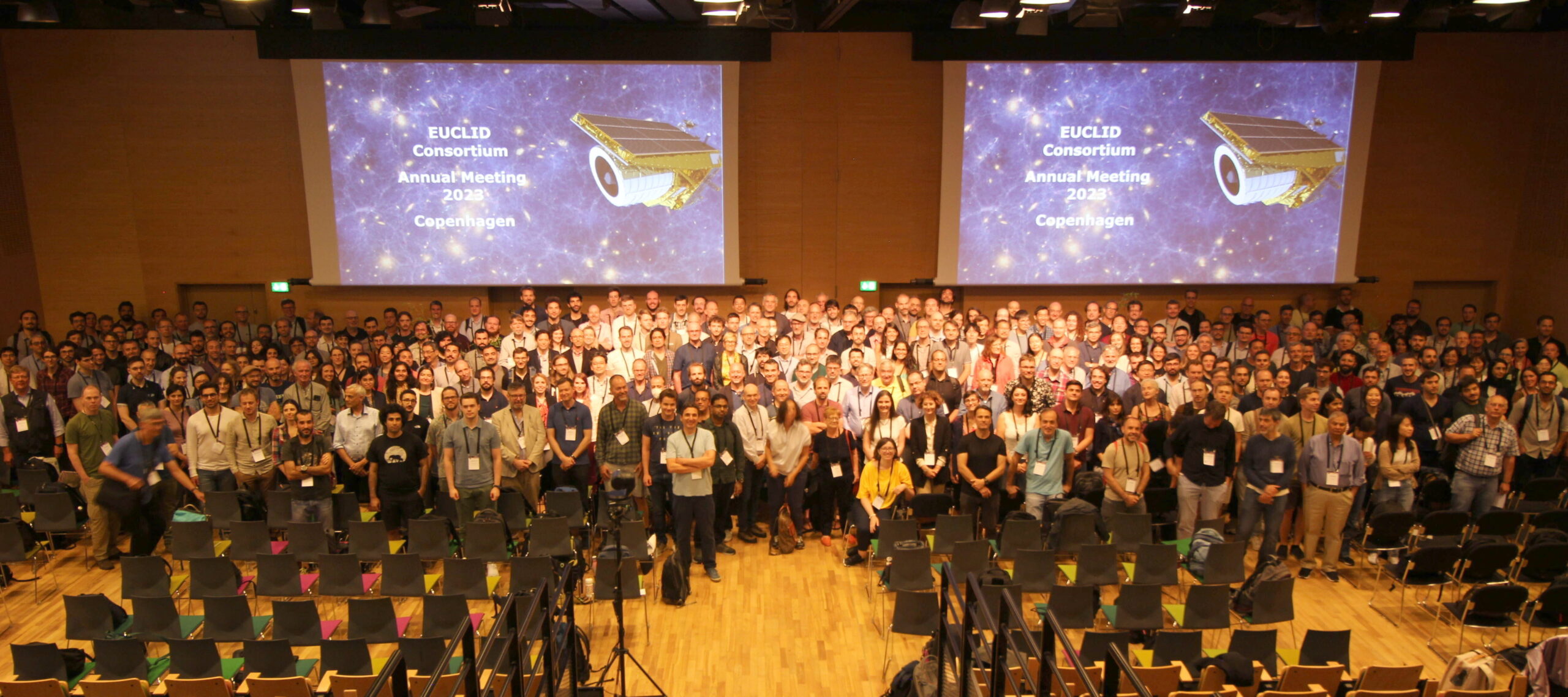
Euclid was launched halfway through the year, on July 1st, an event that took place just a week after or so after the annual Euclid Consortium Meeting in Copenhagen when I took over as Chair of the Euclid Consortium Diversity Committee. The latter led to a huge increase in the number of telecons I had to attend, not only the ECDC’s own bi-weekly Zoom meetings but also various other committees that the ECDC Chair attends ex officio. Much of the Chair’s work is confidential, which means there is no-one to consult with about the difficult matters. Had I not been on sabbatical since September I don’t think I would have had either the time or the energy to carry out these duties. It has taken me quite a while to get the hang of this role, but I do feel that it’s important and that I have contributed in a small way to the Euclid Consortium.
As for the scientific side of Euclid, after a few technical issues the commissioning of Euclid’s instruments is now more-or-less over and the final preparations are being made for the survey proper, which will take commence in the New Year. What is going on now is called a phase diversity analysis, which is being used to verify and improve the performance of the optical system.
In November, a set of Early Release Observations were published. Early in the New Year a number of scientific papers about these will be published, along with other papers about Euclid in general, including an overview paper that provides a high-level description of the mission. Data relating to the Early Release Observations will also be released to the general public.
After that the survey will begin in earnest. The full exercise will take six years to complete – I’ll have retired before it finishes – but there will be a first data release (DR1) using one year’s worth of survey data. That should give a good idea of how well it’s all going to work out for the full survey. That data will be made available to the public.
If all goes to plan, after the annual EC meeting (which next year will be in Rome, from 17th to 21st June), I’ll be stepping down as ECDC Chair and indeed from the ECDC altogether. That is just as well because my sabbatical will be over at the end of August and I’ll be back to a full teaching and admin load at Maynooth, assuming there’s still a Department to return to!
Yesterday I gave a talk at the UK Euclid Consortium (EC) Meeting in London in my role as Chair of the ECDC (Euclid Consortium Diversity Committee). I didn’t actually go to London, but delivered my talk virtually (not without a few hiccups, but I won’t go into that). My presentation was just a short one, outlining some of the things the ECDC does and encouraging others to get involved. One of the matters arising was the EC Code of Conduct, which has recently been updated. This document covers work within the EC generally, as well as specific rules governing EC-sponsored events, such as the meeting I spoke at. Incidentally, one of the latter rules is that organizers should facilitate virtual attendance at meetings, which they clearly did for me yesterday!
Coincidentally, there was a news item in Nature today that reminded me of a post on this blog from a couple of years ago. That was when news first broke of a bullying scandal at the University of Lund, specifically in the historic Lund Observatory, home of the Astronomy Department. Two professors were involved, Sofia Feltzing and Melvyn Davies. As far as I understand the situation, both are still employed by the University, in the Department of Geology and the Department of Mathematics respectively.
The latest news from Lund is that in the aftermath of this scandal, the Astronomy Department has been closed and the staff previously in it subsumed into Physics. That’s a pretty drastic step. In my experience forced mergers of departments, though popular with autocratic managers, are usually counterproductive from the point of view of staff morale. Precisely what the closure of the Lund Observatory after 350 years is meant to achieve is beyond me, but I assume that the atmosphere there had become so toxic that the authorities couldn’t think of anything else to do.
This is a demonstration of something I’ve often said in talks about EDI work. When matters come to formal disciplinary process – if they ever do – the outcome is almost never satisfactory in any respect, not least because the outcomes are often concealed by Non-Disclosure Agreements. The only really hope of creating an inclusive workplace is to ensure that bullying and harassment don’t happen in the first place, or are snuffed out very early on. Early intervention, mediation and conflict resolution are far more likely to provide a successful outcome than formal processes. The problem is that junior members of a department, who are most likely to be the target of bullying, do not feel empowered to make a complaint until it’s too late.
A binding Code of Conduct is one thing, but in order to work it has to be able to be enforced. That is why I agree with the approach suggested by the 21 Group, namely that there should be independent investigators for such matters whose conclusions are binding.
Yesterday came across the above “infographic” – as I’m told such things are called – showing the media traffic generated by last month’s Early Release Observations from the ESA Euclid mission. Some quite interesting facts emerge from it. The new observations were released n 7th November, hence the big spike in the left hand panel on that date.
I see that about 31% of the activity was on Twitter, which I am no longer on, with a slightly smaller amount on Facebook. Overall, social media account for about 60% of the “reach”, with mainstream media (including print, online, and TV/Radio) languishing far behind. Blogs (presumably including this one) account for a mere 1%.
The breakdown by country is interesting too; the table shows only EAS member states. The UK is way out in front, no doubt because BBC News ran a major item on the day of the release. France, Germany, Italy and Spain all have major scientific involvements in Euclid and correspondingly active public engagement activities.
I was pleasantly surprised at the significant amount of interest in Ireland, given that some bigger countries with far greater scientific involvement in Euclid (e.g. Denmark and The Netherlands) generated so little. As the only member of the Euclid Consortium in Ireland I could try to pretend that this was all down to me, but I rather think it’s more likely to be a result of the fact that many Irish people read the UK media so some of the Irish traffic could be spillover from the big UK spike. Still, I think one can interpret this as meaning that the Public in the Republic have an appetite for news about space, something that we have certainly noticed when organizing events in Maynooth.
I thought I’d mention another nice thing. Here is one of the PR images produced by ESA about the early release observations. The point about Euclid is that to achieve its science goals it has to have extremely good optical quality across a very wide field of view. The systems are currently being tested and fine-tuned to see how good their performance actually is, but so far it’s looking good.
The main thing that caught my eye, however, is the collection of little flags along the bottom. How nice it is to see Ireland’s among them!
The views presented here are personal and not necessarily those of my employer (or anyone else for that matter).
Feel free to comment on any of the posts on this blog but comments may be moderated; anonymous comments and any considered by me to be vexatious and/or abusive and/or defamatory will not be accepted. I do not necessarily endorse, support, sanction, encourage, verify or agree with the opinions or statements of any information or other content in the comments on this site and do not in any way guarantee their accuracy or reliability.