Archive for the Euclid Category

Euclid’s Cosmic Mystery Contest!

Posted in Euclid, The Universe and Stuff with tags , on May 9, 2023 by telescoper

I just saw the announcement of this competition and thought I’d share it here to encourage people to enter:

The winner gets a trip to European Space Operations Centre (ESOC) in Darmstadt which will be Mission Control for Euclid, which will be launched from Florida in July.

You can find out more about the competition, including the rules and instructions on how to enter, here.

Here are some suggestions:

You could choose to bake a cake, cross stitch, design a fabric, paint, draw, dance or anything else that comes to mind that symbolizes these proportions 5-25-70 and helps others understand just how much of the Universe we know and don’t know.

Once you have created your creation you have to put an image or a video of it on social media. For more ideas see here.

P.S. The Universe’s vital statistics of 5-25-70 would seem to present quite a challenge if someone were to design an outfit!

Euclid Launch Window Update!

Posted in Euclid, The Universe and Stuff with tags on April 26, 2023 by telescoper

(The Euclid spacecraft will be launched via SpaceX on a Falcon 9 rocket from Cape Canaveral in July 2023, but no further details are publicly available right now.)

Euclid in a Nutshell

Posted in Euclid, Literature, The Universe and Stuff with tags , , , , on February 21, 2023 by telescoper

O God, I could be bounded in a nut shell and count
myself a king of infinite space…

Hamlet, Act 2, Scene II.

It Hamlet rather than Euclid who said those words, but they came into my mind when I saw the latest nice video about the Euclid Mission from the European Space Agency, entitled Euclid in a Nutshell. It’s a quick one-minute summary of of what the mission is for and what it will do:

The text with the video reads:

ESA’s Euclid mission is designed to explore the composition and evolution of the dark Universe. The space telescope will create a great map of the large-scale structure of the Universe across space and time by observing billions of galaxies out to 10 billion light-years, across more than a third of the sky. Euclid will explore how the Universe has expanded and how structure has formed over cosmic history, revealing more about the role of gravity and the nature of dark energy and dark matter.

Euclid is a fully European mission, built and operated by ESA, with contributions from NASA. The Euclid Consortium – consisting of more than 2000 scientists from 300 institutes in 13 European countries, the US, Canada and Japan – provided the scientific instruments and scientific data analysis. ESA selected Thales Alenia Space as prime contractor for the construction of the satellite and its Service Module, with Airbus Defence and Space chosen to develop the Payload Module, including the telescope. NASA provided the near-infrared detectors of the NISP instrument.

The Elements of Euclid

Posted in Euclid, mathematics, The Universe and Stuff with tags , , , , on February 15, 2023 by telescoper

My recent post pointing out that the name of the space mission Euclid is not formed as an acronym but is an homage to the Greek mathematician Euclid (actually Εὐκλείδης in Greek) prompted me to do a post about the Euclid of geometry and mathematics rather than the Euclid of cosmology, so here goes.

When I was a lad – yes, it’s one of those tedious posts about how things were better in the old days – we grammar school kids spent a disproportionate amount of time learning geometry in pretty much the way it has been taught since the days of Euclid. In fact, I still have a copy of the classic Hall & Stevens textbook based on Euclid’s Elements, from which I scanned the proof shown below (after checking that it’s now out of copyright).

This, Proposition 5 of Book I of the Elements, is in fact quite a famous proof known as the Pons Asinorum:

The old-fashioned way we learned geometry required us to prove all kinds of bizarre theorems concerning the shapes and sizes of triangles and parallelograms, properties of chords intersecting circles, angles subtended by various things, tangents to circles, and so on and so forth. Although I still remember various interesting results I had to prove way back then – such as the fact that the angle subtended by a chord at the centre of a circle is twice that subtended at the circumference (Book III, Proposition 20) – I haven’t actually used many of them since. The one notable exception I can think of is Pythagoras’ Theorem (Book I, Proposition 47), which is of course extremely useful in many branches of physics.

The apparent irrelevance of most of the theorems one was required to prove is no doubt the reason why “modern” high school mathematics syllabuses have ditched this formal approach to geometry. I think this was a big mistake. The bottom line in a geometrical proof is not what’s important – it’s how you get there. In particular, it’s learning how to structure a mathematical argument.

That goes not only for proving theorems, but also for solving problems; many of Euclid’s propositions are problems rather than theorems, in fact. I remember well being taught to end the proof of a theorem with QED (Quod Erat Demonstrandum; “which was to be proved”) but end the solution of a problem with QEF (Quod Erat Faciendum; “which was to be done”).

You can see what I mean by looking at the Pons Asinorum, which is a very simple theorem to prove but which illustrates the general structure:

  1. GIVEN
  2. TO PROVE
  3. CONSTRUCTION
  4. PROOF

When you have completed many geometrical proofs this way it becomes second nature to confront any  problem in mathematics (or physics) following the same steps, which are key ingredients of a successful problem-solving strategy

First you write down what is given (or can be assumed), often including the drawing of a diagram. Next you have to understand precisely what you need to prove, so write that down too. It seems trivial, but writing things down on paper really does help. Not all theorems require a “construction”, and that’s usually the bit where ingenuity comes in, so is more difficult. However, the “proof” then follows as a series of logical deductions, with reference to earlier (proved) propositions given in the margin.

This structure carries over perfectly well to problems involving algebra or calculus (or even non-Euclidean geometry) but I think classical geometry provides the ideal context to learn it because it involves visual as well as symbolic logic – it’s not just abstract reasoning in that compasses, rulers and protractors can help you!

I don’t think it’s a particular problem for universities that relatively few students know how to prove, e.g.,  the perpendicular bisector theorem, but it definitely is a problem that so many have no idea what a mathematical proof should even look like.

Come back Euclid, all is forgiven!

A Backronym for Euclid?

Posted in Euclid, mathematics, Poetry, The Universe and Stuff with tags , , , , on February 13, 2023 by telescoper
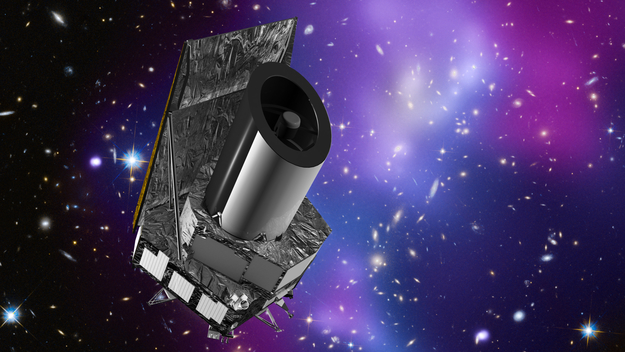
The Euclid Satellite

As a fully paid-up member of the Campaign for the Rejection of Acronymic Practices I was pleased to see the top brass in the Euclid Consortium issue instructions that encourage authors to limit their use of acronyms in official technical documents. Acronyms are widely used in the names of astronomical instruments and surveys. Take BOOMERanG (Balloon Observations Of Millimetric Extragalactic Radiation And Geophysics) and HIPPARCOS (HIgh Precision PARallax COllecting Satellite) to name just two. A much longer list can be found here.

I’m very pleased that the name of the European Space Agency’s Euclid mission is not an acronym. It is actually named after Euclid the Greek mathematician widely regarded as the father of geometry. Quite a few people who have asked me have been surprised that Euclid is not an acronym so I thought it might be fun to challenge my readers – both of them – to construct an appropriate backronym i.e. an acronym formed by expanding the name Euclid into the words of a phrase describing the Euclid mission. The best I’ve seen so far is:

Exploring the Universe with Cosmic Lensing to Identify Dark energy

But Euclid doesn’t just use Cosmic Lensing so I don’t think it’s entirely satisfactory. Anyway, your suggestions are welcome via the box below.

While you’re thinking, here is the best poetic description I have found (from Edna St Vincent Millay):

Euclid alone has looked on Beauty bare. 
Let all who prate of Beauty hold their peace,
And lay them prone upon the earth and cease
To ponder on themselves, the while they stare
At nothing, intricately drawn nowhere
In shapes of shifting lineage...

The Euclid Public Website

Posted in Euclid, The Universe and Stuff with tags , , , , , on February 2, 2023 by telescoper

With the European Space Agency’s Euclid mission now scheduled for launch in the 3rd Quarter of 2023 a lot of work has been put in recently in developing the Euclid mission’s public website. For those of you not in the know, there is a summary on the new website:

ESA’s Euclid mission is designed to explore the composition and evolution of the dark Universe. The space telescope will create a great map of the large-scale structure of the Universe across space and time by observing billions of galaxies out to 10 billion light-years, across more than a third of the sky. Euclid will explore how the Universe has expanded and how structure has formed over cosmic history, revealing more about the role of gravity and the nature of dark energy and dark matter.

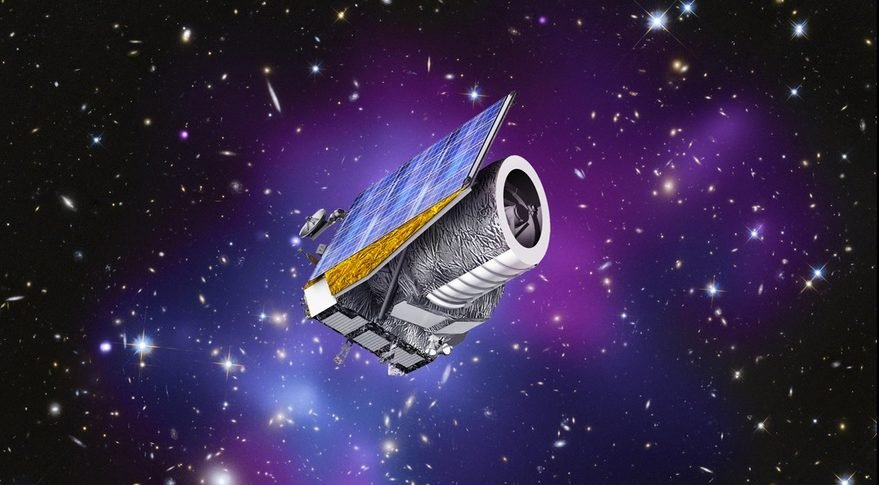
The public website is can be found here. Check it out. Many more stories, pictures and videos will be added over the forthcoming weeks but in the mean time here is a taster animated movie that shows various elements of the Euclid spacecraft, including the telescope, payload module and solar panels.

Even more information about the science to be done with Euclid can be found on the Euclid Consortium website, which is being revamped ahead of the launch.

SpaceX launch confirmed for Euclid

Posted in Biographical, Euclid, The Universe and Stuff with tags , , , on December 15, 2022 by telescoper

I’m a bit fragile today. I don’t know why, but it may be connected with our Departmental Christmas partylast night. I’m glad I didn’t have too much to drink. Ahem.

Anyway, in my current condition I only have time for a short post to pass on the news that I today saw official confirmation that, negotiations having been successfully completed, the European Space Agency’s Euclid mission will indeed be launched by SpaceX, on a Falcon 9 rocket.

Various working meetings have been scheduled to start next week between ESA, SpaceX and Thales Alenia Space – Italia (TAS-I, who constructed the vehicle). The launch period is confirmed to be somewhere in the 3rd Quarter of 2023 and may even be as early as 1st July 2023. The actual launch window of one month will be agreed on the 1st of February.

Now there will be intense activity preparing the Euclid vehicle for launch as well as readying the Ground Segment – the bit that collects and processes the data.

The 2023 Annual Euclid Consortium Meeting, scheduled to be in Copenhagen in from 19th to 23rd June will be the last such meeting before the launch. I am very much looking forward to attending it.

Ethics and the SpaceX Business

Posted in Biographical, Euclid, Politics with tags , on September 6, 2022 by telescoper

Six months ago when Russia invaded Ukraine there was considerable debate about the practicality of sanctions on Putin’s regime. The discussion largely centered around whether economic sanctions would be effective and whether they would harm the nations imposing them more than they would Putin. At the time it seemed to me this was the wrong way of looking about it. The main issue as far as I was concerned was not their likely efficacy, but the ethical and moral dimension of doing business with a warmongering state. A similar issue came up frequently in the 1980s over South Africa, for example. The issue was not for me whether not buying South African oranges would end apartheid; it was about whether I personally felt morally comfortable with doing business with a racist state. Russia is not the only country or entity nowadays with whom I would feel very uncomfortable being involved, but it is one.

Ethical considerations are however often compromised by practical issues. A complete ban on Russian oil and gas imports would cause devastation in the short term, for example, so Western sanctions on Putin have concentrated elsewhere.

Individuals also make ethical decisions about what products they buy, which employers they work for, which countries they visit, and so on. These are of course private matters but people have a right to voice their opinions and argue their case.

At least an individual can decide their own position with unanimity. It’s somewhat more complicated in an organization or group as there are likely to be dissenting views. Nevertheless, I think it is good to have these discussions out in the open. That’s what should happen in a free society and in a well-run organization.

You may nor may not agree with the blog post by Arthur Loureiro about Elon Musk and SpaceX that was published here last week, but I think it raises a similar question: with whom do you feel comfortable doing business?

I suspect that I’m not alone in agreeing with Arthur’s discomfort about Elon Musk. As a matter of fact I think he’s a thoroughly nasty piece of work. Many people no doubt also felt moral discomfort at the prospect of Euclid being launched on a Soyuz spacecraft. In the end the decision will probably be based on pragmatism rather than ethics, but I think it was right for Arthur to raise the issue publicly and I am glad to have been able to make his views public via this website. There are limits and we need to discuss where those limits lie.

P.S. I am glad that the Euclid Consortium has stated aims to be as diverse and inclusive as possible. I am also aware that there are members of the Consortium who disagree with its EDI policies. I’ve observed in many organizations that those who disfavour diversity and inclusion often complain about having diversity “forced upon them”. I shall refrain from commenting further.

Guest Post: The Euclid Consortium has an EDI challenge if ESA goes ahead with SpaceX

Posted in Euclid, LGBTQ+, The Universe and Stuff with tags , , , on September 1, 2022 by telescoper

The following is a guest post from Arthur Loureiro who is Euclid Science Ground Segment Senior Scientist at the The University of Edinburgh. Opinions expressed here are personal and do not reflect those of the Euclid Collaboration nor the University of Edinburgh.

This guest post is based on an open letter sent by Arthur Loureiro & Gabriele Mainetti to the Euclid Consortium Diversity Committee.

–o–

According to news outlets, the European Space Agency is considering using Elon Musk’s SpaceX to send the Euclid Space Telescope to L2. SpaceX is seen as an alternative to fill the gap left by the Soyuz spacecraft – removed by Roscosmos as a consequence of the Russian invasion of Ukraine. Russia made its first invasion of Ukraine back in 2014 and, since then, ESA had plans to use the future Ariane 6 rocket to deliver Euclid. But the plan to use Ariane 6 went to space (differently from Euclid) as Ariane Space signed their largest contract ever with… Bezos! The comic book vilan billionaire doesn’t seem to have enough rockets in his back garden. He needs to cut the queue ahead of Euclid to send more space junk low-orbit satellites for Amazon.

So, off to SpaceX we (seem to) go.

The issue is that SpaceX’s CEO is known to be a complicated figure (to say the least!). Musk has attacked multiple times subjects at the core of the Euclid Collaboration’s values. We cannot claim to care for diversity, inclusion, equality, LGBTQIA+ rights, climate change, vaccines, and democracy and close a deal with such a vile figure. Launching the Euclid telescope via SpaceX would mean dumping millions of euros in the pockets of someone who is very vocal against these values.

In case our telescope decides to hitch a $50+M hike in SpaceX’s Falcon 9, the Euclid Collaboration has an EDI challenge ahead.

Personally, as one of the few Latin Americans involved in Euclid, it feels like a slap in the face to know we will be doing business with him. Musk has zero respect for the fragile democracy we have in our southern continent. In 2020, for example, Musk said “We will coup whoever we want. Deal with it” about the coup against the elected president Evo Morales in Bolivia. For context, the coup was mainly motivated by gaining access to Bolivia’s Lithium reserve. I find this statement absurdly disturbing. Reminiscents of a (hopefully) long gone colonial epoch.

I cannot speak for the group, but I suspect the feeling must be similar for the LGBTQIA+ community within Euclid. Musk has consistently and openly attacked the LGBTQIA+ community on multiple fronts. For the (few) women in the Collaboration, I imagine the feeling is of absolute repulse and disgust. On top of other issues Musk has with women, the telescope they have been working for will be (possibly) launched by SpaceX where recent accusations of sexual harassment have been raised against the CEO.

As a collective and diverse group of scientists, engineers, and academics, are we endorsing Musk and his attitudes by signing a multi-million dollar contract with his company?

As a collaboration that endorses the values of EDI, science, and democracy, what are we going to do to mitigate the damage caused by paying this person and company so much money?

How are we going to deal with the bitter taste (to say the least) left for those members of the EC that has been directly or indirectly attacked by Musk and his followers?

Euclid must fly to its final destination at L2. We cannot wait to see all that our Dark Universe mission has to reveal to us! If ESA decides to use Musk’s SpaceX, that is beyond the Euclid Collaboration’s decision power. However, the Collaboration can and must discuss how to avoid being linked in any way, shape or form to this despicable figure before we change from ESA’s Euclid Mission to Elon’s Euclid Mission. Credit to Musk must be avoided at all costs as the cost will be Euclid’s shot at being a diverse and inclusive Collaboration.

Can SpaceX save Euclid?

Posted in Euclid, The Universe and Stuff with tags , , , , , , , on July 23, 2022 by telescoper

A little over a month ago I posted a piece about the European Space Agency’s Euclid Mission which had been due to be launched in 2023 on a Soyuz ST 2-1b rocket. That no longer being possible because of Russian’s invasion of Ukraine, it seemed there would be a lengthy delay in the launch of Euclid, with late 2024 seeming the earliest feasible date for launch on the obvious alternative, the new Ariane 6.

I ended that piece with this:

It seems to me that the best hope for a resolution of this problem would be for ESA to permit the launch of Euclid using something other than Ariane 6, which means using a vehicle supplied by an independent commercial operator. I sincerely hope ESA is able to come up with an imaginative solution to this very serious problem.

In the Dark, 17th June

I have heard various rumours since then but yesterday I saw a piece by Paris-based astronomer Henry Joy McCracken (a famous name in Ireland) that reveals that a proposal is being actively investigated to launch Euclid on a Falcon 9 rocket operated by Elon Musk’s outfit SpaceX. If all goes well it might be possible to launch Euclid by the end of 2023, and at a fraction of the cost of the alternative Ariane 6-2.

Setting aside any personal opinions about Elon Musk, the Falcon 9 has proved to be very reliable, with the latest version having 110 out of 110 successful launches. Euclid will not be in an Earth orbit, like most of the satellites so far launched by SpaceX, but has to be delivered to the 2nd Lagrange Point, L2. That should not pose to much of a difficulty.

As far as I understand it the decision whether or not this is feasible will be taken later this year after extensive engineering tests, especially to see how Euclid can cope with the spectrum of vibrations generated by Falcon 9. There’s no guarantee this will work out but it might just save a lot of money and a lot of careers.