Archive for the History Category

The First Landing on the Irish

Posted in History with tags , , , , , , on September 7, 2019 by telescoper

While at the Irish National Astronomy Meeting last week I picked up a free copy of the magazine Astronomy Ireland. I chuckled when I saw this little item about the stamps issued in Ireland to commemorate the 50th Anniversary of the Apollo 11 first landing on the Moon:

If you can’t read the text it refers to a spelling error in the Irish language version of the caption on the Neil Armstrong stamp at the top image: instead of the Irish word for Moon (Gealach) the text contains the word for Irish (Gaelach). The caption thus translates as the 50th Anniversary of the First Landing on the Irish

A Very British Coup

Posted in History, Politics with tags , , , on August 28, 2019 by telescoper

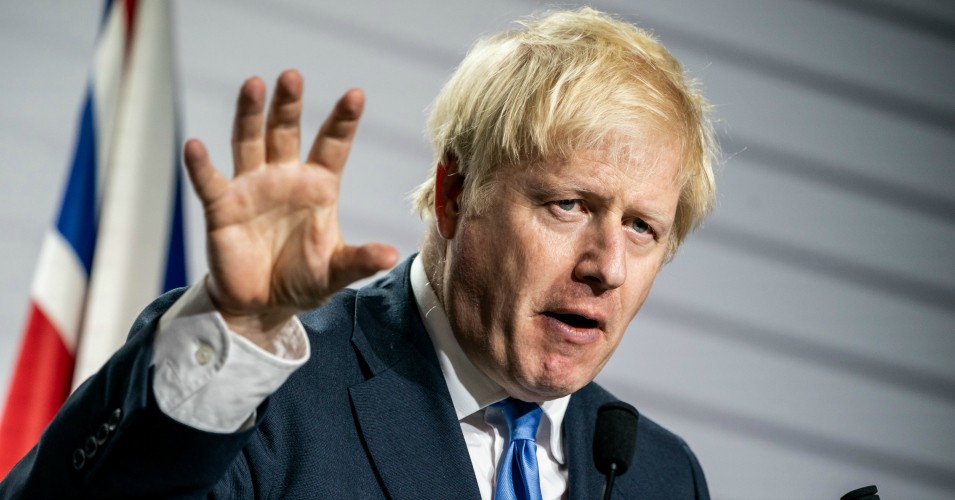
Known liar, charlatan and tinpot dictator Boris Johnson.

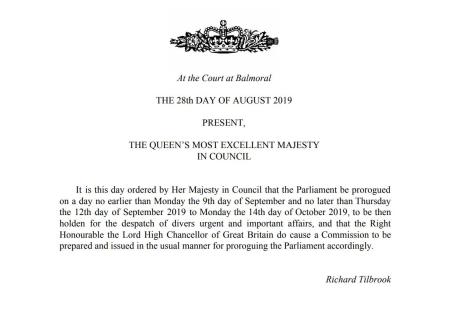
Got back to Ireland this morning to find that the UK Government has decided to suspend Parliament. The deed is already done:

Prorogue

Remind me, what was all that stuff about the European Union being undemocratic?

Any lingering doubts anyone might have had about the direction in which the United Kingdom might go after known liar Boris Johnson became Prime Minister will have been dispelled this morning by the decision (by a small group within the Cabinet) to prorogue Parliament. There can be no doubt that this is a coup d’état. The parallels with 1930s Germany are chilling. If you ever wondered what you would have done in then, as the Nazis took over, that’s what you’re doing now.

This may allow the populist charlatans behind this manoeuvre to force through their chaotic `no deal’ Brexit, but they cannot be allowed to get away with this. I live in hope that one day they will be brought to book for this scandalous act. When that happens the retribution will be a joy to watch.

This disgraceful episode has made much easier a decision I have been putting off for almost two years. I’m putting my house in Wales up for sale and cutting the last of my ties with the United Kingdom. Enough is enough.

Preparatory Reading

Posted in History, Literature, Politics with tags on August 12, 2019 by telescoper

With less than a month to go before I take up a position as Head of Department, I thought I’d spend some of the book tokens I got from the Everyman Crossword prize on some preparatory reading material…

The Coles of Arms

Posted in Biographical, History with tags , , , , , , , , on August 8, 2019 by telescoper

Sparked by an exchange on Twitter last week with another person (who has the same surname as me) on the subject of heraldry, I did a little bit of googling about and found a little snippet I found quite intriguing. Although the name Coles is found all over England and Wales, with strong concentrations in the South West of England and in Northamptonshire, according to this source the name is of Anglo Saxon origin and is first recorded in Yorkshire as the family name of George Coles, which was dated 1555, in the “Register of the Freemen of the City of York”, during the reign of Queen Mary 1. The same source also points out that a branch of the Coles family subsequently moved to Ireland, though it gives no details (unless you pay for them).

I subsequently found that in Burkes General Armory (which details all the Coats of Arms registered in the UK and Ireland) the first entry under the surname Coles is indeed in Ireland, where it was confirmed in 1647. That date is during the Irish Confederate Wars, a couple of years before Oliver Cromwell arrived in Ireland with his army. One might surmise that this particular branch of the Coles lineage was somehow caught up in these hostilities, probably on the English side.

Anyway the description of the corresponding Coat of Arms, in typically cryptic heraldic language is:

Gu. on a chev. betw. two lions’ heads erased or, ten ogresses. Crest — A snake wreathed about a marble pillar ppr. garnished or.

The first part refers to the escutcheon (shield): Gu is short for Gules, a tincture (red), and it describes the main colour of the field of the escutcheon; chev is for chevron (an inverted v-shape), one of the Honorable Ordinaries (basic designs for the escutcheon). This and the two lions’ heads are described as `or’ (andother tincture, meaning gold-coloured); erased means `without the body’; an ogress is a special case of a roundel (filled circle) in which the circle is black (the word `pellet’ is also used).

The Crest is self-explanatory other than that `ppr’ is short for `proper’ which means, roughly speaking, `natural-coloured’. I’m not of the significance of the snake and the marble pillar.

Here is a mock-up of the whole thing:

There are several other entries for the name Coles in Burkes General Armory and I’m certainly not claiming that I have the right to use this Coat of Arms but I am intrigued by the Irish connection with the name Coles and will see what more I can find out about it.

Old-School Physics

Posted in Education, History, The Universe and Stuff with tags , , , on July 27, 2019 by telescoper

The recent circulation to his staff of daft (and in some cases erroneous) rules to be used when writing documents has led to much hilarity on the media we call social. Among the obvious errors are that the correct abbreviation for `Member of Parliament’ is `MP’ not ‘M.P.’ and that `full stop’ is actually two words (not `fullstop’). On top of those his insistence that civil servants use Imperial units for everything actually may be unlawful as the official system of units for the United Kingdom is the metric system.

The latter exhortation has caused a particular outcry among people under the age of about 50 (who have never been taught Imperial units), and especially scientists (who understand the obvious superiority of the SI system).

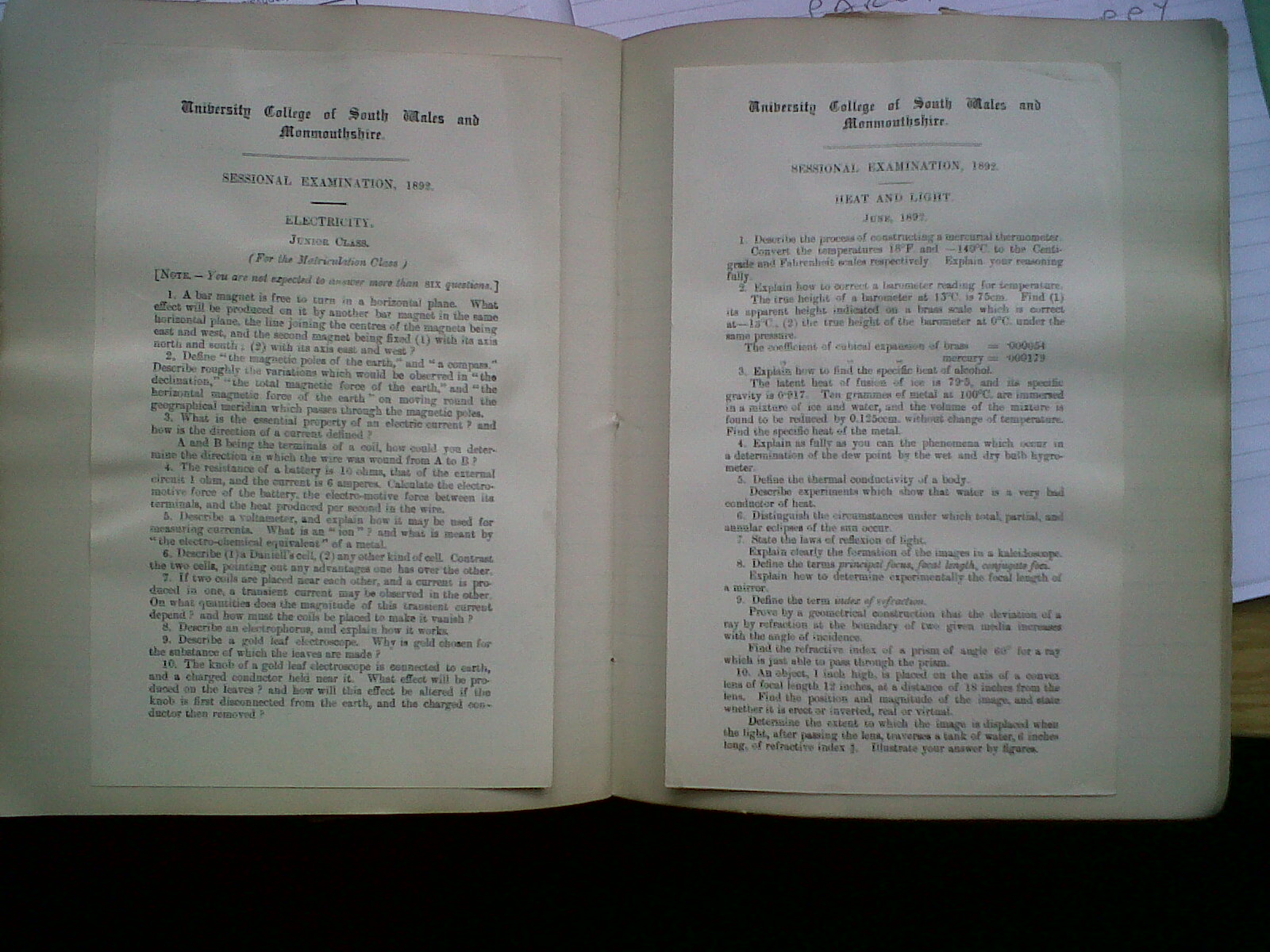
Anyway, all this reminded me that many years ago when at Cardiff there came into my possession a book of very old school and university physics examinations, which are of interest because I’ve been posting slightly less ancient examples in recent weeks. These examinations were set by the University College of South Wales and Monmouthshire, which was founded in 1883,  an institution which eventually became Cardiff University. I find them absolutely fascinating.

The papers are rather fragile, as is the book containing them, so I daren’t risk trying to scan them systematically in case flattening them out causes damage. Here instead are a few random examples that I photographed on my desk, in the manner of an old-fashioned secret agent. Sorry they’re not all that clear, but you can see them blown up if you click on them.

The collection is fairly complete, covering most of classical physics, at all examination levels from university entry to final Honours. Of course there are no questions on relativity or quantum physics appear (which had yet to be invented) but other than that – and the units! – they’re not too different from what you might find in the examinations for the early stages of contemporary physics programmes.

The Wonderful Barn

Posted in History, Maynooth with tags , , on July 26, 2019 by telescoper

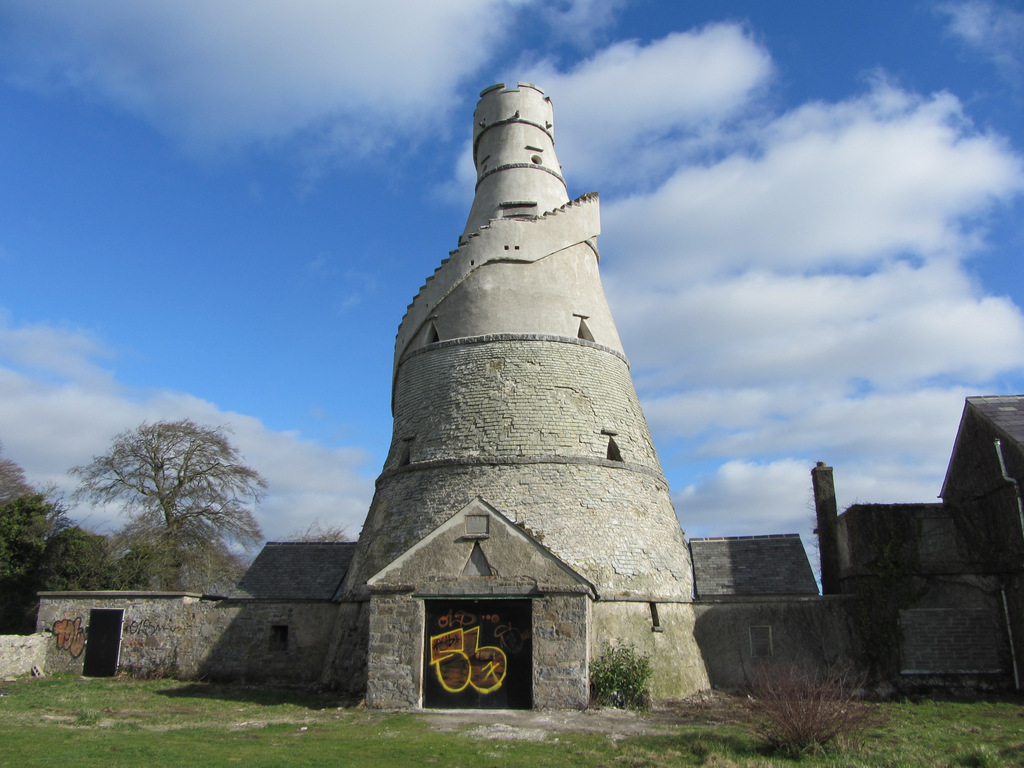
Despite the fact that it’s only a few miles away from Maynooth (in Leixlip) I had never heard of this extraordinary building until yesterday. The Wonderful Barn (for that is its name) is known to have been built in 1743 but nobody actually knows what its purpose was. Probably the best theory is that it was designed to be used as a granary, as it was built immediately after a severe famine (in possible anticipation of others in the future), but alternative possibilities to have been suggested are a tower from which people could shoot game birds, a folly (it was built by the Conolly family, owners of Castletown House and is on the Estate which has another famous folly), and simply as a means of providing work for poor people in a time of great hardship. Anyway, it’s a weird building, built from bricks but faced with what looks like recycled stone rubble.

Here’s a short video that includes some drone footage of the Wonderful Barn that gives you an idea of its corkscrew-shaped construction.

Also Sprach Zarathrustra: Einleitung, oder Sonnenaufgang

Posted in History, Music, The Universe and Stuff with tags , , on July 21, 2019 by telescoper

Here is a short video of the historic first manned landing on the Moon. I don’t know about you but I find the ghostly images are extremely affecting.

If there’s one piece of music indelibly associated with the Apollo missions, it’s the piece accompanying that clip: the introduction (or `Dawn’) from the orchestral tone poem Also Sprach Zarathrustra by Richard Strauss. Amazingly it was only a couple of years ago that I heard this piece performed live for the first time. I vividly remember how  the percussionists were clearly enjoying themselves during that performance. Not many orchestral pieces start with the percussion section front and centre. Whenever I’ve heard the piece since then I can’t help thinking how much I’d love to have a bash at the timpani part!

Anyway, here’s a clip from the Proms a few years ago to give you some idea of the tremendous impact this piece can have when you hear it in a concert hall.


Father Callan and the Induction Coil

Posted in History, Maynooth, The Universe and Stuff with tags , , , , , on July 9, 2019 by telescoper

Historically speaking, Maynooth is more strongly associated with theology than with science but I thought I’d mention here one famous pioneering physicist, who happened also to be a Roman Catholic priest, who spent his working life in these parts.

Father Nicholas Callan (or, more formally, The Reverend Professor Nicholas Joseph Callan) was born in County Louth in 1799 went to the seminary of St Patrick’s College, Maynooth, in 1816 to train as a priest. During his time as a seminarian Callan studied ‘Natural Philosophy’ and became interested in experiments involving electricity. In 1823 Callan was ordained as a priest, and went to Rome in 1826 to obtain his doctorate in Divinity. At the time Italy was a centre for research into electricity and here Callan became familiar with the work of the Italian physicist Alessandro Volta who had developed the world’s first battery. Callan returned to Maynooth where he was made chair of Natural Philosophy, a post he would hold until his death in 1864.

Callan is most famous for inventing the induction coil (in 1836). By connecting two copper wire coils to a battery and electromagnet and then interrupting the current he was able to generate much larger voltages than could be obtained from batteries alone. His 1837 version that used a clock mechanism to interrupt the current 20 times a second is estimated to have produced 60,000 volts – the largest artificially generated charge at that time. It is said that his induction coil could produce sparks 15″ long, which must have been fun to watch.

Callan’s biggest induction coil, unfinished at the time of his death, can be found in the National Science Museum of Ireland (which is in Maynooth). This was one of the largest in the world at the time. The iron core is 109 cm long. The secondary windings are 53 cm in diameter and consist of about 50 km of iron wire insulated with beeswax. They were made in three separate rings separated by air gaps, so wires carrying large voltage differences would not lie adjacent to each other, reducing the risk of the insulation breaking down. At the left end is a vibrating mercury ‘contact breaker’ in the primary circuit, actuated by the magnetic field in the primary, which interrupted the primary current to generate potentials of over 200,000 volts.

Sadly Callan’s work was forgotten for quite a period after his death – experimental electromagnetism was not a priority for St Patrick’s College at this time – for which reason the invention of the induction coil has often been attributed to Heinrich Ruhmkorff who made his first device (independently) about 15 years after Callan. More recently, however, Callan’s achievements have been more widely recognized and in 2000 the Irish government issued a stamp in his honour.

The Callan Building

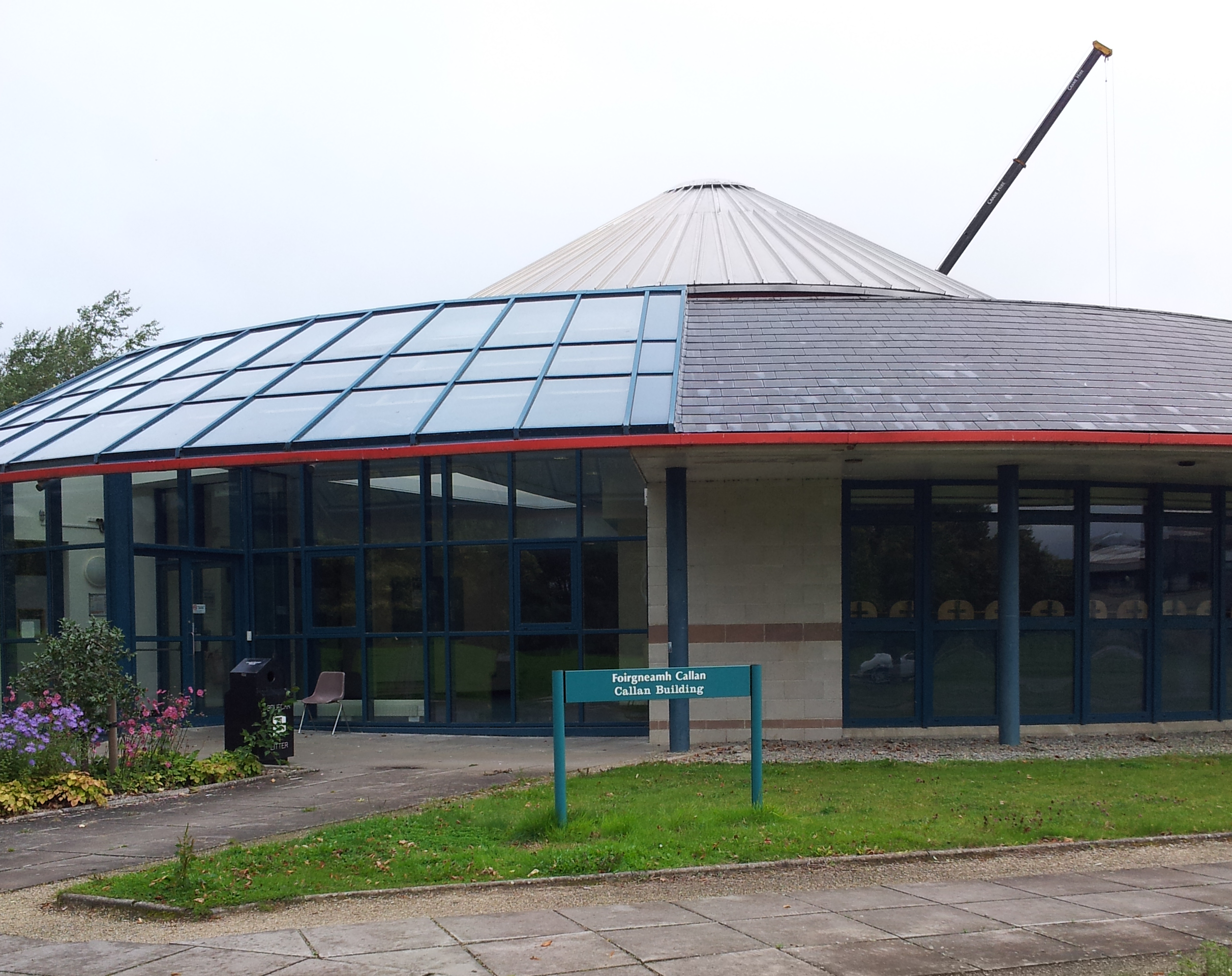
Nicholas Callan was laid to rest in the College Cemetery at Maynooth in 1864. The Callan Building (above) on the North Campus of the present-day Maynooth University is named in his honour.

Fascist Lookalikes No. 357

Posted in History, Politics with tags , , , , , on July 2, 2019 by telescoper


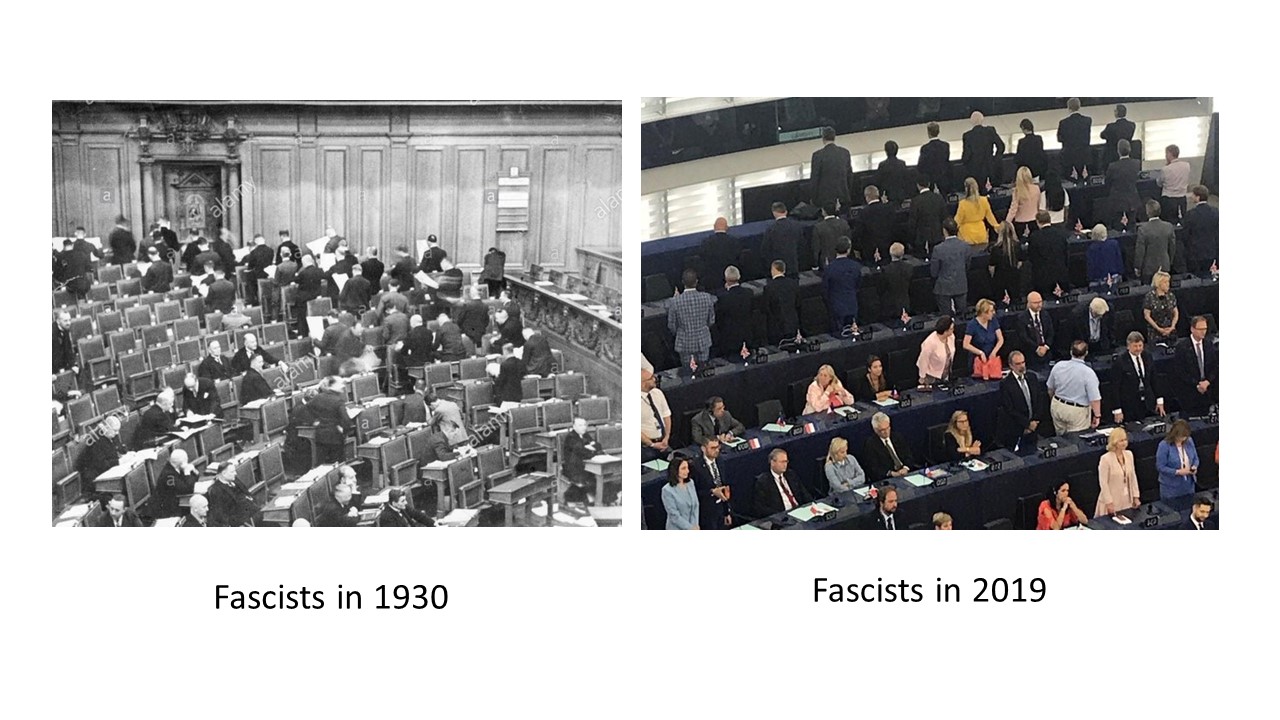
Have you noticed to remarkable similarity in behaviour between representatives of the Nazi Party elected to the Reichstag in 1930* and representatives of the Brexit Party Money-Laundering Company in the European Parliament in Strasbourg?

I wonder if, by any chance, they might be related?

*In an earlier version of this post I used 1926 (the date given by the stock photo supplier Alamy) but this is incorrecr; the right date is 1930.

On Bumfodder

Posted in Books, History with tags , , on June 21, 2019 by telescoper

It’s not quite the end of the week for me, as I am on duty all day tomorrow for the Summer Open Day at Maynooth University, but I thought I’d end the penultimate working day of this week with a post about a piece I read in the Times Literary Supplement a few weeks ago. I subscribe to this mainly for the crossword, but also because some of the reviews are extremely interesting.

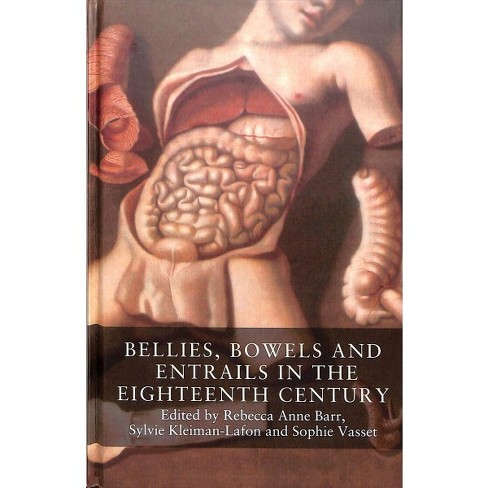
In the May 31st issue of said organ, I came across a review of a book charmingly entitled Bellies, bowels and entrails in the eighteenth century, which is published by Manchester University Press. I’m not planning to buy a copy as it costs £96, but it I was intrigued by the review, which includes such vivid insights as

Stomachs and bellies, hiccups and flatulence dominate the last third of the book…

The thing that really caught my attention however was the issue of toilet paper. As far as I am aware, paper in a form specifically designed for the use of wiping one’s bits clean after defecation wasn’t introduced until the middle of the 19th century, but waste paper was commonly used for that purpose much earlier. In the 18th century it was apparently commonplace to tear pages out of cheap books to use as lavatory tissue, and it appears some people would buy books both to read when on the job and for cleaning up afterwards.

This practice gave rise to the word bumfodder, which the Oxford English Dictionary defines as:

  1. Toilet paper. Also occasionally: a piece of this.

  2. attributive and allusively. Worthless or inferior literature; any written or printed material that is perceived as useless, tedious, or unnecessary.

In case you didn’t know, this is also the origin of the word bumf, which the OED gives as

  1. slang (originally in British public schools). Paper (of any kind). Now rare.

  2. Toilet paper. Now somewhat archaic.

  3. orig. Military slang. Written or printed material that is perceived as useless, tedious, or unnecessary, as bureaucratic paperwork, advertising, etc. Also occasionally: worthless or inferior literature.

I have to admit I’ve used the word `bumf’ in the third sense on a number of occasions without realizing quite how indelicate is its origin.

The first instances of `bumfodder’ quoted in the OED date from the mid-17th Century, which surprises me a little because I was under the impression that paper was an expensive commodity then. By the 18th century, however, it was obviously much cheaper, presumably because of mass production, and so consequently books and newspapers were much less expensive. Waste paper was then used quite frequently not only as toilet paper but also for wrapping groceries and other goods. I should mention, however, that paper was used at toilet tissue in China as far back as the 6th Century AD, so Europe was obviously a bit behind on the matter.

Anyone who has read any 18th Century literature – the humour in which is often rather coarse – will not be surprised by the number of scatalogical jokes about bumfodder going around. Obviously I couldn’t repeat any here.

P.S. Now wash your hands please.