At the risk of being a complete bore about the 1919 Eclipse Expeditions, here is a plug for a public talk I am giving in Maynooth on 29 May 2019, the centenary of the event itself.
Here is the blurb:
Albert Einstein is the undisputed genius whose insights have revolutionised the way we think about the Universe. He is also a cultural icon whose fame extends far beyond the realm of theoretical physics.
Einstein’s transition to global stardom can be dated precisely to 29th May 1919, the date of a total solar eclipse at which the first measurements were made of the bending of light by the Sun’s gravity that tested Einstein’s then new general theory of relativity. The announcement of the results created an unprecedented media sensation: news of Einstein and his revolutionary theory made front-page news around the world.
To mark the centenary of this historic event, Peter Coles will describe the historical and scientific background to an experiment that changed the world, and explain why it was such an important event both for Einstein the physicist and Einstein the celebrity.
The event will be on the North Campus of Maynooth University. It is free, but please register at the Eventbrite site here if you want to attend so we can get an idea of numbers. If, for some reason, you can’t get to Maynooth, we are planning to do a live feed of the talk too, so please watch this blog for more details.
Not surprisingly, given that the centenary is fast approaching, pieces are appearing in the mainstream media about the 1919 Eclipse Expeditions that first measured the deflection of light by the Sun’s gravitational field. One such article, by Robin McKie, appears in today’s Observer. It’s a nice piece, though it concentrates almost entirely on Eddington’s measurements taken at Principe. In fact it was Crommelin’s measurements from Sobral that proved decisive.
Anyway, the article gives me a (very brief) mention courtesy of the piece I wrote in Nature a few weeks ago:
For many years at Cardiff I ran an undergraduate project in which the students had to reanalyze the measurements from the eclipse expeditions. That is possible because all the necessary star positions are tabulated in the paper by Dyson et al. (1920). It is undoubtedly the case that Eddington had to improvise a bit because of the unexpected problems that arose in the field, but this is actually quite normal. As a famous general put it `No plan of battle survives first contact with the enemy’. I remain convinced that Eddington didn’t do anything dodgy, but you don’t have to take my word for it: if you don’t believe me then go ahead and look at the data yourself! At the very least you will then understand what a difficult experiment this was!
Easter was quite late this year, as it was in 1916, the year of the Easter Rising: Easter Monday fell on 22nd April 2019, and on 24th April 1916 – the day that the uprising started. People who were brought up in Ireland would have learnt much events of 1916 at School, and through the annual commemorations, but we weren’t taught anything about the Easter Rising in Britain, so I’ve just picked up bits and pieces here and there from reading about it. This week one of the articles that particularly struck me was about the Battle of Mount Street Bridge so I thought I’d write a little bit about it here.
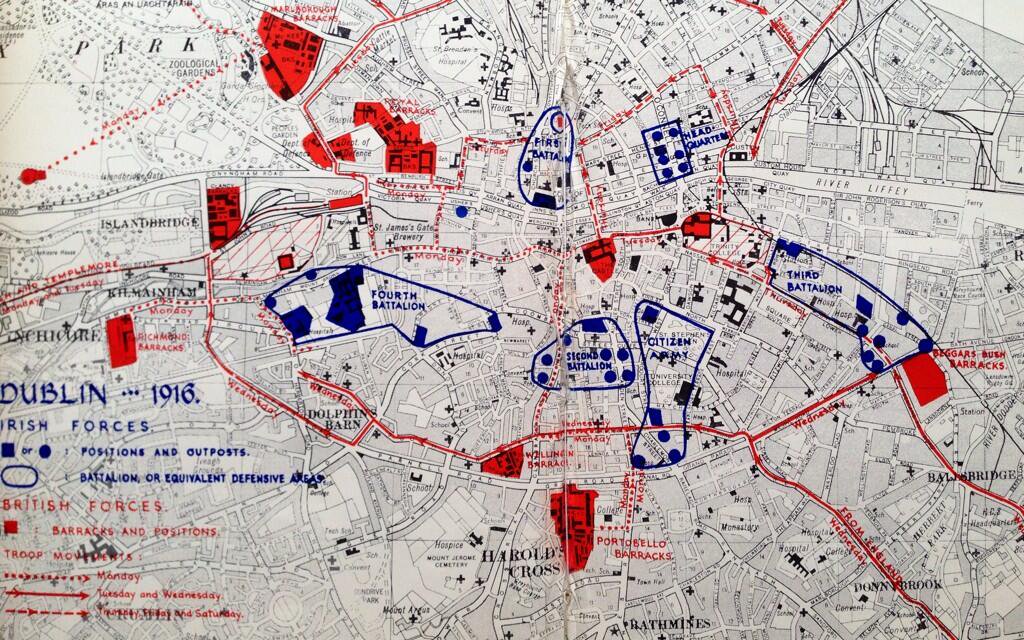
To begin with, here is an old map I came across a while ago that shows the extent of the area of Dublin seized by the rebels in 1916:
You can click on the map to make it clearer. The area of interest here is towards the right of the map, inside the blue perimeter marked ‘3rd Battalion’. The road marked in red leading North West to the Mount Street Bridge past the Beggars Bush Barracks (also marked in red) is Northumberland Road. It changes name to Mount Street on the other (NW) side of the bridge. Northumberland Road forms a junction with Haddingdon Road near the Barracks.
Most of the city’s street layout has survived intact so it is possible to walk around and visit many of the locations on this map, many of which still bear the scars of the Easter Rising. It’s quite a strange feeling doing that, as it brings the violence of the past rather too close for comfort. I think Mount Street Bridge is a good illustration. I walked through the area last year without knowing that it had such a bloody history, but now I don’t think I’ll ever be able to visit it again without getting the shivers. Still, at least it makes one feel grateful to be living in a time of peace though some people don’t seem to think that’s very important these days.
Anyway, the large area surrounded by the blue line to the right of the map was occupied on the 24th April 1916 by the 3rd Battalion of the Irish Volunteers under the command of one Éamon de Valera. De Valera commanded a relatively small contingent of fewer than 150 rebels, with a headquarters in Boland’s Bakery.
At 11am on 24th April 1916, acting under de Valera’s instructions, Lieutenant Michael Malone led 16 Volunteers from the 3rd battalion towards Mount Street Bridge, a key crossing point over the Grand Canal for a road that leads directly into the heart of Dublin. Their task was to stop British reinforcements entering Dublin from the South East. They set up several strong points either side of the bridge, marked on the map by the sold blue circles.
Meanwhile, British High Command in England received an urgent request from Ireland for reinforcements needed to put down the uprising. On the evening of 24th April 1916, the 59th North Midland Division received orders from Brigade HQ to ‘stand to’ for an immediate move. The division consisted of three brigades; 176th (2/5th, 2/6th South Staffordshire regiment, 2/5th, 2/6th North Staffordshire regiment); 177th (2/4th, 2/5th Lincolnshire regiment, 2/4th, 2/5th Leicestershire regiment) and the 178th infantry division (2/5th, 2/6th, 2/7th and 2/8th battalions of the Sherwood Forester regiment). The men were apparently enthusiastic at the thought of active service overseas and believed they were on their way to France or Flanders. In fact the Division began immediate embarkation for Kingstown (now Dun Laoghaire), Ireland.
Lieutenant Malone was still fortifying his post in a house at 25 Northumberland Road on 24th April when his attention was drawn to the sound of soldiers advancing towards his position. Assuming this was the anticipated British counter-attack, Lieutenant Malone, together with James Grace and three others, opened fire on the troops as they reached the junction of Northumberland Road and Haddington Road. The British soldiers were caught completely by surprise. They were not, as it turned out, attempting to assault the rebel positions; they were just returning to their barracks after weekend manoeuvres. Many men fell where they were hit, others ran for cover. They were all unable to return fire, as their rifles were unloaded. After the gunfire had ceased, the street was littered with the dead and dying. Local civilians – the vast majority of whom wanted nothing to do with the uprising – ran from their houses to help the wounded British soldiers.
It was not until early on Wednesday morning (April 26th 1916) that the newly arrived troops from England had disembarked and assembled on the quayside in Kingstown. They were mostly raw recruits who had only just completed six weeks of basic training, and many of them had never even fired a rifle. Orders were received that two battalions were to make their way towards the Royal Hospital Kilmainham. Two more were to make their way to Trinity College. The other battalions were to remain in reserve. Carrying their full military kit, the Sherwood Foresters began to march towards the city centre.
On Tuesday 25th April, Malone had sent away three of his companions as they were `only boys’, leaving just himself and James Grace to defend the position on Northumberland Road. On 26th April, as the British troops reached the junction of Northumberland Road and Haddington Road, these two opened fire into the ranks of the oncoming Sherwood Foresters. The first hail of bullets claimed the lives of ten men.
Following instructions they would have been given in basic training, the British soldiers dropped to the ground in response to the gunfire. That would have been a good tactic to have employed when coming under fire in open countryside – such as they might have experienced in Flanders – as they would have had a chance of crawling for cover in a trench or ditch or hedgerow. In this situation, however, it was just about the worst thing they could have done. They lay prone in the middle of the road and were easily picked off by Malone and Grace, firing down on them from the windows of a house on Northumberland Road. To be fair to the British officers in command, urban warfare was a new thing in 1916 – the horrors of, e.g., Stalingrad were still to come – so they didn’t really know what to do.
The British troops regrouped and tried to charge the position where the gunfire was coming from, but were repulsed, suffering heavy casualties. Even more casualties were sustained when they tried to encircle the building. Finally, using grenades, they managed to blow in the front door of 25 Northumberland Road at the same time as others gained entry to the rear of the house via Percy Lane.
A barricade constructed of household furniture blocked those soldiers attempting to gain entry through the front door. As Malone descended the stairs towards the hall, he was confronted by the British soldiers who entered through the back door and was shot dead. In order to clear the house the military threw grenades into the basement but Grace, who was hiding there, had taken cover behind a metal oven and avoided serious injury. He stayed put, and wasn’t found until after the battle. He was arrested by the British authorities, but released at Christmas 1916.
Altogether the fighting at Mount Street resulted in almost two-thirds of the total British casualties during the Easter Rising. A total of four officers and 216 other ranks were killed or wounded during this bloody episode.
I think it is Blaise Pascal who is to be credited with the quote frequently paraphrased as “I didn’t have time to write a short letter so here’s a long one instead” but, whoever it was, this afternoon’s interesting theoretical physics seminar at Maynooth University about Magnetic Molecules by Jürgen Schnack of Bielefeld University provided a great example of how a short letter can pay off.
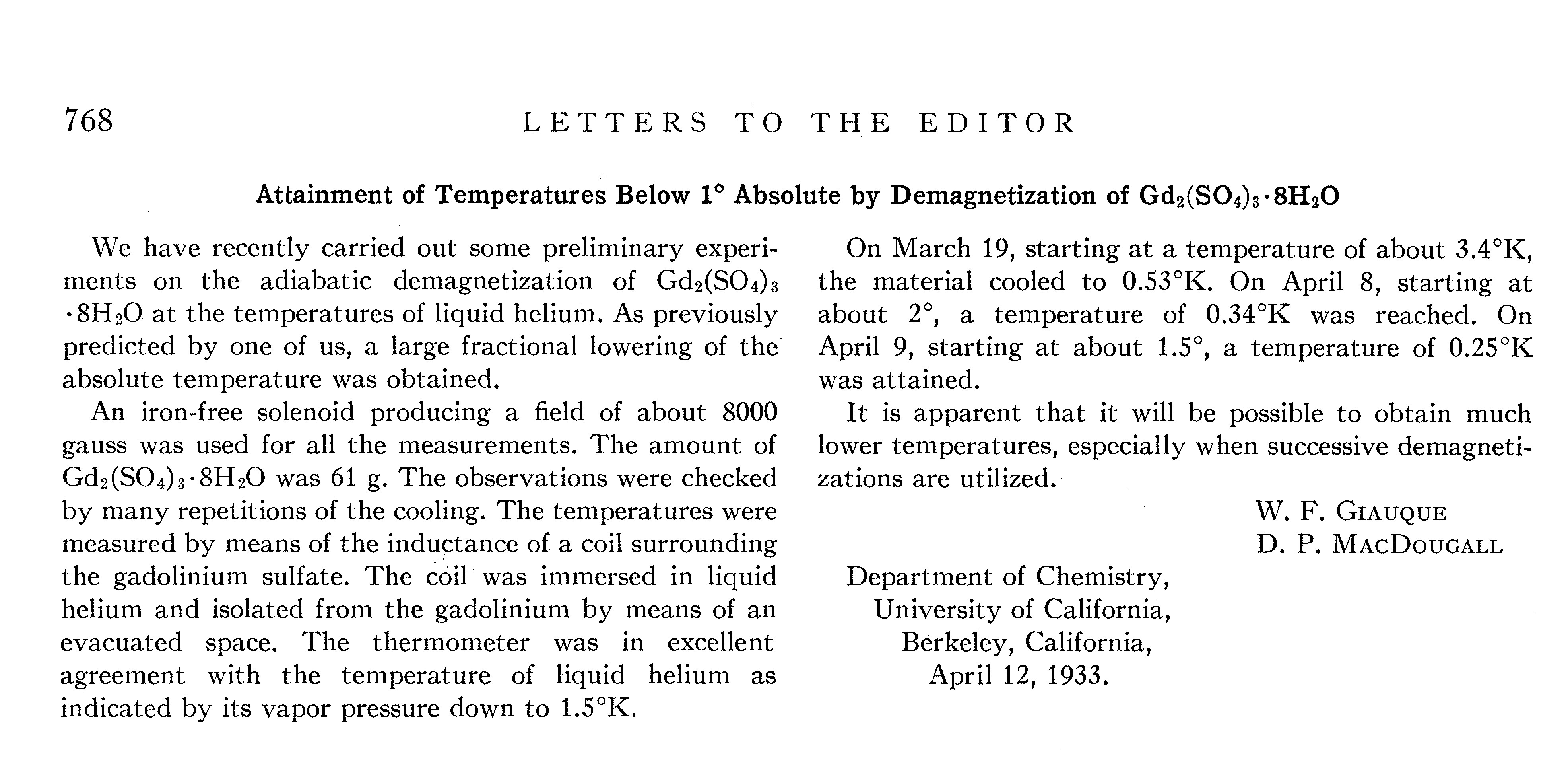
William Giauque was awarded the Nobel Prize for Chemistry in 1949 for his work on the properties (including magnetic properties) of matter at very low temperatures. Among the many achievements that led to this award Giauque was the first person to generate matter in a laboratory with a temperature below 1 Kelvin. This result was described in a publication in Physical Review Letters in 1933. Here is the letter in full:
I’ve seen a number of surprisingly short short communications from this era, but I think this one is the record. I’m not sure how many marks this would get as a lab report from an undergraduate physics student, but it doesn’t seem to have done Giauque any harm to keep it extremely brief!
While I’m here I’ll also mention that this also the common practice of awarding the Nobel Prize for Chemistry on the basis of work that is really Physics is clearly not a recent innovation!
Just a quick post to advertise that a short piece what I wrote is now published online on the journal Nature. It will appear in the print edition published tomorrow.
I think the title is fairly self-explanatory – it’s basically a triple book review, but with some additional scientific background thrown in.
Should you wish to do so, you can download a PDF version of the article here.
As I write, a catastrophic fire is raging in the Cathedral of Notre-Dame de Paris. Having started on the roof (or perhaps in a space underneath it), the flames spread rapidly through the mediaeval timbers of the building, bringing down the ceiling onto the nave, and causing the spire to collapse.
Restoration work on the roof started just four days ago and the area where the fire began was surrounded by scaffolding. Though nobody yet knows for sure what caused the fire, it seems likely to have been something to do with the ongoing repairs.
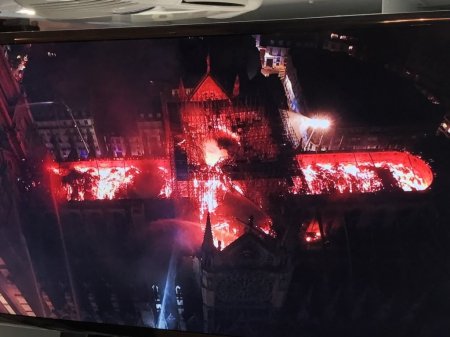
Watching the video streamed live from the scene with increasing horror, it seemed to me that the firemen were helpless to halt the advancing inferno. They just couldn’t get enough water onto the top of the huge structure quickly enough to contain the blaze. It was heartbreaking viewing. I fear very little will be left standing and most of the interior will have been completely destroyed, as this drone picture suggests:
At least there seem to have been no fatalities, although one brave fireman is reported to be seriously injured.
The loss of an iconic building like Notre Dame is shattering event for anyone who has been there, as I have on several occasions. Nobody who has seen the splendour of the 13th Century Rose Windows, for example, will ever forget the experience, so the destruction feels like losing a part of one’s own life. But above all it is a terrible loss for the people of Paris, as Notre Dame is the embodiment of so much of that beautiful and ancient city’s history.
Nobody put this better than Victor Hugo in Notre-Dame de Paris:
Notre Dame de Paris, in particular, is a curious specimen of this variety. Every surface, every stone of this venerable pile, is a page of the history not only of the country, but of science and of art. Thus—to mention here only a few of the chief details—whereas the small Porte Rouge almost touches the limits of fifteenth century Gothic delicacy, the pillars of the nave, by their massiveness and great girth, reach back to the Carlovingian Abbey of Saint-Germain-des-Prés. One would imagine that six centuries lay between that door and those pillars. Not even the Hermetics fail to find in the symbols of the grand doorway a satisfactory compendium of their science, of which the Church of Saint-Jacques-de-la-Boucherie was so complete a hieroglyph. Thus the Roman Abbey—the Church of the Mystics—Gothic art—Saxon art—the ponderous round pillar reminiscent of Gregory VII, the alchemistic symbolism by which Nicolas Flamel paved the way for Luther—papal unity—schism—Saint-Germain-des-Prés—Saint-Jacques-de-la-Boucherie—all are blended, combined, amalgamated in Notre Dame. This generative Mother-Church is, among the other ancient churches of Paris, a sort of Chimera: she has the head of one, the limbs of another, the body of a third—something of all.
I’m sure Parisians will be in a state of shock tonight and that will turn to something very close to grief. Mere words from me won’t help much, but let me in any case express my profound sadness and sympathy to my French friends and colleagues in Paris and around the world.
But if I know them at all, the French will soon set about the task of rebuilding, probably creating something majestic and extraordinary to replace what has been lost.
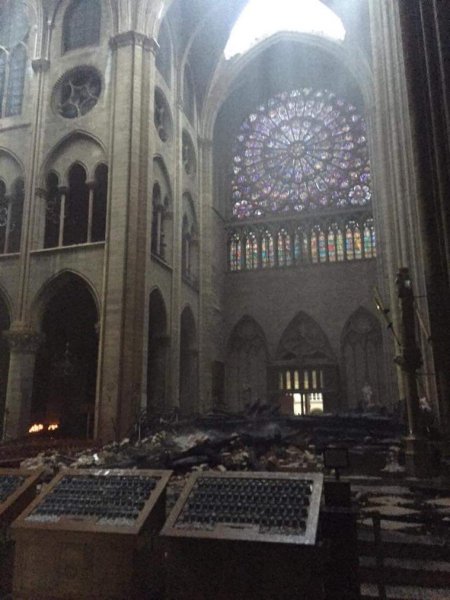
UPDATE: the morning after, it seems the fire was brought under control quickly enough to save the walls and towers, and at least one of the Rose Windows.
That this has been achieved owes everything to the courage and skill of the Pompiers, 500 of whom fought the blaze last night. Magnifique.
The other day I stumbled across an interesting article that discusses, among other things, the famous telescope and optical instrument manufacturing company, Grubb Parsons. The piece is a few years old but I didn’t see it when it came out. It’s well worth a read.
Grubb Parsons was still a famous company when I was at school, but it closed down in 1985. The main works were in Heaton, in Newcastle Upon Tyne, not far from where I was born; my father went to Heaton Grammar School.
Grubb Parsons made a huge number of extremely important astronomical telescopes, including the Isaac Newton Telescope, pictured above at the works in Heaton.
Interestingly, the names ‘Grubb’ and ‘Parsons’ both have strong Irish connections.
Howard Grubb was born in Dublin in 1844 and in 1864 he joined the optical instruments company set up there by his father Thomas Grubb. When his father died in 1878 Howard Grubb took over the Grubb Telescope Company and consolidated its reputation for manufacturing high quality optical components and devices. He was knighted in 1887.
Charles Algernon Parsons, who took over the Grubb Telescope Company after it was liquidated in 1925, and relocated it to Tyneside, was the youngest son of William Parsons ( just as Howard Grubb was the youngest son of Thomas). He no doubt kept the name Grubb in the company name because of its associated reputation.
Parsons had a wide range of business interests besides telescopes, mainly in the marine heavy engineering sector, especially steam turbines. When I was a lad, ‘C A Parsons & Company’ was still one of the biggest employers on Tyneside. It still exists but as part of Siemens and is a much smaller operation than in its heyday.
One final connection is that Sir Howard Grubb and Sir Charles Algernon Parsons both passed away in the same year, 1931.
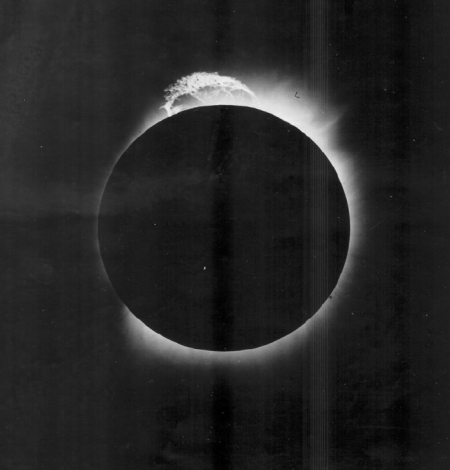
While I seem to be on a little run of posts about the 1919 Eclipse I thought I’d share the above photograph, taken at Principe, that shows that the bending of light from stars was not the only observation made at this eclipse. At the top of the figure you can see a wonderful example of a solarprominence..
As I revealed this afternoon in my talk at the Royal Astronomical Society, yesterday’s mystery object..
..is in fact the 4-inch object (geddit?) glass that was manufactured by Howard Grubb in Dublin and taken to Sobral in Brazil in 1919 to be used in a famous experiment to measure the bending of light by the Sun during a total eclipse.
Here is a picture of the observing setup in Sobral:
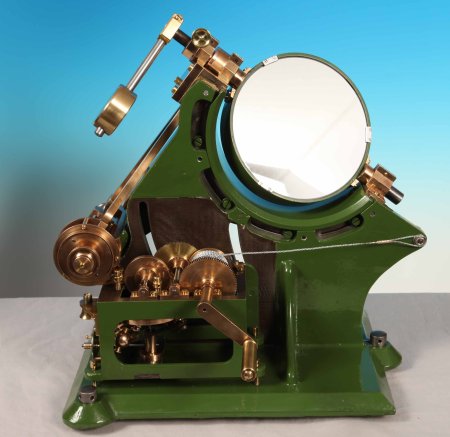
The 4-inch lens is mounted in the square tube on the right. The eclipse was observed using a coelostat (a steerable mirror) that reflected light into the telescopes. Here is a photograph of the coelostat:
The object glass and coelostat are usually on display at Dunsink Observatory but these are currently en route to Brazil for the commemorations of the centenary of the historic expedition.
The views presented here are personal and not necessarily those of my employer (or anyone else for that matter).
Feel free to comment on any of the posts on this blog but comments may be moderated; anonymous comments and any considered by me to be vexatious and/or abusive and/or defamatory will not be accepted. I do not necessarily endorse, support, sanction, encourage, verify or agree with the opinions or statements of any information or other content in the comments on this site and do not in any way guarantee their accuracy or reliability.








 In the Dark