Archive for the mathematics Category

A Problem involving Simpson’s Rule

Posted in Cute Problems, mathematics with tags , on March 9, 2018 by telescoper

Since I’m teaching a course on Computational Physics here in Maynooth and have just been doing methods of numerical integration (i.e. quadrature) I thought I’d add this little item to the Cute Problems folder. You might answer it by writing a short bit of code, but it’s easy enough to do with a calculator and a piece of paper if you prefer.

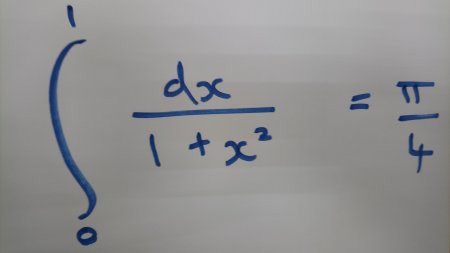
Use the above expression, displayed using my high-tech mathematical visualization software, to obtain an approximate value for π/4 (= 0.78539816339…) by estimating the integral on the left hand side using Simpson’s Rule at ordinates x =0, 0.25, 0.5, 0.75 and 1.

Comment on the accuracy of your result. Solutions and comments through the box please.

HINT 1: Note that the calculation just involves two applications of the usual three-point Simpson’s Rule with weights (1/3, 4/3, 1/3). Alternatively you could do it in one go using weights (1/3, 4/3, 2/3, 4/3, 1/3).

HINT 2: If you’ve written a bit of code to do this, you could try increasing the number of ordinates and see how the result changes…

P.S. Incidentally I learn that, in Germany, Simpson’s Rule is sometimes called called Kepler’s rule, or Keplersche Fassregel after Johannes Kepler, who used something very similar about a century before Simpson…

The de Valera connection

Posted in History, mathematics, Maynooth with tags , , on February 14, 2018 by telescoper

This morning I took the early flight to Dublin, which was on time, and thence via the Airport Hopper to Maynooth. There were only two passengers on the bus, both going to the terminus, so it made good time, travelling all the way along the motorway.

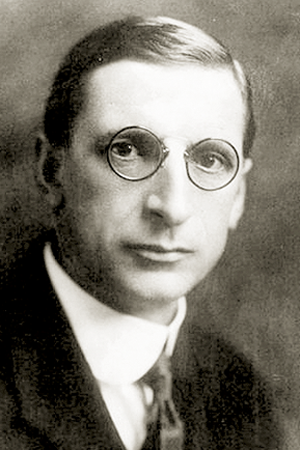
Walking into the Maynooth campus I remembered an interesting little historical fact that I stumbled across last week, concerning Éamon de Valera, founder of Fianna Fáil (one of the two largest political parties in Ireland) and architect of the Irish constitution. De Valera (nickname `Dev’) is an enigmatic figure, who was a Commandant in the Irish Republican Army during the 1916 Easter Rising, but despite being captured he somehow evaded execution by the British. He subsequently became Taoiseach (Prime Minister) and then President (Head of State) of the Irish Republic.

Eamon de Valera, photographed sometime during the 1920s.

The point of connection with Maynooth, however, is less about Dev’s political career than his educational background: he was a mathematics graduate, and for a short time (1912-13) he was Head of the Department of Mathematics and Mathematical Physics at St Patrick’s College, Maynooth, which was then a recognised college of the National University of Ireland. The Department became incorporated in Maynooth University, when it was created in 1997. It is said that one of the spare gowns available to be borrowed by staff for graduation ceremonies belonged to de Valera. Mathematical Physics is no longer a part of the Mathematics Department at Maynooth, having become a Department in its own right and it recently changed its name to the Department of Theoretical Physics.

De Valera missed out on a Professorship in Mathematical Physics at University College Cork in 1913. He joined the the Irish Volunteers, when it was established the same year. And the rest is history. I wonder how differently things would have turned out had he got the job in Cork?

That’s one connection, but when I arrived in the office this morning I found another. An email had arrived announcing a conference later this year in honour of Erwin Schrödinger.  It was de Valera – a notable advocate for science – who in 1940 set up the Dublin Institute for Advanced Studies (DIAS); Schrödinger became the first Director of the School of Theoretical Physics, one of the three Schools in DIAS.

Planes, Trains and Quaternions

Posted in Biographical, History, mathematics, Maynooth with tags , , , , , , , , on January 4, 2018 by telescoper

Well, here I am in Maynooth for the first time in 2018. I flew over from Cardiff yesterday. The flight was rather bumpy owing to the strong winds following Storm Eleanor, and it was rather chilly waiting for the bus to Maynooth from Dublin Airport; nevertheless I got to my flat safely and on time and found everything in order after the Christmas break.

This morning I had to make a trip by train to Dublin city  to keep an appointment at the Intreo Centre in Parnell Street, which is about 15 minutes walk from Dublin Connolly train station. I bought an Adult Day Return which costs the princely sum of €8.80. Trains, stations and track in Ireland are maintained and operated by Irish Rail (Iarnród Éireann), which is publicly owned. Just saying.

The distance between Maynooth and Dublin about 25 km, which takes about 40 minutes on the local stopping train or about 25 minutes on the longer distance trains which run nonstop from Maynooth to Dublin. As it happens I took one of the fast trains this morning, which arrived on schedule, as did the return journey on a commuter train. My first experience of the Irish railway system was therefore rather positive.

I had thought of having a bit of a wander around the city on my way to Parnell Street but it was raining and very cold so I headed straight there. I arrived about 20 minutes ahead of my scheduled appointment, but was seen straight away.

The reason for the interview was to acquire a Personal Public Services Number (PPSN), which is the equivalent of the National Insurance Number we have in the United Kingdom. This number is needed to be registered properly on the tax and benefit system in Ireland and is the key to access a host of public services, the electoral roll, and so on. You have to present yourself in person to get a PPSN, presumably to reduce the opportunity for fraud, and I was told the interview would take 15 minutes. In fact, it only took about 5 minutes and at the end a photograph was taken to go on the ID card that is issued with the number on it.

So there I was, all finished before I was even due to start. The staff were very friendly and it all seems rather easy. Fingers crossed that the letter informing me of my number will arrive soon. It should take a week or so, so I’m told. After that I should be able to access as many personal services as I want whenever I want them. (Are you sure you have the right idea? Ed.)

For  the return trip  to Maynooth I got one of the slower commuter trains, stopping at intermediate stations and running right next to the Royal Canal, which runs from Dublin for 90 miles through  Counties Dublin, Kildare, Meath and Westmeath before entering County Longford, where it joins the River Shannon. One of the intermediate stations along the route next to the canal is Broombridge, the name of which stirred a distant memory.

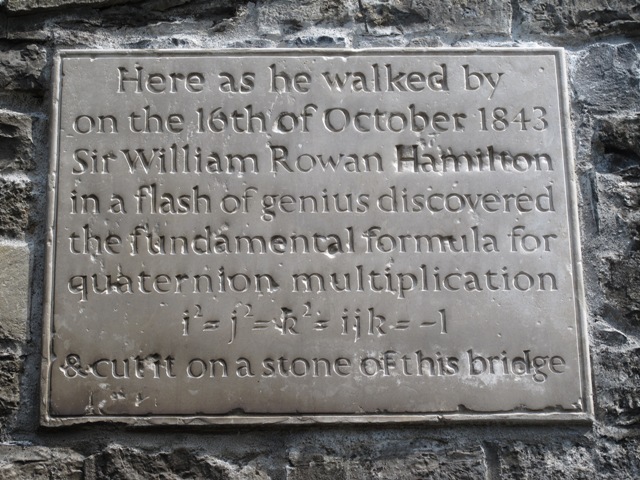
A quick application of Google reminded me that the town of Broombridge is the site of the bridge (Broom Bridge) beside which William Rowan Hamilton first wrote down the fundamental result of quaternions (on 16th October 1843). Apparently he was walking from Dunsink Observatory into town when he had a sudden flash of inspiration  and wrote the result down on the spot, now marked by a plaque:

Picture Credit: Brian Dolan


This episode  is commemorated on 16th October each year by an annual Hamilton Walk. I look forward to reporting from the 2018 walk in due course!

P.S. Maynooth is home to the Hamilton Institute which promotes and facilitates research links between mathematics and other fields.

 

Trees, Graphs and the Leaving Certificate

Posted in Biographical, mathematics, Maynooth, The Universe and Stuff with tags , , , , , , on December 15, 2017 by telescoper

I’m starting to get the hang of some of the differences between things here in Ireland and the United Kingdom, both domestically and in the world of work.

One of the most important points of variation that concerns academic life is the school system students go through before going to University. In the system operating in England and Wales the standard qualification for entry is the GCE A-level. Most students take A-levels in three subjects, which gives them a relatively narrow focus although the range of subjects to choose from is rather large. In Ireland the standard qualification is the Leaving Certificate, which comprises a minimum of six subjects, giving students a broader range of knowledge at the sacrifice (perhaps) of a certain amount of depth; it has been decreed for entry into this system that an Irish Leaving Certificate counts as about 2/3 of an A-level for admissions purposes, so Irish students do the equivalent of at least four A-levels, and many do more than this.

There’s a lot to be said for the increased breadth of subjects undertaken for the leaving certificate, but I have no direct experience of teaching first-year university students here yet so I can’t comment on their level of preparedness.

Coincidentally, though, one of the first emails I received this week referred to a consultation about proposed changes to the Leaving Certificate in Applied Mathematics. Not knowing much about the old syllabus, I didn’t feel there was much I could add but I had a look at the new one and was surprised to see a whole `Strand’, on Mathematical Modelling with netwworks and graphs.

The introductory blurb reads:

In this strand students learn about networks or graphs as mathematical models which can be used to investigate a wide range of real-world problems. They learn about graphs and adjacency matrices and how useful these are in solving problems. They are given further opportunity to consolidate their understanding that mathematical ideas can be represented in multiple ways. They are introduced to dynamic programming as a quantitative analysis technique used to solve large, complex problems that involve the need to make a sequence of decisions. As they progress in their understanding they will explore and appreciate the use of algorithms in problem solving as well as considering some of the wider issues involved with the use of such techniques.


Among the specific topics listed you will find:

  • Minimal Spanning trees applied to problems involving optimising networks and algorithms associated with finding these (Kruskal, Prim);  
  • Bellman’s Optimality Principal to find the shortest paths in a weighted directed network, and to be able to formulate the process algebraically;
  •  Dijkstra’s algorithm to find shortest paths in a weighted directed network; etc.


For the record I should say that I’ve actually used Minimal Spanning Trees in a research context (see, e.g., this paper) and have read (and still have) a number of books on graph theory, which I find a truly fascinating subject. It seems to me that the topics all listed above  are all interesting and they’re all useful in a range of contexts, but they do seem rather advanced topics to me for a pre-university student and will be unfamiliar to a great many potential teachers of Applied Mathematics too. It may turn out, therefore, that the students will end up getting a very superficial knowledge of this very trendy subject, when they would actually be better off getting a more solid basis in more traditional mathematical methods  so I wonder what the reaction will be to this proposal!


Joseph Bertrand and the Monty Hall Problem

Posted in Bad Statistics, History, mathematics with tags , , , , on October 4, 2017 by telescoper

The death a few days ago of Monty Hall reminded me of something I was going to write about the Monty Hall Problem, as it did with another blogger I follow, namely that (unsrurprisingly) Stigler’s Law of Eponymy applies to this problem.

The earliest version of the problem now called the Monty Hall Problem dates from a book, first published in 1889, called Calcul des probabilités written by Joseph Bertrand. It’s a very interesting book, containing much of specific interest to astronomers as well as general things for other scientists. Ypu can read it all online here, if you can read French.

As it happens, I have a copy of the book and here is the relevant problem. If you click on the image it should be legible.

It’s actually Problem 2 of Chapter 1, suggesting that it’s one of the easier, introductory questions. Interesting that it has endured so long, even if it has evolved slightly!

I won’t attempt a full translation into English, but the problem is worth describing as it is actually more interesting than the Monty Hall Problem (with the three doors). In the Bertrand version there are three apparently identical boxes (coffrets) each of which has two drawers (tiroirs). In each drawer of each box there is a medal. In the first box there are two gold medals. The second box contains two silver medals. The third box contains one gold and one silver.

The boxes are shuffled, and you pick a box `at random’ and open one drawer `randomly chosen’ from the two. What is the probability that the other drawer of the same box contains a medal that differs from the first?

Now the probability that you select a box with two different medals in the first place is just 1/3, as it has to be the third box: the other two contain identical medals.

However, once you open one drawer and find (say) a silver medal then the probability of the other one being different (i.e. gold) changes because the knowledge gained by opening the drawer eliminates (in this case) the possibility that you selected the first box (which has only gold medals in it). The probability of the two medals being different is therefore 1/2.

That’s a very rough translation of the part of Bertrand’s discussion on the first page. I leave it as an exercise for the reader to translate the second part!

I just remembered that this is actually the same as the three-card problem I posted about here.

R.I.P. Maryam Mirzakhani (1977-2017)

Posted in mathematics with tags , , on July 18, 2017 by telescoper

Very sad news arrived at the weekend of the death of the brilliant Iranian-born mathematician Maryam Mirzakhani of breast cancer at the age of just 40. Let me first of all express my heartfelt condolences to her family, friends and colleagues on this devastating loss.

A uniquely creative and inspirational figure, Maryam Mirzakhani was the first woman ever to win the coveted Fields Medal; her citation for that award picks out her work on the dynamics and geometry of Riemann surfaces and their moduli spaces.  Here’s a short video of her talking about her life and work. It’s fascinating not only because of the work itself, but the insight it gives into the way she did it – using very large sheets of paper covered in drawings and notes!

R.I.P. Maryam Mirzakhani (1977-2017).


Betting on the Supreme Court

Posted in mathematics with tags , , , , , , , on December 6, 2016 by telescoper

This week the UK Supreme Court is hearing an appeal by HM Government against the judgment recently delivered by the High Court which was that the UK Government must seek the approval of Parliament before it can invoke Article 50 of the Lisbon Treaty and thus begin the process of leaving the European Union. You can watch the proceedings live here. I had a brief look myself this morning but as I’m not a legal expert I found it rather hard to follow as it’s rather technical stuff. That wasn’t helped by the rather dull delivery of James Eade QC who was presenting the government’s case. Nevertheless, it is a very good thing that we can see how the law work in practice. I was surprised at the lack of gowns and wigs!

Although Eade seemed (to me) be on a very sticky wicket for some of the time, it’s impossible for me to come to any informed inference about who’s likely to win. Out of interest, to see what other people think, I therefore had a quick look at the betting markets. Traditional bookmakers (such as William Hill) are offering 1-3 (i.e. 3-1 ON) for the original decision being upheld so they’re clearly expecting the appeal to fail.

These days, however, I’ve started to get interested in other kinds of betting markets, especially the BetFair Exchange. This allows customers to act as bookmakers as well as punters by offering the option to “lay” and/or  “back” various possible bets. “Laying” betting means effectively acting as a bookie, proposing odds on a particular outcome. i.e. selling a bet.  “Backing” a bet means buying a bet. The exchange then advertises this to prospective bettors who sign up of they are prepared to stake money on that particular outcome at those particular odds. It’s very similar in concept to other trading services, e.g. share dealing. Matches aren’t always made of course, so not every bet that’s offered gets accepted. If that happens you can try again with more generous odds.

The advantage of this type of betting is that it represents an “efficient market”. Such a market occurs when all the money going into the market equals all the money being paid out in the market – there is no leakage or profits being taken. Efficient betting markets rarely exist outside of betting exchanges – bookmakers need to reap a profit in order to run a business. For example, though William Hill is offering 1-3 on the Supreme Court ruling being upheld, the odds they offer against this outcome are 12-5. These are not “true odds” in the sense that they can’t represent a consistent pair of probabilities of the two outcomes (as they don’t add up to one). In the case of an exchange market a bet laid at 1-3 is automatically backed at 3-1. These can then be regarded as “true odds”.

This is what the BetFair Exchange on the Supreme Court hearing looks like at the moment (you might want to click on the image to make it clearer):


supreme-court

The odds are given in a slightly funny way, giving the gross return for a unit stake (including the stake). In more normal language “4.3” would be 100-30, i.e. a £1 bet gets you £3.33 plus your £1 back. A bet on “overrule” at “4” (3-1) corresponds to a bet against “uphold” at 1.33 (1-3), reflecting what I was saying about “true odds”.

The first thing that struck me is the figure at the top right: £38,427. This is the value of all bets matched in this market. By BetFair standards this is very low. A typical Premiership football match will involve bets at least ten times as big as this. As in the court case itself there just isn’t very much action!

Apart from that you can see that the odds here are broadly similar with William Hill etc with implied odds around 3-1 to 4-1 against overruling.

Before you ask, I’m not going to bet on this myself. My betting strategy usually involves betting on the outcome I don’t want to happen. Although I think Parliament should be involved in Article 50 I am just happy that this matter should be left to our independent judiciary to decide.

Romanesco and the Golden Spiral

Posted in mathematics, The Universe and Stuff with tags , , , on November 8, 2016 by telescoper

Some time ago I mentioned that I received one of these in my weekly veggie box..

romanesco

Actually, that reminds me that a new box is due tomorrow morning…

Anyway, the vegetable in the picture is called Romanesco. I’ve always thought of it as a cauliflower but I’ve more recently learned that it’s more closely related to broccoli. It doesn’t really matter because both broccoli and cauliflower are forms of brassica, which term also covers things like cabbages, kale and spinach. All are very high in vitamins and are also very tasty if cooked appropriately. Incidentally, the leaves of broccoli and cauliflower are perfectly edible (as are those of Romanesco) like those of cabbage, it’s just that we’re more used to eating the flower (or at least the bud).

It turns out that this week’s Physics World has a short piece on Romanesco, which points out that a “head” of Romanesco has a form of self-similarity, in that each floret is a smaller version of the whole bud and also displays structures that are smaller versions of itself. That fractal behaviour is immediately obvious if you take a close look. Here’s a blow-up so you can see more clearly:
romanesco-broccoli2-550x412

However, one thing that I hadn’t noticed before is that there is another remarkable aspect to the pattern of florets, in that they form an almost perfect golden spiral. This is a form of logarithmic spiral that grows every quarter-turn by a factor of the golden ratio:

\phi = \frac{1+\sqrt{5}}{2}.

Logarithmic, or at least approximately logarithmic, spirals occur naturally in a number of settings. Examples include spiral galaxies, various forms of shell, such as that of the nautilus and in the phenomenon of phyllotaxis in plant growth (of which Romanesco is a special case). It would seem that the reason for the occurrence of logarithmic spirals  in living creatures is that such a shape allows them to grow without any change in shape.

Not really relevant to anything much, I know, but I thought you might be interested…

P.S. One thing the Physics World piece fails to mention is that, regardless of its geometrical properties, Romanesco is really delicious!

Computable Numbers, 80 Years on..

Posted in History, mathematics, Uncategorized with tags , , , , on May 28, 2016 by telescoper

There’s been rather a lot of sad news conveyed via this blog recently, so I thought that today I’d mark a happier event. Eighty years ago today (i.e. on 28th May 1936), a paper by Alan Turing arrived at the London Mathematical Society. Entitled “On Computable Numbers, with an Application to the Enstscheidungsproblem“, this was not only enormously influential but also a truly beautiful piece of work. Turing was only 23 when he wrote it. It was delivered to the London Mathematical Society about 6 months after it was submitted,  i.e. in November 1936..

Here’s the first page:

Turing

The full reference is

Proc. London Math. Soc. (1937) s2-42 (1): 230-265. doi: 10.1112/plms/s2-42.1.230

You can find the full paper here. I heartily recommend reading it, it’s wonderful.