After a long and very trying week I thought I’d sign off for the weekend with a lovely old bit of jazz. This is what I think was Humphrey Lyttelton’s band, vintage 1950, playing a tune, On Treasure Island, that Humph almost certainly got off a copy of the gorgeous record Louis Armstrong made of this song in the 1930s, although the Lyttelton version is very different in tempo and character.
The front line of this incarnation of the Lyttelton band was the best ever: Humphrey Lyttelton himself on trumpet, Wally Fawkes on clarinet and Keith Christie on trombone. The ensemble playing after Humph’s trumpet solo, from about 1.47, is an absolutely fantastic polyphonic blend of three great soloists. Enjoy!
Not too well today – and ridiculously busy – so I thought I’d post a brief pick-me-up by the “King of Swing”. I remember that my Dad – who was a semi-professional Jazz drummer – wasn’t all that keen on Benny Goodman’s clarinet playing, which he regarded as “too clinical”. In fact many jazz writers also refer to Benny Goodman as “unemotional”. I can’t agree – the clarinet on this track is absolutely sensational to me, and I find it a joy to listen to over and over again. And if that wasn’t enough for a three-minute 78 there’s also a fine solo from pioneering electric guitarist Charlie Christian and Cootie Williams on trumpet on this big band version of Fats Waller’s familiar composition Honeysuckle Rose.
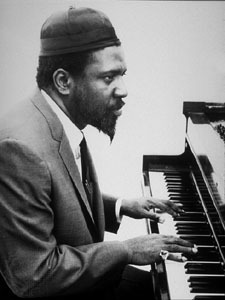
A couple of days ago I posted a piece of music by Eric Dolphy that was inspired by Thelonious Monk , so today I thought I’d post something by Monk himself together with my own appreciation of his music.
Thelonious Monk was a remarkable musician. His self-taught style of piano-playing was unlike that of anyone who came before or after him, including those followers who tried to copy him. He broke many rules, especially in the way he used his fingers – keeping them straight as he played to get a uniquely percussive sound from the instrument, well matched, on the track I’ve posted below, to the vibraphone of Milt Jackson.
Monk was often called “The High Priest of Bop” and regarded as one of the leaders of the post-war bebop revolution in Jazz alongside Charlie Parker and Dizzy Gillespie. Actually, I don’t think Monk ever really played bebop at all. I’ve always thought the archetypal bop pianist was Bud Powell whose style was totally different to Monk’s. But the “High Priest” tag owed at least something to his eccentric personality: he hardly ever spoke and, aside from his music, he seemed to communicate with the outside world largely through his choice of hat.
Monk’s piano style is hard to describe – his wife Nellie once described it as “Melodious Thunk” – but I’ve always loved his music. To me his solos sound like someone talking directly at you in a strange and wonderful language that you don’t quite understand but which sounds beautiful anyway. His use of syncopation is quite different from the usual bebop musicians and it seems, to me anyway, to echo the rhythms of everyday speech. But, above all, when you hear Monk play the piano, you know immediately who it is. He had many admirers, but nobody could play like him. He was a genius.
In later life his behaviour became disturbingly erratic; he would sometimes stand up in the middle of a performance and go wandering around the stage. In my opinion his music also deteriorated from the early sixties onwards. I think it was generally assumed that he had a drugs problem, which he may well have had, but it was eventually realised that he was suffering from a serious mental illness. Although attempts were made to treat this, he stopped playing in the 1970s and lived out the rest of his life as a virtual recluse.
I remember very well the day he died, in February 1982. It was during the Newcastle Jazz Festival, on the day when the great British jazz pianist Stan Tracey was due to give a concert there. As we took our seats in the Newcastle Playhouse for the gig, an announcement was made that Thelonious Monk had died. Stan Tracey, for whom Monk had been a major musical inspiration, responded to the occasion by playing two sets exclusively consisting of tunes by his hero. It was one of the best concerts I’ve ever been to and remains strong in my memory to this day.
I think Monk’s best records are from the 40s and 50s, and he was certainly in his prime in 1948 when he recorded this classic performance, for the Blue Note label, of his own composition, Misterioso.
I haven’t posted much Jazz recently, and was reminded of this fact when I listened to the following track on my iPod yesterday while travelling back from Cardiff to Brighton. Hat and Beard is an original composition by one of my favourite jazz artists, saxophonist Eric Dolphy and was written in honour of another of my favourite jazz artists, Thelonious Monk, who not only sported a splendid beard but also had a famously eccentric taste in headgear…
Anyway, Hat and Beard is taken from the pioneering free jazz album Out to Lunch. This album is without doubt one of the high points of 1960s avant-garde jazz, primarily because of Dolphy’s extraordinary playing (in this case on bass clarinet) but also because of the brilliance of the other musicians: Freddie Hubbard on trumpet; Bobby Hutcherson on vibes; Richard Davis on bass; and the superb Tony Williams on drums (who was only 18 when this track was recorded).
Well, it’s a sunny Friday afternoon here so I thought I’d wind down for the weekend by posting a nice bit of Jazz to end the week. This is a version of a famous composition (by Jelly Roll Morton) made by Humphrey Lyttelton with his Paseo Jazz Band. This consisted of the core of Humph’s band of the time – notably Humph himself on trumpet and Wally Fawkes on clarinet – with the addition of a large number of West Indian musicians whom Humph had met in London; the recordings they made together are an absolute blast, largely because of the fusion of traditional jazz with Caribbean rhythms. The sound contrasts with a lot of the “trad” jazz at the time, but is if anything more authentic than that of many revivalist bands of the period because it echoes the astonishing blend of cultures that was characteristic of New Orleans at the time Jazz was born. This tune in particular gets a rhythmic backdrop of congas, bongos, claves and maracas that gives it a lovely lilting feel. And on top of all the extra percussion there is Fitzroy Coleman’s guitar which was then, is now, and forever shall be, a joy. It’s a very original version indeed of the Original Jelly Roll Blues…
Well, the British Summer has arrived at last. It’s raining. The weather reminded me of little number I posted some time ago by Tommy Flanagan, one of the most consistently enjoyable but underrated Jazz pianists of all time. So naturally I decided to post it again. Tommy Flanagan (who died in 2001) was probably best known as the long-time accompanist of Ella Fitzgerald but he also played on a number of really important Jazz albums with Sonny Rollins and John Coltrane, to name just two. He also loved to play within the classic Jazz piano trio format with George Mraz (bass) and Kenny Washington (drums). Here they are playing a nice tune by the great Billy Strayhorn, called Raincheck…
I haven’t posted any Jazz for a while and given the apparently controversial nature of one of my recent posts, what could be better than a track called I’m Prayin’ Humble?
This Gospel-influenced Swing Era classic was recorded in 1938 by Bob Crosby’s Orchestra and it features the red hot plunger-muted trumpet of Sterling Bose. For those of you who weren’t aware Bob Crosby had a brother called Harry who went by the nickname of Bing. Anyway, his band (Bob’s not Bing’s) had a very distinctive sound all of its own, and some fine soloists.
I just heard the news that Ornette Coleman has passed away at the age of 85. He was one of the true innovators of Jazz and his influence on the development of this music over the last 50 years has been absolutely immense. I don’t have the words to pay adequate tribute to the either the man or his music, so I’ll just highlight two tracks from my favourite album of his, which was recorded Live at the Golden Circle club in Stockholm in 1965, and was proclaimed “Record of the Year” the following summer in Downbeat magazine. This features a trio of Coleman on alto sax, David Izenzon on bass, and Charles Moffit on bass. By the mid-60s Ornette Coleman had already established his reputation as leading light of avant-garde saxophonists and, in his own way, was as great an influence on jazz as Charlie Parker, Sonny Rollins and John Coltrane had been just a few years earlier, but this album is, for me, when Ornette Coleman underwent the transition to greatness.
The track European Echoes starts in a deceptively simple manner, with Ornette’s little two-note statements over a fast waltzy 3/4 foundation provided by Izenzon and Moffitt. It then eases into a passage marked by freer improvisations by Ornette, the meter changing at the same time to 4/4. Ornette plays for more than half the track, after which Izenzon and Moffitt take over for all but the final minute, at which point Izenzon drops out and Moffitt plays an intricate percussion solo.
Although most people I know recognize the virtuosity of modern jazz musicians they don’t really like the music very much. On the other hand fell in love with this track as soon as I heard it, partly because it begins simply enough for a beginning saxophonist to play along with, but also because it’s highly original without being at all self-indulgent. In fact, at one level, everything Ornette Coleman does on this track is quite simple; he plays the saxophone here like he’d just discovered the instrument and was in the process of finding out what it could do; at least in his early years, he didn’t have much of a technique at all in the conventional sense but nevertheless managed to produce amazing music. This a view echoed by the great Charles Mingus in quote I got from another blog about Ornette Coleman:
Now aside from the fact that I doubt he can even play a C scale in whole notes—tied whole notes, a couple of bars apiece—in tune, the fact remains that his notes and lines are so fresh. So when [the jazz dj] Symphony Sid played his record, it made everything else he was playing, even my own record that he played, sound terrible.
I did learn to enjoy and admire Ornette Coleman’s more “difficult” music later on, but European Echoes was the track that convinced me that Ornette Coleman was a genius.
Though from the same album, Faces and Places is quite a different kettle of fish. It goes like the clappers right from the start, with some terrific work on the drums by Moffit, skittering along on the cymbals with interludes of powerful rapid-fire accents on the skins. Fantastic stuff.
I’ve decided that I’m going to spend this evening listening to Ornette Coleman records and drinking to his memory.
As regular readers of this blog (Sid and Doris Bonkers) will know, among the various things I write about apart from The Universe and Stuff is my love of Jazz. I don’t often get the chance to combine music with physics in a post so I’m indebted to George Ellis for drawing my attention to this fascinating little video showing a visualisation of the effects of quantum entanglement:
The experiment shown involves pairs of entangled photons. Here is an excerpt from the blurb on Youtube:
The video shows images of single photon patterns, recorded with a triggered intensified CCD camera, where the influence of a measurement of one photon on its entangled partner photon is imaged in real time. In our experiment the immediate change of the monitored mode pattern is a result of the polarization measurement on the distant partner photon.
You can find out more by clicking through to the Youtube page.
While most of my colleagues were completely absorbed by the pictures, I was fascinated by the choice of musical accompaniment. It is in fact Blue Piano Stomp, a wonderful example of classic Jazz from the 1920s featuring the great Johnny Dodds on clarinet (who also wrote the tune) and the great Lil Armstrong (née Hardin) on piano, who just happened to be the first wife of a trumpet player by the name of Louis Armstrong.
So at last I’ve found an example of Jazz entangled with Physics!
P.S. We often bemoan the shortage of female physicists, but Jazz is another field in which women are under-represented and insufficiently celebrated. Lil Hardin was a great piano player and deserves to be much more widely appreciated for her contribution to Jazz history.
The views presented here are personal and not necessarily those of my employer (or anyone else for that matter).
Feel free to comment on any of the posts on this blog but comments may be moderated; anonymous comments and any considered by me to be vexatious and/or abusive and/or defamatory will not be accepted. I do not necessarily endorse, support, sanction, encourage, verify or agree with the opinions or statements of any information or other content in the comments on this site and do not in any way guarantee their accuracy or reliability.