I stumbled across this on Youtube and just had to share it. I’ve got this track on an old vinyl LP of Charlie Parker performances recorded live at Birdland, the famous New York jazz club named in his (Bird’s) honour. I don’t think any of the tracks on that album have ever been reissued on CD or for download so I was both surprised and delighted to find this. It was recorded live in 1953, so it’s a bit lo-fi, but what’s particularly interesting is the unusual collection of instruments. Bird is alto sax as usual, but the rest of the band consists of Cornelius Thomas on drums, Bernie McKay on guitar and Milt Buckner on the Hammand Organ. That’s very far from a typical bebop band. Milt Buckner’s organ accompaniment is perhaps an acquired taste but Charlie Parker clearly enjoyed this setting. He plays beautifully throughout, especially during the exciting chase sequence with the drummer near the end. The tune was written by Parker’s old sparring partner Dizzy Gillespie and is based on the chords of Whispering, an old ballad written in 1920. I’m not sure why Dizzy Gillespie decided to hang his tune on that particular harmonic progression, but it’s a thrill to hear Bird racing through the changes in such exhilarating style.
Follow @telescoperArchive for the Jazz Category
Groovin’ High
Posted in Jazz with tags bebop, Birdland, Charlier Parker, Groovin' High, Milt Buckner on May 18, 2015 by telescoperSmoke Gets in Your Eyes
Posted in Jazz with tags Don Byas, Jazz, smoke gets in your eyes on May 2, 2015 by telescoperOver thirty years ago I wandered into Windows shop in Newcastle and found an LP called Blues Pour Flirter. It was recorded in Paris in 1962 and features Don Byas on tenor saxophone. I didn’t care much for the title, especially when I looked at the listing to find that there wasn’t a single blues among the tracks – they’re all ballads. I bought the album anyway and am glad I did because Don Byas plays beautifully throughout, and one of the tracks has been a particular favourite of mine ever since.
Some of the tracks involve a big studio orchestra including strings and woodwinds but my favourite has Don Byas on tenor saxophone accompanied by a rhythm section of Christian Garros on drums, Pierre Sim on bass and George Arvanitas on piano. They play a ravishing version of the Jerome Kern standard Smoke Gets InYour Eyes, which someone has had the good grace to put on YouTube. It seems this and some of the other tracks on the album I bought way back when have been reissued on another album.
I love the huge sound Don Byas produces as he plays this tune, like a lion playing with a cub. At one point it seems like he’s going to tear it apart but it all ends peacefully. How I wish I could play like this!
Follow @telescoperWhen You’re Smiling
Posted in Jazz with tags Bille Holliday, Lester Young on March 16, 2015 by telescoperI’m not sure it’s possible for any record to be perfect, but there are definitely some that I couldn’t be improved in any way that I can imagine. I can think of a number of Jazz records that fall into that category, including this version of When You’re Smiling made in 1938. It features Billie Holliday and Lester Young along a number of other members of the Count Basie Orchestra (apart from the Count himself, who is replaced by Teddy Wilson on piano).
That this is a favourite record of mine is a bit of a paradox, because I don’t really like the song very much. However, in jazz the tune is just the starting point. In her early recording career, Billie Holliday wasn’t very well known so she was often given relatively unpromising songs to sing. She turned out to be brilliant at turning this base metal into gold and becamse the best singer of a bad song there has ever been.
It’s not just the way Billie Holliday’s voice floats ethereally across the beat as she takes outrageous liberties with both melody and rhythm. Nor is the way she manages to express everything there is about life and love and hearteache through the rather banal lyrics, investing the song with a deep sense of tragic irony. Nor is it Lester Young’s superbly constructed tenor saxophone solo near the end, which one of the very greatest by one of the very greatest. Nor is it that lightly swinging rhythm section of Freddie Green, Walter Page and Jo Jones who push the whole thing along on gossamer wings, making most of their rivals sound like clodhoppers; the drummer Jones,for example, adds punctuation in the form of accents to the poetry of Lester Young’s solo. All the component parts are magnificent, but the whole is even greater than their sum. It’s a timeless jazz masterpiece.
I don’t know why I haven’t posted this track before, but better late than never. I hope you can take 3 minutes to enjoy it!
Follow @telescoperBloomdido – In Memoriam Charlie Parker
Posted in Jazz with tags bebop, Bloomdido, Blues, Charlie Parker, Dizzy Gillespie, Jazz, Thelonious Monk on March 12, 2015 by telescoper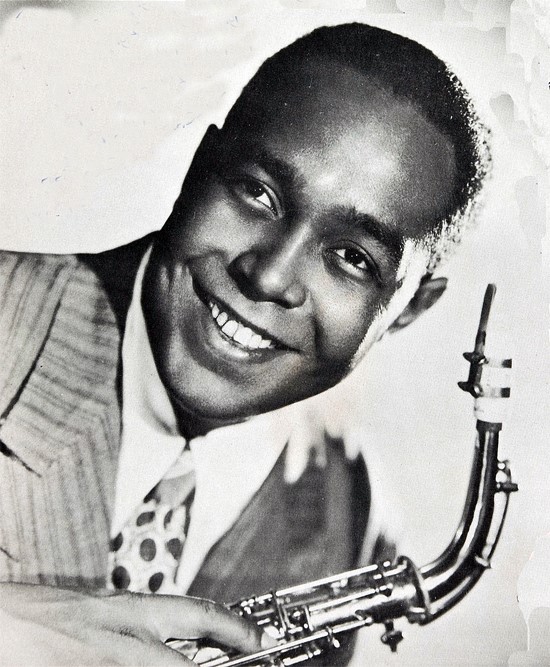
Today marks the 60th anniversary of the death of the great saxophonist Charlie Parker (“Bird”) on 12th March 1955. I’ve written quite a few posts relating to Charlie Parker over the years but today has provided a good excuse to spend my lunchtime writing another one, this time featuring one of my favourite tracks from one of my favourite albums. First released in 1952 but in fact recorded in two separate sessions in 1949 and 1950, the album Bird and Diz was actually the last studio album made under the joint leadership of Charlie Parker and Dizzy Gillespie, the two main architects of the bebop revolution; the track I’ve picked has the added advantage of featuring another great musical genius on piano, Thelonious Monk.
The Charlie Parker composition Bloomdido is yet another of his variations on the blues, though this one is a bit less intricate than some of the others he wrote. Here are the chords for Bloomdido:
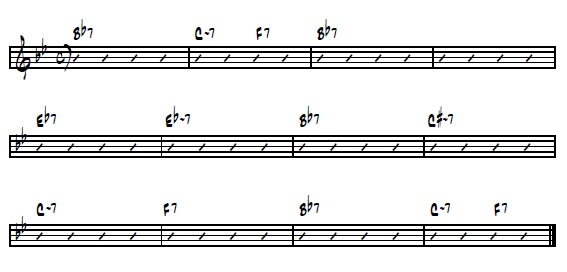
You can see that the progression is based around the standard three chords of a blues in B♭. The foundation is a “tonic” chord (T) based on the root note of whatever key it’s played in, in this case B♭. This sometimes a basic triad consisting of the first, third and five notes of a major scale starting on that note or, as in this example, including the dominant 7th so it’s B♭7. The next chord is the subdominant chord (S), shifting things up by a perfect fourth relative to the tonic, in this case an E♭7 and then finally we have the dominant (D) which brings us up by a fifth from the original root note, in this case F7.
The basic blues sequence in B♭ would be four bars of B♭7 (T), two of E♭7 (S), back to B♭7 (T) for two, then the characteristic bluesy cadence returning to two bars of B♭7 (T) via one bar each of F7 (D) and E♭7 (S). The sequence for Bloomdido has a few alterations, including a characteristic turnaround at the end instead of the tonic, but is otherwise fairly recognizable. I guess the first part of the title is a play on the blues origin too, though I wonder if the second part suggests that some of the alterations are inspired by the A-section of the Juan Tizol standard Perdido?
Some people tell me they find Charlie Parker’s music “too technical” and that somehow if music “needs to be explained” it’s not good music. I don’t understand that attitude at all. I find this music so fascinating and exciting to listen to that I want to try to dig a little bit into it and find out what’s going underneath the surface. It’s particularly striking what a difference a few substitutions and passing chords can make to the overall harmonic “feel” of a piece like this compared to a standard blues sequence, for example. But you don’t need to study the chords to appreciate the sheer beauty of the music that Charlie Parker built on these harmonic foundations; his solo on this track, as on so many others he recorded in his short life, is just sublime even if you don’t realise how hard it is to play! I guess it all depends whether your way of enjoying a thing is to sit back and let it wash over you, or for it to inspire you to find out more. Many of the physicists I know are deeply interested in music. Perhaps that’s because they’re the sort of people who don’t just think “wow that’s beautiful”, they tend to think “wow that’s beautiful – how does it work?”.
Charlie Parker and Albert Einstein died in the same year, just over a month apart, the former in March 1955 and the latter in April. They were two very different geniuses but it’s as difficult to imagine physics without Einstein as jazz without Bird.
Follow @telescoperSonny Rollins’ letter to Coleman Hawkins
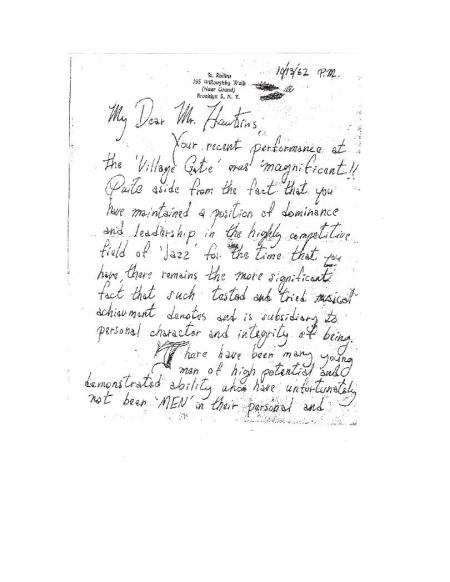
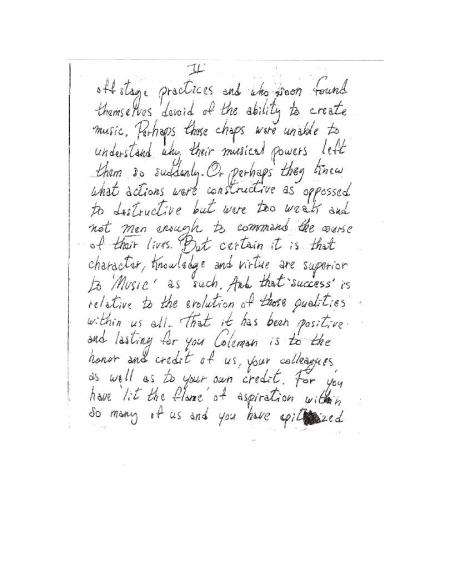
Posted in Jazz with tags All the things you are, Coleman Hawkins, Jazz, Letter, Sonny Rollins on March 4, 2015 by telescoperI couldn’t resist reblogging this wonderful letter from one great saxophonist, Sonny Rollins, to another, Coleman Hawkins.
The letter was written in 1962. You can find here on Youtube a recording of the two of them playing the great Jerome Kern tune All The Things You Are at the Newport Jazz Festival just a few months later in summer 1963. The title seems to match the sentiments of the letter rather nicely!

Do read this, a touching letter from Sonny Rollins to Coleman Hawkins in 1962 (from the website www.jazzclef.com). The greatest players possess not only self-discipline and powers of concentration, but generally, great humility.

It makes my love come down
Posted in Jazz with tags Bessie Smith, Humphrey Lyttelton, it makes my love come down, Jazz, Keith Christie, NFJO, Royal Festival Hall, Wally Fawkes on February 23, 2015 by telescoperA very busy day back in Sussex meant that I had no time for a post until I finished lecturing at 6pm, so there’s just time for a bit of music before I head home. I thought I’d put up another track by Humphrey Lyttelton, from the same concert at the Royal Festival Hall in July 1951 sponsored by the National Federation of Jazz Organizations (NFJO) from which I posted The Dormouse some time ago. This is an excellent performance of a blues called It makes my love come down, which Humph probably transcribed from the classic original recording by the greatest female blues singer of all time, Bessie Smith. Again it shows the Lyttelton band’s front line in fine fettle, especially when they come together for the last couple of choruses.
Follow @telescoper
50 Years of A Love Supreme
Posted in Jazz with tags A Love Supreme, Elvin Jones, Jimmy Garrison, John Coltrane, McCoy Tyner on February 17, 2015 by telescoperA very busy day at work has just ended without time to do a blog post, so before I go home I’ll just do a quickie about the classic album A Love Supreme made by the John Coltrane quartet in late 1964 and released in February 1965. The 50th anniversary of the release of this record has been marked by an extremely interesting programme on BBC Radio 4, broadcast a few days ago but still available on the BBC iPlayer.
A Love Supreme is one of my favourite jazz albums, not only because it’s glorious music to listen to but also for its historical importance. Shortly after making this record Coltrane comprehensively changed his musical direction, abandoning many of the structures that underpinned his earlier work and adopting an approach heavily influenced by the free jazz of the likes of Ornette Coleman and, especially, Albert Ayler. Not everyone likes the music Coltrane made after he made that transition (in 1965) but having taken his earlier style to such a high peak as A Love Supreme he and the rest of the band no doubt felt they couldn’t go any further in that direction.
There are glimpses of the later freer approach in the third track, Pursuance, when the drum and saxophone interchanges between Elvin Jones and Coltrane threaten to break the regular tempo apart, and on this (the second) track Resolution, when McCoy Tyner abandons his usual single-note lines in favour of much more complex chordal improvisations. I think Coltrane’s solo on the last track, Psalm, is entirely improvised and , accompanied by Jones’ rising and falling drum rolls, it acquires a hauntingly solemn atmosphere which makes the hairs stand up on the back of my neck every time I hear it. What a fantastic drummer Elvin Jones was.
But I haven’t got time to analyse the whole album – another’s words are in any case no substitute for listening to this masterpiece yourself – so I’ll just mention that Resolution is based on an 8-bar theme that’s very reminiscent of the theme Africa featured on Africa/Brass made a couple of years earlier. To me it sounds like Coltrane is just itching to cut loose on this track. His saxophone tone has a harder edge than usual for that period, giving the piece an anguished, pleading feel. Elvin Jones is also magnificent, his polyrhythmic accents spurring Coltrane to a climactic solo.
The intensity of Resolution ignites an even more dramatic onslaught on the next track, Pursuance, basically a blues taken at a very fast tempo, before the mood changes completely for the final part, Psalm. And all this builds from the opening track, Acknowledgement, which closes with the whole group chanting the words A Love Supreme in unison to a simple four-note figure stated at the opening of the piece.
Four tracks amounting to just over 30 minutes of music, but a masterpiece by any standards. If you’re thinking of starting a jazz collection, put it straight on your list! You could also listen to the whole thing via Youtube
Follow @telescoperPotato Head Blues
Posted in Biographical, Jazz with tags Hot Seven, Louis Armstrong, Potato Head Blues on February 2, 2015 by telescoperUp very early this cold and frosty morning to get a train back from Cardiff to Brighton, I listened to this track on my iPod and no longer felt either tired or cold. I have posted this before, but that was six years ago, so I hope you won’t mind me posting it again too much.
At one point in the film Manhattan, the character played by Woody Allen makes a list of the things that make life worth living. This record is one of them. Potato Head Blues was recorded on May 10th 1927 in the Okeh Studios in Chicago by Louis Armstrong and the Hot Seven. It’s not actually a blues, but we won’t quibble about that because whatever it is not it is definitely a timeless Jazz masterpiece.
The other members of the band are Johnny Dodds (clarinet, heard to good effect in the solo before Louis Armstrong), Johnny’s brother Warren “Baby” Dodds (drums), Louis Armstrong’s first wife Lil Armstrong (née Hardin, piano), Johnny St Cyr (banjo), Pete Briggs (brass bass or tuba) and John Thomas on trombone. But the star of the performance is, of course, Satchmo himself, who was at the absolute peak of his powers when this record was made. If you have any doubts about what a musical genius he was, go straight to the point (at about 1:50) where he announces his intent with a characteristic three note BA-DA-DAA, a device he used very often to kick off a solo. In this case it provides an entry into his famous stop-time chorus which is just breathtaking in its power, inventiveness and sheer beauty. Built from a succession of dazzling impromptu phrases, it explodes into a joyous climax which is beautifully sustained into the final ensemble chorus that follows. If I ever had to go on one of those radio programmes that involve people picking their favourite pieces of music, this would definitely be one of my selections.
Follow @telescoper
The Dormouse
Posted in Jazz with tags Humphrey Lyttelton, Jazz, Keith Christie, NFJO, Royal Festival Hall, The Dormouse, Wally Fawkes on January 24, 2015 by telescoperJust spent an extremely enjoyable Saturday morning on the Sussex University campus for one of our Applicant Visit Days; there’ll be several more of these occasions over the next few months and I only hope we have such glorious weather for the others!
I thought I’d celebrate the fact that it all went well by posting a bit of old-fashioned good-time jazz. It’s getting on for seven years since the death of the great Humphrey Lyttelton, who was not only a fine trumpeter and bandleader but also blessed with wickedly dry sense of humour. During the late 1940s and early 1950s Humph’s band had a terrific front line consisting of Wally Fawkes on clarinet and the superb Keith Christie on trombone, led by himself on trumpet. Apparently when they did late-night gigs, Keith Christie had a habit of occasional dozing off while someone else was soloing. Not unreasonably, this behaviour reminded Humph of the Dormouse at the Mad Hatter’s Tea Party in Alice’s Adventures in Wonderland, so he decided to write a tune with that name in honour of Keith Christie. I have the studio recording of The Dormouse, which was released on Parlophone as a 78rpm single, and it’s such a blast that I love it to bits, but this is a live performance which I just came across a few days ago. It comes from a famous concert at the Royal Festival Hall in July 1951 sponsored by the National Federation of Jazz Organizations (NFJO) which featured a number of bands as well as Humph’s.
Anyway, it’s a delicious helping of New Orleans jazz served with a generous side order of English eccentricity, guaranteed to bring a smile to the most crabbed of faces. The trombone introduction and fills by Keith Christie, in whose honour the tune was written, are typically full of humour, but the improvised ensemble playing is absolutely terrific, especially from about 1.55 onwards. Humph’s band of this time didn’t have the greatest rhythm section – Humph himself joked that they often sounded like they were wearing diving boots – but the front line was world class.
ps. It definitely should be “The Dormouse” not “The Doormouse”…
pps. Unless my ears deceive me I think this number is announced by Kenneth Horne…
Follow @telescoper

