I came across this on Youtube a while ago and I quite often play it when I’m at work if I’m in need of an aural pick-me-up when I’m flagging a bit. The tune All The Girls Go Crazy is one of many manifestations of a 16-bar blues theme that was fairly ubiquitous in New Orleans Jazz. The recording is by a band led Ken Colyer who I think is on cornet rather than trumpet on this track, but the Youtube poster gives no other information about the personnel or the date. I’m going to stick my neck out and say that the clarinettist sounds to me like Ian Wheeler and the drummer is without doubt Colin Bowden, one of the very best drummers in this style that the UK has ever produced. If I’m right then I think the date is somewhere around the mid-1950s, at the peak of the New Orleans revival in the UK. No doubt some other jazz fan out there will correct me if I’m wrong!
Ken Colyer (`the guvnor’) had very firm ideas about how New Orleans music should be performed, and you’ll notice that there’s much more ensemble work here than you find in the typical string-of-solos approach adopted by many `Trad’ bands of the period.
I’m going to look very silly if it’s not Colin Bowden on drums here, but for me he (or whoever else is the drummer) is the star of this performance, as it is he who is responsible for the steadily increasing sense of momentum, achieved without speeding up (which is the worst thing a rhythm section can do). Notice how he signals the end of each set of 8-bars with a little figure on the tom-toms and/or a cymbal crash, and it is by increasing the strength of these that he raises the excitement level. Notice also that he also has the last word with his cymbal, something jazz drummers are wont to do.
P.S. If you look here, you’ll see a certain Peter Coles playing alongside Ken Colyer in the 1970s. It’s not me, though. It’s my uncle Peter…
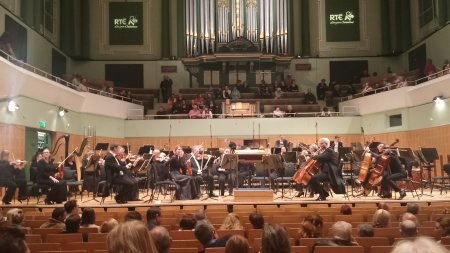
Last night I was once again at the National Concert Hall in Dublin for a concert by the RTÉ National Symphony Orchestra, this time conducted by Kenneth Montgomery. I took the above picture about five minutes before the start of the concert and, although a few more people arrived before the music began, it was a very low attendance. I don’t think the hall was more than 20% full. I’m not sure why. Perhaps Storm Callum made it difficult for some to make the journey to Dublin? I was delayed a bit on the way there from Maynooth, but I’m glad I made it because it was a fine concert.
I always appreciate it when unfamiliar works are programmed alongside more standard repertoire, and last night provided a good example of that. One piece was an established favourite among concert-goers, another I have on CD but have never heard live, and one I had never heard before at all.
The opening piece was In Memoriam by Arnold Bax. Although considered by many to be an archetypal English composer, Bax had a strong affinity for Ireland and indeed lived here from 1911 until the outbreak of war in 1914. I’ve always felt Bax’s music was greatly influenced by Sibelius, but he was very interested in Celtic culture and that comes across in his In Memoriam, which is built around a very folk-like melody. The work was composed to honour Pádraig Pearse, one of the leaders of the 1916 uprising, who was subsequently executed by the British authorities, and was written in the immediate aftermath of the rebellion in 1916. It is a very fine piece, in my opinion, starting in a rather elegiac mood, but with passages that celebrate of Pearce’s life than mourn his death, and the ending is very moving, like a beautiful sunset.
There was then a short delay while various rearrangements were made on stage. Off went the wind instruments and percussion, and into the space vacated by their departure moved a subset of the string instruments, creating a second (smaller) string orchestra separated from the remaining musicians. In addition, the principals of the relevant sections arranged themselves to form a string quartet around the conductor’s podium. If you didn’t know before reading this what was about to be played, then that description will no doubt have led you to conclude that it must be the Fantasia on a Theme by Thomas Tallis by Ralph Vaughan Williams. This is an evergreen concert piece, for good reason, and the string players of the RTÉ National Symphony Orchestra delivered a very fine account of it. I remarked on the fine playing of the string section after the last concert I attended at the NCH, and they did it again.
After the interval was a piece I had never heard before, the Sinfonia “De Profundis” by Belfast-born A.J. `Archie’ Potter, composed fifty years ago in 1968, and first performed in 1969 by the RTÉ National Symphony Orchestra in Dublin. The title is a reference to Psalm 130, and some of the thematic material comes from liturgical music. In the composer’s own words:
As the title suggests, it is a musical account of one man’s own progress from despair over a particular circumstance in his life to spiritual recovery and (for the time being of course) triumph over the powers of darkness.
Although `a journey from darkness into light’ is a description that could apply to many symphonies (especially those of Beethoven), this work in five movements does not have a typically `symphonic’ structure in that it is based on variations on a theme drawn from a 16th century carol spread throughout the whole work rather than confined to one movement, alongside another element comprising a `tone row’. The juxtaposition of `traditional’ diatonic and `modernist’ serialist explorations generates tension which is only released at the very end, when it is released by the arrival of a new theme borrowed from the `Old 124th’.
That brief description of what is going on in this work doesn’t do justice at all to the impression it creates on the listener, which is of a richly varied set of textures sometimes mournful but sometimes boisterous, with dashes of robust humour thrown in for good measure. I’m not at all familiar with A.J. Potter, but I must hear more of his music. Based on this piece, he was both clever and expressive.
As a bonus we had an orchestral encore in the form of another piece by Archie Potter, much shorter and much lighter. Orchestral encores are rare in the UK, but seem to be less so here in Ireland.
After that I left in order to return to Maynooth. Appropriately enough, in the light of the piece by Bax, I took a train from Pearse station…
Following the advice of novelist E.M. Forster to `only connect’, I thought I’d do just that by only connecting two bits of news. The first is that legendary saxophonist Pharaoh Sanders is playing at the National Concert Hall in Dublin next month and the second is that astronomers have been discussing whether or not a moon can have a moon and, if it can, whether it should be called a moonmoon or a submoon or something else. Well, I think such an object should be called a Moon Child, after the album by Pharaoh Sanders from which this is the title track. With a link like that, I’m sure it’s only a matter of time before I get offered a job as a radio presenter!
By way of a small tribute to marking the passing of one of the true greats, here she is singing the beautiful aria Signore, ascolta! from the Opera Turandot by Giacomo Puccini. As the title suggests, you should listen to the whole thing because it’s lovely, but be prepared for something truly astonishing from about 2.16 onwards as the singer demonstrates unbelievable control by holding that final high note in a way that doesn’t seem humanly possible..
Not a lot of people know that today, 29th September 2018, is exactly one hundred years since the first ever performance of The Planets by Gustav Holst which took place at the Queen’s Hall in London.
As it happens, although I’ve heard countless performances of this work on the radio and on record, I had never heard it live – until last night at the National Concert Hall in Dublin.
From its arresting opening with the strings beating out quintuple time col legno battuto on Mars, The Bringer of War to the wordless singing at the end of Neptune, The Mystic the RTÉ National Symphony Orchestra, conducted by José Serebrier (and at the end, and in the wings, the ladies voices of the RTÉ Philharmonic Choir) gave a very good account of this enduringly popular work. The centrepiece of this suite of seven movements is Jupiter, the Bringer of Jollity which consists of an intro and and outro either side of the famous ‘big tune’ (“Thaxted”) often sung as the hymn I Vow To Thee My Country. The string playing at that section was exceptional, with a lovely rich texture and a very well chosen stately tempo.
The only disappointment of this performance for me was the ending. The voices off are supposed to fade away gently until they are inaudible, but last night they cut off abruptly, rather ruining the intended effect.
This didn’t stop the audience giving the Orchestra a standing ovation, however, so obviously not everyone was bothered by the ending.
For the record I’ll just mention that the first half of the concert consisted of two shorter works. The opening piece was one of Leopold Stokowski’s rather unnecessary orchestral arrangements of music by Bach, in this case the famous Toccata & Fugue in D Minor. I spent the entire performance looking at the NCH’s fine concert organ and wishing the original was being played on that. Still, at least the Stokowski arrangement didn’t have a harpsichord in it.
The other first-half piece was far more interesting (to me), the world premiere of a piece by the conductor José Serebrier called Symphonic B A C H Variations for Pianoand Orchestra. This is like a piano concerto in four movements each based a little riff made the four notes B A C and H (in German musical notation, B is B flat and H is B Natural – don’t ask me why). It’s an intriguing piece, which I hope I get to hear again, and was very well played by young Alexandre Kantorow.
Just time for a quick post to mention that tonight is Culture Night in Ireland, which means that over 1600 venues around the country are open this evening for free cultural events. Museums, art galleries and other public buildings and spaces will open later this evening to welcome the general public and there are scores of free concerts going on all over the place. There’s a useful guide here.There are some events in Maynooth tonight, including one at Maynooth Castle.
I would have gone to tonight’s free concert at the National Concert Hall. Although it’s free you have to book a ticket because the capacity is limited and unfortunately I was too late getting around to doing that so couldn’t get in. I’ll probably listen to it on the radio tonight instead.
I think Culture Night is a great idea, as it encourages people to sample cultural fare they might otherwise not get around to trying, and may boost the audiences for the rest of the year as a result. I wonder if anyone has ever thought of running a Culture Night in, say, Cardiff?
As a bit of a change from Open Journal of Astrophysics stuff I thought I’d post this very hot Gospel number featuring the very wonderful Mahalia Jackson, whose many claims to fame include the fact that she gave singing lessons to Aretha Franklin. If you think her voice sounds powerful in this recording, then it’s even more impressive when you see that in this live performance at the Newport Jazz Festival she was standing way back from the microphone! She wasn’t called `The World’s Greatest Gospel Singer’ for nothing.
Anyway, if you look at the title of this piece and think `Oh no, not that old one again’ because it has been done to death by Trad Jazz bands then please give it a listen because I think this version really rocks. The tune When The Saints Go Marching In is an old spiritual and, as such, was composed by the person who wrote all the best music: `Trad’.
One of the things about Gospel music is that it’s usually played in a very distinctive 4/4 which makes it very difficult to resist clapping. But why do so many people -even at Jazz festivals – find it so hard to clap on the right beat? It only works if you clap on an off beat (i.e. beats 2 and 4). If you clap on all the beats or just on the on beats it just kills the rhythm. On this track you’ll hear that Ms Jackson has to deliver clapping instructions not once but twice to an audience that seems to insist to clap on every beat of the bar (and on some beats that don’t correlate with the actual rhythm in any way). I guess “All God’s Children Got Rhythm” might not actually be a true statement.
Last night I had the pleasure of attending the opening performance of the new season of the RTÉ National Symphony Orchestra at the National Concert Hall in Dublin. As well as being the first concert of the season, it was also my first ever visit to the National Concert Hall. To mark the occasion we were in the presence of the Uachtarán na hÉireann, Michael D Higgins, and his wife Sabena. By `occasion’ I of course mean the first concert of the season, rather than my first visit to the NCH. After the concert the audience were all treated to a glass of Prosecco on the house too!
I’ve done quite a few reviews from St David’s Hall in Cardiff over the years, so before writing about the music I thought I’d compare the venues a little. The National Concert Hall was built in 1865 and soon after its construction it was converted into the main building of University College Dublin. It was converted to a concert venue when UCD moved out of the city centre, and fully re-opened in 1981. It is a bit smaller than St David’s – capacity 1200, compared with 2000 – and does not have such a fine acoustic, but it is a very nice venue with a distinctive and decidedly more intimate vibe all of its own. I had a seat in the centre stalls, which cost me €40, which is about the same as one would expect to pay in Cardiff.
The NCH is situated close to St Stephen’s Green, which is a 15 minute walk from Pearse Station or a 30 minute walk from Connolly (both of which are served by trains from Maynooth). The weather was pleasant yesterday evening so I walked rather than taking the bus or Luas from Connolly. I passed a number of inviting hostelries on the way but resisted the temptation to stop for a pint in favour of a glass of wine in the NCH bar before the performance.
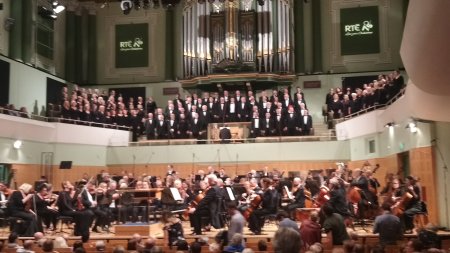
Anyway, last night’s curtain-raiser involved just one piece – but what a piece! – Symphony No.2 (“Resurrection”) by Gustav Mahler. This is a colossal work, in five movements, that lasts about 90 minutes. The performance involved not only a huge orchestra, numbering about a hundred musicians, but also two solo vocalists and a sizeable choir (although the choir does not make its entrance until the start of the long final movement, about an hour into the piece). The choir in this case was the RTÉ Philharmonic Choir. At various points trumpets and/or French horns moved offstage into the wings and, for the finale, into the gallery beside the choir.
About two years ago I blogged about the first performance I had ever heard of the same work. Hearing it again in a different environment in no way diminished its impact.
Stunning though the finale undoubtedly was, I was gripped all the way through, from the relatively sombre but subtly expressive opening movement, through the joyously dancing second that recalls happier times, the third which is based on a Jewish folk tune and which ends in a shattering climax Mahler described as “a shriek of despair”, and the fourth which is built around a setting of one of the songs from Des Knaben Wunderhorn, sung beautifully by Jennifer Johnson (standing in wonderfully for Patricia Bardon, who was unfortunately indisposed). Jennifer Johnson has a lovely velvety voice very well suited to this piece, which seems more like a contralto part than a mezzo. The changing moods of the work are underlined by a tonality that shifts from minor to major and back again. All that was very well performed, but as I suspect is always the case in performances of this work, it was the climactic final movement – which lasts almost half an hour and is based on setting of a poem mostly written by Mahler himself, sung by Orla Boylan – that packs the strongest emotional punch.
The massed ranks of the RTÉ Philharmonic Choir (all 160 of them) weren’t called upon until this final movement, but as soon as they started to sing they made an immediate impact. As the symphony moved inexorably towards its climax the hairs on the back of my neck stood up in anticipation of a thrilling sound to come. I wasn’t disappointed. The final stages of this piece are sublime, jubilant, shattering, transcendent but, above all, magnificently, exquisitely loud! The Choir, responding in appropriate fashion to Mahler’s instruction to sing mit höchster Kraft, combined with the full force of the Orchestra and the fine concert organ of the NCH to create an overwhelming wall of radiant sound.
Mahler himself wrote of the final movement:
The increasing tension, working up to the final climax, is so tremendous that I don’t know myself, now that it is over, how I ever came to write it.
Well, who knows where genius comes from, but Mahler was undoubtedly a genius. People often stay that his compositions are miserable, angst-ridden and depressing. I don’t find that at all. It’s true that this, as well as Mahler’s other great works, takes you on an emotional journey that is at times a difficult one. There are passages that are filled with apprehension or even dread. But without darkness there is no light. The ending of the Resurrection Symphony is all the more triumphant because of what has come before.
The end of the performance was greeted with rapturous applause (and a well-deserved standing ovation). Congratulations to conductor Robert Trevino, the soloists, choir and all the musicians for a memorable concert. On my way out after the Prosecco I picked up the brochure for the forthcoming season by the RTÉ National Symphony Orchestra, which runs until next May. I won’t be attend all the Friday-night concerts, but I will try to make as many as I can of the ones that don’t involve harpsichords.
Update: I hadn’t realised that the concert was actually broadcast on TV and then put on YouTube; here is a video of the whole thing:
I heard part of this on the Radio the other night, and thought I’d share it here. It’s definitely one of the strangest pieces of music I’ve ever heard, but I find it very moving and, in its own way, compelling. The full story can be found here, but is summarized the composer Gavin Bryars:
In 1971, when I lived in London, I was working with a friend, Alan Power, on a film about people living rough in the area around Elephant and Castle and Waterloo Station. In the course of being filmed, some people broke into drunken song – sometimes bits of opera, sometimes sentimental ballads – and one, who in fact did not drink, sang a religious song “Jesus’ Blood Never Failed Me Yet”. This was not ultimately used in the film and I was given all the unused sections of tape, including this one.
When I played it at home, I found that his singing was in tune with my piano, and I improvised a simple accompaniment. I noticed, too, that the first section of the song – 13 bars in length – formed an effective loop which repeated in a slightly unpredictable way.
I took the tape loop to Leicester, where I was working in the Fine Art Department, and copied the loop onto a continuous reel of tape, thinking about perhaps adding an orchestrated accompaniment to this. The door of the recording room opened on to one of the large painting studios and I left the tape copying, with the door open, while I went to have a cup of coffee. When I came back I found the normally lively room unnaturally subdued. People were moving about much more slowly than usual and a few were sitting alone, quietly weeping.
I was puzzled until I realised that the tape was still playing and that they had been overcome by the old man’s singing. This convinced me of the emotional power of the music and of the possibilities offered by adding a simple, though gradually evolving, orchestral accompaniment that respected the homeless man’s nobility and simple faith. Although he died before he could hear what I had done with his singing, the piece remains as an eloquent, but understated testimony to his spirit and optimism.
Several versions of this piece exist. This one, recorded in 1993, is 74 minutes long. It begins with the unaccompanied voice of the old man to which instrumental accompaniment of increasing depth and texture is gradually added and, for the last twenty minutes or so, there is also the voice of Tom Waits…
Mention the name Elkie Brooks to people of my generation or older and most will think of her popular hits from the late 1970s, especially Pearl’s A Singer which made the UK Top Ten in 1977. Elkie Brooks has however had a long and very distinguished career as a Jazz and Blues singer, including regular performances over the years with trumpeter Humphrey Lyttelton and his band. This particular track was recorded in 2002, when Humph was already in his eighties, but I think it’s a lovely performance so I thought I’d share it here.
Trouble in Mind is a very familiar tune that has been recorded countless times by jazz musicians. In fact an earlier manifestation of Humph’s Band made a very nice instrumental version way back in 1950 which I have on an old Parlophone 78. The tune is usually credited to Richard M. Jones, but it has its roots in much older spirituals and folk songs. There are a couple of things worth mentioning about it despite it being so well known.. Although Trouble in Mind is a blues, it is a slightly unusual one because it’s an eight-bar blues rather than the more usual twelve-bar variety. The other thing is that there’s something about this tune that suits a rhythm accompaniment in sixth notes, as exemplified by drummer Adrian Macintosh on this track when the vocal starts.
There’s also some fine trombone on this (by Pete Strange) and a nice bit of banter from Humph at the beginning. Enjoy!
The views presented here are personal and not necessarily those of my employer (or anyone else for that matter).
Feel free to comment on any of the posts on this blog but comments may be moderated; anonymous comments and any considered by me to be vexatious and/or abusive and/or defamatory will not be accepted. I do not necessarily endorse, support, sanction, encourage, verify or agree with the opinions or statements of any information or other content in the comments on this site and do not in any way guarantee their accuracy or reliability.