Archive for the Music Category

The Beautiful Cosmos of Ivor Cutler

Posted in Music, Poetry with tags , , , , on May 14, 2015 by telescoper

Now fully in Brighton Festival mode, last night I went to the Theatre Royal for the first night (and indeed the English premiere) of The Beautiful Cosmos of Ivor Cutler, which continues until Saturday at the same venue. The show is a collaboration between Vanishing Point and the National Theatre of Scotland and continues at the Theatre Royal until Sunday (17th May).

If you don’t know who Ivor Cutler was, he was a Scottish poet and songwriter who gained a cult following through his many appearances on BBC Radio programmes, notably with John Peel. I was introduced to him by an undergraduate friend of mine, Richard Allen, himself a Scot, who loved Ivor Cutler’s poetry and had many cassette tapes of performances by the poet in which he either spoke the poems or sang them to a musical accompaniment, often a harmonium. I loved listening to Ivor Cutler’s voice on these recordings, which added an extra dimension of lugubriousness to the whimsical and at times downright bizarrely comic verses. Many of his poems are about the various bizarre ways in which people try (and usually fail) to communicate with each other. Some of these are joyously silly but they also, like the very best jokes,  convey quite profound things about the limitations of language. Here, for example, is Ivor Cutler’s inimitable hymn to the joy of Morse Code:

Little Black Buzzer is one of the pieces included in The Beautiful Cosmos of Ivor Cutler, but the show is far more than a collection of the poet’s work. It’s also an exploration and celebration of the life of one of the great eccentrics, from his impoverished childhood, through his period of critical and popular success, his long relationship with another poet, Phyllis King , and his old age in which he suffered from dementia, arthritis and Parkinson’s disease. Music and poetry, life and death, joy and sadness, comedy and tragedy are all woven together in a fitting tribute to a unique individual who lived an extraordinary life.

I don’t need to describe the production in detail because there’s a video trailer that gives a very accurate idea:

My verdict on The Beautiful Cosmos of Ivor Cutler is that it’s the best thing I’ve seen in a theatre for decades. If you’re in Brighton then get yourself to the Theatre Royal and see this show. You won’t regret it.

P.S. The Beautiful Cosmos of the title comes from this poem, which I have posted before:

You are the centre of your little world
and I am of mine.
No one again we meet for tea
we’re two of a kind.

This is our universe…
cups of tea.
We have a beautiful cosmos,
you and me.
We have a beautiful cosmos.

What do we talk of whenever we meet:
nothing at all.
You sit with a sandwich,
I look at a roll.
Sometimes I open my mouth,
then shut it.

We have a beautiful cosmos,
you and me.
We have a beautiful cosmos.

You are the centre of your little world
and I am of mine.
No one again we meet for tea
we’re two of a kind.

This is our universe…
cups of tea.
We have a beautiful cosmos,
you and me.
We have a beautiful cosmos.

Britten Sinfonia

Posted in Music with tags , , , on May 13, 2015 by telescoper

Time for a lunchtime post while I eat my sandwich.

Last night I went to a Brighton Festival concert at the Brighton Dome by the Britten Sinfonia, featuring a programme of Mozart, Haydn and Stravinsky. The choice of pieces was made to explore the connections between two great composers of the classical period (Haydn and Mozart) and the Stravinksy’s much later neoclassical compositions. The similarities of structure and performance style are fairly obvious because Stravinsky was striving to make them so, so this point doesn’t need to be laboured although it does provide a good excuse to perform the pieces together. For me the real interest in the concert was partly in the works themselves – some of which I hadn’t heard before – and in their differences rather than their similarities.

The concert opened with Mozart’s Overture to the Opera Idomeneo, an energetic and dramatic work full of tumultuous climaxes that set the tone for the evening. That was followed by an excerpt from Act I Scene 3 of Stravinsky’s Opera The Rake’s Progress. To be honest I generally prefer Stravinsky when he’s not being neoclassical, but I do think The Rake’s Progress is a great opera and probably his greatest neoclassical achievement. It’s also the first time I’ve ever been to a concert in which the conductor, in this case Barbara Hannigan, turned around on stage and started singing or as I might put it more accurately, the first concert at which the star soprano also doubled as conductor. Anyway, whichever way round you think of the performance, she was great: a superb voice and suitably theatrical stage presence.

The first half of the concert closed with Symphony No. 49 in F Minor by Joseph Haydn, nicknamed La Passione. I’m by no means an expert on Haydn’s symphonies – many of them sound much of a muchness to me – but this is definitely an interesting one even if you’re like me and have difficulty telling your Sturm from your Drang. It’s a brooding, tempestuous work with some surprisingly modern characteristics, especially in the sudden changes of key and use of syncopation. My heart did sink when I noticed a harpsichord would be featuring in this work, but it says something for the piece that I enjoyed it as a whole despite the jangly intrusions.

Haydn wrote this while shortly after he had started work at the palace of the Esterhazy family in Austria, which had its own orchestra. An interesting quote from the programme reveals how much he enjoyed the freedom his employer gave hime:

I could make improvements, additions or cuts, and could try out daring effects. I was separated from the rest of the world, with no-one to disturb me or torment me, and so I had to become original.

I think originality in science works in the same way!

Anyway, after a glass of wine in the bar, it was back for Part 2 which opened with another Mozart overture, this time for the Opera La Clemenza di Tito, which was first performed in 1791 (just a few months before the composer’s death) followed by a concert aria Bella mia fiamma, addio (also by Mozart) performed by Barbara Hannigan again. The story goes that Mozart was pressurised into writing the latter piece and extracted his revenge by producing music that is a real challenge to sing. It has subsequently become celebrated test piece for female singers, a test that Hannigan passed with flying colours.

Finally we heard the suite of music composed by Stravinsky for the ballet Pulcinella. This was all new to me and I enjoyed it enormously, not least because of some very fine playing by the brass and woodwinds of the Britten Sinfonia. Although this is clearly neoclassical music, the similarities that struck me were less about the Mozart and Haydn we heard earlier in the concert and more with Benjamin Britten. Whether that was a deliberate choice or not, it provided a very nice ending to the concert for me.

I couldn’t fault the orchestral playing throughout the concert. Some of the music was extremely virtuosic but they were never showy, and I think they got the emotional feel of the pieces just right. The only other thing that struck me was that the orchestra, billed as a chamber orchestra, was much larger than I’d expected, so it produced a fuller sound that imagined beforehand.

The Lads in their Hundreds

Posted in Music, Poetry with tags , , , , on May 6, 2015 by telescoper

So last night I had my first experience of this year’s Brighton Festival when I went to the Theatre Royal in Brighton to see a show called The Lads in the Hundreds, performed by a group from Comédie de Picardie which is situated in Amiens, capital of the Somme region of France. The cast for yesterday’s performance consisted of just four people: Tchéky Karyo (actor); Edmund Hastings (tenor); Michael Foyle (violin); and Edward Liddall (piano). The performance consisted of dramatic recitations by Karyo (mostly in French) interspersed with music, mostly settings of English poems by English composers such as Ivor Gurney and George Butterworth, as well as a couple of instrumental numbers including a beautiful pared-down version for piano and violin of The Lark Ascending by Vaughan Williams which  was, apparently, how it was first performed. The title The Lads in their Hundreds is taken from a poem by A.E. Housman which was among those set to music and included in this show.  Young Edmund Hastings performed this and the other songs with a bright clear and very English tenor voice, dressed in the uniform of a British soldier of the period. Overall the poetry and music create a very poignant blend that brings together moving expressions of loss and remembrance for the fallen of the First World War with stark descriptions of the horror and brutality of conflict.

I particularly wanted to see this show because I had studied (and much admired) the British poets of the First World War when I was at school, especially Wilfred Owen, but knew nothing of French war poetry of the same era and was very keen to find out more. Although I haven’t studied French since O-level, I am glad these verses were performed in their original language. Poetry can be translated, of course, but it rarely gains anything in the process and often loses a lot. Despite being at pains to drink French wine before the performance to assist my powers of recall, I did struggle a bit to follow some of the poems with my schoolboy knowledge of French, but that difficulty was far outweighed by the expressive sound of verse that can only be achieved when spoken in the language in which it was conceived. A couple of the poems were performed in English, including one with a musical accompaniment in the form of an arrangement of the beautiful Andante movement from Beethoven’s Seventh Symphony for violin and piano. That combination took me completely by surprise and had me at the brink of tears.

It’s interesting that the poems echo the savagery and futility of war in much the same way as the poems of Wilfred Owen or Siegfried Sassoon, but the music chosen is quite different in that it draws greatly on English folk music and is consequently quite nostalgic in character. Perhaps the “English Pastoral” style particularly associated with Vaughan Williams was an attempt to cope with the trauma of the First World War by evoking an idyllic representation of the English countryside as a world apart from the horrific realities of the Somme. French poetry and English music together created a whole that was much more than the sum of its parts. It was an evening that was both fascinating and deeply moving and I’m glad I made time during a busy week to attend it.

To end with I thought I’d include the poem I mentioned earlier that was performed to music by Beethoven. The poem is called The Andante and is by Albert-Paul Granier, an officer in the French artillery, whose name was completely unknown to me until yesterday but who wrote poetry which bears comparison with that of any other poet of the Great War. He was killed in action in 1917. To prove that there are exceptions to every rule, this poem is exquisite even in translation (by Ian Higgins):

The rain, endlessly unravelling;
the rain, shovelling at the mud the whole sullen day;
the rain, unendingly sobbing its toneless chords;
and the whispering wind, crumbling the cloud into drizzle . . .

Why, this evening, am I haunted so
by that majestic andante
from the Seventh Symphony?

Its chords, as magnificently simple
as the triumphal arches of the ancients,
hold me in a vast enchantment.

Its harmony is velvet to my soul,
its murmur a caress that soothes
the melancholy as we pick our way
along the bank of this canal.

The rain has never stopped . . .

The mud is all long, snaking rivulets of agate
and clouded onyx, chopped into splashes
with every drawn-out hoof-fall of my horse.

The rain has never stopped, the whole lead-blue day.

The andante
gently eases my resentment
with its divine serenity . . .

Ah, those Sundays, not two years ago —
the Sunday afternoons,
the lamp-lit hall,
the huge orchestra a single mind and spirit
in every flying bow-tip:

The miraculous fluid
a fountain spreading up to the galleries, then
falling like snowflakes onto souls laid bare,
like springtime sunlight through stained glass
on a girl’s communion veil.

The andante,
the andante is gentle, with a touch of sadness,
like an autumn evening over ponds,
or the voix céleste of an organ;
and my chrysalid soul
weaves itself a wonderful cocoon
from this aching blessedness,
on the purple silk weft of the rain.

Smoke Gets in Your Eyes

Posted in Jazz with tags , , on May 2, 2015 by telescoper

Over thirty years ago I wandered into Windows shop in Newcastle and found an LP called Blues Pour Flirter. It was recorded in Paris in 1962 and features Don Byas on tenor saxophone. I didn’t care much for the title, especially when I looked at the listing to find that there wasn’t a single blues among the tracks – they’re all ballads. I bought the album anyway and am glad I did because Don Byas plays beautifully throughout, and one of the tracks has been a particular favourite of mine ever since.

Some of the tracks involve a big studio orchestra including strings and woodwinds but my favourite has Don Byas on tenor saxophone accompanied by a rhythm section of Christian Garros on drums, Pierre Sim on bass and George Arvanitas on piano. They play a ravishing version of the Jerome Kern standard  Smoke Gets InYour Eyes, which someone has had the good grace to put on YouTube. It seems this and some of the other tracks on the album I bought way back when have been reissued on another album.

I love the huge sound Don Byas produces as he plays this tune,  like a lion playing with a cub. At one point it seems like he’s going to tear it apart but it all ends peacefully. How I wish I could play like this!

We have a Beautiful Cosmos

Posted in Music, Poetry with tags , , on April 27, 2015 by telescoper

On the bus coming up to campus just now, I was looking through the Brighton Festival (which starts on 2nd May) and found that there is a show called The Beautiful Cosmos of Ivor Cutler, which is on at the Theatre Royal. As a devout fan of Ivor Cutler I’ll definitely be going, but in the mean time here is the title track (set to video…)

And here be the lyrics:

You are the centre of your little world
and I am of mine.
No one again we meet for tea
we’re two of a kind.

This is our universe…
cups of tea.
We have a beautiful cosmos,
you and me.
We have a beautiful cosmos.

What do we talk of whenever we meet:
nothing at all.
You sit with a sandwich,
I look at a roll.
Sometimes I open my mouth,
then shut it.

We have a beautiful cosmos,
you and me.
We have a beautiful cosmos.

You are the centre of your little world
and I am of mine.
No one again we meet for tea
we’re two of a kind.

This is our universe…
cups of tea.
We have a beautiful cosmos,
you and me.
We have a beautiful cosmos.

Madama Butterfly

Posted in Opera with tags , , , , on April 9, 2015 by telescoper

I have half an hour to spare this lunchtime so I thought I would do a quick review of  the production of Giacomo Puccini‘s Madama Butterfly I saw last Saturday (4th April) at the Royal Opera House in Covent Garden. I got up at 4.30 on Saturday morning to get the 6am bus from Cardiff into London in order to see this Matinee, which started at 12.30, as the trains were screwed up by engineering work over the Easter weekend. As it happened the National Express coach  ran right on schedule so I had plenty of time to get breakfast and pick up the tickets from the Box Office before the performance.

The story of Madama Butterfly must be familiar enough to opera-goers. Cio-Cio-San – the Madam Butterfly of the title – a 15 year old Geisha, is betrothed to Lieutenant BF Pinkerton of the United States Navy who has come to Japan with his ship. Pinkerton is contemptuous of all things Japanese, and shows his true nature by explaining that he has paid just 100 Yen  for his new wife via a marriage broker. She, however, is devoted to her new husband; so much so that she renounces her religion in favour of that of her man (although I doubt Pinkerton ever goes to church). Act I culminates with their wedding and a gorgeous love duet with the kind of ravishing music that only Puccini can supply. Butterfly, who is really just a child, has certainly fallen for Pinkerton but the music seems to suggest that he has even convinced himself that it’s real love.

Act II is set three years later. Pinkerton has gone back to the States, but Butterfly waits patiently for his return, singing the beautiful aria Un bel di vedremo, or One Fine Day as it is usually translated. Her maid Suzuki thinks that he will never come back – she never liked Pinkerton anyway – and points out that they’re running out of money, but Butterfly refuses to contemplate giving up on him and marrying again. She  has had a son by Pinkerton and intends to remain faithful. At the end of Scene 1 we find that Pinkerton’s ship has arrived and Butterfly waits all night to greet him. The exquisitely poignant cora a bocca chiusa (humming chorus) accompanies her vigil.

After this intermezzo, Scene 2 finds  us at dawn the following day. Butterfly is asleep. Pinkerton shows up, but he has brought with him a new American wife who offers to rescue Butterfly from poverty by adopting her son and taking him to America. Butterfly awakes, finds out what has happened. Pinkerton has left money for her but she refuses to take it, having already decided to kill herself.  She says goodbye to her son with the heartbreaking aria  Tu, tu piccolo iddio, binds his eyes so he can’t see, then kills herself. Pinkerton and his wife arrive to see her bloody corpse.

Well, what did you expect from an opera,  a happy ending?

In this production the principals were the brilliant soprano Kristine Opolais as Butterfly and tenor Brian Jagde, who was a solid but unspectacular Pinkerton.  It turned out to be the last performance with these particular leading performers before a cast change. In fact this performance came up as “sold out” when I first looked on the website, but I persevered and managed to find a couple of tickets a few days later. I’m certainly glad we got to see Kristine Opalais who was in superb voice as the tragic heroine and acted with great subtlety and conviction. I’d also like to mention Enkelejda Shkosa as Suzuki, who was also very good.

The performance got off to a strange start, with an announcement from the stage that it would be delayed by about 30 minutes due to “serious problems backstage”. I wondered whether it was some mechanical problem with the set or a bust-up between members of the cast that needed to be calmed down. The orchestra began a bit hesitantly too, perhaps unsettled by the delay, but soon recovered.

The original production of Madam Butterfly was staged in 1904 (although it took several revisions before the two-act version we saw last night emerged). It therefore dates from a time when Europeans (including Puccini) were quite ignorant about Japanese culture. Modern audiences probably find some of the stereotypes rather uncomfortable. I would say, however, that the only two characters in the Opera to show any moral integrity and nobility of spirit are the maid Suzuki and Butterfly herself. The rest are unpleasant in some way or other, especially Pinkerton who is completely odious. So the Opera is not at all nasty about Japan, although its attitudes are a bit dated and the whole opera glosses over the reality that the world of Cio-Cio-San is basically one in which child prostitution is commonplace.

Madama Butterfly is worth it for the music alone. Call me a softi,e but I love Puccini’s music which, after a slightly ropy start,  was handled beautifully by the Orchestra of the Royal Opera House under the direction of Nicola Luisotti.  This production was also visually beautiful, with exquisite costumes and a set consisting of a simple open space, accentuated from time to time with splashes of cherry blossom and glimpses of landscape and night sky revealed through sliding panels.

Here’s the trailer of the 2011 version of this production (with the same scenery and costumes) to give you an idea:

There’s only a couple of performances left of this run, but something tells me it will be revived again in the not too distant future.

When You’re Smiling

Posted in Jazz with tags , on March 16, 2015 by telescoper

I’m not sure it’s possible for any record to be perfect, but there are definitely some that I couldn’t be improved in any way that I can imagine. I can think of a number of Jazz records that fall into that category, including this version of When You’re Smiling made in 1938. It features Billie Holliday and Lester Young along a number of other members of the Count Basie Orchestra (apart from the Count himself, who is replaced by Teddy Wilson on piano).

That this is a favourite record of mine is a bit of a paradox, because I don’t really like the song very much. However, in jazz the tune is just the starting point. In her early recording career, Billie Holliday wasn’t very well known so she was often given relatively unpromising songs to sing. She turned out to be brilliant at turning this base metal into gold and becamse the best singer of a bad song there has ever been.

It’s not just the way Billie Holliday’s voice floats ethereally across the beat as she takes outrageous liberties with both melody and rhythm. Nor is the way she manages to express everything there is about life and love and hearteache through the rather  banal lyrics, investing the song with a deep sense of tragic irony. Nor is it Lester Young’s superbly constructed tenor saxophone solo near the end, which one of the very greatest by one of the very greatest. Nor is it that lightly swinging rhythm section of Freddie Green, Walter Page and Jo Jones who push the whole thing along on gossamer wings, making most of their rivals sound like clodhoppers; the drummer Jones,for example, adds  punctuation in the form of accents to the poetry of Lester Young’s solo. All the component parts are magnificent, but the whole is even greater than their sum. It’s a timeless jazz masterpiece.

I don’t know why I haven’t posted this track before, but better late than never. I hope you can take 3 minutes to enjoy it!

Bloomdido – In Memoriam Charlie Parker

Posted in Jazz with tags , , , , , , on March 12, 2015 by telescoper

bird

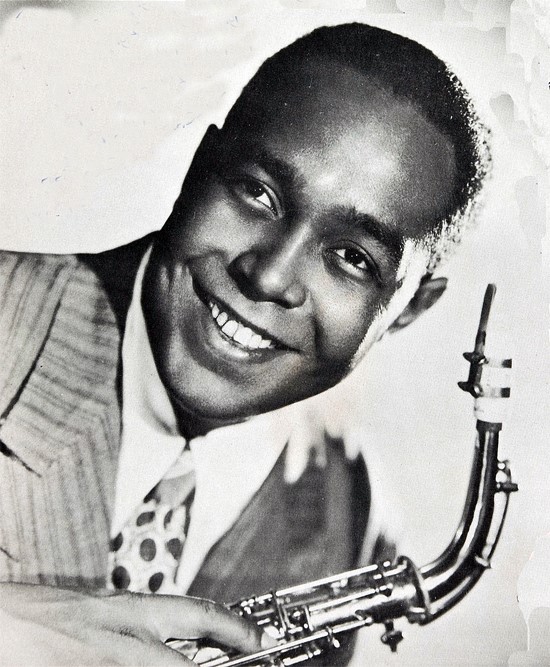
Today marks the 60th anniversary of the death of the great saxophonist Charlie Parker (“Bird”) on 12th March 1955. I’ve written quite a few posts relating to Charlie Parker over the years but today has provided a good excuse to spend my lunchtime writing another one, this time featuring one of my favourite tracks from one of my favourite albums. First released in 1952 but in fact recorded in two separate sessions in 1949 and 1950, the album Bird and Diz was actually the last studio album made under the joint leadership of Charlie Parker and Dizzy Gillespie, the two main architects of the bebop revolution; the track I’ve picked has the added advantage of featuring another great musical genius on piano, Thelonious Monk.

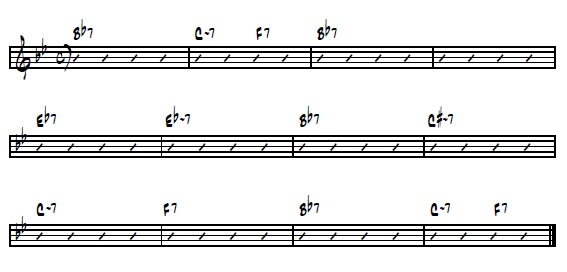
The Charlie Parker composition Bloomdido is yet another of his variations on the blues, though this one is a bit less intricate than some of the others he wrote. Here are the chords for Bloomdido:

Bloomdido

You can see that the progression is based around the standard three chords of a blues in B♭. The foundation is a  “tonic” chord (T) based on the root note of whatever key it’s played in, in this case B♭. This sometimes a basic triad consisting of the first, third and five notes of a major scale starting on that note or, as in this example,  including the dominant 7th so it’s B♭7. The next chord is the subdominant chord  (S), shifting things up by a perfect fourth relative to the tonic, in this case an E♭7 and then finally we have the dominant (D) which brings us up by a fifth from the original root note, in this case F7.

The basic blues sequence in B♭ would be four bars of B♭7 (T), two of E♭7 (S), back to B♭7 (T) for two, then the characteristic bluesy cadence returning to two bars of  B♭7 (T) via one bar each of F7 (D) and E♭7 (S). The sequence for Bloomdido has a few alterations, including a characteristic turnaround at the end instead of the tonic, but is otherwise fairly recognizable. I guess the first part of the title  is a play on the blues origin too, though I wonder if the second part suggests that some of the alterations are inspired by the A-section of the  Juan Tizol standard Perdido?

Some people tell me they find Charlie Parker’s music “too technical” and that somehow if music “needs to be explained” it’s not good music. I don’t understand that attitude at all. I find this music so fascinating and exciting to listen to that I want to try to dig a little bit into it and find out what’s going underneath the surface. It’s particularly striking what a difference a few substitutions and passing chords can make to the overall harmonic “feel” of a piece like this compared to a standard blues sequence, for example. But you don’t need to study the chords to appreciate the sheer beauty of the music that Charlie Parker built on these harmonic foundations; his solo on this track, as on so many others he recorded in his short life,  is just sublime even if you don’t realise how hard it is to play! I guess it all depends whether your way of enjoying a thing is to sit back and let it wash over you, or for it to inspire you to find out more. Many of the physicists I know are deeply interested in music. Perhaps that’s because they’re the sort of people who don’t just think “wow that’s beautiful”, they tend to think “wow that’s beautiful – how does it work?”.

Charlie Parker and Albert Einstein died in the same year, just over a month apart, the former in March 1955 and the latter in April. They were two very different geniuses but it’s as difficult to imagine physics without  Einstein as jazz without Bird.

Sonny Rollins’ letter to Coleman Hawkins

Posted in Jazz with tags , , , , on March 4, 2015 by telescoper

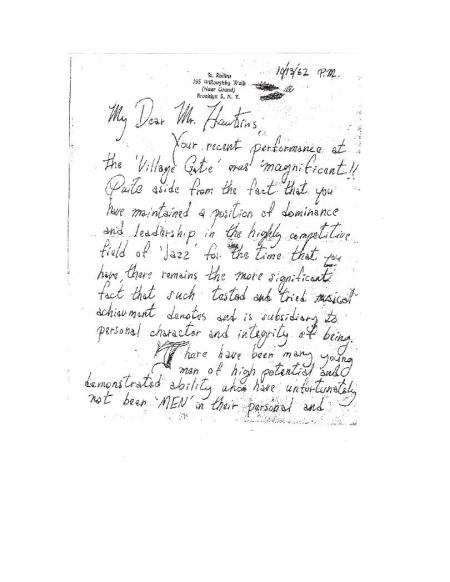
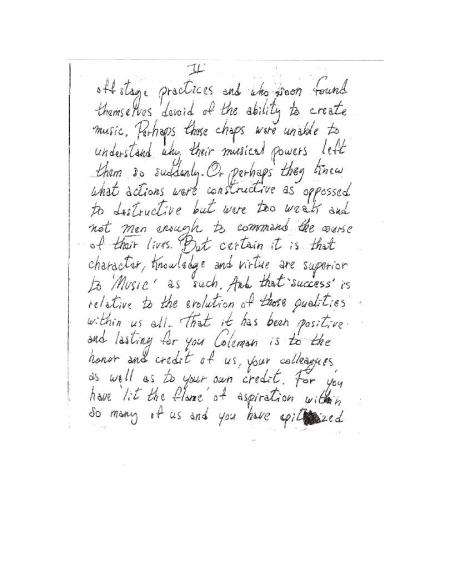
I couldn’t resist reblogging this wonderful letter from one great saxophonist, Sonny Rollins, to another, Coleman Hawkins.

The letter was written in 1962. You can find here on Youtube a recording of the two of them playing the great Jerome Kern tune All The Things You Are at the Newport Jazz Festival just a few months later in summer 1963. The title seems to match the sentiments of the letter rather nicely!

Simon Purcell's avatarSimon Purcell

Do read this, a touching letter from Sonny Rollins to Coleman Hawkins in 1962 (from the website www.jazzclef.com). The greatest players possess not only self-discipline and powers of concentration, but generally, great humility.

View original post

It makes my love come down

Posted in Jazz with tags , , , , , , , on February 23, 2015 by telescoper

A very busy day back in Sussex meant that I had no time for a post until I finished lecturing at 6pm, so there’s just time for a bit of music before I head home. I thought I’d put up another track by Humphrey Lyttelton, from the same concert at the Royal Festival Hall in July 1951 sponsored by the National Federation of Jazz Organizations (NFJO) from which I posted The Dormouse some time ago. This is an excellent performance of a blues called It makes my love come down, which Humph probably transcribed from the classic original recording by the greatest female blues singer of all time, Bessie Smith. Again it shows the Lyttelton band’s front line in fine fettle, especially when they come together for the last couple of choruses.