Archive for the Open Access Category

Preprints in Applications – a plea to the ARC!

Posted in Open Access, Science Politics with tags , on August 25, 2021 by telescoper

I was astonished to discover (via this article) that the Australian Research Council has placed a ban on preprints veing cited in funding applications, and that many applicants have had applications rejected solely on the basis that they referred to preprints in them.

It beggars belief that anyone who actually understands modern scientific practice could come up with such a stupid idea. I can only surmise that the people who run the Australian Research Council are so out of touch with actual research that they don’t understand not only the silliness of this rule but also the damage being caused by it.

I have been on grants panels in the UK many times, and have reviewed many applications for other agencies too, and I can’t think of any that didn’t refer to preprints. It can take a year or more for a paper to appear in a traditional journal and in many fields research moves so quickly that citing results ahead of (formal) publication is the only way to present a true picture of ongoing research. Any author who doesn’t cite other authors’ preprints is either out of touch with ongoing research or presented an unbalanced view of the literature. I would further argue that, at least in astrophysics, any applicant who doesn’t have a clutch of preprints on the topic of the application can’t be sufficiently active to justify grant funding.

Results made available in preprints may not have been refereed but that is no reason to ban them altogether. Any experienced reviewer will know how to treat them. And don’t forget there are plenty of wrong results in the refereed literature too. I’d prefer a policy that banned applicants whose papers were not published in an Open Access form…

There is a petition here urging the Australian Research Council to revise its preprint policies. I urge you to sign it (as I have done). Be quick, though, as the deadline is 31st August 2021.

And in case you think this is a matter for Australians only, I disagree. Science is collaborative and many of the collaborations span many different countries. It is in all our interests to ensure that our Australian cousins don’t get held back by inane policies like this.

UPDATE: Nature has now covered this story.

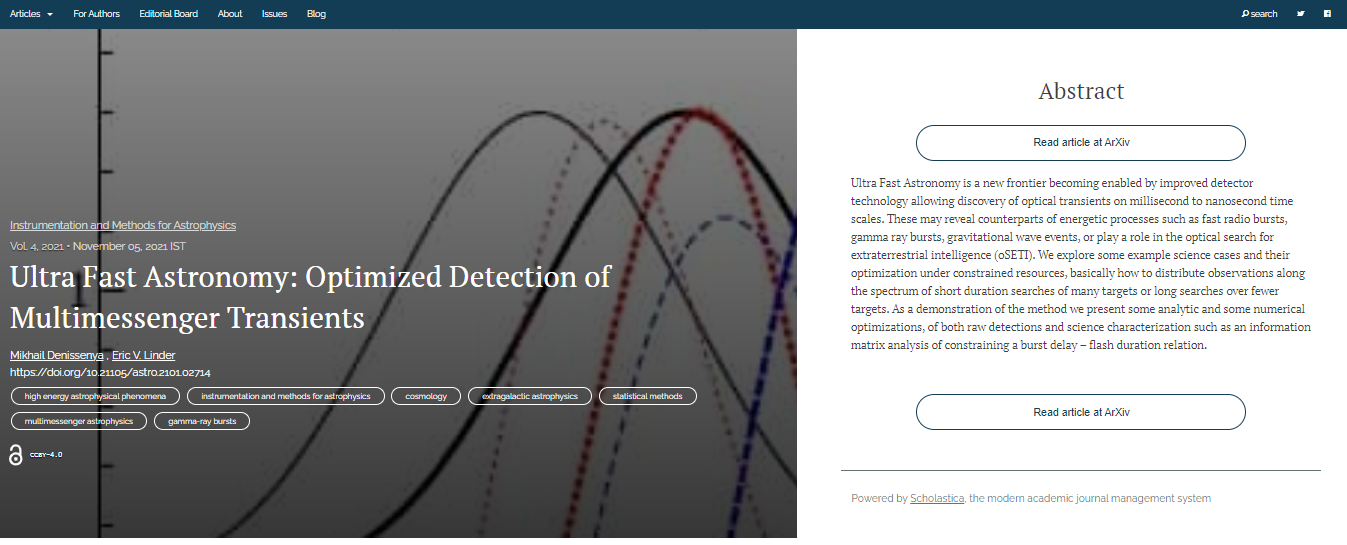
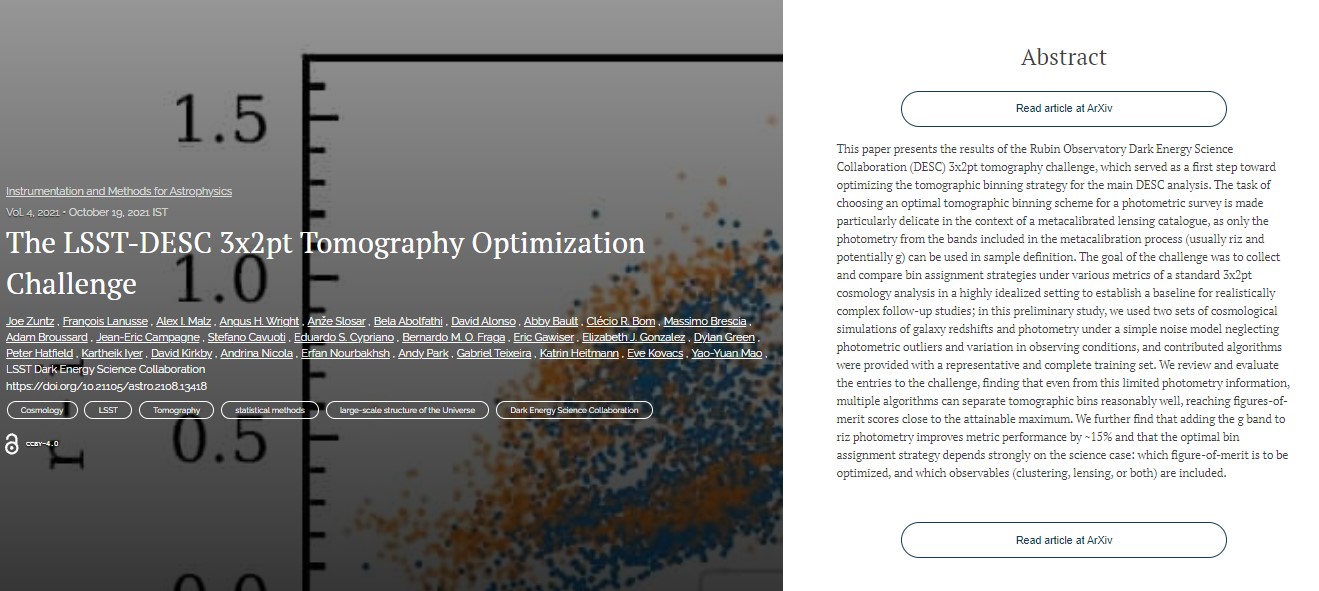
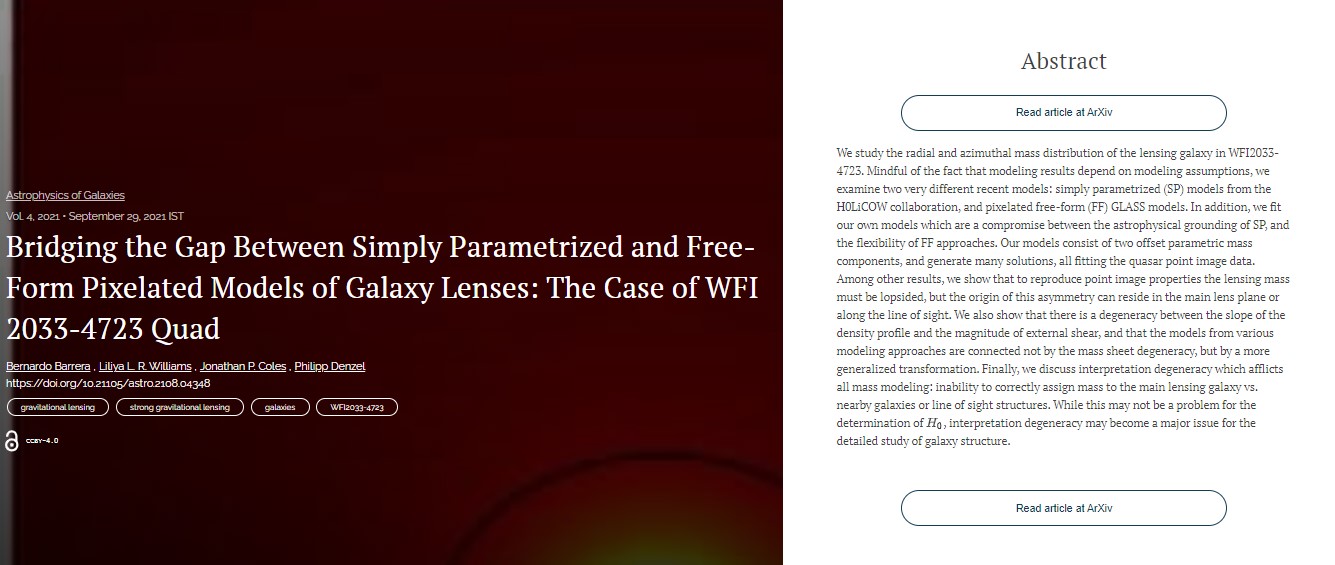
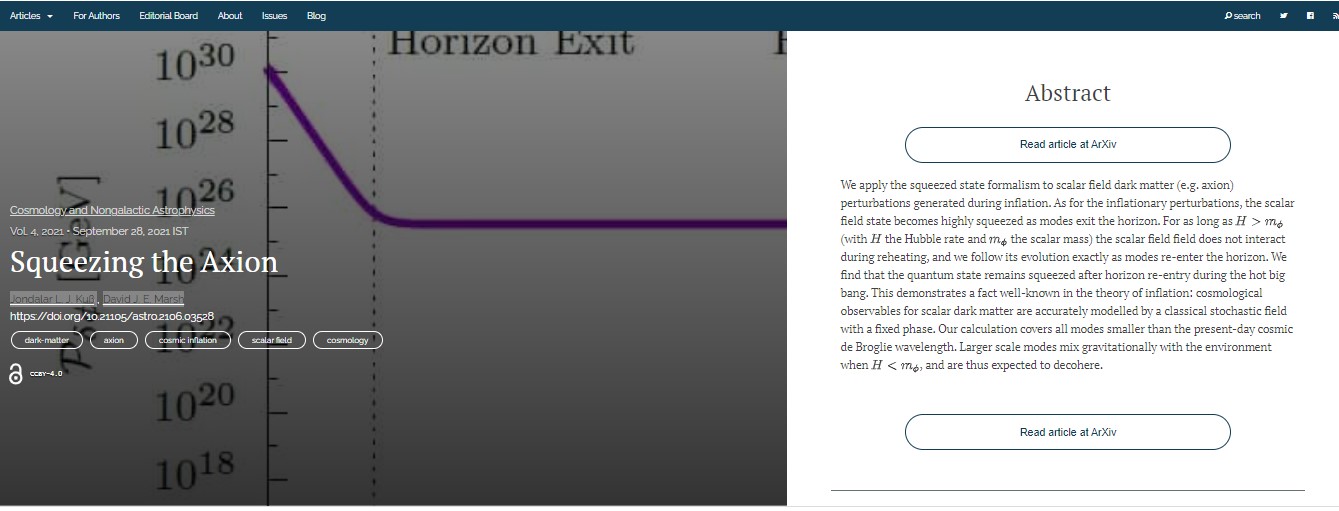
New Publication at the Open Journal of Astrophysics

Posted in OJAp Papers, Open Access, The Universe and Stuff with tags , , , , , , on August 19, 2021 by telescoper

Time to announce another publication in the Open Journal of Astrophysics. This one is the eighth paper in Volume 4 (2021) and the 39th in all.

The latest publication is entitled A Detailed Description of the CAMSPEC Likelihood Pipeline and a Reanalysis of the Planck High Frequency Maps. The authors are George Efstathiou and Steven Gratton of the Kavli Institute for Cosmology at the University of Cambridge.

Here is a screen grab of the overlay which includes the abstract:

You can click on the image to make it larger should you wish to do so. You can find the arXiv version of the paper here. This one is also in the folder marked Cosmology and Nongalactic Astrophysics.

This is a long and detailed paper, running to 92 pages in PDF form. Our Editorial process relies on referees being willing to volunteer their time to read and comment on submissions and this one in particular required a great deal of effort. I am always grateful to referees but in this case I am even more grateful than usual the diligence displayed during and the many useful comments received. I know who our reviewers are and they know who they are, but shall remain anonymous!

Happy 30th Birthday to the arXiv!

Posted in Biographical, Open Access, The Universe and Stuff with tags , , , on August 14, 2021 by telescoper

I was reminded yesterday that today, 14th August, is the 30th anniversary of the start of the arXiv so I thought I’d send a quick birthday greeting to mark the occasion. In case you weren’t aware, arXiv is a free distribution service and an open-access archive containing (currently) 1,928,825 scholarly articles in the fields of physics, mathematics, computer science, quantitative biology, quantitative finance, statistics, electrical engineering and systems science, and economics.

There was a precursor to the arXiv in the form of an email distribution list for preprints, but arXiv proper started on 14th August 1991. It was based at Los Alamos National Laboratory (LANL) with a mirror site in SISSA (Trieste) that was used by those of us in Europe. In the beginning, arXiv was quite a small-scale thing and it wasn’t that easy to upload full papers including figures. In fact the SISSA system was run from a single IBM 386 PC (called “Babbage”). As it expanded, the running of arXiv was taken over Cornell University. You can read more about the history here.

You have to remember that journals didn’t generally have electronic submission in those days: you had to send paper manuscripts in the post to the Editorial office. Likewise many of us carried on sending out paper preprints for some time after the arXiv was set up. Younger researchers should be grateful they don’t have to put up with the absolute chore of producing papers the old-fashioned way!

The astrophysics section of arXiv (“astro-ph”) started in April 1992. Although astrophysicists generally were quick to latch on to this new method of distributing preprints, it took me a little time to get onto arXiv: my first papers did not appear there until February 1993; my first publication was in 1986 so there are quite a few of my early papers that aren’t on arXiv at all. In 1993 I was working at Queen Mary & Westfield College (as it was then called). I was working a lot with collaborators based in Italy at the time and they decided to start posting our joint papers on arXiv. Without that impetus it would have taken me much longer to get to grips with it.

In case you’re interested, my first paper to appear on the arXiv was this one on 23rd February 1993 but it was followed a day later by two others, this one and that one. I don’t remember very well, but this was an exercise in catching up and all three of those papers were actually published in journals before we put them on arXiv. It was only later that we got into the habit of posting papers on arXiv at the same time as submitting to a journal, which I think is the best way to do it!

The Open Journal of Astrophysics would not have been possible without the arXiv but in a wider sense the astrophysics community has a very great deal to thank the arXiv for, but remember that it is funded by donations and is run on a shoestring. If you agree that it’s a tremendously useful asset for your research then please consider making a donation.

New Publication at the Open Journal of Astrophysics

Posted in OJAp Papers, Open Access, The Universe and Stuff with tags , , , on August 13, 2021 by telescoper

Back from my short trip, I now have time to announce another publication in the Open Journal of Astrophysics. This one was published at the end of last month, but owing to the holiday season there was a delay in activating the DOI and registering the metadata  so I have delayed posting about it until just now. It is the seventh paper in Volume 4 (2021) and the 38th in all.

The latest publication is entitled A Differentiable Model of the Assembly of Individual and Populations of Dark Matter Halos. The authors are Andrew P. Hearin,  Jonás Chaves-Montero, Matthew R. Becker and Alex Alarcon, all of the Argonne National Laboratory.

Here is a screen grab of the overlay which includes the abstract:

You can click on the image to make it larger should you wish to do so. You can find the arXiv version of the paper here. This one is also in the folder marked Cosmology and Nongalactic Astrophysics.

We’ve had a bit of a surge in submissions over the last few weeks – no doubt due to authors using their “vacation” to finish off papers. August is not the best month for finding referees, but we’ll do our best to process them quickly!

New Publication at the Open Journal of Astrophysics

Posted in OJAp Papers, Open Access, The Universe and Stuff with tags , , , on August 10, 2021 by telescoper

Time to announce another publication in the Open Journal of Astrophysics. This one was actually published at the end of last month, but owing to the holiday season there was a delay in activating the DOI and registering the metadata  so I have delayed posting about it until just now. It is the sixth paper in Volume 4 (2021) and the 37th in all.

The latest publication is entitled Euclid: Forecasts for k-cut 3 × 2 point statistics. The first author is Peter L. Taylor of the Jet Propulsion Lab in Pasadena, USA and there are almost 100 authors altogether. This is definitely the paper with the longest author list we have published so far, and also the first paper we have published on behalf of the Euclid Consortium. I am a member of Euclid so I of course recused myself from the editorial process.

Here is a screen grab of the overlay which includes the abstract:

You can click on the image to make it larger should you wish to do so. You can find the arXiv version of the paper here. This one is, fairly obviously, in the Cosmology and Nongalactic Astrophysics folder..

The Euclid Consortium has a strict protocol for papers it publishes which, together with the large number of authors, not to mention the pandemic, meant it took quite a long time to make the revisions suggested by referees. Still, it has turned out a very nice paper I think.  I am also very pleased that a major consortium such as Euclid has decided to publish in OJAp.

We have another bunch of papers in the pipeline – in fact one further has already been published – so watch this space for further developments!

I’ll end with a reminder to prospective authors that the OJA  now has the facility to include supplementary files (e.g. code or data sets) along with the papers we publish. If any existing authors (i.e. of papers we have already published) would like us to add supplementary files retrospectively then please contact us with a request!

New Publication at the Open Journal of Astrophysics

Posted in OJAp Papers, Open Access, The Universe and Stuff with tags , , , , , on July 7, 2021 by telescoper

Time to announce another publication in the Open Journal of Astrophysics. This one was actually published last Friday, but I didn’t get time to post about it until just now. It is the fifth paper in Volume 4 (2021) and the 36th paper in all.

The latest publication is entitled Gravitational Wave Direct Detection does not Constrain the Tensor Spectral Index at CMB Scales and the author is Will Kinney of the State University of New York at Buffalo (which is SUNY Buffalo, for short).

Here is a screen grab of the overlay which includes the abstract:

You can click on the image to make it larger should you wish to do so. You can find the arXiv version of the paper here. This one is, fairly obviously, in the Cosmology and Nongalactic Astrophysics folder..

Over the last few months I have noticed that it has taken a bit longer to get referee reports on papers and also for authors to complete their revisions. I think that’s probably a consequence of the pandemic and people being generally overworked. We do have a number of papers at various stages of the pipeline, so although we’re a bit behind where we were last year in terms of papers published I think may well catch up in the next month or two.

I’ll end with a reminder to prospective authors that the OJA  now has the facility to include supplementary files (e.g. code or data sets) along with the papers we publish. If any existing authors (i.e. of papers we have already published) would like us to add supplementary files retrospectively then please contact us with a request!

New Publication at the Open Journal of Astrophysics

Posted in OJAp Papers, Open Access, The Universe and Stuff with tags , , , , , on June 7, 2021 by telescoper

Time to announce another publication in the Open Journal of Astrophysics. This one was actually published on Friday actually, but I didn’t get time to post about it until just now. It is the fourth paper in Volume 4 (2021) and the 35th paper in all.

The latest publication is entitled The local vertical density distribution of ultracool dwarfs M7 to L2.5 and their luminosity function and the ultracool authors are Steve Warren (Imperial College), Saad Ahmed (Open University) and Richard Laithwaite (Imperial College).

Here is a screen grab of the overlay which includes the abstract:

You can click on the image to make it larger should you wish to do so. You can find the arXiv version of the paper here. This one is in the Astrophysics of Galaxies section but it also has overlap with Solar and Stellar Astrophysics.

Over the last few months I have noticed that it has taken a bit longer to get referee reports on papers and also for authors to complete their revisions. I think that’s probably a consequence of the pandemic and people being generally overworked. We do have a number of papers at various stages of the pipeline, so although we’re a bit behind where we were last year in terms of papers published I think may well catch up in the next month or two.

I’ll end with a reminder to prospective authors that the OJA  now has the facility to include supplementary files (e.g. code or data sets) along with the papers we publish. If any existing authors (i.e. of papers we have already published) would like us to add supplementary files retrospectively then please contact us with a request!

Open Science and Open Software

Posted in Open Access, Science Politics, The Universe and Stuff with tags , , , , on May 22, 2021 by telescoper

As the regular readers of this blog – both of them – will know, I’ve been banging on from time to time about Open Access to scientific publications. After posting a video featuring Volker Springel and the GADGET-4 code I thought I’d return to an issue that came up briefly in my recent talk about Open Access and the Open Journal of Astrophysics here which is the question whether open access to scientific results enough, or do we have to go a lot further?

An important aspect of the way science works is that when a given individual or group publishes a result, it should be possible for others to reproduce it (or not as the case may be). Traditional journal publications don’t always allow this. In my own field of astrophysics/cosmology, for example, results in scientific papers are often based on very complicated analyses of large data sets. This is increasingly the case in other fields too. A basic problem obviously arises when data are not made public. Fortunately in astrophysics these days researchers are pretty good at sharing their data, although this hasn’t always been the case.

However, even allowing open access to data doesn’t always solve the reproducibility problem. Often extensive numerical codes are needed to process the measurements and extract meaningful output. Without access to these pipeline codes it is impossible for a third party to check the path from input to output without writing their own version assuming that there is sufficient information to do that in the first place. That researchers should publish their software as well as their results is quite a controversial suggestion, but I think it’s the best practice for science. There isn’t a uniform policy in astrophysics and cosmology, but I sense that quite a few people out there agree with me. Cosmological numerical simulations, for example, can be performed by anyone with a sufficiently big computer using GADGET the source codes of which are freely available. Likewise, for CMB analysis, there is the excellent CAMB code, which can be downloaded at will; this is in a long tradition of openly available numerical codes, including CMBFAST and HealPix. Researchers in these and other areas do tend to share their software on open-access repositories, especially GitHub.

I suspect some researchers might be reluctant to share the codes they have written because they feel they won’t get sufficient credit for work done using them. I don’t think this is true, as researchers are generally very appreciative of such openness and publications describing the corresponding codes are generously cited. In any case I don’t think it’s appropriate to withhold such programs from the wider community, which prevents them being either scrutinized or extended as well as being used to further scientific research. In other words excessively proprietorial attitudes to data analysis software are detrimental to the spirit of open science.

Anyway, my views are by no means guaranteed to be representative of the community, so I’d like to ask for a quick show of hands via a poll that I started about 8 years ago.

You are of course welcome to comment via the usual box, as long as you respect my comments policy…

Rights Retention, Open Access and Learned Society Publishing.

Posted in Open Access on May 4, 2021 by telescoper

The April 2021 issue of Physics World arrived this morning after the usual month in the post to Ireland. I don’t know why it takes so long. My copy of Private Eye usually takes just a couple of days.

Anyway, there is an interview in the latest issue with Steve Hall, the former Managing Director of IOP Publishing who stepped down last month. The piece is entitled The Future of Learned-Society Publishing. Here’s a short excerpt:

I laughed out loud when I read the bit about the “downsides” of a rights-retention policy (basically that authors of a work keep the copyright to their work). Such a policy would of course undermine the subscription model and the Gold Open Access models in the way Steven Hall describes, but that is exactly why it is a good idea as neither of these models is sustainable or justifiable. The Open Journal of Astrophysics – a Diamond Open Access journal fully compliant with Plan S – allows authors to own the copyright of their papers. I’d be astonished if anyone who has the best interests of scientific research at heart would argue against such a policy.

This interview does raise an interesting aspect of the ongoing debate about Open Access publishing is the extent to which “learned societies”, such as the Royal Astronomical Society and the Institute of Physics, rely for their financial security upon the revenues generated by publishing traditional journals.

IOP Publishing is a wholly-owned subsidiary of the Institute of Physics that generates a sizeable annual income – tends of millions of pounds – from books and journals. This is the largest source of the revenue that the IoP needs to run its numerous activities relating to the promotion of physics. A similar situation pertains to the Royal Astronomical Society, although on a smaller scale, as it relies for much of its income from Monthly Notices of the Royal Astronomical Society.

Not surprisingly, these and other learned societies are keen to protect their main source of cash. When I criticized the exploitative behaviour of IoP Publishing in a blog post some time ago, I drew a stern response from the Chief Executive of the Institute of Physics, Paul Hardaker. That comment seems to admit that the high prices charged by IOP Publishing for access to its journals is nothing to do with the cost of disseminating scientific knowledge but is instead a means of generating income to allow the IoP to pursue its noble aim of “promoting Physics”. This explains why such organizations have lobbied very hard for the “Gold” Open Access that is being foisted on the research community, rather than the far more justifiable Diamond Open Access.

The problem with the learned societies behaving this way is twofold. First, I consider it to be inevitable that the traditional journal industry will very soon be completely bypassed by other modes of publication. The internet has changed the entire landscape of scientific publication. It’s now so cheap and so easy to disseminate knowledge that journals are already redundant, especially in my field of astrophysics. The “Gold” OA favoured by such organizations is unjustifiable and unsustainable and it won’t last. The IoP, RAS et al need to find another way of funding their activities pronto, or downsize accordingly.

The other problematic aspect of this approach is that I think it is fundamentally dishonest. University and institutional libraries are provided with funds to provide access to published research, not to provide a backdoor subsidy for a range of extraneous activities that have nothing to do with disseminating research. The learned societies do many good things – and some are indeed oustandingly good – but that does not give them the right to syphon off funds from their constituents in this way. Institutional affiliation, paid for by fee, would be a much fairer way of funding these activities than raiding library budgets.

I should point out that, as a FRAS and a FInstP, I pay annual subscriptions to both the RAS and the IoP. I am happy to do so, as I feel comfortable spending some of my own money supporting astronomy and physics. What I don’t agree with is my department having to fork out huge amounts of money from an ever-dwindling budget for access to scientific research that should in any case be in the public domain because it has already been funded by the taxpayer.

Some time ago I had occasion to visit the London offices of a well-known charitable organization which shall remain nameless. The property they occupied was glitzy, palatial and obviously very expensive. I couldn’t help wondering how they could square the opulence of their headquarters with the quoted desire to spend as much as possible on their good works. Being old and cynical, I came to the conclusion that, although charities might start out with the noblest intentions, there is a grave danger that they simply become self-serving, viewing their own existence in itself as more important than what they do for others.

The academic publishing industry has definitely gone that way. It arose because of the need to review, edit, collate, publish and disseminate the fruits of academic labour. Then the ease with which profits could be made led it astray. It now fulfils little or no useful purpose, but simply consumes financial resources that could be put to much better effect actually doing science. Fortunately, I think the scientific community knows this and the parasite will die a natural death.

But I wonder if the learned societies will go the same way. Is there a financial model according to which they can enjoy a stable and sustainable future? Are they actually needed? After all, if we can publish our own physics, why can’t we ourselves also promote it?

Cosmology Talks about the Open Journal of Astrophysics

Posted in Open Access, The Universe and Stuff with tags , , on May 3, 2021 by telescoper

I have from time to time posted videos from the series of Cosmology Talks curated by Shaun Hotchkiss. These are usually technical talks at the level you might expect for a cosmology seminar, but this time it’s something different. Shaun asked me if I’d like to give a talk about the Open Journal of Astrophysics, so one night last week we recorded this. We ended up chatting about quite a lot of things so it turned out longer than most of the videos in the series, but it’s not a technical talk so I hope you’ll find it bearable!