Archive for the Politics Category

You didn’t ask, but I’ll tell you anyway…

Posted in History, Politics with tags , , , , , , , , on December 19, 2010 by telescoper

I just chanced across the news that the United States Senate has voted to repeal the policy of “Don’t ask, don’t tell”. This silly rule required gay servicemen and women to conceal their sexual orientation or risk being kicked out of the services. It was always an awful compromise and I’m glad to see it has been scrapped.

One of the arguments used against allowing gay people to be open about their sexuality while in the armed forces was that this would be “bad for morale”. I’m not quite sure why, but that’s what people say. Perhaps what it means is that a lot of straight military personnel are deeply prejudiced and that it would be bad for morale to have that prejudice challenged.

Until 2000, the United Kingdom’s Ministry of Defence imposed an outright ban on lesbian and gay people serving in the armed forces. However, in 1999 the European Court of Human Rights ruled that ban illegal. Now, at least officially, the MoD has a much more open and inclusive policy. One regularly sees official representation at Gay Pride marches and so on. Indeed, in 2008, General Sir Richard Dannatt, Chief of the General Staff, said in a speech that

respect for gays, lesbian, bi-sexual and transsexual officers and soldiers was now “a command responsibility” and was vital for “operational effectiveness”

It would have been hard to imagine even ten years ago that a senior officer in the British Army would make such a statement. I’m sure openly gay soldiers still have a pretty tough time in the army, but we’re heading in the right direction. Times have changed.

But all this is perhaps not as new as you might think.

I’m now going to bore you with a bit of history that might surprise you. The elite division of the Theban army in the 4th Century BC was an outfit called the Sacred Band of Thebes. This consisted of about 300 men, hand-picked for their courage and fighting skill. Or not so much 300 men, but 150 same-sex (male) couples; this was the legendary Army of Lovers. Obviously there wasn’t any need for “don’t ask, don’t tell” in ancient Thebes.

The inspiration for this special unit derived from Plato who, in the Symposium, said

And if there were only some way of contriving that a state or an army should be made up of lovers and their beloved, they would be the very best governors of their own city, abstaining from all dishonour, and emulating one another in honour; and when fighting at each other’s side, although a mere handful, they would overcome the world. For what lover would not choose rather to be seen by all mankind than by his beloved, either when abandoning his post or throwing away his arms? He would be ready to die a thousand deaths rather than endure this. Or who would desert his beloved or fail him in the hour of danger?

Initially the members of the Sacred Band were scattered among the rest of the soldiers, in order to raise morale (!), but later on they were all united in a single fighting division, the “special forces” of the Theban army. They were responsible for several famous victories, including the Battle of Leuctra which established Theban independence from Spartan rule.

But brave and steadfast though they were, they eventually met an adversary that even they couldn’t withstand. At the Battle of Chaeronea in 338 BC they fought an army led by Philip II of Macedonia one of whose generals was his son, a young man by the name of Alexander. The Macedonian army had a new infantry tactic that gave it the edge over all armies of its age. This was the phalanx, a large but tightly bunched and highly disciplined group of soldiers with interlocking shields and bristling with spears, which was impervious to cavalry and archery alike. A few years later when Alexander became King of Macedonia and set off on his journey to Greatness, the phalanx continued to be the mainstay of his army and it allowed him to defeat huge forces at least five or six times the size of his own.

At Chaeronea the fearsome phalanx made mincemeat of the rank and file of the Theban army. In the face of the Macedonian onslaught, the Sacred Band stood its ground to the last, but their resistance was futile. At the end of the battle, their corpses were found piled one on top of the other. They hadn’t given an inch, but all had died where they had stood. The Army of Lovers was no more.

In about 300 BC the citizens of Thebes erected a memorial to the Sacred Band where they had been buried, with full military honours, by Philip II’s soldiers, at the spot where they had fallen. When this was excavated in 1890, 254 skeletons were found, neatly arranged in rows.

The point I’m trying to make with this bit of ancient history is that our attitudes to sexuality are not built in. They’re all formed by social conventions. In fact, bisexuality was quite normal in Ancient Greece, so nobody had any reason to think of homosexuality as some kind of “otherness” that could be a focus of discrimination. Alexander the Great himself had relationships with both men and women and, although he was clearly a megalomaniac and not at all a nice person, he was undeniably rather good at being a soldier.

There’s therefore no reason why gays and lesbians shouldn’t serve with distinction in the army, or anywhere else for that matter. The problem’s not with them, but with the rest of you.

Share/Bookmark

Science funding can’t be democratic if education isn’t

Posted in Politics with tags , , , on December 15, 2010 by telescoper

An opinion piece in New Scientist by Dan Hind (who apparently has a new book out) just caught my eye, and I couldn’t resist a quick comment.

The piece makes some good points. One is that much current science funding is actually nothing more than a direct subsidy for private industry. This troubles me. As I’ve blogged before, I think research that really is near-market shouldn’t be funded by the tax payer but by private investment by banks or venture capitalists. Publically funded science should be for speculative research that, regardless of whether it pays off commercially, is good from a cultural and intellectual perspective. I know I’m in a minority of my colleagues on this, but that’s what I think.

Where I disagree strongly with Dan Hind is the suggestion that science funding should be given

… to new bodies set up to allocate resources on the basis of a democratic vote. Scientists could apply to these bodies for funding and we could all have a say in what research is given support.

I can see that there are good intentions behind this suggestion, but in practice I think it would be a disaster. The problem is that the fraction of the general population that knows enough about science to make informed decisions about where to spend funding is just too small. That goes for the political establishment too.

If we left science funding to a democratic vote we’d be wasting vaulable taxpayer’s money on astrology, homeopathy and who knows what other kind of new age quackery. It’s true that the so-called experts get it wrong sometimes, but if left to the general public things would only get worse. I wish things were different, but this idea just wouldn’t work.

On the other hand, I don’t at all disagree with the motivation behind this suggestion. In an increasingly technologically-driven society, the gap between the few in and the many out of the know poses a grave threat to our existence as an open and inclusive democracy. The public needs to be better informed about science (as well as a great many other things). Two areas need attention.

In fields such as my own, astronomy, there’s a widespread culture of working very hard at outreach. This overarching term includes trying to get people interested in science and encouraging more kids to take it seriously at school and college, but also engaging directly with members of the public and institutions that represent them. Not all scientists take the same attitude, though, and we must try harder. Moves are being made to give more recognition to public engagement, but a drastic improvement is necessary if our aim is to make our society genuinely democratic.

But the biggest issue we have to confront is education. The quality of science education must improve, especially in state schools where pupils sometimes don’t have appropriately qualified teachers and so are unable to learn, e.g. physics, properly. The less wealthy are becoming systematically disenfranchised through their lack of access to the education they need to understand the complex issues relating to life in an advanced technological society.

If we improve school education, we may well get more graduates in STEM areas too although this government’s cuts to Higher Education make that unlikely. More science graduates would be good for many reasons, but I don’t think the greatest problem facing the UK is the lack of qualified scientists – it’s that too few ordinary citizens have even a vague understanding of what science is and how it works. They are therefore unable to participate in an informed way in discussions of some of the most important issues facing us in the 21st century.

We can’t expect everyone to be a science expert, but we do need higher levels of basic scientific literacy throughout our society. Unless this happens we will be increasingly vulnerable to manipulation by the dark forces of global capitalism via the media they control. You can see it happening already.


Share/Bookmark

Why should Wales subsidise English universities?

Posted in Education, Finance, Politics with tags , , , , on December 5, 2010 by telescoper

As the argument about increased tuition fees for English universities  intensifies in the run-up to Thursday’s debate in the House of Commons,  the Welsh Assembly Government last week announced that fees for students in Wales would rise to a basic level of £6000 per year, with a possible increase to £9000 “in certain circumstances”.

I’m a bit surprised that the WAG made this announcement in advance of the vote in Westminster, as it seems to me to be by no means certain that England will introduce the post-Browne system that Wales is copying. If the increased fee measure for England doesn’t get through Parliament then Welsh universities will find themselves out on a limb.

More generally, I find it extremely disappointing that there seems to be absolutely no independent thinking going on in Wales about Higher Education funding. The responsibility for this is devolved to the WAG, but time and time again it simply copies what the English are doing. What’s the point of having devolution if you haven’t got politicians willing and able to be different from the Westminster crowd?

One thing that Welsh Assembly Minister Leighton Andrews did announce that isn’t the case in England is that students domiciled in Wales would be protected from any tuition fee rise by a new system of grants, meaning that the Welsh Assembly will pick up the tab for Welsh students. They will still have to pay the existing fee level of £3290 per annum, but the WAG will pay the extra (between about £3K and £6K). This is good news for the students of course, but the grants will be available to Welsh students not just for Welsh universities but wherever they choose to study. Since about 16,000 Welsh students are currently at university in England, this means that the WAG is handing over a great big chunk (at least 16,000 × £3000 = £48 million) of its hard-earned budget straight back to England. It’s a very strange thing to do when the WAG is constantly complaining that the Barnett formula doesn’t give them enough money in the first place.

What’s more, the Welsh Assembly grants for Welsh students will be paid for by top-slicing the teaching grants that HECFW makes to Welsh universities. So further funding cuts for universities in Wales are going to be imposed precisely in order to subsidise English universities. This is hardly in the spirit of devolution either!

English students wanting to study in Wales will have to pay full whack, but will be paying to attend universities whose overall level of state funding is even lower than in England (at least for STEM subjects whose subsidy is protected in England). Currently about 25,000 English students study in Wales compared with the 16,000 Welsh students who study in England. If the new measures go ahead I can see fewer English students coming to Wales, and more Welsh students going to England. This will have deeply damaging consequences for the Welsh Higher Education system.

It’s very surprising that the Welsh Nationalists, Plaid Cymru, who form part of the governing coalition in the Welsh Assembly, have gone along with this strange move. It’s good for Welsh students, but not good for Welsh universities. I would have thought that the best plan for Welsh students would be to keep up the bursaries but apply them only for study in Wales. That way both students and institutions will benefit and the Welsh Assembly’s budget will actually be spent in Wales, which is surely what is supposed to happen…

POSTCRIPT: Leighton Andrews’ speech to the Welsh Assembly can be seen here.


Share/Bookmark

A Gloom of Uninspired Research

Posted in Education, Poetry, Politics, Science Politics with tags , , , , , , , on November 26, 2010 by telescoper

I don’t mind admitting that I’m a bit down today. Being stuck at home with a fever and sore throat, and with mounting backlog of things to do isn’t helping my mood. On top of that I’ve got a general sense of depression about the future.

On the one hand there’s the prospect of huge increases in tuition fees for students, the motivation for many demonstrations all around the country (including an occupation here at Cardiff). I have to admit I’m firmly on the side of the students. It seems to me that what is happening is that whereas we used to finance our national gluttony by borrowing on over-valued property prices, we’ve now decided to borrow instead from the young, forcing them to pay for what we got for free instead of paying for it ourselves; it’s no wonder they’re angry. Call me old-fashioned, but I think universities should be funded out of general taxation. How many universities, and what courses, are different questions and I suspect I differ from the younger generation on the answers.

The other depressing thing relates to the other side of academic life, research. The tide of managerialism looks like sweeping away every last vestige of true originality in scientific research, in a drive for greater “efficiency”. I’ve already blogged about how the Science & Technology Facilities Council (STFC) is introducing a new system for grants which will make it impossible for individual researchers with good ideas to get money to start new research projects. Now it seems the Engineering and Physical Sciences Research Council (EPSRC) is going to go down the same road. It looks likely that in future only large-scale, low-risk research done in big consortia will be funded. Bandwagons are in; creativity is out.

Improving “efficiency” sounds like a good idea, but efficiency of what? These plans may reduce the cost of administering research grants, but they won’t do anything to increase the rate of scientific progress. Still, scientific progress can’t be entered easily on a spreadsheet so I suppose in this day and age that means it doesn’t matter.

I found the following in a story in this weeks Times Higher,

A spokeswoman for the Science and Technology Facilities Council also cited stability and flexibility as the main rationales for merging its grants programmes into one “consolidated grant”, a move announced earlier this month.

It looks like STFC has seconded someone from the  Ministry of Truth. The change to STFC’s grant system is in fact driven by two factors. One is to save money, which is what they’ve been told to do so no criticism there. The other is that the costly fiasco that is the new RCUK Shared Services Centre was so badly conceived that it has a grant system that is unable to adminster 5-year rolling grants of the type we have been used to having in astronomy. On top of that, research grants will last only 3 years (as opposed to the previous 5-year duration). There’s a typically Orwellian inversion  going on in our spokesperson’s comment: for “stability and flexibility”, read “instability and inflexibility”.

We’re not children. We all know that times are tough, but we could do with a bit less spin and a bit more honesty from the people ruining running British science. Still, I’m sure the resident spin doctors at STFC are “efficient”, and these days that’s all that matters.

The following excerpt from Wordsworth’s The Excursion pretty much sums it up.

Life’s autumn past, I stand on winter’s verge;
And daily lose what I desire to keep:
Yet rather would I instantly decline
To the traditionary sympathies
Of a most rustic ignorance, and take
A fearful apprehension from the owl
Or death-watch: and as readily rejoice,
If two auspicious magpies crossed my way;–
To this would rather bend than see and hear
The repetitions wearisome of sense,
Where soul is dead, and feeling hath no place;
Where knowledge, ill begun in cold remark
On outward things, with formal inference ends;
Or, if the mind turn inward, she recoils
At once–or, not recoiling, is perplexed–
Lost in a gloom of uninspired research;
Meanwhile, the heart within the heart, the seat
Where peace and happy consciousness should dwell,
On its own axis restlessly revolving,
Seeks, yet can nowhere find, the light of truth.


Share/Bookmark

Uncertain Universities…

Posted in Education, Politics with tags , , , , on November 24, 2010 by telescoper

Interesting snippets of Higher Education news today from the BBC website.

It seems that the Higher Education Funding Council for Wales (HECFW) has voiced concerns about the sustainability of no less than five Welsh universities. Although it hasn’t named them, I think it’s likely to be those most dependent on state funding which is pretty certain to shrink drastically over the next few years. I’ll leave it as an exercise for the reader to identify the five most likely to fold. This news has emerged as a result of a request by the BBC under the Freedom of Information Act.

This comes as no surprise to me, actually. It’s clear that, for its size and population,  Wales has too many separate institutions currently regarded as “universities”. A sustainable system would have less than half the number than we have now, but managing the change to a more rational structure is bound to be a difficult process, especially if it is allowed to happen by organized neglect (which seems to be the plan). Wales drastically underfunds its Higher Education sector compared to England anyway and, with what jam there is spread over far too many institutions, there’s very little by way of resources to devote to any real sort of strategic development.

Another interesting bit of information in the BBC report is that the Welsh Assembly is expected to outline its response to the Browne Review before Christmas. I was expecting the WAG to but  the introduction of any new fee system will probably have to wait until after the Welsh Assembly elections next May.

Meanwhile Cardiff University students are holding a protest against the possible introduction of fees at the very moment I am writing this, as part of a day of action across the UK. Although there are no definite plans to increase fees in Wales at the moment because the WAG has not announced its policy, I think most of us working in academia think a big increase in fees is imminent in Wales, just as it is in England (provided the necessary legislation gets through the House of Commons). It remains to be seen, however, whether Welsh universities will be allowed to charge as much as English ones, i.e. up to £9000 per annum.


Share/Bookmark

Come White Van Man to Bute Park Now…

Posted in Bute Park, Politics with tags , on November 20, 2010 by telescoper

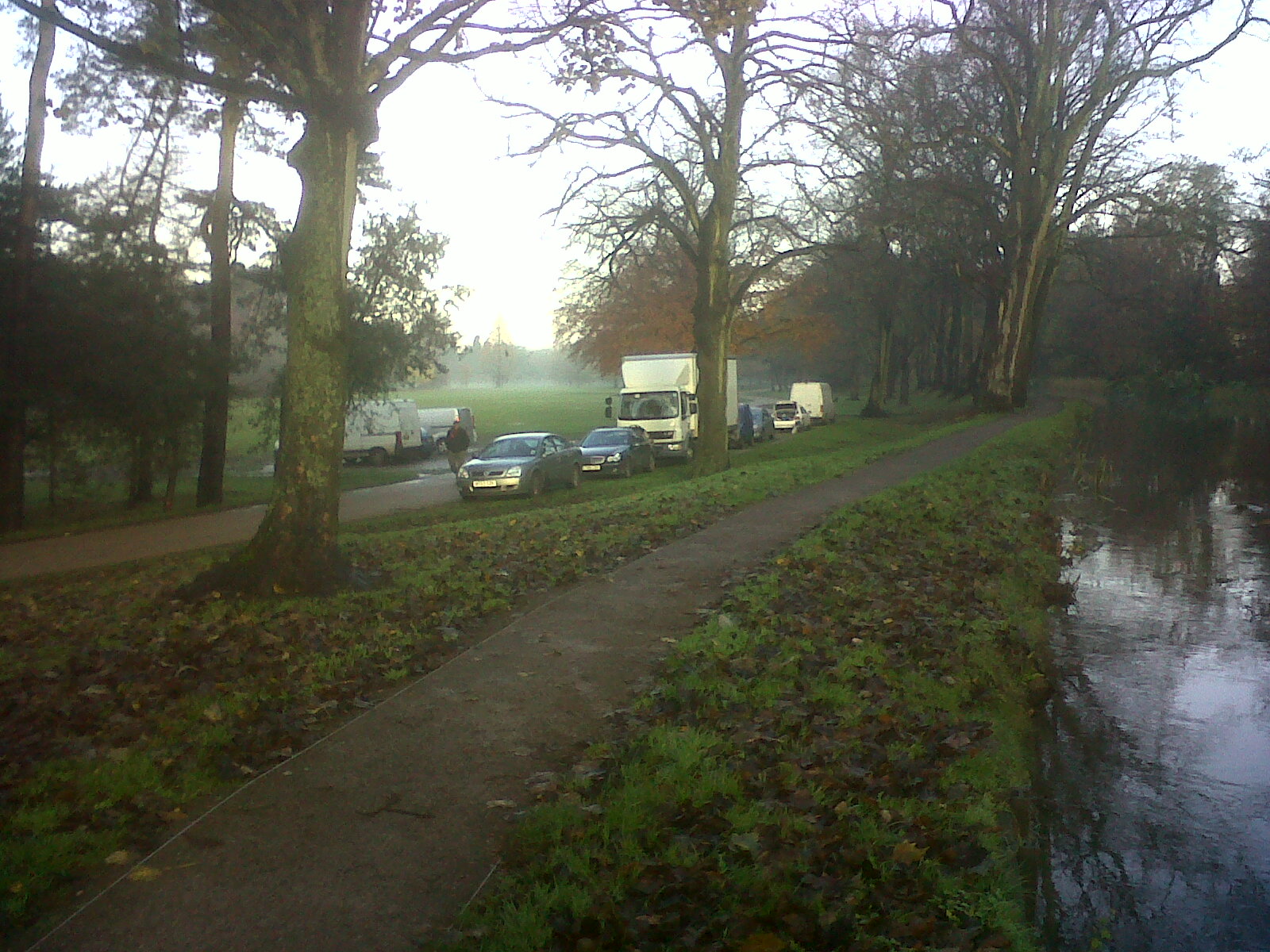
If you needed any proof of Cardiff City Council’s dishonesty about the likely effects of their new road into Bute Park then just take a look at these examples of private vehicles littering this once beautiful site. I should also say that there used to be signs proclaiming a 5mph speed limit on the public footpaths, but these have all been taken away, giving the dreaded White Van Man a licence to drive at high speed around the Park. I’ve stopped walking through it, in fact, on my way to work in the mornings as it has become too unpleasant battling my way through the traffic. Much more of this and I’m afraid Bute Park just won’t be fit for humans…


Share/Bookmark

Higher Education Spending in Wales

Posted in Education, Politics with tags , , , on November 17, 2010 by telescoper

Just a quick post to pass on the news that the Welsh Assembly has now published its draft budget for 2011/12 (and following years). You can find the documents related to this here, the most useful one of which is this.

I haven’t got time to comment in detail but, being a university employee, I skipped directly to the section about Higher Education and found the following:

In order to direct funding to schools and skills, the majority of budget reductions have been focused on specific budgets. Higher Education will receive a reduction over the next 3 years of £51m. This amounts to some 11.8%, compared to the severe reductions proposed in England. The planned reductions will facilitate the statutory commitment to provide financial support for Higher Education students, numbers of which have increased significantly over the past two years. This does not predetermine the Welsh Assembly Government’s response to the Browne Review. The reductions include the efficiency savings we expect to be delivered through the implementation of our Higher Education strategy, For our Future. The commitment to the development of the University of the Heads of The Valleys (UHoVI) and Coleg Cymraeg Cenedlaethol (formerly Coleg Federal) will, however, remain a priority to
be funded from this budget.

In other words, Higher Education is to bear the brunt of protecting the budgets for Schools (which remains roughly level in cash terms) and  Further Education (which is cut by about 2%). Clearly the WAG must either think that  maintaining funding for Higher Education  is a low priority or that money saved from HE can be recouped some other way (i.e. through increasing fees or cutting student support).

An 12% cut in cash terms is much worse in real terms, of course, but the draft budget doesn’t give any details of how this is going to be broken down in terms of research and teaching allocations. Moreover, the Welsh Assembly has yet to formulate a response to the Browne Review which has resulted in proposals for tuition fees up to £9000 per annum in England. Since the Welsh Assembly elections are to be held next May, it is highly unlikely that a new tuition fee system for Wales  will be in place before then. Moreover, the fact that funding is being diverted into the new institutions described above suggests that even less money than this will be available for established universities.

We also don’t know the extent to which research will be protected. In England, a cut of 40% has been applied to teaching budgets from next year, with research funding largely preserved. It appears something similar is going to happen in Scotland, but with a much smaller overall cut to the universities budget there. Will Wales follow the same pattern, or will it sacrifice any chance of having high quality research-led universities by single-mindedly pursuing its “regional agenda”?


Share/Bookmark

To the Warmongers

Posted in History, Poetry, Politics with tags , , , on November 8, 2010 by telescoper

As we approach Remembrance Sunday (which this year lies on 14th November) I find myself once again wearing a poppy on my coat lapel, and having once again to explain this to those I meet in the department and elsewhere who don’t approve. I’ve already said everything I think I need to on this in posts last year and the year before, so I won’t repeat myself at length here.

I am aware (and acutely sensitive to) the danger that the wearing of a poppy might be mistaken for support for militarism and that many of our politicians would like to manipulate the meaning of this symbol in precisely that way for their own ends. Nevertheless, I will wear one and will observe the two minutes’ silence on Thursday too. Why? Lest we forget, that’s why…

But instead of debating this again, I will  post the following poem and letter, both of which were written by Siegfried Sassoon.

The poem is called the To the Warmongers:

I’m back again from hell
With loathsome thoughts to sell;
Secrets of death to tell;
And horrors from the abyss.
Young faces bleared with blood,
Sucked down into the mud,
You shall hear things like this,
Till the tormented slain
Crawl round and once again,
With limbs that twist awry
Moan out their brutish pain,
As for the fighters pass them by.
For you our battles shine
With triumph half-divine;
And the glory of the dead
Kindles in each proud eye.
But a curse is on my head,
That shall not be unsaid,
And the wounds in my heart are red,
For I have watched them die.

The astonishing letter below was written by Siegfried Sassoon in July 1917, and was subsequently read out in the House of Commons. Sassoon narrowly escaped court martial for treason.

It’s worth noting the last two paragraphs:

I have seen and endured the sufferings of the troops and I can no longer be a party to prolonging these sufferings for ends which I believe to be evil and unjust. I am not protesting against the conduct of the war, but against the political errors and insincerities for which the fighting men are being sacrificed.

On behalf of those who are suffering now, I make this protest against the deception which is being practised upon them; also I believe it may help to destroy the callous complacency with which the majority of those at home regard the continuance of agonies which they do not share and which they have not enough imagination to realise.

The tragedy is that these words could equally well have been written about Afghanistan 2010 rather than France or Belgium 1917. The sight of Tony Blair wearing a poppy at the Cenotaph is one that filled me with nausea, but his hypocrisy makes it more, not less, important to hang on to the true meaning. Lest we forget. Nowadays, though, I don’t really “wear my poppy with pride”, but with something rather closer to shame.


Share/Bookmark

After Piero

Posted in Art, Education, Politics, The Universe and Stuff with tags , , , on October 31, 2010 by telescoper

I don’t often blog about things inspired from TV programmes. I don’t watch that many, and those I do see are rarely inspirational. However, last night, I caught the last of the series Renaissance Revolution, presented by Matthew Collings. It was on the subject of a major obsession of mine, the art of Piero della Francesca, and I thought it was wonderful. I regret having missed the previous programmes in the series, but I’m sure I’ll get a chance to see them sometime.

Collings focused on one particular painting by Piero, The Baptism of Christ, which hangs in the National Gallery in London, and which is illustrated below:

The political and religious backround to this painting are almost as fascinating as its composition, based on the offset superposition of a circle (representing heaven) and a square (representing the Earth). The use of perspective was very new around 1450 when this painting was finished, but that’s not the only geometrical aspect to note. There’s a striking use of symmetry (e.g. in the angles of John the Baptist’s arm and leg), and the central vertical axis defined by the dove, John’s hand and Christ’s hands.

Given the mathematical rigour of his compositional techniques, it should come as no surprise to learn that in his lifetime Piero was just as famous as a mathematician as he was as an artist. In other words he was the archetypal renaissance man. Unfortunately, most of his art doesn’t survive; the vast majority of his works were frescoes in various churches, few of which have withstood the test of time. Regrettably, little also is known about Piero the man, except that he lived into his 80s.

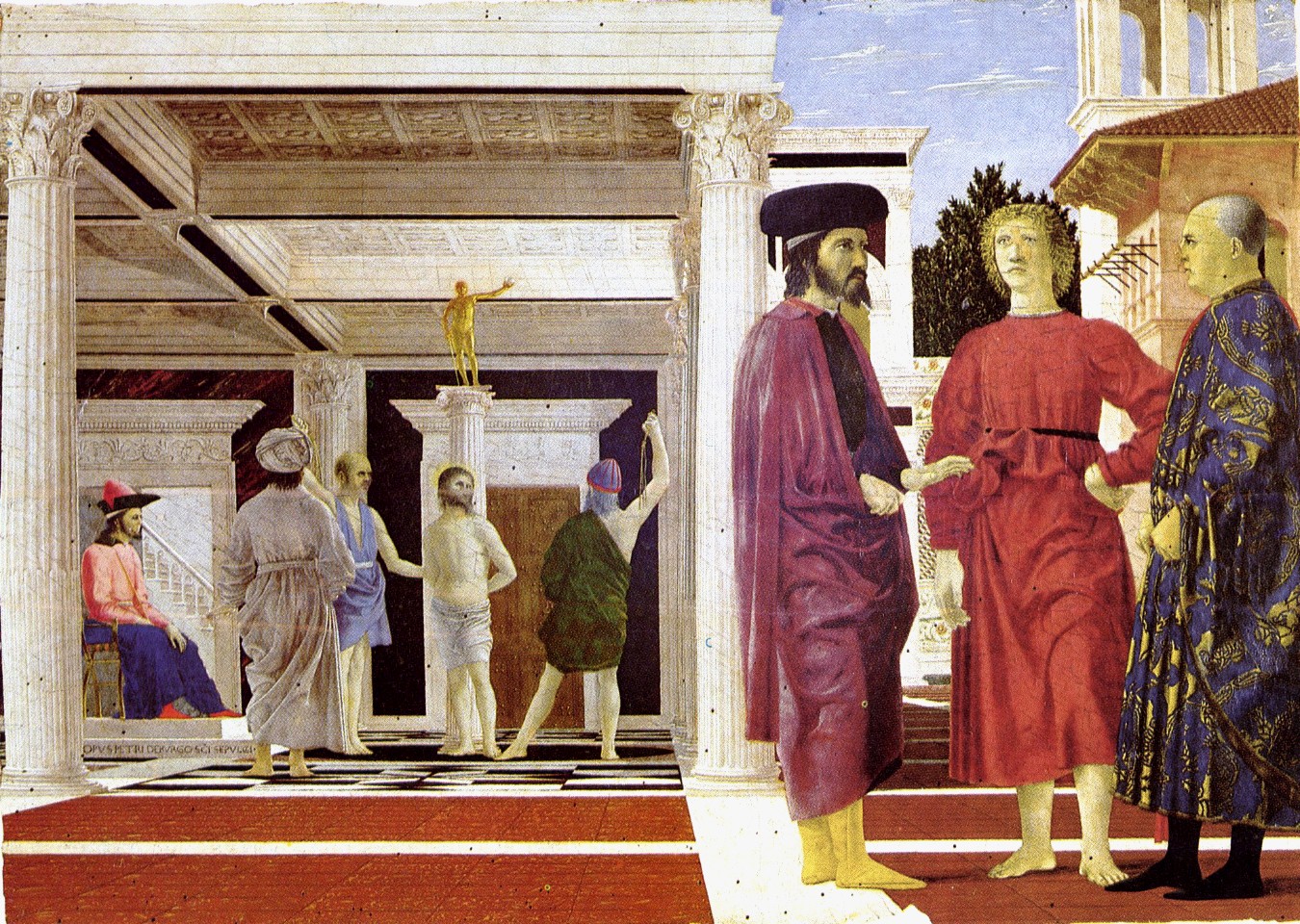
A while ago I mentioned another work by Piero which is the origin of my obsession with his paintings. The Flagellation of Christ is a work that has burrowed so far into my psyche that I quite often dream that I’m in the strange building depicted therein:

In fact I also use this painting in talks about science – I did so in my talk on Wednesday, in fact. The reason I use it in that context is that it is a bit like the standard model of cosmology. On one level it makes sense: the flat Euclidean geometry mapped out by the precise linear perspective allows us to understand the properties of the space extremely well, including the scale (the vanishing point indicates a front-to-back distance of about 250 ft). This is what our standard cosmology says too:- the universe also has a flat geometry. On the other hand, the more you think about the contents, the more confusing the picture gets. The main subject matter of the painting is to the left, in the background, playing an apparently minor part in the whole thing. Who are the characters surrounding the Christ figure? And who are the three figures in the foreground, dominating the whole composition, but seemingly indifferent to what is going on behind? Do they represent dark energy? Do the other characters represent the dark matter?

That’s not meant to be taken seriously, of course, and nobody actually knows what is really going on in this painting. It’s undoubtedly beautiful, but also an enigma, and that combination is what makes it a great work of art. It’s not easy to understand. It makes you wonder.That’s what science is like too. We have our theories, we have data, but there always remains a great deal we don’t understand. And sometimes the more we think about it, the more confused we get. Just as it is with that painting.

As Mark Collings put it brilliantly in the programme last night

When you’re looking at the picture, analysis isn’t exactly what is going on. You’re seeing and you’re getting pleasure from seeing. Partly the picture is telling you how pleasure is constructed, how it’s created, and partly you’re just lost in it. So when you’re lost in the light of Piero, you’re experiencing when you’ve forgotten how to experience. And you’re suddenly curious when you’ve forgotten how to be curious. And what you’re experiencing and being curious about is .. the world.

It doesn’t matter whether you’re a scientist or an artist (or a poet or a philosopher or a historian or whatever). The need to be curious about the world – or some aspect of it – is surely what it’s all about. During the Renaissance it wasn’t unusual for great minds to embrace science, mathematics and art – just think of Leonardo da Vinci. However, over the centuries we’ve become increasingly specialised and compartmentalised and more focused on making money than on making ideas. We’re losing what above all else is what makes us human, our curiosity.

Our society increasingly sees education simply as a means to develop skilled workers, smart enough to do technically complicated jobs, but not clever enough to ask too many questions about the materialistic treadmill they will spend their life upon. The UK government’s plan to withdraw funding for arts and humanities departments in universities is just another step along this path.

It shouldn’t be like this. Universities should be about learning for learning’s sake; not about teaching facts or skills, but about teaching people to ask questions and figure out their own answers. In other words, they should be about curiosity.


Share/Bookmark

Did HE fall, or was it pushed?

Posted in Education, Politics with tags , , , , , , on October 30, 2010 by telescoper

One of the other scary bits of news to emerge last week concerns proposed changes to the arrangements for tuition fees in English universities. According to the Times Higher, the Minister responsible for universities, David Willetts, has admitted that the cuts to university budgets announced in the Comprehensive Spending Review, will occur before any new money flows into universities from whatever new fee arrangements emerge from the government’s deliberations following the Browne Report.

One of the recommendations of the Browne Report was that central government funding for arts, humanities and social sciences be scrapped entirely. Although I’m a scientist and I do think Science is Vital this is a very bad move, as I think other forms of scholarship and learning are vital too, for a wide range of reasons including cultural ones. It was never clear whether arts & humanities departments would be able to recoup the money lost as a result of cuts to central funding, but now it appears they will have to survive for an indeterminate time without any prospect of extra income to offset the shortfall.

The upshot of all this will be a huge and immediate cut in the budgets of many university departments, a  state of affairs about which Willetts commented only thus:

You have to expect that there will be pressure on universities to save money, and we don’t think they should be exempt from the pursuit of efficiencies.

Can an immediate 40% cut in teaching income be made by efficiency savings? I don’t think so, Mr Willetts. Even making large-scale redundancies won’t help there, as that costs a lot of money up front.

So why is the government pushing through cuts to university funding before ensuring that the new fee arrangements are in place? A variety of answers are possible. One would be incompetence, always a possibility when politicians are involved. However, although this government has tried to rush things through very quickly, I do not believe that this is something that hasn’t been considered very carefully. I think it’s deliberate.  I believe that this government wants some universities to fail, and has found an opportunity to push them over the edge.

It’s not about efficiency savings, it’s about survival of the fattest. Only those places able to dig into their reserves for several years will be able to weather the storm. Some will cope, some won’t. That’s the point.

It’s well known that several universities, most of them post-1992 institutions, have been struggling financially for a considerable time. In the past, special procedures have always been implemented to protect organizations of this type that have been close to insolvency. This government has said that will do things differently, and that universities that go bust will now be allowed to fail. This may involve them closing altogether, or being taken over by private companies. If I were working in a university heavily dependent on income from arts, humanities and social science teaching, I would be extremely nervous about the future. I mean, more nervous than I am anyway, working as a scientist in an institution which is financially sound. And that  is already very nervous indeed.

The other side of this particularly nasty coin, is that more “prestigious” institutions specialising in non-STEM areas, such as the London School of Economics, are already considering the option of going private. If the government gives them no support directly, yet insists – as seems likely – in capping the fee students pay at a figure around £7K per annum as well as strangling them with yards of red tape as HEFCE is wont to do, then why not just withdraw from the system and set fees at whatever level they like? It’s unlikely that an institution with a strong science base will go down this road, as the taxpayer is going to continue supporting STEM subjects, but it seems to me that it would make sense for the LSE to opt out of a system whether the costs of membership exceed the benefits received.

In the longer term, the squeeze is set of continue. According again to the Times Higher, the net revenue from fees will only replace part of the funding withdrawn over the CSR period. It looks like five years of struggle during which many departments may go under. The more you think about it, the worse it looks.

However, perhaps a better question than the one I asked a couple of paragraphs ago is the following. Why is the government intent on slashing the budgets of HE institutions, when it appears to have  let Vodafone off without paying a bill for £6 billion tax?

That amount would have been more than enough to tide the HE sector over until the new fee stream came online…


Share/Bookmark