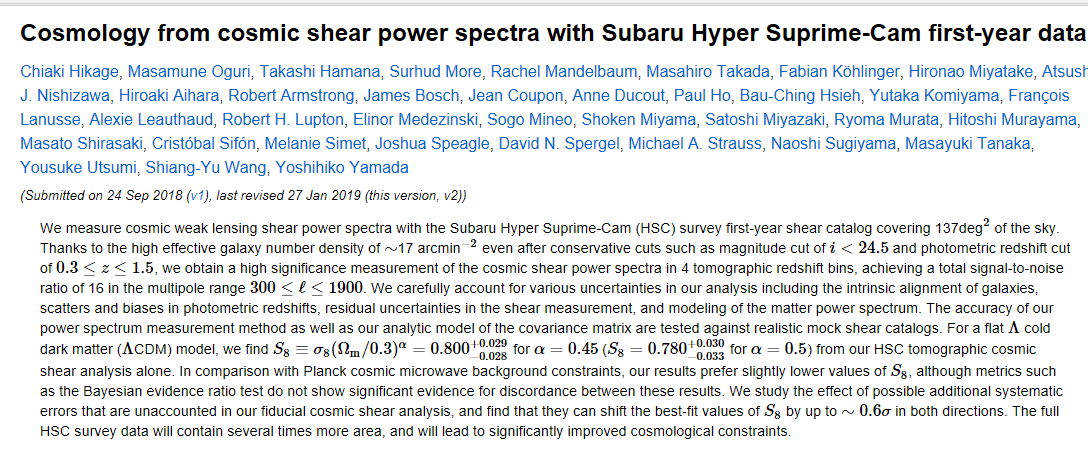
Up with the lark this morning I suddenly remembered I was going to do a post about a paper which actually appeared on the arXiv some time ago. Apart from the fact that it’s a very nice piece of work, the first author is Chiaki Hikage who worked with me as a postdoc about a decade ago. This paper is extremely careful and thorough, which is typical of Chiaki’s work. Its abstract is here:
The work described uses the Hyper-Suprime-CamSubaru Telescope to probe how the large-scale structure of the Universe has evolved by looking at the statistical effect of gravitational lensing – specifically cosmic shear – as a function of redshift (which relates to look-back time). The use of redshift binning as demonstrated in this paper is often called tomography. Gravitational lensing is sensitive to all the gravitating material along the line of sight to the observer so probes dark, as well as luminous, matter.
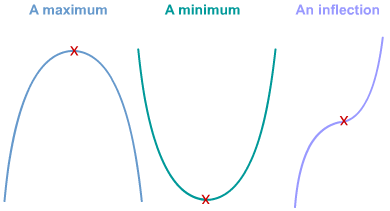
Here’s a related graphic:
The article that reminded me of this paper is entitled New Map of Dark Matter Spanning 10 Million Galaxies Hints at a Flaw in Our Physics. Well, no it doesn’t really. Read the abstract, where you will find a clear statement that these results `do not show significant evidence for discordance’. Just a glance at the figures in the paper will convince you that is the case. Of course, that’s not to say that the full survey (which will be very much bigger; the current paper is based on just 11% of the full data set) may not reveal such discrepancies, just that analysis does not. Sadly this is yet another example of misleadingly exaggerated science reporting. There’s a lot of it about.
Incidentally, the parameter S8 is a (slightly) rescaled version of the more familiar parameter σ8 – which quantifies the matter-density fluctuations on a scale of 8 h-1 Mpc – as defined in the abstract; cosmic shear is particularly sensitive to this parameter.
Anyway, if this is what can be done with just 11%, the full survey should be a doozy!
Yesterday there came to my attention to a tweet from an organization called `Turning Point’. Disappointingly this is not as its name suggests, something to do with differential calculus, but a far-right propaganda organization which, among other things, is bemoaning the `socialist dominance in academia’.
Left-wing infiltration of university education would be a very serious matter if it existed, so to allay the fears of my readership that this is not really a problem, in the following I am going to list a few physics topics I will be teaching this week to make it clear that they can not possibly be accused of being influenced by political bias.
Mathematical Physics. I will be explaining how Laplace Transformations can be used to solve ordinary differential equations by seizing the means of production.
Quantum Mechanics. I will be demonstrating how the path integral formalism allows the result of a quantum mechanical calculation to be obtained by considering the sum over all historical class struggles.
Electrostatics. I will be discussing why some substances are insulators rather than conductors using the theory of dielectrical materialism.
Optics. The topic here is Snell’s Law, which relates the Engels of incidence and refraction for light of a given colour and for given pair of media.
It goes without saying that students will not pass the examination on these topics unless they get enough Marx.
I was quite excited the other day when I got an email notifying me that Science Foundation Ireland (SFI) has announced a new funding programme called Frontiers for the Future. What particularly caught my attention are the so-called Frontiers for the Future Projects, which..
will provide funding for high-risk, high-reward research that facilitates highly innovative and novel approaches to research.
The wording here contrasts with the Frontiers for the Future Awards, which…
will provide larger scale funding for innovative, collaborative and excellent research programmes that have the potential to deliver economic and societal impact.
The Projects can fund up to €480K over 4 years (compared to the Awards, which are up to €1M over 5 years). This second category seems to follow the policy of the past decade of SFI which is only to fund research which is able more-or-less immediately to generate a financial return. I’ve argued previously that I think this is a short-sighted policy, but I won’t repeat that argument here. It is a fact however that SFI’s policy has made it very difficult in Ireland for researchers who want to do basic `blue skies’ research, including us astronomers and astrophysicists.
The new `Projects’ however may just be a step away from this damaging shor-termism.
Further down the page SFI states (my emphasis):
To be eligible for funding through the SFI Frontiers for the Future Programme, all proposals must be aligned to one of the 14 Refreshed Priority Areas for 2018-2023, or to any other research area within SFI’s legal remit (i.e. oriented basic or applied research) where there is convincing evidence that there will be significant potential for economic and/or societal impact in Ireland.
Astronomers in the UK have succeeded in arguing that their big science projects have all kinds of societal impact (in inspiring more students into STEM disciplines, as well as wider public engagement) as well as direct economic impact in terms of developing research methods, and building up a talent pool, especially in areas like data science. Whether SFI will accept such arguments in Ireland, I just don’t know.
If you’re wondering what `oriented basic or applied research’ means, SFI defines it as follows:
Oriented basic research is research that is carried out with the expectation that it will produce a broad base of knowledge that is likely to form the background to the solution of recognised, or expected, current or future problems or possibilities.
To me that means virtually any science!
Anyway, I’ll probably throw the dice to see if I can get some SFI support for my research in cosmology. It might turn out to be a waste of effort, but if you don’t buy a ticket you don’t win the lottery…
I’ve been reading a few items here and there about proposals for a Future Circular Collider, even larger than the Large Hadron Collider (and consequently even more expensive). No doubt particle physicists interested in accelerator experiments will be convinced this is the right move, but of course there are other projects competing for funds and it’s by no means certain that the FCC will actually happen.
One of the important things about `Big Science’ when it gets this big is that it has to capture the imagination of people with political influence if it is to be granted funding. Based on past experience that means that there has to be a Big Discovery to be made or a Big Idea to be tested. This Big Thing has to be simple enough for politicians to understand and exciting enough to capture their imagination (and that of the public). In the case of the Large Hadron Collider (LHC), for example, this was the Higgs Boson. In the case of the Euclid space mission, the motivation is Dark Energy.
The Big Thing that sells a project to politicians is not necessarily the thing that most scientists are interested in. The LHC has done a lot of things other than discover the Higgs, and Euclid will do many things other than probe Dark Energy, but there has to be one thing to set it all in motion. It seems to me that the Big Question about the FCC is whether there is something specific that can motivate this project in the way the Higgs did for the LHC? If so, what is it?
Answers on a postcard or, better, through the comments box below.
Humphrey Bogart with the eponymous Maltese Falcon
Anyway, these thoughts reminded me of the concept of a MacGuffin. Unpick the plot of any thriller or suspense movie and the chances are that somewhere within it you will find lurking at least one MacGuffin. This might be a tangible thing, such the eponymous sculpture of a Falcon in the archetypal noir classic The Maltese Falcon or it may be rather nebulous, like the “top secret plans” in Hitchcock’s The Thirty Nine Steps. Its true character may be never fully revealed, such as in the case of the glowing contents of the briefcase in Pulp Fiction, which is a classic example of the “undisclosed object” type of MacGuffin, or it may be scarily obvious, like a doomsday machine or some other “Big Dumb Object” you might find in a science fiction thriller.
Or the MacGuffin may not be a real thing at all. It could be an event or an idea or even something that doesn’t actually exist in any sense, such the fictitious decoy character George Kaplan in North by Northwest. In fact North by North West is an example of a movie with more than one MacGuffin. Its convoluted plot involves espionage and the smuggling of what is only cursorily described as “government secrets”. These are the main MacGuffin; George Kaplan is a sort of sub-MacGuffin. But although this is behind the whole story, it is the emerging romance, accidental betrayal and frantic rescue involving the lead characters played by Cary Grant and Eve Marie Saint that really engages the characters and the audience as the film gathers pace. The MacGuffin is a trigger, but it soon fades into the background as other factors take over.
Whatever it is or is not, the MacGuffin is responsible for kick-starting the plot. It makes the characters embark upon the course of action they take as the tale begins to unfold. This plot device was particularly beloved by Alfred Hitchcock (who was responsible for introducing the word to the film industry). Hitchcock was however always at pains to ensure that the MacGuffin never played as an important a role in the mind of the audience as it did for the protagonists. As the plot twists and turns – as it usually does in such films – and its own momentum carries the story forward, the importance of the MacGuffin tends to fade, and by the end we have usually often forgotten all about it. Hitchcock’s movies rarely bother to explain their MacGuffin(s) in much detail and they often confuse the issue even further by mixing genuine MacGuffins with mere red herrings.
Here is the man himself explaining the concept at the beginning of this clip. (The rest of the interview is also enjoyable, convering such diverse topics as laxatives, ravens and nudity..)
There’s nothing particular new about the idea of a MacGuffin. I suppose the ultimate example is the Holy Grail in the tales of King Arthur and the Knights of the Round Table in which the Grail itself is basically a peg on which to hang a series of otherwise disconnected stories. It is barely mentioned once each individual story has started and, of course, is never found. That’s often how it goes with MacGuffins -even the Maltese Falcon turned out in the end to be a fake – they’re only really needed to start things off.
So let me rephrase the question I posed earlier on. In the case of the Future Circular Collider, what’s the MacGuffin?
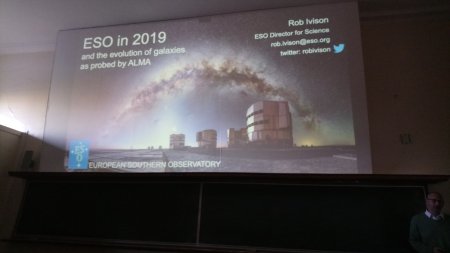
It was a pleasure to welcome Rob Ivison, Director of Science at the European Southern Observatory (ESO) , to Maynooth this afternoon for a colloquium.
I was on my best behaviour introducing his talk and even refrained from pointing out that his native Lancashire is actually in the Midlands.
Ireland became a full member of ESO earlier this year and Rob has been touring Ireland giving talks to encourage Irish astronomers to make the most of the many opportunities membership presents. Having already visited Cork and Galway he passed through Maynooth today before ending up in Dublin tomorrow.
It was an enjoyable and impressive talk and very nice to chat with Rob afterwards over dinner.
You may or may not know that former Northern Irish politician John Hume, is an alumnus of St Patrick’s College Maynooth and thus has close connections with Maynooth University. There’s a building named after him, for one thing.
Born in Derry/Londonderry, John Hume was the second leader of the Social Democratic and Labour Party (SDLP) from 1979 to 2001. He has served as a member of the European Parliament and a member of the UK parliament, as well as a member of the Northern Ireland Assembly.
He is regarded as one of the most important figures in the recent political history of Ireland and one of the architects of the Northern Ireland peace process. The co-recipient of the Nobel Peace Prize with David Trimble in 1998, Hume was also recognised with the Gandhi Peace Prize and the Martin Luther King Award – he is the only recipient of all three major peace awards.
In 2010, he was named ‘Ireland’s Greatest’ in a public poll by RTÉ. It is fitting that Maynooth University recognises the contribution of John and Pat Hume to peace on the island of Ireland.
One of the most important manifestations of the connection between John Hume, his wife Pat Hume, and Maynooth University is a programme of Doctoral Scholarships, which are now being advertised for entry in September 2019.
These are available to fund a PhD in any academic discipline so I encourage anyone interested in doing graduate research to have a look at the details which can be found here. Maynooth University is particularly keen to encourage more women to pursue careers in STEM disciplines, so we particularly encourage female applicants.
If there’s anyone out there who might be interested in doing a PhD in Theoretical Physics or Astrophysics please feel free to contact me directly! And I’d be very grateful if others who see this could draw it to the attention of potential candidates.
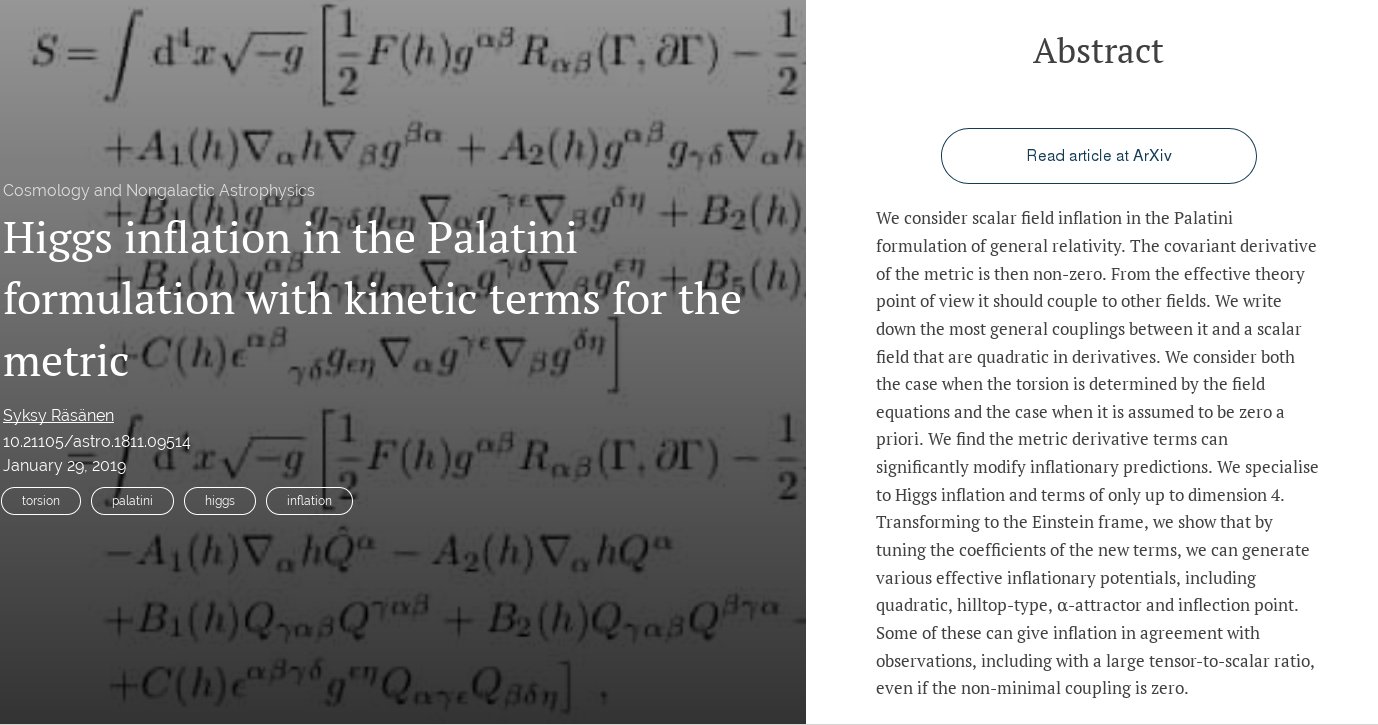
Well, it’s time at last to announce the first paper to be published by the new incarnation of the Open Journal of Astrophysics, which we just published this morning. Here it is!
It’s by Syksy Räsänen of the University of Helsinki. You can find the full article on the arXiv here.
This is the first published paper to have been submitted to the Open Journal of Astrophysics since its re-launch last October; the others on the OJA site were published on the old platform and imported into the new site after publication. This new paper has gone all the way through submission, refereeing, revision and publication on the new platform.
It’s been quite exciting for the last couple of months, as various papers have been working their way through the Editorial pipeline, to see which would win the race and get published first. Some submissions have been slowed down by folk reluctant to accept reviewing requests, presumably because the journal is not so well known and some are suspicious that it might not be bona fide. Hopefully that will pass with time. Moreover, after internal discussions, the Editorial Board have decided to ask for two referees for each paper by default and that has probably also slowed us down a bit.
We have a few other papers coming up for publication soon, and some have been sent back to authors for revise and resubmit. I think I know which one will be published next, but I’ll keep that to myself for now!
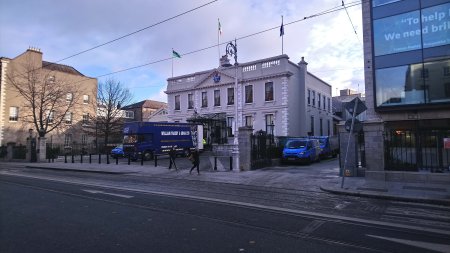
This morning I found myself in the centre of Dublin to attend an event at the Royal Irish Academy, in Dawson Street. Coincidentally this is just a few yards from the Mansion House, scene of the meeting of the First Dáil on 21st January 1919 (which I blogged about here) and also scene of the commemorations of its centenary yesterday. I’m guessing that the removals van was taking away some of the paraphernalia used for yesterday’s event.
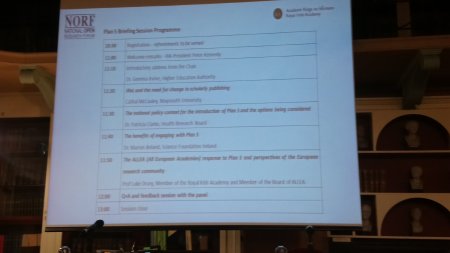
Anyway, the event at the Royal Irish Academy organized by the National Open Research Forum (NORF) was intended to disseminate information about Plan S – a European initiative for Open Access publishing.
I have blogged about Plan S and some of the reactions to it before (e.g. here and here).
The main point is that comprehensive technical guidance on how to comply with Plan S and you can also submit feedback on the guidance here until the deadline of February 8th 2019. Full implementation is expected by January 2020. Things are moving relatively quickly, which is a very good thing. Some people thing this deadline is unrealistic, but I think it was a smart move to make it close so as to galvanize researchers into action.
I learnt a particularly interesting fact during the talk by Maynooth’s own Cathal McCauley, namely that the global revenues of the academic publishing industry amount to about, €22 billion per annum. This exceeds the global revenues of the recorded music industry. Profit margins for these publishers are much larger (up to 45%) than Apple, Google and BMW. The research community is being fleeced, and the worst offenders are the `Big Four’: Elsevier, Springer, Wiley and Taylor & Francis.
One of the main concerns expressed in the discussion session was the extent that move away from traditional journals might have a negative effect on early career researchers, as those responsible for hiring postdocs and new faculty members often concentrate on the journal in which their work is published rather than the work itself. The obvious way to address this problem to use article-level information rather than journal-level metrics, which is entirely feasible to do, but it is true that we need a change of culture across the board to make this work for the benefit of science as whole. I am optimistic about this, largely because I recall very well how rapidly the culture in astrophysics adapted to the existence of the arXiv. With regard to open access publishing the way forward is to disrupt the existing Academic Journal Racket by developing alternative modes publication which demonstrate benefits in cost, reach and simplicity, combined with pressure from funding agencies imposing mandates on publications arising from their grants.
There is no question in my mind that in just a few years, when Open Access is the overwhelmingly dominant mode of publication, researchers will look back and wonder why we ever put up with the absurd system we have at present.
As a final comment I’ll mention that the Open Journal of Astrophysics got a few mentions during the session. I’m hoping to make some exciting announcements about this journal very soon indeed. Before that, however, I have to go to Belfast to give a talk…
In the early hours of the tomorrow morning (Monday 21st January 2019), people in Ireland and the United Kingdom will be able to see a Total Lunar Eclipse. It will in fact be visible across a large part of the Earth’s surface, from Asia to North America. Around these parts the time when the Moon is fully within the shadow of the Earth is about 4.40am until 5.40am (Irish Time). The Moon will be well over the horizon during totality.
For a combination of reasons this eclipse is being called a Super Blood Wolf Moon. The `Super’ is because the Full Moon will be close to its perigee (and will therefore look a bit bigger than usual). The `Blood’ is because the Moon will turn red during the eclipse, the blue component of light reflected from the Moon’s surface having been scattered by the Earth’s atmosphere. The `Wolf’ is because the first Full Moon of the New Year is, according to some traditions, called a `Wolf Moon’, as it is associated with baying wolves. Other names for first Full Moon of the year include: Ice Moon, Snow Moon, and the Moon after Yule.
Having looked at the Weather forecast for Ireland, however, it seems that instead of a Super Blood Wolf Moon we’re more likely to get a Bloody Clouds No Moon…
The official photographer at last week’s LGBT STEMinar took these pictures of me while I was delivering my keynote talk, and I thought you might find it amusing to see them. Actually quite a few of them could serve as subjects for a caption competition!
The views presented here are personal and not necessarily those of my employer (or anyone else for that matter).
Feel free to comment on any of the posts on this blog but comments may be moderated; anonymous comments and any considered by me to be vexatious and/or abusive and/or defamatory will not be accepted. I do not necessarily endorse, support, sanction, encourage, verify or agree with the opinions or statements of any information or other content in the comments on this site and do not in any way guarantee their accuracy or reliability.





 In the Dark