Archive for the The Universe and Stuff Category

Going NUTs

Posted in The Universe and Stuff, Uncategorized with tags , , , on April 5, 2017 by telescoper

If you’ve studied General Relativity the chances are that you’ve come across the Taub-NUT exact solution discussed in this post. It’s generally regarded as something of an oddity in that it’s a bit contrived, but provides a counter-example to some well-known results. For example, in the context of a Black Hole solution, it violates the No Hair Theorem (by violating the assumption of asymptotic flatness).

When I saw this post at CQG, however, I was reminded of a paper published a few years ago discussing this in a cosmological context, where it can be seen as a special case of the Bianchi IX geometry.

Jennifer Sanders's avatarCQG+

By Paul I. Jefremov and Volker Perlick.


Among all known solutions to Einstein’s vacuum field equation the (Taub-)NUT metric isa particularly intriguing one. It is that metric that owing to its counter-intuitive features was once called by Charles Misner “a counter-example to almost anything”. In what follows we give a brief introduction to the NUT black holes, discuss what makes them interesting for a researcher and speculate on how they could be detected should they exist in nature.

paul jefremov-and-volker Volker Perlick and Pavel (Paul) Ionovič Jefremov from the Gravitational Theory group at the University of Bremen in Germany. Volker is a Privatdozent and his research interests are in classical relativity, (standard and non-standard) electrodynamics and Finsler geometry. He is an amateur astronomer and plays the piano with great enthusiasm and poor skills. Paul got his diploma in Physics at the National Research Nuclear University MEPhI in Moscow, 2014. Now he…

View original post 901 more words

The Bayesian Second Law of Thermodynamics

Posted in The Universe and Stuff with tags , , , on April 3, 2017 by telescoper

I post occasionally about Bayesian probability, particularly with respect to Bayesian inference, and related applications to physics and other things, such as thermodynamics, so in that light here’s a paper I stumbled across yesterday. It’s not a brand new paper – it came out on the ArXiv in 2015 – but it’s of sufficiently long-term interest to warrant sharing on here. Here’s the abstract:

You can download the full paper here. There’s also an accessible commentary by one of the authors here.

The interface between thermodynamics, statistical mechanics, information theory  and probability is a fascinating one, but too often important conceptual questions remain unanswered, or indeed unasked, while the field absorbs itself in detailed calculations. Refreshingly, this paper takes the opposite approach.


Is there a kinematic backreaction in cosmology?

Posted in The Universe and Stuff with tags , , , , , on March 28, 2017 by telescoper

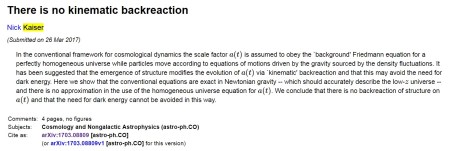
I just noticed that a paper has appeared on the arXiv with the confident title There is no kinematic backreaction. Normally one can be skeptical about such bold claims, but this one is written by Nick Kaiser and he’s very rarely wrong…

The article has a very clear abstract:

Kaiser

This is an important point of debate, because the inference that the universe is dominated by dark energy (i.e. some component of the cosmic energy density that violates the strong energy condition) relies on the assumption that the distribution of matter is homogeneous and isotropic (i.e. that the Universe obeys the Cosmological Principle). Added to the assumption that the large-scale dynamics of the Universe are described by the general theory of relativity, this means that we evolution of the cosmos is described by the Friedmann equations. It is by comparison with the Friedmann equations that we can infer the existence of dark energy from the apparent change in the cosmic expansion rate over time.

But the Cosmological Principle can only be true in an approximate sense, on very large scales, as the universe does contain galaxies, clusters and superclusters. It has been a topic of some discussion over the past few years as to whether the formation of cosmic structure may influence the expansion rate by requiring extra terms that do not appear in the Friedmann equations.

Nick Kaiser says `no’. It’s a succinct and nicely argued paper but it is entirely Newtonian. It seems to me that if you accept that his argument is correct then the only way you can maintain that backreaction can be significant is by asserting that it is something intrinsically relativistic that is not covered by a Newtonian argument. Since all the relevant velocities are much less than that of light and the metric perturbations generated by density perturbations are small (~10-5) this seems a hard case to argue.

I’d be interested in receiving backreactions to this paper via the comments box below.

Science for the Citizen

Posted in Education, Open Access, The Universe and Stuff with tags , , , , , , on March 20, 2017 by telescoper

I spent all day on Friday on business connected with my role in the Data Innovation Research Institute, attending an event to launch the new Data Justice Lab at Cardiff University. It was a fascinating day of discussions about all kinds of ethical, legal and political issues surrounding the “datafication” of society:

Our financial transactions, communications, movements, relationships, and interactions with government and corporations all increasingly generate data that are used to profile and sort groups and individuals. These processes can affect both individuals as well as entire communities that may be denied services and access to opportunities, or wrongfully targeted and exploited. In short, they impact on our ability to participate in society. The emergence of this data paradigm therefore introduces a particular set of power dynamics requiring investigation and critique.

As a scientist whose research is in an area (cosmology) which is extremely data-intensive, I have a fairly clear interpretation of the phrase “Big Data” and recognize the need for innovative methods to handle the scale and complexity of the data we use. This clarity comes largely from the fact that we are asking very well-defined questions which can be framed in quantitative terms within the framework of well-specified theoretical models. In this case, sophisticated algorithms can be constructed that extract meaningful information even when individual measurements are dominated by noise.

The use of “Big Data” in civic society is much more problematic because the questions being asked are often ill-posed and there is rarely any compelling underlying theory. A naive belief exists in some quarters that harvesting more and more data necessarily leads to an increase in relevant information. Instead there is a danger that algorithms simply encode false assumptions and produce unintended consequences, often with disastrous results for individuals. We heard plenty of examples of this on Friday.

Although it is clearly the case that personal data can be – and indeed is – deliberately used for nefarious purposes, I think there’s a parallel danger that we increasingly tend to believe that just because something is based on numerical calculations it somehow must be “scientific”. In reality, any attempt to extract information from quantitative data relies on assumptions. if those assumptions are wrong, then you get garbage out no matter what you put in. Some applications of “data science” – those that don’t recognize these limitations – are in fact extremely unscientific.

I mentioned in discussions on Friday that there is a considerable push in astrophysics and cosmology for open science, by which I mean that not only are the published results openly accessible, but all the data and analysis algorithms are published too. Not all branches of science work this way, and we’re very far indeed from a society that applies such standards to the use of personal data.

Anyway, after the day’s discussion we adjourned to the School of Journalism, Media and Cultural Studies for a set of more formal presentations. The Head of School, Professor Stuart Allan introduced this session with some quotes from a book called Science for the Citizen, written by Lancelot Hogben in 1938. I haven’t read the book, but it looks fascinating and prescient. I have just ordered it and look forward to reading it. You can get the full-text free online here.

Here is the first paragraph of Chapter 1:

A MUCH abused writer of the nineteenth century said: up to the present philosophers have only interpreted the world, it is also necessary to change it. No statement more fittingly distinguishes the standpoint of humanistic philosophy from the scientific outlook. Science is organized workmanship. Its history is co-extensive with that of civilized living. It emerges so soon as the secret lore of the craftsman overflows the dam of oral tradition, demanding a permanent record of its own. It expands as the record becomes accessible to a widening personnel, gathering into itself and coordinating the fruits of new crafts. It languishes when the social incentive to new productive accomplishment is lacking, and when its custodians lose the will to share it with others. Its history, which is the history of the constructive achievements of mankind, is also the history of the democratization of positive knowledge. This book is written to tell the story of its growth as a record of human achievement, a story of the satisfaction of the common needs of mankind, disclosing as it unfolds new horizons of human wellbeing which lie before us, if we plan our new resources intelligently.

The phrase that struck me with particular force is “the democratization of positive knowledge”. That is what I believe science should do, but the closed culture of many fields of modern science makes it difficult to argue that’s what it actually does. Instead, there is an increasing tendency for scientific knowledge in many domains to be concentrated in a small number of people with access to the literature and the expertise needed to make sense of it.

In an increasingly technologically-driven society, the gap between the few in and the many out of the know poses a grave threat to our existence as an open and inclusive democracy. The public needs to be better informed about science (as well as a great many other things). Two areas need attention.

In fields such as my own there’s a widespread culture of working very hard at outreach. This overarching term includes trying to get people interested in science and encouraging more kids to take it seriously at school and college, but also engaging directly with members of the public and institutions that represent them. Not all scientists take the same attitude, though, and we must try harder. Moves are being made to give more recognition to public engagement, but a drastic improvement is necessary if our aim is to make our society genuinely democratic.

But the biggest issue we have to confront is education. The quality of science education must improve, especially in state schools where pupils sometimes don’t have appropriately qualified teachers and so are unable to learn, e.g. physics, properly. The less wealthy are becoming systematically disenfranchised through their lack of access to the education they need to understand the complex issues relating to life in an advanced technological society.

If we improve school education, we may well get more graduates in STEM areas too although this government’s cuts to Higher Education make that unlikely. More science graduates would be good for many reasons, but I don’t think the greatest problem facing the UK is the lack of qualified scientists – it’s that too few ordinary citizens have even a vague understanding of what science is and how it works. They are therefore unable to participate in an informed way in discussions of some of the most important issues facing us in the 21st century.

We can’t expect everyone to be a science expert, but we do need higher levels of basic scientific literacy throughout our society. Unless this happens we will be increasingly vulnerable to manipulation by the dark forces of global capitalism via the media they control. You can see it happening already.

Declining Rotation Curves at High Redshift?

Posted in Astrohype, The Universe and Stuff on March 20, 2017 by telescoper

I was thinking of doing my own blog about a recent high-profile result published in Nature by Genzel et al. (and on the arXiv here), but then I see that Stacy McGaugh has already done a much more thorough and better-informed job than I would have done, so instead of trying to emulate his effort I’ll just direct you to his piece.

A recent paper in Nature by Genzel et al. reports declining rotation curves for high redshift galaxies. I have been getting a lot of questions about this result, which would be very important if true. So I thought I’d share a few thoughts here. Nature is a highly reputable journal – in most fields of […]

via Declining Rotation Curves at High Redshift? — Triton Station

P.S. Don’t ask me why WordPress can’t render the figures properly.

A Quite Interesting Question: How Loud Was the Big Bang?

Posted in The Universe and Stuff with tags , , , , , , , on March 16, 2017 by telescoper

I just found out this morning that this blog got a mention on the QI Podcast. It’s taken a while for this news to reach me, as the item concerned is two years old! You can find this discussion here, about 16 minutes in. And no, it’s not in connection with yawning psychopaths. It was about the vexed question of how loud was the Big Bang?

I’ve posted on this before (here and here)but since I’m very busy again today I  should recycle the discussion, and update it as it relates to the cosmic microwave background, which is what one of the things I work on on the rare occasions on which I get to do anything interesting.

As you probably know the Big Bang theory involves the assumption that the entire Universe – not only the matter and energy but also space-time itself – had its origins in a single event a finite time in the past and it has been expanding ever since. The earliest mathematical models of what we now call the  Big Bang were derived independently by Alexander Friedman and George Lemaître in the 1920s. The term “Big Bang” was later coined by Fred Hoyle as a derogatory description of an idea he couldn’t stomach, but the phrase caught on. Strictly speaking, though, the Big Bang was a misnomer.

Friedman and Lemaître had made mathematical models of universes that obeyed the Cosmological Principle, i.e. in which the matter was distributed in a completely uniform manner throughout space. Sound consists of oscillating fluctuations in the pressure and density of the medium through which it travels. These are longitudinal “acoustic” waves that involve successive compressions and rarefactions of matter, in other words departures from the purely homogeneous state required by the Cosmological Principle. The Friedman-Lemaitre models contained no sound waves so they did not really describe a Big Bang at all, let alone how loud it was.

However, as I have blogged about before, newer versions of the Big Bang theory do contain a mechanism for generating sound waves in the early Universe and, even more importantly, these waves have now been detected and their properties measured.
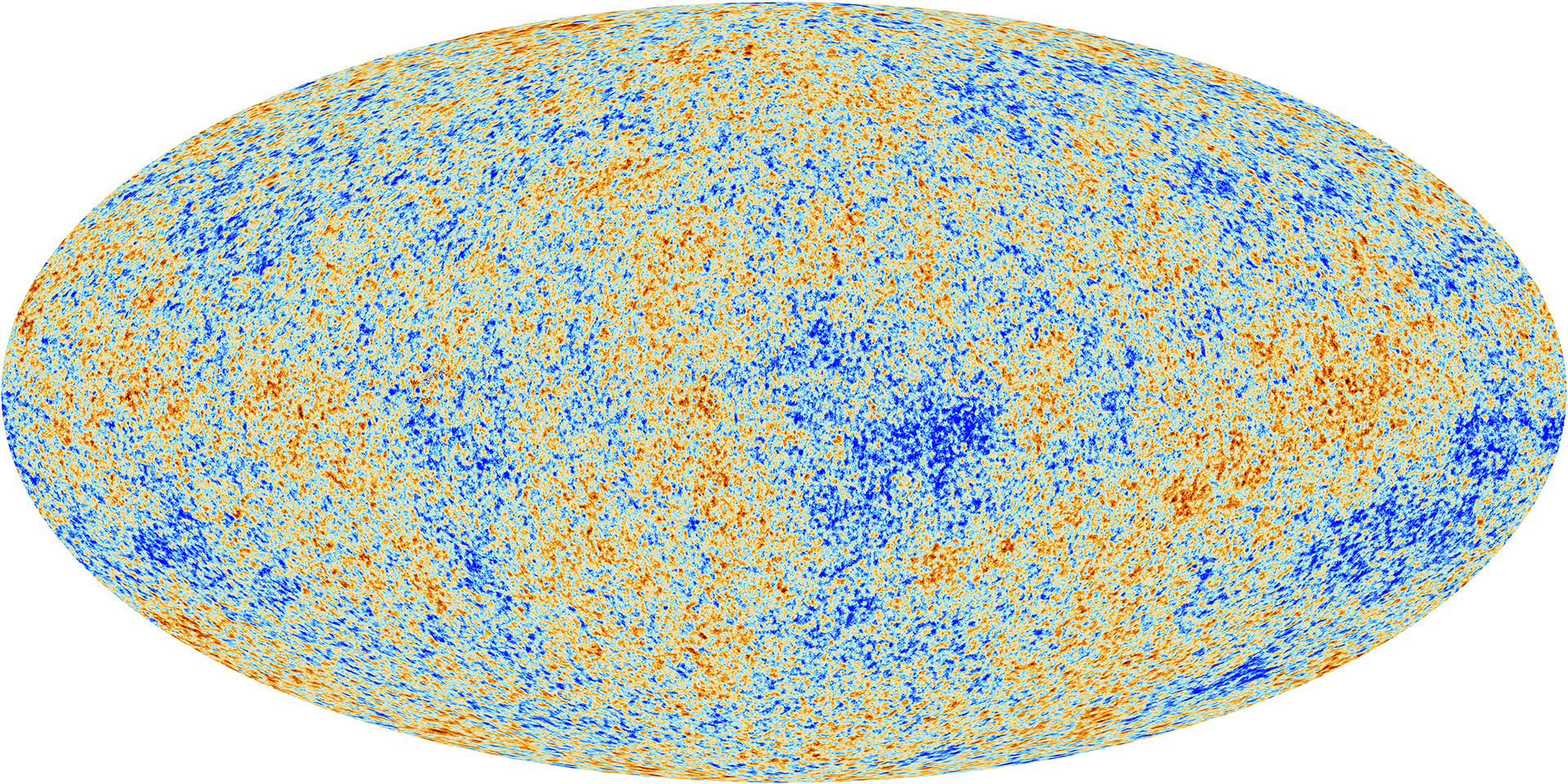
Planck_CMB

The above image shows the variations in temperature of the cosmic microwave background as charted by the Planck Satellite. The average temperature of the sky is about 2.73 K but there are variations across the sky that have an rms value of about 0.08 milliKelvin. This corresponds to a fractional variation of a few parts in a hundred thousand relative to the mean temperature. It doesn’t sound like much, but this is evidence for the existence of primordial acoustic waves and therefore of a Big Bang with a genuine “Bang” to it.

A full description of what causes these temperature fluctuations would be very complicated but, roughly speaking, the variation in temperature you corresponds directly to variations in density and pressure arising from sound waves.

So how loud was it?

The waves we are dealing with have wavelengths up to about 200,000 light years and the human ear can only actually hear sound waves with wavelengths up to about 17 metres. In any case the Universe was far too hot and dense for there to have been anyone around listening to the cacophony at the time. In some sense, therefore, it wouldn’t have been loud at all because our ears can’t have heard anything.

Setting aside these rather pedantic objections – I’m never one to allow dull realism to get in the way of a good story- we can get a reasonable value for the loudness in terms of the familiar language of decibels. This defines the level of sound (L) logarithmically in terms of the rms pressure level of the sound wave Prms relative to some reference pressure level Pref

L=20 log10[Prms/Pref].

(the 20 appears because of the fact that the energy carried goes as the square of the amplitude of the wave; in terms of energy there would be a factor 10).

There is no absolute scale for loudness because this expression involves the specification of the reference pressure. We have to set this level by analogy with everyday experience. For sound waves in air this is taken to be about 20 microPascals, or about 2×10⁻¹⁰ times the ambient atmospheric air pressure which is about 100,000 Pa.  This reference is chosen because the limit of audibility for most people corresponds to pressure variations of this order and these consequently have L=0 dB. It seems reasonable to set the reference pressure of the early Universe to be about the same fraction of the ambient pressure then, i.e.

Pref~2×10⁻¹⁰ Pamb.

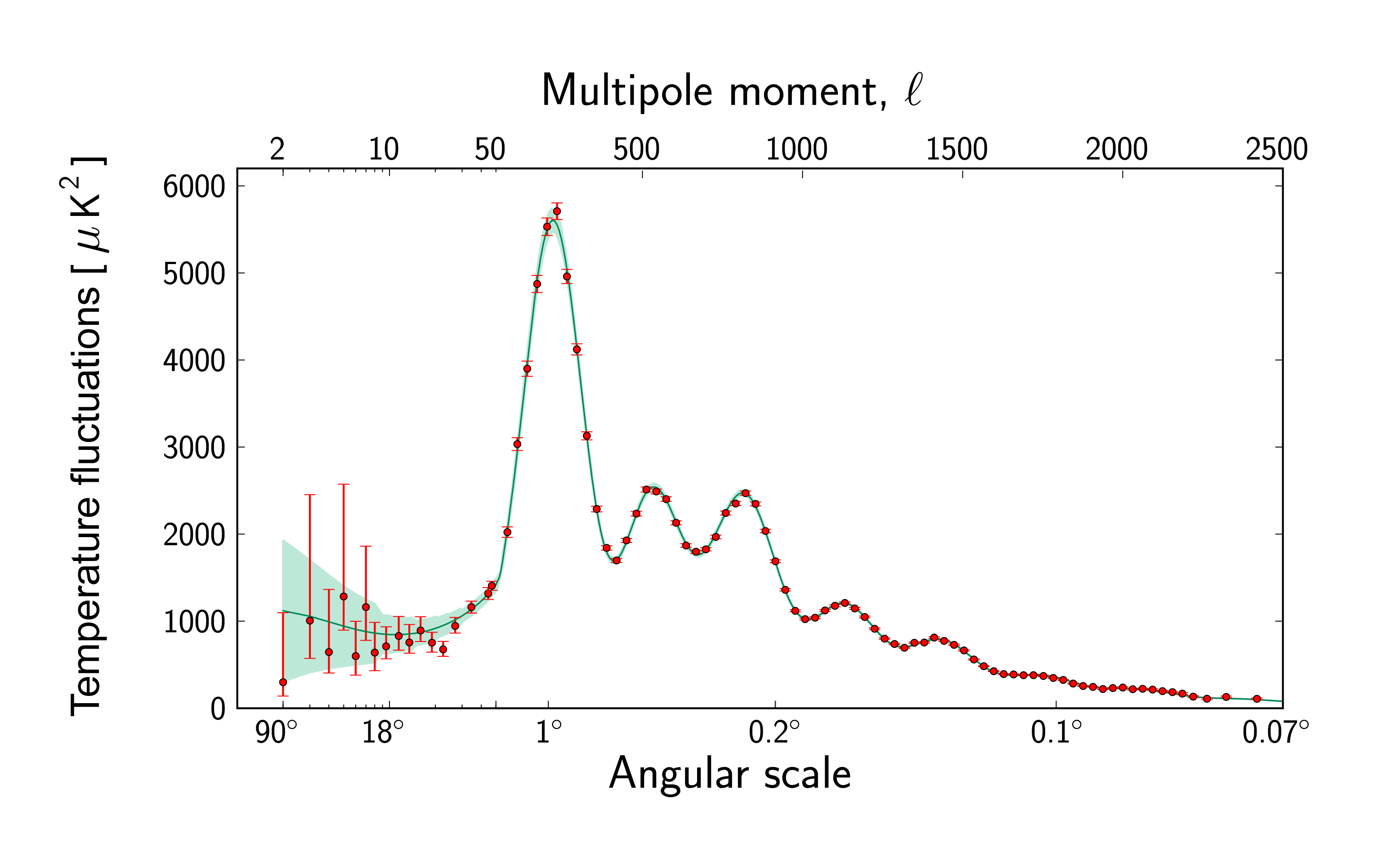
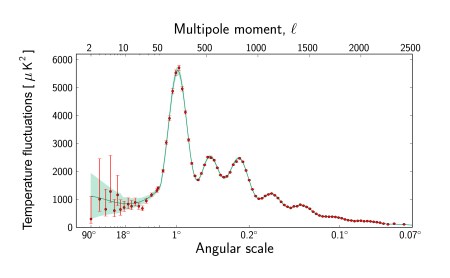
The physics of how primordial variations in pressure translate into observed fluctuations in the CMB temperature is quite complicated, because the primordial universe consists of a plasma rather than air. Moreover, the actual sound of the Big Bang contains a mixture of wavelengths with slightly different amplitudes. In fact here is the spectrum, showing a distinctive signature that looks, at least in this representation, like a fundamental tone and a series of harmonics…
Planck_power_spectrum_orig


If you take into account all this structure it all gets a bit messy, but it’s quite easy to get a rough but reasonable estimate by ignoring all these complications. We simply take the rms pressure variation to be the same fraction of ambient pressure as the averaged temperature variation are compared to the average CMB temperature,  i.e.

Prms~ a few ×10-5Pamb.

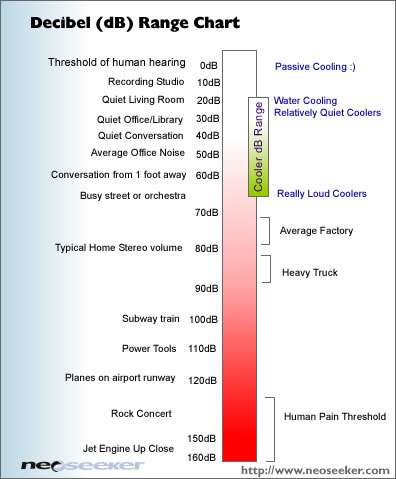
If we do this, scaling both pressures in logarithm in the equation in proportion to the ambient pressure, the ambient pressure cancels out in the ratio, which turns out to be a few times 10-5. With our definition of the decibel level we find that waves of this amplitude, i.e. corresponding to variations of one part in a hundred thousand of the reference level, give roughly L=100dB while part in ten thousand gives about L=120dB. The sound of the Big Bang therefore peaks at levels just a bit less than 120 dB.
cooler_decibel_chart

As you can see in the Figure above, this is close to the threshold of pain,  but it’s perhaps not as loud as you might have guessed in response to the initial question. Modern popular beat combos often play their dreadful rock music much louder than the Big Bang….

A useful yardstick is the amplitude  at which the fluctuations in pressure are comparable to the mean pressure. This would give a factor of about 1010 in the logarithm and is pretty much the limit that sound waves can propagate without distortion. These would have L≈190 dB. It is estimated that the 1883 Krakatoa eruption produced a sound level of about 180 dB at a range of 100 miles. The QI podcast also mentions  that blue whales make a noise that corresponds to about 188 decibels. By comparison the Big Bang was little more than a whimper..

PS. If you would like to read more about the actual sound of the Big Bang, have a look at John Cramer’s webpages. You can also download simulations of the actual sound. If you listen to them you will hear that it’s more of  a “Roar” than a “Bang” because the sound waves don’t actually originate at a single well-defined event but are excited incoherently all over the Universe.

R.I.P. Ronald Drever

Posted in The Universe and Stuff on March 9, 2017 by telescoper

Another item of news I heard yesterday – much sadder this time – is that Professor Ronald Drever passed away earlier this week, on 7th March 2017, at the age of 85.  Ron Drever spent most of his working career at Caltech, who have posted a lengthy and glowing tribute to him which includes this quote from Kip Thorne:

“Ron was one of the most inventive scientists I’ve known, and his contributions to LIGO were huge,” says Thorne. “His approach to physics was so different from mine: intuitive rather than analytic. He could see things intuitively, quickly, that would take hours for me to understand in my more mundane way with mathematical calculations.”

It was almost certain that Ron Drever would have won a share of the 2017 Nobel Prize for Physics had he lived another year, as his work was essential to the discovery of gravitational waves last year by the Advanced LIGO facility. That result came just a little too late to win the 2016 prize but seemed to be a certainty for this year.  The loss of such a great character is always sad for friends, family and colleagues, but the timing in this case adds an ever deeper level of poignancy.

R.I.P. Professor Ronald William Prest Drever (1931-2017).


Doris vs Robert Grosseteste

Posted in Books, Talks and Reviews, The Universe and Stuff on March 2, 2017 by telescoper

Here’s a repost of the blog of the School of Mathematics and Physics at the University of Lincoln about my (storm-delayed) talk there last week, complete with photographs!

Andrei Zvelindovsky's avatarMaths & Physics News

Poseidon has definitely sent storm Doris to  prevent establishing a new tradition in Lincoln – annual public lectures in Cosmology/Astrophysics. However, his efforts were in vain: in a truly heroic 9 hours trip, combining multiple trains and a taxi, our inaugural speaker Professor Peter Coles arrived from Cardiff to the waiting audience in Lincoln. Straight out of the car he delivered a most fascinating 1st Annual Robert Grosseteste Lecture in Astrophysics/Cosmology. The lecture series is named after a medieval bishop of Lincoln, Robert Grosseteste. Peter took us on a time journey of the formation of the Universe and the history of our knowledge about it from the medieval times to the modern research on the large web structures. His talk sparkled some questions, and you can see his slides in this link.

Thank you, Peter!

View original post

The Cosmic Web – my Lincoln lecture slides…

Posted in Talks and Reviews, The Universe and Stuff with tags , on February 28, 2017 by telescoper

For those of you who are interested, here are the slides I used for the 1st Annual Robert Grosseteste Lecture on Astrophysics/Cosmology, given at the University of Lincoln on Thursday 23rd February 2017.

Tension in the Hubble constant

Posted in The Universe and Stuff with tags , , on February 28, 2017 by telescoper

A few months ago I blogged about the apparent “tension” between different measurements of the Hubble constant. Here is an alternative view of the situation, with some recent updates. The plot has thickened a bit, but it’s still unclear to me whether there’s really a significant discrepancy.

Anyway, here’s a totally unscientific poll on the issue! Do feel free to register your vote.

tritonstation's avatarTriton Station

There has been some hand-wringing of late about the tension between the value of the expansion rate of the universe – the famous Hubble constant, H, measured directly from observed redshifts and distances, and that obtained by multi-parameter fits to the cosmic microwave background. Direct determinations consistently give values in the low to mid-70s, like Riess et al. (2016): H = 73.24 ± 1.74 km/s/Mpc while the latest CMB fit from Planck gives H = 67.8 ± 0.9 km/s/Mpc. These are formally discrepant at a modest level: enough to be annoying, but not enough to be conclusive.

The widespread presumption is that there is a subtle systematic error somewhere. Who is to blame depends on what you work on. People who work on the CMB and appreciate its phenomenal sensitivity to cosmic geometry generally presume the problem is with galaxy measurements. To people who work on local galaxies, the CMB value is…

View original post 1,029 more words