Archive for the The Universe and Stuff Category

Dunes on Mars

Posted in Art, The Universe and Stuff with tags , , , , on November 21, 2016 by telescoper

dunes

This isn’t a new picture, but I hadn’t seen it before a friend put in on their Facebook page at the weekend. It isn’t what I first thought it was – a wonderful piece of abstract art – but is, in fact, an equally wonderful photograph of the inside of the Bunge crater on Mars, where a complex pattern of dunes has formed through wind action. The area covered by the image is about 14 kilometers wide.

According to the official NASA webpage: “This image was taken in January 2006 by the Thermal Emission Imaging System instrument on NASA’s Mars Odyssey orbiter and posted in a special December 2010 set marking the occasion of Odyssey becoming the longest-working Mars spacecraft in history.”

Magnets, Data Science and the Intelligent Pig

Posted in Biographical, The Universe and Stuff with tags , , , , , on November 18, 2016 by telescoper

The other day I was talking to some colleagues in the pub (as one does). At one point the subject of conversation turned to the pressure we academics are under these days to collaborate more with the world of industry and commerce. That’s one of the things that the Cardiff University Data Innovation Research Institute – which currently pays half my wages  – is supposed to do, but there was general consternation when I mentioned that I have in the past spent quite a long time working in industry. I am, after all, Professor of Theoretical Astrophysics. Of what possible interest could that be to industry?

My time in industry was spent at one of the research stations of British Gas, called the On-Line Inspection Centre (“OLIC”) which was situated in Cramlington, Northumberland. I started work there in 1981, just after I’d finished my A-levels and the Cambridge Entrance Examination and I worked there for about 9 months, before leaving to start my undergraduate course in 1982. At that time British Gas was still state-owned, and one of the consequences of that was that I had to sign the Official Secrets Act when I joined the staff. Among other things that forbade me from making “unauthorized disclosures” of what I was working on for thirty years. I feel comfortable discussing that work now, partly because the thirty years passed some time ago and partly because OLIC no longer exists. I’m not sure exactly what happened to it, but I presume it got flogged off on the cheap when British Gas was privatized during the Thatcher regime.

The main activity of the On-Line Inspection Centre was developing and exploiting techniques for inspecting gas pipelines for various forms of faults. The UK’s gas transmission network comprises thousands of kilometres of pipelines, made from steel in sections joined together by seam welds. I always thought of it as like a road network: the motorways which were made of 36″ diameter pipes; the A-roads were of smaller, 24″, diameter; and the minor roads were generally made of 12″ pipes. It’s interesting that despite the many failings of my memory now that I’ve reached middle age, I can still remember the names of some of the routes: “Huddersfield to Hopton Top” and “Seabank to Frampton Cotterell” spring immediately to mind.

Anyway, as part of the Mathematics Group at OLIC my job was to work on algorithms to analyse data from various magnetic inspection vehicles. These vehicles – known as “pigs” – were of different sizes to fit snugly  in the various pipes. The term “pig” had originally been applied to simple devices used to clean the gunk from inside of a pipe. They were just put in one end of the line and  gas pressure would push them all the way to the other end, often tens of kilometres away. The pipeline could thus be cleaned without taking it out of service.

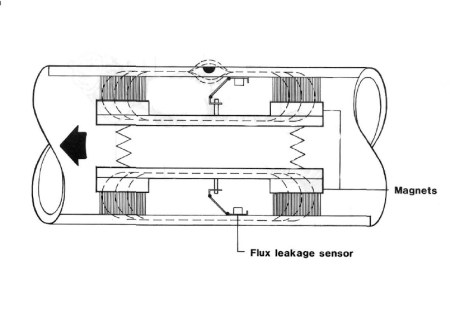
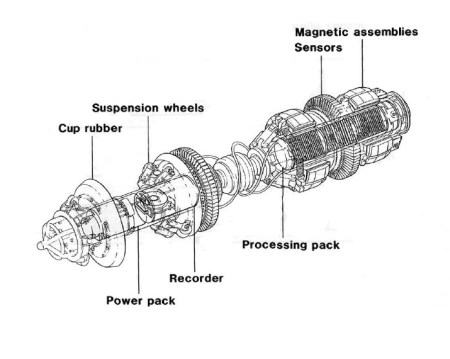
This basic idea was modified to produce the much more sophisticated “intelligent pig” which produced the data I worked on. You can read much more about this here. This looked very similar to the cleaning pig, but had a complicated assembly of magnets and sensors, shown schematically here:
pig

The two sets  of magnets are connected to the pipe wall by steel brushes to maintain good contact. The magnetic field applied by the front set of magnets is contained within the pipe wall forms a kind of circuit with the rear set as shown, unless there is a variation in the thickness of the material. In that case magnetic flux leaks out and is detected by the sensors. The magnets and sensors are deployed in rings to cover the whole circumference of the pipe. A 24″ diameter pig would have 240 sensors, each recorded as a separate channel on the vehicle.

The actual system is fairly complicated so some of the work was experimental. Sections of pipe were made with defects of various sizes machined into them. The pig would then be pulled through these sections and the signals studied to build up an understanding of how the magnetic field would respond in different situations.

The actual pig (which could be several metres long and weighing a couple of tonnes) looks like this:
pig2

I always thought they looked a bit like spacecraft.

The pig usually travels at something like walking pace along the pipeline, and the sampling rate of the sensors was such that a reading would be taken every few millimetres. That sampling rate was necessary because corrosion pits as small as 1cm across could be dangerous.  The larger vehicles had “on-board thresholding” so that recordings of quiescent sections were discarded. Even so pipe surfaces (especially those of smaller bore) could be uneven for various reasons to do with their production rather than the effects of corrosion. Moreover, every few metres there would be a circumferential seam weld where two sections of pipe were joined together; these features would produce a large signal on all channels which the thresholding algorithm did not suppress.  The net result was that a lot of data had to be stored on the vehicle. When I say “a lot”, I mean for that time. A full run might produce about 5 × 107 readings. That seems like nothing now, but it was “Big Data” in those days!

So how was all this data processed back at the station? You probably won’t believe this, but it was printed out on Versatec printers in the form of a chart recording for each channel. Operators then identified funny-looking signals by eye and we then pulled down the data from tape and had a further look, usually comparing the patterns visually with those obtained from “pull-through” experiments.

Among the things I worked on was an algorithm to recognize seam weld signals automatically. That was quite easy actually – because it just requires looking for simultaneous activity on all channels – although it had to be made robust enough to deal with the odd dead channel and other instrumental glitches. This algorithm proved to be useful because sometimes the on-board telemetry would go wrong and we had to locate the pig by counting the number of welds it had passed since the start of the run.

A far more difficult challenge was dealing with data from 12″ diameter pipe. These are manufactured in a way that’s completely different from that used to make pipes of larger diameter, which are made of rolled steel. The 12″ pipes were made from a solid plug of molten steel, the centre of which is bored out by a device that rotates as it goes along. The effect of this is that it imposes a peculiar form of variation on the pipe wall, in the form of a spirally modulated “noise”. Annoyingly, the pitch and amplitude of the spiral varied from one section of pipe to another. After many failed attempts, the group finally came up with an algorithm that used the weld detector as a starting point to establish the vehicle had entered a new section of pipe. It then used data from the start of each section to estimate the parameters of the spiral pattern for that section, and then applied a filter to remove it from the rest of the section. It wasn’t particularly elegant, but it certainly cleaned up the data massively and made it much easier to spot significant features.

You might ask why I’ve written at such length about this when it’s got nothing to do with my current research (or indeed, anything else I’ve done since I graduated from Cambridge in 1985). One reason is that, although I didn’t know it at the time, my time at OLIC was going to prepare me very well for when I started my PhD. That was the case because all the programming I did used VAX computers, which turned out to be the computers used by STARLINK.  When I started my life as a research student I was already fluent in the command language (DCL) as well as the database software DATATRIEVE, which was a great advantage. Another reason is that working in this environment I had to learn to make my code (which, incidentally, was all in Fortran-77) conform to various very strict standards. I didn’t like some of the things we were forced to do, but I was shouted at sufficiently often that I gave up and did what I was told. I have never been particularly good at doing that in general, but in the context of software it is a lesson I’m glad I learned. Above all, though, I think working outside academia gave me a different perspective on research.  As academics were are very lucky to be able- at least some of the time – to choose our own research problems, but I believe that in the long run it can be very for your intellectual development to do something completely different every now and then.

We’re currently discussing a scheme whereby Physics and Astrophysics research students can interrupt their PhD for up to 6 months to undertake a (paid) work placement outside academia. I suspect many graduate students will not be keen on this, as they’ll see it as a distraction from their PhD topic, but I think it has many potential advantages as I hope I’ve explained.


Cardiff: Centre of Gravity

Posted in The Universe and Stuff with tags , , , on November 17, 2016 by telescoper

It’s a very busy period for me as the Cardiff University Data Innovation Research Institute (DII) gears up for some exciting new activities in both teaching and research (of which more in due course) and embarks on is strategy for promoting and fostering interdisciplinary research across Cardiff University and beyond.

Yesterday, however, I attended an informal meeting in the School of Physics & Astronomy at which we had an update about other strategic developments in the Gravitational Physics Group, some of whose members work in the DII Following on from the first-ever detection of gravitational waves earlier this year the group has ambitious plans to build on its involvement in this discovery. Here’s a nice short video produced by Cardiff University that discusses this discovery:


Cardiff University has supported research on gravitational waves for a very long time, and it is important that it reaps the benefit now that its investment is starting to pay off. To rest on laurels at this stage would be to risk losing the benefits of that sustained investment. It was very exciting to hear about the group’s plans for further sustained expansion, which will make the Cardiff one of the leading centres of gravitational wave research  in the world.

I’ve already mentioned on this blog that a couple of new positions have already been advertised, one in gravitational wave astronomy (to consolidate existing activities in theory and data analysis) and the other in a completely new area of Gravitational Wave Experimentation. Those advertisements have now closed and the process of filling the vacancies is under way.

However, yesterday we heard of even more expansion of gravitational physics research, in the form of a new academic position in Time Domain Astronomy with particular emphasis on transient sources of electromagnetic radiation that could be associated with gravitational wave production (such as gamma-ray bursts). I’ll post the advertisement on this blog when it is available. And that’s just the start: further positions will be released over the next few years which will turn Cardiff into a true Centre of Gravity.

Exciting times!

Does the fine structure constant vary?

Posted in The Universe and Stuff with tags , , on November 16, 2016 by telescoper

No.

Reflections on Quantum Backflow

Posted in Cute Problems, The Universe and Stuff with tags , , , , on November 10, 2016 by telescoper

Yesterday afternoon I attended a very interesting physics seminar by the splendidly-named Gandalf Lechner of the School of Mathematics here at Cardiff University. The topic was one I’d never thought about before, called quantum backflow. I went to the talk because I was intrigued by the abstract which had been circulated previously by email, the first part of which reads:

Suppose you are standing at a bus stop in the hope of catching a bus, but are unsure if the bus has passed the stop already. In that situation, common sense tells you that the longer you have to wait, the more likely it is that the bus has not passed the stop already. While this common sense intuition is perfectly accurate if you are waiting for a classical bus, waiting for a quantum bus is quite different: For a quantum bus, the probability of finding it to your left on measuring its position may increase with time, although the bus is moving from left to right with certainty. This peculiar quantum effect is known as backflow.

To be a little more precise about this, imagine you are standing at the origin (x=0). In the classical version of the situation you know that the bus is moving with some constant definite (but unknown) positive velocity v. In other words you know that it is moving from left to right, but you don’t know with what speed v or at what time t0 or from what position (x0<0) it set out. A little thought, (perhaps with the aid of some toy examples where you assign a probability distribution to v, t0 and x0) will convince you that the resulting probability distribution for moves from left to right with time in such a way that the probability of the bus still being to the left of the observer, L(t), represented by the proportion of the overall distribution that lies at x<0 generally decreases with time. Note that this is not what it says in the second sentence of the abstract; no doubt a deliberate mistake was put in to test the reader!

If we then stretch our imagination and suppose that the bus is not described by classical mechanics but by quantum mechanics then things change a bit.  If we insist that it is travelling from left to right then that means that the momentum-space representation of the wave function must be cut off for p<0 (corresponding to negative velocities). Assume that the bus is  a “free particle” described by the relevant Schrödinger equation.One can then calculate the evolution of the position-space wave function. Remember that these two representations of the wave function are just related by a Fourier transform. Solving the Schrödinger equation for the time evolution of the spatial wave function (with appropriately-chosen initial conditions) allows one to calculate how the probability of finding the particle at a given value of evolves with time. In contrast to the classical case, it is possible for the corresponding L(t) does not always decrease with time.

To put all this another way, the probability current in the classical case is always directed from left to right, but in the quantum case that isn’t necessarily true. One can see how this happens by thinking about what the wave function actually looks like: an imposed cutoff in momentum can imply a spatial wave function that is rather wiggly which means the probability distribution is wiggly too, but the detailed shape changes with time. As these wiggles pass the origin the area under the probability distribution to the left of the observer can go up as well as down. The particle may be going from left to right, but the associated probability flux can behave in a more complicated fashion, sometimes going in the opposite direction.

Another other way of thinking about it is that the particle velocity corresponds to the phase velocity of the wave function but the probability flux is controlled by the group velocity

For a more technical discussion of this phenomenon see this review article. The exact nature of the effect is dependent on the precise form of the initial conditions chosen and there are some quantum systems for which no backflow happens at all. The effect has never been detected experimentally, but a recent paper has suggested that it might be measured. Here is the abstract:

Quantum backflow is a classically forbidden effect consisting in a negative flux for states with negligible negative momentum components. It has never been observed experimentally so far. We derive a general relation that connects backflow with a critical value of the particle density, paving the way for the detection of backflow by a density measurement. To this end, we propose an explicit scheme with Bose-Einstein condensates, at reach with current experimental technologies. Remarkably, the application of a positive momentum kick, via a Bragg pulse, to a condensate with a positive velocity may cause a current flow in the negative direction.

Fascinating!


Romanesco and the Golden Spiral

Posted in mathematics, The Universe and Stuff with tags , , , on November 8, 2016 by telescoper

Some time ago I mentioned that I received one of these in my weekly veggie box..

romanesco

Actually, that reminds me that a new box is due tomorrow morning…

Anyway, the vegetable in the picture is called Romanesco. I’ve always thought of it as a cauliflower but I’ve more recently learned that it’s more closely related to broccoli. It doesn’t really matter because both broccoli and cauliflower are forms of brassica, which term also covers things like cabbages, kale and spinach. All are very high in vitamins and are also very tasty if cooked appropriately. Incidentally, the leaves of broccoli and cauliflower are perfectly edible (as are those of Romanesco) like those of cabbage, it’s just that we’re more used to eating the flower (or at least the bud).

It turns out that this week’s Physics World has a short piece on Romanesco, which points out that a “head” of Romanesco has a form of self-similarity, in that each floret is a smaller version of the whole bud and also displays structures that are smaller versions of itself. That fractal behaviour is immediately obvious if you take a close look. Here’s a blow-up so you can see more clearly:
romanesco-broccoli2-550x412

However, one thing that I hadn’t noticed before is that there is another remarkable aspect to the pattern of florets, in that they form an almost perfect golden spiral. This is a form of logarithmic spiral that grows every quarter-turn by a factor of the golden ratio:

\phi = \frac{1+\sqrt{5}}{2}.

Logarithmic, or at least approximately logarithmic, spirals occur naturally in a number of settings. Examples include spiral galaxies, various forms of shell, such as that of the nautilus and in the phenomenon of phyllotaxis in plant growth (of which Romanesco is a special case). It would seem that the reason for the occurrence of logarithmic spirals  in living creatures is that such a shape allows them to grow without any change in shape.

Not really relevant to anything much, I know, but I thought you might be interested…

P.S. One thing the Physics World piece fails to mention is that, regardless of its geometrical properties, Romanesco is really delicious!

A Cosmic Microwave Background Dipole Puzzle

Posted in Cute Problems, The Universe and Stuff with tags , , , , , on October 31, 2016 by telescoper

The following is tangentially related to a discussion I had during a PhD examination last week, and I thought it might be worth sharing here to stimulate some thought among people interested in cosmology.

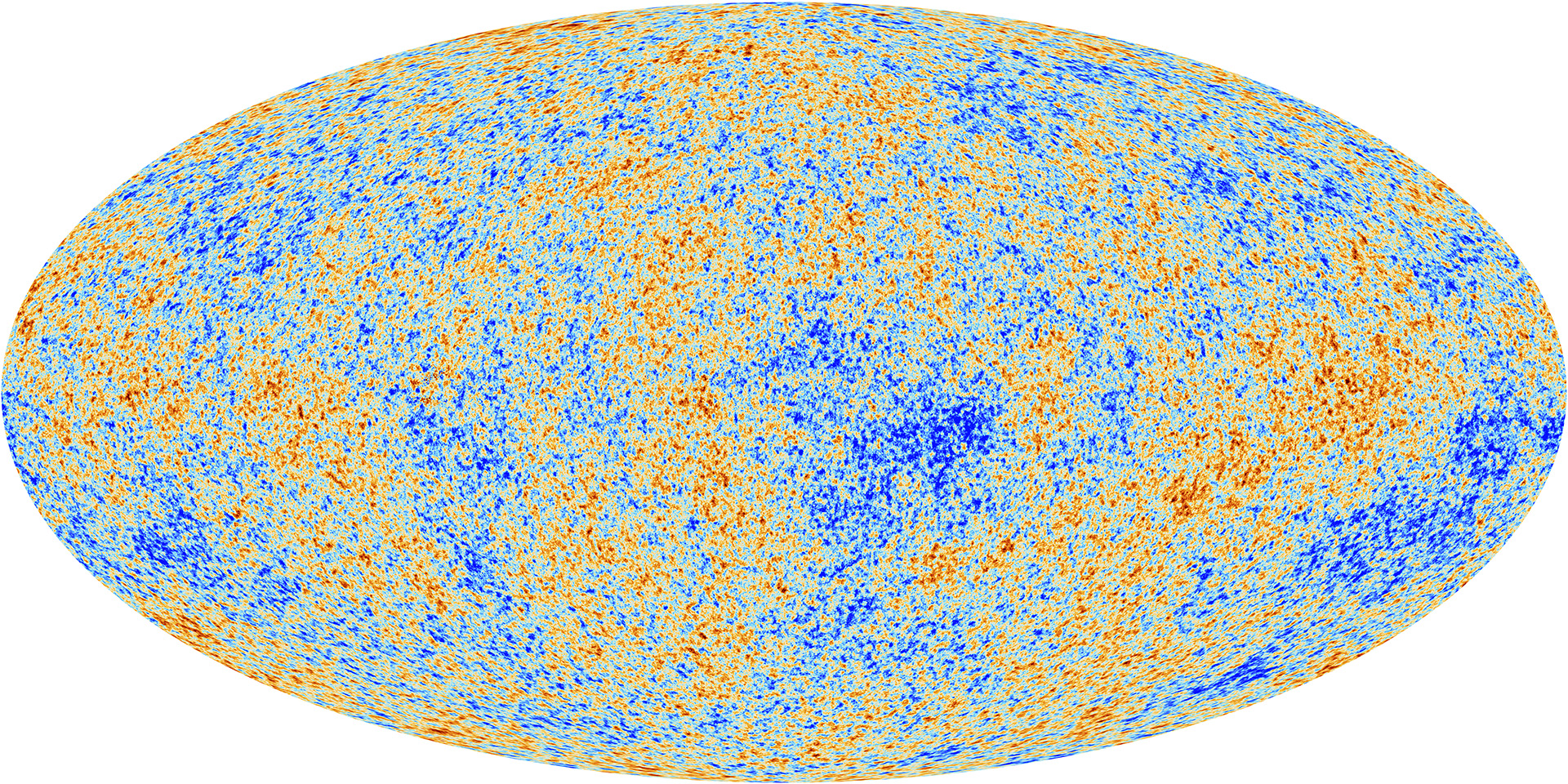
First here’s a picture of the temperature fluctuations in the cosmic microwave background from Planck (just because it’s so pretty).

planck_cmb

The analysis of these fluctuations yields a huge amount of information about the universe, including its matter content and spatial geometry as well as the form of primordial fluctuations that gave rise to galaxies and large-scale structure. The variations in temperature that you see in this image are small – about one-part in a hundred thousand – and they show that the universe appears to be close to isotropic (at least around us).

I’ll blog later on (assuming I find time) on the latest constraints on this subject, but for the moment I’ll just point out something that has to be removed from the above map to make it look isotropic, and that is the Cosmic Microwave Background Dipole. Here is a picture (which I got from here):

dipole_map

This signal – called a dipole because it corresponds to a simple 180 degree variation across the sky – is about a hundred times larger than the “intrinsic” fluctuations which occur on smaller angular scales and are seen in the first map. According to the standard cosmological framework this dipole is caused by our peculiar motion through the frame in which microwave background photons are distributed homogeneously and isotropically. Had we no peculiar motion then we would be “at rest” with respect to this CMB reference frame so there would be no such dipole. In the standard cosmological framework this “peculiar motion” of ours is generated by the gravitational effect of local structures and is thus a manifestation of the fact that our universe is not homogeneous on small scales; by “small” I mean on the scales of a hundred Megaparsecs or so. Anyway, if you’re interested in goings-on in the very early universe or its properties on extremely large scales the dipole is thus of no interest and, being so large, it is quite easy to subtract. That’s why it isn’t there in maps such as the Planck map shown above. If it had been left in it would swamp the other variations.

Anyway, the interpretation of the CMB dipole in terms of our peculiar motion through the CMB frame leads to a simple connection between the pattern shown in the second figure and the velocity of the observational frame: it’s a Doppler Effect. We are moving towards the upper right of the figure (in which direction photons are blueshifted, so the CMB looks a bit hotter in that direction) and away from the bottom left (whence the CMB photons are redshifted so the CMB appears a bit cooler). The amplitude of the dipole implies that the Solar System is moving with a velocity of around 370 km/s with respect to the CMB frame.

Now 370 km/s is quite fast, but it’s much smaller than the speed of light – it’s only about 0.12%, in fact – which means that one can treat this is basically a non-relativistic Doppler Effect. That means that it’s all quite straightforward to understand with elementary physics. In the limit that v/c<<1 the Doppler Effect only produces a dipole pattern of the type we see in the Figure above, and the amplitude of the dipole is ΔT/T~v/c because all terms of higher order in v/c are negligibly smallFurthermore in this case the dipole is simply superimposed on the primordial fluctuations but otherwise does not affect them.

My question to the reader, i.e. you,  is the following. Suppose we weren’t travelling at a sedate 370 km/s through the CMB frame but instead enter the world of science fiction and take a trip on a spacecraft that can travel close to the speed of light. What would this do to the CMB? Would we still just see a dipole, or would we see additional (relativistic) effects? If there are other effects, what would they do to the pattern of “intrinsic” fluctuations?

Comments and answers through the box below, please!


On First Looking into Chapman’s Homer

Posted in Poetry, The Universe and Stuff with tags , , on October 26, 2016 by telescoper

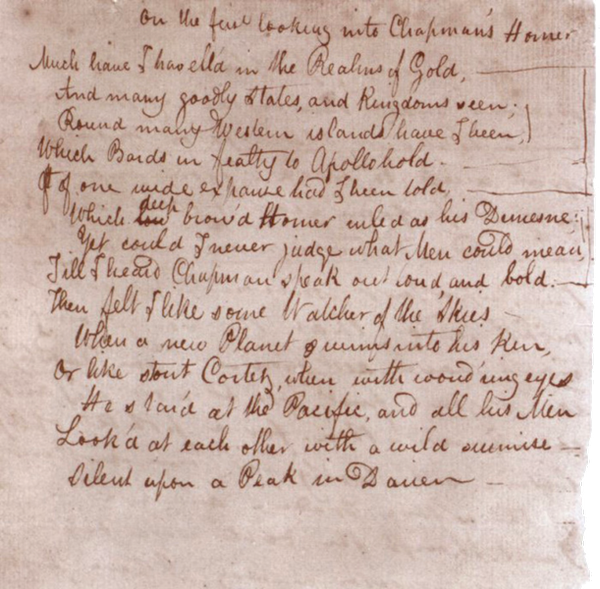
This very famous and very wonderful sonnet, considered the highlight of Keats’s first volume of poetry, was written on this day in October 1816 and is thus exactly 200 years old.  It was originally a gift for his friend, Charles Cowden Clarke. The two men had spent an evening reading George Chapman’s superb 17th century translation of the Iliad and Odyssey. Here is the original hand-written version (which I got here)

chapman

And here’s a more legible version:

Much have I travell’d in the realms of gold,
And many goodly states and kingdoms seen;
Round many western islands have I been
Which bards in fealty to Apollo hold.
Oft of one wide expanse had I been told
That deep-brow’d Homer ruled as his demesne;
Yet did I never breathe its pure serene
Till I heard Chapman speak out loud and bold:
Then felt I like some watcher of the skies
When a new planet swims into his ken;
Or like stout Cortez when with eagle eyes
He star’d at the Pacific–and all his men
Look’d at each other with a wild surmise–
Silent, upon a peak in Darien.

A Non-accelerating Universe?

Posted in Astrohype, The Universe and Stuff with tags , , , , , on October 26, 2016 by telescoper

There’s been quite a lot of reaction on the interwebs over the last few days much of it very misleading; here’s a sensible account) to a paper by Nielsen, Guffanti and Sarkar which has just been published online in Scientific Reports, an offshoot of Nature. I think the above link should take you an “open access” version of the paper but if it doesn’t you can find the arXiv version here. I haven’t cross-checked the two versions so the arXiv one may differ slightly.

Anyway, here is the abstract:

The ‘standard’ model of cosmology is founded on the basis that the expansion rate of the universe is accelerating at present — as was inferred originally from the Hubble diagram of Type Ia supernovae. There exists now a much bigger database of supernovae so we can perform rigorous statistical tests to check whether these ‘standardisable candles’ indeed indicate cosmic acceleration. Taking account of the empirical procedure by which corrections are made to their absolute magnitudes to allow for the varying shape of the light curve and extinction by dust, we find, rather surprisingly, that the data are still quite consistent with a constant rate of expansion.

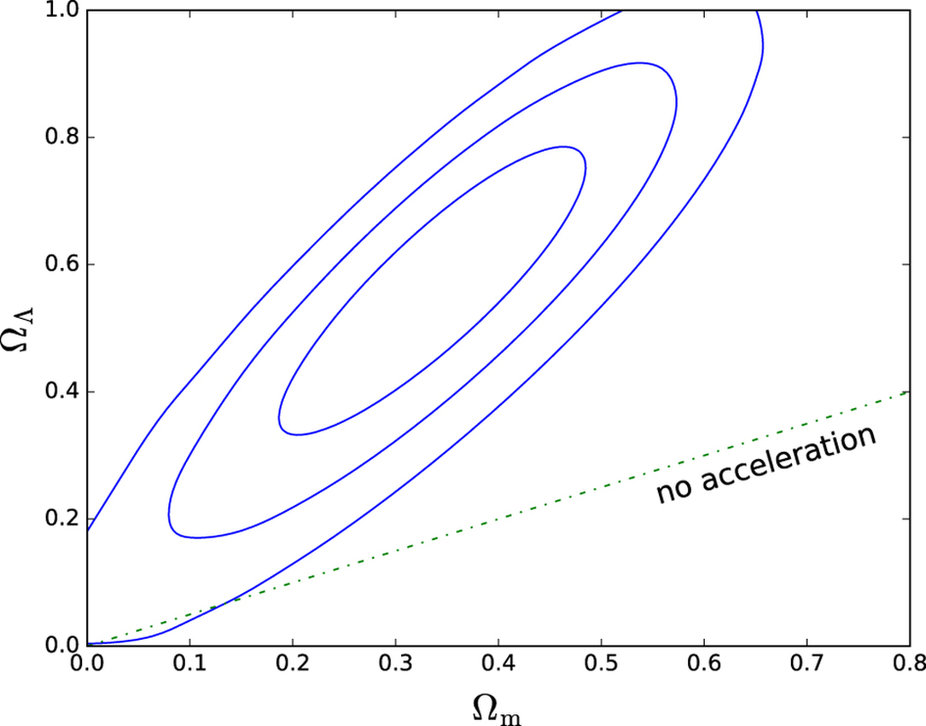
Obviously I haven’t been able to repeat the statistical analysis but I’ve skimmed over what they’ve done and as far as I can tell it looks a fairly sensible piece of work (although it is a frequentist analysis). Here is the telling plot (from the Nature version)  in terms of the dark energy (y-axis) and matter (x-axis) density parameters:

lambda

Models shown in this plane by a line have the correct balance between Ωm, and ΩΛ to cancel out the decelerating effect of the former against the accelerating effect of the latter (a special case is the origin on the plot, which is called the Milne model and represents an entirely empty universe). The contours show “1, 2 and 3σ” contours, regarding all other parameters as nuisance parameters. It is true that the line of no acceleration does go inside the 3σcontour so in that sense is not entirely inconsistent with the data. On the other hand, the “best fit” (which is at the point Ωm=0.341, ΩΛ=0.569) does represent an accelerating universe.

I am not all that surprised by this result, actually. I’ve always felt that taken on its own the evidence for cosmic acceleration from supernovae alone was not compelling. However, when it is combined with other measurements (particularly of the cosmic microwave background and large-scale structure) which are sensitive to other aspects of the cosmological space-time geometry, the agreement is extremely convincing and has established a standard “concordance” cosmology. The CMB, for example, is particularly sensitive to spatial curvature which, measurements tells us, must be close to zero. The Milne model, on the other hand, has a large (negative) spatial curvature entirely excluded by CMB observations. Curvature is regarded as a “nuisance parameter” in the above diagram.

I think this paper is a worthwhile exercise. Subir Sarkar (one of the authors) in particular has devoted a lot of energy to questioning the standard ΛCDM model which far too many others accept unquestioningly. That’s a noble thing to do, and it is an essential part of the scientific method, but this paper only looks at one part of an interlocking picture. The strongest evidence comes from the cosmic microwave background and despite this reanalysis I feel the supernovae measurements still provide a powerful corroboration of the standard cosmology.

Let me add, however, that the supernovae measurements do not directly measure cosmic acceleration. If one tries to account for them with a model based on Einstein’s general relativity and the assumption that the Universe is on large-scales is homogeneous and isotropic and with certain kinds of matter and energy then the observations do imply a universe that accelerates. Any or all of those assumptions may be violated (though some possibilities are quite heavily constrained). In short we could, at least in principle, simply be interpreting these measurements within the wrong framework, and statistics can’t help us with that!

KiDS-450: Testing extensions to the standard cosmological model [CEA]

Posted in The Universe and Stuff with tags , , , on October 19, 2016 by telescoper

Since I’ve just attended a seminar in Cardiff by Catherine Heymans on exactly this work, I couldn’t resist reblogging the arXiver entry for this paper which appeared on arXiv a couple of days ago.

The key finding is that the weak lensing analysis of KIDS data (which is mainly to the distribution of matter at low redshift) does seem to be discrepant with the predictions of the standard cosmological model established by Planck (which is sensitive mainly to high-redshift fluctuations).

Could this discrepancy be interpreted as evidence of something going on beyond the standard cosmology? Read the paper to explore some possibilities!

arxiver's avatararXiver

http://arxiv.org/abs/1610.04606

We test extensions to the standard cosmological model with weak gravitational lensing tomography using 450 deg$^2$ of imaging data from the Kilo Degree Survey (KiDS). In these extended cosmologies, which include massive neutrinos, nonzero curvature, evolving dark energy, modified gravity, and running of the scalar spectral index, we also examine the discordance between KiDS and cosmic microwave background measurements from Planck. The discordance between the two datasets is largely unaffected by a more conservative treatment of the lensing systematics and the removal of angular scales most sensitive to nonlinear physics. The only extended cosmology that simultaneously alleviates the discordance with Planck and is at least moderately favored by the data includes evolving dark energy with a time-dependent equation of state (in the form of the $w_0-w_a$ parameterization). In this model, the respective $S_8 = sigma_8 sqrt{Omega_{rm m}/0.3}$ constraints agree at the $1sigma$ level, and there is `substantial concordance’ between…

View original post 159 more words