Archive for the The Universe and Stuff Category

Dark Energy and its Discontents

Posted in Biographical, Books, The Universe and Stuff with tags , on April 24, 2015 by telescoper

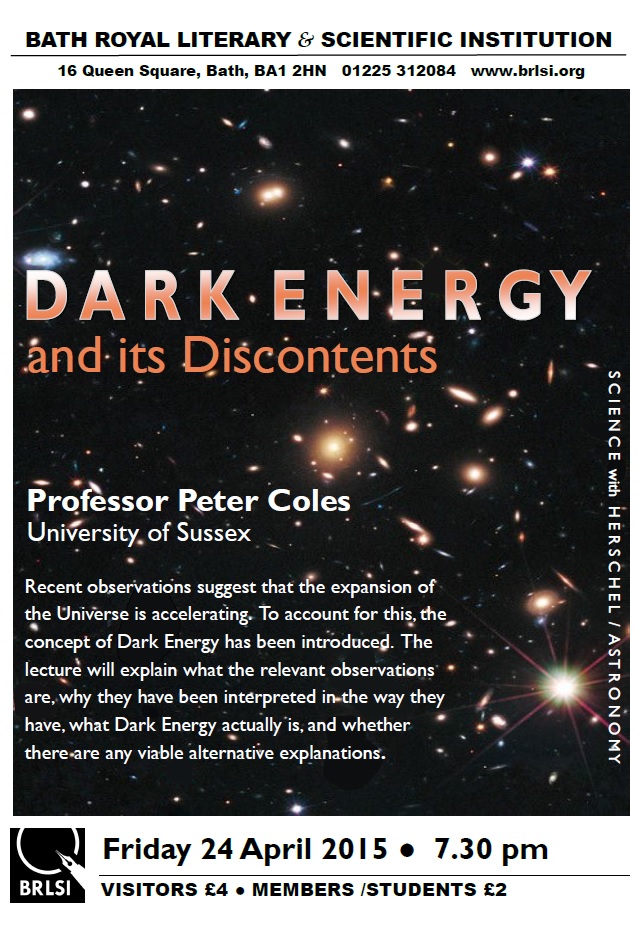
Just time for a spot of gratuitous self-promotion. I shall be giving a public lecture tonight, Friday 24th April 2015, entitled Dark Energy and its Discontents, at the very posh-sounding Bath Royal Literary and Scientific Institution.
I am just finishing the slides for the talk, and packing some dark energy in my bag to use as a demonstration.
Here is the poster for tonight’s event, which explains all…

Bath_lecture

Perhaps I’ll see the odd reader of this blog there?

The Supervoid and the Cold Spot

Posted in Astrohype, Cosmic Anomalies, The Universe and Stuff with tags , , , , , on April 21, 2015 by telescoper

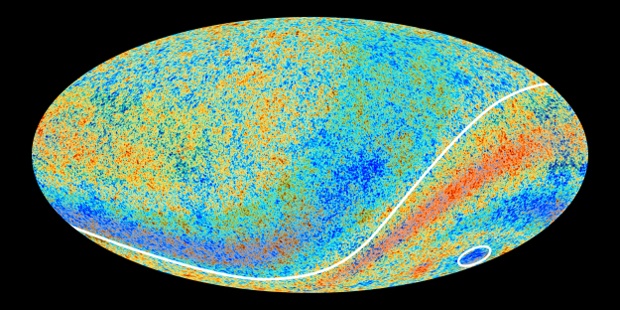
While I was away at the SEPnet meeting yesterday a story broke in the press broke about the discovery of a large underdensity in the distribution of galaxies. The discovery is described in a paper by Szapudi et al. in the journal Monthly Notices of the Royal Astronomical Society. The claim is that this structure in the galaxy distribution can account for the apresence of a mysterious cold spot in the cosmic microwave background, shown here (circled) in the map generated by Planck:

Planck_coldspot

I’ve posted about this feature myself here in the category Cosmic Anomalies.

The abstract of the latest paper is here:

We use the WISE-2MASS infrared galaxy catalogue matched with Pan-STARRS1 (PS1) galaxies to search for a supervoid in the direction of the cosmic microwave background (CMB) cold spot (CS). Our imaging catalogue has median redshift z ≃ 0.14, and we obtain photometric redshifts from PS1 optical colours to create a tomographic map of the galaxy distribution. The radial profile centred on the CS shows a large low-density region, extending over tens of degrees. Motivated by previous CMB results, we test for underdensities within two angular radii, 5°, and 15°. The counts in photometric redshift bins show significantly low densities at high detection significance, ≳5σ and ≳6σ, respectively, for the two fiducial radii. The line-of-sight position of the deepest region of the void is z ≃ 0.15–0.25. Our data, combined with an earlier measurement by Granett, Szapudi & Neyrinck, are consistent with a large Rvoid = (220 ± 50) h−1 Mpc supervoid with δm ≃ −0.14 ± 0.04 centred at z = 0.22 ± 0.03. Such a supervoid, constituting at least a ≃3.3σ fluctuation in a Gaussian distribution of the Λ cold dark matter model, is a plausible cause for the CS.

The result is not entirely new: it has been discussed at various conferences over the past year or so (e.g this one) but this is the first refereed paper showing details of the discovery.

This gives me the excuse to post this wonderful cartoon, the context of which is described here. Was that really in 1992? That was twenty years ago!

Anyway, I just wanted to make a few points about this because some of the press coverage has been rather misleading. I’ve therefore filed this one in the category Astrophype.

First, the “supervoid” structure that has been discovered is not a “void”, which would be a region completely empty of galaxies. As the paper makes clear it is less dramatic than that: it’s basically an underdensity of around 14% in the density of galaxies. It is (perhaps) the largest underdensity yet found on such a large scale – though that depends very much on how you define a void – but it is not in itself inconsistent with the standard cosmological framework. Such large underdensities are expected to be rare, but rare things do occur if you survey a large enough volume of the universe. Large overdensities also arise as statistical fluctuations in large volumes.

Second, and probably most importantly, although this “supervoid” is in the direction of the CMB Cold Spot it cannot on its own explain the Cold Spot; the claim in the abstract that it provides a plausible explanation of the cold spot is simply incorrect. A void can affect the measured temperature of the CMB through the Integrated Sachs-Wolfe effect: photons travelling through such a structure are redshifted as they travel through the underdense region, so the CMB looks cooler in the direction of the void. However, even optimistic calculations of the magnitude of the effect suggest that this particular “void” can only account for about 10% of the signal associated with the Cold Spot. This is a reasonably significant contribution but it does not account for the signal on its own.

This is not to say however that it is irrelevant. It could well be that the supervoid actually sits in front of a region of the CMB sky that was already cold, as a result of a primordial fluctuation rather than a line-of-sight effect. Such an effect could well arise by chance, at least with some probability. If the original perturbation were a “3σ” temperature fluctuation then the additional effect of the supervoid would turn it into a 3.3σ effect. Since this pushes the event further out into the tail of the probability distribution it makes a reasonably uncommon feature look  less probable. Because the tail of a Gaussian distribution drops off very quickly this has quite a large effect on the probability. For example, a fluctuation of 3.3σ or greater has a probability of 0.00048 whereas one of 3.0σ has a probability of 0.00135, about a factor of 2.8 larger. That’s an effect, but not a large one.

In summary, I think the discovery of this large underdensity is indeed interesting but it is not a plausible explanation for the CMB Cold Spot. Not, that is, unless there’s some new physical process involved in the propagation of light that we don’t yet understand.

Now that would be interesting…

Albert, Bernard and Bell’s Theorem

Posted in The Universe and Stuff with tags , , , , , , , , , , on April 15, 2015 by telescoper

You’ve probably all heard of the little logic problem involving the mysterious Cheryl and her friends Albert and Bernard that went viral on the internet recently. I decided not to post about it directly because it’s already been done to death. It did however make me think that if people struggle so much with “ordinary” logic problems of this type its no wonder they are so puzzled by the kind of logical issues raised by quantum mechanics. Hence the motivation of updating a post I did quite a while ago. The question we’ll explore does not concern the date of Cheryl’s birthday but the spin of an electron.

To begin with, let me give a bit of physics background. Spin is a concept of fundamental importance in quantum mechanics, not least because it underlies our most basic theoretical understanding of matter. The standard model of particle physics divides elementary particles into two types, fermions and bosons, according to their spin.  One is tempted to think of  these elementary particles as little cricket balls that can be rotating clockwise or anti-clockwise as they approach an elementary batsman. But, as I hope to explain, quantum spin is not really like classical spin.

Take the electron,  for example. The amount of spin an electron carries is  quantized, so that it always has a magnitude which is ±1/2 (in units of Planck’s constant; all fermions have half-integer spin). In addition, according to quantum mechanics, the orientation of the spin is indeterminate until it is measured. Any particular measurement can only determine the component of spin in one direction. Let’s take as an example the case where the measuring device is sensitive to the z-component, i.e. spin in the vertical direction. The outcome of an experiment on a single electron will lead a definite outcome which might either be “up” or “down” relative to this axis.

However, until one makes a measurement the state of the system is not specified and the outcome is consequently not predictable with certainty; there will be a probability of 50% probability for each possible outcome. We could write the state of the system (expressed by the spin part of its wavefunction  ψ prior to measurement in the form

|ψ> = (|↑> + |↓>)/√2

This gives me an excuse to use  the rather beautiful “bra-ket” notation for the state of a quantum system, originally due to Paul Dirac. The two possibilities are “up” (↑­) and “down” (↓) and they are contained within a “ket” (written |>)which is really just a shorthand for a wavefunction describing that particular aspect of the system. A “bra” would be of the form <|; for the mathematicians this represents the Hermitian conjugate of a ket. The √2 is there to insure that the total probability of the spin being either up or down is 1, remembering that the probability is the square of the wavefunction. When we make a measurement we will get one of these two outcomes, with a 50% probability of each.

At the point of measurement the state changes: if we get “up” it becomes purely |↑>  and if the result is  “down” it becomes |↓>. Either way, the quantum state of the system has changed from a “superposition” state described by the equation above to an “eigenstate” which must be either up or down. This means that all subsequent measurements of the spin in this direction will give the same result: the wave-function has “collapsed” into one particular state. Incidentally, the general term for a two-state quantum system like this is a qubit, and it is the basis of the tentative steps that have been taken towards the construction of a quantum computer.

Notice that what is essential about this is the role of measurement. The collapse of  ψ seems to be an irreversible process, but the wavefunction itself evolves according to the Schrödinger equation, which describes reversible, Hamiltonian changes.  To understand what happens when the state of the wavefunction changes we need an extra level of interpretation beyond what the mathematics of quantum theory itself provides,  because we are generally unable to write down a wave-function that sensibly describes the system plus the measuring apparatus in a single form.

So far this all seems rather similar to the state of a fair coin: it has a 50-50 chance of being heads or tails, but the doubt is resolved when its state is actually observed. Thereafter we know for sure what it is. But this resemblance is only superficial. A coin only has heads or tails, but the spin of an electron doesn’t have to be just up or down. We could rotate our measuring apparatus by 90° and measure the spin to the left (←) or the right (→). In this case we still have to get a result which is a half-integer times Planck’s constant. It will have a 50-50 chance of being left or right that “becomes” one or the other when a measurement is made.

Now comes the real fun. Suppose we do a series of measurements on the same electron. First we start with an electron whose spin we know nothing about. In other words it is in a superposition state like that shown above. We then make a measurement in the vertical direction. Suppose we get the answer “up”. The electron is now in the eigenstate with spin “up”.

We then pass it through another measurement, but this time it measures the spin to the left or the right. The process of selecting the electron to be one with  spin in the “up” direction tells us nothing about whether the horizontal component of its spin is to the left or to the right. Theory thus predicts a 50-50 outcome of this measurement, as is observed experimentally.

Suppose we do such an experiment and establish that the electron’s spin vector is pointing to the left. Now our long-suffering electron passes into a third measurement which this time is again in the vertical direction. You might imagine that since we have already measured this component to be in the up direction, it would be in that direction again this time. In fact, this is not the case. The intervening measurement seems to “reset” the up-down component of the spin; the results of the third measurement are back at square one, with a 50-50 chance of getting up or down.

This is just one example of the kind of irreducible “randomness” that seems to be inherent in quantum theory. However, if you think this is what people mean when they say quantum mechanics is weird, you’re quite mistaken. It gets much weirder than this! So far I have focussed on what happens to the description of single particles when quantum measurements are made. Although there seem to be subtle things going on, it is not really obvious that anything happening is very different from systems in which we simply lack the microscopic information needed to make a prediction with absolute certainty.

At the simplest level, the difference is that quantum mechanics gives us a theory for the wave-function which somehow lies at a more fundamental level of description than the usual way we think of probabilities. Probabilities can be derived mathematically from the wave-function,  but there is more information in ψ than there is in |2; the wave-function is a complex entity whereas the square of its amplitude is entirely real. If one can construct a system of two particles, for example, the resulting wave-function is obtained by superimposing the wave-functions of the individual particles, and probabilities are then obtained by squaring this joint wave-function. This will not, in general, give the same probability distribution as one would get by adding the one-particle probabilities because, for complex entities A and B,

A2+B2 ≠(A+B)2

in general. To put this another way, one can write any complex number in the form a+ib (real part plus imaginary part) or, generally more usefully in physics , as Re, where R is the amplitude and θ  is called the phase. The square of the amplitude gives the probability associated with the wavefunction of a single particle, but in this case the phase information disappears; the truly unique character of quantum physics and how it impacts on probabilies of measurements only reveals itself when the phase information is retained. This generally requires two or more particles to be involved, as the absolute phase of a single-particle state is essentially impossible to measure.

Finding situations where the quantum phase of a wave-function is important is not easy. It seems to be quite easy to disturb quantum systems in such a way that the phase information becomes scrambled, so testing the fundamental aspects of quantum theory requires considerable experimental ingenuity. But it has been done, and the results are astonishing.

Let us think about a very simple example of a two-component system: a pair of electrons. All we care about for the purpose of this experiment is the spin of the electrons so let us write the state of this system in terms of states such as  which I take to mean that the first particle has spin up and the second one has spin down. Suppose we can create this pair of electrons in a state where we know the total spin is zero. The electrons are indistinguishable from each other so until we make a measurement we don’t know which one is spinning up and which one is spinning down. The state of the two-particle system might be this:

|ψ> = (|↑↓> – |↓↑>)/√2

squaring this up would give a 50% probability of “particle one” being up and “particle two” being down and 50% for the contrary arrangement. This doesn’t look too different from the example I discussed above, but this duplex state exhibits a bizarre phenomenon known as quantum entanglement.

Suppose we start the system out in this state and then separate the two electrons without disturbing their spin states. Before making a measurement we really can’t say what the spins of the individual particles are: they are in a mixed state that is neither up nor down but a combination of the two possibilities. When they’re up, they’re up. When they’re down, they’re down. But when they’re only half-way up they’re in an entangled state.

If one of them passes through a vertical spin-measuring device we will then know that particle is definitely spin-up or definitely spin-down. Since we know the total spin of the pair is zero, then we can immediately deduce that the other one must be spinning in the opposite direction because we’re not allowed to violate the law of conservation of angular momentum: if Particle 1 turns out to be spin-up, Particle 2  must be spin-down, and vice versa. It is known experimentally that passing two electrons through identical spin-measuring gadgets gives  results consistent with this reasoning. So far there’s nothing so very strange in this.

The problem with entanglement lies in understanding what happens in reality when a measurement is done. Suppose we have two observers, Albert and Bernard, who are bored with Cheryl’s little games and have decided to do something interesting with their lives by becoming physicists. Each is equipped with a device that can measure the spin of an electron in any direction they choose. Particle 1 emerges from the source and travels towards Albert whereas particle 2 travels in Bernard’s direction. Before any measurement, the system is in an entangled superposition state. Suppose Albert decides to measure the spin of electron 1 in the z-direction and finds it spinning up. Immediately, the wave-function for electron 2 collapses into the down direction. If Albert had instead decided to measure spin in the left-right direction and found it “left” similar collapse would have occurred for particle 2, but this time putting it in the “right” direction.

Whatever Albert does, the result of any corresponding measurement made by Bernard has a definite outcome – the opposite to Alberts result. So Albert’s decision whether to make a measurement up-down or left-right instantaneously transmits itself to Bernard who will find a consistent answer, if he makes the same measurement as Albert.

If, on the other hand, Albert makes an up-down measurement but Bernard measures left-right then Albert’s answer has no effect on Bernard, who has a 50% chance of getting “left” and 50% chance of getting right. The point is that whatever Albert decides to do, it has an immediate effect on the wave-function at ’s position; the collapse of the wave-function induced by Albert immediately collapses the state measured by Bernard. How can particle 1 and particle 2 communicate in this way?

This riddle is the core of a thought experiment by Einstein, Podolsky and Rosen in 1935 which has deep implications for the nature of the information that is supplied by quantum mechanics. The essence of the EPR paradox is that each of the two particles – even if they are separated by huge distances – seems to know exactly what the other one is doing. Einstein called this “spooky action at a distance” and went on to point out that this type of thing simply could not happen in the usual calculus of random variables. His argument was later tightened considerably by John Bell in a form now known as Bell’s theorem.

To see how Bell’s theorem works, consider the following roughly analagous situation. Suppose we have two suspects in prison, say Albert and Bernard (presumably Cheryl grassed them up and has been granted immunity from prosecution). The  two are taken apart to separate cells for individual questioning. We can allow them to use notes, electronic organizers, tablets of stone or anything to help them remember any agreed strategy they have concocted, but they are not allowed to communicate with each other once the interrogation has started. Each question they are asked has only two possible answers – “yes” or “no” – and there are only three possible questions. We can assume the questions are asked independently and in a random order to the two suspects.

When the questioning is over, the interrogators find that whenever they asked the same question, Albert and Bernard always gave the same answer, but when the question was different they only gave the same answer 25% of the time. What can the interrogators conclude?

The answer is that Albert and Bernard must be cheating. Either they have seen the question list ahead of time or are able to communicate with each other without the interrogator’s knowledge. If they always give the same answer when asked the same question, they must have agreed on answers to all three questions in advance. But when they are asked different questions then, because each question has only two possible responses, by following this strategy it must turn out that at least two of the three prepared answers – and possibly all of them – must be the same for both Albert and Bernard. This puts a lower limit on the probability of them giving the same answer to different questions. I’ll leave it as an exercise to the reader to show that the probability of coincident answers to different questions in this case must be at least 1/3.

This a simple illustration of what in quantum mechanics is known as a Bell inequality. Albert and Bernard can only keep the number of such false agreements down to the measured level of 25% by cheating.

This example is directly analogous to the behaviour of the entangled quantum state described above under repeated interrogations about its spin in three different directions. The result of each measurement can only be either “yes” or “no”. Each individual answer (for each particle) is equally probable in this case; the same question always produces the same answer for both particles, but the probability of agreement for two different questions is indeed ¼ and not larger as would be expected if the answers were random. For example one could ask particle 1 “are you spinning up” and particle 2 “are you spinning to the right”? The probability of both producing an answer “yes” is 25% according to quantum theory but would be higher if the particles weren’t cheating in some way.

Probably the most famous experiment of this type was done in the 1980s, by Alain Aspect and collaborators, involving entangled pairs of polarized photons (which are bosons), rather than electrons, primarily because these are easier to prepare.

The implications of quantum entanglement greatly troubled Einstein long before the EPR paradox. Indeed the interpretation of single-particle quantum measurement (which has no entanglement) was already troublesome. Just exactly how does the wave-function relate to the particle? What can one really say about the state of the particle before a measurement is made? What really happens when a wave-function collapses? These questions take us into philosophical territory that I have set foot in already; the difficult relationship between epistemological and ontological uses of probability theory.

Thanks largely to the influence of Niels Bohr, in the relatively early stages of quantum theory a standard approach to this question was adopted. In what became known as the  Copenhagen interpretation of quantum mechanics, the collapse of the wave-function as a result of measurement represents a real change in the physical state of the system. Before the measurement, an electron really is neither spinning up nor spinning down but in a kind of quantum purgatory. After a measurement it is released from limbo and becomes definitely something. What collapses the wave-function is something unspecified to do with the interaction of the particle with the measuring apparatus or, in some extreme versions of this doctrine, the intervention of human consciousness.

I find it amazing that such a view could have been held so seriously by so many highly intelligent people. Schrödinger hated this concept so much that he invented a thought-experiment of his own to poke fun at it. This is the famous “Schrödinger’s cat” paradox.

In a closed box there is a cat. Attached to the box is a device which releases poison into the box when triggered by a quantum-mechanical event, such as radiation produced by the decay of a radioactive substance. One can’t tell from the outside whether the poison has been released or not, so one doesn’t know whether the cat is alive or dead. When one opens the box, one learns the truth. Whether the cat has collapsed or not, the wave-function certainly does. At this point one is effectively making a quantum measurement so the wave-function of the cat is either “dead” or “alive” but before opening the box it must be in a superposition state. But do we really think the cat is neither dead nor alive? Isn’t it certainly one or the other, but that our lack of information prevents us from knowing which? And if this is true for a macroscopic object such as a cat, why can’t it be true for a microscopic system, such as that involving just a pair of electrons?

As I learned at a talk a while ago by the Nobel prize-winning physicist Tony Leggett – who has been collecting data on this  – most physicists think Schrödinger’s cat is definitely alive or dead before the box is opened. However, most physicists don’t believe that an electron definitely spins either up or down before a measurement is made. But where does one draw the line between the microscopic and macroscopic descriptions of reality? If quantum mechanics works for 1 particle, does it work also for 10, 1000? Or, for that matter, 1023?

Most modern physicists eschew the Copenhagen interpretation in favour of one or other of two modern interpretations. One involves the concept of quantum decoherence, which is basically the idea that the phase information that is crucial to the underlying logic of quantum theory can be destroyed by the interaction of a microscopic system with one of larger size. In effect, this hides the quantum nature of macroscopic systems and allows us to use a more classical description for complicated objects. This certainly happens in practice, but this idea seems to me merely to defer the problem of interpretation rather than solve it. The fact that a large and complex system makes tends to hide its quantum nature from us does not in itself give us the right to have a different interpretations of the wave-function for big things and for small things.

Another trendy way to think about quantum theory is the so-called Many-Worlds interpretation. This asserts that our Universe comprises an ensemble – sometimes called a multiverse – and  probabilities are defined over this ensemble. In effect when an electron leaves its source it travels through infinitely many paths in this ensemble of possible worlds, interfering with itself on the way. We live in just one slice of the multiverse so at the end we perceive the electron winding up at just one point on our screen. Part of this is to some extent excusable, because many scientists still believe that one has to have an ensemble in order to have a well-defined probability theory. If one adopts a more sensible interpretation of probability then this is not actually necessary; probability does not have to be interpreted in terms of frequencies. But the many-worlds brigade goes even further than this. They assert that these parallel universes are real. What this means is not completely clear, as one can never visit parallel universes other than our own …

It seems to me that none of these interpretations is at all satisfactory and, in the gap left by the failure to find a sensible way to understand “quantum reality”, there has grown a pathological industry of pseudo-scientific gobbledegook. Claims that entanglement is consistent with telepathy, that parallel universes are scientific truths, that consciousness is a quantum phenomena abound in the New Age sections of bookshops but have no rational foundation. Physicists may complain about this, but they have only themselves to blame.

But there is one remaining possibility for an interpretation of that has been unfairly neglected by quantum theorists despite – or perhaps because of – the fact that is the closest of all to commonsense. This view that quantum mechanics is just an incomplete theory, and the reason it produces only a probabilistic description is that does not provide sufficient information to make definite predictions. This line of reasoning has a distinguished pedigree, but fell out of favour after the arrival of Bell’s theorem and related issues. Early ideas on this theme revolved around the idea that particles could carry “hidden variables” whose behaviour we could not predict because our fundamental description is inadequate. In other words two apparently identical electrons are not really identical; something we cannot directly measure marks them apart. If this works then we can simply use only probability theory to deal with inferences made on the basis of information that’s not sufficient for absolute certainty.

After Bell’s work, however, it became clear that these hidden variables must possess a very peculiar property if they are to describe out quantum world. The property of entanglement requires the hidden variables to be non-local. In other words, two electrons must be able to communicate their values faster than the speed of light. Putting this conclusion together with relativity leads one to deduce that the chain of cause and effect must break down: hidden variables are therefore acausal. This is such an unpalatable idea that it seems to many physicists to be even worse than the alternatives, but to me it seems entirely plausible that the causal structure of space-time must break down at some level. On the other hand, not all “incomplete” interpretations of quantum theory involve hidden variables.

One can think of this category of interpretation as involving an epistemological view of quantum mechanics. The probabilistic nature of the theory has, in some sense, a subjective origin. It represents deficiencies in our state of knowledge. The alternative Copenhagen and Many-Worlds views I discussed above differ greatly from each other, but each is characterized by the mistaken desire to put quantum mechanics – and, therefore, probability –  in the realm of ontology.

The idea that quantum mechanics might be incomplete  (or even just fundamentally “wrong”) does not seem to me to be all that radical. Although it has been very successful, there are sufficiently many problems of interpretation associated with it that perhaps it will eventually be replaced by something more fundamental, or at least different. Surprisingly, this is a somewhat heretical view among physicists: most, including several Nobel laureates, seem to think that quantum theory is unquestionably the most complete description of nature we will ever obtain. That may be true, of course. But if we never look any deeper we will certainly never know…

With the gradual re-emergence of Bayesian approaches in other branches of physics a number of important steps have been taken towards the construction of a truly inductive interpretation of quantum mechanics. This programme sets out to understand  probability in terms of the “degree of belief” that characterizes Bayesian probabilities. Recently, Christopher Fuchs, amongst others, has shown that, contrary to popular myth, the role of probability in quantum mechanics can indeed be understood in this way and, moreover, that a theory in which quantum states are states of knowledge rather than states of reality is complete and well-defined. I am not claiming that this argument is settled, but this approach seems to me by far the most compelling and it is a pity more people aren’t following it up…
Dark Matter from the Dark Energy Survey

Posted in The Universe and Stuff with tags , , , on April 14, 2015 by telescoper

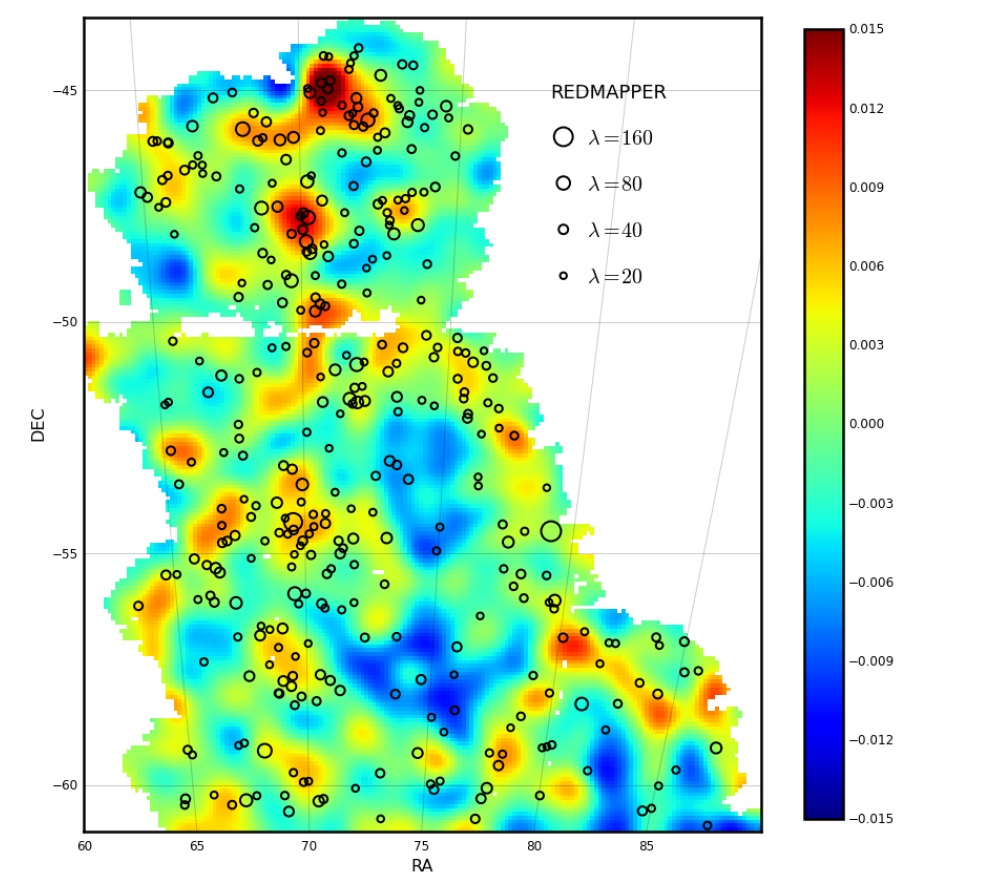
I’m a bit late onto this story which has already been quite active in the media today, and has generated an associated flurry of activity on social media, but I thought it was still worth passing it on via the medium of this blog. The Dark Energy Survey has just released a number of papers onto the arXiv, the most interesting of which (to me) is entitled Wide-Field Lensing Mass Maps from DES Science Verification Data. The abstract reads as follows (the link was added by me):

Weak gravitational lensing allows one to reconstruct the spatial distribution of the projected mass density across the sky. These “mass maps” provide a powerful tool for studying cosmology as they probe both luminous and dark matter. In this paper, we present a weak lensing mass map reconstructed from shear measurements in a 139 deg^2 area from the Dark Energy Survey (DES) Science Verification (SV) data overlapping with the South Pole Telescope survey. We compare the distribution of mass with that of the foreground distribution of galaxies and clusters. The overdensities in the reconstructed map correlate well with the distribution of optically detected clusters. Cross-correlating the mass map with the foreground galaxies from the same DES SV data gives results consistent with mock catalogs that include the primary sources of statistical uncertainties in the galaxy, lensing, and photo-z catalogs. The statistical significance of the cross-correlation is at the 6.8 sigma level with 20 arcminute smoothing. A major goal of this study is to investigate systematic effects arising from a variety of sources, including PSF and photo-z uncertainties. We make maps derived from twenty variables that may characterize systematics and find the principal components. We find that the contribution of systematics to the lensing mass maps is generally within measurement uncertainties. We test and validate our results with mock catalogs from N-body simulations. In this work, we analyze less than 3% of the final area that will be mapped by the DES; the tools and analysis techniques developed in this paper can be applied to forthcoming larger datasets from the survey.

This is by no means a final result from the Dark Energy Survey, as it was basically put together in order to test the telescope, but it is interesting from the point of view that it represents a kind of proof of concept. Here is one of the key figures from the paper which shows a reconstruction of the mass distribution of the Universe (dominated by dark matter) obtained indirectly by the Dark Energy Survey using distortions of galaxy images produced by gravitational lensing by foreground objects, onto which the positions of large galaxy clusters seen in direct observations have been plotted. Although this is just a small part of the planned DES study (it covers only 0.4% of the sky) it does seem to indicate that the strong concentrations of dark matter (red) do corrrelate with the positions of concentrations of galaxy clusters.

DES_MAP

It all seems to work, so hopefully we can look forward to lots of interesting science results in future!

P.S. When I first saw the map it looked like a map of the North of England Midlands and I was surprised to see that the survey showed such strong support for the Greens…

Last Call for Cosmology Talks at NAM 2015!

Posted in The Universe and Stuff with tags , on April 13, 2015 by telescoper

Just a quick post about this year’s forthcoming Royal Astronomical Society National Astronomy Meeting, which will be taking place at the splendid Venue Cymru conference centre, Llandudno, North Wales, from Sunday 5th July to Thursday 9th July 2015. I’m on the Scientific Organizing Committee for NAM 2015 and as such I’ll be organizing a part of this meeting, namely a couple of sessions on Cosmology under the title Cosmology Beyond the Standard Model, with the following description.

Recent observations, particularly those from the Planck satellite, have provided strong empirical foundations for a standard cosmological model that is based on Einstein’s general theory of relativity and which describes a universe which is homogeneous and isotropic on large scales and which is dominated by dark energy and matter components. This session will explore theoretical and observational challenges to this standard picture, including modified gravity theories, models with large-scale inhomogeneity and/or anisotropy, and alternative forms of matter-energy. The aim will be to both take stock of the evidence for, and stimulate further investigation of, physics beyond the standard model.

The deadline for submitting abstracts for this and other sessions was originally 1st April, but this has been extended until 14th April (i.e. tomorrow). The cosmology sessions are shaping up to be very interesting indeed, but I might be able to squeeze in one or two more talks. If you’ve been prevaricating about submitting a proposal, then please get your finger out and visit the NAM2015 website right now. This is your last chance!

NAM is a particularly good opportunity for younger researchers – PhD students and postdocs – to present their work to a big audience so I particularly encourage such persons to submit abstracts. Would more senior readers please pass this message on to anyone they think might want to give a talk?

If you have any questions please feel free to use the comments box (or contact me privately).

A Birthday Message to Donald Lynden-Bell

Posted in The Universe and Stuff with tags , on April 12, 2015 by telescoper

On Friday being the second Friday of the month of April I went up to London for the regular Open Meeting of the Royal Astronomical Society and afterwards to dinner with the RAS Club. Unusually for club dinners, we were provided with champagne before the toasts but it was a while before I realized why. A distinguished member and indeed former President of the club, Prof. Donald Lynden-Bell, had recently celebrated his eightieth birthday and we were all invited to drink his health.

Donald is an amazing character, not least because he hasn’t changed a bit since I first met him over thirty years ago when he was lecturer for one of the courses I took in the first year. His research has spanned an enormous breadth of subjects, from theoretical topics in classical and quantum physics to astrophysics and cosmology, including data analysis. Anyway, it was great that he was there to receive the toast in person. I’ll take the opportunity here to say a more public Happy Birthday!

On the way home I posted on Facebook that Donald had just celebrated his eightieth birthday. One of my astronomer friends, Manuela Magliocchetti, posted a charming comment about him that I’m sharing here (below) publicly in a slightly edited form, with her permission. By the way, in the interest of full disclosure, I should point out that I subsequently had the honour to be the External Examiner for Manuela’s PhD…

–o–

I just learnt that today from Peter there were celebrations at the RAS Dining Club for the 80th birthday of Professor Donald Lynden-Bell. Since I basically owe my scientific carrier to him, I thought I’d  thank him publicly now.

It was summer 1995 and I had pestered my undergraduate supervisor to send me to Cambridge to attend the conference on Gravitational Dynamics that had been organized for the 60th birthday of Donald (gee, already 20 years ago!), since all my undergrad thesis was on some evidence of a phenomenon (gravothermal catastrophe) that he first theorized in a breakthrough paper published in 1968 that by then I knew by heart. So he definitely was my scientific hero.

At the end of the conference I knocked at his office door to ask him whether it was possible for me to apply for a PhD position at Cambridge. He let me in, but did not even allow me to start talking. Instead he started asking me about the thesis work I had done, since in Italy everyone in Physics has to produce some original work in order to be awarded the undegraduate degree. He had me writing on his blackboard for about an hour (which felt like centuries to me) about all my results, asking genuinely interested questions, discussing, and in some bits  criticizing my work. He was very pushy (as I learned later, this  was his style) and was talking oh-so-very fast.

I was soo unsettled and scared and not even sure I was understanding all his points correctly: my English was so basic… After all this torture, he suddently stopped and, with his slightly squeaky voice, went:” So, why are you here?” I very humbly answered that it was to have information on how to apply to Cambridge for a PhD position. He then looked at me, then at the blackboard, then at me again and told me what I wrote on the blackboard indeed was PhD work. I answered that no, it was just undergraduate work. At that point he jumped off his chair, grabbed my arm and dragged me to the secretary of the Isaac Newton Scholarship, introducing me to her and telling her that I would be applying for both a PhD position at the Institute of Astronomy at University of Cambridge and for the scholarship. So I did apply, and in the end got both and found myself thrown in that fantastically stimulating environment which is Cambridge and the IoA.

Thank you so much Donald! Forever grateful. Without you all this and what happened next, including my present job and career and even my kids, since I met their (astronomer) dad over there, would not have been possible!


Why the Big Bang wasn’t as loud as you think…

Posted in The Universe and Stuff with tags , , , , , on March 31, 2015 by telescoper

So how loud was the Big Bang?

I’ve posted on this before but a comment posted today reminded me that perhaps I should recycle it and update it as it relates to the cosmic microwave background, which is what I work on on the rare occasions on which I get to do anything interesting.

As you probably know the Big Bang theory involves the assumption that the entire Universe – not only the matter and energy but also space-time itself – had its origins in a single event a finite time in the past and it has been expanding ever since. The earliest mathematical models of what we now call the  Big Bang were derived independently by Alexander Friedman and George Lemaître in the 1920s. The term “Big Bang” was later coined by Fred Hoyle as a derogatory description of an idea he couldn’t stomach, but the phrase caught on. Strictly speaking, though, the Big Bang was a misnomer.

Friedman and Lemaître had made mathematical models of universes that obeyed the Cosmological Principle, i.e. in which the matter was distributed in a completely uniform manner throughout space. Sound consists of oscillating fluctuations in the pressure and density of the medium through which it travels. These are longitudinal “acoustic” waves that involve successive compressions and rarefactions of matter, in other words departures from the purely homogeneous state required by the Cosmological Principle. The Friedman-Lemaitre models contained no sound waves so they did not really describe a Big Bang at all, let alone how loud it was.

However, as I have blogged about before, newer versions of the Big Bang theory do contain a mechanism for generating sound waves in the early Universe and, even more importantly, these waves have now been detected and their properties measured.

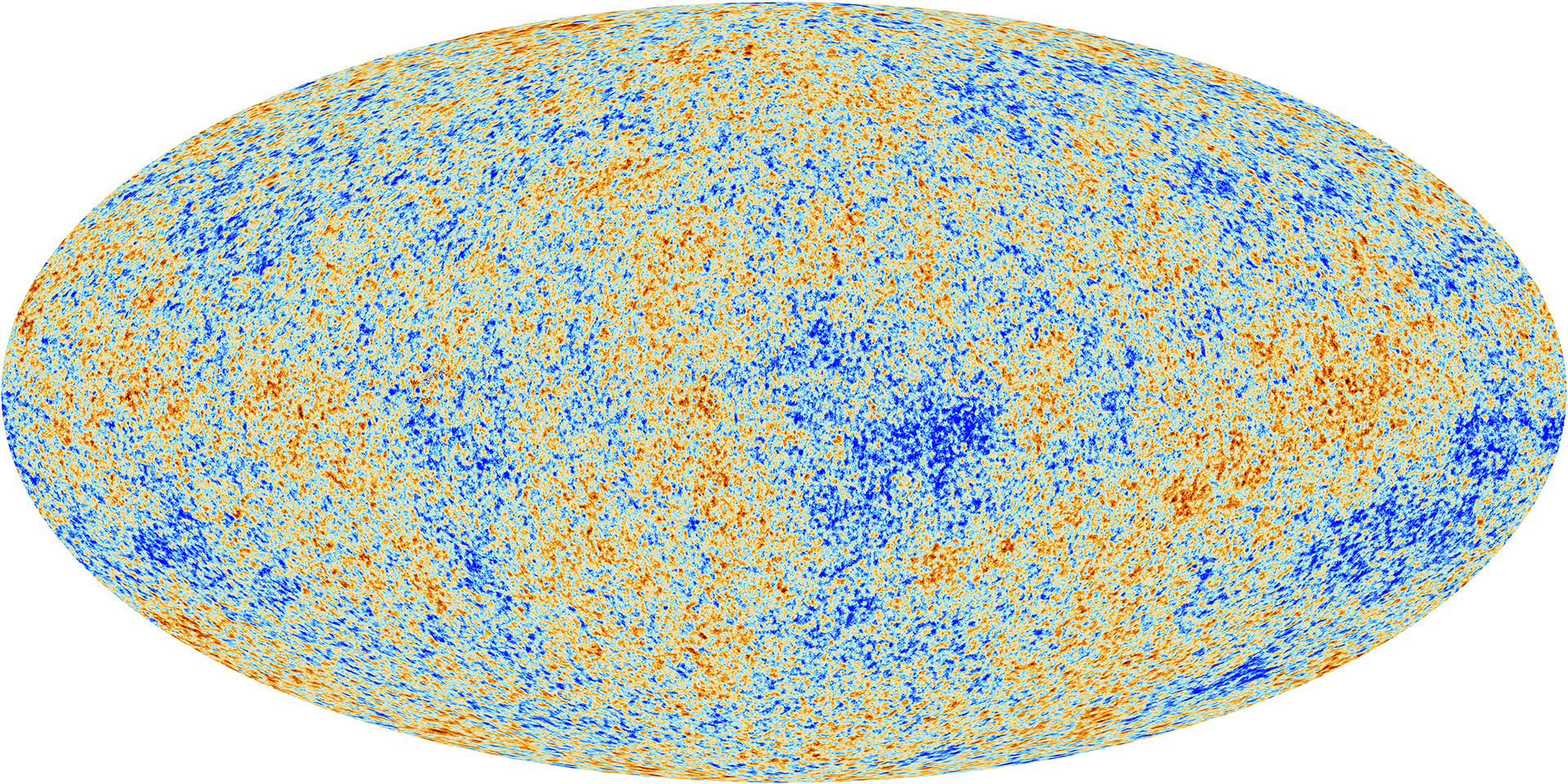
Planck_CMB

The above image shows the variations in temperature of the cosmic microwave background as charted by the Planck Satellite. The average temperature of the sky is about 2.73 K but there are variations across the sky that have an rms value of about 0.08 milliKelvin. This corresponds to a fractional variation of a few parts in a hundred thousand relative to the mean temperature. It doesn’t sound like much, but this is evidence for the existence of primordial acoustic waves and therefore of a Big Bang with a genuine “Bang” to it.

A full description of what causes these temperature fluctuations would be very complicated but, roughly speaking, the variation in temperature you corresponds directly to variations in density and pressure arising from sound waves.

So how loud was it?

The waves we are dealing with have wavelengths up to about 200,000 light years and the human ear can only actually hear sound waves with wavelengths up to about 17 metres. In any case the Universe was far too hot and dense for there to have been anyone around listening to the cacophony at the time. In some sense, therefore, it wouldn’t have been loud at all because our ears can’t have heard anything.

Setting aside these rather pedantic objections – I’m never one to allow dull realism to get in the way of a good story- we can get a reasonable value for the loudness in terms of the familiar language of decibels. This defines the level of sound (L) logarithmically in terms of the rms pressure level of the sound wave Prms relative to some reference pressure level Pref

L=20 log10[Prms/Pref].

(the 20 appears because of the fact that the energy carried goes as the square of the amplitude of the wave; in terms of energy there would be a factor 10).

There is no absolute scale for loudness because this expression involves the specification of the reference pressure. We have to set this level by analogy with everyday experience. For sound waves in air this is taken to be about 20 microPascals, or about 2×10⁻¹⁰ times the ambient atmospheric air pressure which is about 100,000 Pa.  This reference is chosen because the limit of audibility for most people corresponds to pressure variations of this order and these consequently have L=0 dB. It seems reasonable to set the reference pressure of the early Universe to be about the same fraction of the ambient pressure then, i.e.

Pref~2×10⁻¹⁰ Pamb.

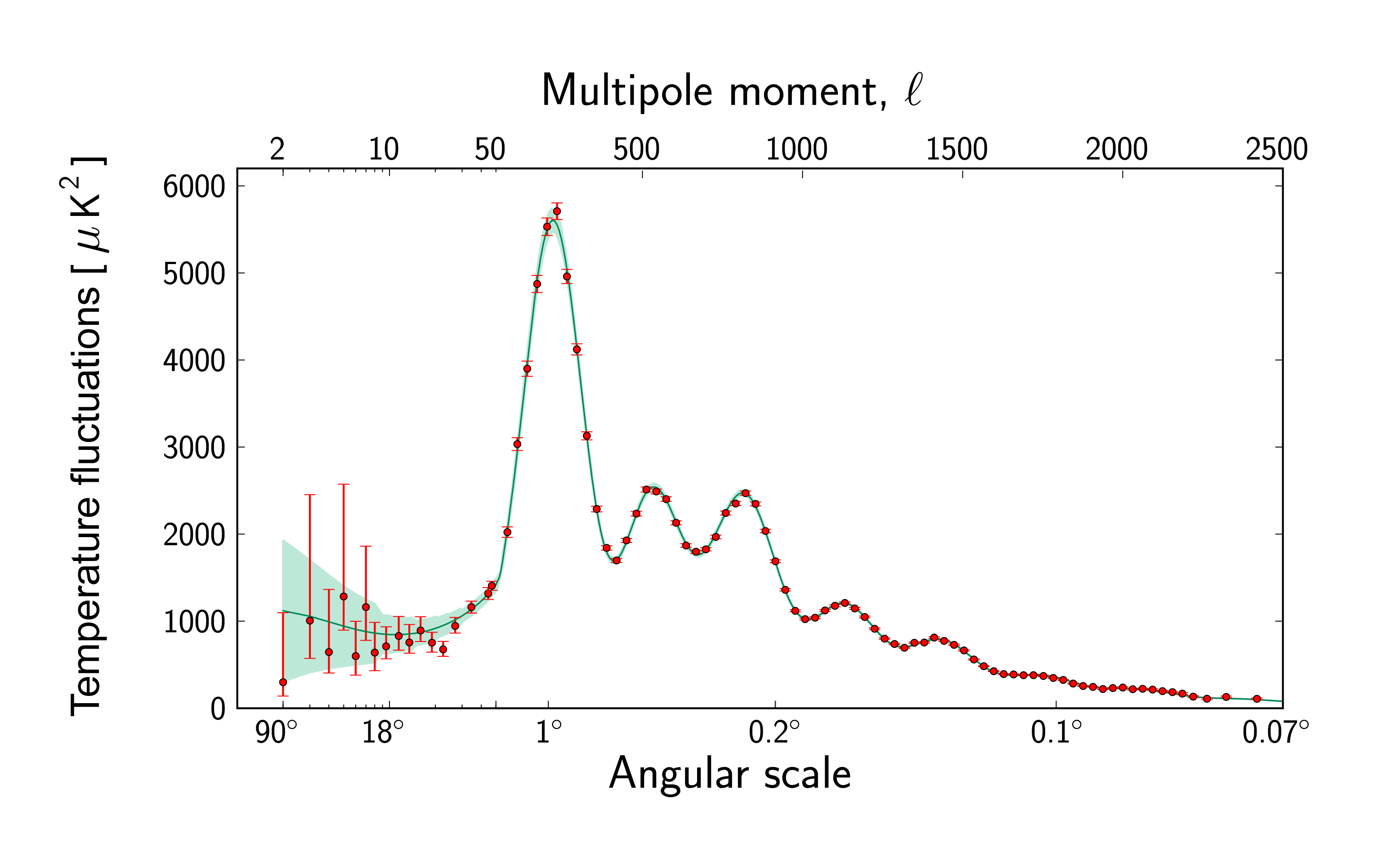
The physics of how primordial variations in pressure translate into observed fluctuations in the CMB temperature is quite complicated, because the primordial universe consists of a plasma rather than air. Moreover, the actual sound of the Big Bang contains a mixture of wavelengths with slightly different amplitudes. In fact here is the spectrum, showing a distinctive signature that looks, at least in this representation, like a fundamental tone and a series of harmonics…

Planck_power_spectrum_orig


If you take into account all this structure it all gets a bit messy, but it’s quite easy to get a rough but reasonable estimate by ignoring all these complications. We simply take the rms pressure variation to be the same fraction of ambient pressure as the averaged temperature variation are compared to the average CMB temperature,  i.e.

Prms~ a few ×10-5Pamb.

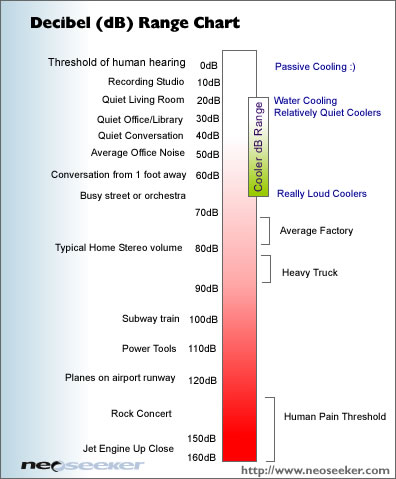
If we do this, scaling both pressures in logarithm in the equation in proportion to the ambient pressure, the ambient pressure cancels out in the ratio, which turns out to be a few times 10-5. With our definition of the decibel level we find that waves of this amplitude, i.e. corresponding to variations of one part in a hundred thousand of the reference level, give roughly L=100dB while part in ten thousand gives about L=120dB. The sound of the Big Bang therefore peaks at levels just a bit less than 120 dB.

cooler_decibel_chart

As you can see in the Figure above, this is close to the threshold of pain,  but it’s perhaps not as loud as you might have guessed in response to the initial question. Modern popular beat combos often play their dreadful rock music much louder than the Big Bang….

A useful yardstick is the amplitude  at which the fluctuations in pressure are comparable to the mean pressure. This would give a factor of about 1010 in the logarithm and is pretty much the limit that sound waves can propagate without distortion. These would have L≈190 dB. It is estimated that the 1883 Krakatoa eruption produced a sound level of about 180 dB at a range of 100 miles. By comparison the Big Bang was little more than a whimper.

PS. If you would like to read more about the actual sound of the Big Bang, have a look at John Cramer’s webpages. You can also download simulations of the actual sound. If you listen to them you will hear that it’s more of  a “Roar” than a “Bang” because the sound waves don’t actually originate at a single well-defined event but are excited incoherently all over the Universe.

Praise, by R.S. Thomas

Posted in Poetry, The Universe and Stuff with tags , , , on March 29, 2015 by telescoper

Today is Palm Sunday, the start of what Christians call “Holy Week”, which culiminates in Easter. It’s also the birthday of the great Welsh poet R.S. Thomas, who was born on this day in 1913. Thomas spent much of his life as an Anglican priest. I’m not a Christian but I am drawn to the religious verse of R.S. Thomas not only for its directness and lack of artifice but also the honesty with which he addresses the problems his faith sets him. There are many atheists who think religion is some kind of soft option for those who can’t cope with life in an unfriendly universe, but reading R.S. Thomas, whose faith was neither cosy nor comfortable, led me to realise that is very far from the case. I recommend him as an antidote to the simple-minded antagonism of people like Richard Dawkins. There are questions that science alone will never answer, so we should respect people who search for a truth we ourselves cannot understand.

And whether or not it is clear to you, no doubt the universe is unfolding as it should. Therefore be at peace with God, whatever you conceive Him to be.

I will be offline for the Easter holiday so I thought I’d post a poem that I find appropriate to the time of year. You can read it as Praise for God, or for Nature, or for both. I don’t think it matters.

I praise you because
you are artist and scientist
in one. When I am somewhat
fearful of your power,
your ability to work miracles
with a set-square, I hear
you murmuring to yourself
in a notation Beethoven
dreamed of but never achieved.
You run off your scales of
rain water and sea water, play
the chords of the morning
and evening light, sculpture
with shadow, join together leaf
by leaf, when spring
comes, the stanzas of
an immense poem. You speak
all languages and none,
answering our most complex
prayers with the simplicity
of a flower, confronting
us, when we would domesticate you
to our uses, with the rioting
viruses under our lens.

Quantum Technology and the Frontier of Computing

Posted in The Universe and Stuff with tags , , , on March 26, 2015 by telescoper

Here’s a short video I just found featuring our own Winfried Hensinger, Professor of Quantum Technologies at the University of Sussex.

It’s part of a pilot documentary that explores the connection between science fiction and science reality. Here is the official blurb:

“The science fiction genre has a history of playing with our imagination; inventing “impossible” technologies and concepts such as time travel and teleportation. The “spooky” discoveries that quantum physicists have recently made are challenging the very “impossibility” of sci-fi. This documentary will explore the ways in which sci-fi has catalysed the imagination of scientists who are pioneering these discoveries.

The theme will explore the causal link between science and science fiction, using the inner workings of the quantum computer that Dr Winfried Hensinger is currently developing as a case study. Dr Hensinger, the head of the Sussex Ion Quantum Technology research group, was inspired early on by the well known 60s science fiction television show Star Trek. Having led multiple breakthroughs in the field of Quantum Computing research, he speaks to the importance of not losing our imagination, citing his childhood desire to be the science officer on Star Trek’s Enterprise as the prime motivator of going into the scientific field. Exploring the relationship between the human beings developing this technology and the non-human genre of science fiction, we will demonstrate that the boundaries between imagination and reality are blurrier than conventionally thought.”

I’ll take the opportunity presented by this video to remind you that the University of Sussex is the only university in the UK to offer an MSc course in Quantum Technologies, and this year there are special bursaries that make this an extremely attractive  option for students seeking to extend their studies into this burgeoning new area. We’ve already seen a big surge in applications for this course this course so if you’re thinking of applying don’t wait too long or it might fill up!

NAM 2015: Abstract Submission Reminder!

Posted in The Universe and Stuff with tags , on March 24, 2015 by telescoper

Time for another quick plug of this year’s  Royal Astronomical Society National Astronomy Meeting, which will be taking place at the splendid Venue Cymru conference centre, Llandudno, North Wales, from Sunday 5th July to Thursday 9th July 2015. I’ve posted about  this before, but I thought I’d post it again because there is just a week left to submit an abstract for a contributed talk or poster; the deadline for doing that is April 1st. I’m actually on the Scientific Organizing Committee for NAM 2015 and as such I’ll be organizing part of this meeting, namely a couple of sessions on Cosmology under the title Cosmology Beyond the Standard Model, with the following description.

Recent observations, particularly those from the Planck satellite, have provided strong empirical foundations for a standard cosmological model that is based on Einstein’s general theory of relativity and which describes a universe which is homogeneous and isotropic on large scales and which is dominated by dark energy and matter components. This session will explore theoretical and observational challenges to this standard picture, including modified gravity theories, models with large-scale inhomogeneity and/or anisotropy, and alternative forms of matter-energy. The aim will be to both take stock of the evidence for, and stimulate further investigation of, physics beyond the standard model.

It’s obviously quite a broad remit so I hope that there will be plenty of contributed talks and posters. NAM is a particularly good opportunity for younger researchers – PhD students and postdocs – to present their work to a big audience so I particularly encourage such persons to submit abstracts. Would more senior readers please pass this message on to anyone they think might want to give a talk?   To further whet your appetite, here are some pictures of lovely Llandudno  I took at the last National Astronomy Meeting there, back in 2011.     If you have any questions please feel free to use the comments box (or contact me privately).