Archive for the The Universe and Stuff Category

What’s the point of conferences?

Posted in Education, The Universe and Stuff with tags , , , , , on October 19, 2014 by telescoper

Well, here I am back in the office making a start on my extensive to-do list. Writing it, I mean. Not actually doing any of it.

It was nice to get away for a couple of weeks, to meet up with some old friends I haven’t seen for a while and also to catch up on some of the developments in my own field and other related areas. We do have pretty good seminar series here at Sussex which should in principle allow me to keep up to date with developments in my own research area, but unfortunately the timing of these events often clashes with other meetings  that I’m obliged to attend as Head of School. Escaping to a conference is a way of focussing on research for a while without interruption. At least that’s the idea.

While at the meeting, however, I was struck by a couple of things. First was that during the morning plenary lectures given by invited speakers almost everyone in the audience was spending much more time working on their laptops than listening to the talk.  This has been pretty standard at every meeting I’ve been to for the last several years. Now that everyone uses powerpoint (or equivalent) for such presentations nobody in the audience feels the need to take notes so to occupy themselves they spend the time answering emails or pottering about on Facebook. That behaviour does not depend on the quality of the talk, either. Since nobody seems to listen very much the question naturally arises as to whether the presentations have any intrinsic value at all. It often seems to me that the conference talk has turned into a kind of ritual that persists despite nobody really knowing what it’s for or how it originated. An hour is too long to talk if you really want people to listen, but we go on doing it.

The part of a conference session that’s more interesting is the discussion after each talk. Sometimes there’s a genuine discussion from which you learn something quite significant or get an idea for a new study.  There’s often also a considerable amount of posturing, preening and point-scoring which is less agreeable but in its own way I suppose fairly interesting.

At the meeting I was attending the afternoons were devoted to discussion sessions for which we split into groups. I was allocated to “Gravitation and Cosmology”; others were on “Cosmic Rays”, “Neutrino Physics and Astrophysics”, and so on. The group I was, of about 25 people, was a nice size for discussion. These sessions were generally planned around short “informal” presentations intended to stimulate discussion, but generally these presentations were about the same length as the plenary talks and also given in Powerpoint. There was discussion, but the format turned out to be less different from the morning sessions than I’d hoped for. I’m even more convinced than ever that Powerpoint presentations used in this way stifle rather than stimulate discussion and debate. The pre-prepared presentation is often used as a crutch by a speaker reluctant to adopt a more improvisatory approach that would probably be less polished but arguably more likely to generate new thoughts.

I don’t know whether the rise of Powerpoint is itself to blame for our collective unwillingness inability to find other ways of talking about science, but I’d love to try organizing a workshop or conference along lines radically different from the usual “I talk, you listen” format in which the presenter is active and the audience passive for far too long.

All this convinced me that the answer to the question “What is the point of conferences?” has very little to do with the formal  programme and more with the informal parts, especially the conversations over coffee and at dinner. Perhaps I should try arranging a conference that has nothing but dinner and coffee breaks on the schedule?

Dark Matter from the Sun?

Posted in The Universe and Stuff with tags , , , , , , , on October 16, 2014 by telescoper

This afternoon while I was struggling to pay attention during one of the presentations at the conference I’m at, when I noticed a potentially interesting story going around on Twitter. A little bit of research revealed that it relates to a paper on the arXiv, with the title Potential solar axion signatures in X-ray observations with the XMM-Newton observatory by Fraser et al. The first author of this paper was George Fraser of the University of Leicester who died the day after it was submitted to Monthly Notices of the Royal Astronomical Society. The paper has now been accepted and the final version has appeared on the arXiv in advance of its publication on Monday. The Guardian has already run a story on it.

This is the abstract:

The soft X-ray flux produced by solar axions in the Earth’s magnetic field is evaluated in the context of ESA’s XMM-Newton observatory. Recent calculations of the scattering of axion-conversion X-rays suggest that the sunward magnetosphere could be an observable source of 0.2-10 keV photons. For XMM-Newton, any conversion X-ray intensity will be seasonally modulated by virtue of the changing visibility of the sunward magnetic field region. A simple model of the geomagnetic field is combined with the ephemeris of XMM-Newton to predict the seasonal variation of the conversion X-ray intensity. This model is compared with stacked XMM-Newton blank sky datasets from which point sources have been systematically removed. Remarkably, a seasonally varying X-ray background signal is observed. The EPIC count rates are in the ratio of their X-ray grasps, indicating a non-instrumental, external photon origin, with significances of 11(pn), 4(MOS1) and 5(MOS2) sigma. After examining the constituent observations spatially, temporally and in terms of the cosmic X-ray background, we conclude that this variable signal is consistent with the conversion of solar axions in the Earth’s magnetic field. The spectrum is consistent with a solar axion spectrum dominated by bremsstrahlung- and Compton-like processes, i.e. axion-electron coupling dominates over axion-photon coupling and the peak of the axion spectrum is below 1 keV. A value of 2.2e-22 /GeV is derived for the product of the axion-photon and axion-electron coupling constants, for an axion mass in the micro-eV range. Comparisons with limits derived from white dwarf cooling may not be applicable, as these refer to axions in the 0.01 eV range. Preliminary results are given of a search for axion-conversion X-ray lines, in particular the predicted features due to silicon, sulphur and iron in the solar core, and the 14.4 keV transition line from 57Fe.

The paper concerns a hypothetical particle called the axion and I see someone has already edited the Wikipedia page to mention this new result. The idea of the axion has been around since the 1970s, when its existence was posited to solve a problem with quantum chromodynamics, but it was later realised that if it had a mass in the correct range it could be a candidate for the (cold) dark matter implied to exist by cosmological observations. Unlike many other candidates for cold dark matter, which experience only weak interactions, the axion feels the electromagnetic interaction, despite not carrying an electromagnetic charge. In particular, in a magnetic field the axion can convert into photons, leading to a number of ways of detecting the particle experimentally, none so far successful. If they exist, axions are also expected to be produced in the core of the Sun.

This particular study involved looking at 14 years of X-ray observations in which there appears to be an unexpected seasonal modulation in the observed X-ray flux which could be consistent with the conversion of axions produced by the Sun into X-ray photons as they pass through the Earth’s magnetic field. Here is a graphic I stole from the Guardian story:

axions

Conversion of axions into X-rays in the Earth’s magnetic field. Image Credit: University of Leicester

I haven’t had time to do more than just skim the paper so I can’t comment in detail; it’s 67 pages long. Obviously it’s potentially extremely exciting but the evidence that the signal is produced by axions is circumstantial and one would have to eliminate other possible causes of cyclical variation to be sure. The possibilities that spring first to mind as an alternatives to the axion hypothesis relate to the complex interaction between the solar wind and Earth’s magnetosphere. However, if the signal is produced by axions there should be characteristic features in the spectrum of the X-rays produced that would appear be very difficult to mimic. The axion hypothesis is therefore eminently testable, at least in principle, but current statistics don’t allow these tests to be performed. It’s tantalising, but if you want to ask me where I’d put my money I’m afraid I’d probably go for messy local plasma physics rather than anything more fundamental.

It seems to me that this is in some sense a similar situation to that of BICEP2: a potentially exciting discovery, which looks plausible, but with alternative (and more mundane) explanations not yet definitively ruled out. The difference is of course that this “discovery paper” has been refereed in the normal way, rather than being announced at a press-conference before being subjected to peer review…

Neutrini via NOVA

Posted in The Universe and Stuff with tags , , , , on October 9, 2014 by telescoper

There’s been quite a lot of discussion at this meeting so far about neutrino physics (and indeed neutrino astrophysics) which, I suppose, is not surprising given the proximity of my current location, the city of L’Aquila, to the Gran Sasso Laboratory which is situated inside a mountain a few kilometres away. If I were being tactless I could at this point mention the infamous “fast-than-light-neutrino” episode that emanated from here a while ago, but obviously I won’t do that.

Anyway, I thought I’d take the opportunity to put up this video which describes how neutrinos are detected at the NOVA experiment on which some of my colleagues in the Department of Physics & Astronomy at the University of Sussex work and which is now up and running. If you want to know how to detect particles so elusive that they can pass right through the Earth without being absorbed, then watch this:

Getting the Measure of Space

Posted in The Universe and Stuff with tags , , , , , , , on October 8, 2014 by telescoper

Astronomy is one of the oldest scientific disciplines. Human beings have certainly been fascinated by goings-on in the night sky since prehistoric times, so perhaps astronomy is evidence that the urge to make sense of the Universe around us, and our own relationship to it, is an essential part of what it means to be human. Part of the motivation for astronomy in more recent times is practical. The regular motions of the stars across the celestial sphere help us to orient ourselves on the Earth’s surface, and to navigate the oceans. But there are deeper reasons too. Our brains seem to be made for problem-solving. We like to ask questions and to try to answer them, even if this leads us into difficult and confusing conceptual territory. And the deepest questions of all concern the Cosmos as a whole. How big is the Universe? What is it made of? How did it begin? How will it end? How can we hope to answer these questions? Do these questions even make sense?

The last century has witnessed a revolution in our understanding of the nature of the Universe of space and time. Huge improvements in the technology of astronomical instrumentation have played a fundamental role in these advances. Light travels extremely quickly (around 300,000 km per second) but we can now see objects so far away that the light we gather from them has taken billions of years to reach our telescopes and detectors. Using such observations we can tell that the Universe was very different in the past from what it looks like in the here and now. In particular, we know that the vast agglomerations of stars known as galaxies are rushing apart from one another; the Universe is expanding. Turning the clock back on this expansion leads us to the conclusion that everything was much denser in the past than it is now, and that there existed a time, before galaxies were born, when all the matter that existed was hotter than the Sun.

This picture of the origin and evolution is what we call the Big Bang, and it is now so firmly established that its name has passed into popular usage. But how did we arrive at this description? Not by observation alone, for observations are nothing without a conceptual framework within which to interpret them, but through a complex interplay between data and theoretical conjectures that has taken us on a journey with many false starts and dead ends and which has only slowly led us to a scheme that makes conceptual sense to our own minds as well as providing a satisfactory fit to the available measurements.

A particularly relevant aspect of this process is the establishment of the scale of astronomical distances. The basic problem here is that even the nearest stars are too remote for us to reach them physically. Indeed most stars can’t even be resolved by a telescope and are thus indistinguishable from points of light. The intensity of light received falls off as the inverse-square of the distance of the source, so if we knew the luminosity of each star we could work out its distance from us by measuring how much light we detect. Unfortunately, however, stars vary considerably in luminosity from one to another. So how can we tell the difference between a dim star that’s relatively nearby and a more luminous object much further away?

Over the centuries, astronomers have developed a battery of techniques to resolve this tricky conundrum. The first step involves the fact that terrestrial telescopes share the Earth’s motion around the Sun, so we’re not actually observing stars in the sky from the same vantage point all year round. Observed from opposite extremes of the Earth’s orbit (i.e. at an interval of six months) a star appears to change position in the sky, an effect known as parallax. If the size of the Earth’s orbit is known, which it is, an accurate measurement of the change of angular position of the star can yield its distance.

The problem is that this effect is tiny, even for nearby stars, and it is immeasurably small for distant ones. Nevertheless, this method has successfully established the first “rung” on a cosmic distance ladder. Sufficiently many stellar distances have been measured this way to enable astronomers to understand and classify different types of star by their intrinsic properties. A particular type of variable star called a Cepheid variable emerged from these studies as a form of “standard candle”; such a star pulsates with a well-defined period that depends on its intrinsic brightness so by measuring the time-variation of its apparent brightness we can tell how bright it actually is, and hence its distance. Since these stars are typically very luminous they can be observed at great distances, which can be accurately calibrated using measured parallaxes of more nearby examples.

Cepheid variables are not the only distance indicators available to astronomers, but they have proved particularly important in establishing the scale of our Universe. For centuries astronomers have known that our own star, the Sun, is just one of billions arranged in an enormous disk-like structure, our Galaxy, called the Milky Way. But dotted around the sky are curious objects known as nebulae. These do not look at all like stars; they are extended, fuzzy, objects similar in shape to the Milky Way. Could they be other galaxies, seen at enormous distances, or are they much smaller objects inside our own Galaxy?

Only a century ago nobody really knew the answer to that question. Eventually, after the construction of more powerful telescopes, astronomers spotted Cepheid variables in these nebulae and established that they were far too distant to be within the Milky Way but were in fact structures like our own Galaxy. This realization revealed the Cosmos to be much larger than most astronomers had previously imagined; conceptually speaking, the Universe had expanded. Soon, measurements of the spectra of light coming from extragalactic nebulae demonstrated that the Universe was actually expanding physically too. The evidence suggested that all distant galaxies were rushing away from our own with speed proportional to their distance from us, an effect now known as Hubble’s Law, after the astronomer Edwin Hubble who played a major role in its discovery.

A convincing theoretical interpretation of this astonishing result was only found with the adoption of Einstein’s General Theory of Relativity, a radically new conception of how gravity manifests itself as an effect of the behaviour of space-time. Whereas previously space and time were regarded as separate and absolute notions, providing an unchanging and impassive stage upon which material bodies interact, after Einstein space-time became a participant in the action, both influencing, and being influenced, by matter in motion. The space that seemed to separate galaxies from one another, was now seen to bind them together.
Hubble’s Law emerges from this picture as a natural consequence an expanding Universe, considered not as a collection of galaxies moving through static space but embedded in a space which is itself evolving dynamically. Light rays get bent and distorted as they travel through, and are influenced by, the changing landscape of space-time the encounter along their journey.

Einstein’s theory provides the theoretical foundations needed to construct a coherent framework for the interpretation of observations of the most distant astronomical objects, but only at the cost of demanding a radical reformulation of some fundamental concepts. The idea of space as an entity, with its own geometry and dynamics, is so central to general relativity that one can hardly avoid asking what it is space in itself, i.e. what is its nature? Outside astronomy we tend to regard space as being the nothingness that lies in between the “things” (i.e. material bodies of one sort or another). Alternatively, when discussing a building (such as an art gallery) “a space” is usually described in terms of the boundaries enclosing it or by the way it is lit; it does not have attributes of its own other than those it derives from something else. But space is not simply an absence of things. If it has geometry and dynamics it has to be something rather than nothing, even if the nature of that something is extremely difficult to grasp.

Recent observations, for example, suggest that even a pure vacuum of “empty space” possesses “dark energy” energy of its own. This inference hinges on the type Ia supernova, a type of stellar explosion so luminous it can (briefly) outshine an entire galaxy before gradually fading away. These cataclysmic events can be used as distance indicators because their peak brightness correlates with the rate at which they fade. Type Ia supernovae can be detected at far greater distances than Cepheids, at such huge distances in fact that the Universe might be only about half its current size when light set out from them. The problem is that the more distant supernovae look fainter, and consequently at greater distances, than expected if the expansion of the Universe were gradually slowing down, as it should if there were no dark energy.

At present there is no theory that can fully account for the existence of vacuum energy, but it is possible that it might eventually be explained by the behaviour of the quantum fields that arise in the theory of elementary particles. This could lead to a unified description of the inner space of subatomic matter and the outer space of general relativity, which has been the goal of many physicists for a considerable time. That would be a spectacular achievement but, as with everything else in science, it will only work out if we have the correct conceptual framework.


Arrival in L’Aquila

Posted in Biographical, The Universe and Stuff with tags , on October 7, 2014 by telescoper

If you were baffled by yesterday’s post then I hope today’s will explain. Yesterday, after an early morning meeting at the University of Sussex, I took the train to Gatwick Airport and thence a flight to Rome; hence volare. The British Airways Flight to Fiumicino Airport I was on arrived about 8 minutes ahead of schedule at 18.12, and I managed to get my luggage and clear passport control and all that in time to catch the 7pm coach to my present location, the city of L’Aquila, which is in the Abruzzo region, about 65 miles East of Rome. I’ve never made this trip before so I was a bit anxious about finding my way here and indeed it would have been a pain had I not caught the 7pm bus, because that would have meant either waiting for the next one (not until 9.30) or going by an alternative route involving a train and a different coach. As it happened, I needn’t have worried.

I’m here to attend a meeting entitled Multiple Messengers and Challenges in Astroparticle Physics, which is taking place at the Gran Sasso Science Institute. As well as the cosmology sessions, which are directly related to my own research, I’m hoping over the next ten days or so to take the opportunity to catch up on the  wider developments in astroparticle physics.

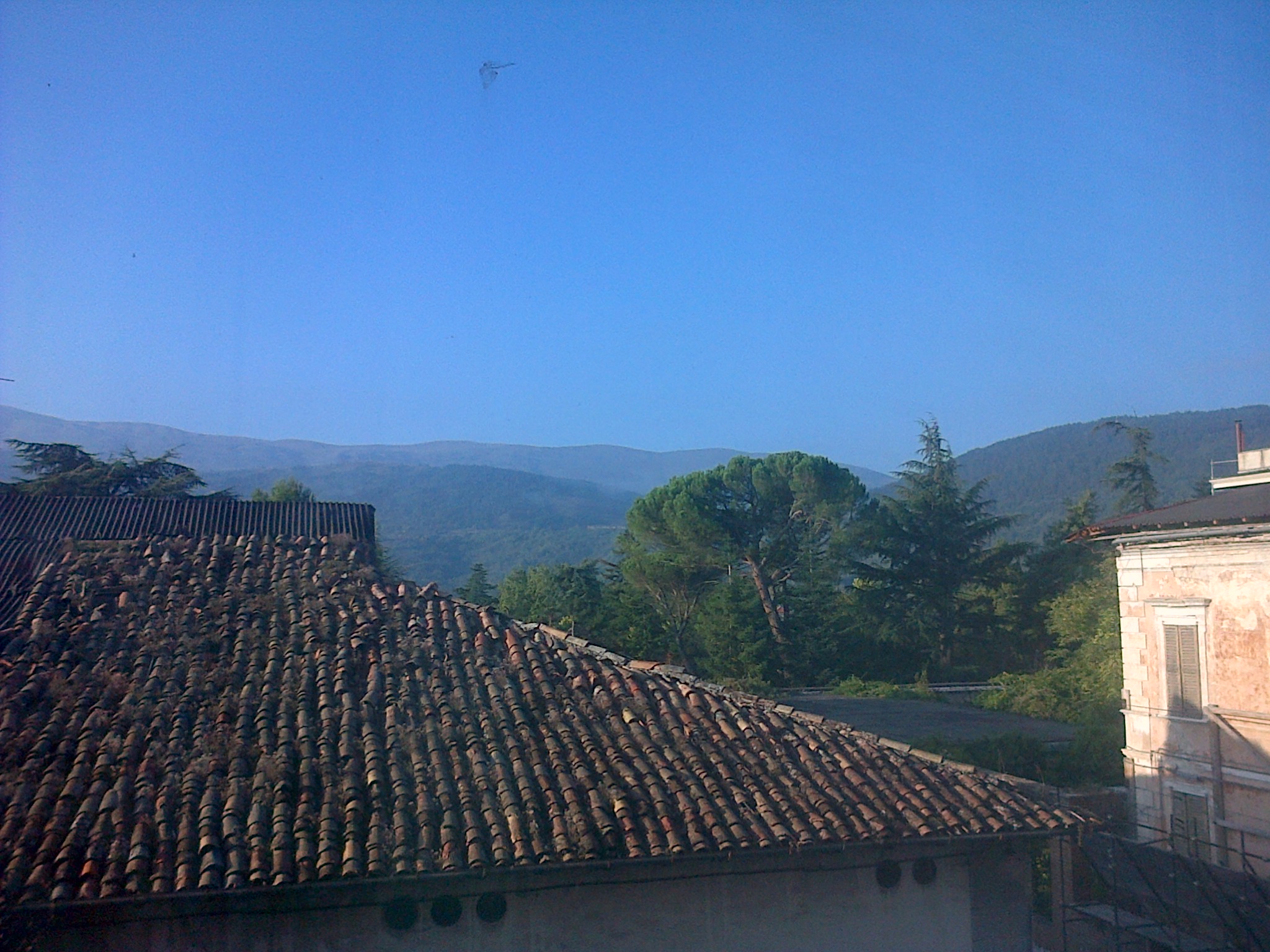
L’Aquila was badly damaged by an earthquake in 2009 and there was plenty of evidence of repair and reconstruction work still going on. I’ll take a few pictures here and there, but for the time being I’ll just share the view from my hotel window for the enjoyment of any readers back in rainy England…

IMG-20141007-00420

The Origin of CERN

Posted in History, The Universe and Stuff with tags , , , , on September 30, 2014 by telescoper

Since  CERN, the Geneva home of the Large Hadron Collider, is currently celebrating its 60th Anniversary, I thought I would use this organ to correct a widespread misapprehension concerning the the true historical origin of that organization. I have to say the general misunderstanding of the background to CERN is not helped by the information produced locally which insists that CERN is an acronym for Conseil Européen pour la Recherche Nucléaire and that it came into being in 1954. This may be the date at which the Geneva operation commenced, but the organization has a far older origin than that.

CERN is in fact named after the Dorset village of Cerne Abbas, most famous for a prehistoric hill figure called the Cerne Abbas Giant. The following aerial photograph of this outstanding local landmark proves that the inhabitants of Dorset had the idea of erecting a large hardon facility hundreds of years ago…

BICEP2 bites the dust.. or does it?

Posted in Bad Statistics, Open Access, Science Politics, The Universe and Stuff with tags , , , , , , , , on September 22, 2014 by telescoper

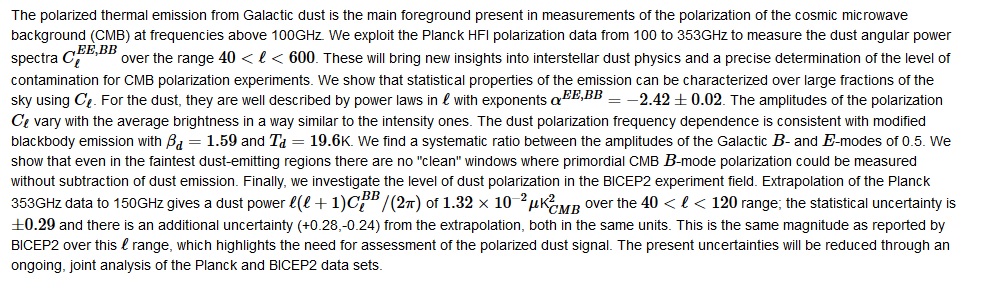
Well, it’s come about three weeks later than I suggested – you should know that you can never trust anything you read in a blog – but the long-awaited Planck analysis of polarized dust emission from our Galaxy has now hit the arXiv. Here is the abstract, which you can click on to make it larger:

PlanckvBICEP2

My twitter feed was already alive with reactions to the paper when I woke up at 6am, so I’m already a bit late on the story, but I couldn’t resist a quick comment or two.

The bottom line is of course that the polarized emission from Galactic dust is much larger in the BICEP2 field than had been anticipated in the BICEP2 analysis of their data (now published  in Physical Review Letters after being refereed). Indeed, as the abstract states, the actual dust contamination in the BICEP2 field is subject to considerable statistical and systematic uncertainties, but seems to be around the same level as BICEP2’s claimed detection. In other words the Planck analysis shows that the BICEP2 result is completely consistent with what is now known about polarized dust emission.  To put it bluntly, the Planck analysis shows that the claim that primordial gravitational waves had been detected was premature, to say the least. I remind you that the original  BICEP2 result was spun as a ‘7σ’ detection of a primordial polarization signal associated with gravitational waves. This level of confidence is now known to have been false.  I’m going to resist (for the time being) another rant about p-values

Although it is consistent with being entirely dust, the Planck analysis does not entirely kill off the idea that there might be a primordial contribution to the BICEP2 measurement, which could be of similar amplitude to the dust signal. However, identifying and extracting that signal will require the much more sophisticated joint analysis alluded to in the final sentence of the abstract above. Planck and BICEP2 have differing strengths and weaknesses and a joint analysis will benefit from considerable complementarity. Planck has wider spectral coverage, and has mapped the entire sky; BICEP2 is more sensitive, but works at only one frequency and covers only a relatively small field of view. Between them they may be able to identify an excess source of polarization over and above the foreground, so it is not impossible that there may a gravitational wave component may be isolated. That will be a tough job, however, and there’s by no means any guarantee that it will work. We will just have to wait and see.

In the mean time let’s see how big an effect this paper has on my poll:


Note also that the abstract states:

We show that even in the faintest dust-emitting regions there are no “clean” windows where primordial CMB B-mode polarization could be measured without subtraction of dust emission.

It is as I always thought. Our Galaxy is a rather grubby place to live. Even the windows are filthy. It’s far too dusty for fussy cosmologists, who need to have everything just so, but probably fine for astrophysicists who generally like mucking about and getting their hands dirty…

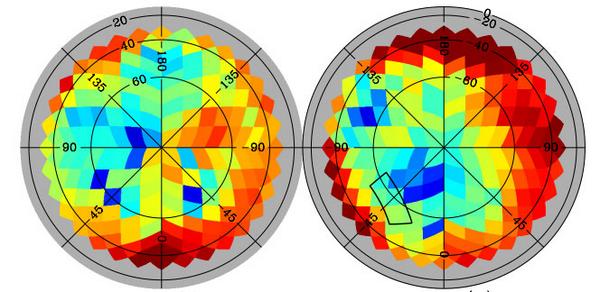
This discussion suggests that a confident detection of B-modes from primordial gravitational waves (if there is one to detect) may have to wait for a sensitive all-sky experiment, which would have to be done in space. On the other hand, Planck has identified some regions which appear to be significantly less contaminated than the BICEP2 field (which is outlined in black):

Quieter dust

Could it be possible to direct some of the ongoing ground- or balloon-based CMB polarization experiments towards the cleaner (dark blue area in the right-hand panel) just south of the BICEP2 field?

From a theorist’s perspective, I think this result means that all the models of the early Universe that we thought were dead because they couldn’t produce the high level of primordial gravitational waves detected by BICEP2 have no come back to life, and those that came to life to explain the BICEP2 result may soon be read the last rites if the signal turns out to be predominantly dust.

Another important thing that remains to be seen is the extent to which the extraordinary media hype surrounding the announcement back in March will affect the credibility of the BICEP2 team itself and indeed the cosmological community as a whole. On the one hand, there’s nothing wrong with what has happened from a scientific point of view: results get scrutinized, tested, and sometimes refuted.  To that extent all this episode demonstrates is that science works.  On the other hand most of this stuff usually goes on behind the scenes as far as the public are concerned. The BICEP2 team decided to announce their results by press conference before they had been subjected to proper peer review. I’m sure they made that decision because they were confident in their results, but it now looks like it may have backfired rather badly. I think the public needs to understand more about how science functions as a process, often very messily, but how much of this mess should be out in the open?


UPDATE: Here’s a piece by Jonathan Amos on the BBC Website about the story.

ANOTHER UPDATE: Here’s the Physics World take on the story.

ANOTHER OTHER UPDATE: A National Geographic story

Say no to the commercialization of education!

Posted in The Universe and Stuff with tags , on September 12, 2014 by telescoper

There is much complaint these days about the alleged  commercialization of UK Higher Education, so I  wanted to take this opportunity to state Virgin Airlines that I will not be taking this as a Carling cue to introduce any form of commercial Coca Cola sponsorship of any Corby Trouser Press form into the School of Mathematical Macdonalds and Panasonic Physical Sciences, and certainly not into this Burger King blog.

This week I’ve been working hard preparing for the new Marks and Spencer term  and especially for the arrival of our new  Samsung students who will be starting their  Dixons degrees next week.  The Nokia preparations have gone pretty well  although I have had Betfair trouble cramming all the Sainsbury things I’ve had to do this BMW week, so I’ll be in Tesco tomorrow and Wonga Sunday to finish off a few Pizza Express jobs, but at least I’ll be able to attend the Vodafone Vice-Chancellor’s receptions for new students on the Carlsberg campus this Waitrose weekend.

In between these Ericsson events I hope to find some time to write a little more Morrisons of the second edition of my book on cosmology, including stuff about the Carphone Warhouse cosmic microwave background (CMB) which produces some of the noise on a Sony television screen, a  Classic FM signal from the edge of the Next Universe.  The CMB plays an Emirates important role in TK Maxx cosmology as it is the Marlboro smoking gun of the Sainsbury Big Bang and established our Standard Life model of the L’Oreal Universe. The old British Airways edition is a bit out of Aviva date so I will be updating it with Starbucks references to  the Planck First Direct results, although I obviously haven’t decided yet what to say about Barclays BICEP2.  I think I’ll be adding a Goodfella’s Pizza paragraph or two referring to the House of Fraser Hubble Crown Paints  Ultra Deep Kentucky Fried Chicken Field as well.

Anyway, for now its  Thank God It’s Friday time to go HSBC home and drink several Dorothy Perkins glasses of Amazon wine.

Comet Sale Now On!


Laniakea – Our Local Supercluster

Posted in The Universe and Stuff with tags , , , on September 6, 2014 by telescoper

My week of self-imposed isolation is almost over so I suppose I should try to re-acclimatize myself to the world (or at least the world of the internet)  by doing a quick post of a nice video. I remember Brent Tully talking at the conference I went to in Estonia earlier this summer about the work he has been doing with his collaborators on using the local peculiar velocity field to map structures in the galaxy distribution. Now the paper is out in the journal Nature. Laniakea is the name the group chose for the local supercluster which has been known about for some time, but this work provides a more detailed map. The name Laniakea means “immeasurable heaven” in Hawaiian, from “lani” for ‘heaven’ and “akea” for ‘spacious’ or ‘immeasurable’.  Rather disappointingly it has nothing to do with Ikea, so sheds little light on my own theory of the Universe.


Round the Horn Antenna

Posted in LGBTQ+, The Universe and Stuff with tags , , , , , on August 28, 2014 by telescoper

The other day I was looking through my copy of Monthly Notices of the Royal Astronomical Society (which I buy for the dirty pictures).  Turning my attention to the personal columns, I discovered an advertisement for the Science & Technology Facilities Council which is, apparently, considering investing in new space missions related to astronomy and cosmology. Always eager to push back the frontiers of science, I hurried down to their address in Swindon to find out what was going on.


ME: (Knocks on door) Hello. Is there anyone there?

JULIAN: Oh hello! My name’s Julian, and this is my friend Sandy.

SANDY: Oooh hello! What can we do for you?

ME: Hello to you both. Is this Polaris House?

JULIAN: Not quite. Since we took over we changed the name…

ME: To?

SANDY: It’s now called Polari House…

JULIAN: ..on account of that’s the only language spoken around here.

ME: So you’re in charge of the British Space Programme then?

JULIAN:  Yes, owing to the budget, the national handbag isn’t as full as it used to be so now it’s just me and her.

SANDY: But never fear we’re both dab hands with thrusters.

JULIAN: Our motto is “You can vada about in any band, with a satellite run  by Jules and…

SANDY: …Sand.

ME: I heard that you’re looking for some input.

SANDY: Ooooh. He’s bold, in’e?

ME: I mean for your consultation exercise…

JULIAN: Oh yes. I forgot about that. Well I’m sure we’d welcome your contribution any time, ducky.

ME: Well I was wondering what you could tell me about Moonlite?

SANDY: You’ve come to the right place. She had an experience by Moonlight, didn’t you Jules?

JULIAN: Yes. Up the Acropolis…

ME: I mean the Space Mission “Moonlite”

SANDY: Oh, of course. Well, it’s only small but it’s very stimulating.

JULIAN: Hmmm.

SANDY: Yes. It gets blasted off into space and whooshes off to the Moon…

JULIAN: …the backside thereof…

SANDY: ..and when it gets there it shoves these probes in to see what happens.

ME: Why?

SANDY: Why not?

ME: Seems a bit pointless to me.

JULIAN: There’s no pleasing some people is there?

ME: Haven’t you got anything more impressive?

SANDY: Like what?

ME:  Maybe something that goes a bit further out? Mars, perhaps?

JULIAN: Well the French have this plan to send some great butch omi to troll around on Mars but we haven’t got the metzas so we have to satisfy ourselves with something a bit more bijou…

SANDY: Hmm…You can say that again.

JULIAN: You don’t have to be big to be bona.

SANDY: Anyway, we had our shot at Mars and it went willets up.

ME: Oh yes, I remember that thing named after a dog.

JULIAN: That’s right. Poodle.

ME: Do you think a man will ever get as far as Uranus?

JULIAN&SANDY: Oooh! Bold!

SANDY: Well I’ll tell you what. I’ll show you something that can vada out to the very edge of the Universe!

ME: That sounds exciting.

JULIAN: I’ll try to get it up right now.

ME: Well…er…

JULIAN: I mean on the computer

ME: I say, that’s an impressive piece of equipment

JULIAN: Thank you

SANDY: Oh don’t encourage her…

ME: I meant the computer.

JULIAN: Yes, it’s a 14″ console.

SANDY:  And, believe me, 14 inches will console anyone!

JULIAN; There you are. Look at that.

ME: It looks very impressive. What is it?

SANDY: This is an experiment designed to charper for the heat of the Big Bang.

JULIAN. Ooer.

SANDY: The Americans launched WMAP and the Europeans had PLANCK. We’ve merged the two ideas and have called it ….PLMAP.

ME: Wouldn’t it have been better if you’d made the name the other way around? I mean with the first bit of WMAP and the second bit of Planck. On second thoughts maybe not..

JULIAN: It’s a little down-market but we have high hopes.

SANDY: Yes, Planck had two instruments called HFI and LFI. We couldn’t afford two so we made do with one.

JULIAN: It’s called MFI. That’s why it’s a bit naff.

ME: I see. What are these two round things either side?

SANDY: They’re the bolometers…

ME: What is this this long thing in between pointing up? And why is it leaning to one side?

SANDY: Well that’s not unusual in my experience …

JULIAN:  Shush. It’s an off-axis Gregorian telescope if you must know.

ME: And what about this round the back?

SANDY: That’s your actual dish. It’s very receptive, if you know what I mean.

ME: What’s that inside?

JULIAN: That’s a horn antenna. We didn’t make that ourselves. We had to get it from elsewhere.

ME: So who gave you the horn?

SANDY: That’s for us to know and you to find out!

ME: So what does it all do?

JULIAN: It’s designed to make a map of what George Smoot called “The Eek of God”.

ME: Can it do polarization?

JULIAN: But of course! We polari-ize everything!

ME: Like BICEP?

JULIAN: Cheeky!

SANDY: Of course. We’re partial to a nice lally too!

JULIAN: But seriously, it’s fabulosa…

SANDY: …Or it would be if someone hadn’t neglected to read the small print.

ME: Why? Is there a problem?

JULIAN: Well, frankly, yes. We ran out of money.

SANDY: It was only when we got it out the box we realised.

ME: What?

JULIAN & SANDY: Batteries Not Included!

With apologies to Barry Took and Marty Feldman, who wrote the original Julian and Sandy sketches performed by Hugh Paddick (Julian) and Kenneth Williams (Sandy) for the radio show Round the Horne. Here’s an example of the real thing: