Archive for the The Universe and Stuff Category

Planck and Being Human

Posted in The Universe and Stuff with tags , , , on October 23, 2013 by telescoper

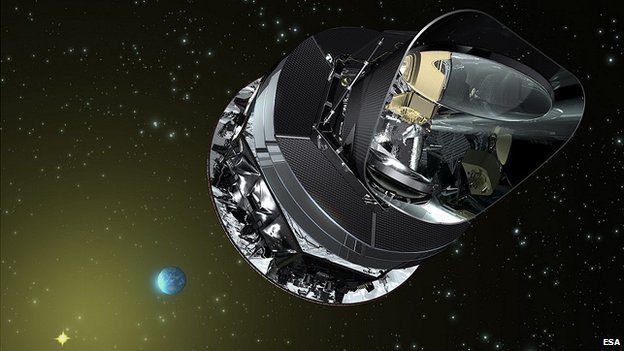
On Saturday 19th October the instruments and cooling systems on the European Space Agency’s Planck spacecraft were switched off, marking the end of the scientific part of the Planck mission, after about four years of mapping the cosmic microwave background.  Later, a piece of software was uploaded that would prevent  the spacecraft systems being  accidentally switched on again after being switched off and the transmitter from causing interference with any future probes.  Planck is already “parked” indefinitely in a what is called a “disposal” orbit, far from the Earth-Moon system, having been nudged off its perch at the 2nd Lagrangian Point (L2) in August by a complicated series of manoeuvres. On October 21st the spacecraft’s thrusters were fired to burn up the last of its fuel, an important aspect of rendering the spacecraft inert, as required by ESA’s space debris mitigation guidelines.

Planck

These preliminaries having been completed, today, at 12.00 GMT,  a final instruction will be transmitted to the spacecraft  to close it down permanently; thereafter Planck will circle the Sun as a silent memorial to the stunning success it achieved when active. I’m sure all those who worked on the Planck mission will pause as the final shutdown command is given and ponder the lonely future  of the spacecraft that had supplied so much interesting data.

But although this will be the end of the Planck mission, it is by no means the end of the Planck Era. Vast amounts of data still need to be fully analysed and key science results are still in the pipeline,  relating in particular to the polarization of the microwave background radiation. Moreover, the numerous maps, catalogues and other data products will be a priceless legacy to this generation, and no doubt many future generations, of scientists.

The fate of Planck illustrates two contrasting aspects of the human experience. On the one hand, there’s the fragility of our existence in a cosmos too vast for us to comprehend. Like the defunct spacecraft, our Earth too circles this little Sun of ours in a precarious orbit while the rest of the Universe – with its countless billion upon billion of other suns – carries on, oblivious to our very existence. Planck makes us painfully aware of our own insignificance.

But on the other hand there’s the sense of fulfillment, and even of joy, at finding things out. We may have puny monkey brains and many things are likely to remain forever beyond our mental grasp, but trying to figure things out is one of the things that defines us as human.  Experiments like Planck (and, for that matter, the Large Hadron Collider) are not the wasteful extravagance some people claim them to be. We need them not just for the sake of science, but to remind us of our common humanity.

UPDATE: And now, from ESA, confirmation that Planck has received its last command. Goodbye, and enjoy your retirement!

Updates for Cosmology: A Very Short Introduction?

Posted in Books, Talks and Reviews, The Universe and Stuff with tags , , , , , on October 21, 2013 by telescoper

Yet another very busy day, travelling in the morning and then in meetings all afternoon, so just time for another brief post. I thought I’d take the opportunity to do a little bit of crowdsourcing…

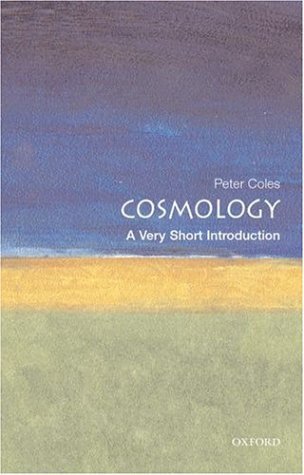
A few days ago I was contacted by Oxford University Press who are apparently considering the possibility of a second edition of my little book Cosmology: A Very Short Introduction, which is part of an extensive series of intensive books on all kinds of subjects.

I really enjoyed writing this book, despite the tough challenge of trying to cover the whole of cosmology in less than 35,000 words and was very pleased with the way it turned out. It has sold over 25000 copies in English and has been published in several other languages.

It is meant to be accessible to the interested layperson but the constraints imposed by the format mean it goes fairly quickly through some quite difficult concepts. Judging by the reviews, though, most people seem to think it gives a useful introduction to the subject, although you can’t please all of the people all of the time!

However, the book was published way back in 2001 and, well, one or two things have happened in the field of cosmology since then.  I have in fact had a number of emails from people asking whether there was going to be a new edition to include the latest developments, but the book is part of a very large series and it was basically up to the publisher to decide whether it wanted to update some, all or none of the series.

Now it seems the powers that be at OUP have decided to explore the possibility further and have asked me to make a pitch for a new edition.  I have some ideas of things that would have to be revised – the section on Dark Energy definitely needs to be updated, and of course first WMAP and then Planck have refined our view of the cosmic microwave background pretty comprehensively?

Anyway, I thought it would be fun to ask people out there who have read it, or even those who haven’t, what they feel I should change for a new edition if there is to be one. That might include new topics or revisions of things that could be improved. Your comments are therefore invited via the famous Comments Box. Please bear in mind that any new edition will be also constrained to be no more than 35,000 words.

Oh, and if you haven’t seen the First Edition at all, why not rush out and buy a copy before it’s too late? I understand you can snap up a copy for just £3 while stocks last. I can assure you all the royalties will go to an excellent cause. Me.

Emmy Noether on Ada Lovelace Day

Posted in History, The Universe and Stuff with tags , , on October 15, 2013 by telescoper

It’s been an interesting morning. We had no electricity in the School for most of the morning owing to a power cut, but it was eventually restored while I was away at a meeting elsewhere on campus. Before that I was delayed getting into work because there was an explosion in central Brighton which disrupted the bus service I use to get to Falmer campus. That palaver provides me with a reasonable justification for not having much time to write a blog today.

However, since today is Ada Lovelace day, on which we celebrate inspiring stories of women in science and technology, I thought I’d post a (rather long) video about pioneering mathematical physicist Emmy Noether who is undoubtedly one of the most underrated physicists of all time. When I used to teach Theoretical Particle Physics many moons ago I spent quite a bit of time talking about the very deep connections that Noether uncovered between symmetry and conservation laws. Most of the students were well aware of the laws of conservation of energy and momentum, say, but unaware of the relationship between these laws and symmetries under time and space translations respectively. Making this connection helps to develop a much deeper understanding of many areas of physics. It’s also a very beautiful bit of mathematical analysis.

Yesterday in Parliament

Posted in Science Politics, The Universe and Stuff with tags , , , , , on October 9, 2013 by telescoper

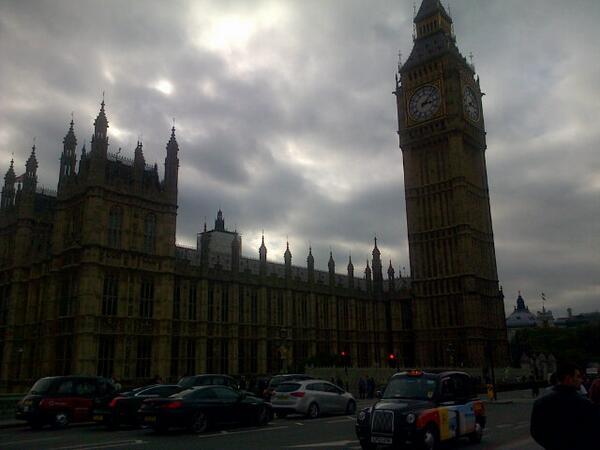
Yesterday afternoon I arrived in a rather muggy Westminster to attend a reception at the Houses of Parliament associated with an exhibition called Unveiling the Universe in all its Light which is currently set up inside the Palace of Westminster but will later go on tour around the UK.

Parliament

It took me a while to find the way in. I lived in London for the best part of 9 years but never bothered to visit the Houses of Parliament (at least not the interior), so I was quite excited as, clutching my invitation in a rather sweaty hand, I eventually joined the queue to go through the security checks. That didn’t take very long, so despite getting lost in the corridors of power en route – it’s a bit of a maze inside – I had plenty of time to see the exhibition before joining the assembled throng in the Strangers’ Dining Room. There, surrounded by walls covered in expensive but tasteless flock wallpaper, I had a couple of couples of glasses of wine and ate some posh sandwiches while chatting to various astronomers, particle physicists and others, including a contingent of familiar faces from the Science and Technology Facilities Council.

It was a coincidence, of course, that this event took place on the day that the Nobel Prize for Physics was announced; it was impressive that posters were already there celebrating the award to Peter Higgs. General opinion was delight that Higgs had won a share of the prize, but sadness that Tom Kibble had been left out.

There were upbeat speeches by Minister for Universities and Science David Willetts (who isn’t as tall as he looks on telly), Andrew Miller (Chair of the Parliamentary Select Committee on Science and Technology), John Womersley (Chief Executive of STFC) and Lord Rees (Astronomer Royal). I think everyone present came away with a strong sense that astronomy and particle physics had strong political backing. Martin Rees in particular said that he thought we were living in a “golden age” for fundamental science, involving an exciting interplay between the inner space of subatomic particles and the outer space of cosmology. I couldn’t agree more.

The 2013 Nobel Prize for Physics .. goes to Englert and Higgs

Posted in Science Politics, The Universe and Stuff with tags , , , , , , on October 8, 2013 by telescoper

Well, there we are. After an excruciating (and unexplained) delay the 2013 Nobel Prize for Physics has gone to François Englert and Peter Higgs. You can find the full press release here; the first section of text reads:

François Englert and Peter W. Higgs are jointly  awarded the Nobel Prize in Physics 2013 for the  theory of how particles acquire mass. In 1964, they  proposed the theory independently of each other  (Englert together with his now deceased colleague  Robert Brout). In 2012, their ideas were confirmed  by the discovery of a so called Higgs particle at the  CERN laboratory outside Geneva in Switzerland. The awarded theory is a central part of the Standard  Model of particle  hysics that describes how the world is  constructed. According to the Standard Model, every­thing, from flowers and people to stars and planets,  consists of just a few building blocks: matter particles.  These particles are governed by forces mediated by force  particles that make sure everything works as it should. The entire Standard Model also rests on the existence  of a special kind of particle: the Higgs particle. This  particle originates from an invisible field that fills up  all space. Even when the universe seems empty this  field is there. Without it, we would not exist, because  it is from contact with the field that particles acquire  mass. The theory proposed by Englert and Higgs  describes this process.

Anyway, congratulations to the two Laureates. I did get a bit excited when the rumour started that the winner this year would be someone born in Newcastle upon Tyne whose first name is Peter, but I guess I’ll have to wait until next year..

Oh, and François Englert is the first ever Belgian winner of the Nobel Prize for Physics!

I have to head off to London for a Parliamentary Reception organized by the Science & Technology Facilities Council, so I’ll have to leave it there but please feel free to add reactions to the announcement via the Comments Box.

P.S. Yesterday’s poll is now closed.

Physics Nobel Betting

Posted in Science Politics, The Universe and Stuff with tags , , , , , , , on October 7, 2013 by telescoper

I’m back in circulation just in time for tomorrow’s announcement of the 2013 Nobel Prize for Physics. The smart money is going on an award for the discovery of the Higgs Boson, but to whom should it be awarded. Today’s Grauniad summarizes the difficulties thus:

The committee can contrive the wording of the prize to narrow the number downwards and this is likely to happen. The prize could go to François Englert, who published the idea first, and Peter Higgs, who was second, but crucially was first to flag up the new particle. But that would rebuff the trio of Gerald Guralnik, Carl Richard Hagen and Tom Kibble, who developed the theory separately and published just a month after Higgs. The possibility has already caused acrimony among the scientists. Guralnik and Hagen, two US researchers, believe European physicists have conspired to erase their contribution from history.

This doesn’t seem to me to be entirely accurate, though. As far as I understand it, Higgs was the only one of the names above to mention a massive scalar particle, There is, I believe, therefore a strong case that the Nobel Prize should be awarded to Peter Higgs outright. Or if not to him, to some other person called Peter who was born in the North East…

However, I am used to being in a minority of one so there will undoubtedly be many others who feel differently.  Time for a poll! This one is different from my usual ones, in that you are allowed to vote more than once. Please use up to three votes: if you think Peter Higgs should win it outright vote three times for him. If you think it should be a three way split then vote for three different people, etc.

I should say that I don’t think the Nobel Committee for Physics is allowed to make an award to an institution such as CERN, but I’ve left that option in to see whether folks think that tradition should change..

UPDATE: Here are the Thomson-Reuters predictions, including Marcy, Mayor and Queloz for Extra Solar Planets…


Why the Universe is (probably) not rotating

Posted in Cosmic Anomalies, The Universe and Stuff with tags , , , , , on October 1, 2013 by telescoper

Just a quick post to point you towards a nice blog post by Jason McEwen entitled Is the Universe rotating? It’s a general rule that if  an article has a question for a title then the answer to that question is probably “no”, and “probably no” is indeed the answer in this case.

The item relates to a paper by McEwen et al whose abstract is given here:

We perform a definitive analysis of Bianchi VII_h cosmologies with WMAP observations of the cosmic microwave background (CMB) temperature anisotropies. Bayesian analysis techniques are developed to study anisotropic cosmologies using full-sky and partial-sky, masked CMB temperature data. We apply these techniques to analyse the full-sky internal linear combination (ILC) map and a partial-sky, masked W-band map of WMAP 9-year observations. In addition to the physically motivated Bianchi VII_h model, we examine phenomenological models considered in previous studies, in which the Bianchi VII_h parameters are decoupled from the standard cosmological parameters. In the two phenomenological models considered, Bayes factors of 1.7 and 1.1 units of log-evidence favouring a Bianchi component are found in full-sky ILC data. The corresponding best-fit Bianchi maps recovered are similar for both phenomenological models and are very close to those found in previous studies using earlier WMAP data releases. However, no evidence for a phenomenological Bianchi component is found in the partial-sky W-band data. In the physical Bianchi VII_h model we find no evidence for a Bianchi component: WMAP data thus do not favour Bianchi VII_h cosmologies over the standard Lambda Cold Dark Matter (LCDM) cosmology. It is not possible to discount Bianchi VII_h cosmologies in favour of LCDM completely, but we are able to constrain the vorticity of physical Bianchi VII_h cosmologies at $(\omega/H)_0 < 8.6 \times 10^{-10}$ with 95% confidence.

For non-experts the Bianchi cosmologies are based on exact solutions of Einstein’s equations for general relativity which obey the condition that they are spatially homogeneous but not necessarily isotropic. If you find that concept hard to understand, imagine a universe which looks the same everywhere but which is pervaded by a uniform magnetic field: that would be homogeneous (because every place is identical) but anisotropic (because there is a preferred direction – along the magnetic field lines). Another example of would be s a universe which is, for reasons known only to itself, rotating; the preferred direction here is the axis of rotation. The complete classification of all Bianchi space-times is discussed here. I also mentioned them and showed some pictures on this blog here.

As Jason’s post explains, observations of the cosmic microwave background by the Wilkinson Microwave Anisotropy Probe (WMAP) suggest  that there is something a little bit fishy about it: it seems to be have an anomalous large-scale asymmetry not expected in the standard cosmology. These suggestions seem to be confirmed by Planck, though the type of analysis done for WMAP has not yet been performed for Planck. The paper mentioned above investigates whether the WMAP asymmetry could be accounted for by one particular Bianchi cosmology, i.e. Bianchi VII_h. This is quite a complicated model which has negative spatial curvature, rotation (vorticity) and shear; formally speaking, it is the most general Bianchi model of any type that includes the standard Friedmann cosmology as a special case.

The question whether such a complicated model actually provides a better fit to the data than the much simpler standard model is one naturally answered by Bayesian techniques that trade off the increased complexity of a more sophisticated model  against the improvement in goodness-of-fit achieved by having more free parameters.  Using this approach McEwen et al. showed that, in simple  terms, while a slight improvement in fit is indeed gained by adding a Bianchi VII_h component to the model,  the penalty paid in terms of increased complexity means that the alternative model is not significantly more probable than the simple one. Ockham’s Razor strikes again! Although this argument does not definitively exclude the possibility that the Universe is rotating, it does put limits on how much rotation there can be. It also excludes one possible explanation of the  peculiar pattern  of the temperature fluctuations seen by WMAP.

So what does cause the anomalous behaviour of the cosmic microwave background?

I have no idea.

The Amplituhedron and Other Excellently Silly Words

Posted in The Universe and Stuff with tags , on September 27, 2013 by telescoper

No time for a proper post between meetings, so I thought I’d take the opportunity to reblog one of many interesting posts I’ve seen recently about the Amplituhedron. “The what?” I hear you say. Well, read on. And, better still, perhaps you can pass an opinion on whether it is more than hype…

4gravitons's avatar4 gravitons

Nima Arkani-Hamed recently gave a talk at the Simons Center on the topic of what he and Jaroslav Trnka are calling the Amplituhedron.

There’s an article on it in Quanta Magazine. The article starts out a bit hype-y for my taste (too much language of importance, essentially), but it has several very solid descriptions of the history of the situation. I particularly like how the author concisely describes the Feynman diagram picture in the space of a single paragraph, and I would recommend reading that part even if you don’t have time to read the whole article. In general it’s worth it to get a picture of what’s going on.

That said, I obviously think I can clear a few things up, otherwise I wouldn’t be writing about it, so here I go!

“The” Amplituhedron

Nima’s new construction, the Amplituhedron, encodes amplitudes (building blocks of probabilities in particle…

View original post 997 more words

Whither The Sky at Night?

Posted in Television, The Universe and Stuff with tags , , on September 24, 2013 by telescoper

According to rumours flying around on Twitter, the BBC has decided to axe the long-running astronomy programme The Sky at Night.  There’s been a predictable outcry from fans of the show and a petition has been organized.  What I’ve heard is that the series will end in December, but that a new astronomy programme will be launched in April next year.

I’ve long felt it was inevitable that The Sky at Night would cease to be when Patrick Moore died. The programme was so much Patrick’s programme that it would be very difficult to find another presenter to fill the role in the unique way that he did. Moreover, although there’s no doubt that it is an important vehicle for UK astronomy, many feel that the format has become very tired and uninspiring. As for myself, I can’t really comment. I don’t watch television very much at all and in any case, The Sky at Night is on way past my bedtime.

Way back in 1996 I was involved with a show at the NEC in Birmingham called Tomorrow’s World Live. This involved all the regular presenters of Tomorrow’s World, but wasn’t broadcast, but performed in a small theatre with a live audience. My contribution was to talk a little bit about the Hubble Space Telescope and then answer questions from the audience.  We did four such shows a day for three days. It was tiring and a bit nerve-wracking, but a lot of fun.

Typically for the BBC the contributors such as myself were paid a negligible fee, but we did get our meals paid for. At dinner one evening I chatted to a well-known TV Producer who was involved with the live event. After a while the conversation turned to The Sky at Night. The person concerned explained that he thought the show was well past its prime and was actually holding back astronomy programming on TV: it was too old-fashioned and had a tiny audience yet while it existed it was impossible to make the case to the Beeb to commission other astro-related shows. On the other hand, while Patrick was still around, and undoubtedly a National Institution, the outcry would be so intense if they cancelled The Sky at Night that nobody had the nerve to do it. Impasse.

Of course now, 17 years later, Patrick Moore has passed away and there’s now a chance to change things. It is promising that that the BBC seems to be going to launch a new programme next year. But any new show will have to tread very carefully. The Sky at Night was followed by thousands of dedicated amateur astronomers who know a great deal about their subject and would not be interested in the simple-minded gee-whizzery that plagues so many so-called Science Programme (e.g. Horizon). These people are very important for UK astronomy, because without them UK astronomy would not have the unique role that it has in our scientific and cultural landscape. We professional astronomers would be funded anything like as well as we are either.  On the other hand, there is at least the possibility of coming up with a format that reaches a new audience as well as retaining the interest of those already enthused about astronomy.

But how to ensure that this happens? Answers on a postcard, or through the comments box!

Meanwhile here’s a little poll to gauge the strength of opinion:

Science, Religion and Henry Gee

Posted in Bad Statistics, Books, Talks and Reviews, Science Politics, The Universe and Stuff with tags , , , , , , , , , on September 23, 2013 by telescoper

Last week a piece appeared on the Grauniad website by Henry Gee who is a Senior Editor at the magazine Nature.  I was prepared to get a bit snarky about the article when I saw the title, as it reminded me of an old  rant about science being just a kind of religion by Simon Jenkins that got me quite annoyed a few years ago. Henry Gee’s article, however, is actually rather more coherent than that and  not really deserving of some of the invective being flung at it.

For example, here’s an excerpt that I almost agree with:

One thing that never gets emphasised enough in science, or in schools, or anywhere else, is that no matter how fancy-schmancy your statistical technique, the output is always a probability level (a P-value), the “significance” of which is left for you to judge – based on nothing more concrete or substantive than a feeling, based on the imponderables of personal or shared experience. Statistics, and therefore science, can only advise on probability – they cannot determine The Truth. And Truth, with a capital T, is forever just beyond one’s grasp.

I’ve made the point on this blog many times that, although statistical reasoning lies at the heart of the scientific method, we don’t do anywhere near enough  to teach students how to use probability properly; nor do scientists do enough to explain the uncertainties in their results to decision makers and the general public.  I also agree with the concluding thought, that science isn’t about absolute truths. Unfortunately, Gee undermines his credibility by equating statistical reasoning with p-values which, in my opinion, are a frequentist aberration that contributes greatly to the public misunderstanding of science. Worse, he even gets the wrong statistics wrong…

But the main thing that bothers me about Gee’s article is that he blames scientists for promulgating the myth of “science-as-religion”. I don’t think that’s fair at all. Most scientists I know are perfectly well aware of the limitations of what they do. It’s really the media that want to portray everything in simple black and white terms. Some scientists play along, of course, as I comment upon below, but most of us are not priests but pragmatatists.

Anyway, this episode gives me the excuse to point out  that I ended a book I wrote in 1998 with a discussion of the image of science as a kind of priesthood which it seems apt to repeat here. The book was about the famous eclipse expedition of 1919 that provided some degree of experimental confirmation of Einstein’s general theory of relativity and which I blogged about at some length last year, on its 90th anniversary.

I decided to post the last few paragraphs here to show that I do think there is a valuable point to be made out of the scientist-as-priest idea. It’s to do with the responsibility scientists have to be honest about the limitations of their research and the uncertainties that surround any new discovery. Science has done great things for humanity, but it is fallible. Too many scientists are too certain about things that are far from proven. This can be damaging to science itself, as well as to the public perception of it. Bandwagons proliferate, stifling original ideas and leading to the construction of self-serving cartels. This is a fertile environment for conspiracy theories to flourish.

To my mind the thing  that really separates science from religion is that science is an investigative process, not a collection of truths. Each answer simply opens up more questions.  The public tends to see science as a collection of “facts” rather than a process of investigation. The scientific method has taught us a great deal about the way our Universe works, not through the exercise of blind faith but through the painstaking interplay of theory, experiment and observation.

This is what I wrote in 1998:

Science does not deal with ‘rights’ and ‘wrongs’. It deals instead with descriptions of reality that are either ‘useful’ or ‘not useful’. Newton’s theory of gravity was not shown to be ‘wrong’ by the eclipse expedition. It was merely shown that there were some phenomena it could not describe, and for which a more sophisticated theory was required. But Newton’s theory still yields perfectly reliable predictions in many situations, including, for example, the timing of total solar eclipses. When a theory is shown to be useful in a wide range of situations, it becomes part of our standard model of the world. But this doesn’t make it true, because we will never know whether future experiments may supersede it. It may well be the case that physical situations will be found where general relativity is supplanted by another theory of gravity. Indeed, physicists already know that Einstein’s theory breaks down when matter is so dense that quantum effects become important. Einstein himself realised that this would probably happen to his theory.

Putting together the material for this book, I was struck by the many parallels between the events of 1919 and coverage of similar topics in the newspapers of 1999. One of the hot topics for the media in January 1999, for example, has been the discovery by an international team of astronomers that distant exploding stars called supernovae are much fainter than had been predicted. To cut a long story short, this means that these objects are thought to be much further away than expected. The inference then is that not only is the Universe expanding, but it is doing so at a faster and faster rate as time passes. In other words, the Universe is accelerating. The only way that modern theories can account for this acceleration is to suggest that there is an additional source of energy pervading the very vacuum of space. These observations therefore hold profound implications for fundamental physics.

As always seems to be the case, the press present these observations as bald facts. As an astrophysicist, I know very well that they are far from unchallenged by the astronomical community. Lively debates about these results occur regularly at scientific meetings, and their status is far from established. In fact, only a year or two ago, precisely the same team was arguing for exactly the opposite conclusion based on their earlier data. But the media don’t seem to like representing science the way it actually is, as an arena in which ideas are vigorously debated and each result is presented with caveats and careful analysis of possible error. They prefer instead to portray scientists as priests, laying down the law without equivocation. The more esoteric the theory, the further it is beyond the grasp of the non-specialist, the more exalted is the priest. It is not that the public want to know – they want not to know but to believe.

Things seem to have been the same in 1919. Although the results from Sobral and Principe had then not received independent confirmation from other experiments, just as the new supernova experiments have not, they were still presented to the public at large as being definitive proof of something very profound. That the eclipse measurements later received confirmation is not the point. This kind of reporting can elevate scientists, at least temporarily, to the priesthood, but does nothing to bridge the ever-widening gap between what scientists do and what the public think they do.

As we enter a new Millennium, science continues to expand into areas still further beyond the comprehension of the general public. Particle physicists want to understand the structure of matter on tinier and tinier scales of length and time. Astronomers want to know how stars, galaxies  and life itself came into being. But not only is the theoretical ambition of science getting bigger. Experimental tests of modern particle theories require methods capable of probing objects a tiny fraction of the size of the nucleus of an atom. With devices such as the Hubble Space Telescope, astronomers can gather light that comes from sources so distant that it has taken most of the age of the Universe to reach us from them. But extending these experimental methods still further will require yet more money to be spent. At the same time that science reaches further and further beyond the general public, the more it relies on their taxes.

Many modern scientists themselves play a dangerous game with the truth, pushing their results one-sidedly into the media as part of the cut-throat battle for a share of scarce research funding. There may be short-term rewards, in grants and TV appearances, but in the long run the impact on the relationship between science and society can only be bad. The public responded to Einstein with unqualified admiration, but Big Science later gave the world nuclear weapons. The distorted image of scientist-as-priest is likely to lead only to alienation and further loss of public respect. Science is not a religion, and should not pretend to be one.

PS. You will note that I was voicing doubts about the interpretation of the early results from supernovae  in 1998 that suggested the universe might be accelerating and that dark energy might be the reason for its behaviour. Although more evidence supporting this interpretation has since emerged from WMAP and other sources, I remain sceptical that we cosmologists are on the right track about this. Don’t get me wrong – I think the standard cosmological model is the best working hypothesis we have _ I just think we’re probably missing some important pieces of the puzzle. I don’t apologise for that. I think sceptical is what a scientist should be.